Mineral & Rock
Review
Chapters 3 & 4
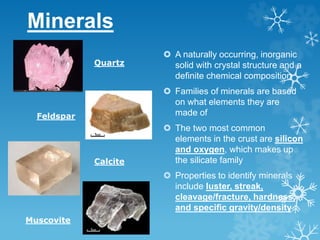
Minerals
 A naturally occurring, inorganic
solid with crystal structure and a
definite chemical composition
 Families of minerals are based
on what elements they are
made of
 The two most common
elements in the crust are silicon
and oxygen, which makes up
the silicate family
 Properties to identify minerals
include luster, streak,
cleavage/fracture, hardness,
and specific gravity/density
Quartz
Feldspar
Calcite
Muscovite
Some Minerals Found in VA
 Calcite
 Turquoise
 Hematite
 Amethyst
 Pyrite
 Barite
 Mica
 Halite
 Gypsum
 Feldspar
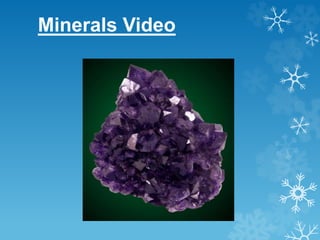
Minerals Video
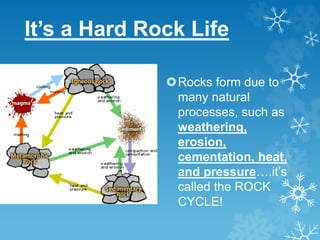
It’s a Hard Rock Life
Rocks form due to
many natural
processes, such as
weathering,
erosion,
cementation, heat,
and pressure….it’s
called the ROCK
CYCLE!
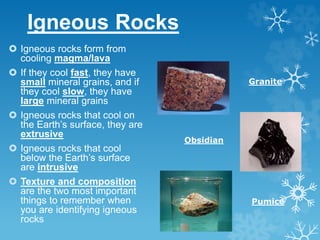
Igneous Rocks
 Igneous rocks form from
cooling magma/lava
 If they cool fast, they have
small mineral grains, and if
they cool slow, they have
large mineral grains
 Igneous rocks that cool on
the Earth’s surface, they are
extrusive
 Igneous rocks that cool
below the Earth’s surface
are intrusive
 Texture and composition
are the two most important
things to remember when
you are identifying igneous
rocks
Granite
Obsidian
Pumice
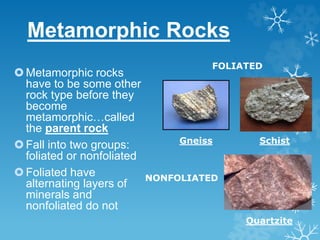
Metamorphic Rocks
Metamorphic rocks
have to be some other
rock type before they
become
metamorphic…called
the parent rock
Fall into two groups:
foliated or nonfoliated
Foliated have
alternating layers of
minerals and
nonfoliated do not
Gneiss Schist
Quartzite
NONFOLIATED
FOLIATED
Sedimentary Rocks
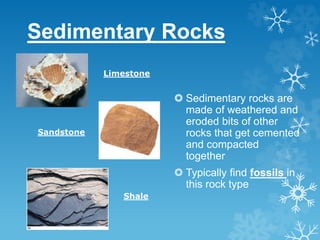
 Sedimentary rocks are
made of weathered and
eroded bits of other
rocks that get cemented
and compacted
together
 Typically find fossils in
this rock type
Limestone
Sandstone
Shale
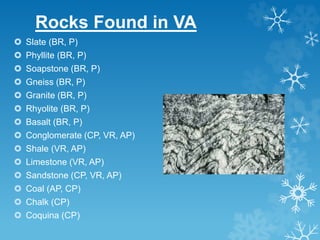
Rocks Found in VA
 Slate (BR, P)
 Phyllite (BR, P)
 Soapstone (BR, P)
 Gneiss (BR, P)
 Granite (BR, P)
 Rhyolite (BR, P)
 Basalt (BR, P)
 Conglomerate (CP, VR, AP)
 Shale (VR, AP)
 Limestone (VR, AP)
 Sandstone (CP, VR, AP)
 Coal (AP, CP)
 Chalk (CP)
 Coquina (CP)
Rock Videos

SOL Mineral and Rock Review

  • 1.
  • 2.
    Minerals  A naturallyoccurring, inorganic solid with crystal structure and a definite chemical composition  Families of minerals are based on what elements they are made of  The two most common elements in the crust are silicon and oxygen, which makes up the silicate family  Properties to identify minerals include luster, streak, cleavage/fracture, hardness, and specific gravity/density Quartz Feldspar Calcite Muscovite
  • 3.
    Some Minerals Foundin VA  Calcite  Turquoise  Hematite  Amethyst  Pyrite  Barite  Mica  Halite  Gypsum  Feldspar
  • 4.
  • 5.
    It’s a HardRock Life Rocks form due to many natural processes, such as weathering, erosion, cementation, heat, and pressure….it’s called the ROCK CYCLE!
  • 6.
    Igneous Rocks  Igneousrocks form from cooling magma/lava  If they cool fast, they have small mineral grains, and if they cool slow, they have large mineral grains  Igneous rocks that cool on the Earth’s surface, they are extrusive  Igneous rocks that cool below the Earth’s surface are intrusive  Texture and composition are the two most important things to remember when you are identifying igneous rocks Granite Obsidian Pumice
  • 7.
    Metamorphic Rocks Metamorphic rocks haveto be some other rock type before they become metamorphic…called the parent rock Fall into two groups: foliated or nonfoliated Foliated have alternating layers of minerals and nonfoliated do not Gneiss Schist Quartzite NONFOLIATED FOLIATED
  • 8.
    Sedimentary Rocks  Sedimentaryrocks are made of weathered and eroded bits of other rocks that get cemented and compacted together  Typically find fossils in this rock type Limestone Sandstone Shale
  • 9.
    Rocks Found inVA  Slate (BR, P)  Phyllite (BR, P)  Soapstone (BR, P)  Gneiss (BR, P)  Granite (BR, P)  Rhyolite (BR, P)  Basalt (BR, P)  Conglomerate (CP, VR, AP)  Shale (VR, AP)  Limestone (VR, AP)  Sandstone (CP, VR, AP)  Coal (AP, CP)  Chalk (CP)  Coquina (CP)
  • 10.