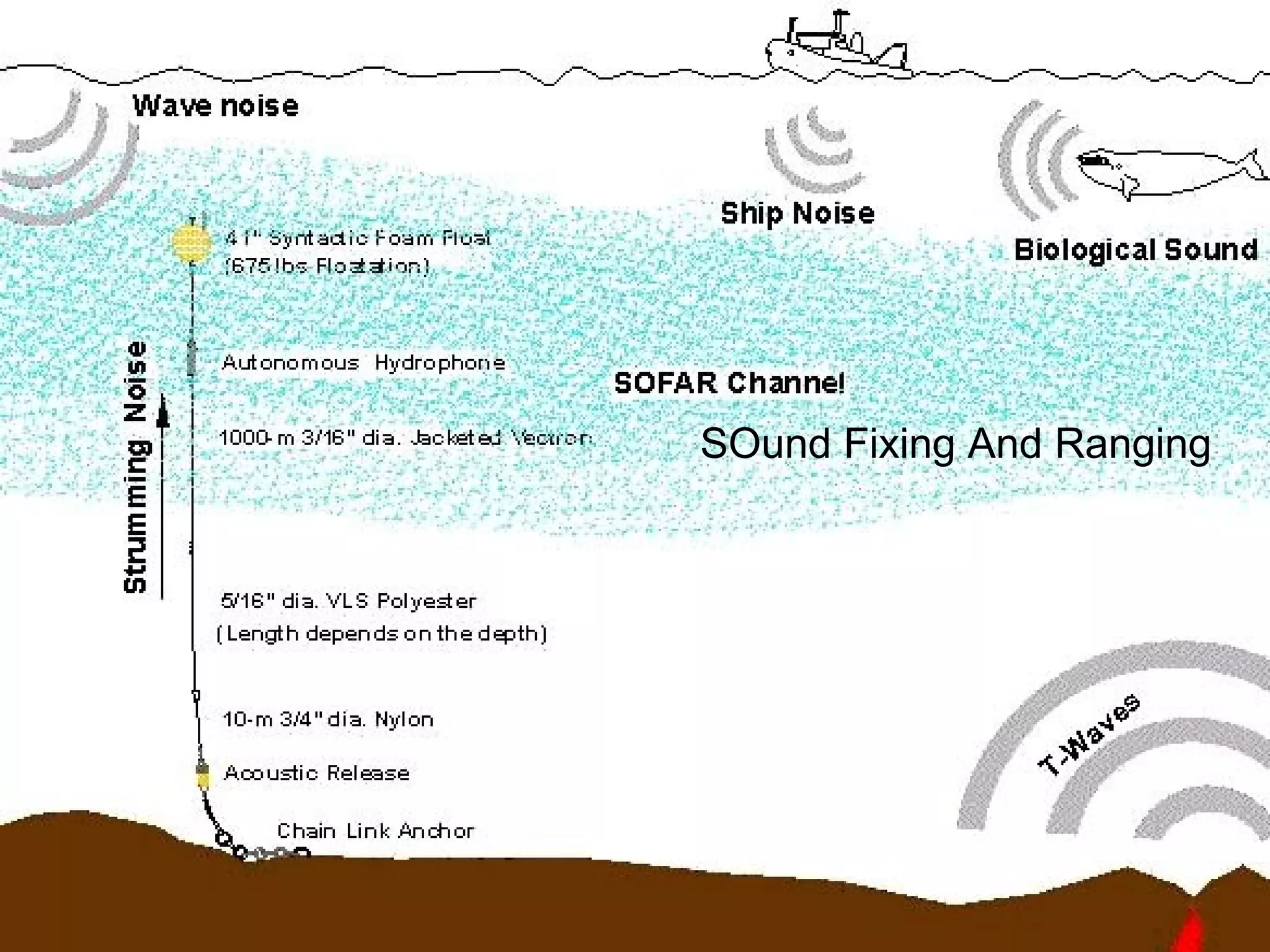
SOund Fixing And Ranging
History of the SOFAR Channel
• In 1944, ocean scientists, Maurice Ewing and J. Worzel,
  aboard the R/V Saluda set sail to test a theory that
  predicted that low-frequency sound should be able to
  travel long distances in the deep ocean.
• A deep receiving hydrophone was hung from R/V Saluda.
• A second ship dropped 4-pound explosive charges set to
  explode deep in the ocean at distances up to 900 miles
  from the R/V Saluda's hydrophone.
• Ewing and Worzel heard, for the first time, the
  characteristic sound of a SOFAR (SOund Fixing And
  Ranging) transmission, consisting of a series of pulses
  building up to its climax:

   bump        bump      bump     bump     bump bump
Discovery of the SOFAR Channel
•   Shot 43 recorded aboard the R/V Saluda on April 3, 1944.
•   Charges were exploded at a depth of 4000 feet and a range of 320 nautical miles.
    Times are labeled for 370, 371, ... , 374 seconds following the explosion. Channel 1
    shows time markers. The remaining channels show the received signal after different
    types of signal processing. (Adapted from Ewing and Worzel, 1948. Ewing and Worzel
    recording from Fig. A.1 of Munk et al., 1995)
• The U.S. Navy used the ability of low-frequency sound to
  travel long distances in the deep ocean to increase the range
  at which submarines could be detected.
• In great secrecy during the 1950's, at the height of the cold
  war with the former Soviet Union, the U.S. Navy launched a
  project with the code name Jezebel. Later known as the
  SOund SUrveillance System (SOSUS).
• Arrays of hydrophones were placed on the ocean bottom and
  connected by underwater cables to processing centers
  located on shore.
• The SOSUS system was very successful in detecting and
  tracking the noisy Soviet submarines of that era.
• Sailors also detected some sounds whose sources were at
  first unknown. One particular unknown sound was attributed
  to the "Jezebel Monster." The sound was later found to be
  low-frequency blue and fin whale vocalizations.
• In the early 1960's the U.S. Navy experimented with the
  use of these long-range transmissions as a lifesaving
  tool. The notion was that survivors of a downed aircraft
  or sinking ship could drop a small explosive charge set to
  explode in the ocean sound channel. The arrival times of
  the signal at a number of widely spaced listening stations
  ashore would then be used to compute the position of
  the life raft (See
  How is sound used to navigate underwater?). The
  project was called SOFAR (for SOund Fixing and
  Ranging), giving the SOFAR channel its name.
•   Oceanographers subsequently realized that the speed and direction of deep
    ocean currents could be measured using floats designed to drift with the
    current at mid-depth and transmit low-frequency acoustic signals at regular
    intervals. The acoustic signals were originally received on the SOSUS
    hydrophone arrays and the arrival times were used to compute the float
    positions. The floats were called SOFAR floats (See SOFAR Floats).
    Because the drifting sound sources were expensive, the approach was soon
    turned around to use drifting receivers. Low-cost receivers were designed
    to drift at mid-depth and record the transmissions from moored sound
    sources. The floats, called RAFOS floats (SOFAR spelled backwards),
    surfaced at the end of their lives and radioed the arrival times that they had
    recorded back to shore via satellite, from which the positions of the floats as
    they drifted with the ocean currents could be computed (See RAFOS
    Floats). Oceanographers later realized that precise measurements of the
    travel times between widely space sources and receivers could be used to
    measure large-scale ocean temperature variability (See How is sound used
    to measure global climate change?).
References
• http://www.dosits.org/science/sndmoves/4
  a.htm
• http://oceanexplorer.noaa.gov/explorations
  /sound01/background/acoustics/media/sof
  ar.html
• Activities:
  http://www.coexploration.org/bbsr/classroo
  mbats/html/body_sofar.html

Sofar channel

  • 1.
  • 2.
    History of theSOFAR Channel • In 1944, ocean scientists, Maurice Ewing and J. Worzel, aboard the R/V Saluda set sail to test a theory that predicted that low-frequency sound should be able to travel long distances in the deep ocean. • A deep receiving hydrophone was hung from R/V Saluda. • A second ship dropped 4-pound explosive charges set to explode deep in the ocean at distances up to 900 miles from the R/V Saluda's hydrophone. • Ewing and Worzel heard, for the first time, the characteristic sound of a SOFAR (SOund Fixing And Ranging) transmission, consisting of a series of pulses building up to its climax: bump bump bump bump bump bump
  • 3.
    Discovery of theSOFAR Channel • Shot 43 recorded aboard the R/V Saluda on April 3, 1944. • Charges were exploded at a depth of 4000 feet and a range of 320 nautical miles. Times are labeled for 370, 371, ... , 374 seconds following the explosion. Channel 1 shows time markers. The remaining channels show the received signal after different types of signal processing. (Adapted from Ewing and Worzel, 1948. Ewing and Worzel recording from Fig. A.1 of Munk et al., 1995)
  • 4.
    • The U.S.Navy used the ability of low-frequency sound to travel long distances in the deep ocean to increase the range at which submarines could be detected. • In great secrecy during the 1950's, at the height of the cold war with the former Soviet Union, the U.S. Navy launched a project with the code name Jezebel. Later known as the SOund SUrveillance System (SOSUS). • Arrays of hydrophones were placed on the ocean bottom and connected by underwater cables to processing centers located on shore. • The SOSUS system was very successful in detecting and tracking the noisy Soviet submarines of that era. • Sailors also detected some sounds whose sources were at first unknown. One particular unknown sound was attributed to the "Jezebel Monster." The sound was later found to be low-frequency blue and fin whale vocalizations.
  • 5.
    • In theearly 1960's the U.S. Navy experimented with the use of these long-range transmissions as a lifesaving tool. The notion was that survivors of a downed aircraft or sinking ship could drop a small explosive charge set to explode in the ocean sound channel. The arrival times of the signal at a number of widely spaced listening stations ashore would then be used to compute the position of the life raft (See How is sound used to navigate underwater?). The project was called SOFAR (for SOund Fixing and Ranging), giving the SOFAR channel its name.
  • 6.
    Oceanographers subsequently realized that the speed and direction of deep ocean currents could be measured using floats designed to drift with the current at mid-depth and transmit low-frequency acoustic signals at regular intervals. The acoustic signals were originally received on the SOSUS hydrophone arrays and the arrival times were used to compute the float positions. The floats were called SOFAR floats (See SOFAR Floats). Because the drifting sound sources were expensive, the approach was soon turned around to use drifting receivers. Low-cost receivers were designed to drift at mid-depth and record the transmissions from moored sound sources. The floats, called RAFOS floats (SOFAR spelled backwards), surfaced at the end of their lives and radioed the arrival times that they had recorded back to shore via satellite, from which the positions of the floats as they drifted with the ocean currents could be computed (See RAFOS Floats). Oceanographers later realized that precise measurements of the travel times between widely space sources and receivers could be used to measure large-scale ocean temperature variability (See How is sound used to measure global climate change?).
  • 7.
    References • http://www.dosits.org/science/sndmoves/4 a.htm • http://oceanexplorer.noaa.gov/explorations /sound01/background/acoustics/media/sof ar.html • Activities: http://www.coexploration.org/bbsr/classroo mbats/html/body_sofar.html