By Composition

•

Terrestrial or Rocky planets
–
–
–
–
–
–

•

Solid surfaces
Composed primarily of rock
Have relatively high densities
Slow rotation
No rings
Few satellites

Examples:
– Mercury, Venus, Earth, and Mars
• Jovian or Gas planets
– Composed primarily of hydrogen and
helium
– Generally have low densities
– Rapid rotation
– Rings
– Lots of satellites
• Examples:
– Jupiter, Saturn, Uranus, and Neptune
•

Small planets

By Size

–
•

•

Example:
– Mercury, Venus, Earth, Mars

Big planets
–

•

Have diameters less than 13000 km

Have diameters greater than 48000 km

Example:
– Jupiter, Saturn, Uranus and Neptune
By Relative Position
from Sun

•

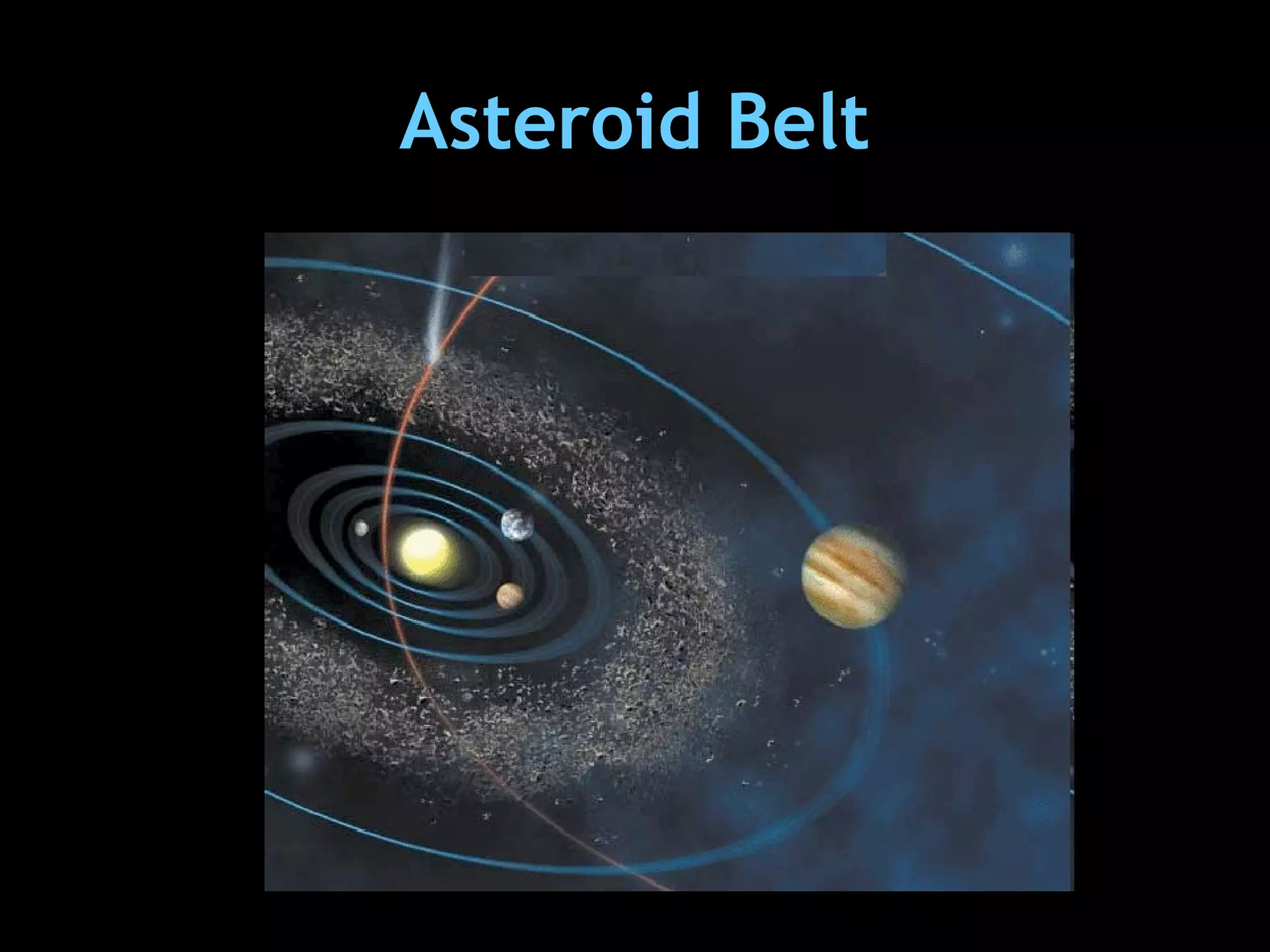
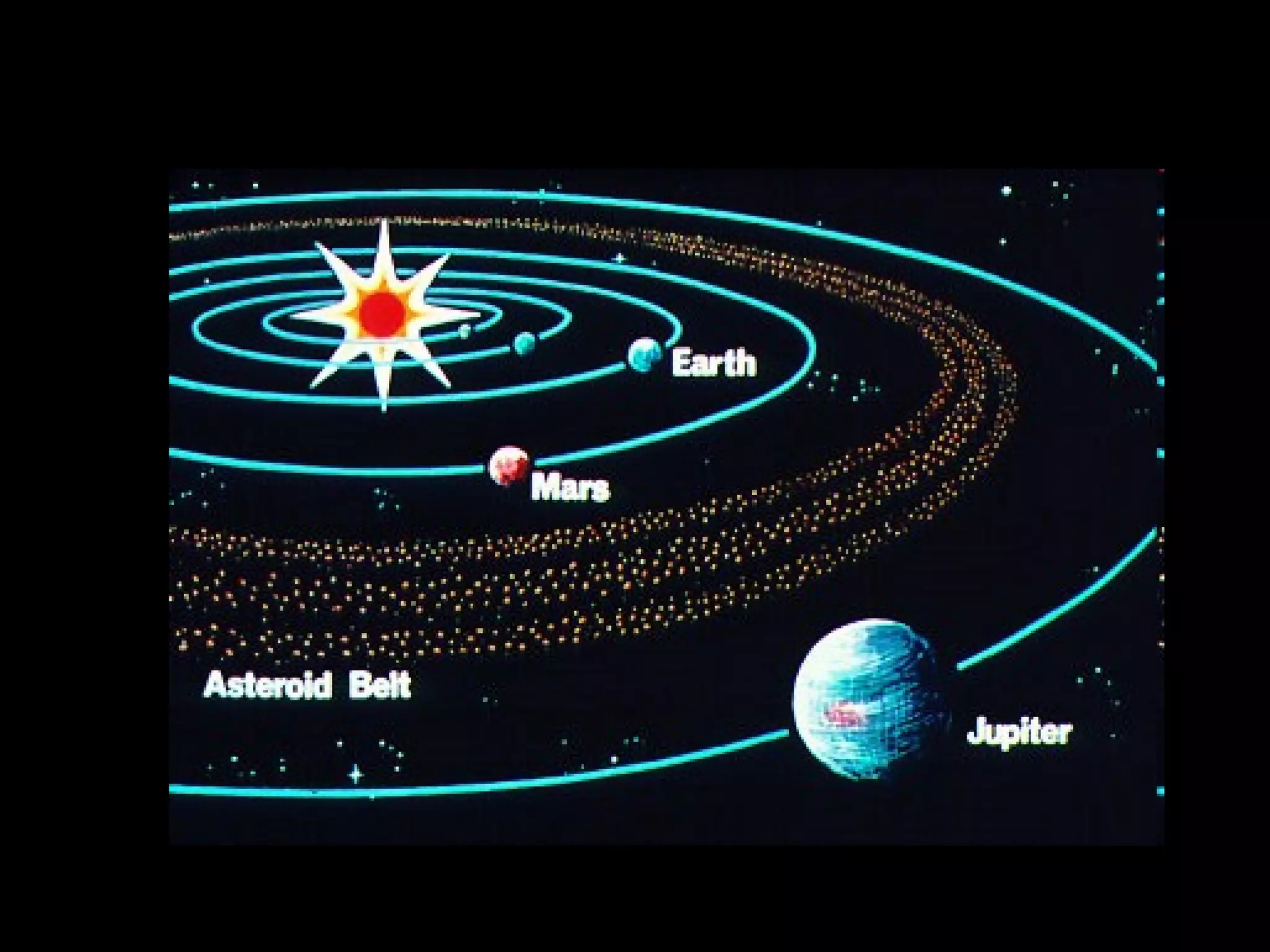
The asteroid belt between Mars
and Jupiter forms the boundary
between the inner solar system
and the outer solar system

•

Inner Planets:
– Mercury, Venus, Earth, Mars

•

Outer planets:
– Jupiter, Saturn, Uranus, Neptune
Asteroid Belt
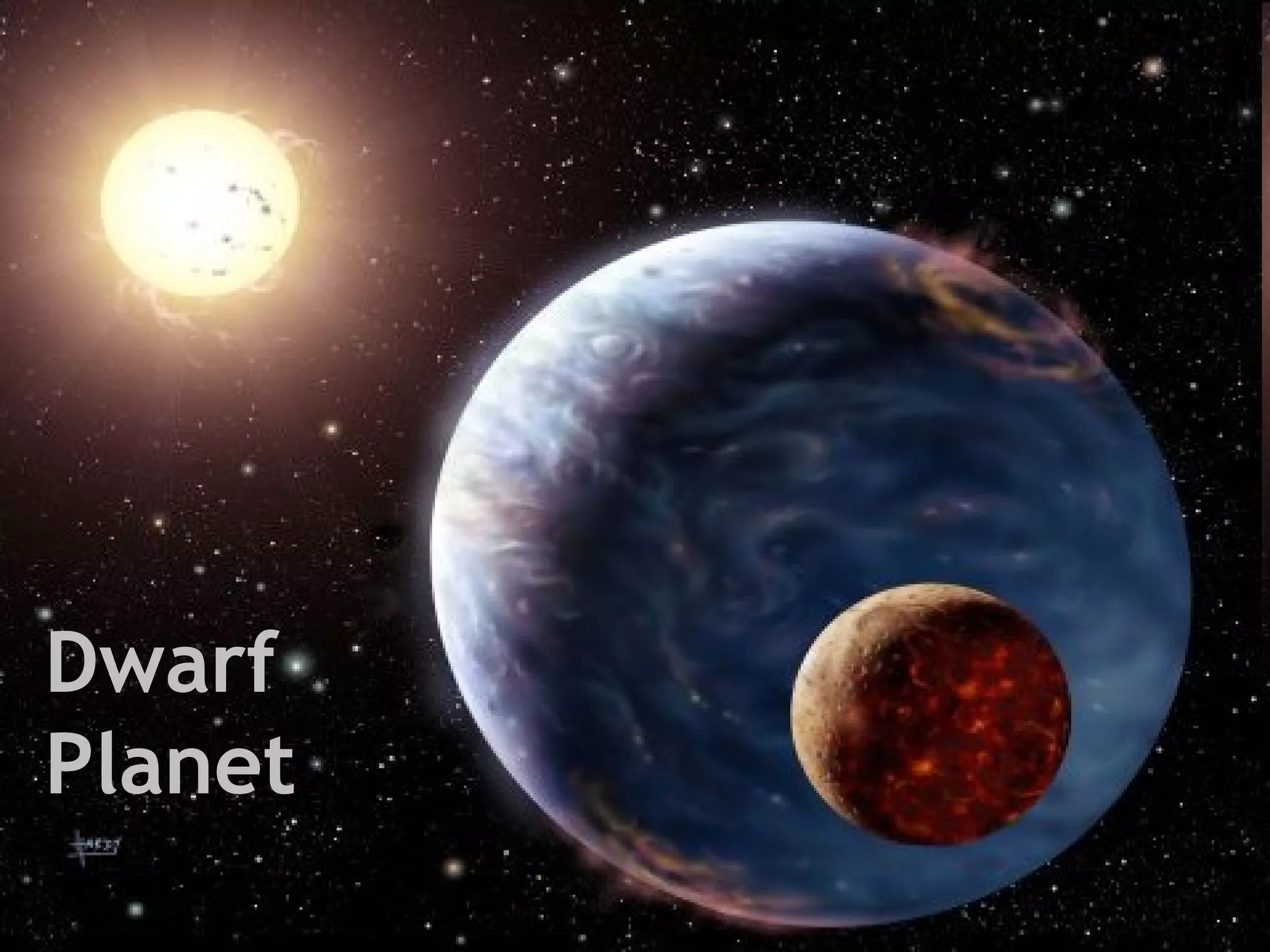
Dwarf
Planet
Properties of Dwarf Planet
• Must orbit the Sun
• Does not emit light
• Must be smaller than 3031 miles in diameter
• Large enough so that its own gravity pulls it
into the shape of sphere
• Due to weaker gravity, it is unable to clear out
its orbit
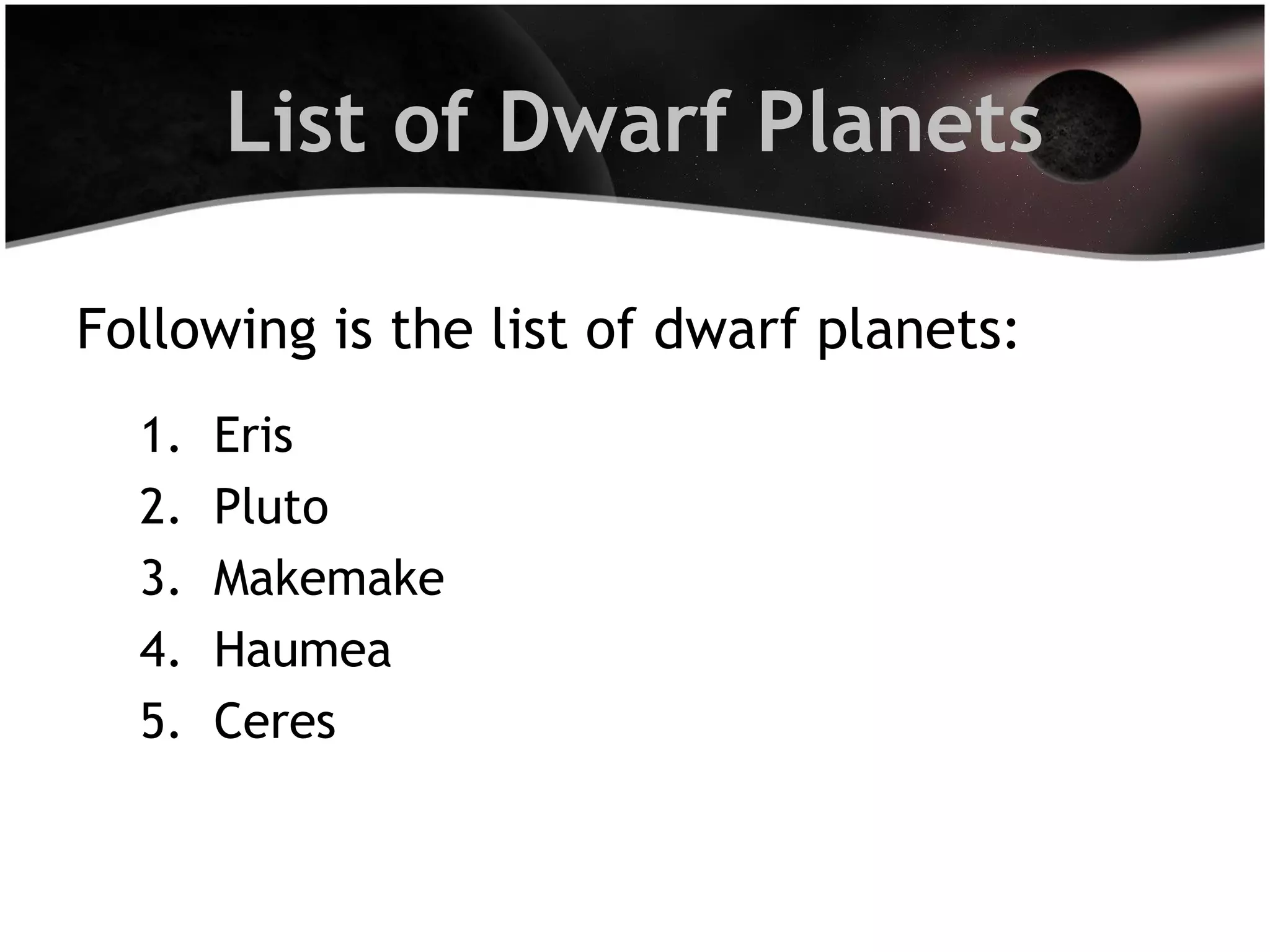
List of Dwarf Planets
Following is the list of dwarf planets:
1.
2.
3.
4.
5.

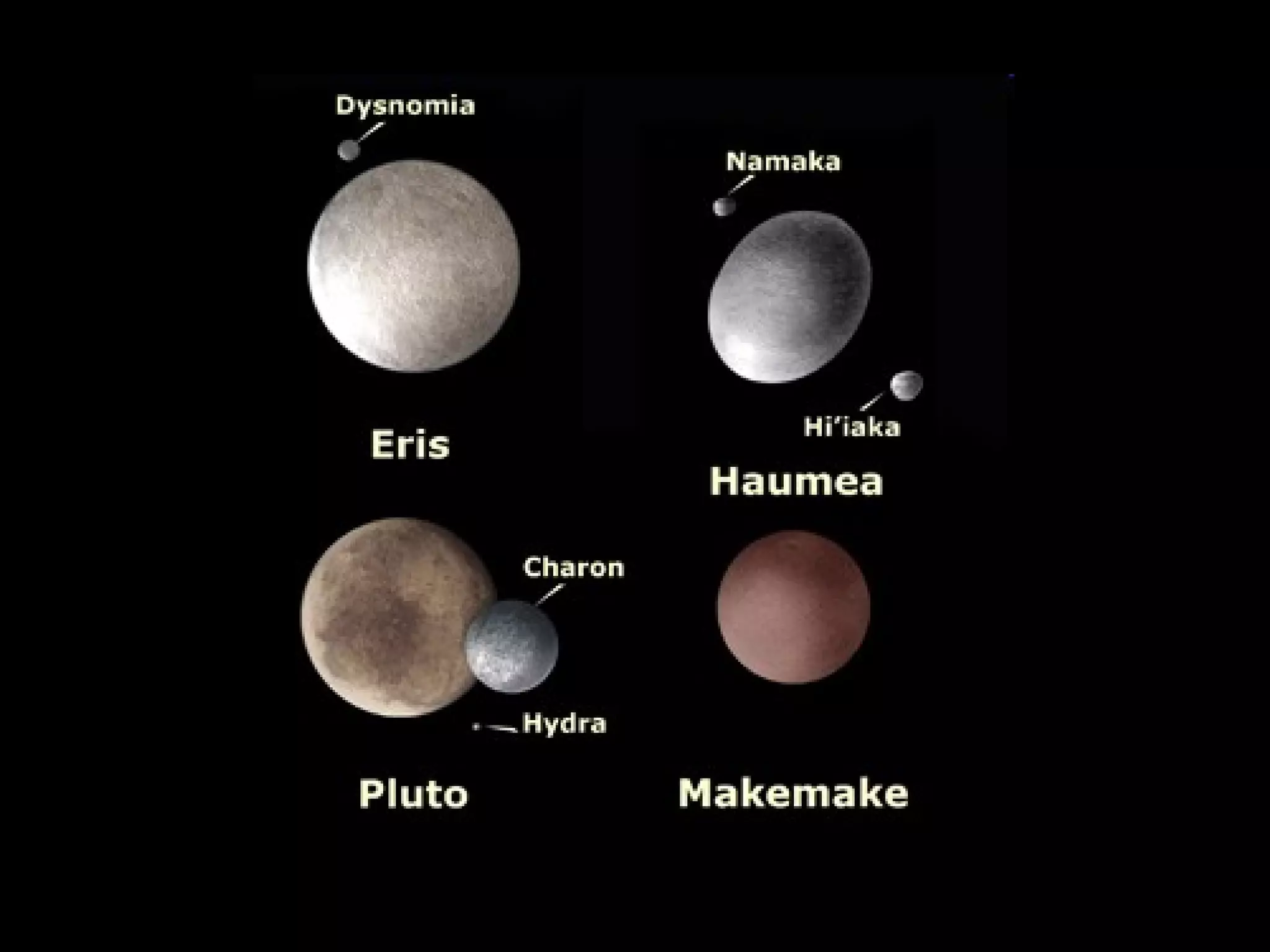
Eris
Pluto
Makemake
Haumea
Ceres
Eris
Eris

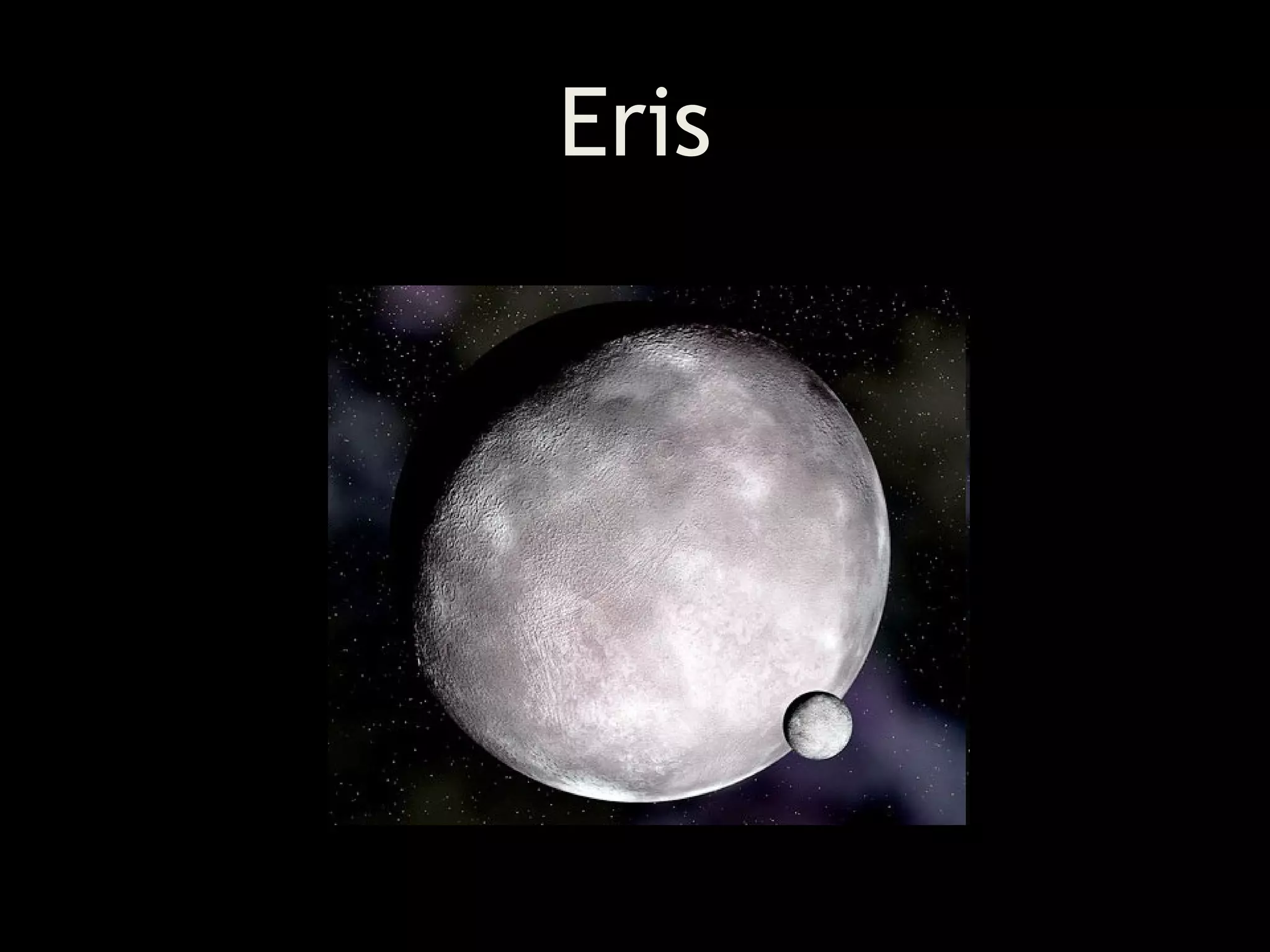
• Largest known dwarf planet
• The most distant member of our
solar system
– 3 times farther out than Pluto

• Moon  1
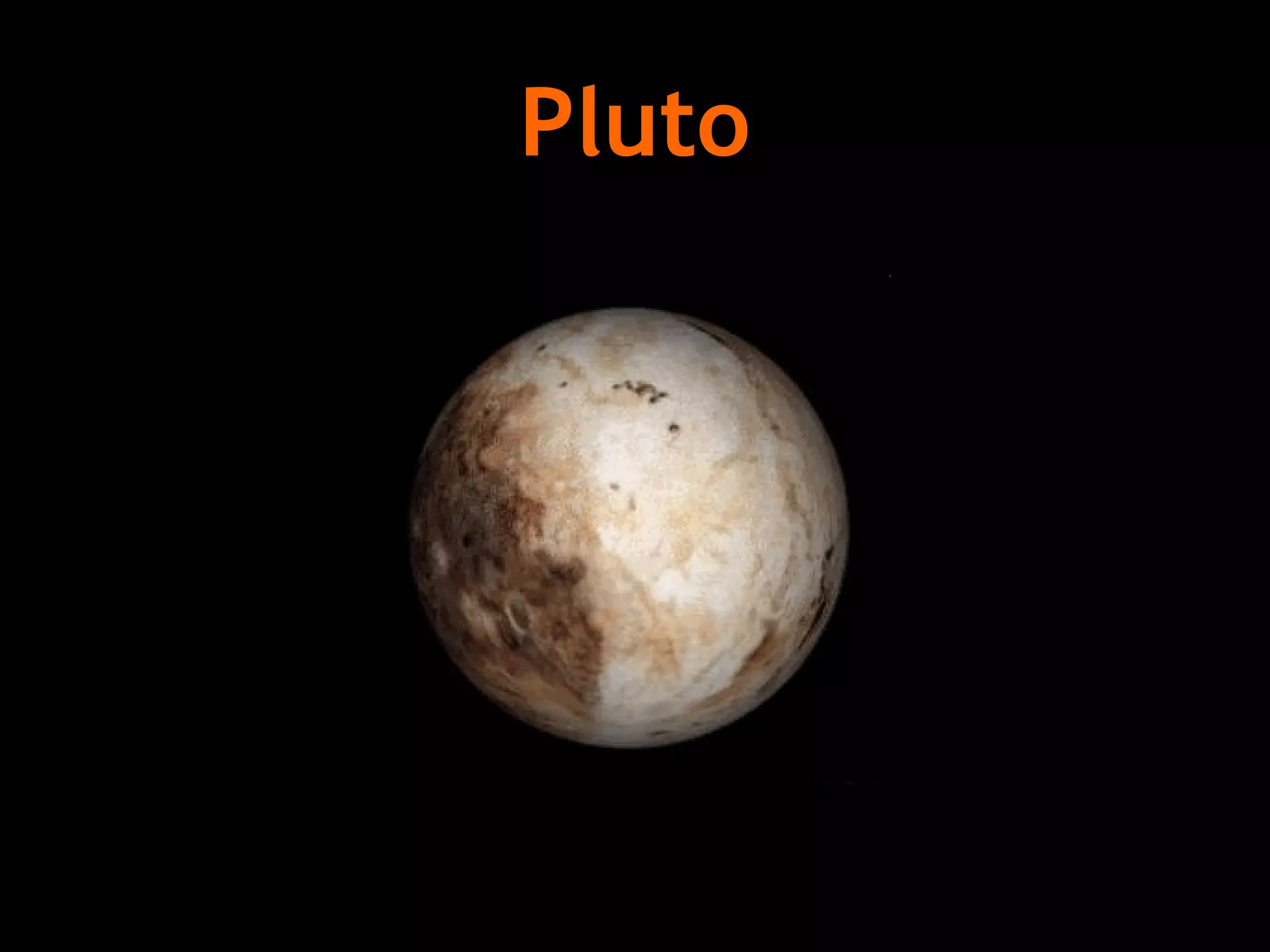
Pluto
• The god of the dead and
underworld

Pluto

– Because it is dark and desolate

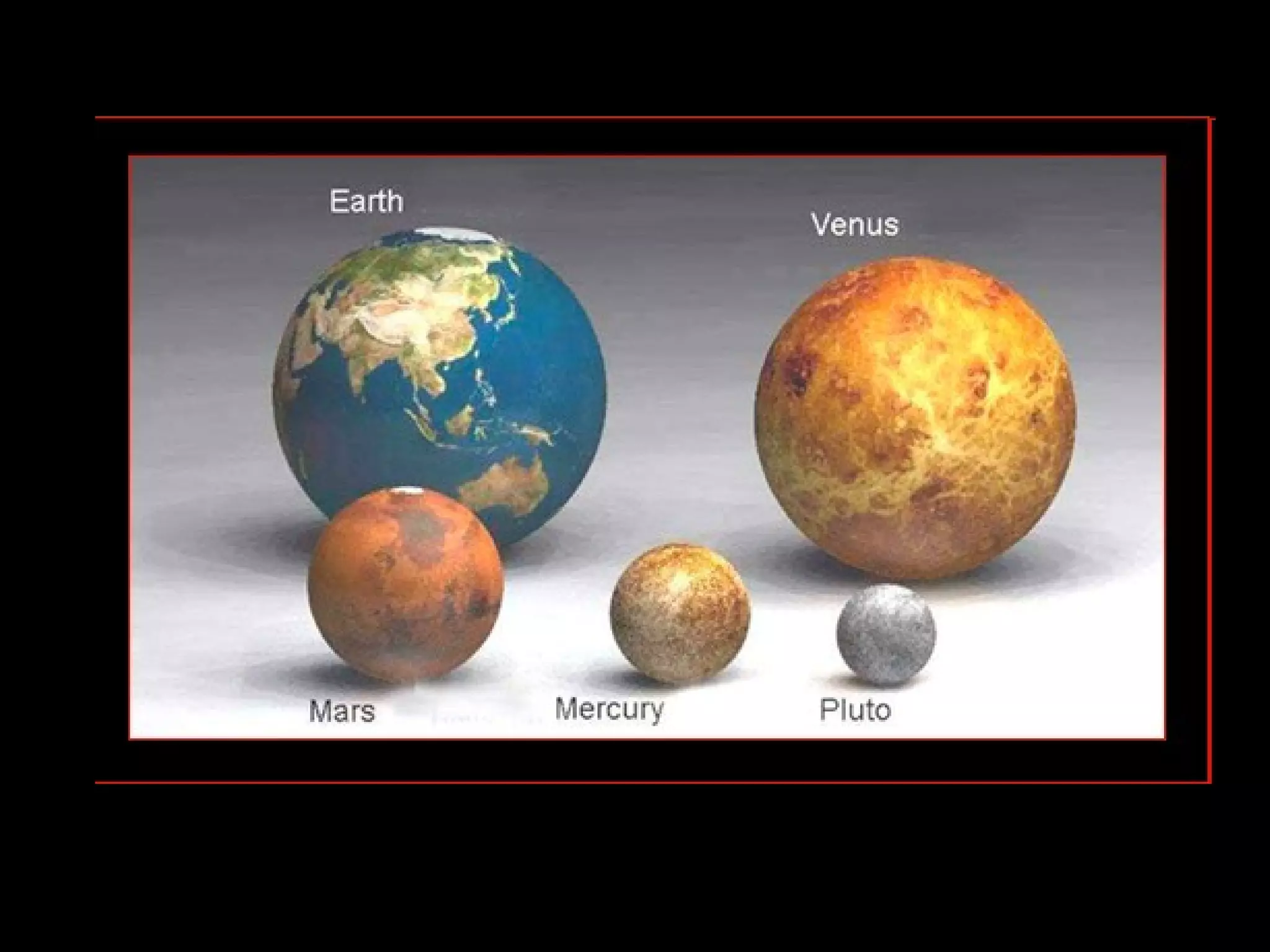
• Formerly the smallest of the nine
"traditional" planets
• But in 2006, it was demoted to
dwarf planet status
• Second largest dwarf planet
• Moon  3
– Largest moon is called Charon, which
is half the size of Pluto

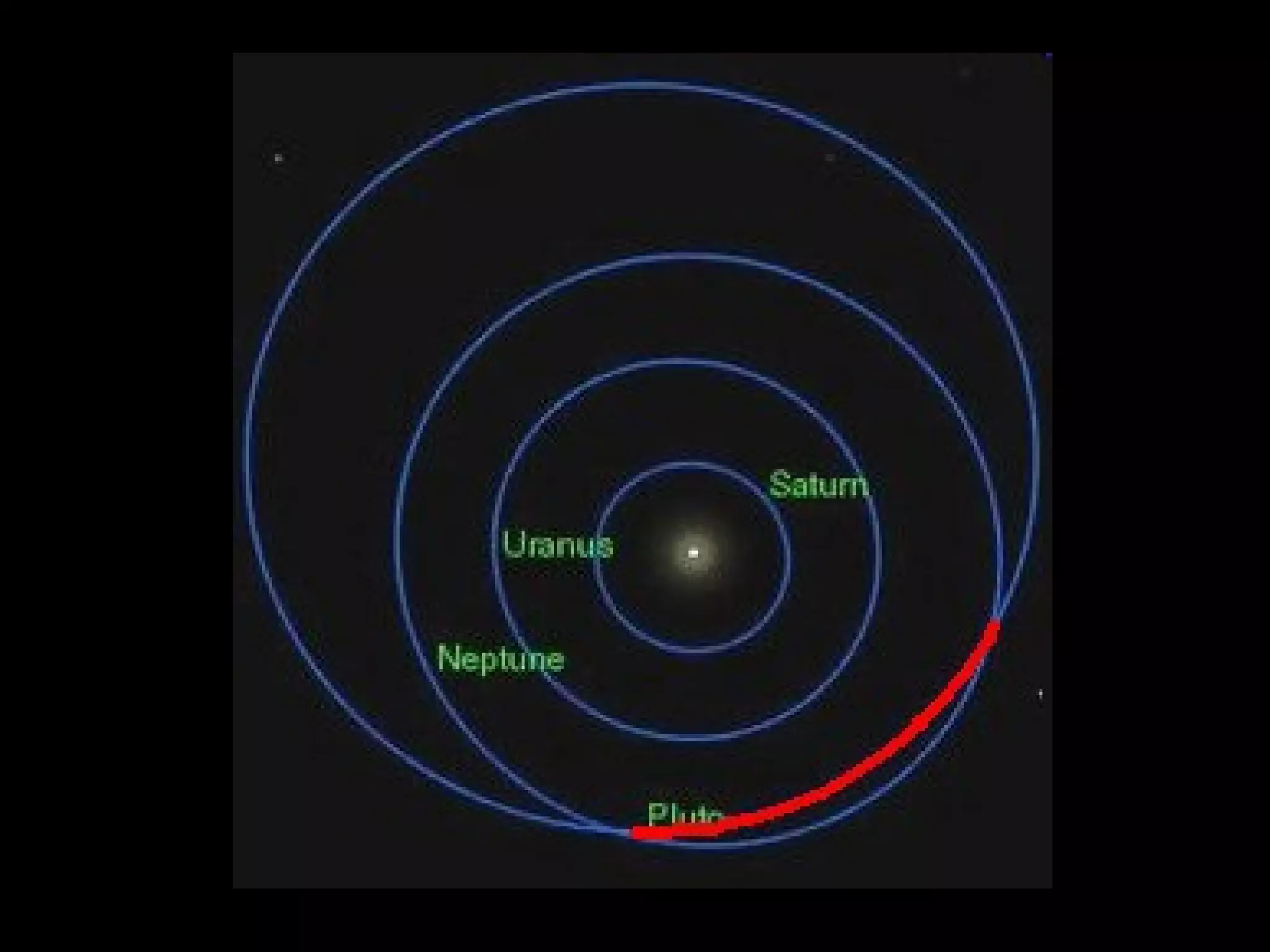
• Unusual orbit
– Once every 248 Earth years, Pluto
swings inside the orbit of Neptune
– It stays there for twenty years
– During those twenty years, Pluto is
closer to the Sun than Neptune
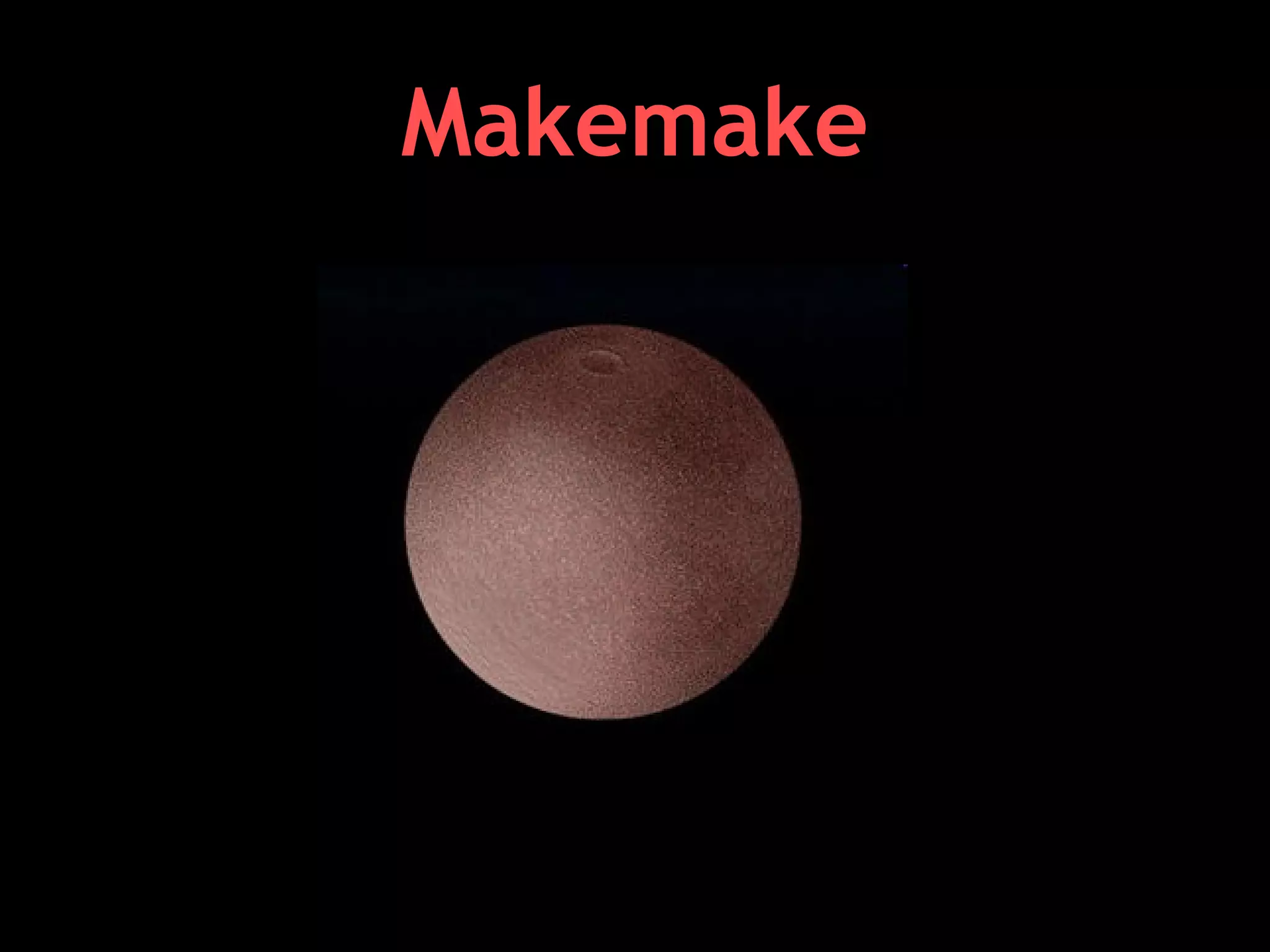
Makemake
Makemake

• Pronounced mah-kee-mah-kee
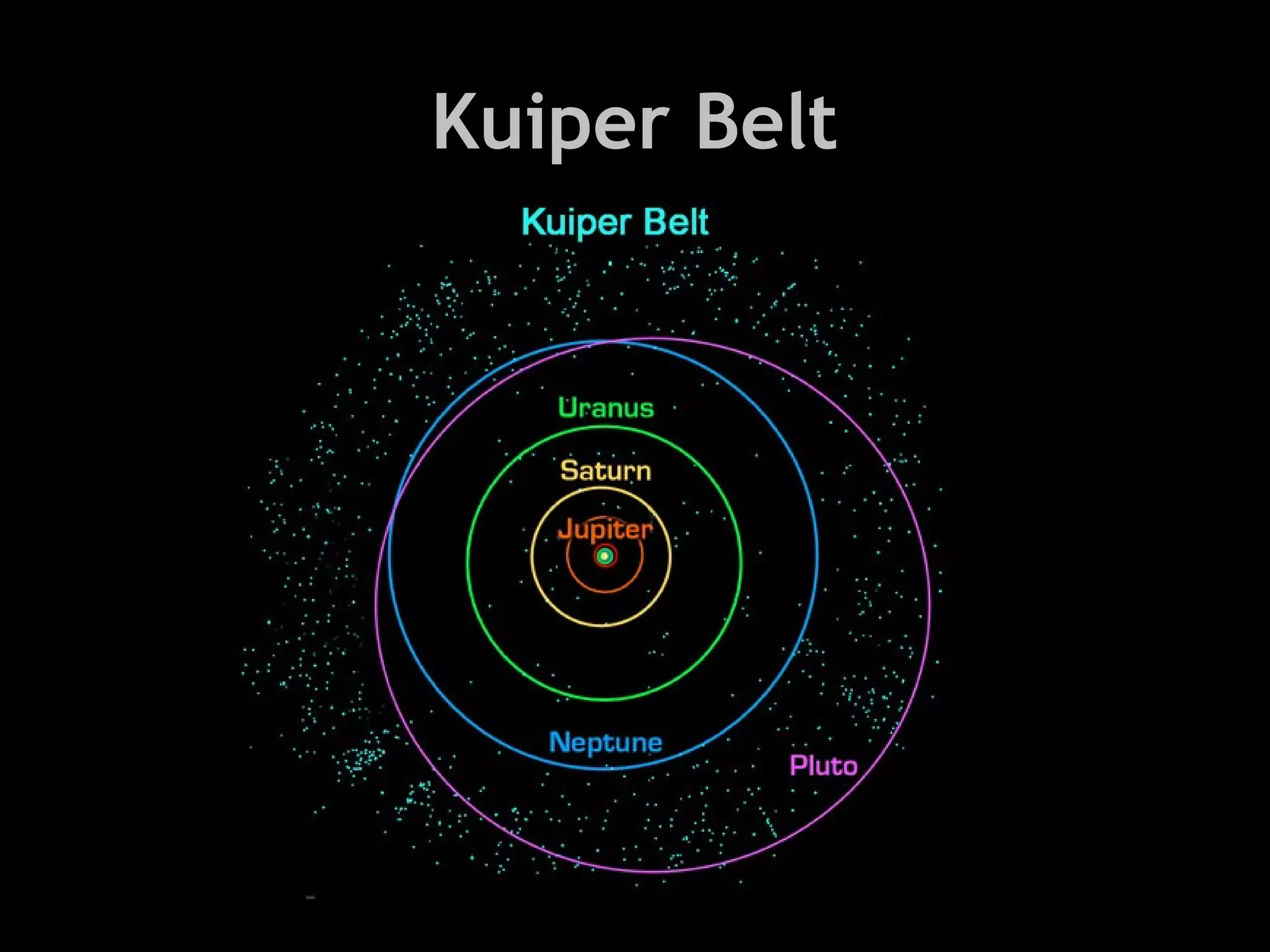
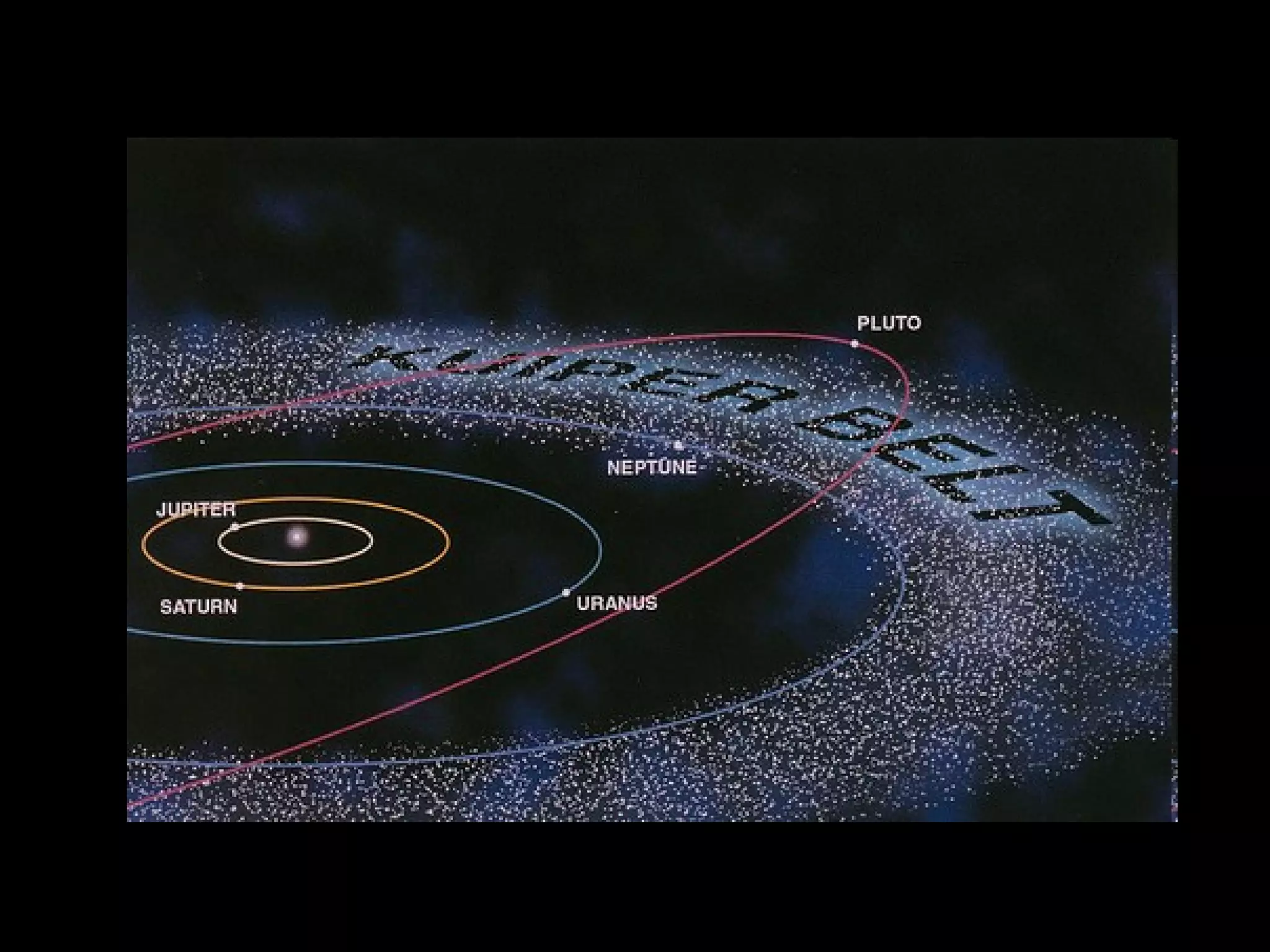
• Located in the Kuiper Belt
• Third largest dwarf planet
• Appears reddish in color
• Moon  None
Kuiper Belt
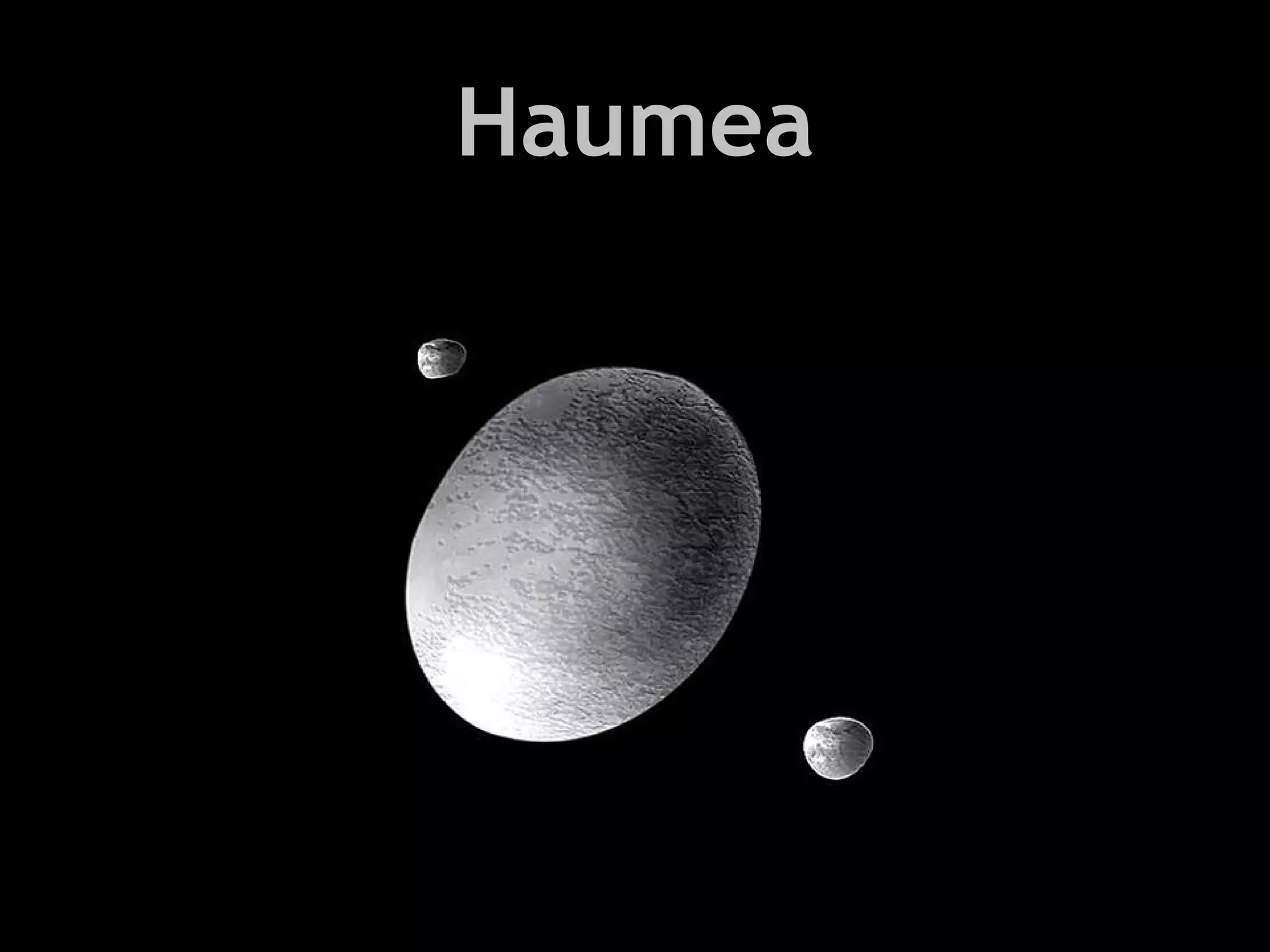
Haumea
Haumea

• Found in the Kuiper Belt
• Has an ellipsoidal; not a sphere
– Its ellipsoidal shape is thought to
result from its rapid rotation
• In much the same way that a water
balloon stretches out when tossed with
a spin, and not from a lack of sufficient
gravity to overcome the compressive
strength of its material
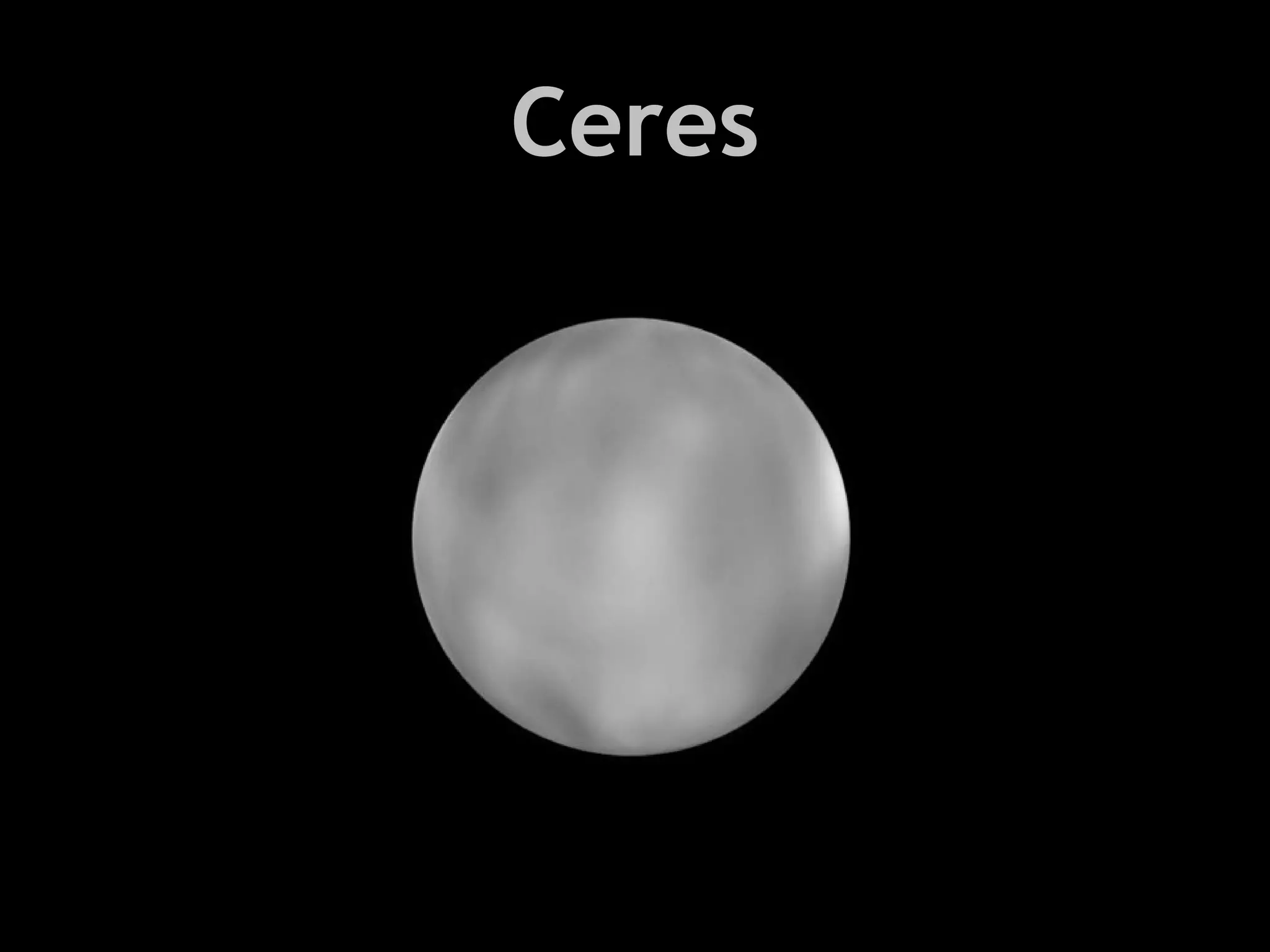
Ceres
Ceres

•

Located in the asteroid belt
between Mars and Jupiter

•

When Ceres was first discovered
–
–
–
–

It was called a comet
Then called a planet
Then called an asteroid
Since 2006, it has been called a
dwarf planet
Moon
Moon
Definition:
– A celestial body that makes an orbit around a planet,
including the eight major planets, dwarf planets,
and minor planets

• Also referred as planet’s natural satellite
• More than 170 known natural satellites
• Moon is much smaller than its planet
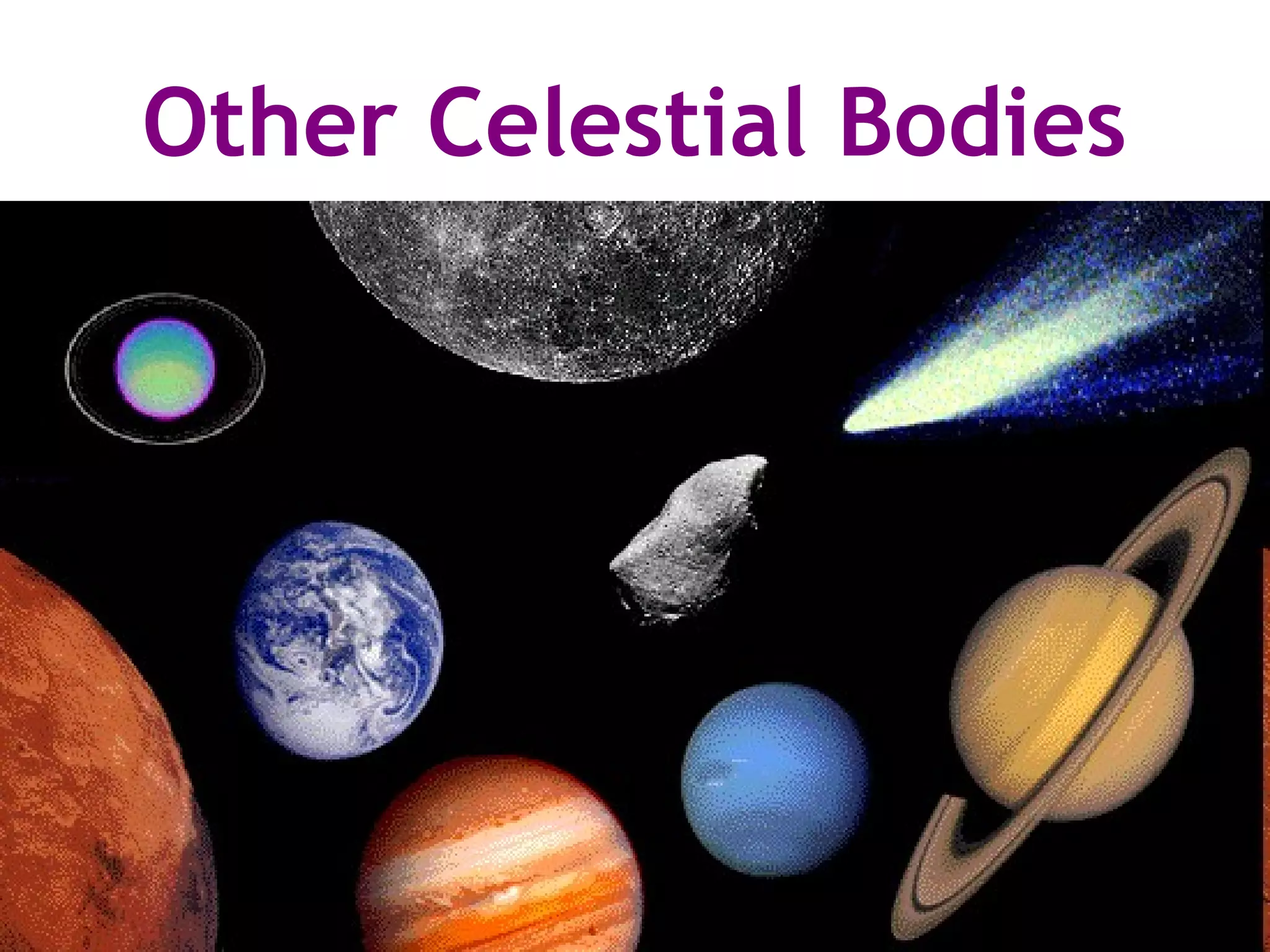
Other Celestial Bodies

Chapter - 17

Solar System
Other Celestial Bodies
• Discuss the following celestial bodies:
– Comet
– Asteroid
– Meteoroid
– Black Hole
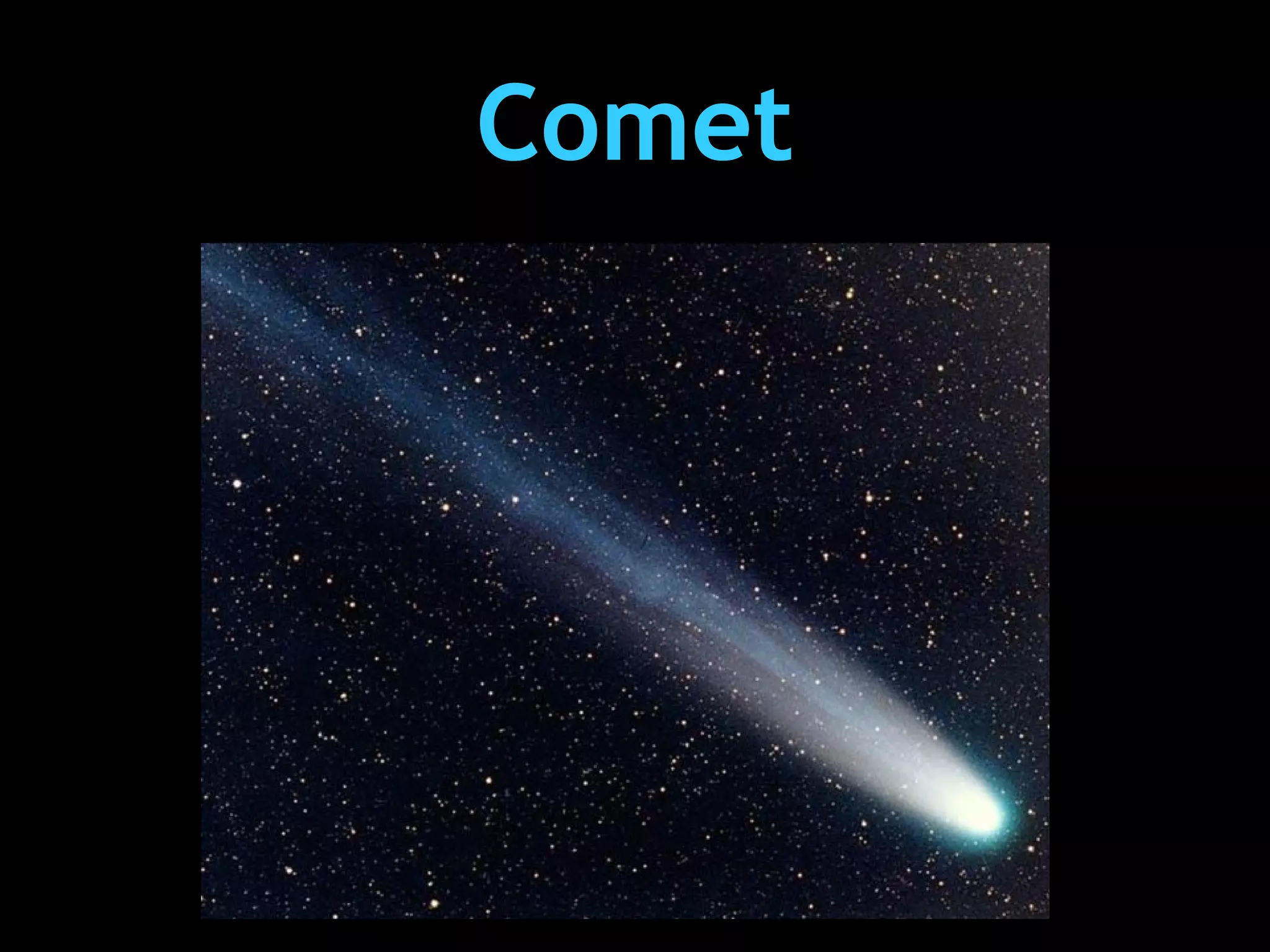
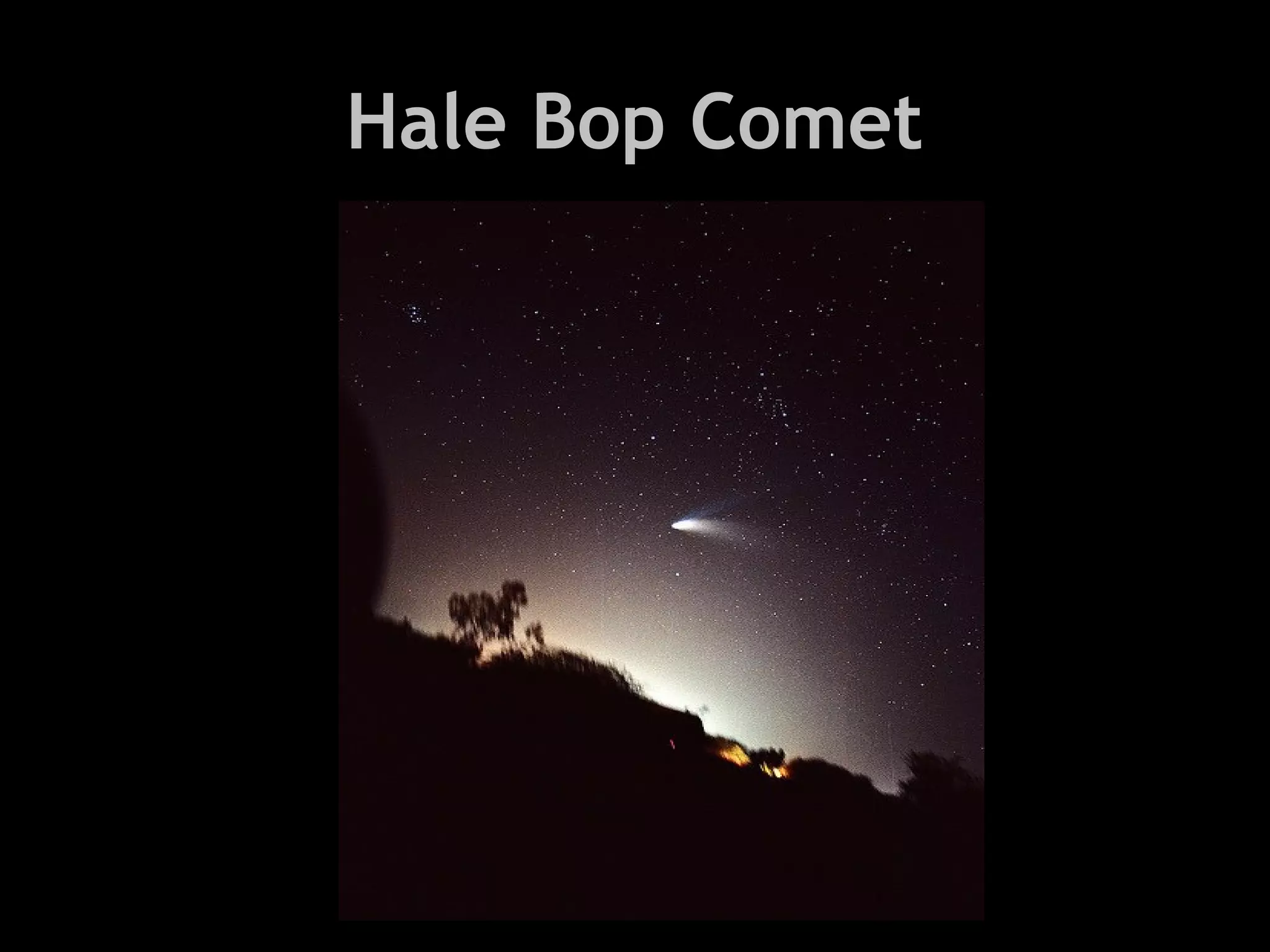
Comet
Comet

Definition
– A celestial object consisting of a
nucleus of ice and dust and, when
near the sun, a “tail” of gas and
dust particles pointing away from
the sun

• Orbits around the sun
• Comets have a coma or a tail
• They are composed of dirt and
ices
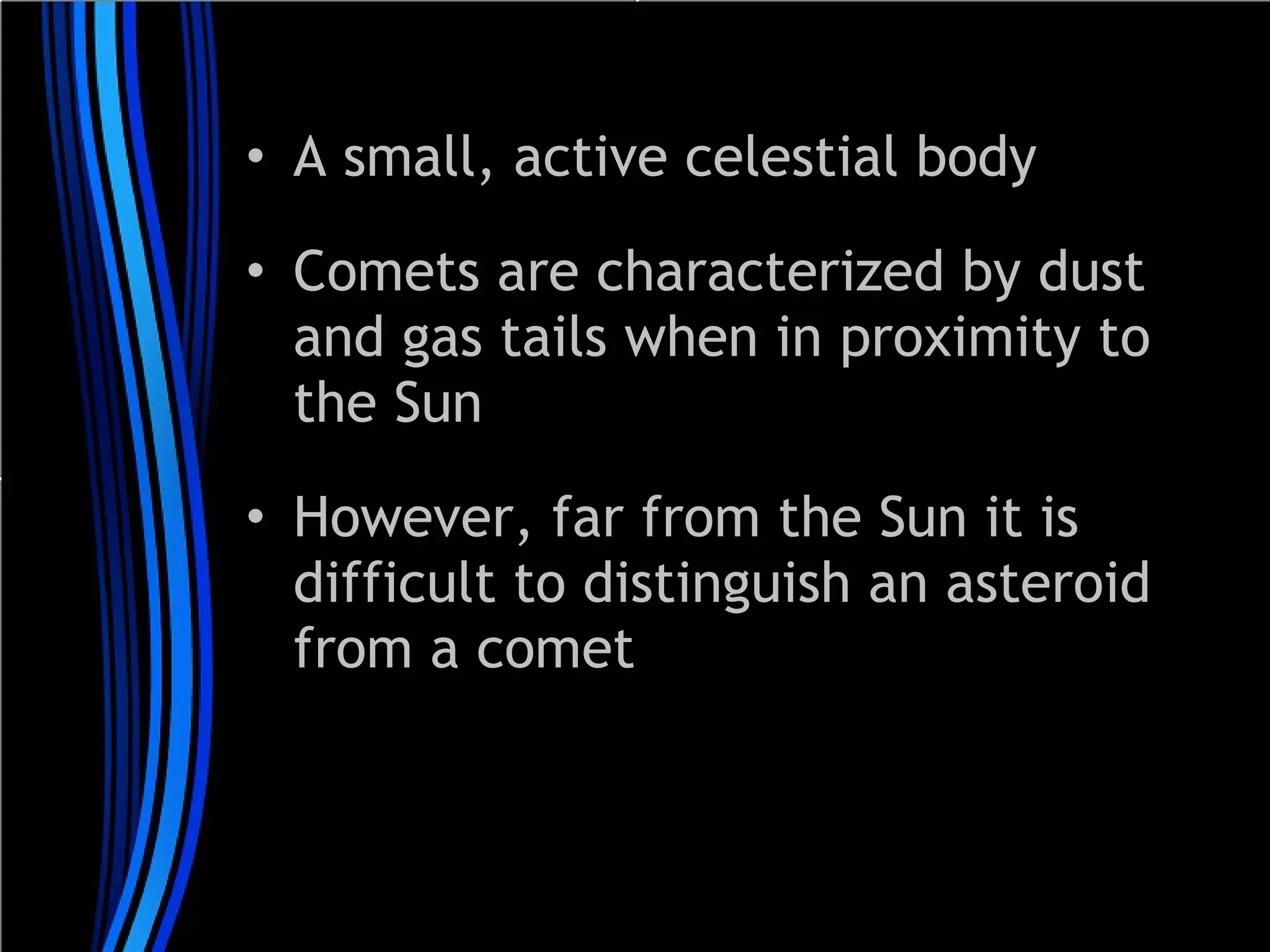
• A small, active celestial body
• Comets are characterized by dust
and gas tails when in proximity to
the Sun
• However, far from the Sun it is
difficult to distinguish an asteroid
from a comet
Hale Bop Comet
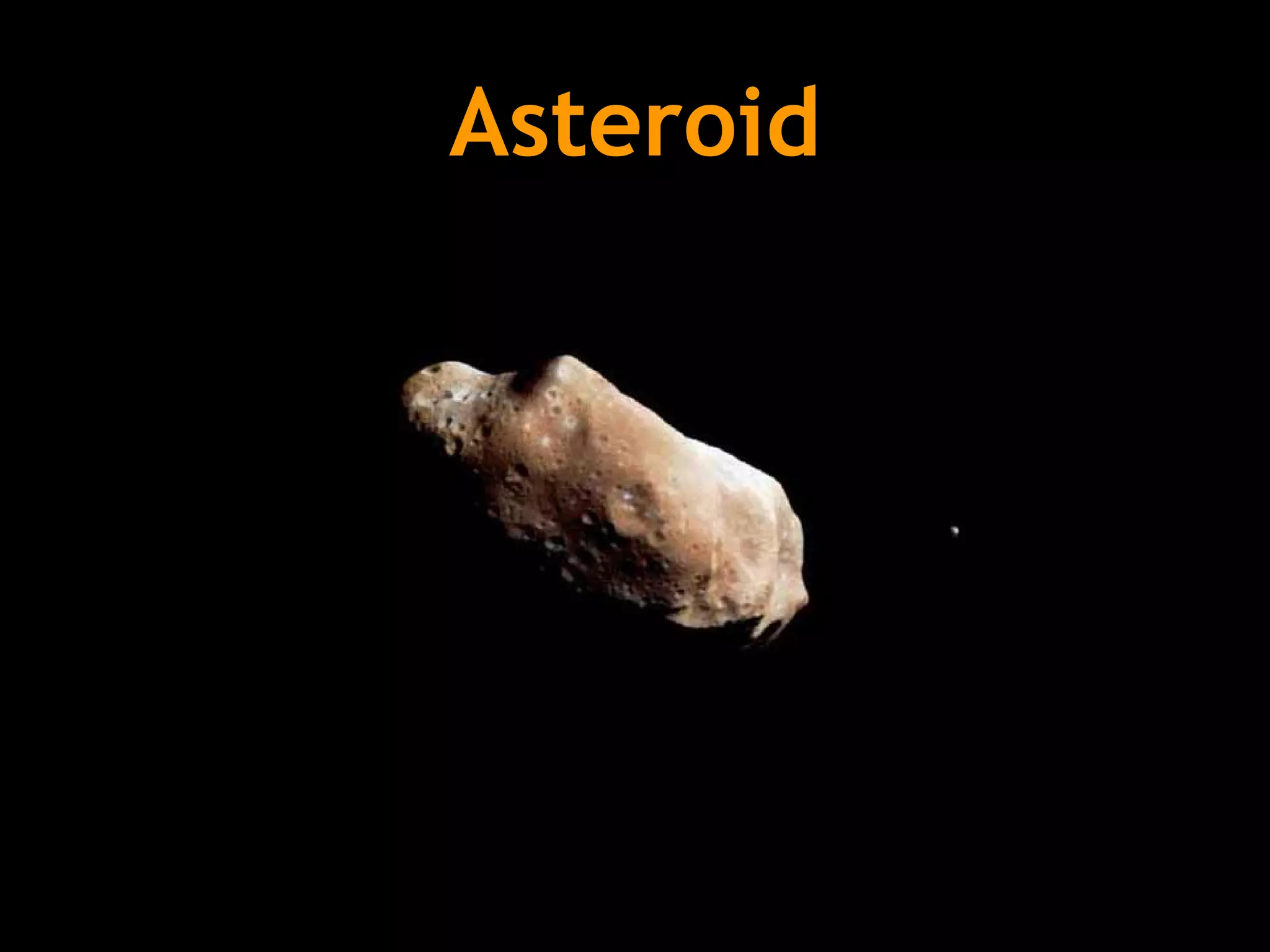
Asteroid
Asteroid

Definition
– A relatively small, inactive body,
composed of rock, carbon or
metal, which is orbiting the Sun.

• Asteroids are rocky
• Most of them exist in the
asteroid belt located between
Jupiter and Mars
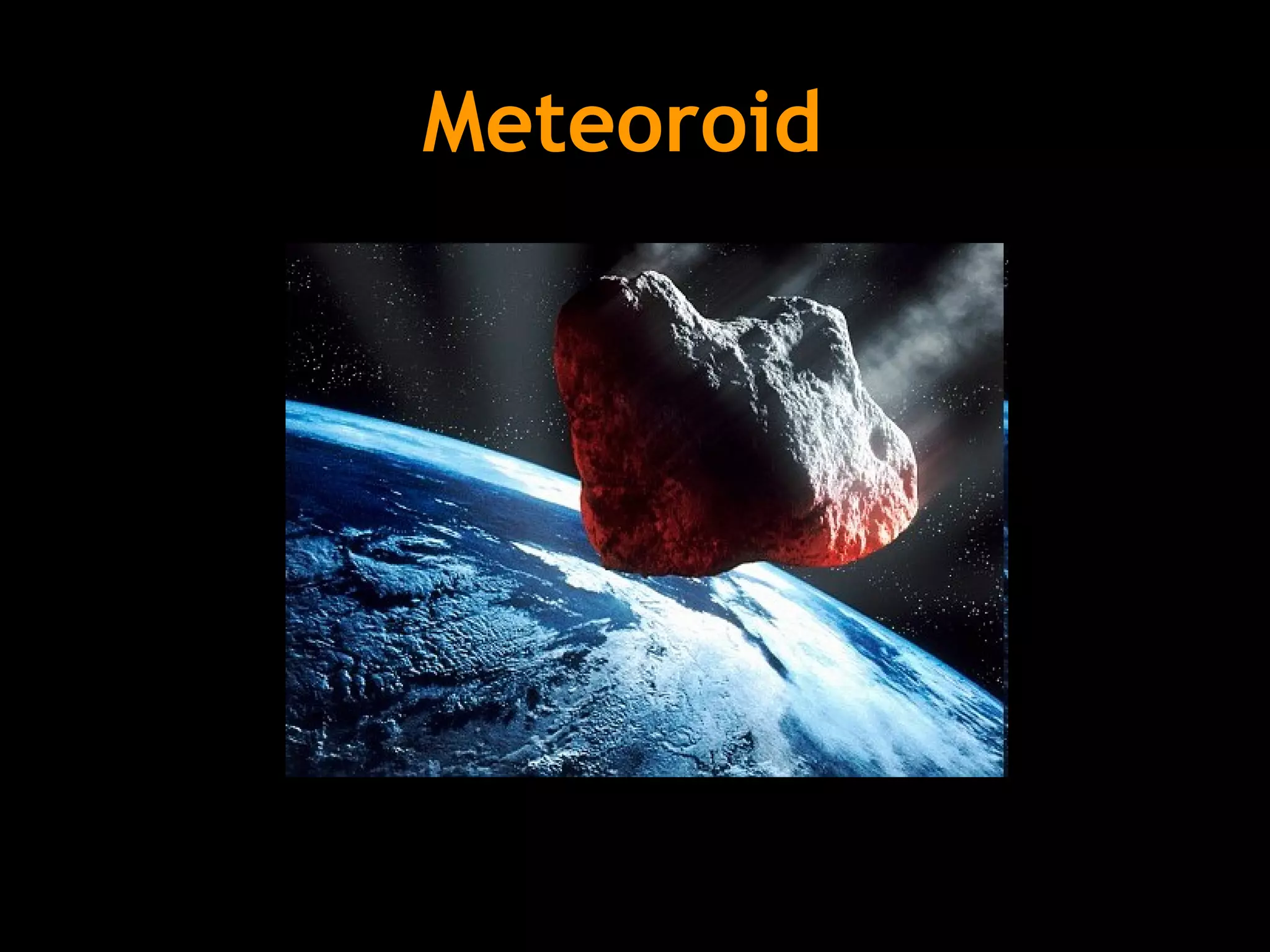
Meteoroid
Meteoroid

Definition:
– A small particle from an asteroid or
comet orbiting the Sun
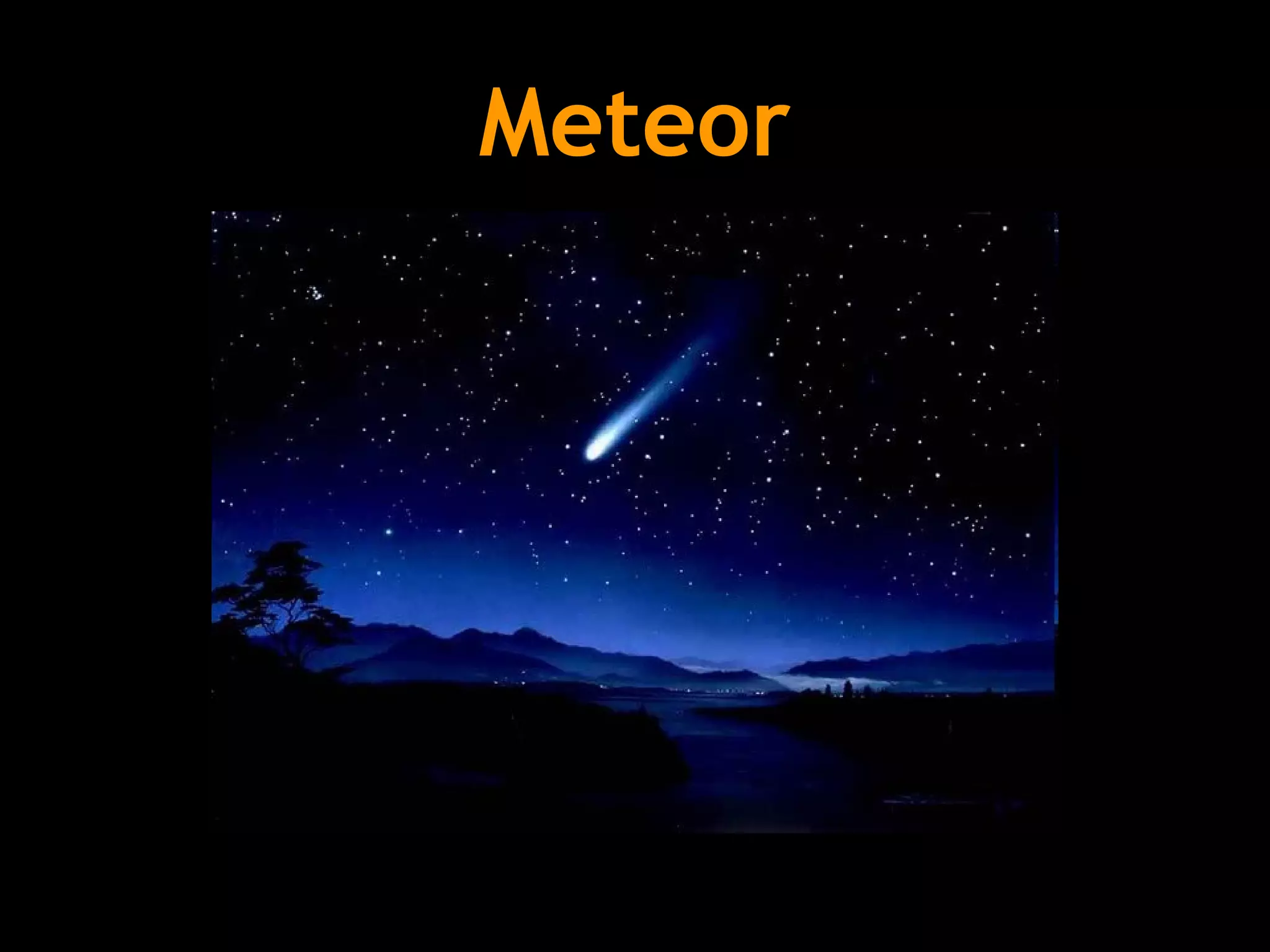
Meteor
Meteor

Definition
– Literal meaning  The flash of light
you see
– A meteoroid that is observed as it
burns up in the Earth's atmosphere a shooting star

• They are asteroids that have
succumbed to earths gravity
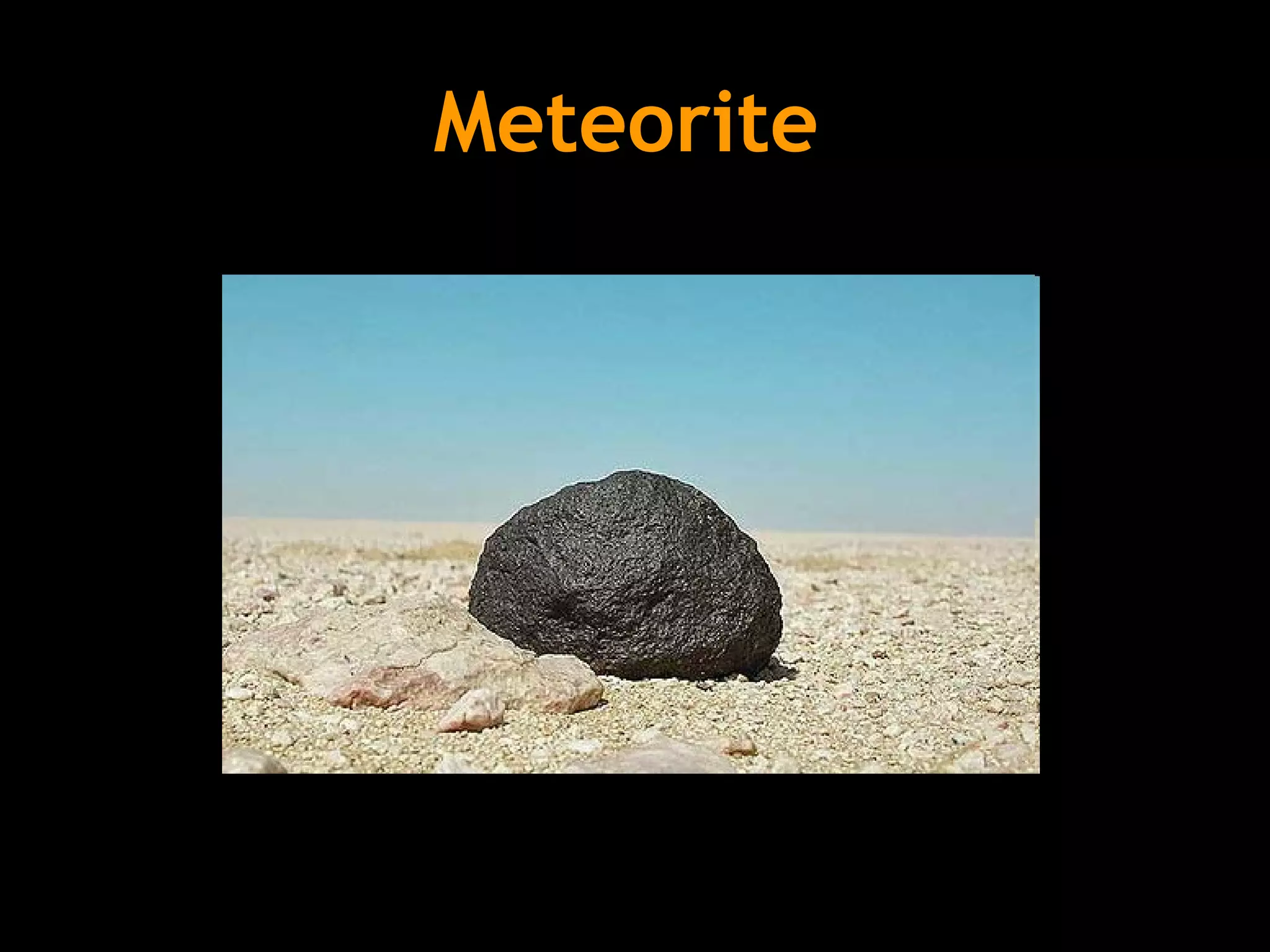
Meteorite
Meteorite

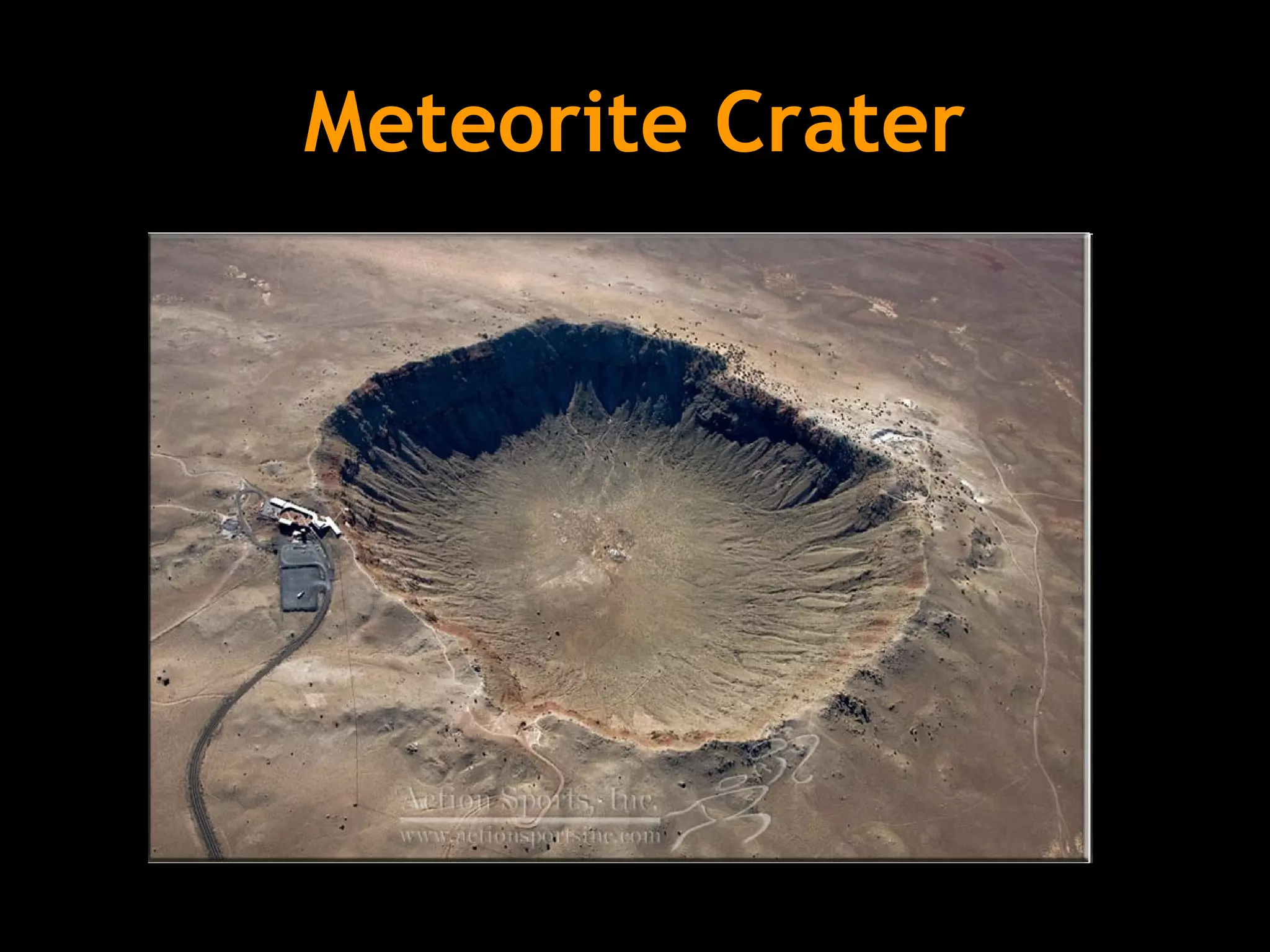
Definition:
– A meteoroid that survives its
passage through the Earth's
atmosphere and impacts the Earth's
surface

• Its size can vary from big
boulders to tiny rocks
Meteorite Crater
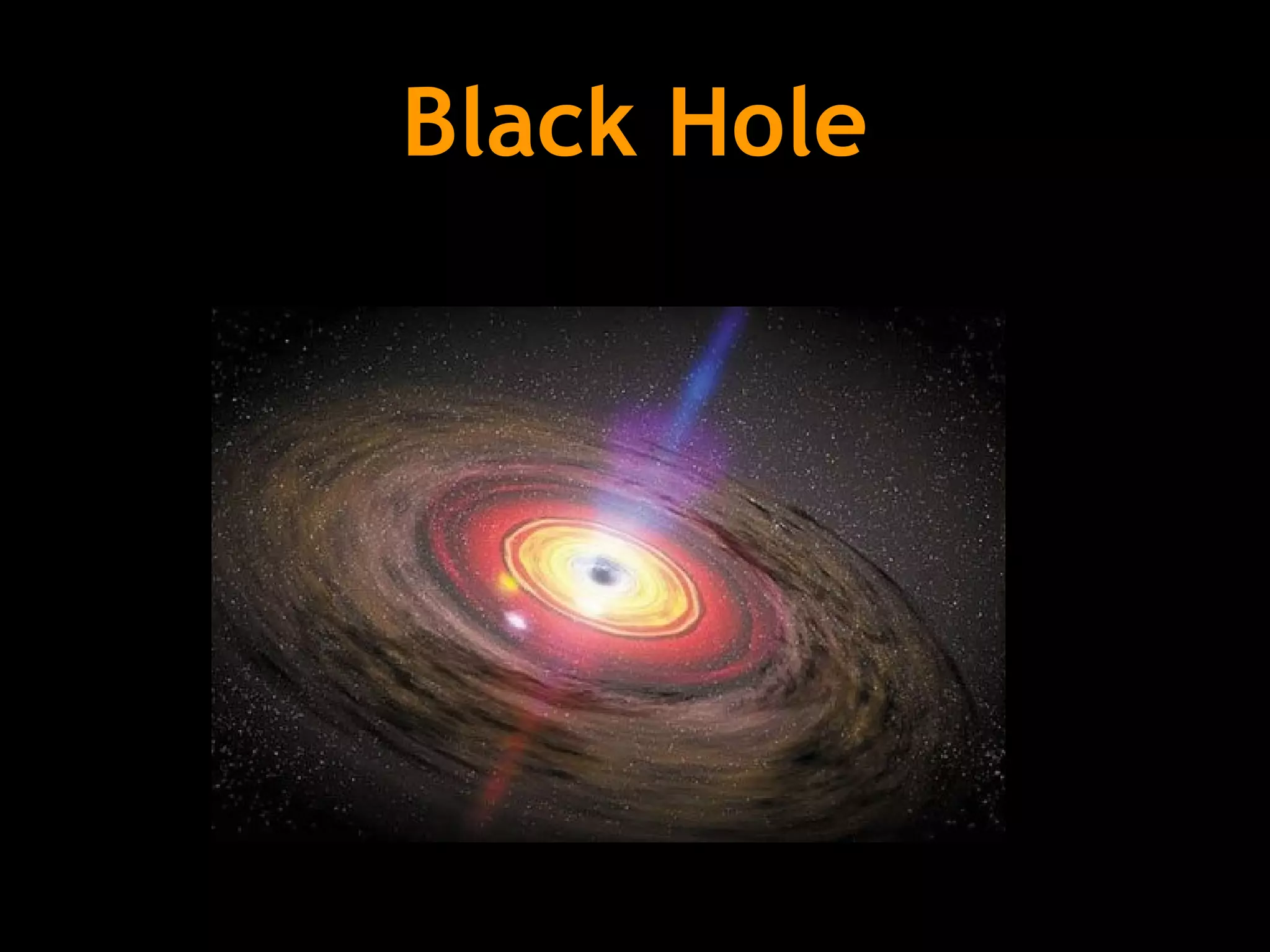
Black Hole
Black Hole

• Definition:
– It is an area in space where gravity is so
strong that even light cannot escape from
it. Since light cannot escape from a black
hole, it appears black

• A black hole is not really a hole and it
is not empty
• It is filled with a lot of material
crammed into an extremely small
space
• The term black hole is used because
these objects look like black holes in
space - since they put out no light
• How do black holes form? 
– When a large star runs out of fuel it can no
longer support its heavy weight.
– The pressure from the star's massive layers of
hydrogen press down forcing the star to get
smaller and smaller and smaller. 
– Eventually the star will get even smaller than
an atom.
– Imagine that for a moment, an entire star
squashed up into less space than a tiny atom
• If you make something smaller by
squishing it, its gravity becomes
much stronger. Imagine then, if
you squish a star into the size of an
atom how powerful its gravity
would become
• A black hole's gravity becomes so
powerful that anything, including
light that gets too close, gets
pulled in
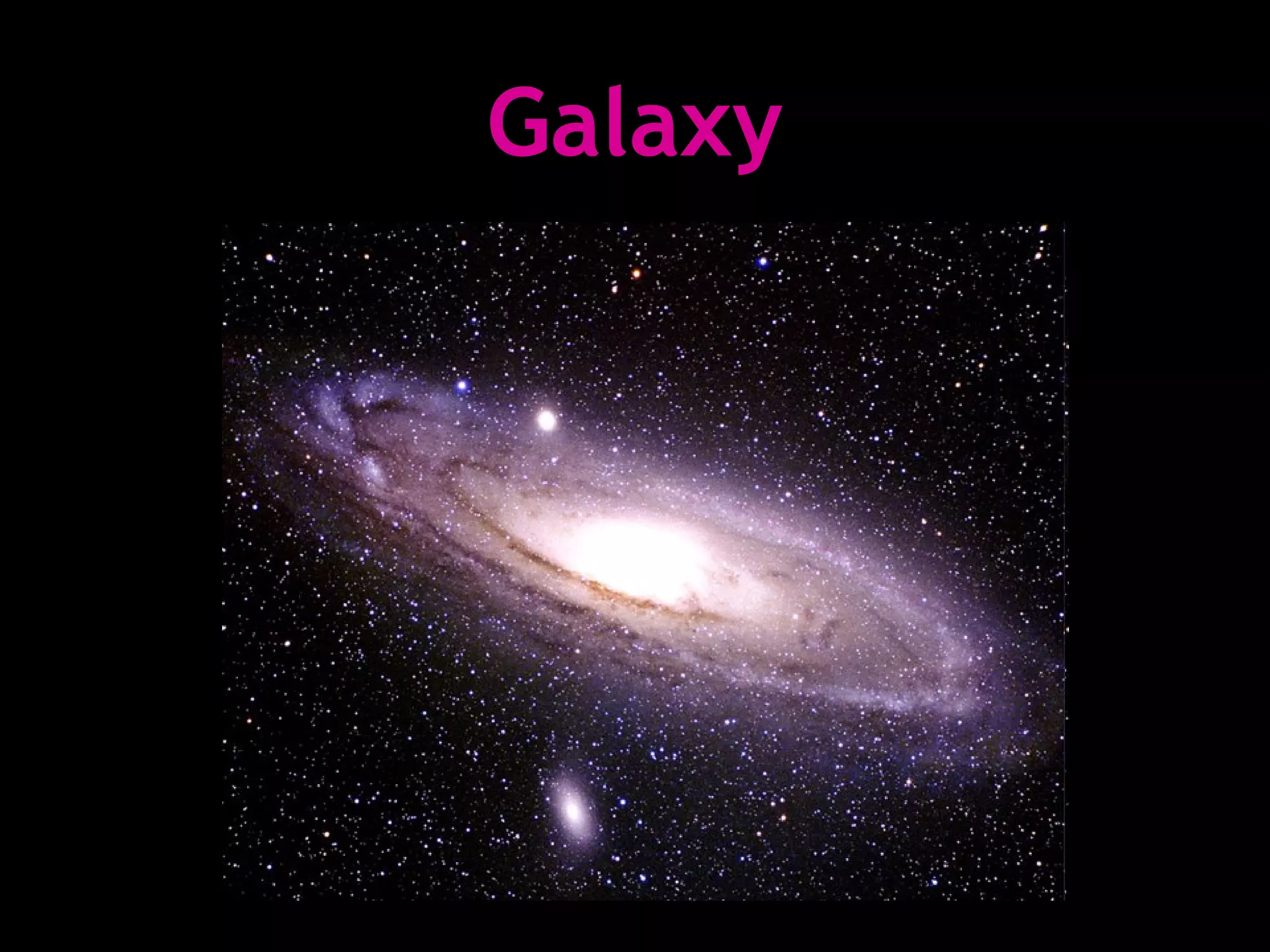
Galaxy
Galaxy

Definition:
– A group of millions of stars that are
relatively near each other

• Most stars seem to be in one or
another galaxy
• Example:
– Earth's own star, the Sun, is in the
Milky Way galaxy
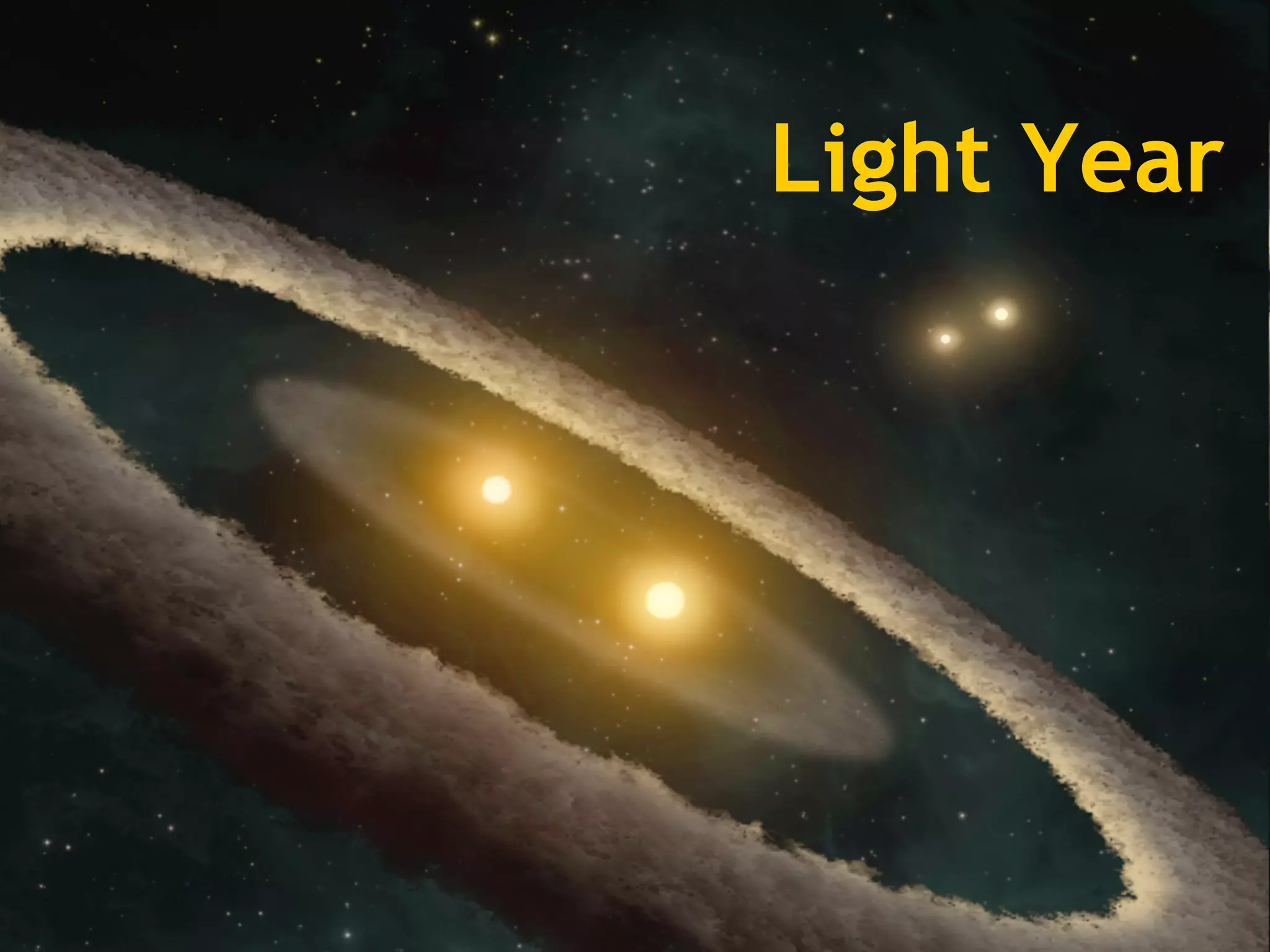
Light Year
Light Year
Definition
– A light year is the distance between two
points in space that it would take light to
travel when the distance between the two
points in time are one year
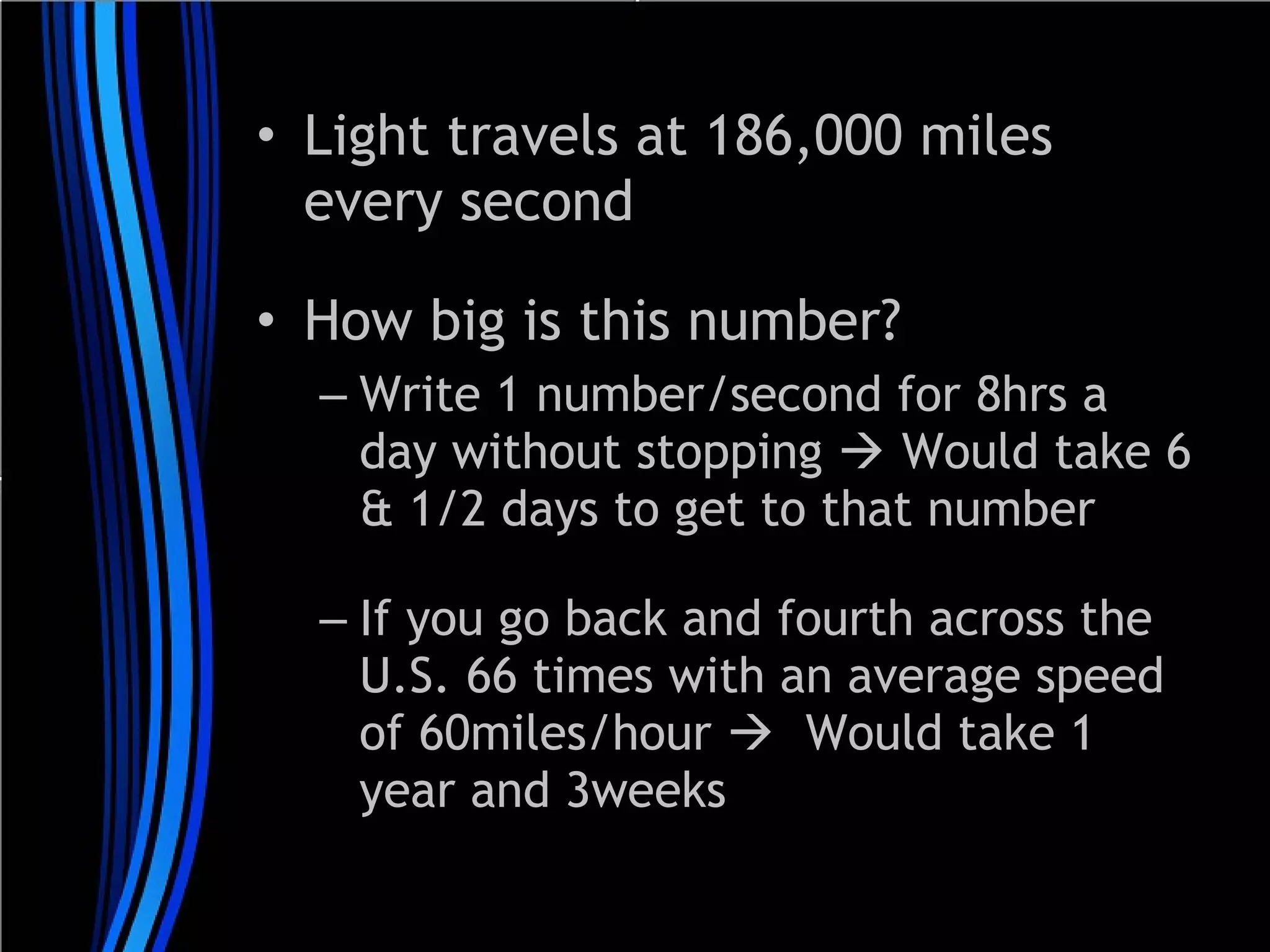
• Light travels at 186,000 miles
every second
• How big is this number?
– Write 1 number/second for 8hrs a
day without stopping  Would take 6
& 1/2 days to get to that number
– If you go back and fourth across the
U.S. 66 times with an average speed
of 60miles/hour  Would take 1
year and 3weeks
•
•
•
•

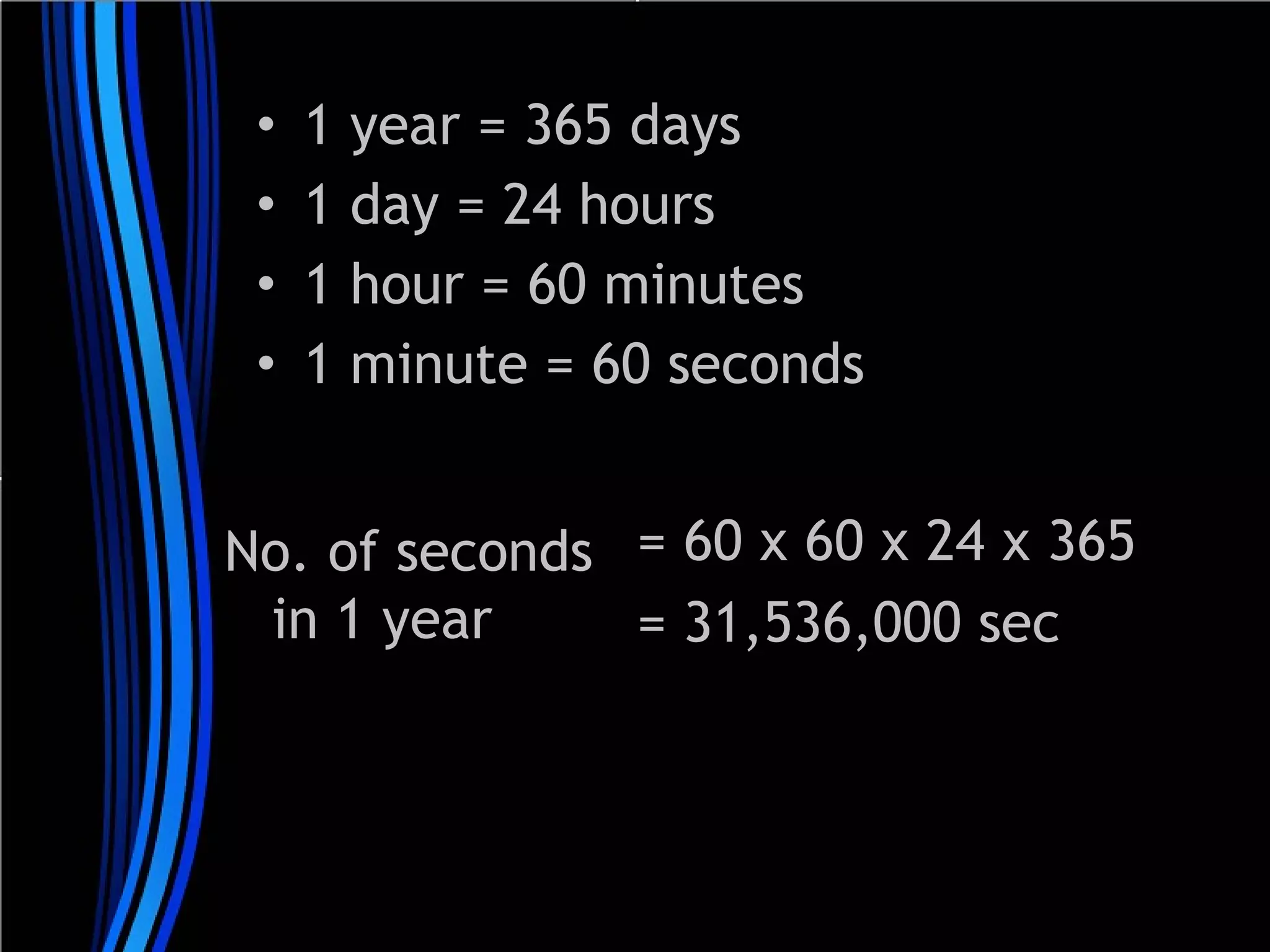
1
1
1
1

year = 365 days
day = 24 hours
hour = 60 minutes
minute = 60 seconds

No. of seconds = 60 x 60 x 24 x 365
in 1 year
= 31,536,000 sec
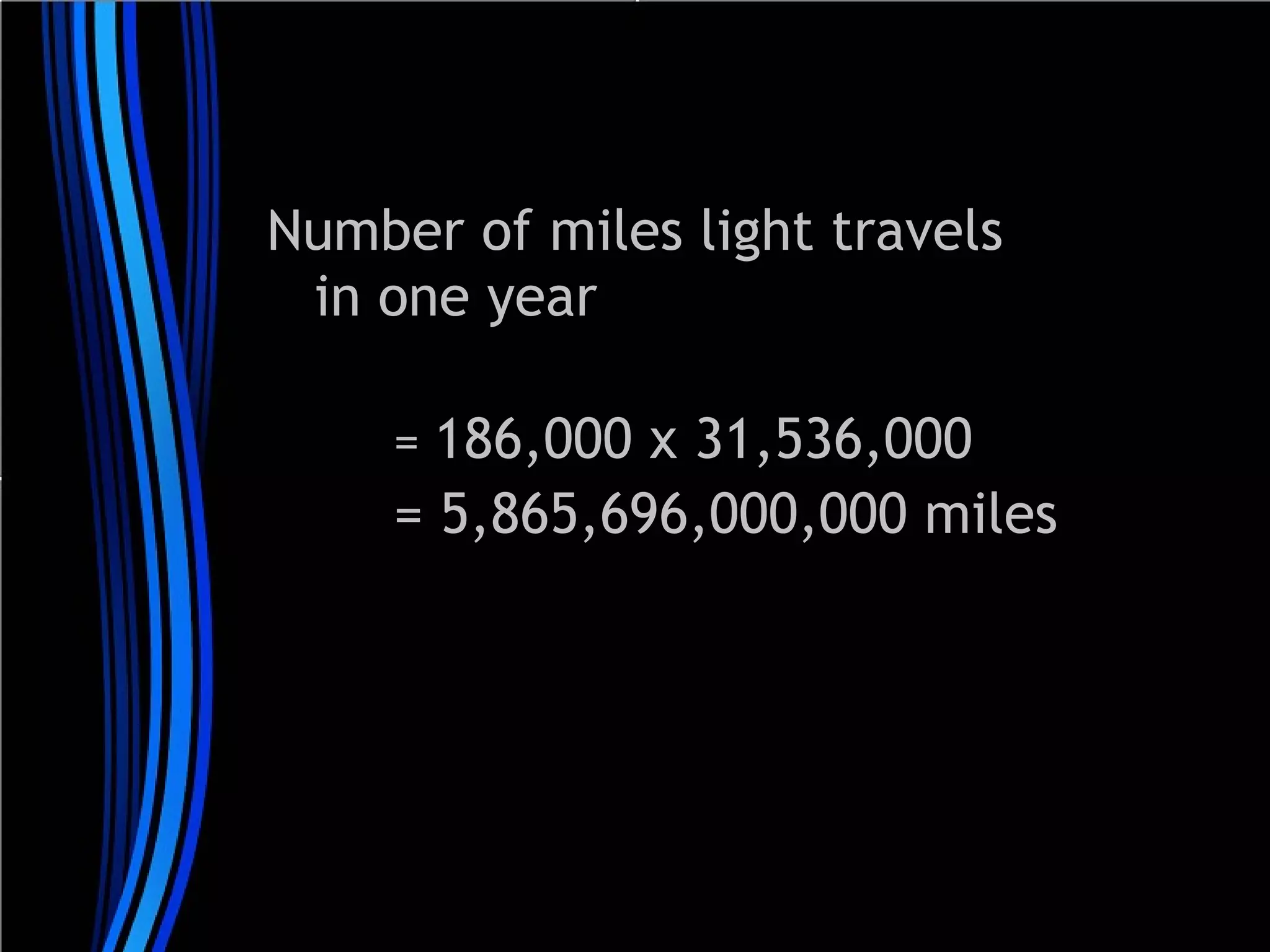
Number of miles light travels
in one year
= 186,000 x 31,536,000

= 5,865,696,000,000 miles
• The closest star is 4 light years away
= 4 x 5,865,696,000,000
= 23,462,784,000,000 miles

• Edge of universe is 15 billion light
years away
• How far is it?

1 hrly gs ch 01 solar system part 2

  • 1.
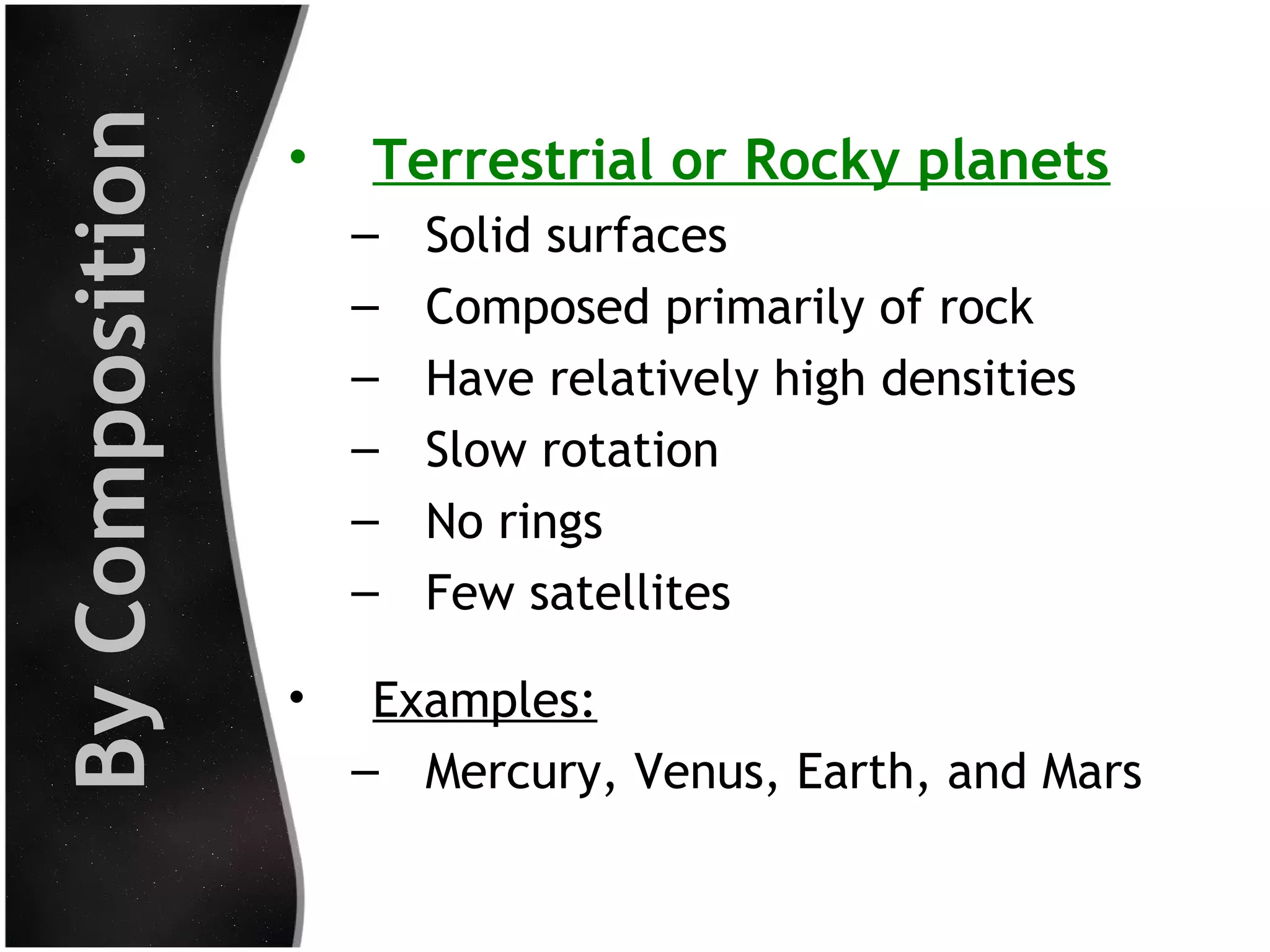
    By Composition • Terrestrial orRocky planets – – – – – – • Solid surfaces Composed primarily of rock Have relatively high densities Slow rotation No rings Few satellites Examples: – Mercury, Venus, Earth, and Mars
  • 2.
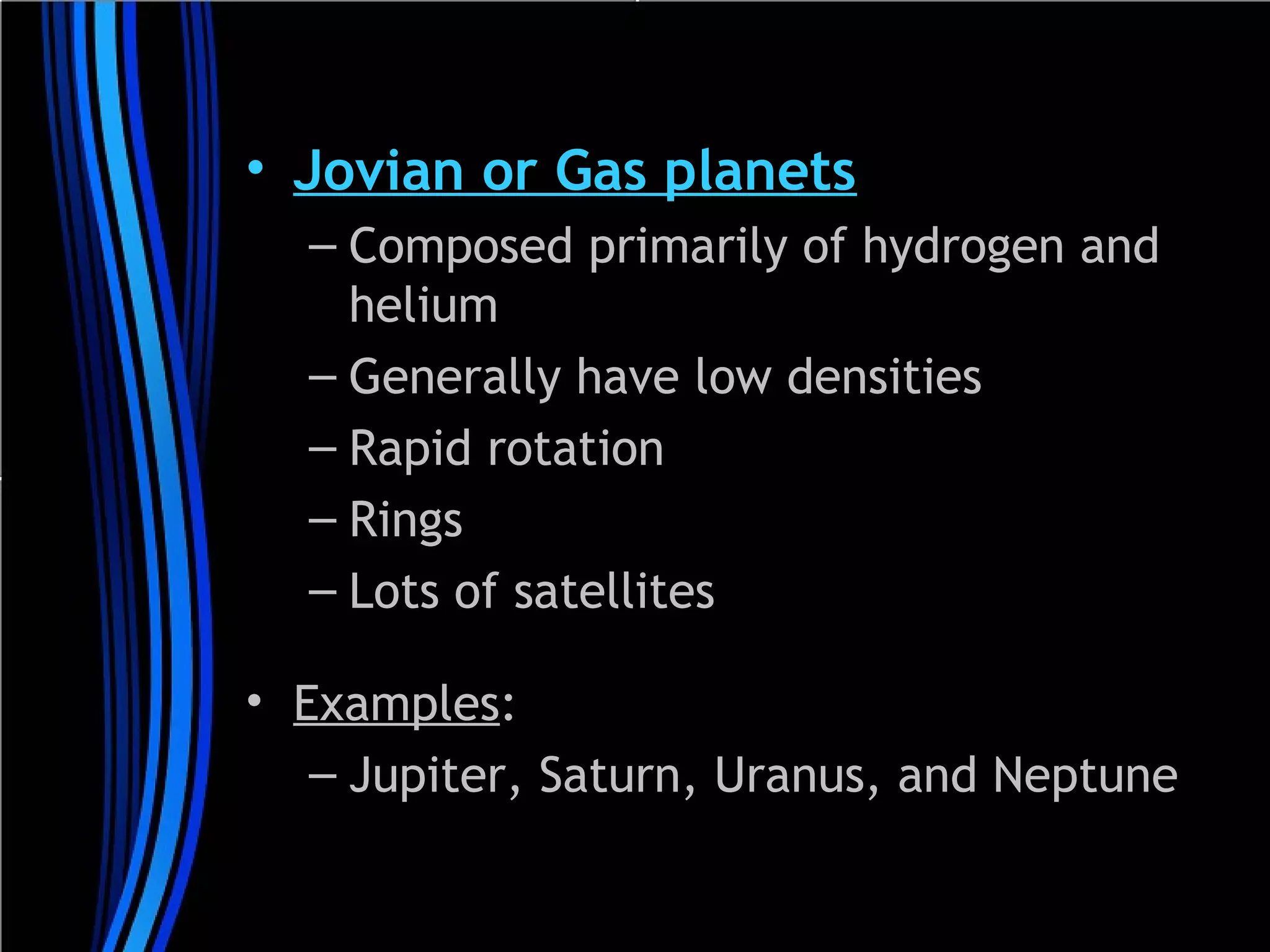
    • Jovian orGas planets – Composed primarily of hydrogen and helium – Generally have low densities – Rapid rotation – Rings – Lots of satellites • Examples: – Jupiter, Saturn, Uranus, and Neptune
  • 3.
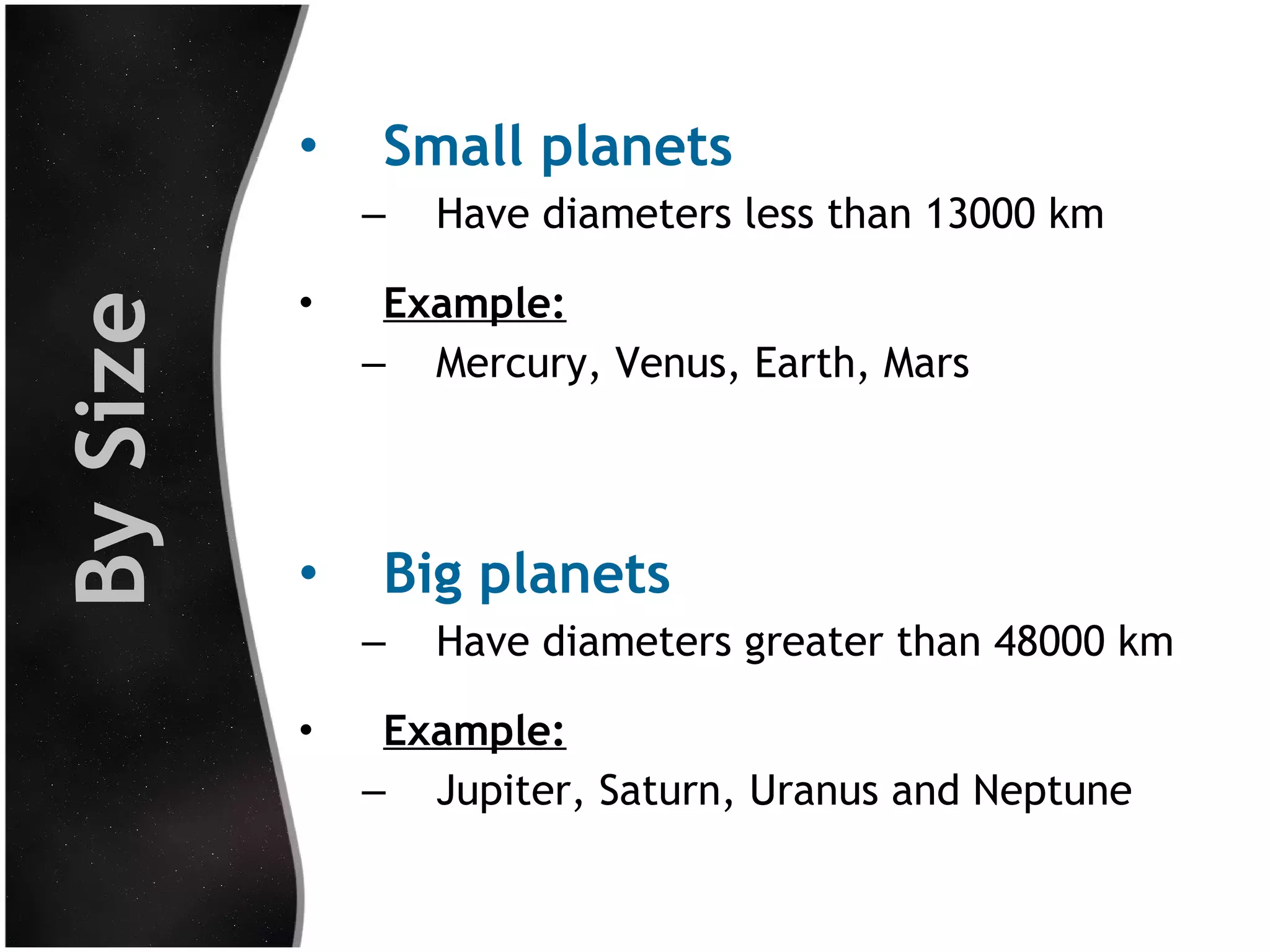
    • Small planets By Size – • • Example: –Mercury, Venus, Earth, Mars Big planets – • Have diameters less than 13000 km Have diameters greater than 48000 km Example: – Jupiter, Saturn, Uranus and Neptune
  • 4.
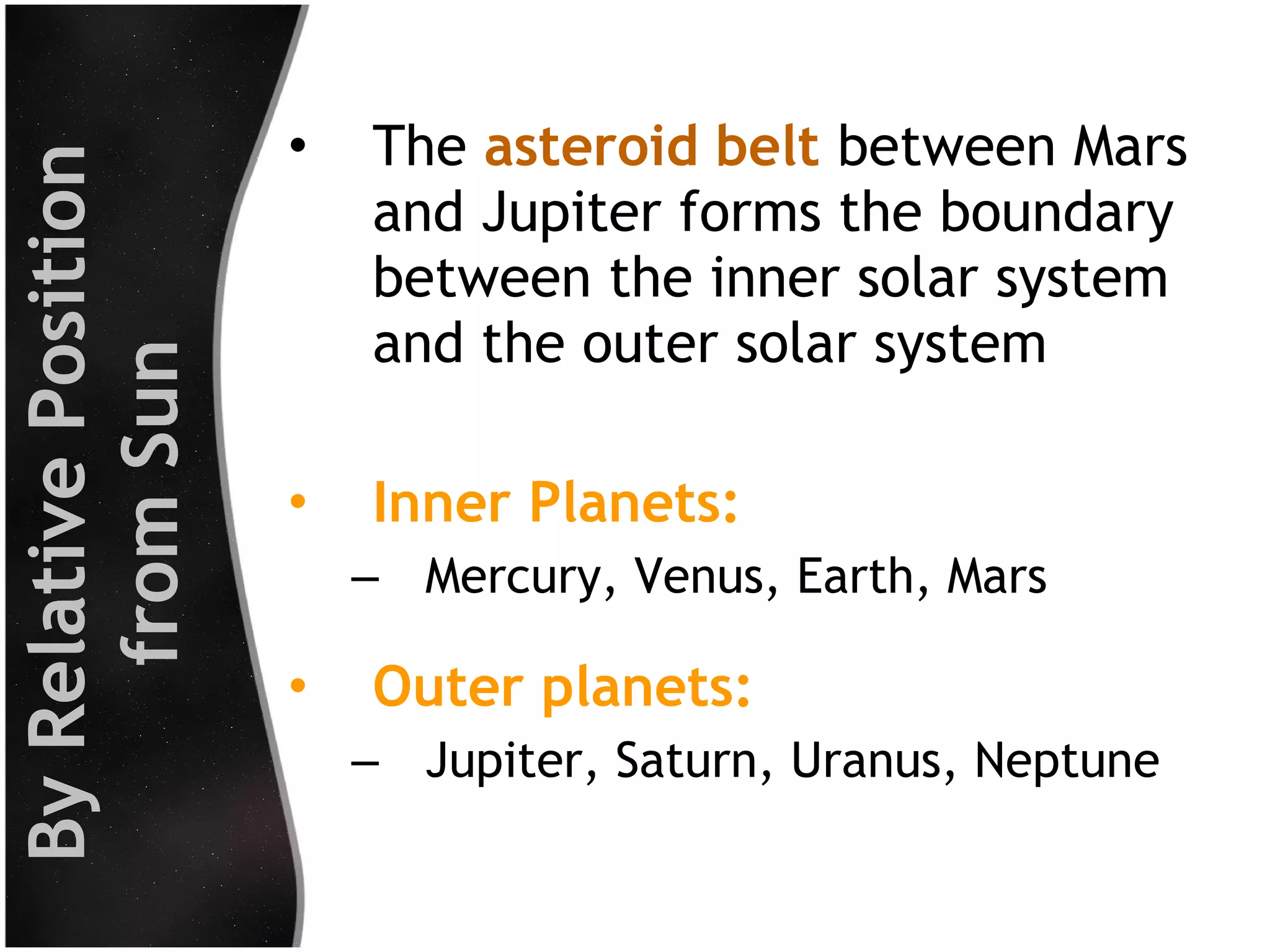
    By Relative Position fromSun • The asteroid belt between Mars and Jupiter forms the boundary between the inner solar system and the outer solar system • Inner Planets: – Mercury, Venus, Earth, Mars • Outer planets: – Jupiter, Saturn, Uranus, Neptune
  • 5.
  • 7.
  • 8.
    Properties of DwarfPlanet • Must orbit the Sun • Does not emit light • Must be smaller than 3031 miles in diameter • Large enough so that its own gravity pulls it into the shape of sphere • Due to weaker gravity, it is unable to clear out its orbit
  • 9.
    List of DwarfPlanets Following is the list of dwarf planets: 1. 2. 3. 4. 5. Eris Pluto Makemake Haumea Ceres
  • 12.
  • 13.
    Eris • Largest knowndwarf planet • The most distant member of our solar system – 3 times farther out than Pluto • Moon  1
  • 14.
  • 15.
    • The godof the dead and underworld Pluto – Because it is dark and desolate • Formerly the smallest of the nine "traditional" planets • But in 2006, it was demoted to dwarf planet status • Second largest dwarf planet
  • 16.
    • Moon 3 – Largest moon is called Charon, which is half the size of Pluto • Unusual orbit – Once every 248 Earth years, Pluto swings inside the orbit of Neptune – It stays there for twenty years – During those twenty years, Pluto is closer to the Sun than Neptune
  • 18.
  • 19.
    Makemake • Pronounced mah-kee-mah-kee •Located in the Kuiper Belt • Third largest dwarf planet • Appears reddish in color • Moon  None
  • 20.
  • 22.
  • 23.
    Haumea • Found inthe Kuiper Belt • Has an ellipsoidal; not a sphere – Its ellipsoidal shape is thought to result from its rapid rotation • In much the same way that a water balloon stretches out when tossed with a spin, and not from a lack of sufficient gravity to overcome the compressive strength of its material
  • 24.
  • 25.
    Ceres • Located in theasteroid belt between Mars and Jupiter • When Ceres was first discovered – – – – It was called a comet Then called a planet Then called an asteroid Since 2006, it has been called a dwarf planet
  • 26.
  • 27.
    Moon Definition: – A celestialbody that makes an orbit around a planet, including the eight major planets, dwarf planets, and minor planets • Also referred as planet’s natural satellite • More than 170 known natural satellites • Moon is much smaller than its planet
  • 28.
  • 29.
    Other Celestial Bodies •Discuss the following celestial bodies: – Comet – Asteroid – Meteoroid – Black Hole
  • 30.
  • 31.
    Comet Definition – A celestialobject consisting of a nucleus of ice and dust and, when near the sun, a “tail” of gas and dust particles pointing away from the sun • Orbits around the sun • Comets have a coma or a tail • They are composed of dirt and ices
  • 32.
    • A small,active celestial body • Comets are characterized by dust and gas tails when in proximity to the Sun • However, far from the Sun it is difficult to distinguish an asteroid from a comet
  • 33.
  • 34.
  • 35.
    Asteroid Definition – A relativelysmall, inactive body, composed of rock, carbon or metal, which is orbiting the Sun. • Asteroids are rocky • Most of them exist in the asteroid belt located between Jupiter and Mars
  • 36.
  • 37.
    Meteoroid Definition: – A smallparticle from an asteroid or comet orbiting the Sun
  • 38.
  • 39.
    Meteor Definition – Literal meaning The flash of light you see – A meteoroid that is observed as it burns up in the Earth's atmosphere a shooting star • They are asteroids that have succumbed to earths gravity
  • 40.
  • 41.
    Meteorite Definition: – A meteoroidthat survives its passage through the Earth's atmosphere and impacts the Earth's surface • Its size can vary from big boulders to tiny rocks
  • 42.
  • 43.
  • 44.
    Black Hole • Definition: –It is an area in space where gravity is so strong that even light cannot escape from it. Since light cannot escape from a black hole, it appears black • A black hole is not really a hole and it is not empty • It is filled with a lot of material crammed into an extremely small space
  • 45.
    • The termblack hole is used because these objects look like black holes in space - since they put out no light • How do black holes form?  – When a large star runs out of fuel it can no longer support its heavy weight. – The pressure from the star's massive layers of hydrogen press down forcing the star to get smaller and smaller and smaller.  – Eventually the star will get even smaller than an atom. – Imagine that for a moment, an entire star squashed up into less space than a tiny atom
  • 46.
    • If youmake something smaller by squishing it, its gravity becomes much stronger. Imagine then, if you squish a star into the size of an atom how powerful its gravity would become • A black hole's gravity becomes so powerful that anything, including light that gets too close, gets pulled in
  • 47.
  • 48.
    Galaxy Definition: – A groupof millions of stars that are relatively near each other • Most stars seem to be in one or another galaxy • Example: – Earth's own star, the Sun, is in the Milky Way galaxy
  • 49.
  • 50.
    Light Year Definition – Alight year is the distance between two points in space that it would take light to travel when the distance between the two points in time are one year
  • 51.
    • Light travelsat 186,000 miles every second • How big is this number? – Write 1 number/second for 8hrs a day without stopping  Would take 6 & 1/2 days to get to that number – If you go back and fourth across the U.S. 66 times with an average speed of 60miles/hour  Would take 1 year and 3weeks
  • 52.
    • • • • 1 1 1 1 year = 365days day = 24 hours hour = 60 minutes minute = 60 seconds No. of seconds = 60 x 60 x 24 x 365 in 1 year = 31,536,000 sec
  • 53.
    Number of mileslight travels in one year = 186,000 x 31,536,000 = 5,865,696,000,000 miles
  • 54.
    • The closeststar is 4 light years away = 4 x 5,865,696,000,000 = 23,462,784,000,000 miles • Edge of universe is 15 billion light years away • How far is it?