Surface WaterSurface Water
Stream StagesStream Stages
 ________:________:

RapidsRapids

WaterfallsWaterfalls

Fast-moving waterFast-moving water

Steep slopeSteep slope
 _______:_______:

Broad floodplainBroad floodplain

MeandersMeanders

Oxbow lakesOxbow lakes

Meander ScarsMeander Scars
Youthful Old
Important DefinitionsImportant Definitions
 ____________ – a stream and all its____________ – a stream and all its
tributariestributaries
 ________ – a smaller stream that empties________ – a smaller stream that empties
into a larger streaminto a larger stream
 _________ – the land area drained by a_________ – the land area drained by a
river systemriver system
 ______ – a high point that separates river______ – a high point that separates river
systemssystems
River System
Tributary
Watershed
Divide
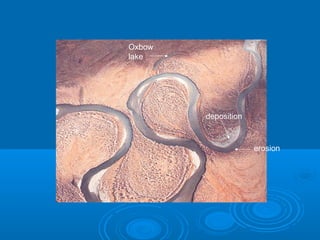
________ – the bends and curves________ – the bends and curves
of a streamof a stream
Meanders
Oxbow
lake
deposition
erosion
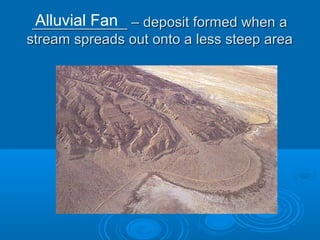
____________ – deposit formed when a____________ – deposit formed when a
stream spreads out onto a less steep areastream spreads out onto a less steep area
Alluvial Fan
_____ – where a stream empties_____ – where a stream empties
into a larger body of waterinto a larger body of water
Delta
____________ – when an old age stream____________ – when an old age stream
downcuts to “make it new again”downcuts to “make it new again”
Rejuvenation
Stream LoadStream Load
 A stream can carry its load in threeA stream can carry its load in three
different ways:different ways:
 1.________ – material is dissolved1.________ – material is dissolved
 2.__________ – particles are held up by2.__________ – particles are held up by
stream’s moving waterstream’s moving water
 3._________ – material pushed or rolled3._________ – material pushed or rolled
along the stream’s channelalong the stream’s channel
solution
suspension
bed load
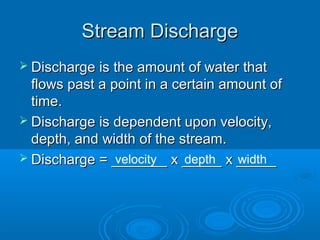
Stream DischargeStream Discharge
 Discharge is the amount of water thatDischarge is the amount of water that
flows past a point in a certain amount offlows past a point in a certain amount of
time.time.
 Discharge is dependent upon velocity,Discharge is dependent upon velocity,
depth, and width of the stream.depth, and width of the stream.
 Discharge = _______ x _____ x _____Discharge = _______ x _____ x _____velocity depth width
Surface Water Review
solution, suspension, bed load
land area drained by a river system
divide
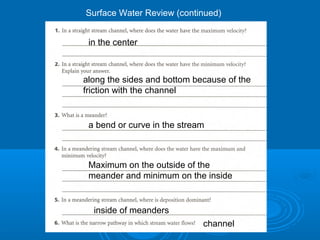
Surface Water Review (continued)
in the center
along the sides and bottom because of the
friction with the channel
a bend or curve in the stream
Maximum on the outside of the
meander and minimum on the inside
inside of meanders
channel

Surface Water

  • 1.
  • 2.
    Stream StagesStream Stages ________:________:  RapidsRapids  WaterfallsWaterfalls  Fast-moving waterFast-moving water  Steep slopeSteep slope  _______:_______:  Broad floodplainBroad floodplain  MeandersMeanders  Oxbow lakesOxbow lakes  Meander ScarsMeander Scars Youthful Old
  • 3.
    Important DefinitionsImportant Definitions ____________ – a stream and all its____________ – a stream and all its tributariestributaries  ________ – a smaller stream that empties________ – a smaller stream that empties into a larger streaminto a larger stream  _________ – the land area drained by a_________ – the land area drained by a river systemriver system  ______ – a high point that separates river______ – a high point that separates river systemssystems River System Tributary Watershed Divide
  • 4.
    ________ – thebends and curves________ – the bends and curves of a streamof a stream Meanders
  • 5.
  • 6.
    ____________ – depositformed when a____________ – deposit formed when a stream spreads out onto a less steep areastream spreads out onto a less steep area Alluvial Fan
  • 7.
    _____ – wherea stream empties_____ – where a stream empties into a larger body of waterinto a larger body of water Delta
  • 8.
    ____________ – whenan old age stream____________ – when an old age stream downcuts to “make it new again”downcuts to “make it new again” Rejuvenation
  • 9.
    Stream LoadStream Load A stream can carry its load in threeA stream can carry its load in three different ways:different ways:  1.________ – material is dissolved1.________ – material is dissolved  2.__________ – particles are held up by2.__________ – particles are held up by stream’s moving waterstream’s moving water  3._________ – material pushed or rolled3._________ – material pushed or rolled along the stream’s channelalong the stream’s channel solution suspension bed load
  • 10.
    Stream DischargeStream Discharge Discharge is the amount of water thatDischarge is the amount of water that flows past a point in a certain amount offlows past a point in a certain amount of time.time.  Discharge is dependent upon velocity,Discharge is dependent upon velocity, depth, and width of the stream.depth, and width of the stream.  Discharge = _______ x _____ x _____Discharge = _______ x _____ x _____velocity depth width
  • 11.
    Surface Water Review solution,suspension, bed load land area drained by a river system divide
  • 12.
    Surface Water Review(continued) in the center along the sides and bottom because of the friction with the channel a bend or curve in the stream Maximum on the outside of the meander and minimum on the inside inside of meanders channel