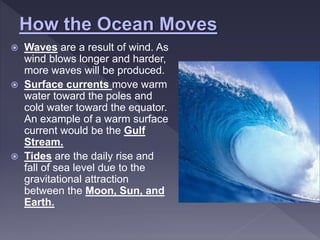
 Waves are a result of wind. As
wind blows longer and harder,
more waves will be produced.
 Surface currents move warm
water toward the poles and
cold water toward the equator.
An example of a warm surface
current would be the Gulf
Stream.
 Tides are the daily rise and
fall of sea level due to the
gravitational attraction
between the Moon, Sun, and
Earth.
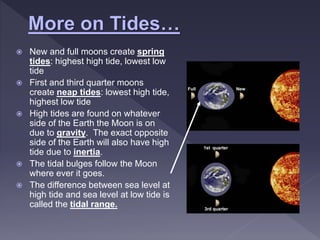
 New and full moons create spring
tides: highest high tide, lowest low
tide
 First and third quarter moons
create neap tides: lowest high tide,
highest low tide
 High tides are found on whatever
side of the Earth the Moon is on
due to gravity. The exact opposite
side of the Earth will also have high
tide due to inertia.
 The tidal bulges follow the Moon
where ever it goes.
 The difference between sea level at
high tide and sea level at low tide is
called the tidal range.
 High oceanic productivity
occurs in areas of upwelling
in the ocean, particularly
along continental shelves
 The coastal upwelling in
these regions is the result of
deep oceanic currents
colliding with sharp coastal
shelves, forcing nutrient-
rich cool water to the
surface and pushing surface
waters offshore.
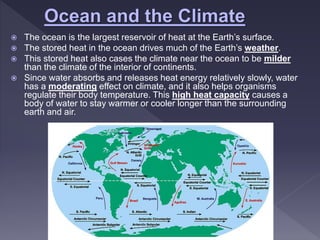
 The ocean is the largest reservoir of heat at the Earth’s surface.
 The stored heat in the ocean drives much of the Earth’s weather.
 This stored heat also cases the climate near the ocean to be milder
than the climate of the interior of continents.
 Since water absorbs and releases heat energy relatively slowly, water
has a moderating effect on climate, and it also helps organisms
regulate their body temperature. This high heat capacity causes a
body of water to stay warmer or cooler longer than the surrounding
earth and air.
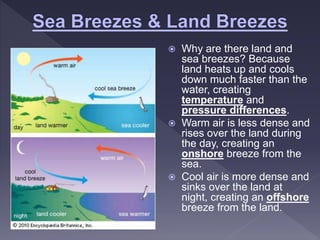
 Why are there land and
sea breezes? Because
land heats up and cools
down much faster than the
water, creating
temperature and
pressure differences.
 Warm air is less dense and
rises over the land during
the day, creating an
onshore breeze from the
sea.
 Cool air is more dense and
sinks over the land at
night, creating an offshore
breeze from the land.
 The submerged extension of the continent below sea level is
the continental margin.
 Mid-ocean ridges, trenches, volcanic island arcs, and
seamounts are the result of tectonic activity.
 Chemosynthesis does not require sunlight. This occurs at
hydrothermal vents near mid-ocean ridges.
 Photosynthesis is how plants and cyanobacteria (blue-
green algae) near the ocean surface produce oxygen.
 El Niño is marked by warmer water in the Pacific
off the coast of South America. It alters weather
patterns in the United States and around the
world.
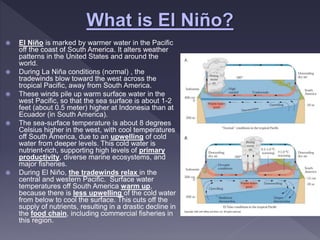
 During La Niña conditions (normal) , the
tradewinds blow toward the west across the
tropical Pacific, away from South America.
 These winds pile up warm surface water in the
west Pacific, so that the sea surface is about 1-2
feet (about 0.5 meter) higher at Indonesia than at
Ecuador (in South America).
 The sea-surface temperature is about 8 degrees
Celsius higher in the west, with cool temperatures
off South America, due to an upwelling of cold
water from deeper levels. This cold water is
nutrient-rich, supporting high levels of primary
productivity, diverse marine ecosystems, and
major fisheries.
 During El Niño, the tradewinds relax in the
central and western Pacific. Surface water
temperatures off South America warm up,
because there is less upwelling of the cold water
from below to cool the surface. This cuts off the
supply of nutrients, resulting in a drastic decline in
the food chain, including commercial fisheries in
this region.
 Evidence shows that human
activities, including intense
fishing around the world, are
altering ocean ecosystems
beyond their natural state.
 A recent study which has
mapped the total human
impact on the seas for the
first time has revealed that
the picture is far worse than
the scientists imagined.
 40% of the world's oceans
have been heavily affected by
human activities, including
fishing, coastal
development, and pollution
from shipping.
Oceanography

Oceanography

  • 2.
     Waves area result of wind. As wind blows longer and harder, more waves will be produced.  Surface currents move warm water toward the poles and cold water toward the equator. An example of a warm surface current would be the Gulf Stream.  Tides are the daily rise and fall of sea level due to the gravitational attraction between the Moon, Sun, and Earth.
  • 3.
     New andfull moons create spring tides: highest high tide, lowest low tide  First and third quarter moons create neap tides: lowest high tide, highest low tide  High tides are found on whatever side of the Earth the Moon is on due to gravity. The exact opposite side of the Earth will also have high tide due to inertia.  The tidal bulges follow the Moon where ever it goes.  The difference between sea level at high tide and sea level at low tide is called the tidal range.
  • 4.
     High oceanicproductivity occurs in areas of upwelling in the ocean, particularly along continental shelves  The coastal upwelling in these regions is the result of deep oceanic currents colliding with sharp coastal shelves, forcing nutrient- rich cool water to the surface and pushing surface waters offshore.
  • 5.
     The oceanis the largest reservoir of heat at the Earth’s surface.  The stored heat in the ocean drives much of the Earth’s weather.  This stored heat also cases the climate near the ocean to be milder than the climate of the interior of continents.  Since water absorbs and releases heat energy relatively slowly, water has a moderating effect on climate, and it also helps organisms regulate their body temperature. This high heat capacity causes a body of water to stay warmer or cooler longer than the surrounding earth and air.
  • 6.
     Why arethere land and sea breezes? Because land heats up and cools down much faster than the water, creating temperature and pressure differences.  Warm air is less dense and rises over the land during the day, creating an onshore breeze from the sea.  Cool air is more dense and sinks over the land at night, creating an offshore breeze from the land.
  • 7.
     The submergedextension of the continent below sea level is the continental margin.  Mid-ocean ridges, trenches, volcanic island arcs, and seamounts are the result of tectonic activity.  Chemosynthesis does not require sunlight. This occurs at hydrothermal vents near mid-ocean ridges.  Photosynthesis is how plants and cyanobacteria (blue- green algae) near the ocean surface produce oxygen.
  • 8.
     El Niñois marked by warmer water in the Pacific off the coast of South America. It alters weather patterns in the United States and around the world.  During La Niña conditions (normal) , the tradewinds blow toward the west across the tropical Pacific, away from South America.  These winds pile up warm surface water in the west Pacific, so that the sea surface is about 1-2 feet (about 0.5 meter) higher at Indonesia than at Ecuador (in South America).  The sea-surface temperature is about 8 degrees Celsius higher in the west, with cool temperatures off South America, due to an upwelling of cold water from deeper levels. This cold water is nutrient-rich, supporting high levels of primary productivity, diverse marine ecosystems, and major fisheries.  During El Niño, the tradewinds relax in the central and western Pacific. Surface water temperatures off South America warm up, because there is less upwelling of the cold water from below to cool the surface. This cuts off the supply of nutrients, resulting in a drastic decline in the food chain, including commercial fisheries in this region.
  • 9.
     Evidence showsthat human activities, including intense fishing around the world, are altering ocean ecosystems beyond their natural state.  A recent study which has mapped the total human impact on the seas for the first time has revealed that the picture is far worse than the scientists imagined.  40% of the world's oceans have been heavily affected by human activities, including fishing, coastal development, and pollution from shipping.