Chapter 12
The Sun, Our Star
Copyright © McGraw-Hill Education. Permission required for reproduction or display.
The Sun
• The Sun is a star, a luminous ball of gas more than 100
times bigger than the Earth
• Although seemingly quiescent from a naked eye view,
telescopic observations reveal a bevy of violent activity
– fountains of incandescent gas and twisting magnetic
fields
• The Sun’s core is equally violent with a furnace of
thermonuclear fire converting hydrogen into helium to
the tune of an energy production equivalent to the
detonation of 100 nuclear bombs
• The force of gravity keeps the Sun in check – for now
Radius and Mass
• With a radius 100× and
a mass of 300,000× that
of Earth, the Sun must
expend a large amount
of energy to withstand
its own self-gravity
Properties of the Sun
• The Sun’s distance from
Earth (about 150 million
km or 1 AU) was once
measured by triangulation,
but is now done by radar
• Once the distance is
known, its diameter (about
1.4 million km) can be
found from its angular size
(about 1/2 degree)
Mass and Temperature
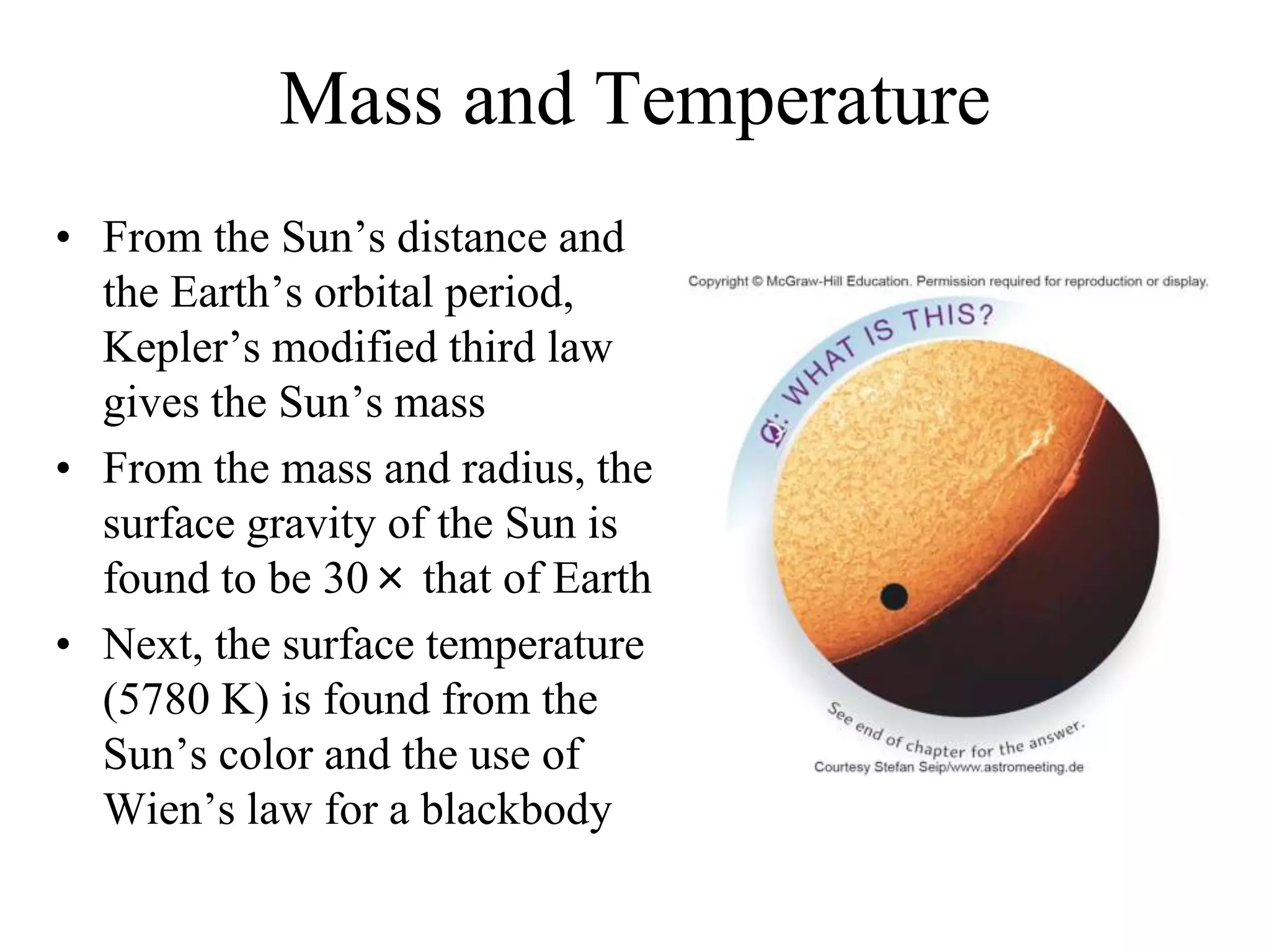
• From the Sun’s distance and
the Earth’s orbital period,
Kepler’s modified third law
gives the Sun’s mass
• From the mass and radius, the
surface gravity of the Sun is
found to be 30× that of Earth
• Next, the surface temperature
(5780 K) is found from the
Sun’s color and the use of
Wien’s law for a blackbody
Composition and Structure
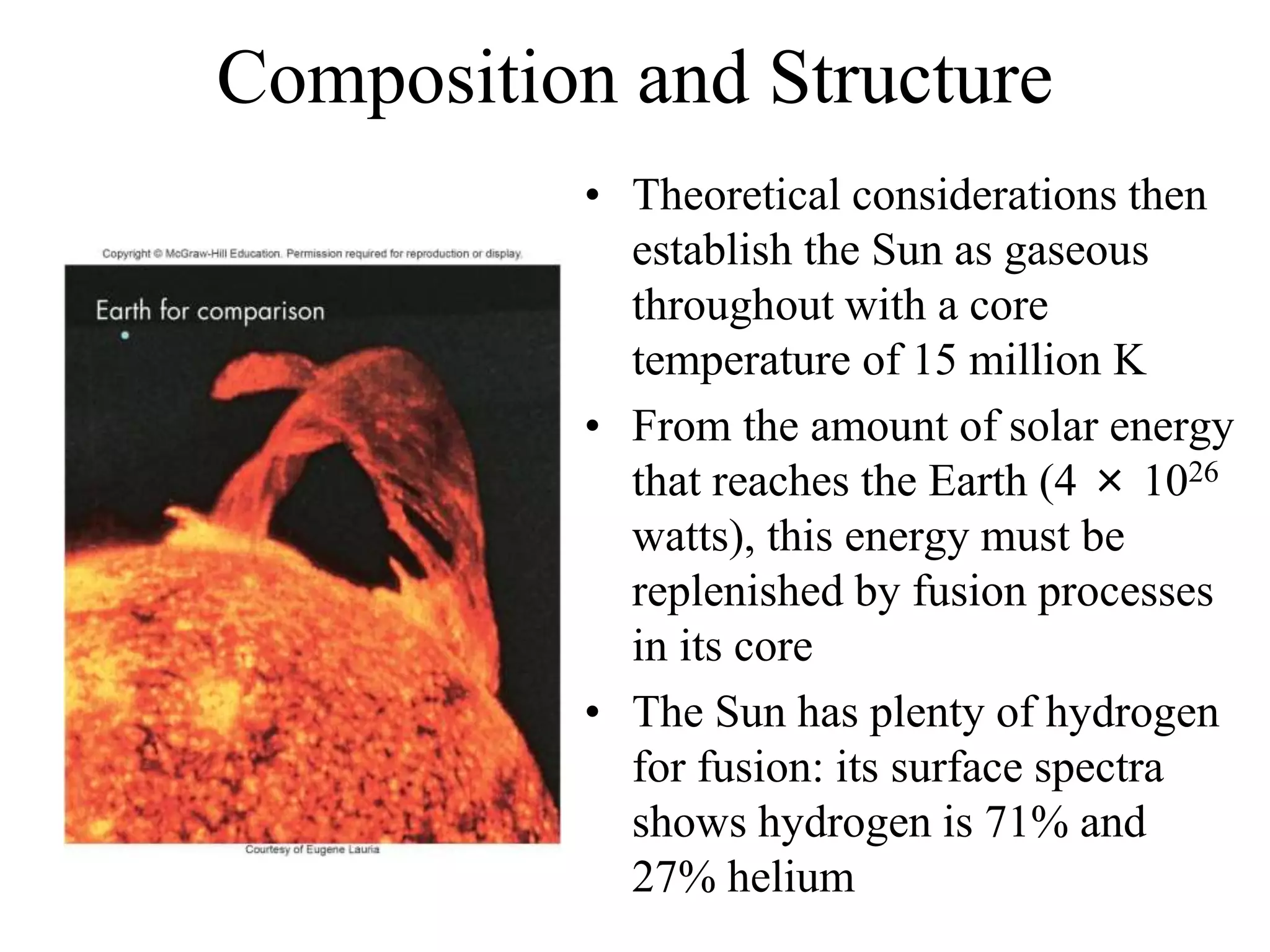
• Theoretical considerations then
establish the Sun as gaseous
throughout with a core
temperature of 15 million K
• From the amount of solar energy
that reaches the Earth (4 × 1026
watts), this energy must be
replenished by fusion processes
in its core
• The Sun has plenty of hydrogen
for fusion: its surface spectra
shows hydrogen is 71% and
27% helium
The Structure of the Sun
The Solar Interior
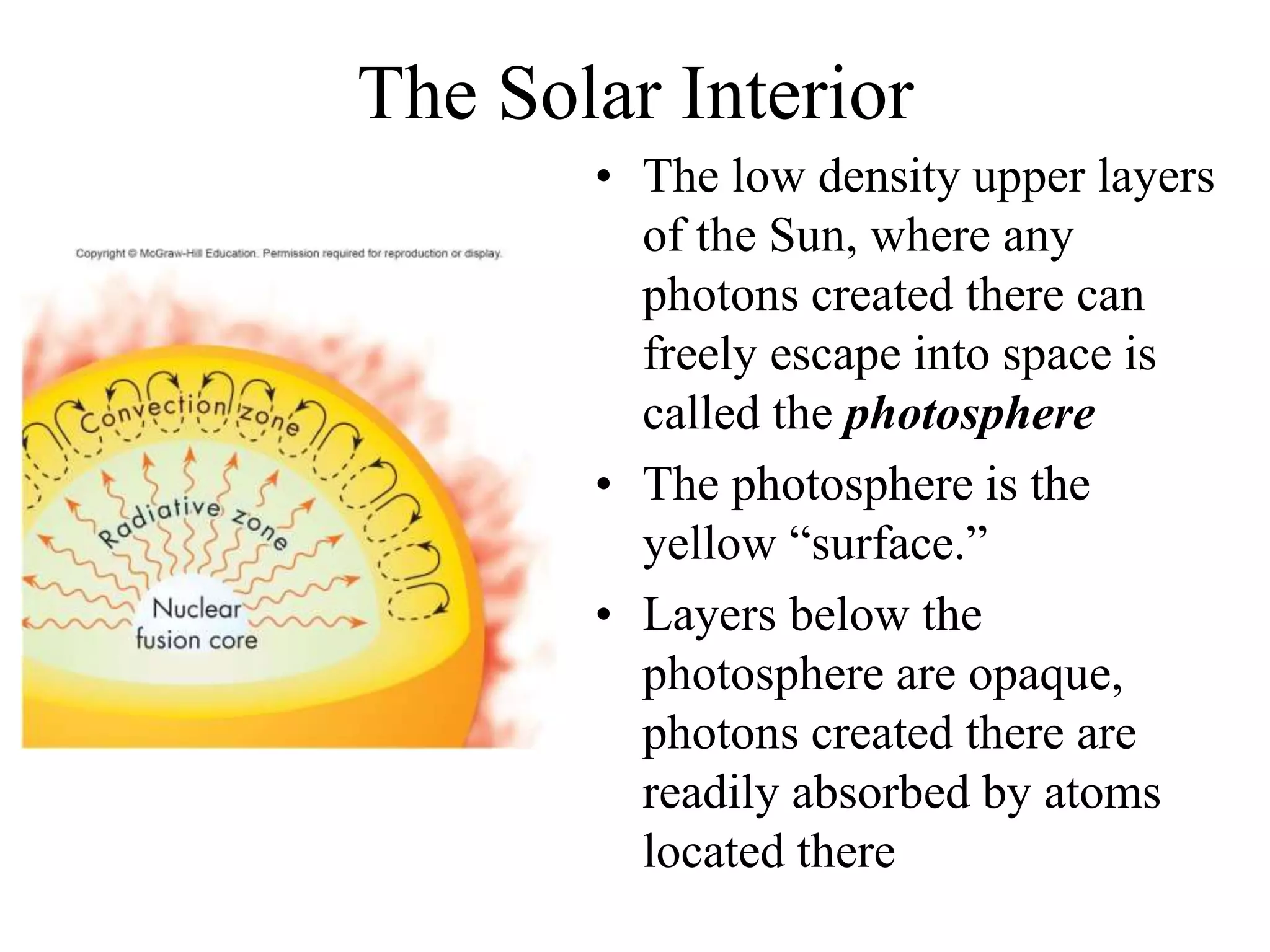
• The low density upper layers
of the Sun, where any
photons created there can
freely escape into space is
called the photosphere
• The photosphere is the
yellow “surface.”
• Layers below the
photosphere are opaque,
photons created there are
readily absorbed by atoms
located there
Temperature and Density Changes
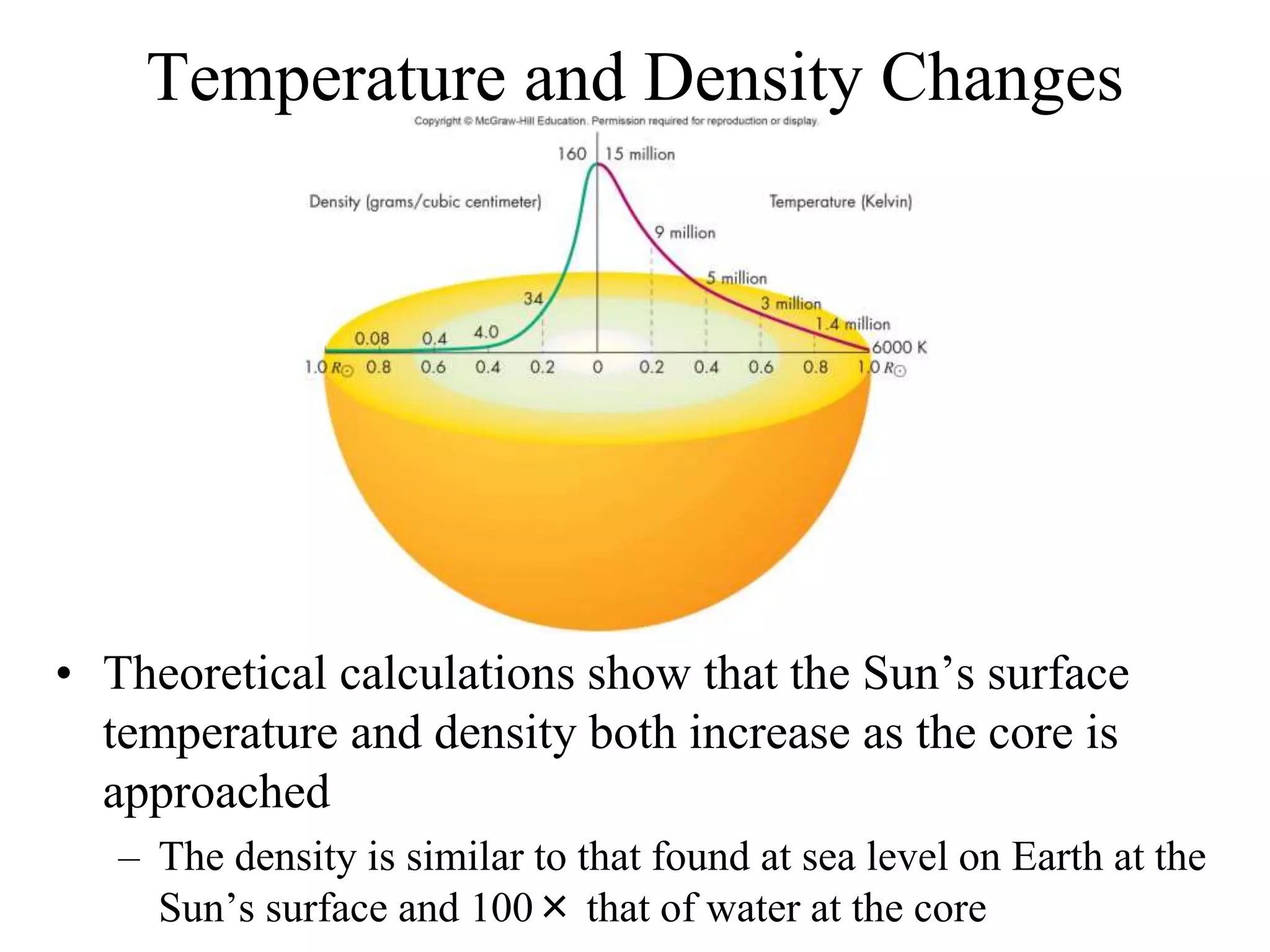
• Theoretical calculations show that the Sun’s surface
temperature and density both increase as the core is
approached
– The density is similar to that found at sea level on Earth at the
Sun’s surface and 100× that of water at the core
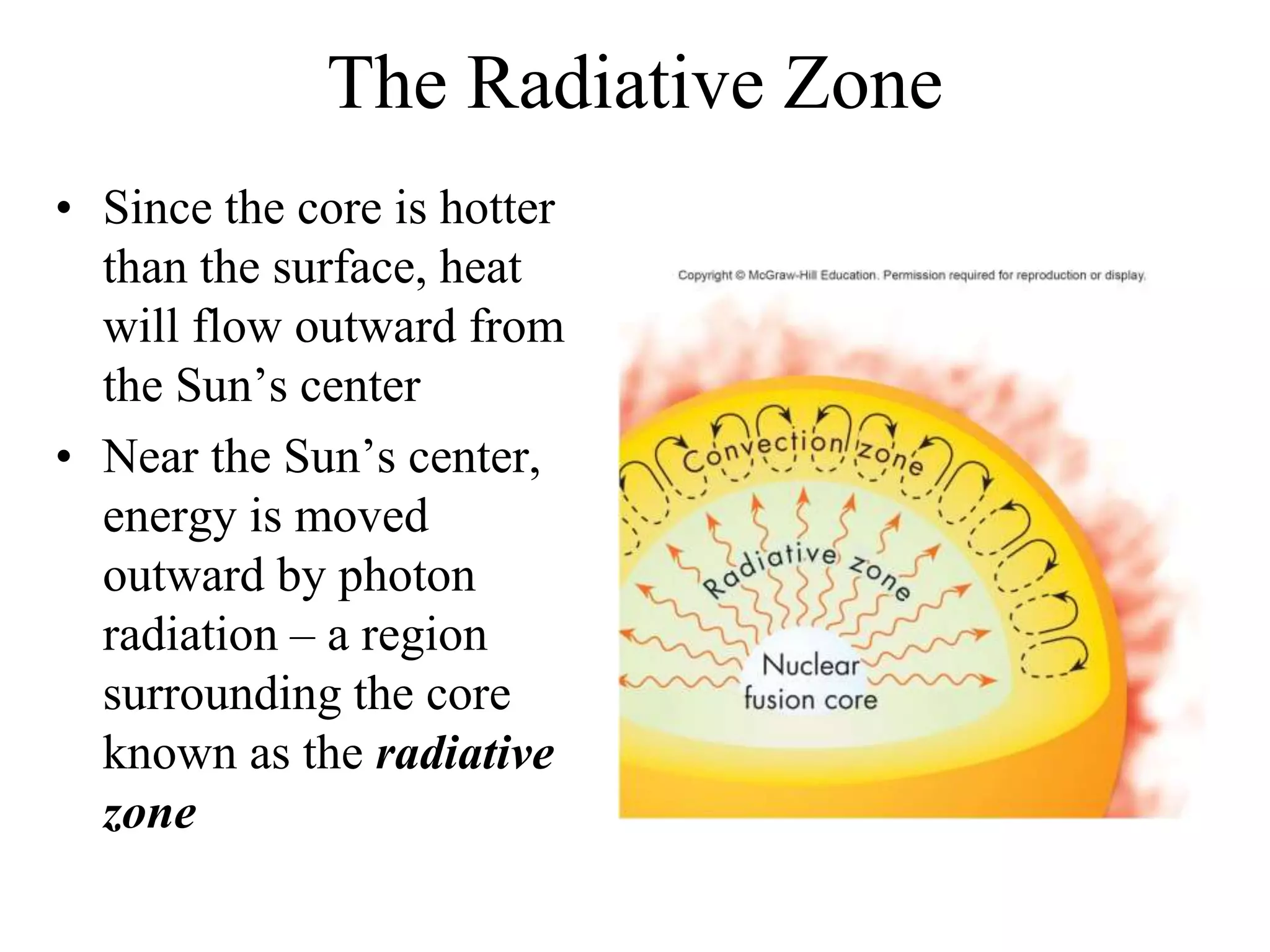
The Radiative Zone
• Since the core is hotter
than the surface, heat
will flow outward from
the Sun’s center
• Near the Sun’s center,
energy is moved
outward by photon
radiation – a region
surrounding the core
known as the radiative
zone
Very Old Light
• Photons created in the
Sun’s interior do not
travel very far before
being reabsorbed –
energy created in the
Sun’s center will take
anywhere from hundreds
of thousands to 10s of
millions of years to
eventually diffuse to the
surface!
• Here’s the math
The Convection Zone
• Above the radiative
zone energy is more
efficiently
transported by the
rising and sinking of
gas – this is the
convection zone
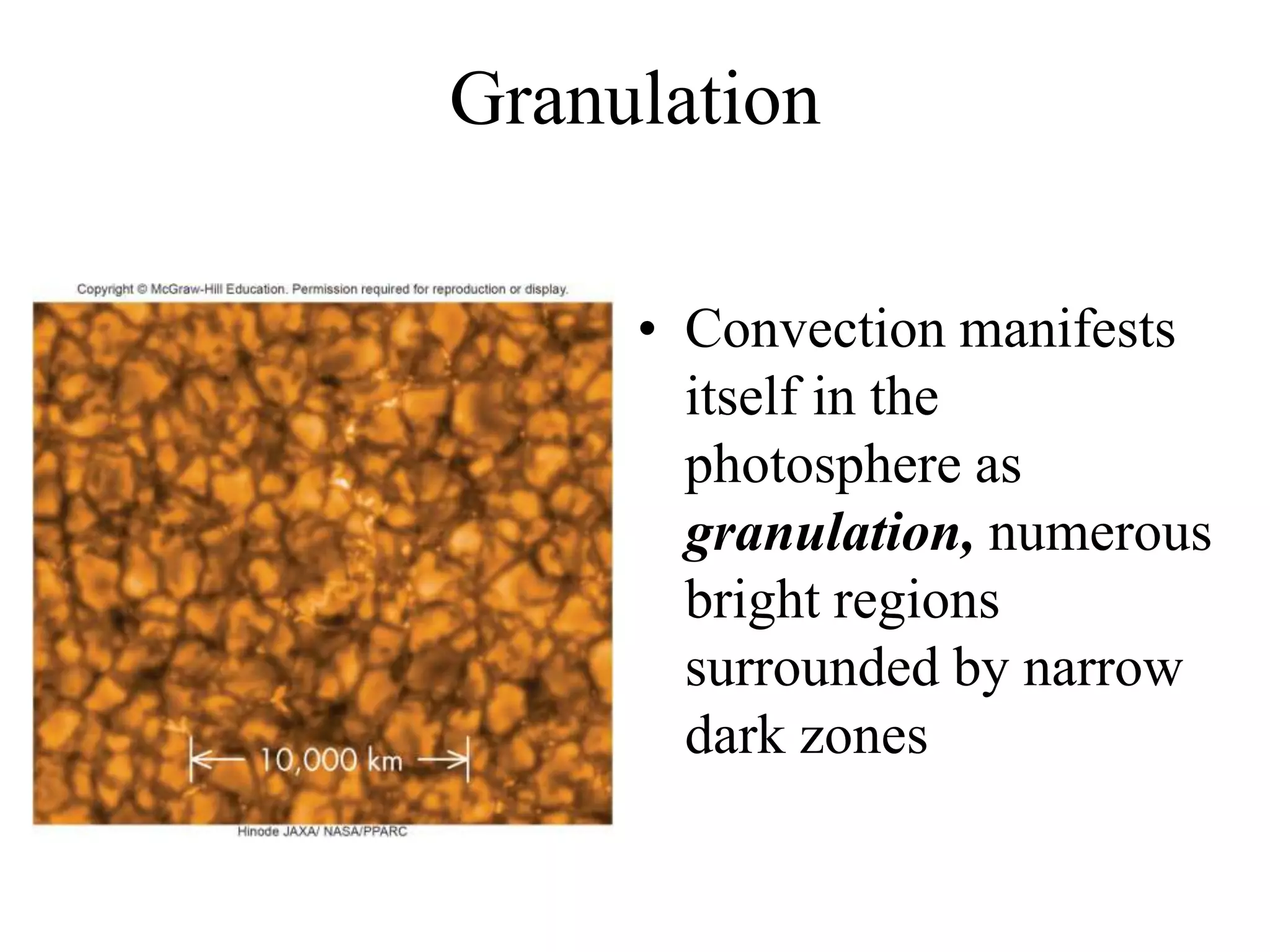
Granulation
• Convection manifests
itself in the
photosphere as
granulation, numerous
bright regions
surrounded by narrow
dark zones
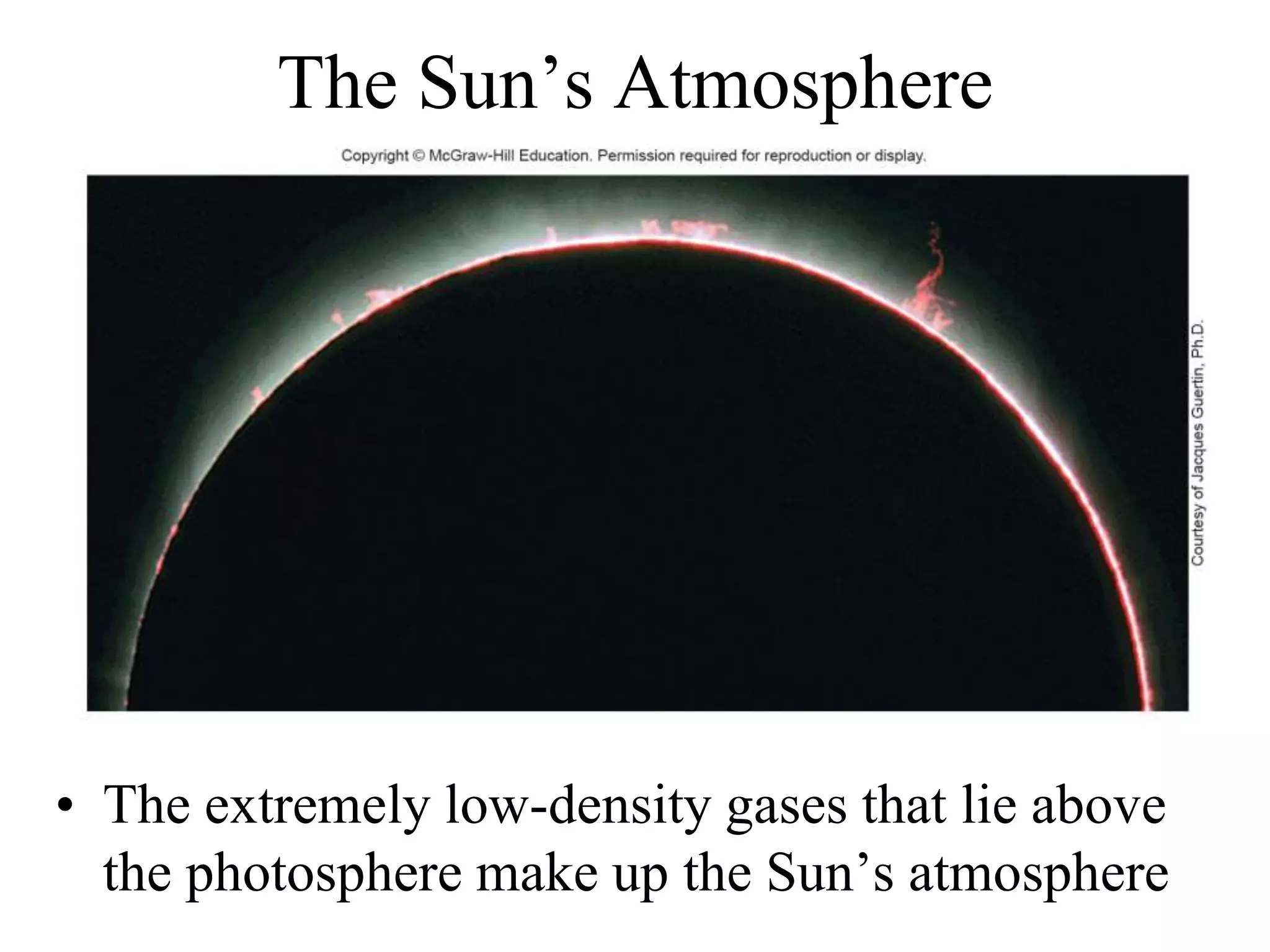
The Sun’s Atmosphere
• The extremely low-density gases that lie above
the photosphere make up the Sun’s atmosphere
Temperature Profile
• The density of the atmosphere decreases steadily with altitude and
eventually merges with the near-vacuum of space.
• Immediately above the photosphere, the temperature of the
atmosphere decreases but at higher altitudes, the temperature
grows hotter, reaching temperatures of several million Kelvin.
• The reason for the increase in temperature is unknown, but
speculation is that Sun’s magnetic field plays an important role.
• The Parker Solar Mission will hopefully answer some of those
questions soon
• A 10-year study has shown that acoustic waves deep inside the
Sun excite the Alfvénic waves which heat the corona and
accelerate the solar wind.
The Sun’s place on the H-R Diagram [Temperature
on the X-axis – Luminosity on the Y-axis]
The
Sun –
a G2V
star
The Chromosphere
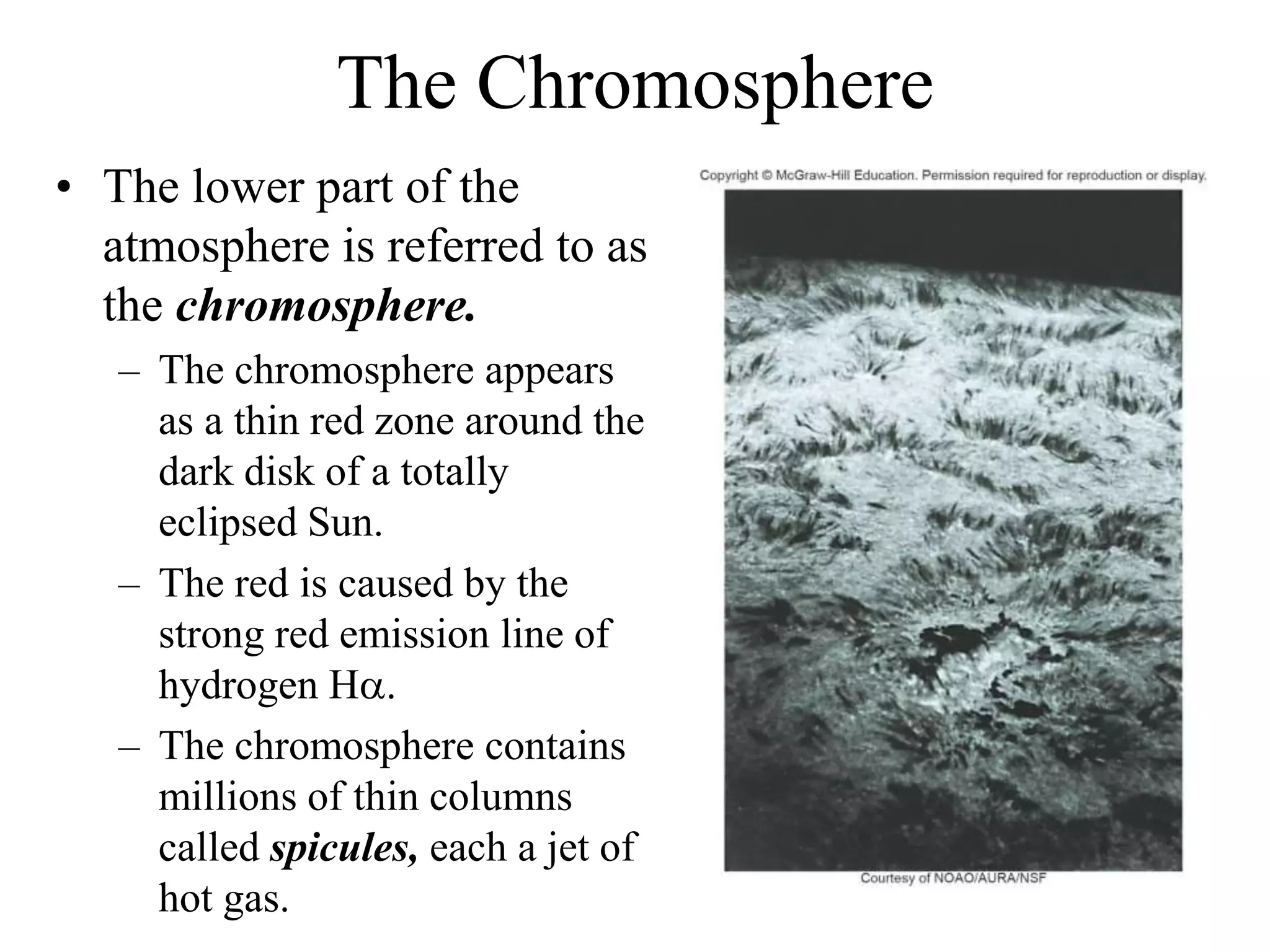
• The lower part of the
atmosphere is referred to as
the chromosphere.
– The chromosphere appears
as a thin red zone around the
dark disk of a totally
eclipsed Sun.
– The red is caused by the
strong red emission line of
hydrogen Ha.
– The chromosphere contains
millions of thin columns
called spicules, each a jet of
hot gas.
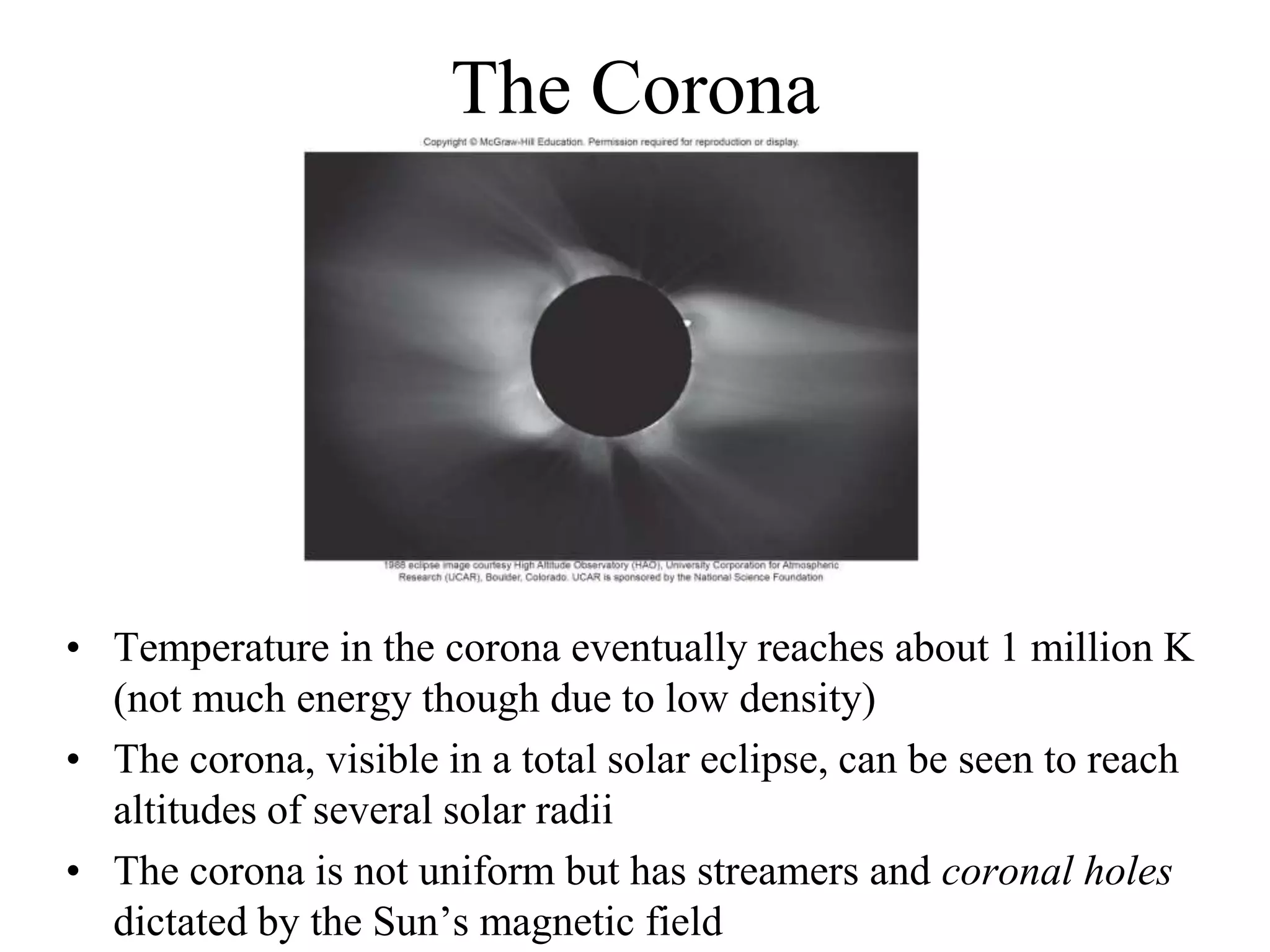
The Corona
• Temperature in the corona eventually reaches about 1 million K
(not much energy though due to low density)
• The corona, visible in a total solar eclipse, can be seen to reach
altitudes of several solar radii
• The corona is not uniform but has streamers and coronal holes
dictated by the Sun’s magnetic field
How the Sun Works
• Structure of the Sun depends on
a balance between its internal
forces – specifically, a
hydrostatic equilibrium between
a force that prevents the Sun
from collapsing and a force that
holds it together
• The inward (holding) force is the
Sun’s own gravity, while the
outward (non-collapsing) force
arises from the Sun’s internal
gas pressure.
• Without balance the Sun would
change very rapidly
Pressure in the Sun
• Pressure in a gas comes from atomic collisions.
• The amount of pressure is in direct proportion to the
speed of the atoms and their density and is expressed in
the perfect or ideal gas law.
Powering the Sun
• Given that the Sun loses energy as sunshine,
an internal energy source must be present to
maintain hydrostatic equilibrium.
– If the Sun were made of pure coal, the Sun would
last only a few thousand years.
– If the Sun were not in equilibrium, but creating
light energy from gravitational energy (the Sun is
collapsing), the Sun could last 10 million years.
– These and many other chemical-based sources of
energy are not adequate to account for the Sun’s
several billion year age.
E = mc2
• Mass-energy is the key
– In 1905, Einstein showed that energy and
mass were equivalent through his famous
E = mc2 equation
– 1 gram of mass is equivalent to the energy
of a small nuclear weapon
– The trick is finding a process to convert
mass into other forms of energy
Nuclear Fusion
• A detailed process for mass conversion in
the Sun called nuclear fusion was found:
– Sun’s core temperature is high enough to force
positively charged protons close enough
together to bind them together via the nuclear
or strong force [clip]
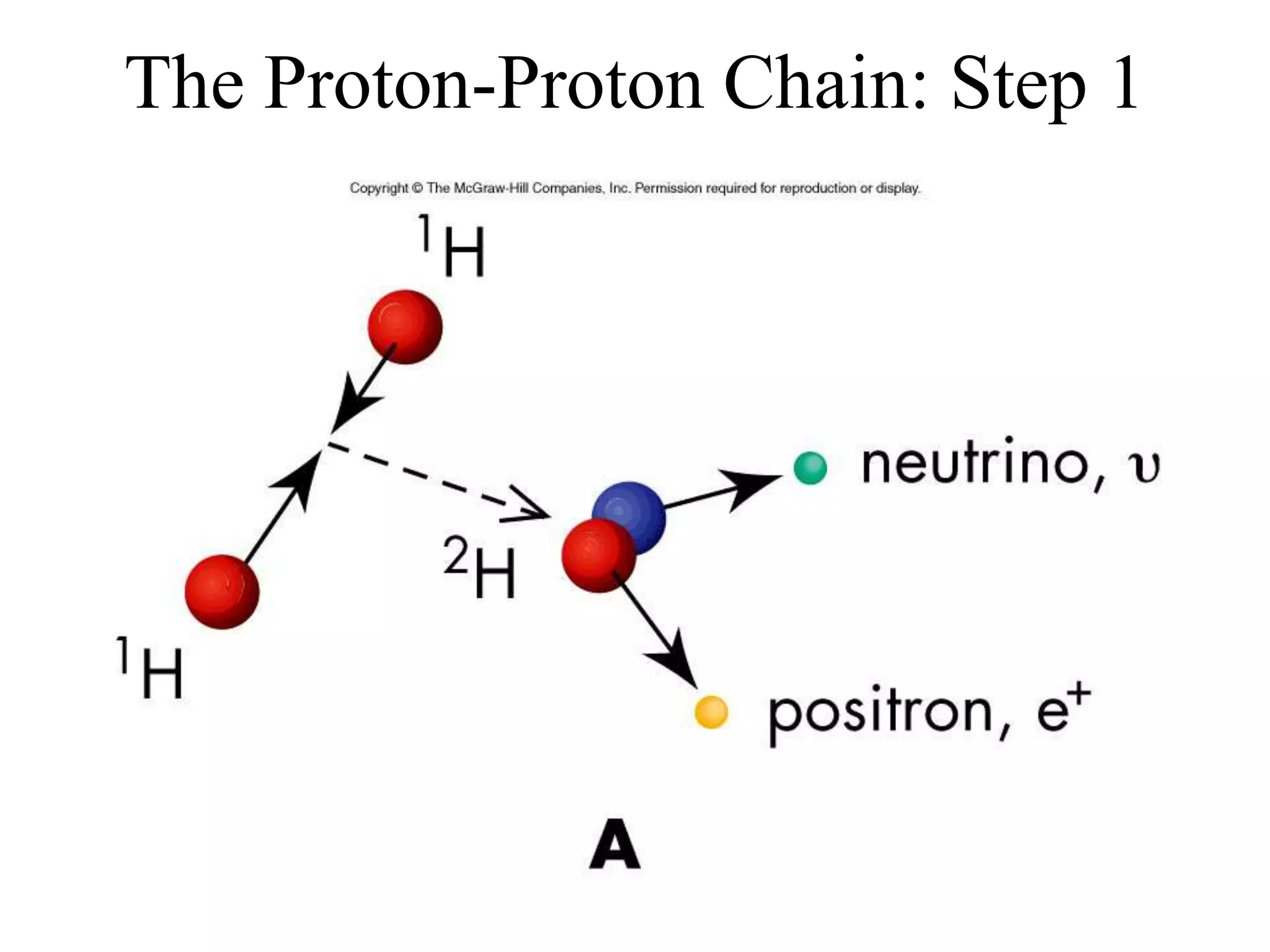
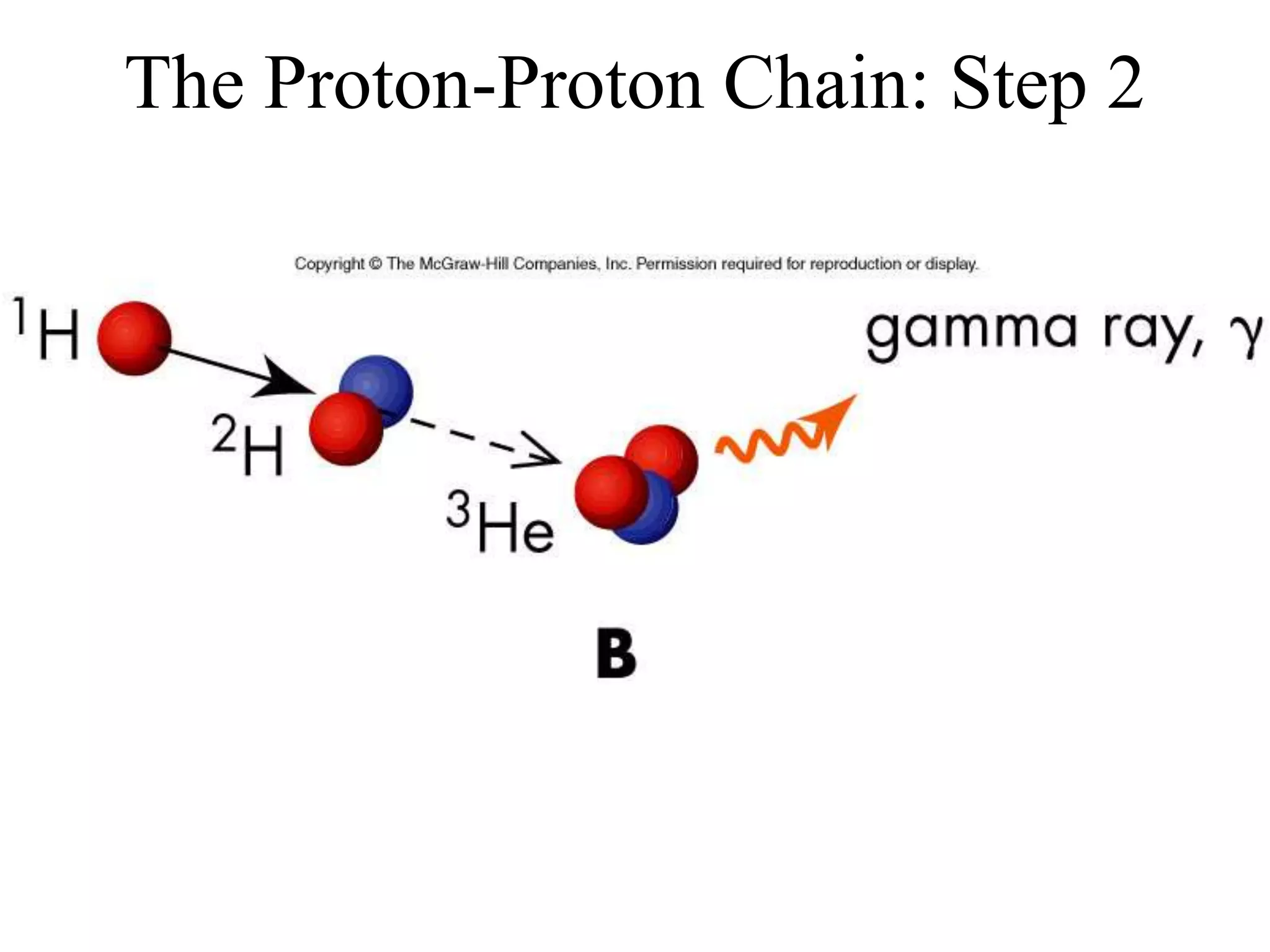
– The net effect is that four protons are converted
into a helium nucleus (plus other particles and
energy) in a three-step process called the
proton-proton chain
Isotopes
• In the proton-
proton cycle,
isotopes are
intermediate steps
between protons
and their ultimate
fusion into 4He.
The Proton-Proton Chain
The Proton-Proton Chain: Step 1
The Proton-Proton Chain: Step 2
The Proton-Proton Chain: Step 3
Solar Neutrinos
• The nuclear fusion
process in the Sun’s core
creates neutrinos.
• Neutrinos lack electric
charge, have a very small
mass, escape the Sun’s
interior relatively
unaffected, and shower
the Earth (about 1 trillion
pass through a human per
second).
• Let’s review all that!
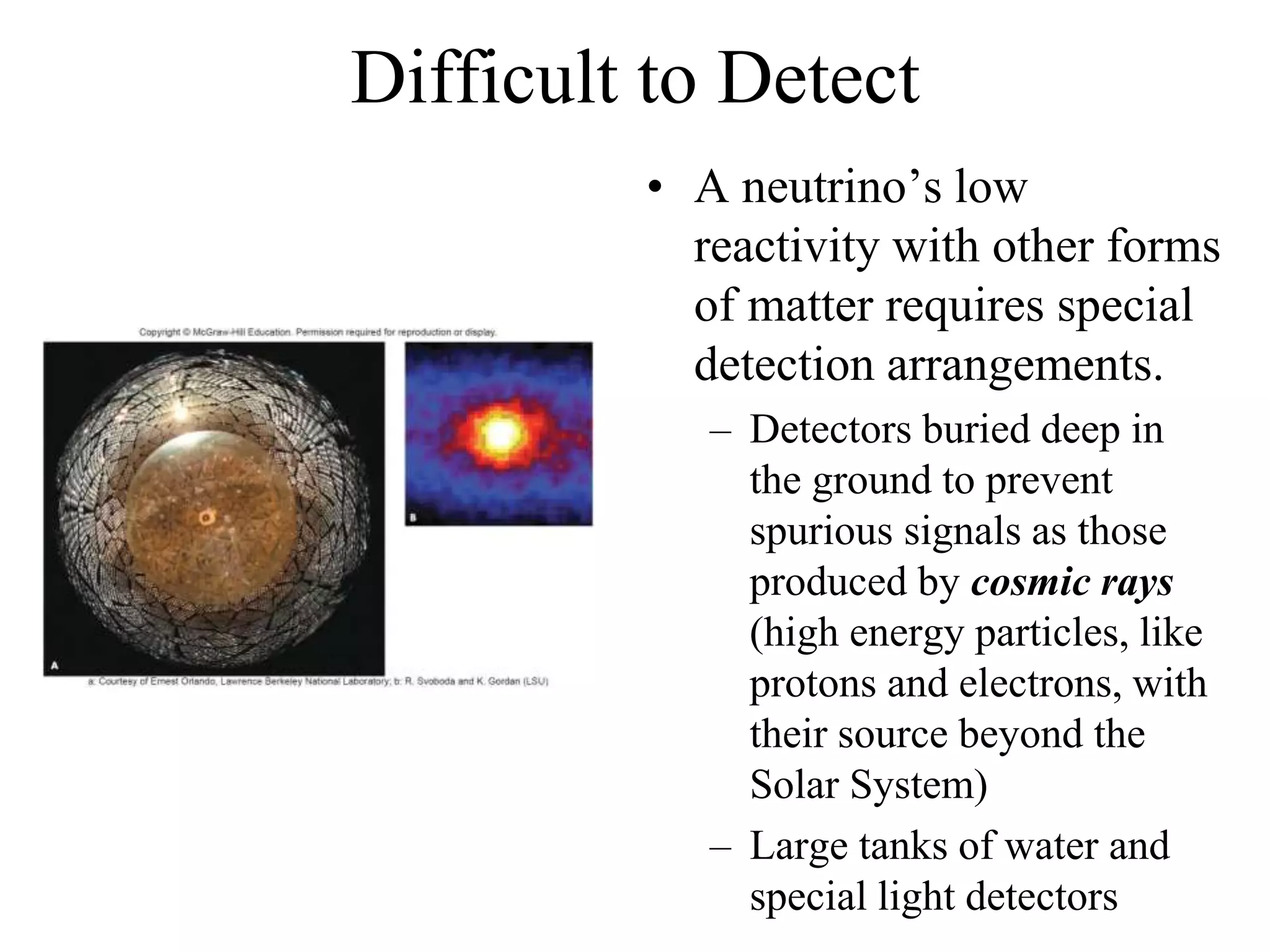
Difficult to Detect
• A neutrino’s low
reactivity with other forms
of matter requires special
detection arrangements.
– Detectors buried deep in
the ground to prevent
spurious signals as those
produced by cosmic rays
(high energy particles, like
protons and electrons, with
their source beyond the
Solar System)
– Large tanks of water and
special light detectors
The Neutrino Crisis
• Detected neutrinos are about three times less than
predicted – possible reasons:
– Model of solar interior could be wrong
– Neutrinos have properties that are not well understood.
• Current view to explain measured solar neutrinos:
neutrinos come in three varieties (instead of previous
one), each with a different mass, and first detectors
could not detect all varieties.
• Subsequent observations with new detectors found all
three types of neutrinos.
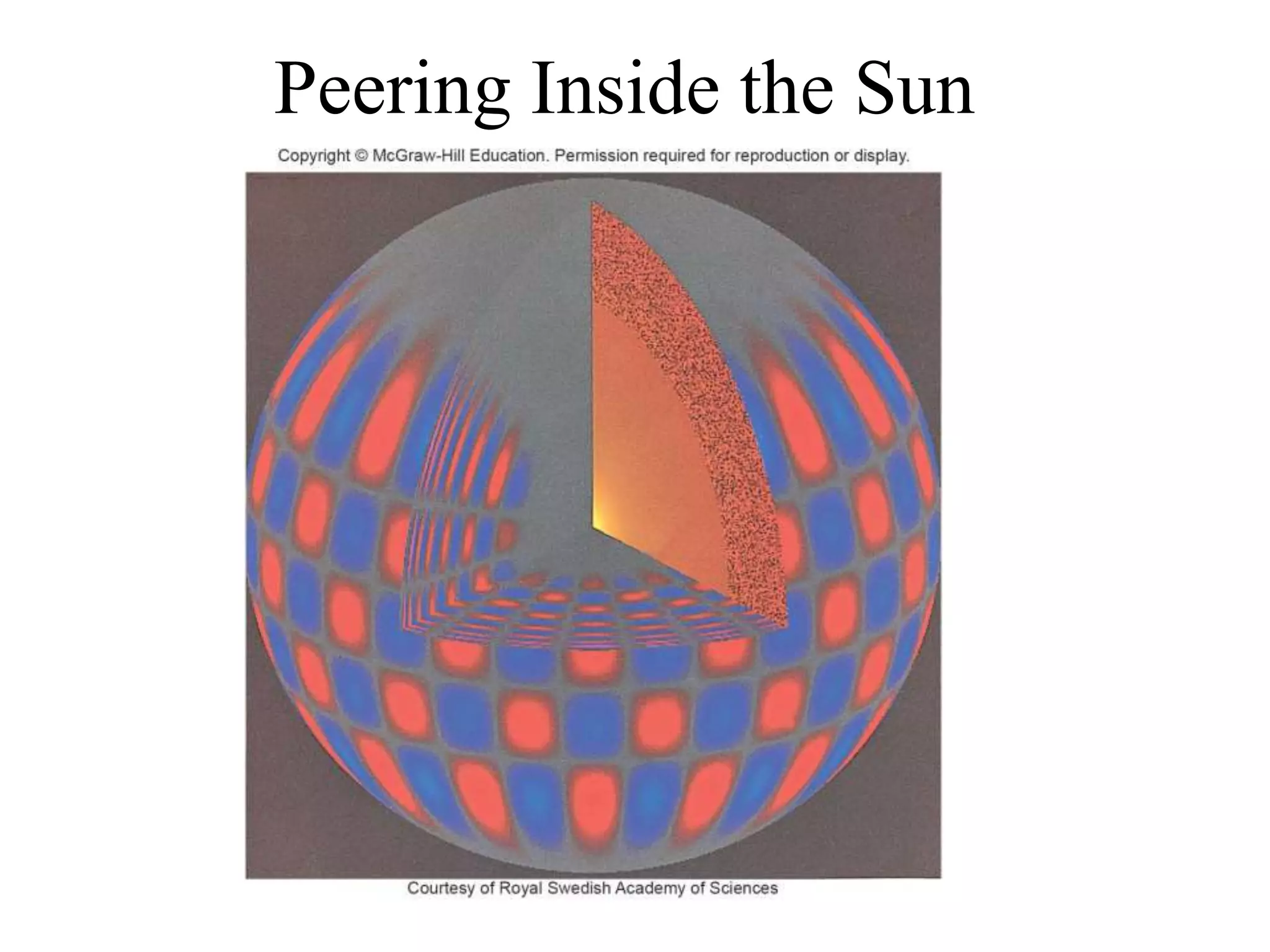
Solar Seismology
• Solar seismology is the study of the Sun’s
interior by analyzing wave motions on the
Sun’s surface and atmosphere
• The wave motion can be detected by the
Doppler shift of the moving material
• The detected wave motion gives temperature
and density profiles deep in the Sun’s interior
• These profiles agree very well with current
models
Peering Inside the Sun
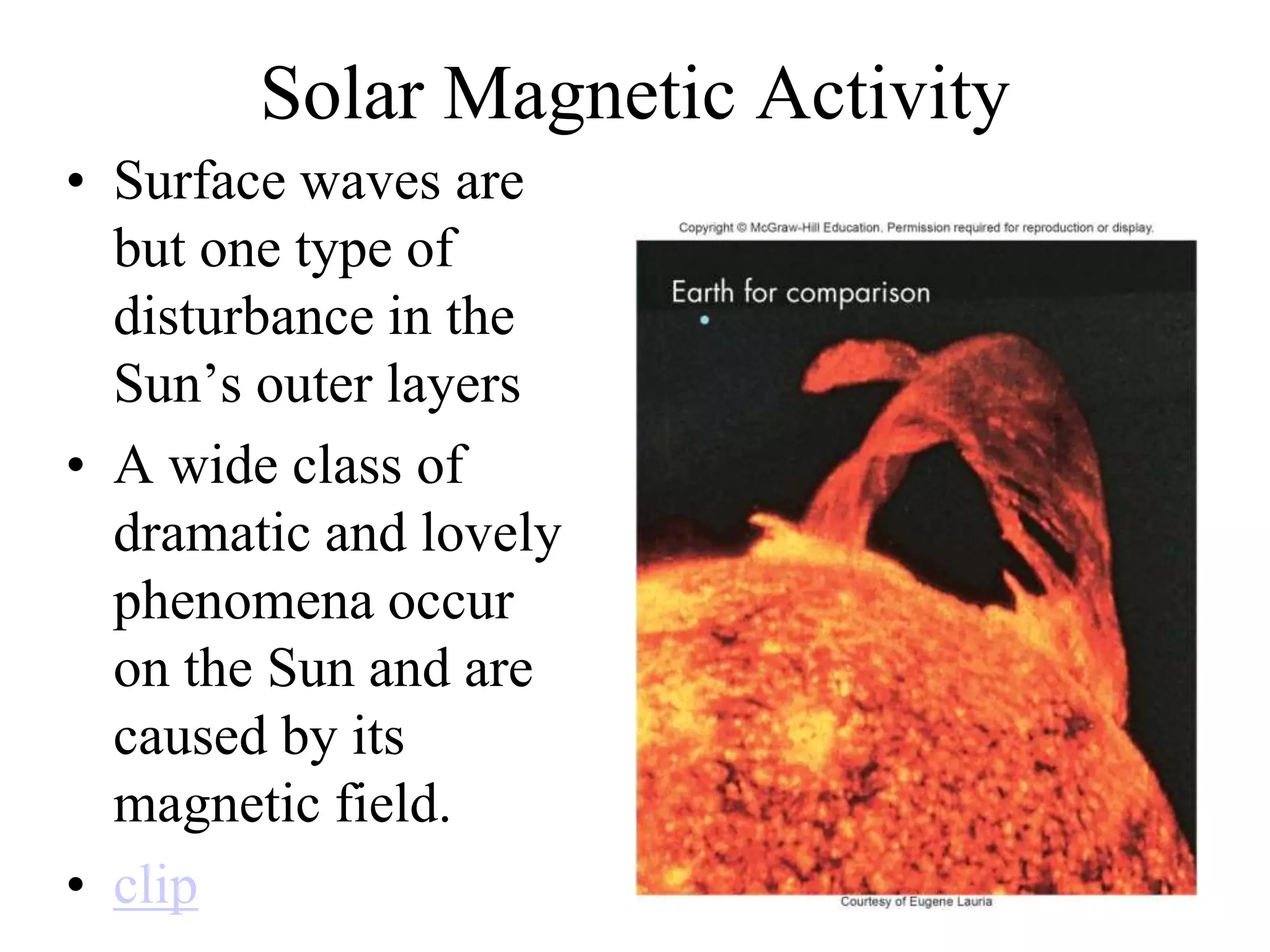
Solar Magnetic Activity
• Surface waves are
but one type of
disturbance in the
Sun’s outer layers
• A wide class of
dramatic and lovely
phenomena occur
on the Sun and are
caused by its
magnetic field.
• clip
Interaction of Fields and Particles
• Charged particles tend
to spiral along magnetic
field lines easier than
they drift across them.
• Bulk motion of plasma
carries the field along
with it.
• Motion of the field
carries particles along
with it.
Sunspots
• Dark-appearing regions
ranging in size from a few
hundred to a few thousand
kilometers across
• Last a few days to over a
month
• Darker because they are
cooler than their
surroundings (4500 K vs
6000 K)
• Cooler due to stronger
magnetic fields within them
Origin of Sunspots
• Starved of heat from below, the surface cools where the
magnetic fields breach the surface creating a dark sunspot
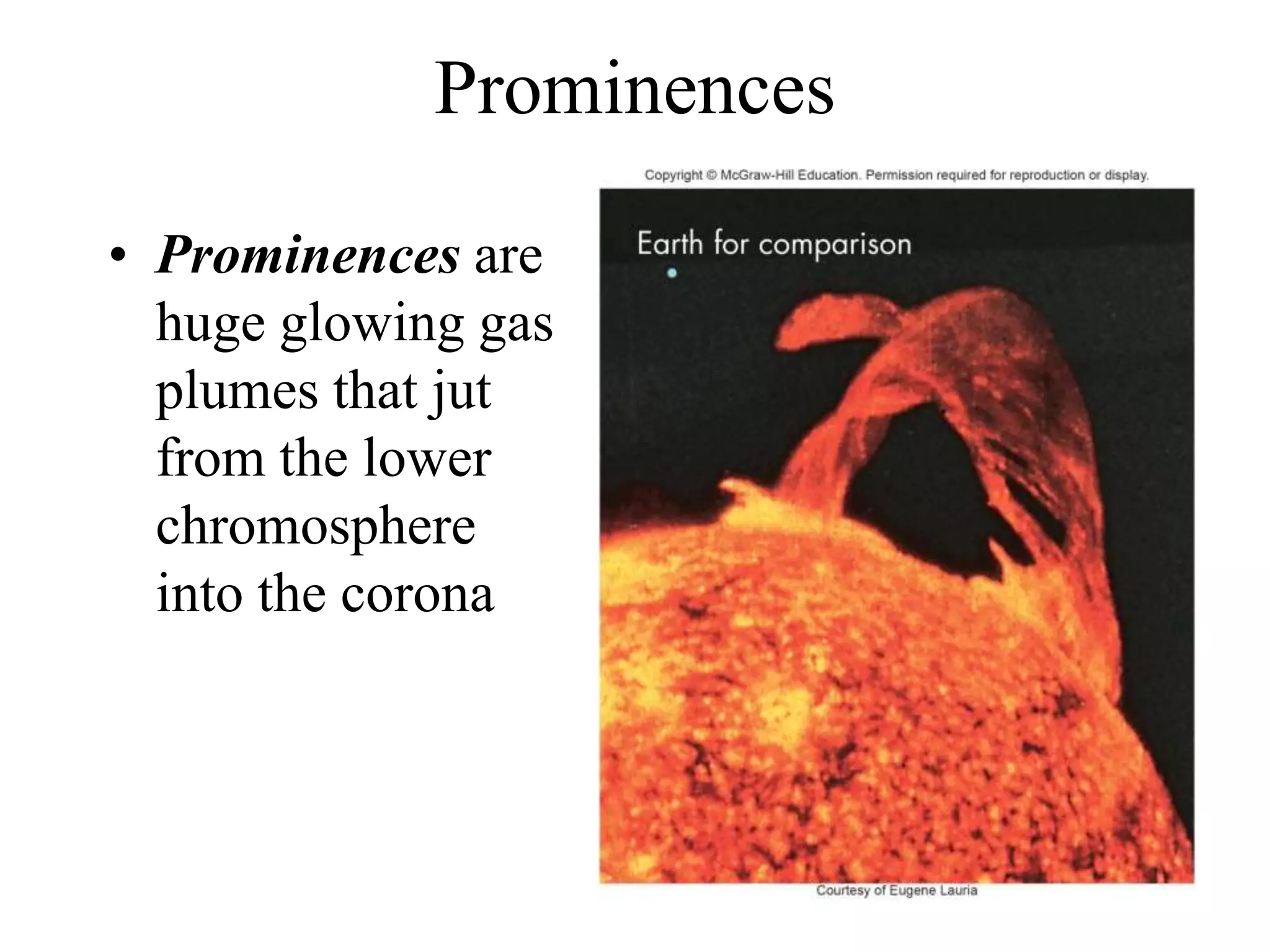
Prominences
• Prominences are
huge glowing gas
plumes that jut
from the lower
chromosphere
into the corona
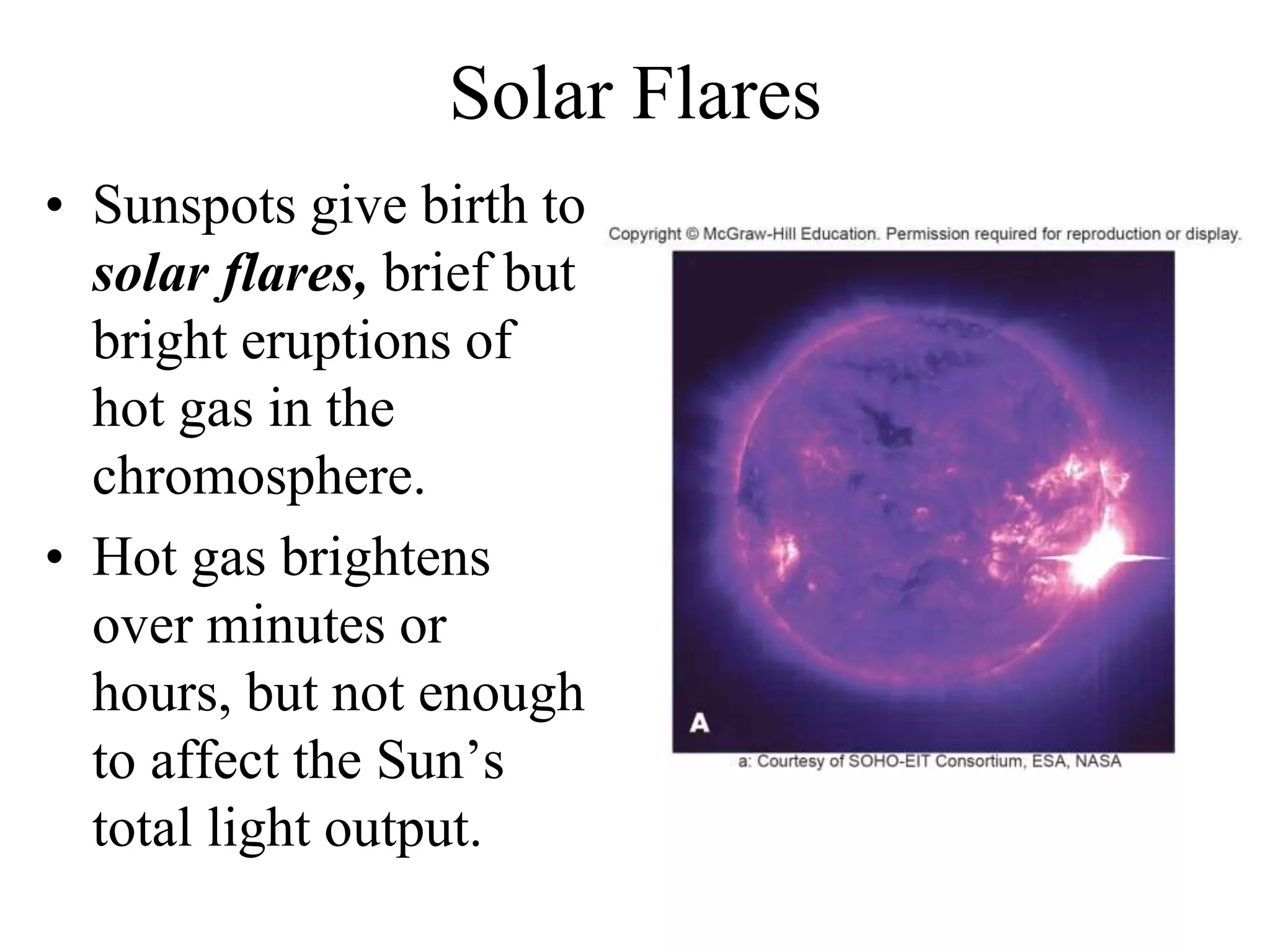
Solar Flares
• Sunspots give birth to
solar flares, brief but
bright eruptions of
hot gas in the
chromosphere.
• Hot gas brightens
over minutes or
hours, but not enough
to affect the Sun’s
total light output.
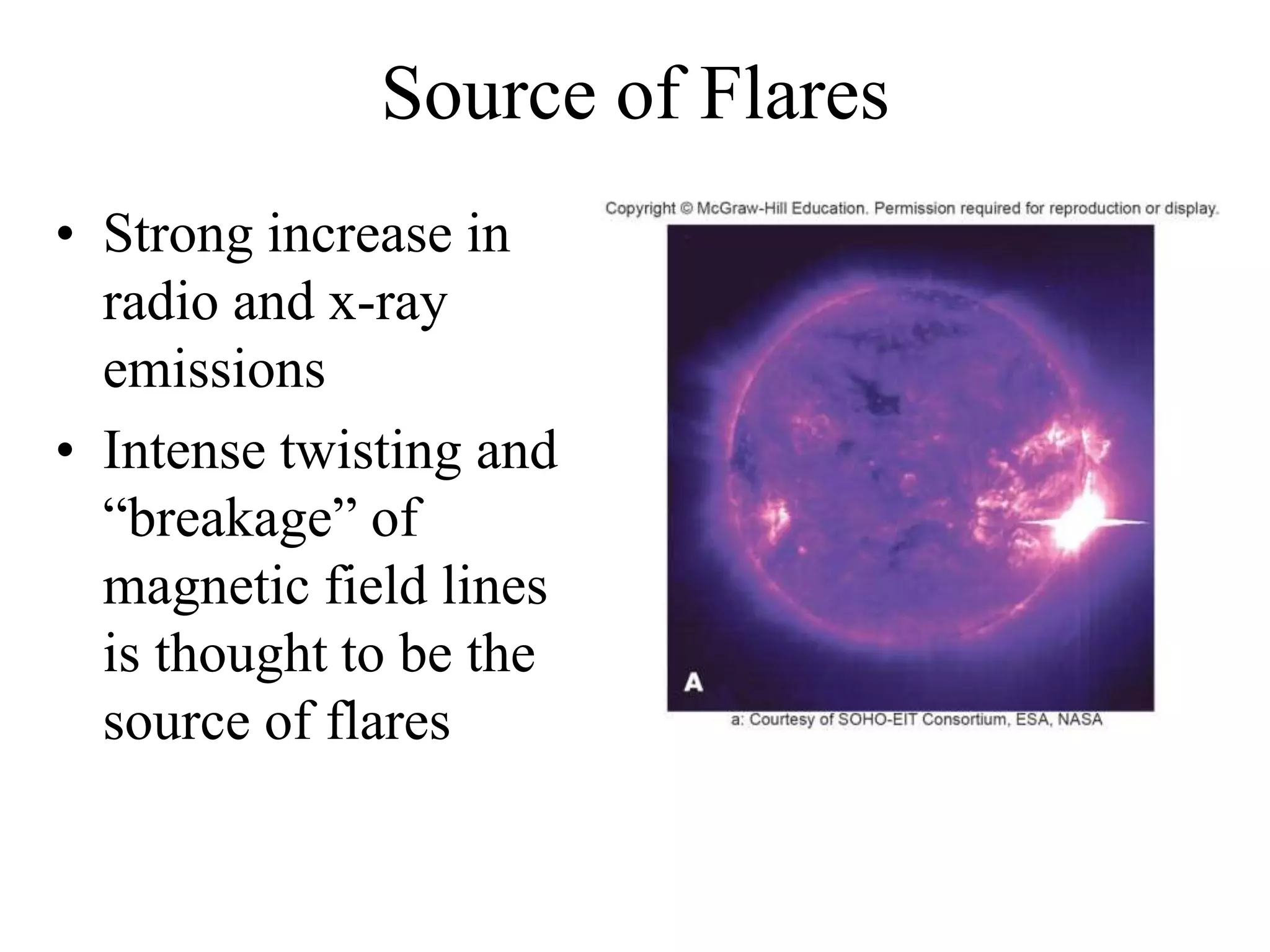
Source of Flares
• Strong increase in
radio and x-ray
emissions
• Intense twisting and
“breakage” of
magnetic field lines
is thought to be the
source of flares
Coronal Mass Ejections
• Coronal mass
ejections can
explosively
shoot gas
across the Solar
System and
result in
spectacular
auroral displays
Impact of Solar Flares
Heating of the Chromosphere and Corona
• While the Sun’s magnetic field cools sunspots and
prominences, it heats the chromosphere and corona
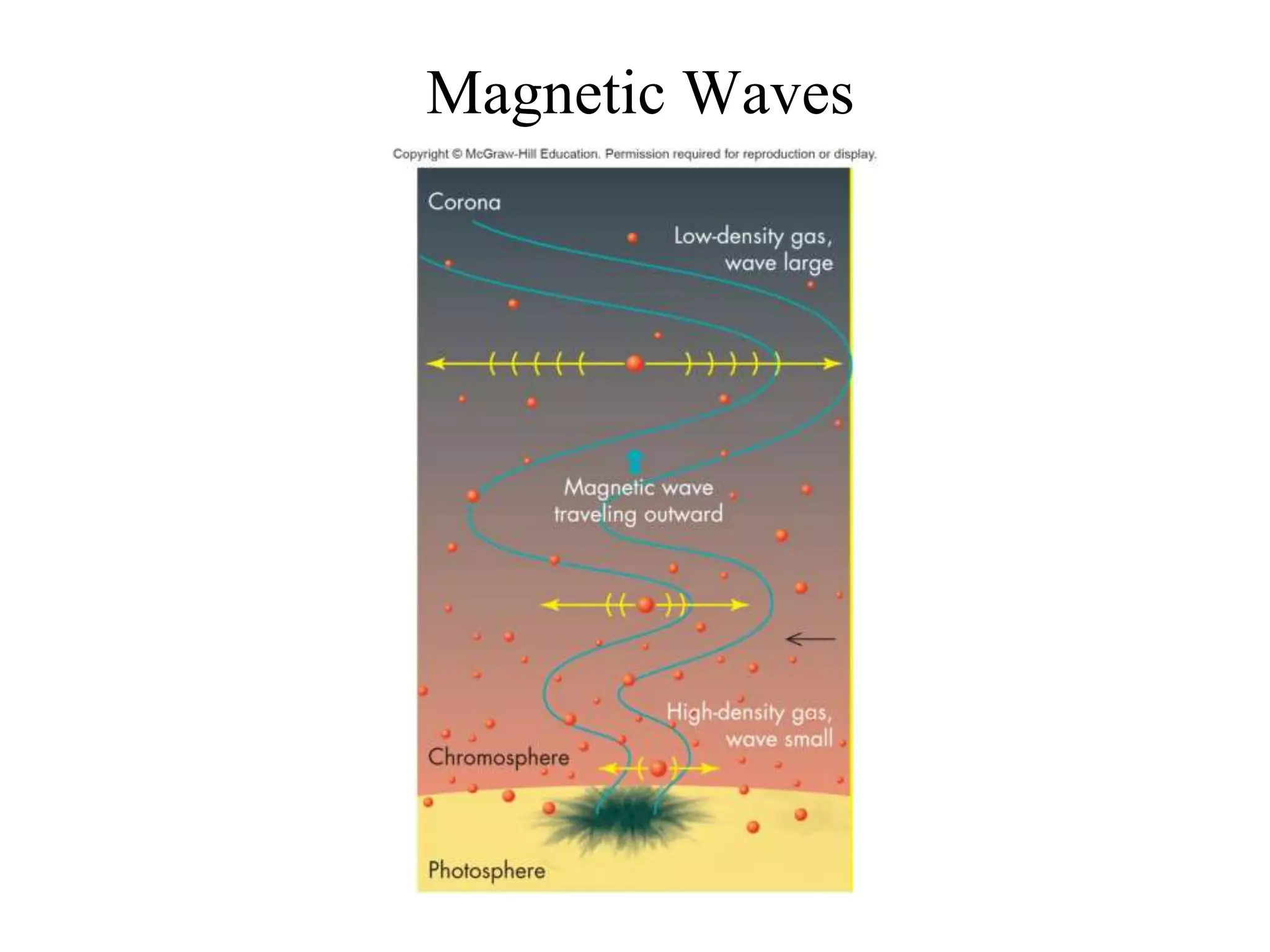
• Heating is caused by magnetic waves generated in the
relatively dense photosphere
– These waves move up into the thinning atmospheric gases,
grow in magnitude, and “whip” the charged particles found
there to higher speeds and hence higher temperatures.
– Origin of waves may be from rising bubbles in convection
zone.
Magnetic Waves
The Solar Wind
• The corona’s high temperature gives its atoms enough
energy to exceed the escape velocity of the Sun.
• As these atoms stream into space, they form the solar
wind, a tenuous gas of hydrogen and helium that
sweeps across the entire Solar System.
• The amount of material lost from the Sun via the Solar
Wind is insignificant.
• Typical values at the Earth’s orbit: a few atoms per cm3
and a speed of about 500 km/sec.
• At some point, the solar wind merges with interstellar
space.
The Solar Cycle
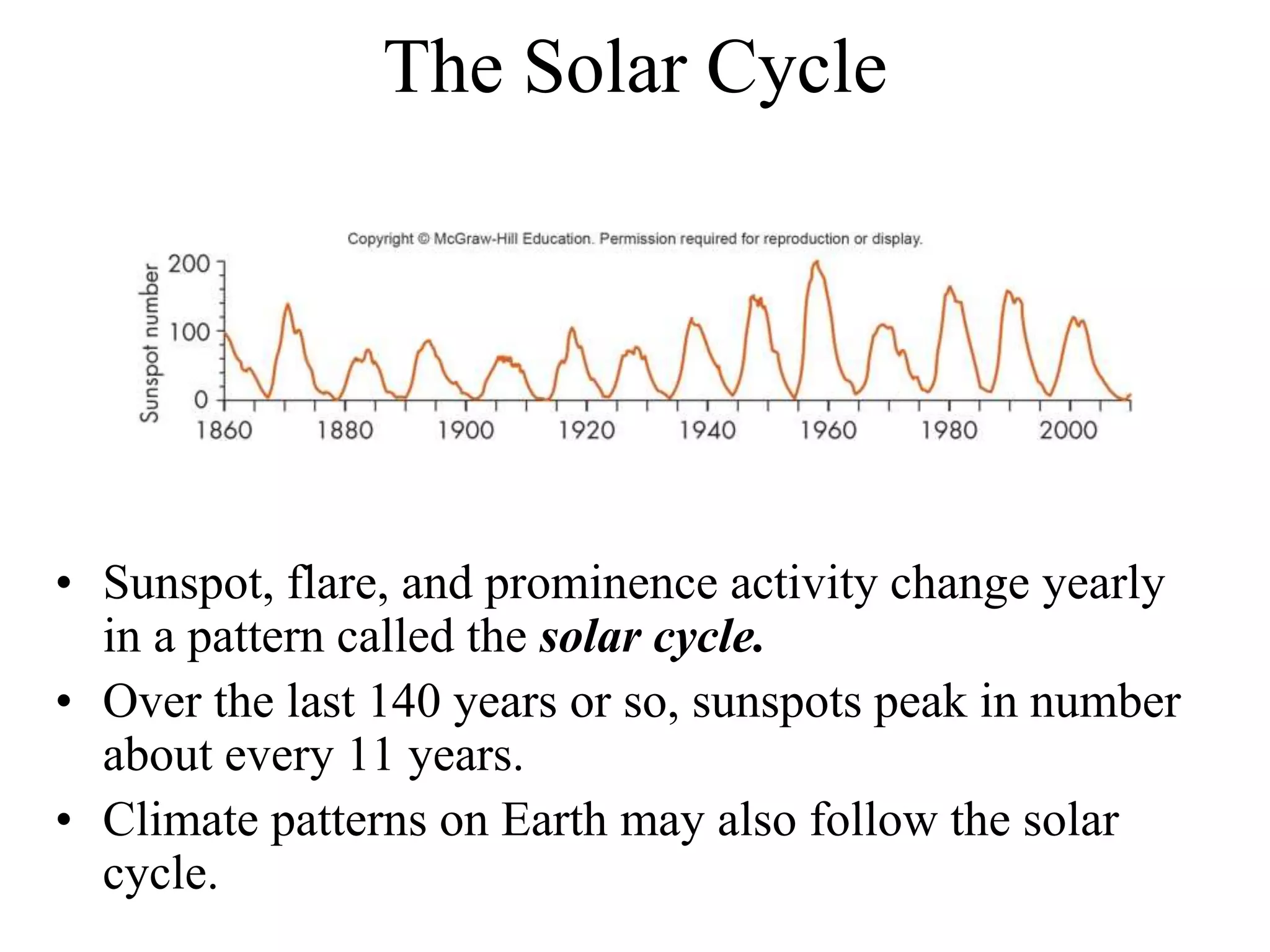
• Sunspot, flare, and prominence activity change yearly
in a pattern called the solar cycle.
• Over the last 140 years or so, sunspots peak in number
about every 11 years.
• Climate patterns on Earth may also follow the solar
cycle.
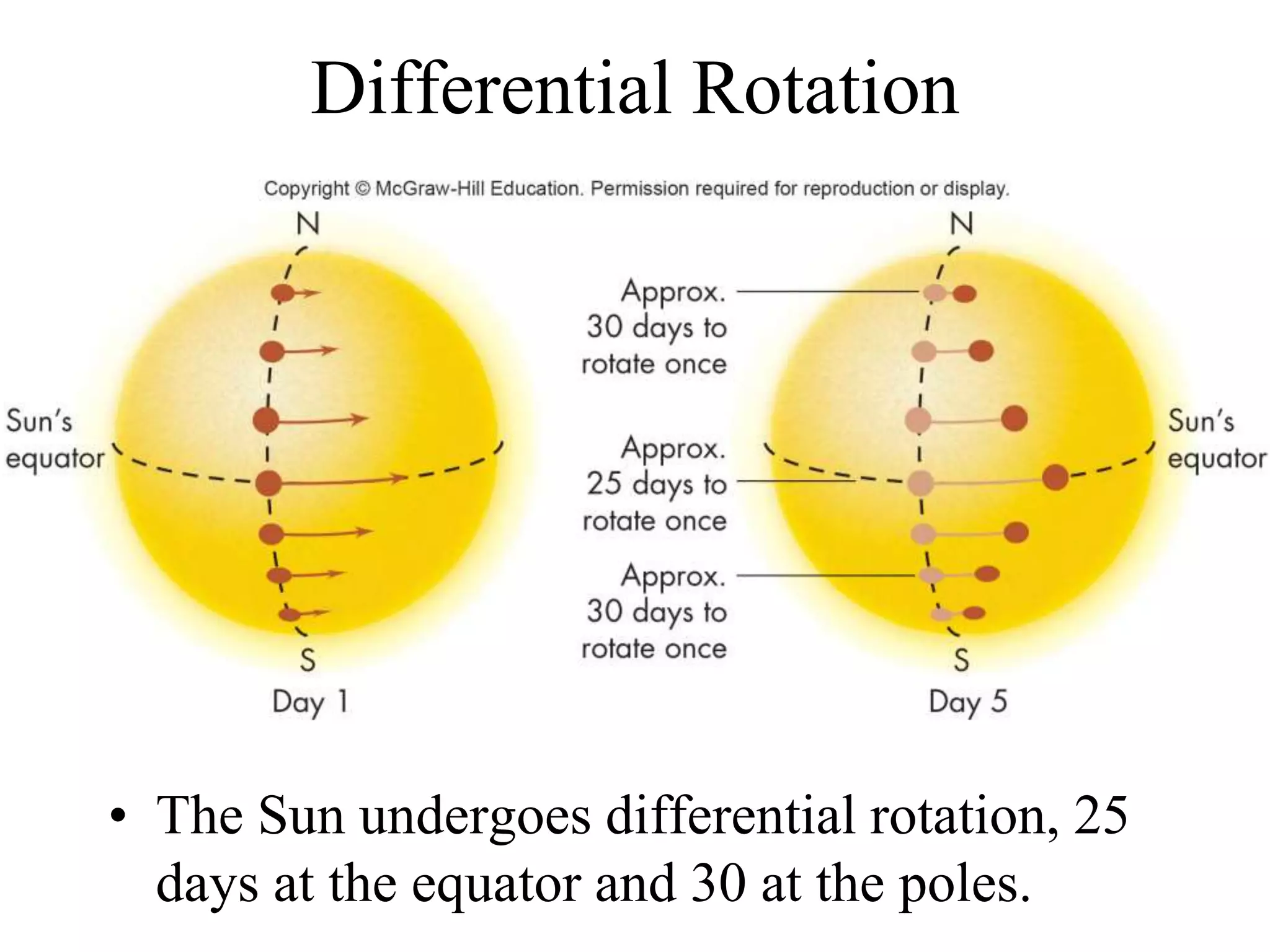
Differential Rotation
• The Sun undergoes differential rotation, 25
days at the equator and 30 at the poles.
Cause of the Solar Cycle
• This rotation causes the Sun’s
magnetic field to “wind up,”
increasing solar activity
(magnetic field “kinks” that
break through the surface).
• The cycle ends when the field
twists too “tightly” and
collapses – the process then
repeats
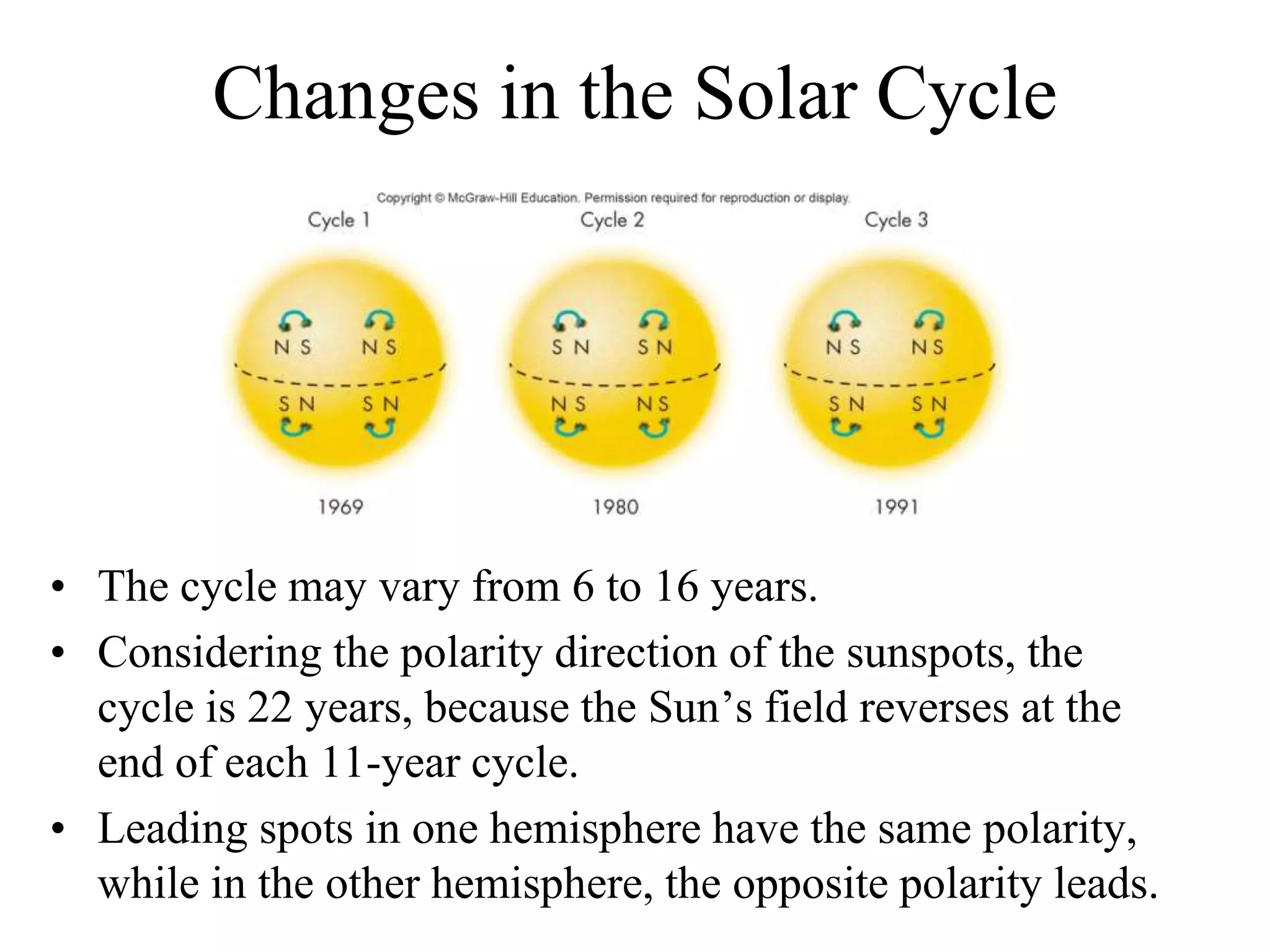
Changes in the Solar Cycle
• The cycle may vary from 6 to 16 years.
• Considering the polarity direction of the sunspots, the
cycle is 22 years, because the Sun’s field reverses at the
end of each 11-year cycle.
• Leading spots in one hemisphere have the same polarity,
while in the other hemisphere, the opposite polarity leads.
Solar Cycle and Climate
• Midwestern United States and Canada experience a 22-
year drought cycle.
• Few sunspots existed from 1645-1715, the Maunder
Minimum, the same time of the “little ice age in Europe
and North America.
• Number of sunspots correlates with change in ocean
temperatures.
• The Sun and terrestrial impact

Ch12 our sun (1)

  • 1.
    Chapter 12 The Sun,Our Star Copyright © McGraw-Hill Education. Permission required for reproduction or display.
  • 2.
    The Sun • TheSun is a star, a luminous ball of gas more than 100 times bigger than the Earth • Although seemingly quiescent from a naked eye view, telescopic observations reveal a bevy of violent activity – fountains of incandescent gas and twisting magnetic fields • The Sun’s core is equally violent with a furnace of thermonuclear fire converting hydrogen into helium to the tune of an energy production equivalent to the detonation of 100 nuclear bombs • The force of gravity keeps the Sun in check – for now
  • 3.
    Radius and Mass •With a radius 100× and a mass of 300,000× that of Earth, the Sun must expend a large amount of energy to withstand its own self-gravity
  • 4.
    Properties of theSun • The Sun’s distance from Earth (about 150 million km or 1 AU) was once measured by triangulation, but is now done by radar • Once the distance is known, its diameter (about 1.4 million km) can be found from its angular size (about 1/2 degree)
  • 5.
    Mass and Temperature •From the Sun’s distance and the Earth’s orbital period, Kepler’s modified third law gives the Sun’s mass • From the mass and radius, the surface gravity of the Sun is found to be 30× that of Earth • Next, the surface temperature (5780 K) is found from the Sun’s color and the use of Wien’s law for a blackbody
  • 6.
    Composition and Structure •Theoretical considerations then establish the Sun as gaseous throughout with a core temperature of 15 million K • From the amount of solar energy that reaches the Earth (4 × 1026 watts), this energy must be replenished by fusion processes in its core • The Sun has plenty of hydrogen for fusion: its surface spectra shows hydrogen is 71% and 27% helium
  • 7.
  • 8.
    The Solar Interior •The low density upper layers of the Sun, where any photons created there can freely escape into space is called the photosphere • The photosphere is the yellow “surface.” • Layers below the photosphere are opaque, photons created there are readily absorbed by atoms located there
  • 9.
    Temperature and DensityChanges • Theoretical calculations show that the Sun’s surface temperature and density both increase as the core is approached – The density is similar to that found at sea level on Earth at the Sun’s surface and 100× that of water at the core
  • 10.
    The Radiative Zone •Since the core is hotter than the surface, heat will flow outward from the Sun’s center • Near the Sun’s center, energy is moved outward by photon radiation – a region surrounding the core known as the radiative zone
  • 11.
    Very Old Light •Photons created in the Sun’s interior do not travel very far before being reabsorbed – energy created in the Sun’s center will take anywhere from hundreds of thousands to 10s of millions of years to eventually diffuse to the surface! • Here’s the math
  • 12.
    The Convection Zone •Above the radiative zone energy is more efficiently transported by the rising and sinking of gas – this is the convection zone
  • 13.
    Granulation • Convection manifests itselfin the photosphere as granulation, numerous bright regions surrounded by narrow dark zones
  • 14.
    The Sun’s Atmosphere •The extremely low-density gases that lie above the photosphere make up the Sun’s atmosphere
  • 15.
    Temperature Profile • Thedensity of the atmosphere decreases steadily with altitude and eventually merges with the near-vacuum of space. • Immediately above the photosphere, the temperature of the atmosphere decreases but at higher altitudes, the temperature grows hotter, reaching temperatures of several million Kelvin. • The reason for the increase in temperature is unknown, but speculation is that Sun’s magnetic field plays an important role. • The Parker Solar Mission will hopefully answer some of those questions soon • A 10-year study has shown that acoustic waves deep inside the Sun excite the Alfvénic waves which heat the corona and accelerate the solar wind.
  • 16.
    The Sun’s placeon the H-R Diagram [Temperature on the X-axis – Luminosity on the Y-axis] The Sun – a G2V star
  • 17.
    The Chromosphere • Thelower part of the atmosphere is referred to as the chromosphere. – The chromosphere appears as a thin red zone around the dark disk of a totally eclipsed Sun. – The red is caused by the strong red emission line of hydrogen Ha. – The chromosphere contains millions of thin columns called spicules, each a jet of hot gas.
  • 18.
    The Corona • Temperaturein the corona eventually reaches about 1 million K (not much energy though due to low density) • The corona, visible in a total solar eclipse, can be seen to reach altitudes of several solar radii • The corona is not uniform but has streamers and coronal holes dictated by the Sun’s magnetic field
  • 19.
    How the SunWorks • Structure of the Sun depends on a balance between its internal forces – specifically, a hydrostatic equilibrium between a force that prevents the Sun from collapsing and a force that holds it together • The inward (holding) force is the Sun’s own gravity, while the outward (non-collapsing) force arises from the Sun’s internal gas pressure. • Without balance the Sun would change very rapidly
  • 20.
    Pressure in theSun • Pressure in a gas comes from atomic collisions. • The amount of pressure is in direct proportion to the speed of the atoms and their density and is expressed in the perfect or ideal gas law.
  • 21.
    Powering the Sun •Given that the Sun loses energy as sunshine, an internal energy source must be present to maintain hydrostatic equilibrium. – If the Sun were made of pure coal, the Sun would last only a few thousand years. – If the Sun were not in equilibrium, but creating light energy from gravitational energy (the Sun is collapsing), the Sun could last 10 million years. – These and many other chemical-based sources of energy are not adequate to account for the Sun’s several billion year age.
  • 22.
    E = mc2 •Mass-energy is the key – In 1905, Einstein showed that energy and mass were equivalent through his famous E = mc2 equation – 1 gram of mass is equivalent to the energy of a small nuclear weapon – The trick is finding a process to convert mass into other forms of energy
  • 23.
    Nuclear Fusion • Adetailed process for mass conversion in the Sun called nuclear fusion was found: – Sun’s core temperature is high enough to force positively charged protons close enough together to bind them together via the nuclear or strong force [clip] – The net effect is that four protons are converted into a helium nucleus (plus other particles and energy) in a three-step process called the proton-proton chain
  • 24.
    Isotopes • In theproton- proton cycle, isotopes are intermediate steps between protons and their ultimate fusion into 4He.
  • 25.
  • 26.
  • 27.
  • 28.
  • 29.
    Solar Neutrinos • Thenuclear fusion process in the Sun’s core creates neutrinos. • Neutrinos lack electric charge, have a very small mass, escape the Sun’s interior relatively unaffected, and shower the Earth (about 1 trillion pass through a human per second). • Let’s review all that!
  • 30.
    Difficult to Detect •A neutrino’s low reactivity with other forms of matter requires special detection arrangements. – Detectors buried deep in the ground to prevent spurious signals as those produced by cosmic rays (high energy particles, like protons and electrons, with their source beyond the Solar System) – Large tanks of water and special light detectors
  • 31.
    The Neutrino Crisis •Detected neutrinos are about three times less than predicted – possible reasons: – Model of solar interior could be wrong – Neutrinos have properties that are not well understood. • Current view to explain measured solar neutrinos: neutrinos come in three varieties (instead of previous one), each with a different mass, and first detectors could not detect all varieties. • Subsequent observations with new detectors found all three types of neutrinos.
  • 32.
    Solar Seismology • Solarseismology is the study of the Sun’s interior by analyzing wave motions on the Sun’s surface and atmosphere • The wave motion can be detected by the Doppler shift of the moving material • The detected wave motion gives temperature and density profiles deep in the Sun’s interior • These profiles agree very well with current models
  • 33.
  • 34.
    Solar Magnetic Activity •Surface waves are but one type of disturbance in the Sun’s outer layers • A wide class of dramatic and lovely phenomena occur on the Sun and are caused by its magnetic field. • clip
  • 35.
    Interaction of Fieldsand Particles • Charged particles tend to spiral along magnetic field lines easier than they drift across them. • Bulk motion of plasma carries the field along with it. • Motion of the field carries particles along with it.
  • 36.
    Sunspots • Dark-appearing regions rangingin size from a few hundred to a few thousand kilometers across • Last a few days to over a month • Darker because they are cooler than their surroundings (4500 K vs 6000 K) • Cooler due to stronger magnetic fields within them
  • 37.
    Origin of Sunspots •Starved of heat from below, the surface cools where the magnetic fields breach the surface creating a dark sunspot
  • 38.
    Prominences • Prominences are hugeglowing gas plumes that jut from the lower chromosphere into the corona
  • 39.
    Solar Flares • Sunspotsgive birth to solar flares, brief but bright eruptions of hot gas in the chromosphere. • Hot gas brightens over minutes or hours, but not enough to affect the Sun’s total light output.
  • 40.
    Source of Flares •Strong increase in radio and x-ray emissions • Intense twisting and “breakage” of magnetic field lines is thought to be the source of flares
  • 41.
    Coronal Mass Ejections •Coronal mass ejections can explosively shoot gas across the Solar System and result in spectacular auroral displays
  • 42.
  • 43.
    Heating of theChromosphere and Corona • While the Sun’s magnetic field cools sunspots and prominences, it heats the chromosphere and corona • Heating is caused by magnetic waves generated in the relatively dense photosphere – These waves move up into the thinning atmospheric gases, grow in magnitude, and “whip” the charged particles found there to higher speeds and hence higher temperatures. – Origin of waves may be from rising bubbles in convection zone.
  • 44.
  • 45.
    The Solar Wind •The corona’s high temperature gives its atoms enough energy to exceed the escape velocity of the Sun. • As these atoms stream into space, they form the solar wind, a tenuous gas of hydrogen and helium that sweeps across the entire Solar System. • The amount of material lost from the Sun via the Solar Wind is insignificant. • Typical values at the Earth’s orbit: a few atoms per cm3 and a speed of about 500 km/sec. • At some point, the solar wind merges with interstellar space.
  • 46.
    The Solar Cycle •Sunspot, flare, and prominence activity change yearly in a pattern called the solar cycle. • Over the last 140 years or so, sunspots peak in number about every 11 years. • Climate patterns on Earth may also follow the solar cycle.
  • 47.
    Differential Rotation • TheSun undergoes differential rotation, 25 days at the equator and 30 at the poles.
  • 48.
    Cause of theSolar Cycle • This rotation causes the Sun’s magnetic field to “wind up,” increasing solar activity (magnetic field “kinks” that break through the surface). • The cycle ends when the field twists too “tightly” and collapses – the process then repeats
  • 49.
    Changes in theSolar Cycle • The cycle may vary from 6 to 16 years. • Considering the polarity direction of the sunspots, the cycle is 22 years, because the Sun’s field reverses at the end of each 11-year cycle. • Leading spots in one hemisphere have the same polarity, while in the other hemisphere, the opposite polarity leads.
  • 50.
    Solar Cycle andClimate • Midwestern United States and Canada experience a 22- year drought cycle. • Few sunspots existed from 1645-1715, the Maunder Minimum, the same time of the “little ice age in Europe and North America. • Number of sunspots correlates with change in ocean temperatures. • The Sun and terrestrial impact