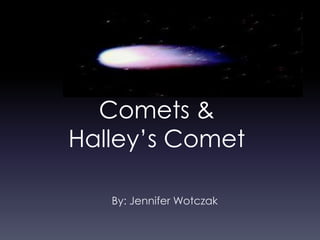
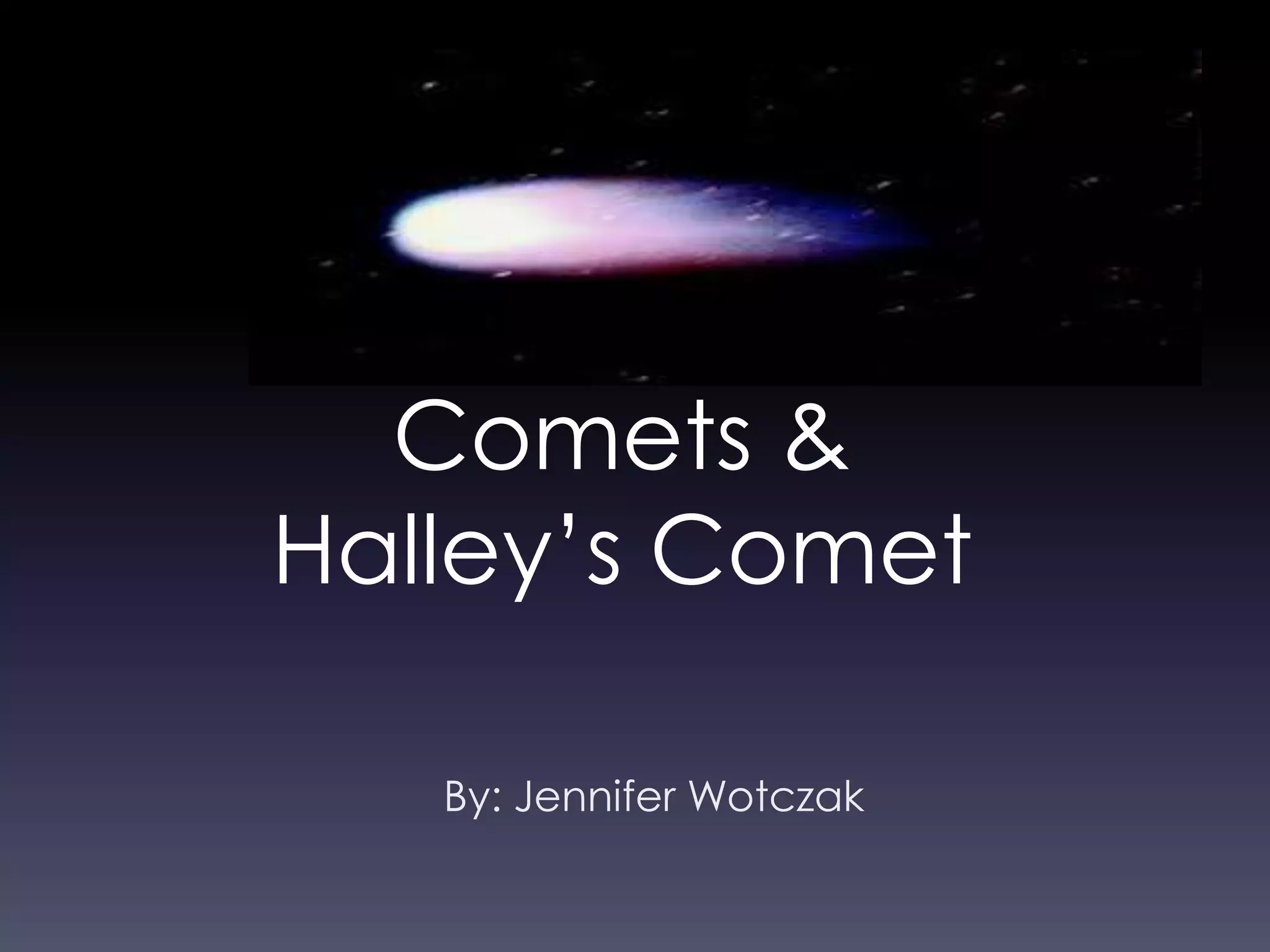
Comets &
Halley’s Comet
By: Jennifer Wotczak
Agenda
1. Comets
2. Comet Makeup
3. Comet Orbit
4. Comets in History
5. Halley’s Comet
6. Conclusion
7. Bibliography
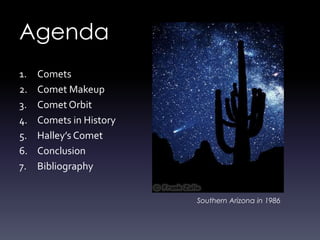
Southern Arizona in 1986
Comets Fast Facts• *Dirty Snowballs – Fred
Whipple (icy dirtballs)
• Small icy solar system body
that outgasses: when
ORBITINGTHE SUN
• Dust, ice, carbon dioxide,
ammonia, methane, and
more!
• Left over from the formation
of stars & planets billions of
years ago
Physical Characteristic
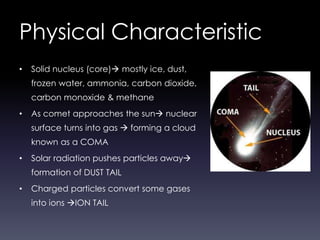
• Solid nucleus (core) mostly ice, dust,
frozen water, ammonia, carbon dioxide,
carbon monoxide & methane
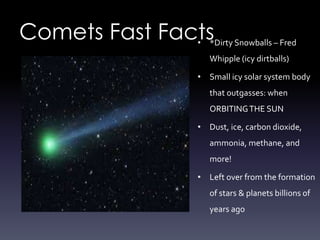
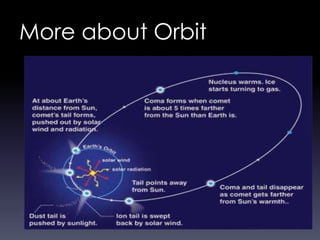
• As comet approaches the sun nuclear
surface turns into gas  forming a cloud
known as a COMA
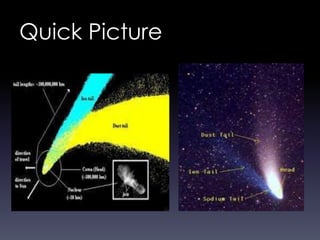
• Solar radiation pushes particles away
formation of DUST TAIL
• Charged particles convert some gases
into ions ION TAIL
Quick Picture
More about the Makeup
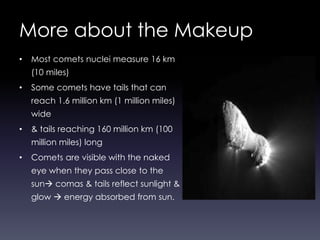
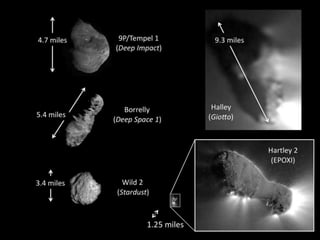
• Most comets nuclei measure 16 km
(10 miles)
• Some comets have tails that can
reach 1.6 million km (1 million miles)
wide
• & tails reaching 160 million km (100
million miles) long
• Comets are visible with the naked
eye when they pass close to the
sun comas & tails reflect sunlight &
glow  energy absorbed from sun.
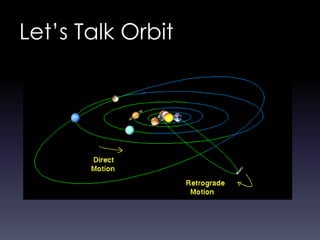
Let’s Talk Orbit
More about Orbit
Orbital Characteristic
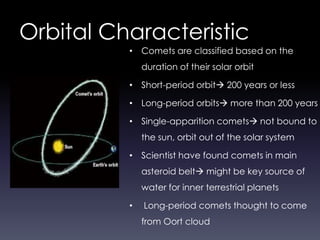
• Comets are classified based on the
duration of their solar orbit
• Short-period orbit 200 years or less
• Long-period orbits more than 200 years
• Single-apparition comets not bound to
the sun, orbit out of the solar system
• Scientist have found comets in main
asteroid belt might be key source of
water for inner terrestrial planets
• Long-period comets thought to come
from Oort cloud
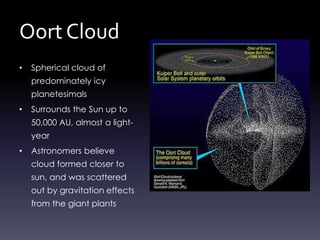
Oort Cloud
• Spherical cloud of
predominately icy
planetesimals
• Surrounds the Sun up to
50,000 AU, almost a light-
year
• Astronomers believe
cloud formed closer to
sun, and was scattered
out by gravitation effects
from the giant plants
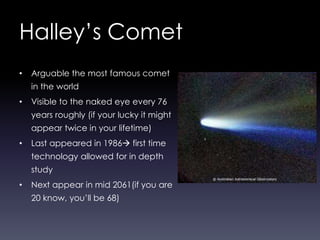
Halley’s Comet
• Arguable the most famous comet
in the world
• Visible to the naked eye every 76
years roughly (if your lucky it might
appear twice in your lifetime)
• Last appeared in 1986 first time
technology allowed for in depth
study
• Next appear in mid 2061(if you are
20 know, you’ll be 68)
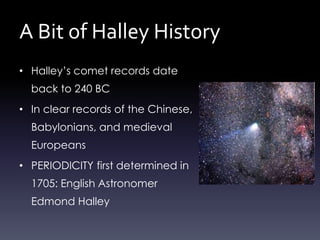
A Bit of Halley History
• Halley’s comet records date
back to 240 BC
• In clear records of the Chinese,
Babylonians, and medieval
Europeans
• PERIODICITY first determined in
1705: English Astronomer
Edmond Halley
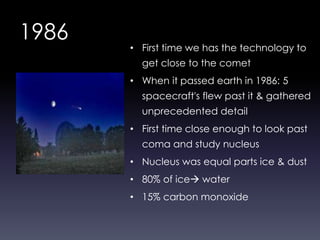
1986
• First time we has the technology to
get close to the comet
• When it passed earth in 1986: 5
spacecraft's flew past it & gathered
unprecedented detail
• First time close enough to look past
coma and study nucleus
• Nucleus was equal parts ice & dust
• 80% of ice water
• 15% carbon monoxide
Quick Video
• https://www.youtube.com/watch?v=C8zV1xiGqf4
Important Take Always
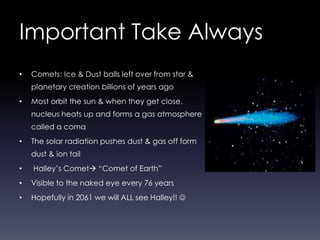
• Comets: Ice & Dust balls left over from star &
planetary creation billions of years ago
• Most orbit the sun & when they get close,
nucleus heats up and forms a gas atmosphere
called a coma
• The solar radiation pushes dust & gas off form
dust & ion tail
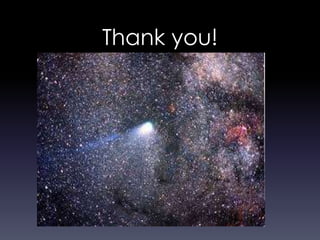
• Halley’s Comet “Comet of Earth”
• Visible to the naked eye every 76 years
• Hopefully in 2061 we will ALL see Halley!! 
Thank you!
Bibliography
• https://solarsystem.nasa.gov/planets/profile.cfm?Object=Comets
• http://www.space.com/53-comets-formation-discovery-and-
exploration.html

Halley's Comet

  • 1.
  • 2.
    Agenda 1. Comets 2. CometMakeup 3. Comet Orbit 4. Comets in History 5. Halley’s Comet 6. Conclusion 7. Bibliography Southern Arizona in 1986
  • 3.
    Comets Fast Facts•*Dirty Snowballs – Fred Whipple (icy dirtballs) • Small icy solar system body that outgasses: when ORBITINGTHE SUN • Dust, ice, carbon dioxide, ammonia, methane, and more! • Left over from the formation of stars & planets billions of years ago
  • 4.
    Physical Characteristic • Solidnucleus (core) mostly ice, dust, frozen water, ammonia, carbon dioxide, carbon monoxide & methane • As comet approaches the sun nuclear surface turns into gas  forming a cloud known as a COMA • Solar radiation pushes particles away formation of DUST TAIL • Charged particles convert some gases into ions ION TAIL
  • 5.
  • 6.
    More about theMakeup • Most comets nuclei measure 16 km (10 miles) • Some comets have tails that can reach 1.6 million km (1 million miles) wide • & tails reaching 160 million km (100 million miles) long • Comets are visible with the naked eye when they pass close to the sun comas & tails reflect sunlight & glow  energy absorbed from sun.
  • 8.
  • 9.
  • 10.
    Orbital Characteristic • Cometsare classified based on the duration of their solar orbit • Short-period orbit 200 years or less • Long-period orbits more than 200 years • Single-apparition comets not bound to the sun, orbit out of the solar system • Scientist have found comets in main asteroid belt might be key source of water for inner terrestrial planets • Long-period comets thought to come from Oort cloud
  • 11.
    Oort Cloud • Sphericalcloud of predominately icy planetesimals • Surrounds the Sun up to 50,000 AU, almost a light- year • Astronomers believe cloud formed closer to sun, and was scattered out by gravitation effects from the giant plants
  • 12.
    Halley’s Comet • Arguablethe most famous comet in the world • Visible to the naked eye every 76 years roughly (if your lucky it might appear twice in your lifetime) • Last appeared in 1986 first time technology allowed for in depth study • Next appear in mid 2061(if you are 20 know, you’ll be 68)
  • 13.
    A Bit ofHalley History • Halley’s comet records date back to 240 BC • In clear records of the Chinese, Babylonians, and medieval Europeans • PERIODICITY first determined in 1705: English Astronomer Edmond Halley
  • 14.
    1986 • First timewe has the technology to get close to the comet • When it passed earth in 1986: 5 spacecraft's flew past it & gathered unprecedented detail • First time close enough to look past coma and study nucleus • Nucleus was equal parts ice & dust • 80% of ice water • 15% carbon monoxide
  • 15.
  • 16.
    Important Take Always •Comets: Ice & Dust balls left over from star & planetary creation billions of years ago • Most orbit the sun & when they get close, nucleus heats up and forms a gas atmosphere called a coma • The solar radiation pushes dust & gas off form dust & ion tail • Halley’s Comet “Comet of Earth” • Visible to the naked eye every 76 years • Hopefully in 2061 we will ALL see Halley!! 
  • 17.
  • 18.