1515
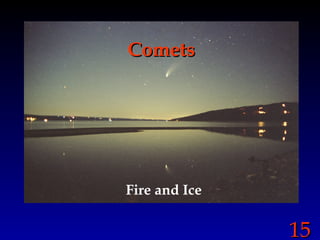
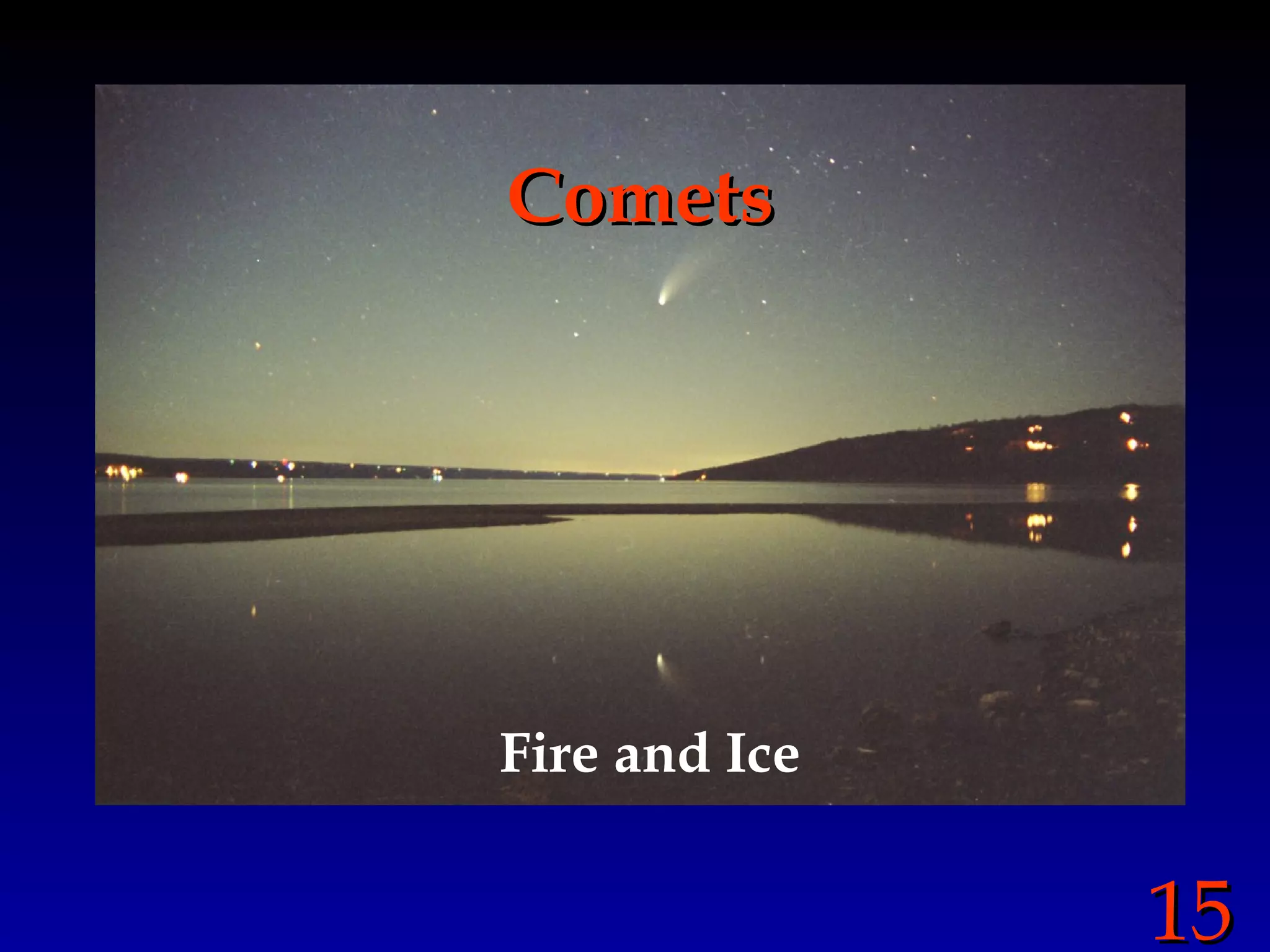
CometsComets
Fire and Ice
1515
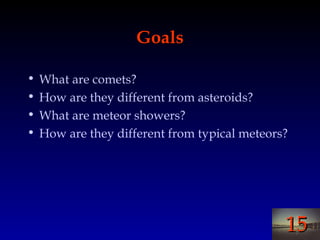
GoalsGoals
• What are comets?
• How are they different from asteroids?
• What are meteor showers?
• How are they different from typical meteors?
1515
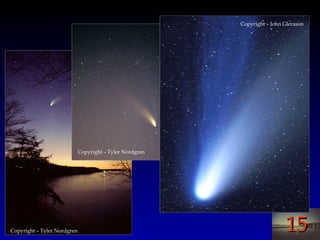
Comets – Hale Bopp
Copyright – Tyler Nordgren
Copyright – John Glerason
1515
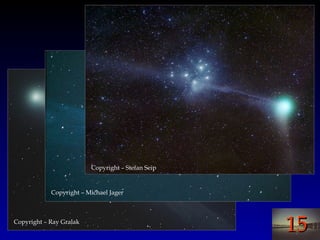
Comets
Copyright – Ray Gralak
Copyright – Michael Jager
Copyright – Stefan Seip
1515
Comet Facts
• Formed beyond the frostline, comets are icy
counterparts to asteroids.
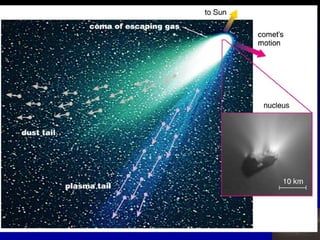
• “Dirty snowballs” = the nucleus
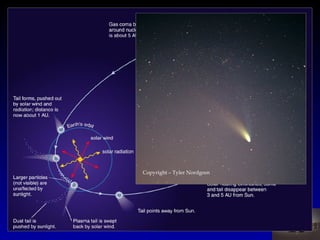
• Most comets do not have tails.
• Most comets remain perpetually frozen in the
outer solar system. Only a few enter the inner
solar system, where they can grow tails.
1515
Copyright – Tyler Nordgren
1515
Concept Test
• Suppose we discover a new comet on an
orbit that brings it closer to the Sun than
Mercury every 125 years. What can we
conclude?
a. It has been on its current orbit for only a very
short time compared to the age of our solar
system.
b. It has a coma and tail during most of each orbit.
c. It came from the Oort cloud.
d. It came from the Kuiper belt.
e. None of the above.
1515
1515
Concept Test
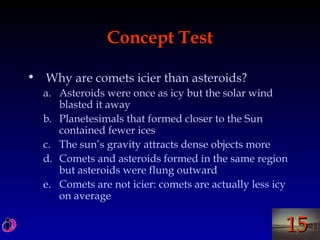
• Why are comets icier than asteroids?
a. Asteroids were once as icy but the solar wind
blasted it away
b. Planetesimals that formed closer to the Sun
contained fewer ices
c. The sun’s gravity attracts dense objects more
d. Comets and asteroids formed in the same region
but asteroids were flung outward
e. Comets are not icier: comets are actually less icy
on average
1515
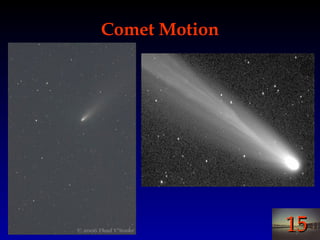
Comet Motion
1515
Concept Test
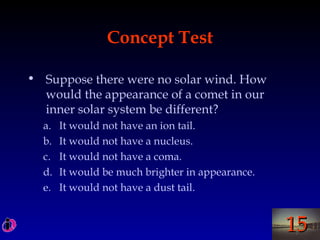
• Suppose there were no solar wind. How
would the appearance of a comet in our
inner solar system be different?
a. It would not have an ion tail.
b. It would not have a nucleus.
c. It would not have a coma.
d. It would be much brighter in appearance.
e. It would not have a dust tail.
1515
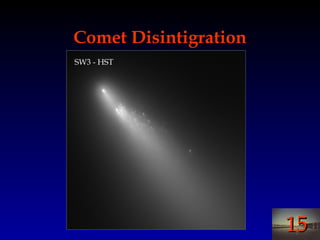
Comet Disintigration
SW3 - HST
1515
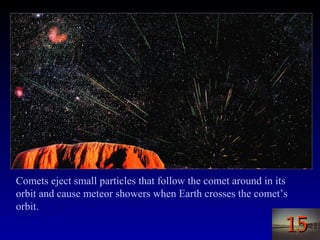
Comets eject small particles that follow the comet around in its
orbit and cause meteor showers when Earth crosses the comet’s
orbit.
1515
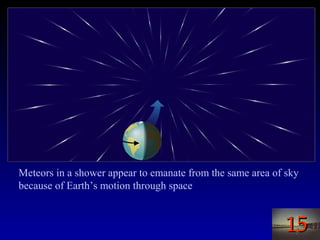
Meteors in a shower appear to emanate from the same area of sky
because of Earth’s motion through space
1515
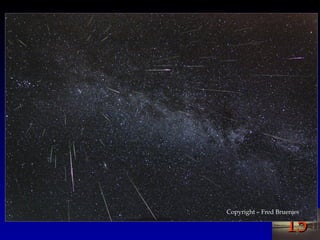
Copyright – Fred Bruenjes
1515
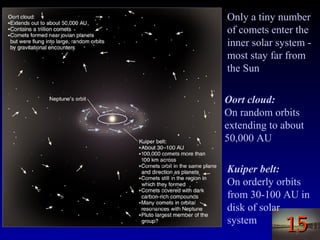
Kuiper belt:
On orderly orbits
from 30-100 AU in
disk of solar
system
Oort cloud:
On random orbits
extending to about
50,000 AU
Only a tiny number
of comets enter the
inner solar system -
most stay far from
the Sun
1515
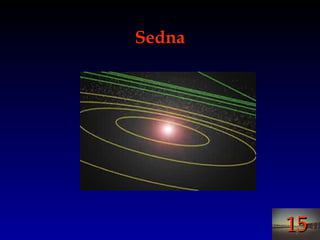
Sedna
1515
How did they get there?
• Kuiper belt comets formed in the Kuiper belt: flat
plane, aligned with the plane of planetary orbits,
orbiting in the same direction as the planets.
• Oort cloud comets were once closer to the Sun, but
they were kicked out there by gravitational
interactions with jovian planets: spherical
distribution, orbits in any direction.
1515
Concept Test
• Oort cloud comet orbits are ‘random’ compared to
Kuiper Belt comets because…
a. The comets have collided so frequently their orbits became
randomized
b. They formed from the collapsing cloud before it formed an
organized disk
c. They were ejected by the jovian planets onto random orbits
d. Orbital resonances with nearby stars randomized the
orbits
e. None of the above: Kuiper Belt comets have more random
orbits
1515
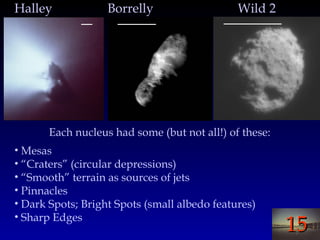
Halley Borrelly Wild 2
• Mesas
• “Craters” (circular depressions)
• “Smooth” terrain as sources of jets
• Pinnacles
• Dark Spots; Bright Spots (small albedo features)
• Sharp Edges
Each nucleus had some (but not all!) of these:
1515
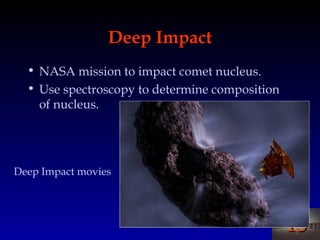
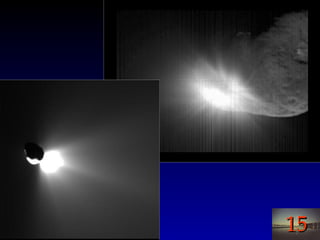
Deep Impact
• NASA mission to impact comet nucleus.
• Use spectroscopy to determine composition
of nucleus.
Deep Impact movies
1515
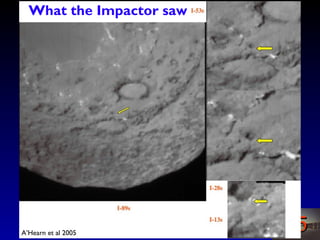
What the Impactor saw
A’Hearn et al 2005
1515A’Hearn et al 2005
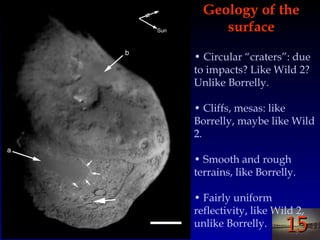
Geology of theGeology of the
surfacesurface
• Circular “craters”: due
to impacts? Like Wild 2?
Unlike Borrelly.
• Cliffs, mesas: like
Borrelly, maybe like Wild
2.
• Smooth and rough
terrains, like Borrelly.
• Fairly uniform
reflectivity, like Wild 2,
unlike Borrelly.
1515
1515
Homework #20Homework #20
• Due Friday 21-Nov:
• Read Bennett 12.4
• Do 13, 33, 34
• What is the Torino Scale?

comets

  • 1.
  • 2.
    1515 GoalsGoals • What arecomets? • How are they different from asteroids? • What are meteor showers? • How are they different from typical meteors?
  • 3.
    1515 Comets – HaleBopp Copyright – Tyler Nordgren Copyright – Tyler Nordgren Copyright – John Glerason
  • 4.
    1515 Comets Copyright – RayGralak Copyright – Michael Jager Copyright – Stefan Seip
  • 5.
    1515 Comet Facts • Formedbeyond the frostline, comets are icy counterparts to asteroids. • “Dirty snowballs” = the nucleus • Most comets do not have tails. • Most comets remain perpetually frozen in the outer solar system. Only a few enter the inner solar system, where they can grow tails.
  • 6.
  • 7.
    1515 Concept Test • Supposewe discover a new comet on an orbit that brings it closer to the Sun than Mercury every 125 years. What can we conclude? a. It has been on its current orbit for only a very short time compared to the age of our solar system. b. It has a coma and tail during most of each orbit. c. It came from the Oort cloud. d. It came from the Kuiper belt. e. None of the above.
  • 8.
  • 9.
    1515 Concept Test • Whyare comets icier than asteroids? a. Asteroids were once as icy but the solar wind blasted it away b. Planetesimals that formed closer to the Sun contained fewer ices c. The sun’s gravity attracts dense objects more d. Comets and asteroids formed in the same region but asteroids were flung outward e. Comets are not icier: comets are actually less icy on average
  • 10.
  • 11.
    1515 Concept Test • Supposethere were no solar wind. How would the appearance of a comet in our inner solar system be different? a. It would not have an ion tail. b. It would not have a nucleus. c. It would not have a coma. d. It would be much brighter in appearance. e. It would not have a dust tail.
  • 12.
  • 13.
    1515 Comets eject smallparticles that follow the comet around in its orbit and cause meteor showers when Earth crosses the comet’s orbit.
  • 14.
    1515 Meteors in ashower appear to emanate from the same area of sky because of Earth’s motion through space
  • 15.
  • 16.
    1515 Kuiper belt: On orderlyorbits from 30-100 AU in disk of solar system Oort cloud: On random orbits extending to about 50,000 AU Only a tiny number of comets enter the inner solar system - most stay far from the Sun
  • 17.
  • 18.
    1515 How did theyget there? • Kuiper belt comets formed in the Kuiper belt: flat plane, aligned with the plane of planetary orbits, orbiting in the same direction as the planets. • Oort cloud comets were once closer to the Sun, but they were kicked out there by gravitational interactions with jovian planets: spherical distribution, orbits in any direction.
  • 19.
    1515 Concept Test • Oortcloud comet orbits are ‘random’ compared to Kuiper Belt comets because… a. The comets have collided so frequently their orbits became randomized b. They formed from the collapsing cloud before it formed an organized disk c. They were ejected by the jovian planets onto random orbits d. Orbital resonances with nearby stars randomized the orbits e. None of the above: Kuiper Belt comets have more random orbits
  • 20.
    1515 Halley Borrelly Wild2 • Mesas • “Craters” (circular depressions) • “Smooth” terrain as sources of jets • Pinnacles • Dark Spots; Bright Spots (small albedo features) • Sharp Edges Each nucleus had some (but not all!) of these:
  • 21.
    1515 Deep Impact • NASAmission to impact comet nucleus. • Use spectroscopy to determine composition of nucleus. Deep Impact movies
  • 22.
    1515 What the Impactorsaw A’Hearn et al 2005
  • 23.
    1515A’Hearn et al2005 Geology of theGeology of the surfacesurface • Circular “craters”: due to impacts? Like Wild 2? Unlike Borrelly. • Cliffs, mesas: like Borrelly, maybe like Wild 2. • Smooth and rough terrains, like Borrelly. • Fairly uniform reflectivity, like Wild 2, unlike Borrelly.
  • 24.
  • 25.
    1515 Homework #20Homework #20 •Due Friday 21-Nov: • Read Bennett 12.4 • Do 13, 33, 34 • What is the Torino Scale?

Editor's Notes

  • #15 Just like driving into a snowstorm