Comets, Asteroids, and Meteors-
Oh My!
Comets
• BrainPop
Comets
• Description: Cold clumps of gases and
dusty ice from the outer parts of the solar
system
• Comet means long haired star
• Called “Dirty Snowballs”
Comet
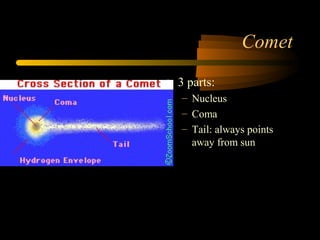
• 3 parts:
– Nucleus
– Coma
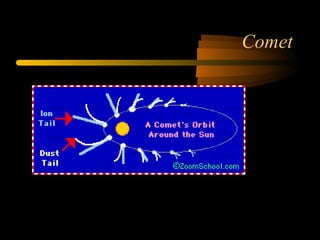
– Tail: always points
away from sun
Comet
Parts Explained
• Nucleus – mass of ice and frozen gas
• Coma – cloud of gas that surrounds the
nucleus
• Tail – formed when the comet travels near
the sun; it’s the nucleus vaporizing
Comet Orbits
• Comets have long, narrow elliptical orbits
• Short period comets are found in the Kuiper
Belt
• Long period comets are found in the Oort
Cloud
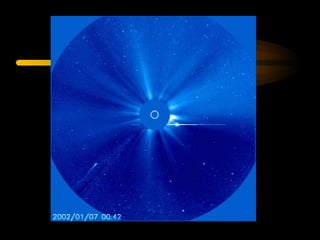
• Sometimes, comets get too close to the sun,
and then…
NASA
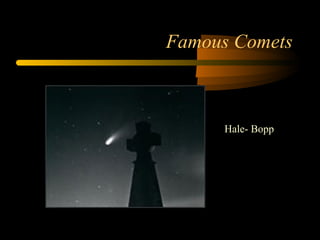
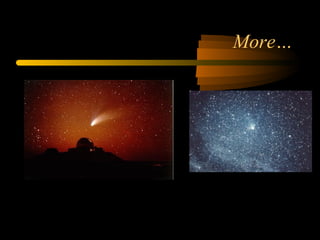
Famous Comets
Hale- Bopp
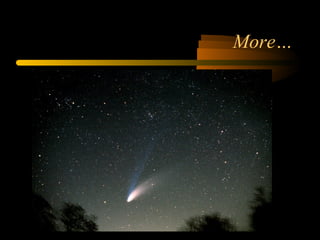
More…
More…
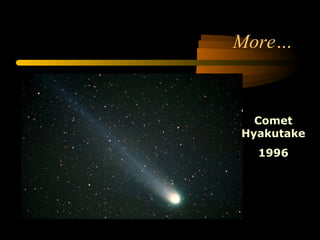
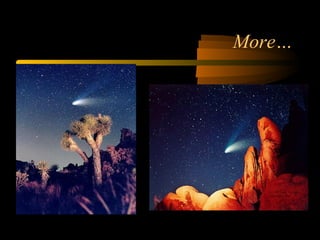
Comet
Hyakutake
1996
More…
More…
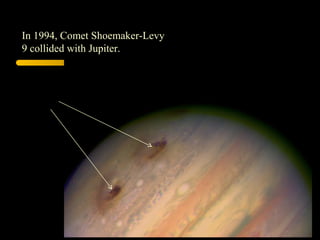
In 1994, Comet Shoemaker-Levy
9 collided with Jupiter.
Asteroid
• BrainPop
Asteroids
• Description: Rocky remains from the
formation of the solar system
• Notable Asteroids:
– Ceres – now a dwarf planet, only one in the
asteroid belt
– Vesta – can be seen without a telescope
Asteroids
• Composition:
– Rocky, iron, or rocky-iron
• Location/Orbit:
– Asteroid Belt – between Mars and Jupiter
– Trojans – orbit with a planet
– Near Earth Asteroids – cross the Earth’s orbit
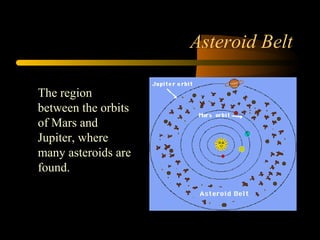
Asteroid Belt
The region
between the orbits
of Mars and
Jupiter, where
many asteroids are
found.
Asteroids
• Size: Varies from a few hundred feet to a
few hundred miles
• Jupiter’s relationship with asteroids:
– Scientists believe the asteroid belt is the
remains of a planet that never formed because
of Jupiter’s gravity
• Evidence asteroids have hit planets:
– Impact craters like the one thought to have
caused the dinosaur extinction
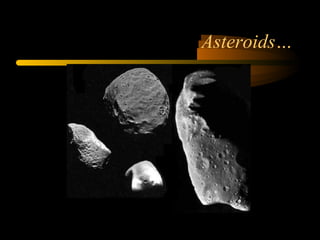
Asteroids…
Asteroids Summary
• Not all asteroids are located in the asteroids
belt and can pass near Earth
• Jupiter’s gravity kept the asteroids from
forming a planet
• Some asteroids orbit just before and after
Jupiter
• Largest asteroid, Ceres, is 580 mi across but
most are less than a few miles across
Asteroid Impacts Summary
• Scientists think an asteroid impact near
Mexico caused the dinosaur extinction.
• Chicxulub Crater in Mexico
• Video
http://www.mnh.si.edu/
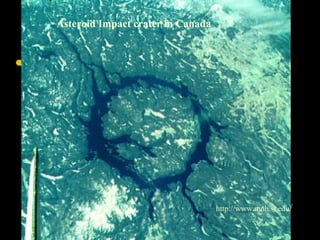
Asteroid Impact crater in Canada
Meteors
• Video
Meteors
• Description: Rocky or metal debris in
space; most no bigger than a pebble
• Meteoroid: a small chunk of rock or dust in
space
• Meteor: a streak of light in the sky
produced by the burning of a meteoroid in
Earth’s atmosphere
• Meteorite: a meteoroid that has hit Earth’s
surface
Meteoroids
• Meteoroids are small chunks of rock and
dust left over from asteroids and comets
that pass by the Earth.
• Composition: rocky, iron, or mixed
• Location/orbit: Found within the path of the
Earth’s orbit around the sun.
Meteoroids
• Types:
– Stony
– Iron
– Stony-Iron
• Meteor Shower: yearly predictable meteors
when Earth passes through comet or
asteroid debris
Meteors
• 3 types:
• Meteor: a streak of light in the sky
produced by the burning of a meteoroid in
Earth’s atmosphere
• Meteoroid: a chunk of rock or dust in space
• Meteorite: a meteoroid that has hit Earth’s
surface
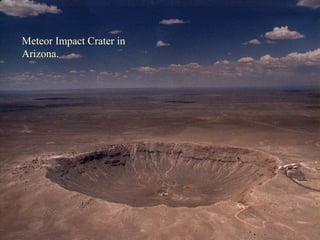
Meteor Impact Crater in
Arizona.
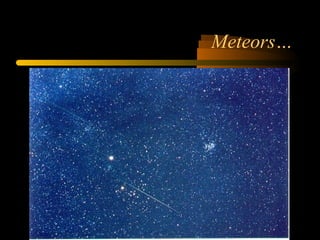
Meteors…
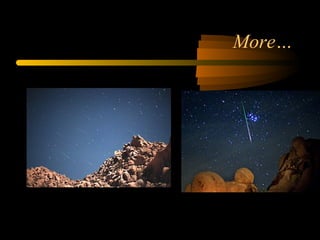
More…

Comets asteroids meteors wilson 2013 with foldable

  • 1.
    Comets, Asteroids, andMeteors- Oh My!
  • 2.
  • 3.
    Comets • Description: Coldclumps of gases and dusty ice from the outer parts of the solar system • Comet means long haired star • Called “Dirty Snowballs”
  • 4.
    Comet • 3 parts: –Nucleus – Coma – Tail: always points away from sun
  • 5.
  • 6.
    Parts Explained • Nucleus– mass of ice and frozen gas • Coma – cloud of gas that surrounds the nucleus • Tail – formed when the comet travels near the sun; it’s the nucleus vaporizing
  • 7.
    Comet Orbits • Cometshave long, narrow elliptical orbits • Short period comets are found in the Kuiper Belt • Long period comets are found in the Oort Cloud • Sometimes, comets get too close to the sun, and then…
  • 8.
  • 9.
  • 10.
  • 11.
  • 12.
  • 13.
  • 14.
    In 1994, CometShoemaker-Levy 9 collided with Jupiter.
  • 15.
  • 16.
    Asteroids • Description: Rockyremains from the formation of the solar system • Notable Asteroids: – Ceres – now a dwarf planet, only one in the asteroid belt – Vesta – can be seen without a telescope
  • 17.
    Asteroids • Composition: – Rocky,iron, or rocky-iron • Location/Orbit: – Asteroid Belt – between Mars and Jupiter – Trojans – orbit with a planet – Near Earth Asteroids – cross the Earth’s orbit
  • 18.
    Asteroid Belt The region betweenthe orbits of Mars and Jupiter, where many asteroids are found.
  • 19.
    Asteroids • Size: Variesfrom a few hundred feet to a few hundred miles • Jupiter’s relationship with asteroids: – Scientists believe the asteroid belt is the remains of a planet that never formed because of Jupiter’s gravity • Evidence asteroids have hit planets: – Impact craters like the one thought to have caused the dinosaur extinction
  • 20.
  • 21.
    Asteroids Summary • Notall asteroids are located in the asteroids belt and can pass near Earth • Jupiter’s gravity kept the asteroids from forming a planet • Some asteroids orbit just before and after Jupiter • Largest asteroid, Ceres, is 580 mi across but most are less than a few miles across
  • 22.
    Asteroid Impacts Summary •Scientists think an asteroid impact near Mexico caused the dinosaur extinction. • Chicxulub Crater in Mexico • Video
  • 23.
  • 24.
  • 25.
    Meteors • Description: Rockyor metal debris in space; most no bigger than a pebble • Meteoroid: a small chunk of rock or dust in space • Meteor: a streak of light in the sky produced by the burning of a meteoroid in Earth’s atmosphere • Meteorite: a meteoroid that has hit Earth’s surface
  • 26.
    Meteoroids • Meteoroids aresmall chunks of rock and dust left over from asteroids and comets that pass by the Earth. • Composition: rocky, iron, or mixed • Location/orbit: Found within the path of the Earth’s orbit around the sun.
  • 27.
    Meteoroids • Types: – Stony –Iron – Stony-Iron • Meteor Shower: yearly predictable meteors when Earth passes through comet or asteroid debris
  • 28.
    Meteors • 3 types: •Meteor: a streak of light in the sky produced by the burning of a meteoroid in Earth’s atmosphere • Meteoroid: a chunk of rock or dust in space • Meteorite: a meteoroid that has hit Earth’s surface Meteor Impact Crater in Arizona.
  • 29.
  • 30.