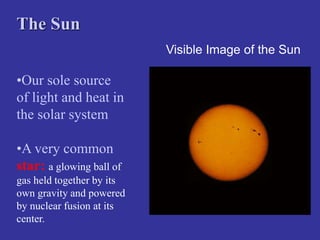
Visible Image of the Sun
The Sun
•Our sole source
of light and heat in
the solar system
•A very common
star: a glowing ball of
gas held together by its
own gravity and powered
by nuclear fusion at its
center.
Pressure (from heat
caused by nuclear
reactions) balances the
gravitational pull
toward the Sun’s center.
Called “Hydrostatic
Equilibrium.
This balance leads to a
spherical ball of gas,
called the Sun.
What would happen if
the nuclear reactions
(“burning”) stopped?
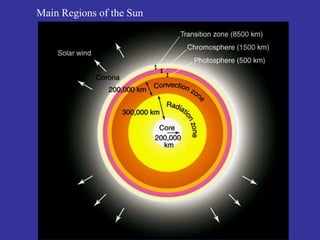
Main Regions of the Sun
Radius = 696,000 km
(100 times Earth)
Mass = 2 x 1030 kg
(300,000 times Earth)
Av. Density = 1410 kg/m3
Rotation Period =
24.9 days (equator)
29.8 days (poles)
Surface temp = 5780 K
Solar Properties
The Moon’s orbit around the
Earth would easily fit within
the Sun!
Luminosity of the Sun
= LSUN
Solar constant:
LSUN / 4R2
(energy/second/area
at the radius of
Earth’s orbit)
(Total light energy
emitted per second)
~ 4 x 1026 W
100 billion one-
megaton nuclear bombs
every second!
The Solar Interior
“Helioseismology”
•In the 1960s, it was
discovered that the
surface of the Sun
vibrates like a bell
•Internal pressure
waves reflect off the
photosphere
•Analysis of the
surface patterns of
these waves tell us
about the inside of the
Sun
How do we know the interior
structure of the Sun?
The Standard Solar Model
Energy Transport within the Sun
• Extremely hot core - ionized gas
• No electrons left on atoms to capture photons - core/interior is transparent to
light (radiation zone)
• Temperature falls further from core - more and more non-ionized atoms
capture the photons - gas becomes opaque to light in the convection zone
• The low density in the photosphere makes it transparent to light - radiation
takes over again
Convection
 Convection takes over when
the gas is too opaque for
radiative energy transport.
 Hot gas is less dense and
rises (or “floats,” like a hot air
balloon or a beach ball in a
pool).
 Cool gas is more dense and
sinks
Solar Granulation
Evidence for
Convection
 Solar Granules are the tops of convection cells.
 Bright regions are where hot material is upwelling
(1000 km across).
 Dark regions are where cooler material is sinking.
 Material rises/sinks @ ~1 km/sec (2200 mph; Doppler).
 The solar spectrum has
thousands of absorption
lines
 More than 67 different
elements are present!
 Hydrogen is the most
abundant element followed
by Helium (1st discovered
in the Sun!)
The Solar Atmosphere
Spectral lines only tell us about the part of the Sun that
forms them (photosphere and chromosphere) but these
elements are also thought to be representative of the entire
Sun.
Chromosphere
Chromosphere (seen during full Solar eclipse)
 Chromosphere emits very little light because it is of low density
 Reddish hue due to 32 (656.3 nm) line emission from Hydrogen
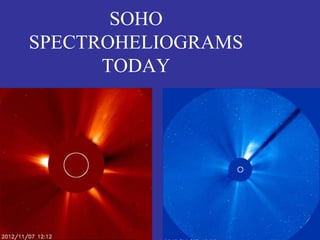
SOHO
SPECTROHELIOGRAMS
TODAY
Chromospheric Spicules:
warm jets of matter
shooting out at ~100 km/s
last only minutes
Spicules are thought to the
result of magnetic
disturbances
H light
Transition Zone and Corona
Transition Zone
& Corona
 Why does the Temperature rise further from the hot light source?
We see emission
lines from highly
ionized elements
(Fe+5
– Fe+13
) which
indicates that the
temperature here is
very HOT
Very low density,
T ~ 106
K
 magnetic “activity” -spicules and other more energetic
phenomena (more about this later…)
Corona (seen during full Solar eclipse)
Hot coronal gas
escapes the Sun
 Solar wind
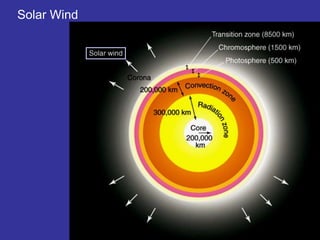
Solar Wind
Solar Wind
 Coronal gas has enough heat (kinetic) energy to escape the
Sun’s gravity.
 The Sun is evaporating via this “wind”.
Solar wind travels at ~500 km/s, reaching Earth in ~3 days
 The Sun loses about 1 million tons of matter each second!
However, over the Sun’s lifetime, it has lost only ~0.1% of
its total mass.
Hot coronal gas (~1,000,000 K) emits mostly in X-rays.
Coronal holes
are sources of
the solar wind
(lower density
regions)
Coronal holes
are related to the
Sun’s magnetic
field
Most of theSolar luminosity is continuous photosphere emission.
But, there is an irregular component
(contributing little to the Sun’s total luminosity).
The Active Sun
UV light
Sunspots
Granulation around sunspot
Sunspots
• Typically about 10000 km
across
• At any time, the sun may
have hundreds or none
• Dark color because they
are cooler than photospheric
gas (4500K in darkest parts)
• Each spot can last from a few days to a few months
• Galileo observed these spots and realized the sun is rotating
differentially (faster at the poles, slower at the equator)
Sunspots &
Magnetic Fields
•The magnetic field in a sunspot
is 1000x greater than the
surrounding area
•Sunspots are almost always in
pairs at the same latitude with
each member having opposite
polarity
•All sunspots in the same
hemisphere have the same
magnetic configuration
SOLAR MAGNETOGRAM
11/13/12
The Sun’s differential rotation distorts the magnetic field lines
The twisted and tangled field lines occasionally get kinked, causing the field
strength to increase
“tube” of lines bursts through atmosphere creating sunspot pair
Sunspot Cycle
Solar Cycle is 22 years long – direction of magnetic field
polarity flips every 11 years (back to original orientation every 22 years)
Solar maximum is
reached every ~11 years
 Charged particles (mostly
protons and electrons) are
accelerated along magnetic field
“lines” above sunspots.
 This type of activity, not light
energy, heats the corona.
Heating of the Corona
Charged particles follow magnetic fields between sunspots:
Solar Prominences
Sunspots are cool,
but the gas above
them is hot!
Earth
Solar Prominence
Typical size is 100,000 km
May persist for days or weeks
The Sun
November 14, 2011
Very large solar prominence (1/2 million km across base,
i.e. 39 Earth diameters) taken from Skylab in UV light.
Solar Flare and Resulting
Prominence
Solar Plages and Filaments
Solar Flare, Prominence and
Filament
Coronal
activity
increases
with the
number of
sunspots.
SOLAR-TERRESTRIAL RELATIONSHIPS
• AURORAE
• SOLAR WIND
• MAGNETIC STORMS
• RADIO FADEOUTS
• COSMIC RAYS
• WEATHER (?)
The Proton-Proton
Chain:
4 H
He
What makes the Sun shine?
Nuclear Fusion
E = m c 2
(c = speed of light)
But where does the
Energy come from?
 c2
is a very large number!
 A little mass equals a LOT of energy.
Example:
 1 gram of matter  1014
Joules (J) of energy.
 Enough to power a 100 Watt light bulb for ~32,000 years!
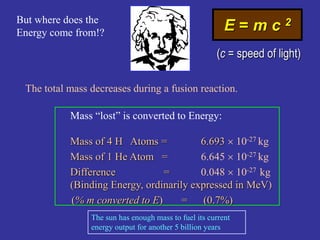
Mass “lost” is converted to Energy:
Mass of 4 H Atoms = 6.693  10-27 kg
Mass of 1 He Atom = 6.645  10-27 kg
Difference = 0.048  10-27 kg
(Binding Energy, ordinarily expressed in MeV)
(% m converted to E) = (0.7%)
E = m c 2
(c = speed of light)
But where does the
Energy come from!?
The total mass decreases during a fusion reaction.
The sun has enough mass to fuel its current
energy output for another 5 billion years
 Nuclear fusion requires temperatures
of at least 107
K – why?
 Atomic nuclei are positively charged
 they repel via the electromagnetic
force.
 Merging nuclei (protons in
Hydrogen) require high speeds.
 (Higher temperature – faster motion)
 At very close range, the strong nuclear force takes over,
binding protons and neutrons together (FUSION).
 Neutrinos are one byproduct.
Neutrinos are almost
non-interacting with
matter… So they
stream out freely.
Neutrinos provide important tests of nuclear energy generation.
The energy output from the core of the sun is in the form of
gammy rays. These are transformed into visible and IR light by
the time they reach the surface (after interactions with particles in the Sun).
Solar Neutrino Problem: There
are fewer observed neutrinos
than theory predicts (!)
A discrepancy between theory
and experiments could mean we
have the Sun’s core temperature
wrong.
But probably means we have
more to learn about neutrinos!
(Neutrinos might “oscillate”
into something else, a little like
radioactive decays…)
Detecting Solar Neutrinos – these light detectors measure photons
emitted by rare chlorine-neutrino reactions in the fluid.

The_Sun.ppt

  • 1.
    Visible Image ofthe Sun The Sun •Our sole source of light and heat in the solar system •A very common star: a glowing ball of gas held together by its own gravity and powered by nuclear fusion at its center.
  • 2.
    Pressure (from heat causedby nuclear reactions) balances the gravitational pull toward the Sun’s center. Called “Hydrostatic Equilibrium. This balance leads to a spherical ball of gas, called the Sun. What would happen if the nuclear reactions (“burning”) stopped?
  • 3.
  • 4.
    Radius = 696,000km (100 times Earth) Mass = 2 x 1030 kg (300,000 times Earth) Av. Density = 1410 kg/m3 Rotation Period = 24.9 days (equator) 29.8 days (poles) Surface temp = 5780 K Solar Properties The Moon’s orbit around the Earth would easily fit within the Sun!
  • 5.
    Luminosity of theSun = LSUN Solar constant: LSUN / 4R2 (energy/second/area at the radius of Earth’s orbit) (Total light energy emitted per second) ~ 4 x 1026 W 100 billion one- megaton nuclear bombs every second!
  • 6.
    The Solar Interior “Helioseismology” •Inthe 1960s, it was discovered that the surface of the Sun vibrates like a bell •Internal pressure waves reflect off the photosphere •Analysis of the surface patterns of these waves tell us about the inside of the Sun How do we know the interior structure of the Sun?
  • 7.
  • 8.
    Energy Transport withinthe Sun • Extremely hot core - ionized gas • No electrons left on atoms to capture photons - core/interior is transparent to light (radiation zone) • Temperature falls further from core - more and more non-ionized atoms capture the photons - gas becomes opaque to light in the convection zone • The low density in the photosphere makes it transparent to light - radiation takes over again
  • 9.
    Convection  Convection takesover when the gas is too opaque for radiative energy transport.  Hot gas is less dense and rises (or “floats,” like a hot air balloon or a beach ball in a pool).  Cool gas is more dense and sinks
  • 10.
    Solar Granulation Evidence for Convection Solar Granules are the tops of convection cells.  Bright regions are where hot material is upwelling (1000 km across).  Dark regions are where cooler material is sinking.  Material rises/sinks @ ~1 km/sec (2200 mph; Doppler).
  • 11.
     The solarspectrum has thousands of absorption lines  More than 67 different elements are present!  Hydrogen is the most abundant element followed by Helium (1st discovered in the Sun!) The Solar Atmosphere Spectral lines only tell us about the part of the Sun that forms them (photosphere and chromosphere) but these elements are also thought to be representative of the entire Sun.
  • 12.
  • 13.
    Chromosphere (seen duringfull Solar eclipse)  Chromosphere emits very little light because it is of low density  Reddish hue due to 32 (656.3 nm) line emission from Hydrogen
  • 14.
  • 15.
    Chromospheric Spicules: warm jetsof matter shooting out at ~100 km/s last only minutes Spicules are thought to the result of magnetic disturbances H light
  • 16.
  • 17.
    Transition Zone & Corona Why does the Temperature rise further from the hot light source? We see emission lines from highly ionized elements (Fe+5 – Fe+13 ) which indicates that the temperature here is very HOT Very low density, T ~ 106 K  magnetic “activity” -spicules and other more energetic phenomena (more about this later…)
  • 18.
    Corona (seen duringfull Solar eclipse) Hot coronal gas escapes the Sun  Solar wind
  • 19.
  • 20.
    Solar Wind  Coronalgas has enough heat (kinetic) energy to escape the Sun’s gravity.  The Sun is evaporating via this “wind”. Solar wind travels at ~500 km/s, reaching Earth in ~3 days  The Sun loses about 1 million tons of matter each second! However, over the Sun’s lifetime, it has lost only ~0.1% of its total mass.
  • 21.
    Hot coronal gas(~1,000,000 K) emits mostly in X-rays. Coronal holes are sources of the solar wind (lower density regions) Coronal holes are related to the Sun’s magnetic field
  • 22.
    Most of theSolarluminosity is continuous photosphere emission. But, there is an irregular component (contributing little to the Sun’s total luminosity). The Active Sun UV light
  • 23.
  • 24.
    Sunspots • Typically about10000 km across • At any time, the sun may have hundreds or none • Dark color because they are cooler than photospheric gas (4500K in darkest parts) • Each spot can last from a few days to a few months • Galileo observed these spots and realized the sun is rotating differentially (faster at the poles, slower at the equator)
  • 25.
    Sunspots & Magnetic Fields •Themagnetic field in a sunspot is 1000x greater than the surrounding area •Sunspots are almost always in pairs at the same latitude with each member having opposite polarity •All sunspots in the same hemisphere have the same magnetic configuration
  • 26.
  • 28.
    The Sun’s differentialrotation distorts the magnetic field lines The twisted and tangled field lines occasionally get kinked, causing the field strength to increase “tube” of lines bursts through atmosphere creating sunspot pair
  • 29.
    Sunspot Cycle Solar Cycleis 22 years long – direction of magnetic field polarity flips every 11 years (back to original orientation every 22 years) Solar maximum is reached every ~11 years
  • 32.
     Charged particles(mostly protons and electrons) are accelerated along magnetic field “lines” above sunspots.  This type of activity, not light energy, heats the corona. Heating of the Corona
  • 33.
    Charged particles followmagnetic fields between sunspots: Solar Prominences Sunspots are cool, but the gas above them is hot!
  • 34.
    Earth Solar Prominence Typical sizeis 100,000 km May persist for days or weeks
  • 35.
  • 36.
    Very large solarprominence (1/2 million km across base, i.e. 39 Earth diameters) taken from Skylab in UV light.
  • 37.
    Solar Flare andResulting Prominence
  • 38.
  • 39.
  • 40.
  • 41.
    SOLAR-TERRESTRIAL RELATIONSHIPS • AURORAE •SOLAR WIND • MAGNETIC STORMS • RADIO FADEOUTS • COSMIC RAYS • WEATHER (?)
  • 42.
    The Proton-Proton Chain: 4 H He Whatmakes the Sun shine? Nuclear Fusion
  • 43.
    E = mc 2 (c = speed of light) But where does the Energy come from?  c2 is a very large number!  A little mass equals a LOT of energy. Example:  1 gram of matter  1014 Joules (J) of energy.  Enough to power a 100 Watt light bulb for ~32,000 years!
  • 44.
    Mass “lost” isconverted to Energy: Mass of 4 H Atoms = 6.693  10-27 kg Mass of 1 He Atom = 6.645  10-27 kg Difference = 0.048  10-27 kg (Binding Energy, ordinarily expressed in MeV) (% m converted to E) = (0.7%) E = m c 2 (c = speed of light) But where does the Energy come from!? The total mass decreases during a fusion reaction. The sun has enough mass to fuel its current energy output for another 5 billion years
  • 45.
     Nuclear fusionrequires temperatures of at least 107 K – why?  Atomic nuclei are positively charged  they repel via the electromagnetic force.  Merging nuclei (protons in Hydrogen) require high speeds.  (Higher temperature – faster motion)  At very close range, the strong nuclear force takes over, binding protons and neutrons together (FUSION).  Neutrinos are one byproduct.
  • 46.
    Neutrinos are almost non-interactingwith matter… So they stream out freely. Neutrinos provide important tests of nuclear energy generation. The energy output from the core of the sun is in the form of gammy rays. These are transformed into visible and IR light by the time they reach the surface (after interactions with particles in the Sun).
  • 47.
    Solar Neutrino Problem:There are fewer observed neutrinos than theory predicts (!) A discrepancy between theory and experiments could mean we have the Sun’s core temperature wrong. But probably means we have more to learn about neutrinos! (Neutrinos might “oscillate” into something else, a little like radioactive decays…) Detecting Solar Neutrinos – these light detectors measure photons emitted by rare chlorine-neutrino reactions in the fluid.