
COMETS
Prepared By:- Kishan V
WHAT ARE COMETS?


ar From Pluto There is a group of about
millions of celestials objects. It is know
as cloud of Oort or Kuiper-belt . These
objects due to some reasons start moving
towards the sun. They are known as
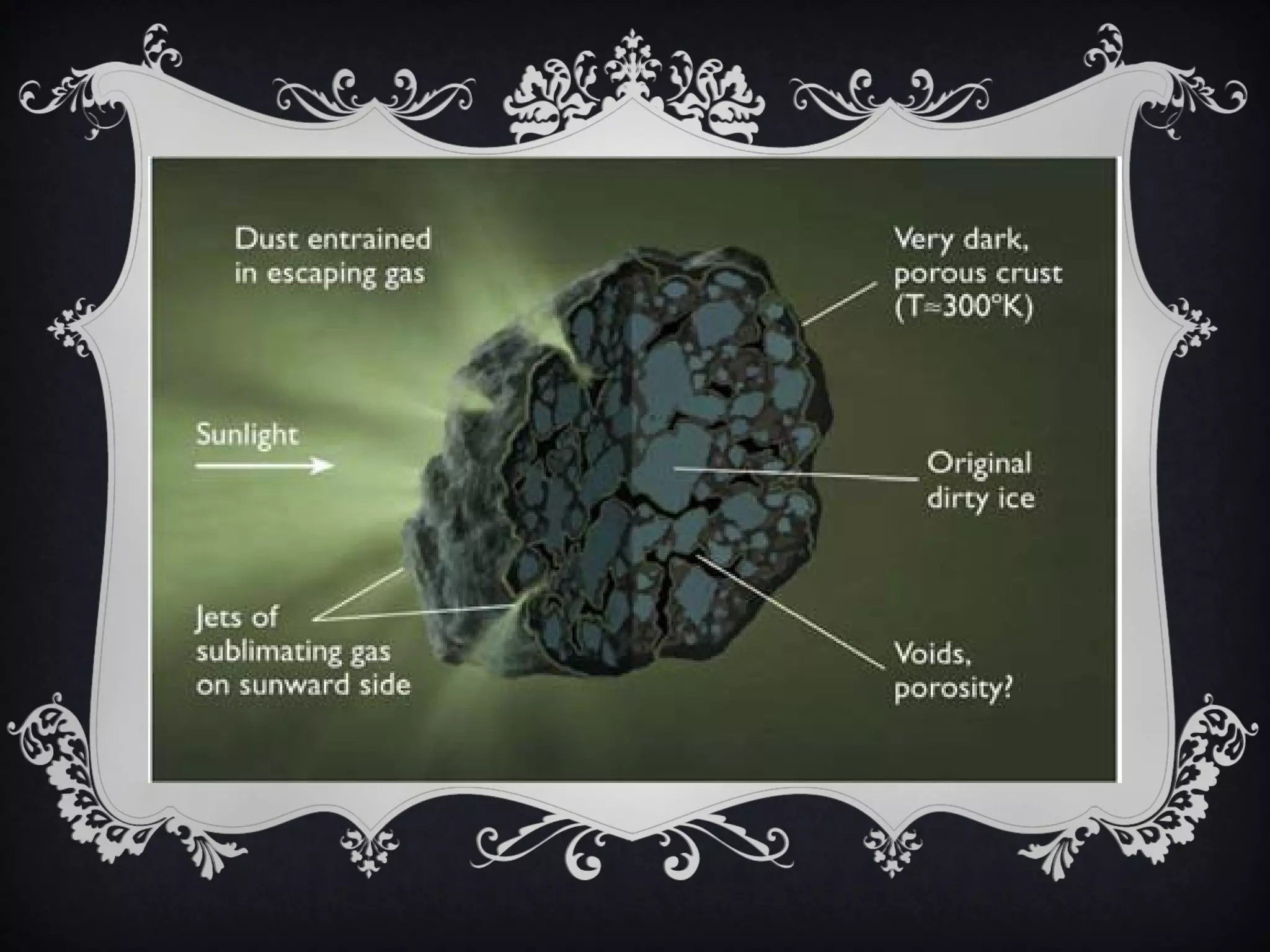
comets. Comet are made up of dust and
icy rocks.
COMET TAIL

hen the comet starts moving towards
the sun the ice which is frozen around
the nucleus of the comet starts melting.
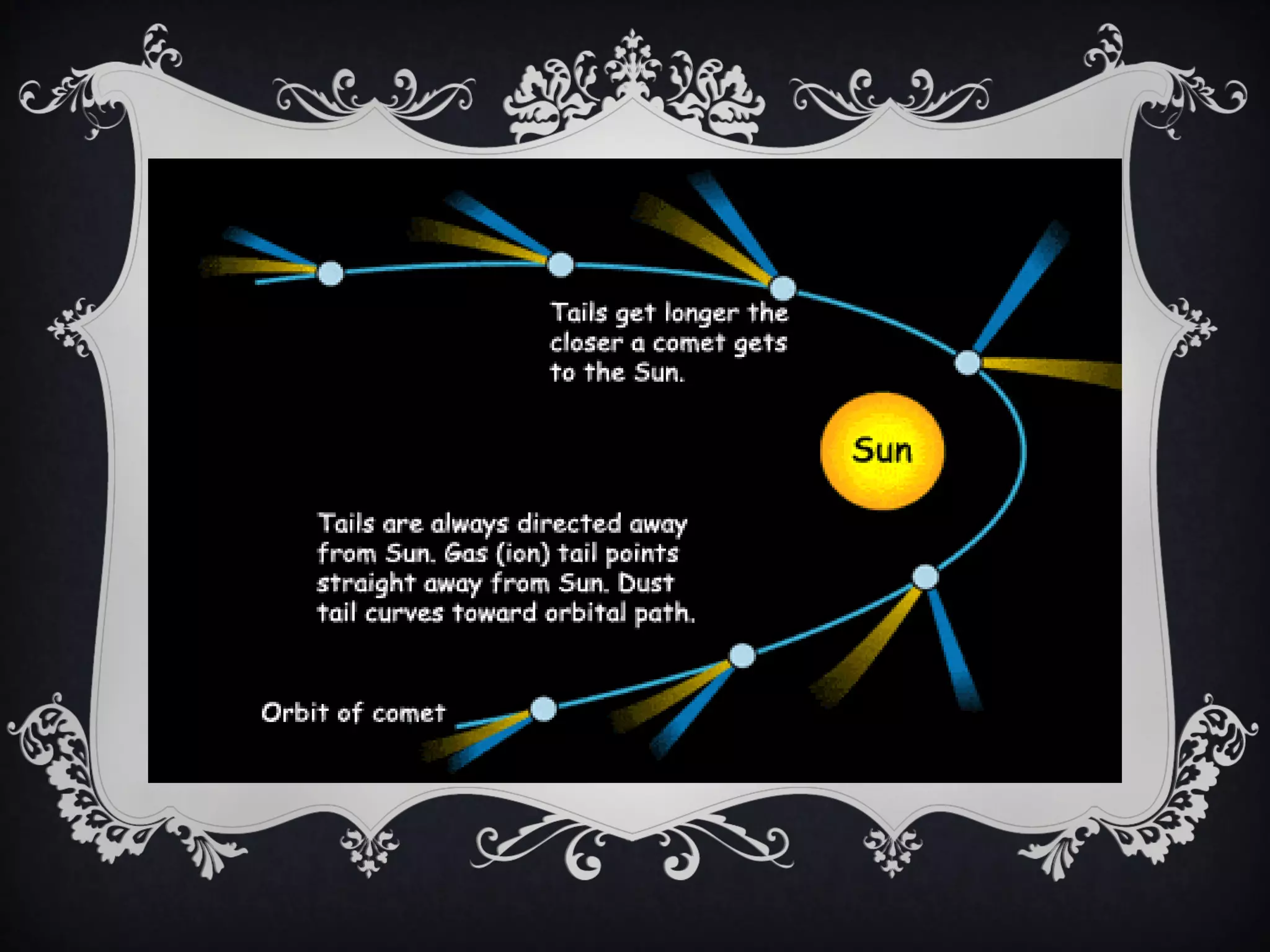
When the comet is near to the sun the
tail of it is longest and when it starts
moving far from the sun the tail becomes
shorter And last it vanishes.
TWO TYPES OF TAILS
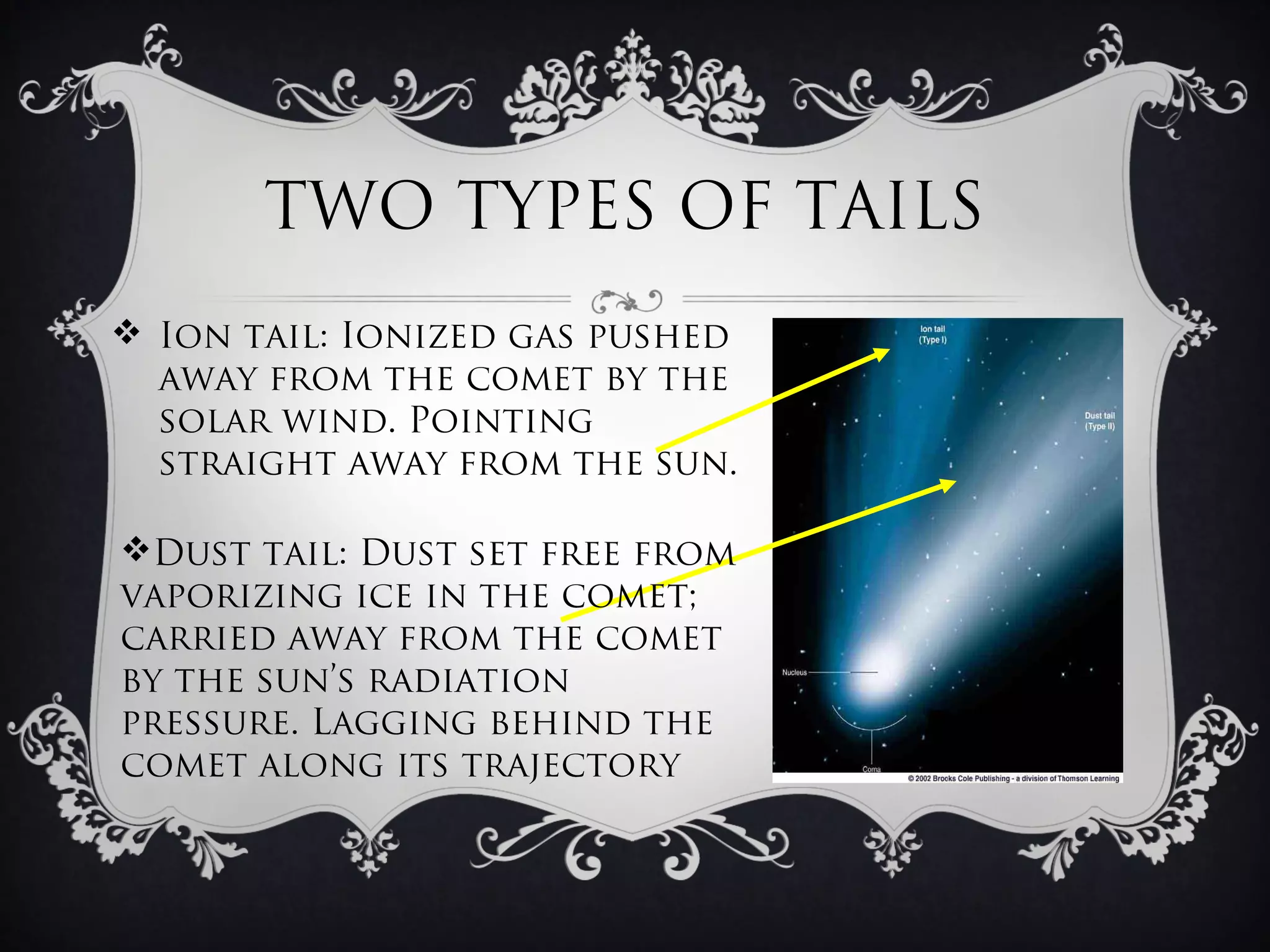
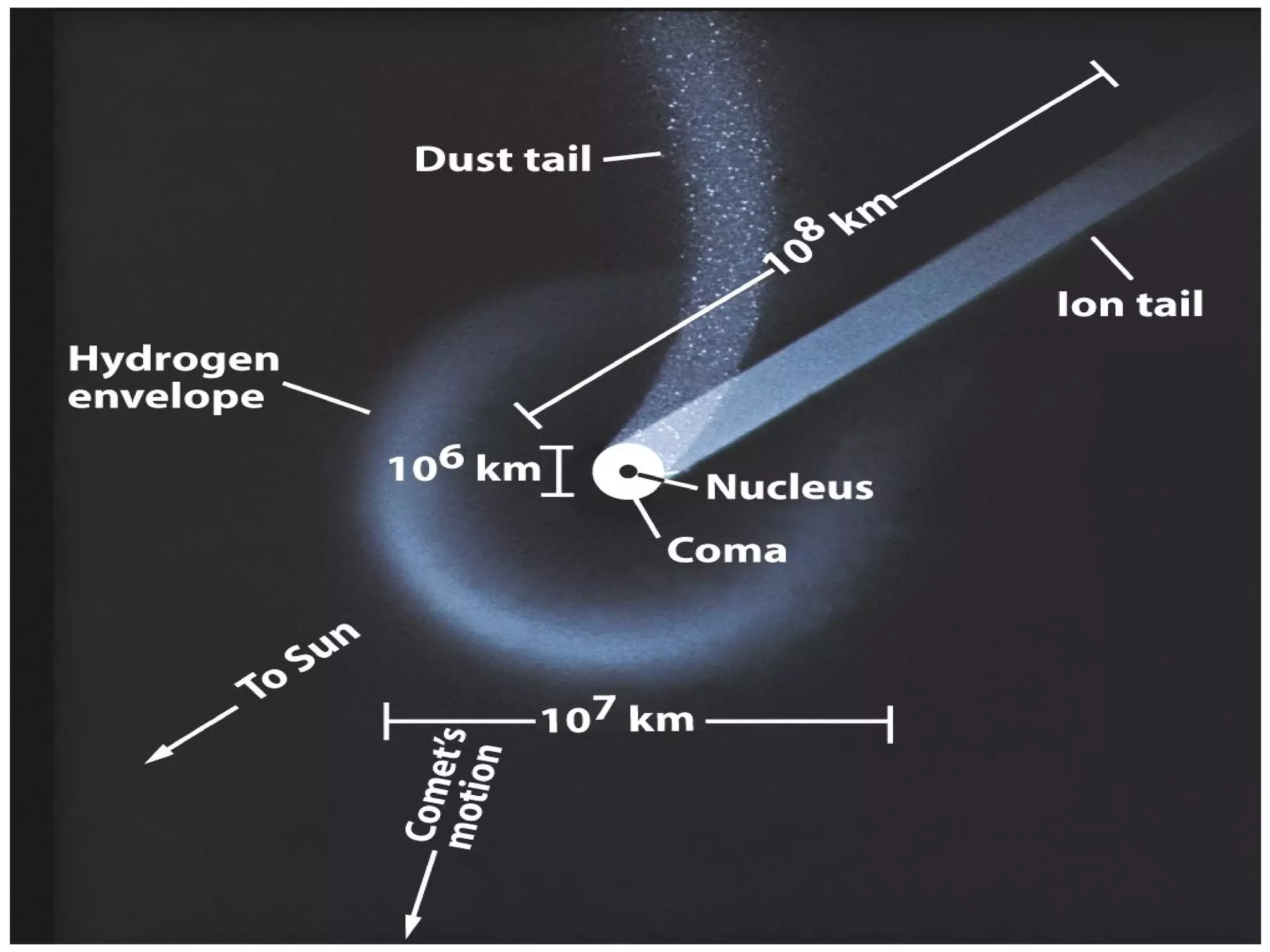
 Ion tail: Ionized gas pushed
  away from the comet by the
  solar wind. Pointing
  straight away from the sun.

Dust tail: Dust set free from
vaporizing ice in the comet;
carried away from the comet
by the sun’s radiation
pressure. Lagging behind the
comet along its trajectory
TAILED-STAR


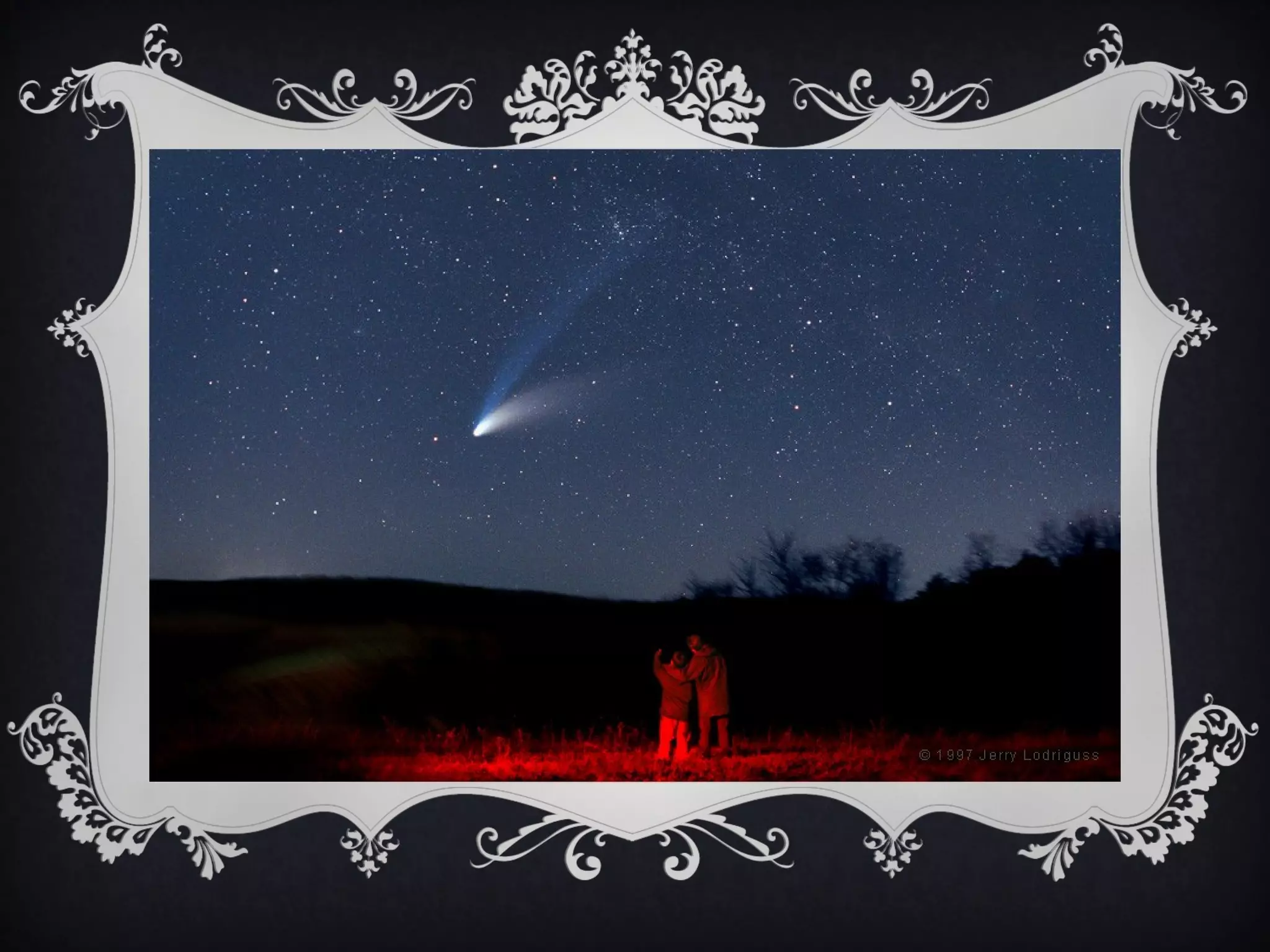
f we see from the earth we see the tail is
seen with the comet so it is know as a
Tailed-star.


n fact it is not a star and its tail is not
permanent.
HALLEY’S COMET

ar from orbits of more than750 comets
are know.


he most famous comet is Halley’s comet.


t visits our solar family every 76 years.


t was last seen in 1996.
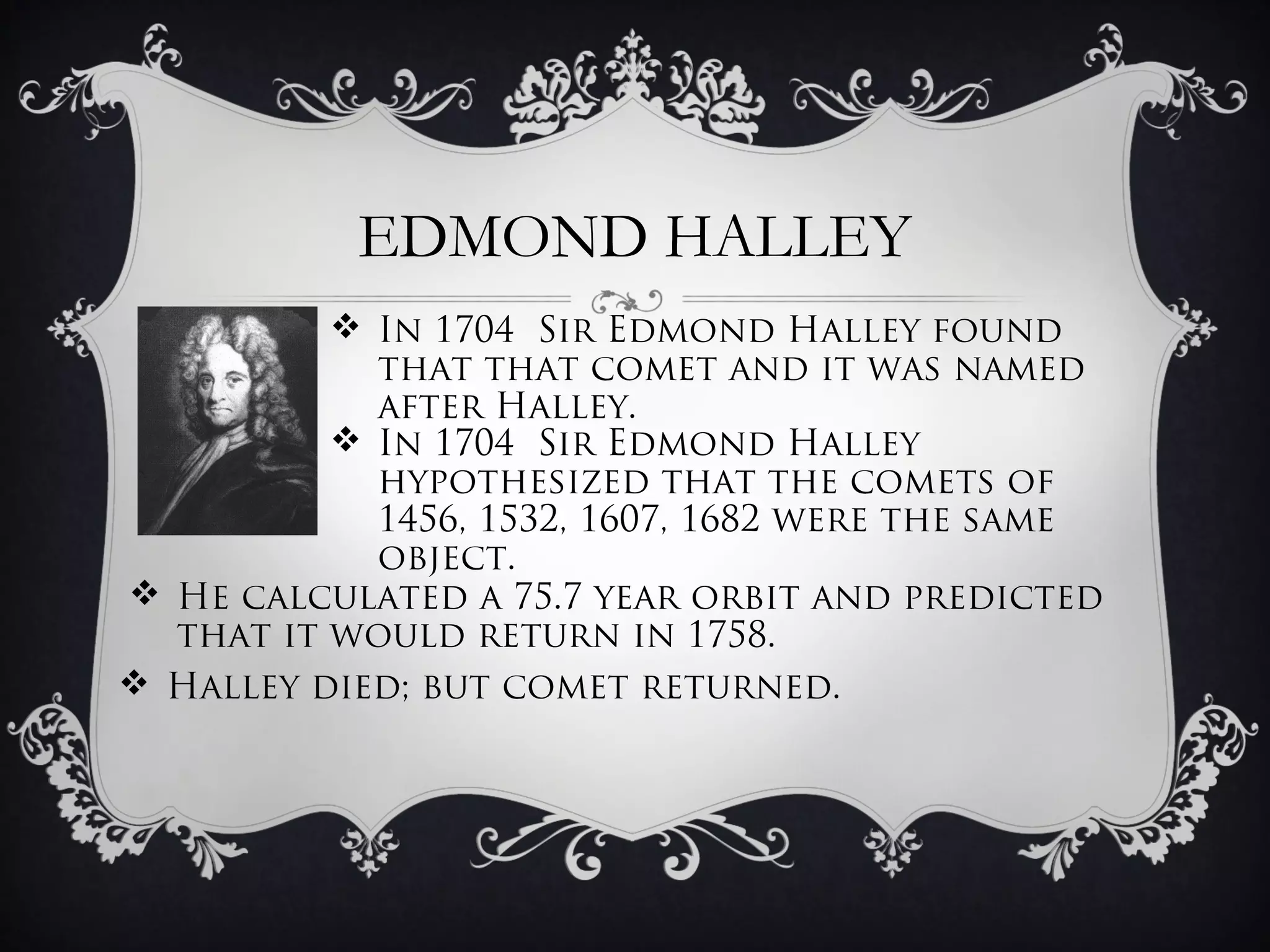
EDMOND HALLEY
           In 1704 Sir Edmond Halley found
            that that comet and it was named
            after Halley.
           In 1704 Sir Edmond Halley
            hypothesized that the comets of
            1456, 1532, 1607, 1682 were the same
            object.
 He calculated a 75.7 year orbit and predicted
  that it would return in 1758.
 Halley died; but comet returned.
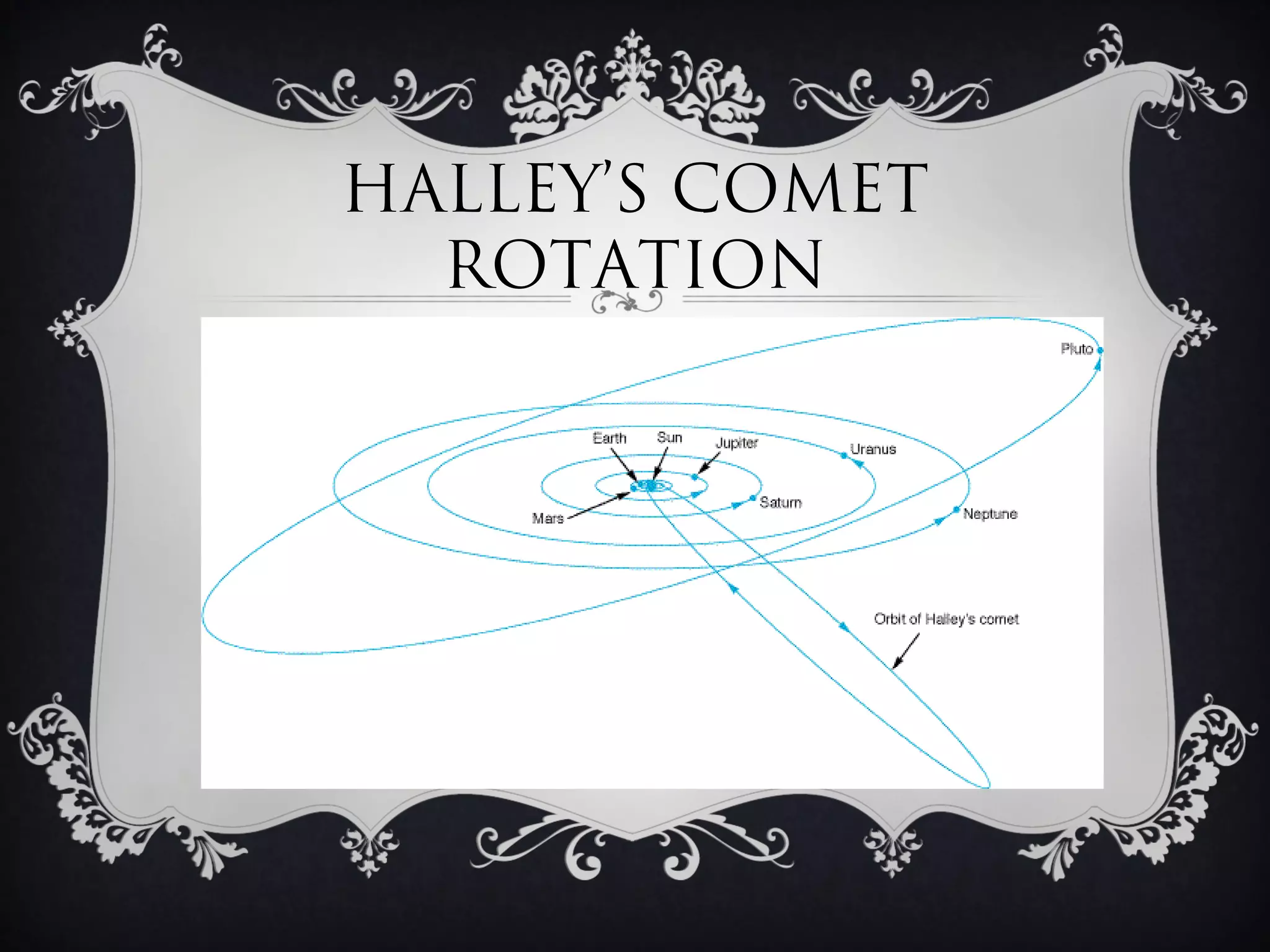
HALLEY’S COMET
  ROTATION
COMPOSITION OF COMET

ces
• H2O, Carbon Monoxide (CO), Methanol(CH3OH), and other
  frozen materials
 Minerals
      •   Silicate minerals


omplex organic molecules and dust particles
•   C=Carbon
•   H=Hydrogen
•   O=Oxygen
•   N=Nitrogen
COMET AS BAD LUCK IN
         OLD AGE
In ancient days arrival of the comet was
considered to be responsiblefor war, epidemic
or a natural calamity like flood.

But mordern science has proved that arrival
and departure of a comet is just a normal event
and there is no need to panic about it.
THANK YOU

Comet

  • 1.
  • 2.
    WHAT ARE COMETS? arFrom Pluto There is a group of about millions of celestials objects. It is know as cloud of Oort or Kuiper-belt . These objects due to some reasons start moving towards the sun. They are known as comets. Comet are made up of dust and icy rocks.
  • 3.
    COMET TAIL hen thecomet starts moving towards the sun the ice which is frozen around the nucleus of the comet starts melting. When the comet is near to the sun the tail of it is longest and when it starts moving far from the sun the tail becomes shorter And last it vanishes.
  • 5.
    TWO TYPES OFTAILS  Ion tail: Ionized gas pushed away from the comet by the solar wind. Pointing straight away from the sun. Dust tail: Dust set free from vaporizing ice in the comet; carried away from the comet by the sun’s radiation pressure. Lagging behind the comet along its trajectory
  • 6.
    TAILED-STAR f we seefrom the earth we see the tail is seen with the comet so it is know as a Tailed-star. n fact it is not a star and its tail is not permanent.
  • 9.
    HALLEY’S COMET ar fromorbits of more than750 comets are know. he most famous comet is Halley’s comet. t visits our solar family every 76 years. t was last seen in 1996.
  • 10.
    EDMOND HALLEY  In 1704 Sir Edmond Halley found that that comet and it was named after Halley.  In 1704 Sir Edmond Halley hypothesized that the comets of 1456, 1532, 1607, 1682 were the same object.  He calculated a 75.7 year orbit and predicted that it would return in 1758.  Halley died; but comet returned.
  • 11.
  • 12.
    COMPOSITION OF COMET ces •H2O, Carbon Monoxide (CO), Methanol(CH3OH), and other frozen materials  Minerals • Silicate minerals omplex organic molecules and dust particles • C=Carbon • H=Hydrogen • O=Oxygen • N=Nitrogen
  • 14.
    COMET AS BADLUCK IN OLD AGE In ancient days arrival of the comet was considered to be responsiblefor war, epidemic or a natural calamity like flood. But mordern science has proved that arrival and departure of a comet is just a normal event and there is no need to panic about it.
  • 15.