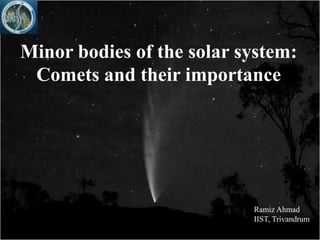
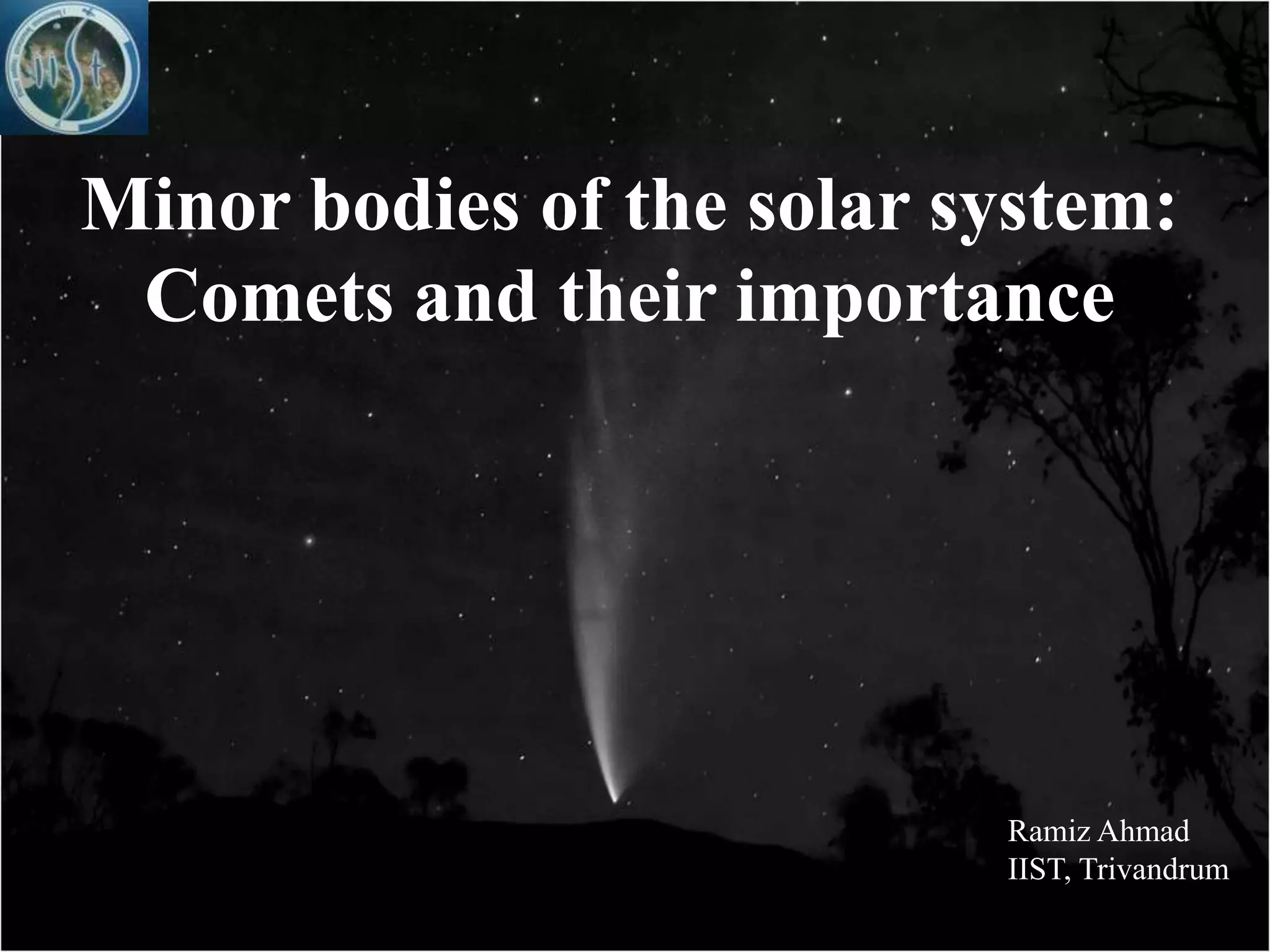
Minor bodies of the solar system:
 Comets and their importance


                           Ramiz Ahmad
                           IIST, Trivandrum
Plan of the talk:

•Introduction
•Historical view point
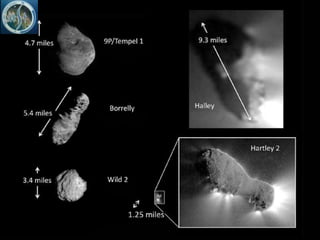
•Structure of comets
•Origin.
•Reasons for studying comets
•Missions for comets
•Conclusion
Introduction:
Comets: Dirty Balls of Ice

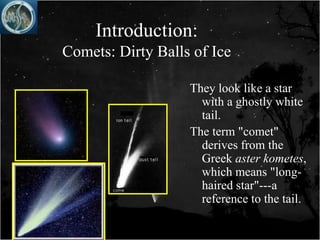
                   They look like a star
                     with a ghostly white
                     tail.
                   The term "comet"
                     derives from the
                     Greek aster kometes,
                     which means "long-
                     haired star"---a
                     reference to the tail.
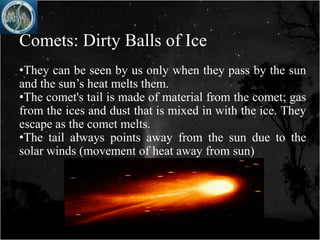
Comets: Dirty Balls of Ice
•They can be seen by us only when they pass by the sun
and the sun’s heat melts them.
•The comet's tail is made of material from the comet; gas
from the ices and dust that is mixed in with the ice. They
escape as the comet melts.
•The tail always points away from the sun due to the
solar winds (movement of heat away from sun)
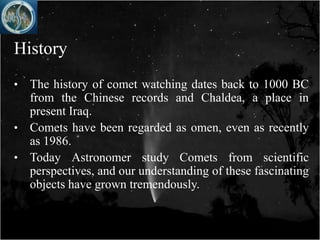
History
• The history of comet watching dates back to 1000 BC
  from the Chinese records and Chaldea, a place in
  present Iraq.
• Comets have been regarded as omen, even as recently
  as 1986.
• Today Astronomer study Comets from scientific
  perspectives, and our understanding of these fascinating
  objects have grown tremendously.
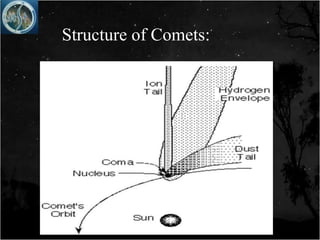
Structure of Comets:
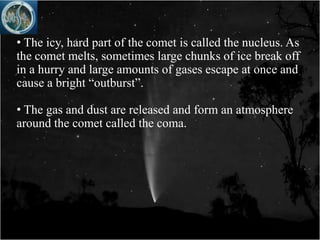
• The icy, hard part of the comet is called the nucleus. As
the comet melts, sometimes large chunks of ice break off
in a hurry and large amounts of gases escape at once and
cause a bright “outburst”.

• The gas and dust are released and form an atmosphere
around the comet called the coma.
Importance of studying Comets:

• The study of the composition of the comets gives an idea
of the composition of the solar system in the early stages of
the solar system.
•Life on earth is theorized to have been seeded by the
comets. A detailed study will provide with sufficient
evidence to either support or reject the theory.
Missions for comets
•New Horizons - NASA Pluto and Kuiper Belt mission
•Deep Impact/EPOXI - NASA Flyby of Comets
P/Tempel 1 and Hartley 2 (2005)
•Rosetta - ESA Mission to Comet Churyumov-
Gerasimenko (2004)
•CONTOUR - NASA Mission to fly by three comet
nuclei (2002)
•Genesis - NASA Discovery Solar Wind Sample Return
Mission (2001)
•Stardust - NASA Discovery Mission to collect samples
from Comet P/Wild 2 (1999)
•Deep Space 1 - NASA Flyby Mission to comet Borrelly
and asteroid Braille (1998)
•Galileo - NASA Mission to Jupiter, imaged Comet
Shoemaker-Levy 9 Impact (1989)
•Giotto - ESA mission to Comets Halley and Grigg-
Skjellerup
•ICE (ISEE-3) - NASA Mission to Comet Giacobini-
Zinner
•Sakigake - Japanese ISAS mission to Comet Halley
•Suisei - Japanese ISAS mission to Comet Halley
•Vega 1 - Soviet mission to Venus and Comet Halley
•Vega 2 - Soviet mission to Venus and Comet Halley
References:
• www.wikipedia.org
• Chapman, C. R.; Morrison, D.; Zellner, B. (1975).
  "Surface properties of asteroids: A synthesis of
  polarimetry, radiometry, and
  spectrophotometry". Icarus 25 (1): 104–
  130. Bibcode 1975Icar...25..104C.doi:10.1016/0019-
  1035(75)90191-8.
• http://solarsystem.nasa.gov/
• "Lagrange Points" by Enrique Zeleny, Wolfram
  Demonstrations Project.
Thank You for your Patience!!!

Minor bodies of the solar system: Comets and their importance

  • 1.
    Minor bodies ofthe solar system: Comets and their importance Ramiz Ahmad IIST, Trivandrum
  • 2.
    Plan of thetalk: •Introduction •Historical view point •Structure of comets •Origin. •Reasons for studying comets •Missions for comets •Conclusion
  • 3.
    Introduction: Comets: Dirty Ballsof Ice They look like a star with a ghostly white tail. The term "comet" derives from the Greek aster kometes, which means "long- haired star"---a reference to the tail.
  • 4.
    Comets: Dirty Ballsof Ice •They can be seen by us only when they pass by the sun and the sun’s heat melts them. •The comet's tail is made of material from the comet; gas from the ices and dust that is mixed in with the ice. They escape as the comet melts. •The tail always points away from the sun due to the solar winds (movement of heat away from sun)
  • 5.
    History • The historyof comet watching dates back to 1000 BC from the Chinese records and Chaldea, a place in present Iraq. • Comets have been regarded as omen, even as recently as 1986. • Today Astronomer study Comets from scientific perspectives, and our understanding of these fascinating objects have grown tremendously.
  • 6.
  • 7.
    • The icy,hard part of the comet is called the nucleus. As the comet melts, sometimes large chunks of ice break off in a hurry and large amounts of gases escape at once and cause a bright “outburst”. • The gas and dust are released and form an atmosphere around the comet called the coma.
  • 9.
    Importance of studyingComets: • The study of the composition of the comets gives an idea of the composition of the solar system in the early stages of the solar system. •Life on earth is theorized to have been seeded by the comets. A detailed study will provide with sufficient evidence to either support or reject the theory.
  • 10.
    Missions for comets •NewHorizons - NASA Pluto and Kuiper Belt mission •Deep Impact/EPOXI - NASA Flyby of Comets P/Tempel 1 and Hartley 2 (2005) •Rosetta - ESA Mission to Comet Churyumov- Gerasimenko (2004) •CONTOUR - NASA Mission to fly by three comet nuclei (2002) •Genesis - NASA Discovery Solar Wind Sample Return Mission (2001) •Stardust - NASA Discovery Mission to collect samples from Comet P/Wild 2 (1999)
  • 11.
    •Deep Space 1- NASA Flyby Mission to comet Borrelly and asteroid Braille (1998) •Galileo - NASA Mission to Jupiter, imaged Comet Shoemaker-Levy 9 Impact (1989) •Giotto - ESA mission to Comets Halley and Grigg- Skjellerup •ICE (ISEE-3) - NASA Mission to Comet Giacobini- Zinner •Sakigake - Japanese ISAS mission to Comet Halley •Suisei - Japanese ISAS mission to Comet Halley •Vega 1 - Soviet mission to Venus and Comet Halley •Vega 2 - Soviet mission to Venus and Comet Halley
  • 12.
    References: • www.wikipedia.org • Chapman,C. R.; Morrison, D.; Zellner, B. (1975). "Surface properties of asteroids: A synthesis of polarimetry, radiometry, and spectrophotometry". Icarus 25 (1): 104– 130. Bibcode 1975Icar...25..104C.doi:10.1016/0019- 1035(75)90191-8. • http://solarsystem.nasa.gov/ • "Lagrange Points" by Enrique Zeleny, Wolfram Demonstrations Project.
  • 13.
    Thank You foryour Patience!!!