Ocean Chemistry
Salinity: amount of dissolved
solids
• Avg. 3.5%
• NaCl is most common salt
• salinity is high when:
–high evaporation (hot dry
climate)
–freezing (only fresh water
freezes, leaving salts behind)
–low circulation (ex:
Mediterranean)
Salinity is low when:
• High rainfall
• near melting glaciers
• near the mouth of a river
Ocean salinity peaks at about 30° N and 30° S because the
evaporation rate is very high and the precipitation rate is low.
Conversely, salinity is low near the Equator, where
precipitation is high and evaporation is low.
Courtesy Lawrence Berkeley National Laboratory
Dissolved Gases
• O2, CO2, N2
• essential for marine life forms
• gases dissolve better in cold water
and at high pressure
• oceans are “sponges” for carbon
dioxide, absorbing up to 2 billion
tons/year
Ocean Temperature
• Mixed layer: warm upper layer
where wind and waves mix heat
evenly
–light penetrates here
–surface water is warmer at
equator, colder at poles
Thermocline: zone of rapid
temperature decrease, caused by
decreased sunlight as depth
increases
• Warmer, less dense surface
water doesn’t mix easily with
dense, cold deep water
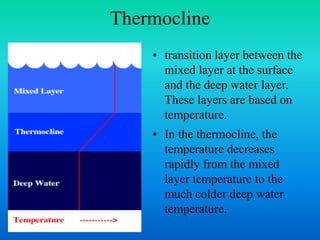
Thermocline
• transition layer between the
mixed layer at the surface
and the deep water layer.
These layers are based on
temperature.
• In the thermocline, the
temperature decreases
rapidly from the mixed
layer temperature to the
much colder deep water
temperature.
Deep ocean water : cold, dark
• Temperature almost constant at
just above freezing from
thermocline down to bottom
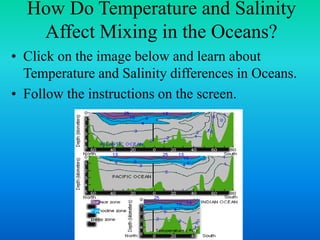
How Do Temperature and Salinity
Affect Mixing in the Oceans?
• Click on the image below and learn about
Temperature and Salinity differences in Oceans.
• Follow the instructions on the screen.
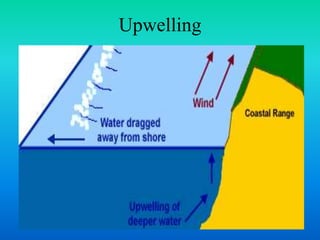
Upwelling
• transport of deeper water to shallow levels
• Nutrient-rich water rises from deeper levels to
replace surface water that drifted away
• The nutrients are responsible for supporting the
large fish population commonly found in these
areas.
• The effectiveness of upwelling and its ability to
support abundant sea life is greatly dependent
upon the depth of the thermocline.
Upwelling
Economic Consequences of El Nino
and Lack of Upwelling
• The coast of Peru is one of five major fishing
grounds in the world (along with the coastal
waters of California, Namibia, Mauritania, and
Somalia).
• The abundance of fish is supported by the
upwelling of nutrient rich waters from deeper
levels (below the thermocline).
Economic Consequences of El Nino
and Lack of Upwelling
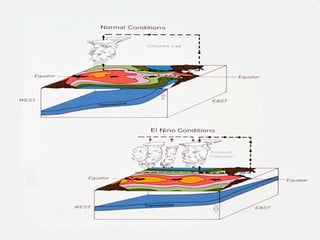
• During non-El Niño years
upwelling brings up
colder deep sea water rich
in nutrients which can
sustain large fish
populations.
Economic Consequences of El Nino
and Lack of Upwelling
• During an El Nino event
upwelling does not occur
because of a deeper
thermocline.
• Consequently, warm
nutrient-poor water
predominates the region
and a decrease in the fish
population is observed.
Results of Lack of Upwelling
• A reduction of the fish population reduces the
amount of fishmeal produced and exported (by
local industry) to other countries for feeding
poultry and livestock.
• If the world's fishmeal supply decreases, more
expensive alternative feed sources must be used,
resulting in an increase in poultry prices
worldwide.
When Were the Atlantic and Pacific
Oceans Separated by Land?
• Click on the image below and learn about
differences between ocean chemistry and fossils
separated by a thin ‘slice’ (isthmus) of land.
• Follow the instructions on the screen.
References
• http://www.studyofplace.com/Activities/Act
ivity.cfm?ActivityId=8&ActivityItemId=58
• http://www.classzone.com/books/earth_scie
nce/terc/content/investigations/es2307/es23
07page01.cfm?chapter_no=investigation
• http://www.classzone.com/books/earth_scie
nce/terc/content/investigations/es2202/es22
02page01.cfm?chapter_no=investigation

Ocean Chemistry

  • 1.
  • 2.
    Salinity: amount ofdissolved solids • Avg. 3.5% • NaCl is most common salt
  • 4.
    • salinity ishigh when: –high evaporation (hot dry climate) –freezing (only fresh water freezes, leaving salts behind) –low circulation (ex: Mediterranean)
  • 5.
    Salinity is lowwhen: • High rainfall • near melting glaciers • near the mouth of a river
  • 6.
    Ocean salinity peaksat about 30° N and 30° S because the evaporation rate is very high and the precipitation rate is low. Conversely, salinity is low near the Equator, where precipitation is high and evaporation is low. Courtesy Lawrence Berkeley National Laboratory
  • 7.
    Dissolved Gases • O2,CO2, N2 • essential for marine life forms • gases dissolve better in cold water and at high pressure • oceans are “sponges” for carbon dioxide, absorbing up to 2 billion tons/year
  • 8.
    Ocean Temperature • Mixedlayer: warm upper layer where wind and waves mix heat evenly –light penetrates here –surface water is warmer at equator, colder at poles
  • 9.
    Thermocline: zone ofrapid temperature decrease, caused by decreased sunlight as depth increases • Warmer, less dense surface water doesn’t mix easily with dense, cold deep water
  • 10.
    Thermocline • transition layerbetween the mixed layer at the surface and the deep water layer. These layers are based on temperature. • In the thermocline, the temperature decreases rapidly from the mixed layer temperature to the much colder deep water temperature.
  • 12.
    Deep ocean water: cold, dark • Temperature almost constant at just above freezing from thermocline down to bottom
  • 14.
    How Do Temperatureand Salinity Affect Mixing in the Oceans? • Click on the image below and learn about Temperature and Salinity differences in Oceans. • Follow the instructions on the screen.
  • 15.
    Upwelling • transport ofdeeper water to shallow levels • Nutrient-rich water rises from deeper levels to replace surface water that drifted away • The nutrients are responsible for supporting the large fish population commonly found in these areas. • The effectiveness of upwelling and its ability to support abundant sea life is greatly dependent upon the depth of the thermocline.
  • 17.
  • 18.
    Economic Consequences ofEl Nino and Lack of Upwelling • The coast of Peru is one of five major fishing grounds in the world (along with the coastal waters of California, Namibia, Mauritania, and Somalia). • The abundance of fish is supported by the upwelling of nutrient rich waters from deeper levels (below the thermocline).
  • 20.
    Economic Consequences ofEl Nino and Lack of Upwelling • During non-El Niño years upwelling brings up colder deep sea water rich in nutrients which can sustain large fish populations.
  • 21.
    Economic Consequences ofEl Nino and Lack of Upwelling • During an El Nino event upwelling does not occur because of a deeper thermocline. • Consequently, warm nutrient-poor water predominates the region and a decrease in the fish population is observed.
  • 22.
    Results of Lackof Upwelling • A reduction of the fish population reduces the amount of fishmeal produced and exported (by local industry) to other countries for feeding poultry and livestock. • If the world's fishmeal supply decreases, more expensive alternative feed sources must be used, resulting in an increase in poultry prices worldwide.
  • 23.
    When Were theAtlantic and Pacific Oceans Separated by Land? • Click on the image below and learn about differences between ocean chemistry and fossils separated by a thin ‘slice’ (isthmus) of land. • Follow the instructions on the screen.
  • 24.