BACTERIAL FOOD POISONING By MSC STUDENT DR Z.B.M AL-MUSTANSIRIYA UNIVERSITY COLLEGE OF MEDICINE  DEP. OF MICROBIOLOGY HIGHER STUDIES  
FOOD POISONING any illness resulting from  ingestion of water and wide variety of food contaminated with pathogenic microorganisms (bacteria, viruses, protozoa, fungi), their toxins and chemicals. Food poisoning must be suspected when an acute illness with gastrointestinal or neurological manifestation affect two or more persons, who have shared a meal during the previous 72 hours.
Types of food poisoning A.  Bacterial Food poisoning B.  Non- Bacterial Food poisoning
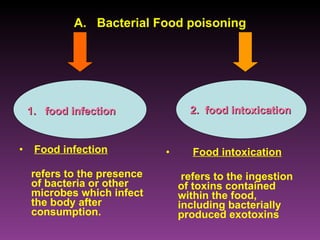
A.  Bacterial Food poisoning Food infection refers to the presence of bacteria or other microbes which infect the body after consumption.   Food intoxication refers to the ingestion of toxins contained within the food, including bacterially produced exotoxins  1.  food infection 2.  food intoxication
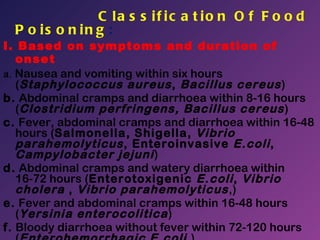
Classification Of Food Poisoning : I. Based on symptoms and duration of onset a .  Nausea and vomiting within six hours ( Staphylococcus aureus ,  Bacillus cereus ) b.  Abdominal cramps and diarrhoea within 8-16 hours ( Clostridium perfringens, Bacillus cereus ) c.  Fever, abdominal cramps and diarrhoea within 16-48 hours ( Salmonella, Shigella,  Vibrio parahemolyticus , Enteroinvasive  E.coli ,  Campylobacter jejuni ) d.  Abdominal cramps and watery diarrhoea within 16-72 hours ( Enterotoxigenic  E.coli ,  Vibrio cholera  ,  Vibrio parahemolyticus ,) e.  Fever and abdominal cramps within 16-48 hours ( Yersinia enterocolitica ) f.  Bloody diarrhoea without fever within 72-120 hours ( Enterohemorrhagic E.coli  ) g.  Nausea, vomiting, diarrhoea and paralysis within 18-36 hours ( Clostridium botulinum )
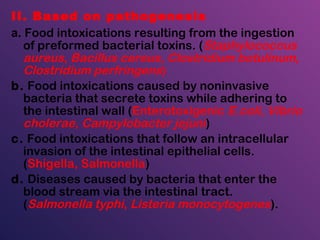
II. Based on pathogenesis a.   Food intoxications resulting from the ingestion of preformed bacterial toxins. ( Staphylococcus aureus ,  Bacillus cereus, Clostridium botulinum, Clostridium perfringens ) b.  Food intoxications caused by noninvasive bacteria that secrete toxins while adhering to the intestinal wall ( Enterotoxigenic  E.coli ,  Vibrio cholerae, Campylobacter jejuni ) c.  Food intoxications that follow an intracellular invasion of the intestinal epithelial cells. ( Shigella, Salmonella ) d.  Diseases caused by bacteria that enter the blood stream via the intestinal tract. ( Salmonella typhi ,  Listeria monocytogenes ).
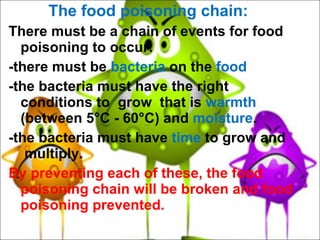
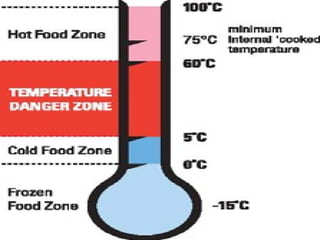
The food poisoning chain: There must be a chain of events for food poisoning to occur: -there must be  bacteria  on the  food -the bacteria must have the right conditions to  grow  that is  warmth  (between 5°C - 60°C) and  moisture . -the bacteria must have  time  to grow and  multiply.  By preventing each of these, the food poisoning chain will be broken and food poisoning prevented.
 
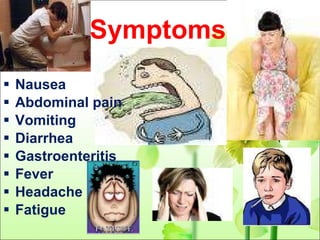
Symptoms Nausea Abdominal pain Vomiting Diarrhea Gastroenteritis Fever Headache  Fatigue
Most common food poisoning bacteria
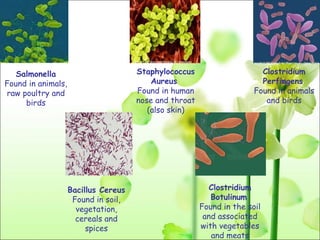
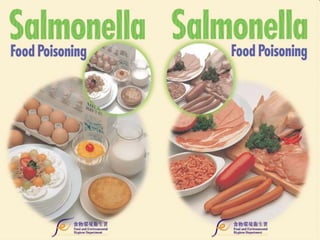
Bacillus Cereus   Found in  soil, vegetation, cereals and spices Staphylococcus Aureus   Found in  human nose and throat (also skin) Clostridium Perfingens   Found in  animals and birds Salmonella Found in animals, raw poultry and birds Clostridium Botulinum   Found in  the soil and associated with vegetables and meats
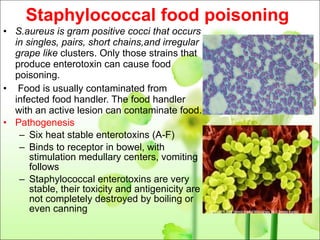
Staphylococcal food poisoning S.aureus is gram positive cocci that occurs in singles, pairs, short chains,and irregular grape like  clusters. Only those strains that produce enterotoxin can cause food poisoning. Food is usually contaminated from infected food handler. The food handler with an active lesion can contaminate food. Pathogenesis Six heat stable enterotoxins (A-F) Binds to receptor in bowel, with stimulation medullary centers, vomiting follows Staphylococcal enterotoxins are very stable, their toxicity and antigenicity are not completely destroyed by boiling or even canning
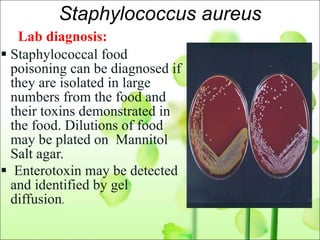
Staphylococcus aureus Lab diagnosis: Staphylococcal food poisoning can be diagnosed if they are isolated in large numbers from the food and their toxins demonstrated in the food. Dilutions of food may be plated on  Mannitol Salt agar. Enterotoxin may be detected and identified by gel diffusion .
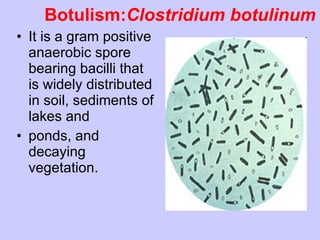
Botulism: Clostridium botulinum It is a gram positive anaerobic spore bearing bacilli that is widely distributed in soil, sediments of lakes and ponds, and decaying vegetation.
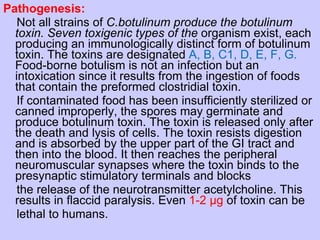
Pathogenesis:  Not all strains of  C.botulinum produce the botulinum toxin. Seven toxigenic types of the  organism exist, each producing an immunologically distinct form of botulinum toxin. The toxins are designated  A, B, C1, D, E, F, G.  Food-borne botulism is not an infection but an intoxication since it results from the ingestion of foods that contain the preformed clostridial toxin. If contaminated food has been insufficiently sterilized or canned improperly, the spores may germinate and produce botulinum toxin. The toxin is released only after the death and lysis of cells. The toxin resists digestion and is absorbed by the upper part of the GI tract and then into the blood. It then reaches the peripheral neuromuscular synapses where the toxin binds to the presynaptic stimulatory terminals and blocks the release of the neurotransmitter acetylcholine. This results in flaccid paralysis. Even  1-2 μg  of toxin can be lethal to humans.
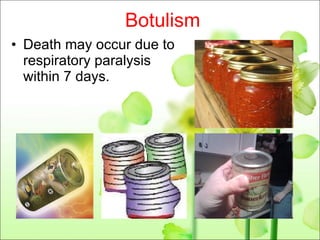
Botulism Death may occur due to respiratory paralysis within 7 days.
Laboratory diagnosis:  Spoilage of food or swelling of cans or presence of bubbles inside the can indicate clostridial growth. Food is homogenized in broth and inoculated in Robertson cooked meat medium and blood agar or egg-yolk agar, which is incubated anareobically for 3-5 days at 37oC. The toxin can be demonstrated by injecting intraperitoneally the extract of food or culture into mice or guinea pig.
Clostridium perfringens  It is a gram positive anaerobic spore bearing bacilli that is present abundantly in the environment, vegetation,sewage and animal feces. food-borne outbreaks of  C.perfringens  involve meat products that are eaten 1- 2 days after   preparation. Meats that have been cooked, allowed to cool slowly, and then held for some time before eating.
: Pathogenesis Spores in food may survive cooking and then germinate when they are improperly stored. When these vegetative cells form endospores in the intestine, they release enterotoxins. The bacterium is known to produce at least 12 different toxins. Food poisoning is mainly caused by Type A strains, which produces alpha and theta toxins. The toxins result in excessive fluid accumulation in the intestinal lumen.
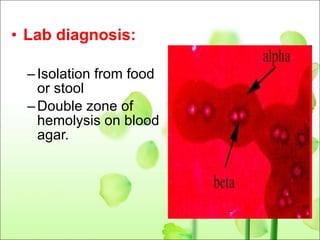
Lab diagnosis: Isolation from food or stool Double zone of hemolysis on blood agar.
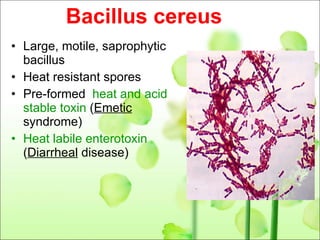
Bacillus cereus Large, motile, saprophytic  bacillus Heat resistant spores Pre-formed  heat and acid stable toxin  ( Emetic  syndrome) Heat labile enterotoxin  ( Diarrheal  disease)
Bacillus cereus Incubation period < 6 hours Severe vomiting Lasts 8-10 hours Incubation period > 6 hours Diarrhea  Lasts 20-36 hours EMETIC FORM  DIARRHEAL   FORM
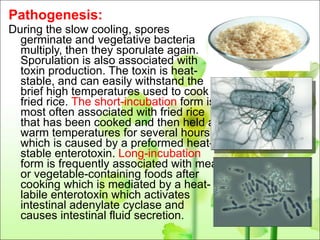
Pathogenesis: During the slow cooling, spores germinate and vegetative bacteria multiply, then they sporulate again. Sporulation is also associated with toxin production. The toxin is heat-stable, and can easily withstand the brief high temperatures used to cook fried rice.  The short-incubation  form is most often associated with fried rice that has been cooked and then held at warm temperatures for several hours which is caused by a preformed heat-stable enterotoxin.  Long-incubation  form is frequently associated with meat or vegetable-containing foods after cooking which is mediated by a heat-labile enterotoxin which activates intestinal adenylate cyclase and causes intestinal fluid secretion.
Laboratory diagnosis:  The short-incubation or emetic form of the disease is diagnosed by the isolation of  B. cereus  from the incriminated food.  The long-incubation or diarrheal form is diagnosed by isolation of the organism from stool and food. Isolation from stools alone is not sufficient because 14% of healthy adults have been reported to have transient gastrointestinal colonization with  B. cereus.
 
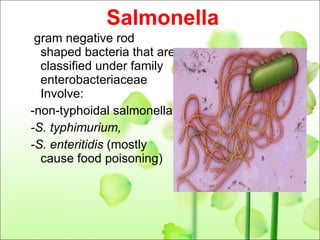
Salmonella gram negative rod shaped bacteria that are classified under family enterobacteriaceae Involve: -non-typhoidal salmonella -S. typhimurium,  -S.  enteritidis  (mostly cause food poisoning)
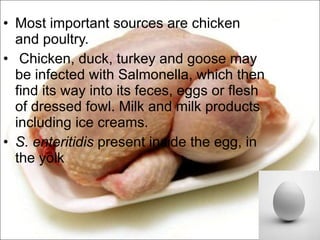
Most important sources are chicken and poultry. Chicken, duck, turkey and goose may be infected with Salmonella, which then find its way into its feces, eggs or flesh of dressed fowl. Milk and milk products including ice creams. S. enteritidis  present inside the egg, in the yolk
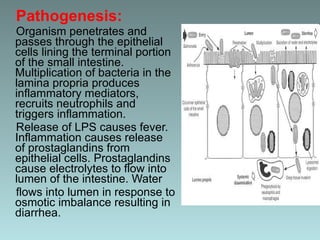
Pathogenesis:  Organism penetrates and passes through the epithelial cells lining the terminal portion of the small intestine. Multiplication of bacteria in the lamina propria produces inflammatory mediators, recruits neutrophils and triggers inflammation. Release of LPS causes fever. Inflammation causes release of prostaglandins from epithelial cells. Prostaglandins cause electrolytes to flow into lumen of the intestine. Water flows into lumen in response to osmotic imbalance resulting in diarrhea.
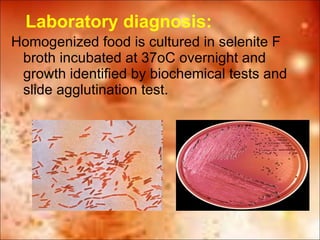
Laboratory diagnosis: Homogenized food is cultured in selenite F broth incubated at 37oC overnight and growth identified by biochemical tests and slide agglutination test.
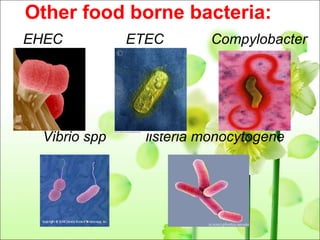
Other food borne bacteria: EHEC  ETEC  Compylobacter Vibrio spp  listeria monocytogene
The golden rules for prevention of food poisoning: 1-Choose foods processed for safety. 2-Cook food thoroughly. 3-Eat cooked food immediately. 4-Store cooked food carefully. 5- Reheat cooked food thoroughly.
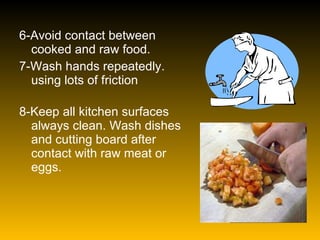
6-Avoid contact between cooked and raw food. 7-Wash hands repeatedly. using lots of friction 8-Keep all kitchen surfaces always clean. Wash dishes and cutting board after contact with raw meat or eggs.
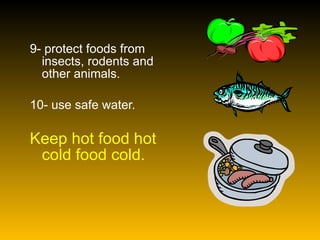
9- protect foods from insects, rodents and other animals. 10- use safe water. Keep hot food hot cold food cold.
 

Bacterial food poisoning

  • 1.
    BACTERIAL FOOD POISONINGBy MSC STUDENT DR Z.B.M AL-MUSTANSIRIYA UNIVERSITY COLLEGE OF MEDICINE DEP. OF MICROBIOLOGY HIGHER STUDIES  
  • 2.
    FOOD POISONING anyillness resulting from ingestion of water and wide variety of food contaminated with pathogenic microorganisms (bacteria, viruses, protozoa, fungi), their toxins and chemicals. Food poisoning must be suspected when an acute illness with gastrointestinal or neurological manifestation affect two or more persons, who have shared a meal during the previous 72 hours.
  • 3.
    Types of foodpoisoning A. Bacterial Food poisoning B. Non- Bacterial Food poisoning
  • 4.
    A. BacterialFood poisoning Food infection refers to the presence of bacteria or other microbes which infect the body after consumption. Food intoxication refers to the ingestion of toxins contained within the food, including bacterially produced exotoxins 1. food infection 2. food intoxication
  • 5.
    Classification Of FoodPoisoning : I. Based on symptoms and duration of onset a . Nausea and vomiting within six hours ( Staphylococcus aureus , Bacillus cereus ) b. Abdominal cramps and diarrhoea within 8-16 hours ( Clostridium perfringens, Bacillus cereus ) c. Fever, abdominal cramps and diarrhoea within 16-48 hours ( Salmonella, Shigella, Vibrio parahemolyticus , Enteroinvasive E.coli , Campylobacter jejuni ) d. Abdominal cramps and watery diarrhoea within 16-72 hours ( Enterotoxigenic E.coli , Vibrio cholera , Vibrio parahemolyticus ,) e. Fever and abdominal cramps within 16-48 hours ( Yersinia enterocolitica ) f. Bloody diarrhoea without fever within 72-120 hours ( Enterohemorrhagic E.coli ) g. Nausea, vomiting, diarrhoea and paralysis within 18-36 hours ( Clostridium botulinum )
  • 6.
    II. Based onpathogenesis a. Food intoxications resulting from the ingestion of preformed bacterial toxins. ( Staphylococcus aureus , Bacillus cereus, Clostridium botulinum, Clostridium perfringens ) b. Food intoxications caused by noninvasive bacteria that secrete toxins while adhering to the intestinal wall ( Enterotoxigenic E.coli , Vibrio cholerae, Campylobacter jejuni ) c. Food intoxications that follow an intracellular invasion of the intestinal epithelial cells. ( Shigella, Salmonella ) d. Diseases caused by bacteria that enter the blood stream via the intestinal tract. ( Salmonella typhi , Listeria monocytogenes ).
  • 7.
    The food poisoningchain: There must be a chain of events for food poisoning to occur: -there must be bacteria on the food -the bacteria must have the right conditions to grow that is warmth (between 5°C - 60°C) and moisture . -the bacteria must have time to grow and multiply. By preventing each of these, the food poisoning chain will be broken and food poisoning prevented.
  • 8.
  • 9.
    Symptoms Nausea Abdominalpain Vomiting Diarrhea Gastroenteritis Fever Headache Fatigue
  • 10.
    Most common foodpoisoning bacteria
  • 11.
    Bacillus Cereus Found in soil, vegetation, cereals and spices Staphylococcus Aureus Found in human nose and throat (also skin) Clostridium Perfingens Found in animals and birds Salmonella Found in animals, raw poultry and birds Clostridium Botulinum Found in the soil and associated with vegetables and meats
  • 12.
    Staphylococcal food poisoningS.aureus is gram positive cocci that occurs in singles, pairs, short chains,and irregular grape like clusters. Only those strains that produce enterotoxin can cause food poisoning. Food is usually contaminated from infected food handler. The food handler with an active lesion can contaminate food. Pathogenesis Six heat stable enterotoxins (A-F) Binds to receptor in bowel, with stimulation medullary centers, vomiting follows Staphylococcal enterotoxins are very stable, their toxicity and antigenicity are not completely destroyed by boiling or even canning
  • 13.
    Staphylococcus aureus Labdiagnosis: Staphylococcal food poisoning can be diagnosed if they are isolated in large numbers from the food and their toxins demonstrated in the food. Dilutions of food may be plated on Mannitol Salt agar. Enterotoxin may be detected and identified by gel diffusion .
  • 14.
    Botulism: Clostridium botulinumIt is a gram positive anaerobic spore bearing bacilli that is widely distributed in soil, sediments of lakes and ponds, and decaying vegetation.
  • 15.
    Pathogenesis: Notall strains of C.botulinum produce the botulinum toxin. Seven toxigenic types of the organism exist, each producing an immunologically distinct form of botulinum toxin. The toxins are designated A, B, C1, D, E, F, G. Food-borne botulism is not an infection but an intoxication since it results from the ingestion of foods that contain the preformed clostridial toxin. If contaminated food has been insufficiently sterilized or canned improperly, the spores may germinate and produce botulinum toxin. The toxin is released only after the death and lysis of cells. The toxin resists digestion and is absorbed by the upper part of the GI tract and then into the blood. It then reaches the peripheral neuromuscular synapses where the toxin binds to the presynaptic stimulatory terminals and blocks the release of the neurotransmitter acetylcholine. This results in flaccid paralysis. Even 1-2 μg of toxin can be lethal to humans.
  • 16.
    Botulism Death mayoccur due to respiratory paralysis within 7 days.
  • 17.
    Laboratory diagnosis: Spoilage of food or swelling of cans or presence of bubbles inside the can indicate clostridial growth. Food is homogenized in broth and inoculated in Robertson cooked meat medium and blood agar or egg-yolk agar, which is incubated anareobically for 3-5 days at 37oC. The toxin can be demonstrated by injecting intraperitoneally the extract of food or culture into mice or guinea pig.
  • 18.
    Clostridium perfringens It is a gram positive anaerobic spore bearing bacilli that is present abundantly in the environment, vegetation,sewage and animal feces. food-borne outbreaks of C.perfringens involve meat products that are eaten 1- 2 days after preparation. Meats that have been cooked, allowed to cool slowly, and then held for some time before eating.
  • 19.
    : Pathogenesis Sporesin food may survive cooking and then germinate when they are improperly stored. When these vegetative cells form endospores in the intestine, they release enterotoxins. The bacterium is known to produce at least 12 different toxins. Food poisoning is mainly caused by Type A strains, which produces alpha and theta toxins. The toxins result in excessive fluid accumulation in the intestinal lumen.
  • 20.
    Lab diagnosis: Isolationfrom food or stool Double zone of hemolysis on blood agar.
  • 21.
    Bacillus cereus Large,motile, saprophytic bacillus Heat resistant spores Pre-formed heat and acid stable toxin ( Emetic syndrome) Heat labile enterotoxin ( Diarrheal disease)
  • 22.
    Bacillus cereus Incubationperiod < 6 hours Severe vomiting Lasts 8-10 hours Incubation period > 6 hours Diarrhea Lasts 20-36 hours EMETIC FORM DIARRHEAL FORM
  • 23.
    Pathogenesis: During theslow cooling, spores germinate and vegetative bacteria multiply, then they sporulate again. Sporulation is also associated with toxin production. The toxin is heat-stable, and can easily withstand the brief high temperatures used to cook fried rice. The short-incubation form is most often associated with fried rice that has been cooked and then held at warm temperatures for several hours which is caused by a preformed heat-stable enterotoxin. Long-incubation form is frequently associated with meat or vegetable-containing foods after cooking which is mediated by a heat-labile enterotoxin which activates intestinal adenylate cyclase and causes intestinal fluid secretion.
  • 24.
    Laboratory diagnosis: The short-incubation or emetic form of the disease is diagnosed by the isolation of B. cereus from the incriminated food. The long-incubation or diarrheal form is diagnosed by isolation of the organism from stool and food. Isolation from stools alone is not sufficient because 14% of healthy adults have been reported to have transient gastrointestinal colonization with B. cereus.
  • 25.
  • 26.
    Salmonella gram negativerod shaped bacteria that are classified under family enterobacteriaceae Involve: -non-typhoidal salmonella -S. typhimurium, -S. enteritidis (mostly cause food poisoning)
  • 27.
    Most important sourcesare chicken and poultry. Chicken, duck, turkey and goose may be infected with Salmonella, which then find its way into its feces, eggs or flesh of dressed fowl. Milk and milk products including ice creams. S. enteritidis present inside the egg, in the yolk
  • 28.
    Pathogenesis: Organismpenetrates and passes through the epithelial cells lining the terminal portion of the small intestine. Multiplication of bacteria in the lamina propria produces inflammatory mediators, recruits neutrophils and triggers inflammation. Release of LPS causes fever. Inflammation causes release of prostaglandins from epithelial cells. Prostaglandins cause electrolytes to flow into lumen of the intestine. Water flows into lumen in response to osmotic imbalance resulting in diarrhea.
  • 29.
    Laboratory diagnosis: Homogenizedfood is cultured in selenite F broth incubated at 37oC overnight and growth identified by biochemical tests and slide agglutination test.
  • 30.
    Other food bornebacteria: EHEC ETEC Compylobacter Vibrio spp listeria monocytogene
  • 31.
    The golden rulesfor prevention of food poisoning: 1-Choose foods processed for safety. 2-Cook food thoroughly. 3-Eat cooked food immediately. 4-Store cooked food carefully. 5- Reheat cooked food thoroughly.
  • 32.
    6-Avoid contact betweencooked and raw food. 7-Wash hands repeatedly. using lots of friction 8-Keep all kitchen surfaces always clean. Wash dishes and cutting board after contact with raw meat or eggs.
  • 33.
    9- protect foodsfrom insects, rodents and other animals. 10- use safe water. Keep hot food hot cold food cold.
  • 34.

Editor's Notes

  • #32 Do any of you eat poisonous plants? ( ask for show of hands ). No one would intentionall y eat a poisonous plant. Now, raise your hand if you eat apples, peaches, or apricots ( show of hands ). Believe it or not, all of these are poisonous plants. What part of them do you avoid eating? The pits or seeds. And does anyone know what poison is the seeds? Cyanide. If you grind up a lot of them, enough cyanide could be produced to cause illness. People have been poisoned by mistaking hemlock roots for turnips or carrots, mistaking lily bulbs for onions, by eating fruits like ackee before they’re ripe, or by not preparing food properly (pokeweed has to be boiled well before eating).
  • #33 You’re probably familiar with the ways to get a food borne illness. Keep in mind that food borne illness occurs is because the bacteria do not make the food look, smell, or taste bad. Here is a good rule to follow: When in doubt, throw it out!
  • #34 You know the importance of good hand washing, but your challenge is to teach this to others. The steps listed above are the most effective ways to reduce food borne illness. A fast food chain taught their employees by using the acronym W.A.S.H. “Warm and soapy Happy birthday.” They should wash as long as it takes to sing “Happy Birthday” twice. Use lots of friction when rubbing hands together. Use this rule when storing food. If raw or cooked food has been in the refrigerator for more than 3 days, it’s not safe to eat. And, don’t eat food that has been sitting at room temperature for more than 2 hours. That’s when bacteria begins to grow.