Methicillin Resistant
Staphylococcus aureus (MRSA)
in the Community:
Epidemiology and Management
Rachel Gorwitz, MD, MPH
Division of Healthcare Quality Promotion
Centers for Disease Control and Prevention
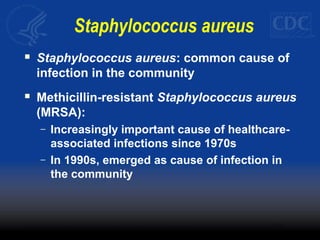
Staphylococcus aureus
 Staphylococcus aureus: common cause of
infection in the community
 Methicillin-resistant Staphylococcus aureus
(MRSA):
– Increasingly important cause of healthcare-
associated infections since 1970s
– In 1990s, emerged as cause of infection in
the community
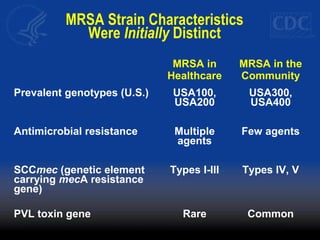
MRSA Strain Characteristics
Were Initially Distinct
MRSA in
Healthcare
MRSA in the
Community
Prevalent genotypes (U.S.) USA100,
USA200
USA300,
USA400
Antimicrobial resistance Multiple
agents
Few agents
SCCmec (genetic element
carrying mecA resistance
gene)
Types I-III Types IV, V
PVL toxin gene Rare Common
Dice (Opt:0.50%) (Tol 1.3%-1.3%) (H>0.0% S>0.0%) [0.0%-100.0%]
Pfsma
100
90
80
70
60
50
Pfsma
2001005114
2001005078
2000018626
2001035045
99045065
95009938
94042318
96023760
99034758
96028758
AA0097
2004711282
.
.
.
.
.
.
.
.
.
.
.
.
IVa
IVa
I I
I V
IVa
I V
IV
I I
I I
IVa
USA300
USA700
USA100
USA800
USA400
USA500
USA1000
USA900
USA600 .
USA200
USA1100
USA1200
8
72
5
5
1
8
59
15 / 13 1.
36
30
.
.
.
.
.
.
.
POS
NEG
NEG
NEG
NEG
NE
NE
NE
NE
NE
NE
PO
NE
PFT SCCmecMLST pvl
USA300 8 IV POS
USA700 72 IV NEG
USA100 5 I I NEG
USA800 5 IV NEG
USA400 1 IV POS
USA500 8 IV, I I NEG
USA1000 59 IV NEG/POS
USA900 15 MSSA NEG
USA600 45 I I NEG
USA200 36 I I NEG
USA1100 30 IV POS
USA1200 MSSA POS
McDougal et al J Clin Micro 2003;41:5113-5120
National Database of MRSA Pulsed-Field Types
(Highlighted PFTs: historically community-associated)
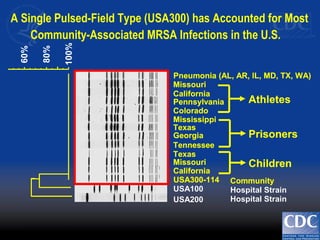
100%
80%
60%
Athletes
Prisoners
Children
Hospital Strain
Hospital Strain
Missouri
California
Texas
Pennsylvania
Texas
Mississippi
Colorado
Georgia
Missouri
Tennessee
USA300-114
USA100
USA200
Community
California
Pneumonia (AL, AR, IL, MD, TX, WA)
100%
80%
60%
Athletes
Prisoners
Children
Hospital Strain
Hospital Strain
Missouri
California
Texas
Pennsylvania
Texas
Mississippi
Colorado
Georgia
Missouri
Tennessee
USA300-114
USA100
USA200
Community
California
Pneumonia (AL, AR, IL, MD, TX, WA)
100%
80%
60%
Athletes
Prisoners
Children
Hospital Strain
Hospital Strain
Missouri
California
Texas
Pennsylvania
Texas
Mississippi
Colorado
Georgia
Missouri
Tennessee
USA300-114
USA100
USA200
Community
California
Pneumonia (AL, AR, IL, MD, TX, WA)
100%
80%
60%
Athletes
Prisoners
Children
Hospital Strain
Hospital Strain
Missouri
California
Texas
Pennsylvania
Texas
Mississippi
Colorado
Georgia
Missouri
Tennessee
USA300-114
USA100
USA200
Community
California
Pneumonia (AL, AR, IL, MD, TX, WA)
100%
80%
60%
Athletes
Prisoners
Children
Hospital Strain
Hospital Strain
Missouri
California
Texas
Pennsylvania
Texas
Mississippi
Colorado
Georgia
Missouri
Tennessee
USA300-114
USA100
USA200
Community
California
Pneumonia (AL, AR, IL, MD, TX, WA)
100%
80%
60%
Athletes
Prisoners
Children
Hospital Strain
Hospital Strain
Missouri
California
Texas
Pennsylvania
Texas
Mississippi
Colorado
Georgia
Missouri
Tennessee
USA300-114
USA100
USA200
Community
California
Pneumonia (AL, AR, IL, MD, TX, WA)
A Single Pulsed-Field Type (USA300) has Accounted for Most
Community-Associated MRSA Infections in the U.S.
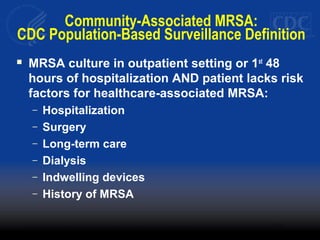
Community-Associated MRSA:
CDC Population-Based Surveillance Definition
 MRSA culture in outpatient setting or 1st
48
hours of hospitalization AND patient lacks risk
factors for healthcare-associated MRSA:
– Hospitalization
– Surgery
– Long-term care
– Dialysis
– Indwelling devices
– History of MRSA
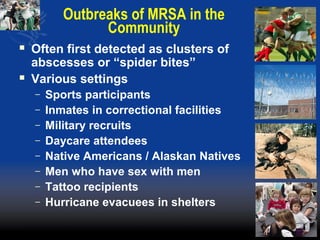
Outbreaks of MRSA in the
Community
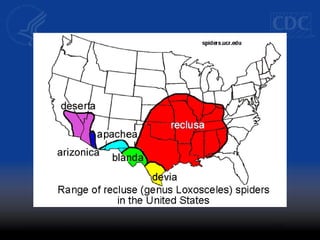
 Often first detected as clusters of
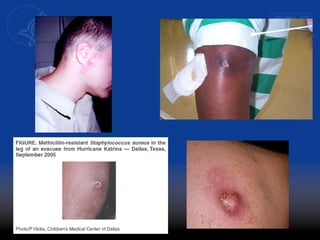
abscesses or “spider bites”
 Various settings
– Sports participants
– Inmates in correctional facilities
– Military recruits
– Daycare attendees
– Native Americans / Alaskan Natives
– Men who have sex with men
– Tattoo recipients
– Hurricane evacuees in shelters
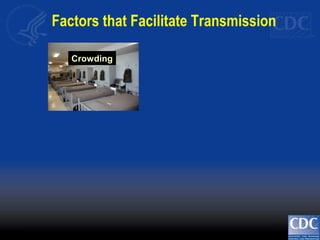
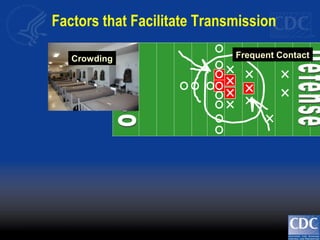
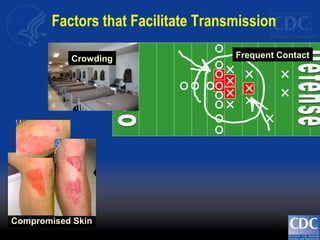
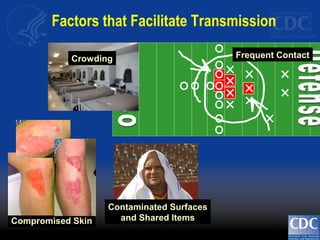
Factors that Facilitate Transmission
Crowding
Frequent ContactCrowding
Factors that Facilitate Transmission
Frequent ContactCrowding
Compromised Skin
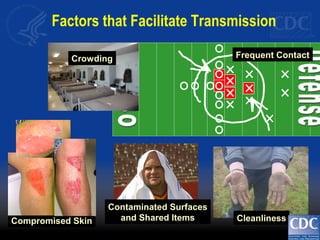
Factors that Facilitate Transmission
Frequent Contact
Contaminated Surfaces
and Shared Items
Crowding
Factors that Facilitate Transmission
Compromised Skin
Frequent Contact
Cleanliness
Crowding
Contaminated Surfaces
and Shared ItemsCompromised Skin
Factors that Facilitate Transmission
Contaminated Surfaces
and Shared Items
Frequent Contact
Cleanliness
Crowding
Compromised Skin
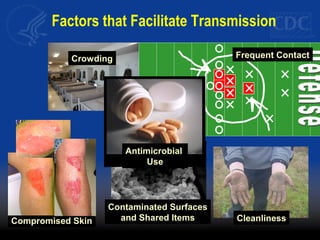
Factors that Facilitate Transmission
Antimicrobial
Use
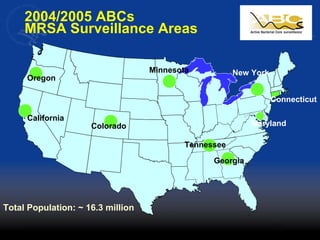
2004/2005 ABCs
MRSA Surveillance Areas
Total Population: ~ 16.3 million
Oregon
California
Colorado
Tennessee
Georgia
Maryland
Connecticut
New YorkMinnesota
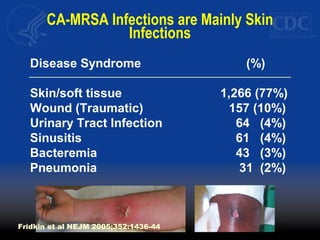
CA-MRSA Infections are Mainly Skin
Infections
Disease Syndrome (%)
Skin/soft tissue 1,266 (77%)
Wound (Traumatic) 157 (10%)
Urinary Tract Infection 64 (4%)
Sinusitis 61 (4%)
Bacteremia 43 (3%)
Pneumonia 31 (2%)
Fridkin et al NEJM 2005;352:1436-44
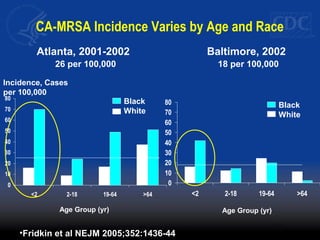
Age Group (yr)
Atlanta, 2001-2002 Baltimore, 2002
0
10
20
30
40
50
60
70
80
<2 2-18 19-64 >64
0
10
20
30
40
50
60
70
80
<2 2-18 19-64 >64
Incidence, Cases
per 100,000
Age Group (yr)
Black
White
Black
White
CA-MRSA Incidence Varies by Age and Race
26 per 100,000 18 per 100,000
•Fridkin et al NEJM 2005;352:1436-44
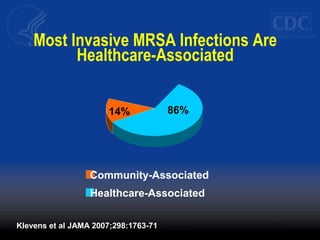
Most Invasive MRSA Infections Are
Healthcare-Associated
Community-Associated
Klevens et al JAMA 2007;298:1763-71
14% 86%
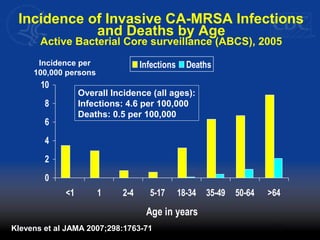
Incidence of Invasive CA-MRSA Infections
and Deaths by Age
Active Bacterial Core surveillance (ABCS), 2005
0
2
4
6
8
10
<1 1 2-4 5-17 18-34 35-49 50-64 >64
Age in years
Infections DeathsIncidence per
100,000 persons
Klevens et al JAMA 2007;298:1763-71
Overall Incidence (all ages):
Infections: 4.6 per 100,000
Deaths: 0.5 per 100,000
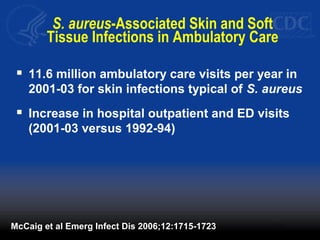
S. aureus-Associated Skin and Soft
Tissue Infections in Ambulatory Care
 11.6 million ambulatory care visits per year in
2001-03 for skin infections typical of S. aureus
 Increase in hospital outpatient and ED visits
(2001-03 versus 1992-94)
McCaig et al Emerg Infect Dis 2006;12:1715-1723
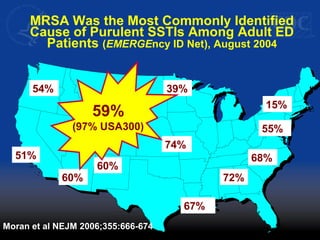
54%
51%
60%
60%
67%
74%
39%
15%
55%
68%
72%
59%
(97% USA300)
MRSA Was the Most Commonly Identified
Cause of Purulent SSTIs Among Adult ED
Patients (EMERGEncy ID Net), August 2004
Moran et al NEJM 2006;355:666-674
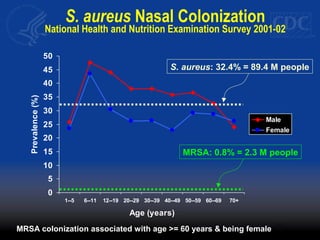
S. aureus Nasal Colonization
National Health and Nutrition Examination Survey 2001-02
0
5
10
15
20
25
30
35
40
45
50
1--5 6--11 12--19 20--29 30--39 40--49 50--59 60--69 70+
Age (years)
Prevalence(%)
Male
Female
S. aureus: 32.4% = 89.4 M people
MRSA: 0.8% = 2.3 M people
MRSA colonization associated with age >= 60 years & being female
0
5
10
15
20
Year 1 Year 2 Year 3
%ClindamycinResistant
Community Onset, Healthcare-associated MRSA
Community-associated MRSA
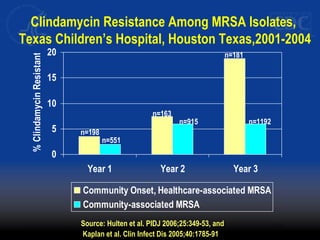
Clindamycin Resistance Among MRSA Isolates,
Texas Children’s Hospital, Houston Texas,2001-2004
n=551
n=915 n=1192
n=198
n=163
n=181
Source: Hulten et al. PIDJ 2006;25:349-53, and
Kaplan et al. Clin Infect Dis 2005;40:1785-91
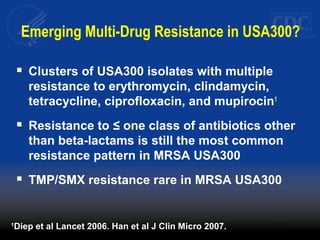
Emerging Multi-Drug Resistance in USA300?
 Clusters of USA300 isolates with multiple
resistance to erythromycin, clindamycin,
tetracycline, ciprofloxacin, and mupirocin1
 Resistance to ≤ one class of antibiotics other
than beta-lactams is still the most common
resistance pattern in MRSA USA300
 TMP/SMX resistance rare in MRSA USA300
1
Diep et al Lancet 2006. Han et al J Clin Micro 2007.
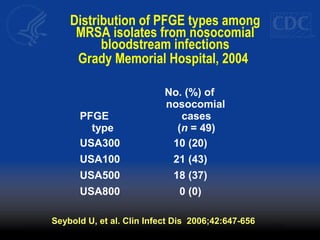
PFGE
type
No. (%) of
nosocomial
cases
(n = 49)
USA300 10 (20)
USA100 21 (43)
USA500 18 (37)
USA800 0 (0)
Distribution of PFGE types among
MRSA isolates from nosocomial
bloodstream infections
Grady Memorial Hospital, 2004
Seybold U, et al. Clin Infect Dis 2006;42:647-656
Strategies for Clinical Management of
MRSA in the Community
http:www.cdc.gov/ncidod/dhqp/ar_mrsa_ca.html
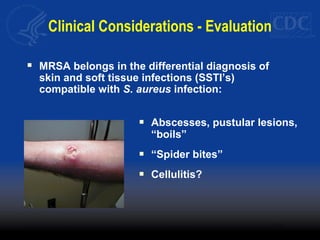
Clinical Considerations - Evaluation
 MRSA belongs in the differential diagnosis of
skin and soft tissue infections (SSTI’s)
compatible with S. aureus infection:
 Abscesses, pustular lesions,
“boils”
 “Spider bites”
 Cellulitis?
Clinical Considerations - Evaluation
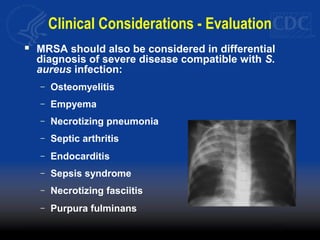
 MRSA should also be considered in differential
diagnosis of severe disease compatible with S.
aureus infection:
– Osteomyelitis
– Empyema
– Necrotizing pneumonia
– Septic arthritis
– Endocarditis
– Sepsis syndrome
– Necrotizing fasciitis
– Purpura fulminans
Management of Skin
Infections in the Era of CA-
MRSA
 I&D should be routine for purulent skin
lesions
Management of Skin
Infections in the Era of CA-
MRSA
 I&D should be routine for purulent skin
lesions
 Obtain material for culture
Management of Skin
Infections in the Era of CA-
MRSA
 I&D should be routine for purulent skin
lesions
 Obtain material for culture
 No data to suggest molecular typing or
toxin-testing should guide management
Management of Skin
Infections in the Era of CA-
MRSA
 I&D should be routine for purulent skin
lesions
 Obtain material for culture
 No data to suggest molecular typing or
toxin-testing should guide management
 Empiric antimicrobial therapy may be
needed
Management of Skin
Infections in the Era of CA-
MRSA
 I&D should be routine for purulent skin
lesions
 Obtain material for culture
 No data to suggest molecular typing or
toxin-testing should guide management
 Empiric antimicrobial therapy may be
needed
 Alternative agents have +’s and –’s: More
data needed to identify optimal strategies
Management of Skin Infections
in the Era of CA-MRSA
 I&D should be routine for purulent skin
lesions
 Obtain material for culture
 No data to suggest molecular typing or toxin-
testing should guide management
 Empiric antimicrobial therapy may be needed
 Alternative agents have +’s and –’s: More
data needed to identify optimal strategies
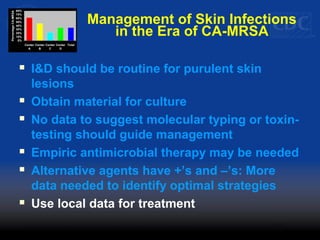
 Use local data for treatment
0%
10%
20%
30%
40%
50%
60%
70%
80%
Center
A
Center
B
Center
C
Center
D
Total
PercentageCA-MRSA
Management of Skin
Infections in the Era of CA-
MRSA
 I&D should be routine for purulent skin
lesions
 Obtain material for culture
 No data to suggest molecular typing or
toxin-testing should guide management
 Empiric antimicrobial therapy may be
needed
 Alternative agents have +’s and –’s: More
data needed to identify optimal strategies
 Use local data for treatment
 Patient education is critical!
Management of Skin
Infections in the Era of CA-
MRSA
 I&D should be routine for purulent skin
lesions
 Obtain material for culture
 No data to suggest molecular typing or
toxin-testing should guide management
 Empiric antimicrobial therapy may be
needed
 Alternative agents have +’s and –’s: More
data needed to identify optimal strategies
 Use local data for treatment
 Patient education is critical!
 Maintain adequate follow-up
Clinical Considerations - Management
Antimicrobial Selection (SSTIs)
 Alternative agents (More data needed to establish
effectiveness!):
– Clindamycin – Potential for inducible resistance,
Relatively higher risk of C. difficile associated disease?
– TMP/SMX – Group A strep isolates commonly
resistant
– Tetracyclines – Not recommended for <8yo
– Rifampin – Not as a single agent
– Linezolid – Expensive, Potential for resistance with
inappropriate use
Clinical Considerations - Management
Antimicrobial Selection (SSTIs)
 Not optimal for MRSA (High prevalence of
resistance or potential for rapid
development of resistance):
– Macrolides
– Fluoroquinolones
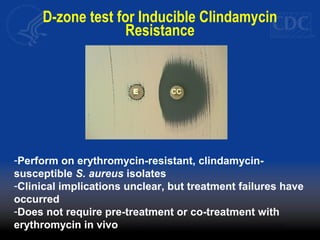
D-zone test for Inducible Clindamycin
Resistance
CCE
-Perform on erythromycin-resistant, clindamycin-
susceptible S. aureus isolates
-Clinical implications unclear, but treatment failures have
occurred
-Does not require pre-treatment or co-treatment with
erythromycin in vivo
Management of Severe / Invasive
Infections
 Vancomycin remains a 1st
-line therapy for
severe infections possibly caused by MRSA
 Other IV agents may be appropriate Consult
an infectious disease specialist.
 Final therapy decisions should be based on
results of culture and susceptibility testing
 Severe community-acquired pneumonia:
Vancomycin or linezolid if MRSA is a
consideration*
*IDSA/ATS Guidelines for treatment of CAP in adults: Mandell et
al. CID 2007;44:S27-72
Screening and Decolonization
 In general, colonization cultures of infected or
exposed persons in community settings are not
recommended. (May have a role in public health
investigations).
 Decolonization regimens:
– May have a role in preventing recurrent infections
(more data needed to establish efficacy and optimal
regimens for use in community settings).
– After treating active infections and reinforcing hygiene
and appropriate wound care, consider consultation with
an infectious disease specialist regarding use of
decolonization when there are recurrent infections in an
individual patient or members of a household.
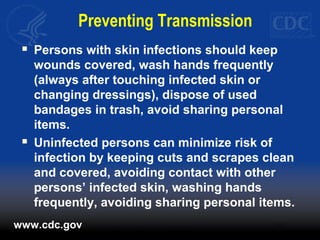
Preventing Transmission
 Persons with skin infections should keep
wounds covered, wash hands frequently
(always after touching infected skin or
changing dressings), dispose of used
bandages in trash, avoid sharing personal
items.
 Uninfected persons can minimize risk of
infection by keeping cuts and scrapes clean
and covered, avoiding contact with other
persons’ infected skin, washing hands
frequently, avoiding sharing personal items.
www.cdc.gov
Preventing Transmission
 Exclusion of patients from school, work, sports
activities, etc should be reserved for those that
are unable to keep the infected skin covered
with a clean, dry bandage and maintain good
personal hygiene.
 In general, it is not necessary to close schools
to “disinfect” them when MRSA infections
occur.
 In ambulatory care settings, use standard
precautions for all patients (hand hygiene
before and after contact, barriers such as
gloves, gowns as appropriate for contact with
wound drainage and other body fluids).
www.cdc.gov
Role of Pets
 Greatest risk of Staph aureus / MRSA exposure in
most humans is other humans
 When household pet animals carry MRSA, likely
acquired from a human
 Transmission of MRSA from an infected or
colonized pet to a human is possible, but likely
accounts for a very small proportion of human
infections
 Reasonable to consider pet as a source if
transmission continues in a household despite
optimizing other control strategies
 Little evidence that antimicrobial-based eradication
therapy is effective in pets; however, colonization
tends to be short-term*
Barton et al 2006;Can J Infect Dis Med Microbiol
Conclusions
 New strains of MRSA have emerged in the community,
with implications for management of skin infections
and other staphylococcal infections.
 Incision and drainage remains a primary therapy for
purulent skin infections.
 Oral treatment options are available for patients with
skin infections that require ancillary antibiotic therapy.
 Patient education on proper wound care is a critical
component of case management for patients with skin
infections.
 Strategies focusing on increased awareness, early
detection and appropriate management, enhanced
hygiene, and maintenance of a clean environment have
been successful in controlling clusters / outbreaks of
infection.
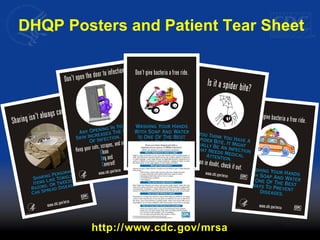
DHQP Posters and Patient Tear Sheet
http://www.cdc.gov/mrsa
CA-MRSA Working Group Meeting
Participants, July 2004
Gordon L. Archer
Carol L. Baker
Elizabeth Bancroft
Henry F. Chambers
Robert S. Daum
Jeffrey S. Duchin
Monica Farley
James Hadler
Jim Jorgensen
Sheldon K. Kaplan
Newton E. Kendig
Kathleen Harriman
Franklin D. Lowy
Ruth Lynfield
J. Kathryn MacDonald
Loren Miller
Gregory Moran
Olga Nuno
John H. Powers
L. Barth Reller
Nalini Singh
Marcus Zervos
Craig Zinderman
CDC
Daniel B. Jernigan*
John Jernigan*
Jay C. Butler
Denise Cardo
Roberta Carey
Rachel Gorwitz
Jeffrey C. Hageman
Thomas Hennessy
James M. Hughes
Jean Patel
Fred Tenover
J. Todd Weber
*Meeting Co-Chair
DHQP Inquiries
hip@cdc.gov
Questions?

MRSA

  • 1.
    Methicillin Resistant Staphylococcus aureus(MRSA) in the Community: Epidemiology and Management Rachel Gorwitz, MD, MPH Division of Healthcare Quality Promotion Centers for Disease Control and Prevention
  • 2.
    Staphylococcus aureus  Staphylococcusaureus: common cause of infection in the community  Methicillin-resistant Staphylococcus aureus (MRSA): – Increasingly important cause of healthcare- associated infections since 1970s – In 1990s, emerged as cause of infection in the community
  • 3.
    MRSA Strain Characteristics WereInitially Distinct MRSA in Healthcare MRSA in the Community Prevalent genotypes (U.S.) USA100, USA200 USA300, USA400 Antimicrobial resistance Multiple agents Few agents SCCmec (genetic element carrying mecA resistance gene) Types I-III Types IV, V PVL toxin gene Rare Common
  • 4.
    Dice (Opt:0.50%) (Tol1.3%-1.3%) (H>0.0% S>0.0%) [0.0%-100.0%] Pfsma 100 90 80 70 60 50 Pfsma 2001005114 2001005078 2000018626 2001035045 99045065 95009938 94042318 96023760 99034758 96028758 AA0097 2004711282 . . . . . . . . . . . . IVa IVa I I I V IVa I V IV I I I I IVa USA300 USA700 USA100 USA800 USA400 USA500 USA1000 USA900 USA600 . USA200 USA1100 USA1200 8 72 5 5 1 8 59 15 / 13 1. 36 30 . . . . . . . POS NEG NEG NEG NEG NE NE NE NE NE NE PO NE PFT SCCmecMLST pvl USA300 8 IV POS USA700 72 IV NEG USA100 5 I I NEG USA800 5 IV NEG USA400 1 IV POS USA500 8 IV, I I NEG USA1000 59 IV NEG/POS USA900 15 MSSA NEG USA600 45 I I NEG USA200 36 I I NEG USA1100 30 IV POS USA1200 MSSA POS McDougal et al J Clin Micro 2003;41:5113-5120 National Database of MRSA Pulsed-Field Types (Highlighted PFTs: historically community-associated)
  • 5.
    100% 80% 60% Athletes Prisoners Children Hospital Strain Hospital Strain Missouri California Texas Pennsylvania Texas Mississippi Colorado Georgia Missouri Tennessee USA300-114 USA100 USA200 Community California Pneumonia(AL, AR, IL, MD, TX, WA) 100% 80% 60% Athletes Prisoners Children Hospital Strain Hospital Strain Missouri California Texas Pennsylvania Texas Mississippi Colorado Georgia Missouri Tennessee USA300-114 USA100 USA200 Community California Pneumonia (AL, AR, IL, MD, TX, WA) 100% 80% 60% Athletes Prisoners Children Hospital Strain Hospital Strain Missouri California Texas Pennsylvania Texas Mississippi Colorado Georgia Missouri Tennessee USA300-114 USA100 USA200 Community California Pneumonia (AL, AR, IL, MD, TX, WA) 100% 80% 60% Athletes Prisoners Children Hospital Strain Hospital Strain Missouri California Texas Pennsylvania Texas Mississippi Colorado Georgia Missouri Tennessee USA300-114 USA100 USA200 Community California Pneumonia (AL, AR, IL, MD, TX, WA) 100% 80% 60% Athletes Prisoners Children Hospital Strain Hospital Strain Missouri California Texas Pennsylvania Texas Mississippi Colorado Georgia Missouri Tennessee USA300-114 USA100 USA200 Community California Pneumonia (AL, AR, IL, MD, TX, WA) 100% 80% 60% Athletes Prisoners Children Hospital Strain Hospital Strain Missouri California Texas Pennsylvania Texas Mississippi Colorado Georgia Missouri Tennessee USA300-114 USA100 USA200 Community California Pneumonia (AL, AR, IL, MD, TX, WA) A Single Pulsed-Field Type (USA300) has Accounted for Most Community-Associated MRSA Infections in the U.S.
  • 6.
    Community-Associated MRSA: CDC Population-BasedSurveillance Definition  MRSA culture in outpatient setting or 1st 48 hours of hospitalization AND patient lacks risk factors for healthcare-associated MRSA: – Hospitalization – Surgery – Long-term care – Dialysis – Indwelling devices – History of MRSA
  • 7.
    Outbreaks of MRSAin the Community  Often first detected as clusters of abscesses or “spider bites”  Various settings – Sports participants – Inmates in correctional facilities – Military recruits – Daycare attendees – Native Americans / Alaskan Natives – Men who have sex with men – Tattoo recipients – Hurricane evacuees in shelters
  • 10.
    Factors that FacilitateTransmission Crowding
  • 11.
  • 12.
  • 13.
    Frequent Contact Contaminated Surfaces andShared Items Crowding Factors that Facilitate Transmission Compromised Skin
  • 14.
    Frequent Contact Cleanliness Crowding Contaminated Surfaces andShared ItemsCompromised Skin Factors that Facilitate Transmission
  • 15.
    Contaminated Surfaces and SharedItems Frequent Contact Cleanliness Crowding Compromised Skin Factors that Facilitate Transmission Antimicrobial Use
  • 16.
    2004/2005 ABCs MRSA SurveillanceAreas Total Population: ~ 16.3 million Oregon California Colorado Tennessee Georgia Maryland Connecticut New YorkMinnesota
  • 17.
    CA-MRSA Infections areMainly Skin Infections Disease Syndrome (%) Skin/soft tissue 1,266 (77%) Wound (Traumatic) 157 (10%) Urinary Tract Infection 64 (4%) Sinusitis 61 (4%) Bacteremia 43 (3%) Pneumonia 31 (2%) Fridkin et al NEJM 2005;352:1436-44
  • 18.
    Age Group (yr) Atlanta,2001-2002 Baltimore, 2002 0 10 20 30 40 50 60 70 80 <2 2-18 19-64 >64 0 10 20 30 40 50 60 70 80 <2 2-18 19-64 >64 Incidence, Cases per 100,000 Age Group (yr) Black White Black White CA-MRSA Incidence Varies by Age and Race 26 per 100,000 18 per 100,000 •Fridkin et al NEJM 2005;352:1436-44
  • 19.
    Most Invasive MRSAInfections Are Healthcare-Associated Healthcare-Associated Community-Associated Klevens et al JAMA 2007;298:1763-71 14% 86%
  • 20.
    Incidence of InvasiveCA-MRSA Infections and Deaths by Age Active Bacterial Core surveillance (ABCS), 2005 0 2 4 6 8 10 <1 1 2-4 5-17 18-34 35-49 50-64 >64 Age in years Infections DeathsIncidence per 100,000 persons Klevens et al JAMA 2007;298:1763-71 Overall Incidence (all ages): Infections: 4.6 per 100,000 Deaths: 0.5 per 100,000
  • 21.
    S. aureus-Associated Skinand Soft Tissue Infections in Ambulatory Care  11.6 million ambulatory care visits per year in 2001-03 for skin infections typical of S. aureus  Increase in hospital outpatient and ED visits (2001-03 versus 1992-94) McCaig et al Emerg Infect Dis 2006;12:1715-1723
  • 22.
    54% 51% 60% 60% 67% 74% 39% 15% 55% 68% 72% 59% (97% USA300) MRSA Wasthe Most Commonly Identified Cause of Purulent SSTIs Among Adult ED Patients (EMERGEncy ID Net), August 2004 Moran et al NEJM 2006;355:666-674
  • 23.
    S. aureus NasalColonization National Health and Nutrition Examination Survey 2001-02 0 5 10 15 20 25 30 35 40 45 50 1--5 6--11 12--19 20--29 30--39 40--49 50--59 60--69 70+ Age (years) Prevalence(%) Male Female S. aureus: 32.4% = 89.4 M people MRSA: 0.8% = 2.3 M people MRSA colonization associated with age >= 60 years & being female
  • 24.
    0 5 10 15 20 Year 1 Year2 Year 3 %ClindamycinResistant Community Onset, Healthcare-associated MRSA Community-associated MRSA Clindamycin Resistance Among MRSA Isolates, Texas Children’s Hospital, Houston Texas,2001-2004 n=551 n=915 n=1192 n=198 n=163 n=181 Source: Hulten et al. PIDJ 2006;25:349-53, and Kaplan et al. Clin Infect Dis 2005;40:1785-91
  • 25.
    Emerging Multi-Drug Resistancein USA300?  Clusters of USA300 isolates with multiple resistance to erythromycin, clindamycin, tetracycline, ciprofloxacin, and mupirocin1  Resistance to ≤ one class of antibiotics other than beta-lactams is still the most common resistance pattern in MRSA USA300  TMP/SMX resistance rare in MRSA USA300 1 Diep et al Lancet 2006. Han et al J Clin Micro 2007.
  • 26.
    PFGE type No. (%) of nosocomial cases (n= 49) USA300 10 (20) USA100 21 (43) USA500 18 (37) USA800 0 (0) Distribution of PFGE types among MRSA isolates from nosocomial bloodstream infections Grady Memorial Hospital, 2004 Seybold U, et al. Clin Infect Dis 2006;42:647-656
  • 27.
    Strategies for ClinicalManagement of MRSA in the Community http:www.cdc.gov/ncidod/dhqp/ar_mrsa_ca.html
  • 28.
    Clinical Considerations -Evaluation  MRSA belongs in the differential diagnosis of skin and soft tissue infections (SSTI’s) compatible with S. aureus infection:  Abscesses, pustular lesions, “boils”  “Spider bites”  Cellulitis?
  • 29.
    Clinical Considerations -Evaluation  MRSA should also be considered in differential diagnosis of severe disease compatible with S. aureus infection: – Osteomyelitis – Empyema – Necrotizing pneumonia – Septic arthritis – Endocarditis – Sepsis syndrome – Necrotizing fasciitis – Purpura fulminans
  • 30.
    Management of Skin Infectionsin the Era of CA- MRSA  I&D should be routine for purulent skin lesions
  • 31.
    Management of Skin Infectionsin the Era of CA- MRSA  I&D should be routine for purulent skin lesions  Obtain material for culture
  • 32.
    Management of Skin Infectionsin the Era of CA- MRSA  I&D should be routine for purulent skin lesions  Obtain material for culture  No data to suggest molecular typing or toxin-testing should guide management
  • 33.
    Management of Skin Infectionsin the Era of CA- MRSA  I&D should be routine for purulent skin lesions  Obtain material for culture  No data to suggest molecular typing or toxin-testing should guide management  Empiric antimicrobial therapy may be needed
  • 34.
    Management of Skin Infectionsin the Era of CA- MRSA  I&D should be routine for purulent skin lesions  Obtain material for culture  No data to suggest molecular typing or toxin-testing should guide management  Empiric antimicrobial therapy may be needed  Alternative agents have +’s and –’s: More data needed to identify optimal strategies
  • 35.
    Management of SkinInfections in the Era of CA-MRSA  I&D should be routine for purulent skin lesions  Obtain material for culture  No data to suggest molecular typing or toxin- testing should guide management  Empiric antimicrobial therapy may be needed  Alternative agents have +’s and –’s: More data needed to identify optimal strategies  Use local data for treatment 0% 10% 20% 30% 40% 50% 60% 70% 80% Center A Center B Center C Center D Total PercentageCA-MRSA
  • 36.
    Management of Skin Infectionsin the Era of CA- MRSA  I&D should be routine for purulent skin lesions  Obtain material for culture  No data to suggest molecular typing or toxin-testing should guide management  Empiric antimicrobial therapy may be needed  Alternative agents have +’s and –’s: More data needed to identify optimal strategies  Use local data for treatment  Patient education is critical!
  • 37.
    Management of Skin Infectionsin the Era of CA- MRSA  I&D should be routine for purulent skin lesions  Obtain material for culture  No data to suggest molecular typing or toxin-testing should guide management  Empiric antimicrobial therapy may be needed  Alternative agents have +’s and –’s: More data needed to identify optimal strategies  Use local data for treatment  Patient education is critical!  Maintain adequate follow-up
  • 38.
    Clinical Considerations -Management Antimicrobial Selection (SSTIs)  Alternative agents (More data needed to establish effectiveness!): – Clindamycin – Potential for inducible resistance, Relatively higher risk of C. difficile associated disease? – TMP/SMX – Group A strep isolates commonly resistant – Tetracyclines – Not recommended for <8yo – Rifampin – Not as a single agent – Linezolid – Expensive, Potential for resistance with inappropriate use
  • 39.
    Clinical Considerations -Management Antimicrobial Selection (SSTIs)  Not optimal for MRSA (High prevalence of resistance or potential for rapid development of resistance): – Macrolides – Fluoroquinolones
  • 40.
    D-zone test forInducible Clindamycin Resistance CCE -Perform on erythromycin-resistant, clindamycin- susceptible S. aureus isolates -Clinical implications unclear, but treatment failures have occurred -Does not require pre-treatment or co-treatment with erythromycin in vivo
  • 41.
    Management of Severe/ Invasive Infections  Vancomycin remains a 1st -line therapy for severe infections possibly caused by MRSA  Other IV agents may be appropriate Consult an infectious disease specialist.  Final therapy decisions should be based on results of culture and susceptibility testing  Severe community-acquired pneumonia: Vancomycin or linezolid if MRSA is a consideration* *IDSA/ATS Guidelines for treatment of CAP in adults: Mandell et al. CID 2007;44:S27-72
  • 42.
    Screening and Decolonization In general, colonization cultures of infected or exposed persons in community settings are not recommended. (May have a role in public health investigations).  Decolonization regimens: – May have a role in preventing recurrent infections (more data needed to establish efficacy and optimal regimens for use in community settings). – After treating active infections and reinforcing hygiene and appropriate wound care, consider consultation with an infectious disease specialist regarding use of decolonization when there are recurrent infections in an individual patient or members of a household.
  • 43.
    Preventing Transmission  Personswith skin infections should keep wounds covered, wash hands frequently (always after touching infected skin or changing dressings), dispose of used bandages in trash, avoid sharing personal items.  Uninfected persons can minimize risk of infection by keeping cuts and scrapes clean and covered, avoiding contact with other persons’ infected skin, washing hands frequently, avoiding sharing personal items. www.cdc.gov
  • 44.
    Preventing Transmission  Exclusionof patients from school, work, sports activities, etc should be reserved for those that are unable to keep the infected skin covered with a clean, dry bandage and maintain good personal hygiene.  In general, it is not necessary to close schools to “disinfect” them when MRSA infections occur.  In ambulatory care settings, use standard precautions for all patients (hand hygiene before and after contact, barriers such as gloves, gowns as appropriate for contact with wound drainage and other body fluids). www.cdc.gov
  • 45.
    Role of Pets Greatest risk of Staph aureus / MRSA exposure in most humans is other humans  When household pet animals carry MRSA, likely acquired from a human  Transmission of MRSA from an infected or colonized pet to a human is possible, but likely accounts for a very small proportion of human infections  Reasonable to consider pet as a source if transmission continues in a household despite optimizing other control strategies  Little evidence that antimicrobial-based eradication therapy is effective in pets; however, colonization tends to be short-term* Barton et al 2006;Can J Infect Dis Med Microbiol
  • 46.
    Conclusions  New strainsof MRSA have emerged in the community, with implications for management of skin infections and other staphylococcal infections.  Incision and drainage remains a primary therapy for purulent skin infections.  Oral treatment options are available for patients with skin infections that require ancillary antibiotic therapy.  Patient education on proper wound care is a critical component of case management for patients with skin infections.  Strategies focusing on increased awareness, early detection and appropriate management, enhanced hygiene, and maintenance of a clean environment have been successful in controlling clusters / outbreaks of infection.
  • 47.
    DHQP Posters andPatient Tear Sheet http://www.cdc.gov/mrsa
  • 48.
    CA-MRSA Working GroupMeeting Participants, July 2004 Gordon L. Archer Carol L. Baker Elizabeth Bancroft Henry F. Chambers Robert S. Daum Jeffrey S. Duchin Monica Farley James Hadler Jim Jorgensen Sheldon K. Kaplan Newton E. Kendig Kathleen Harriman Franklin D. Lowy Ruth Lynfield J. Kathryn MacDonald Loren Miller Gregory Moran Olga Nuno John H. Powers L. Barth Reller Nalini Singh Marcus Zervos Craig Zinderman CDC Daniel B. Jernigan* John Jernigan* Jay C. Butler Denise Cardo Roberta Carey Rachel Gorwitz Jeffrey C. Hageman Thomas Hennessy James M. Hughes Jean Patel Fred Tenover J. Todd Weber *Meeting Co-Chair
  • 49.

Editor's Notes

  • #4 These community strains do not appear to have been transferred from the hospitals. Patients with MRSA acquired in the community usually have no previous contact with healthcare centers clinical manifestations are also different, Community strains cause mostly skin and soft tissue infections, but rarely cause upper respiratory or urinary tract infections, which are common with healthcare strains The community strains are only resistant to beta-lactams and sometimes other antimicrobial group, in contrast to the multi-resistant pattern of the healthcare strains This different antimicrobial susceptibility is explained by a distinct genetic background and, although still in debate, the difference in clinical manifestations may be due to the presence in community strains of toxins such as PVL or Panton Vanlentine Leukocidine, that causes severe inflammation
  • #17 These are the 9 sites participating in this collaboration, this surveillance project is population based, that is all residents of these areas are under surveillance; the green circles indicate that certain counties are included, whereas in CT, surveillance is state wide.
  • #26 37 kb plasmid with macrolide and high-level mupirocin resistance geness identified
  • #48 Can hear more about this in one of the 2 break out sessions