Standard Costing
Standard Cost (SC) 
• A standard cost is a 'planned unit cost of a 
product, component or service'. 
• It is a carefully predetermined unit cost 
which is prepared for each cost unit. 
• It contains details of the standard amount 
and price of each resource that will be 
utilised in providing the service or 
manufacturing the product. 
• A standard cost card shows full details of 
the standard cost of each product.
Standard Costing 
• It is the preparation of standard costs. 
• Control technique that reports variances by 
comparing actual costs to pre-set standards 
so facilitating action through management 
by exception. 
• Management by exception is the practice of 
focusing on activities which require 
attention and ignoring those which appear 
to be conforming to expectations.
A standard 
• Benchmark measurement of resource usage or 
revenue or profit generation, set in defined 
conditions. 
• A number of bases which can be used to set the 
standard. These bases include 
– a prior period level of performance by the same 
organisation; 
– the level of performance achieved by comparable 
organisations; 
– the level of performance required to meet 
organisational objectives.
When SC is used? 
• Degree of repetition in the production 
process. 
– Mass production 
– Repetitive assembly work 
• It can be calculated per task if there is 
a similarity of tasks.
The uses of standard costing 
• To value inventories and cost production for 
cost accounting purposes. It is an alternative 
method of valuation to methods like FIFO and 
LIFO. 
• To act as a control device by establishing 
standards (planned costs), highlighting (via 
variance analysis) activities that are not 
conforming to plan and thus alerting 
management to areas which may be out of 
control and in need of corrective action.
Standard Costing involves… 
• The establishment of predetermined 
estimates of the costs of products or 
services 
• The collection of actual costs 
• The comparison of the actual costs with 
the predetermined estimates
Setting Standards for 
Manufacturing
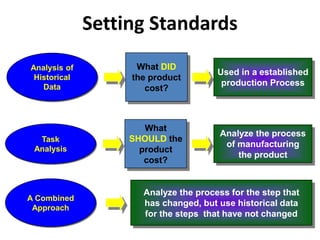
Analysis of 
Historical 
Data 
Task 
Analysis 
Setting Standards 
Used in a established 
production Process 
Analyze the process 
of manufacturing 
the product 
What DID 
the product 
cost? 
What 
SHOULD the 
product 
cost? 
A Combined 
Approach 
Analyze the process for the step that 
has changed, but use historical data 
for the steps that have not changed
Setting standards for materials costs 
• Direct material prices will be estimated by 
the purchasing department from their 
existing knowledge. 
– Purchase contract already agreed 
– Pricing discussions with regular supplies 
– Quotations and estimates from potential 
suppliers 
– The forecast movement of prices in the market 
– The availability of bulk purchase discounts 
– Material quality required
Setting standards for labour rates 
• Direct labour rate per hour will be set 
– by discussions with the human resource 
department 
– reference to the pay role 
– Any agreements with trade union(s) 
• A separate average hourly rate or weekly wage 
will be set for each different labour grade / 
type of employee (qualification / experience).
Setting standards for material usage 
and labour efficiency 
• Technical specification must be prepared for 
each product by production experts. 
• Material usage and labour efficiency standards 
are known as performance standards.
Performance Standards
Ideal standard 
• This is based on perfect operating conditions 
(no wastage, no inefficiencies, no idle time, no 
breakdowns). 
• Standards may be set at ideal levels, which 
make no allowance for inefficiencies. 
• Variances from ideal standards are useful for 
pinpointing areas where a close examination 
may result in large savings in order to 
maximise efficiency and minimise waste. 
• No allowance.
Attainable standard 
• Standards may also be set at attainable 
(possible) levels which assume efficient 
levels of operation, but which include 
allowances for factors such as losses, 
waste and machine downtime.
Current standard 
• Standards based on current performance 
levels (current wastage, current inefficiencies) 
are known as current standards. 
• The disadvantage is that they do not 
encourage any attempt to improve on current 
levels of efficiency.
Basic Standard 
• These are kept unaltered over a long period of 
time, and may be out of date. 
• They are used to show changes in efficiency or 
performance over a long period of time. 
• These are perhaps the least useful and least 
common type of standard in use.
Setting standards for Variable Overheads 
• Standard variable overhead costs are usually 
charged to products using a standard rate per 
labour hour. 
• Where labour hours are to be used as the 
basis for charging variable overhead cost. 
• Careful analysis of overhead costs will be 
necessary.
Setting standards for Fixed Overheads 
• As per marginal costing no need to 
determine a standard unit rate for fixed OH. 
• In the absorption costing system the 
standard overhead absorption rate is the 
same as the predetermined overhead 
absorption rate. 
• The standard overhead absorption rate will 
depend on the total value of budgeted 
overheads for the forthcoming period and on 
the planned activity or production volume 
for the period.
Setting standards for Selling Price and 
Margin or Contribution 
• Anticipated market demand 
• Manufacturing cost 
• Competing products and 
competitors’ action 
• Inflation estimates

Standard costing

  • 1.
  • 2.
    Standard Cost (SC) • A standard cost is a 'planned unit cost of a product, component or service'. • It is a carefully predetermined unit cost which is prepared for each cost unit. • It contains details of the standard amount and price of each resource that will be utilised in providing the service or manufacturing the product. • A standard cost card shows full details of the standard cost of each product.
  • 3.
    Standard Costing •It is the preparation of standard costs. • Control technique that reports variances by comparing actual costs to pre-set standards so facilitating action through management by exception. • Management by exception is the practice of focusing on activities which require attention and ignoring those which appear to be conforming to expectations.
  • 4.
    A standard •Benchmark measurement of resource usage or revenue or profit generation, set in defined conditions. • A number of bases which can be used to set the standard. These bases include – a prior period level of performance by the same organisation; – the level of performance achieved by comparable organisations; – the level of performance required to meet organisational objectives.
  • 5.
    When SC isused? • Degree of repetition in the production process. – Mass production – Repetitive assembly work • It can be calculated per task if there is a similarity of tasks.
  • 6.
    The uses ofstandard costing • To value inventories and cost production for cost accounting purposes. It is an alternative method of valuation to methods like FIFO and LIFO. • To act as a control device by establishing standards (planned costs), highlighting (via variance analysis) activities that are not conforming to plan and thus alerting management to areas which may be out of control and in need of corrective action.
  • 7.
    Standard Costing involves… • The establishment of predetermined estimates of the costs of products or services • The collection of actual costs • The comparison of the actual costs with the predetermined estimates
  • 8.
    Setting Standards for Manufacturing
  • 9.
    Analysis of Historical Data Task Analysis Setting Standards Used in a established production Process Analyze the process of manufacturing the product What DID the product cost? What SHOULD the product cost? A Combined Approach Analyze the process for the step that has changed, but use historical data for the steps that have not changed
  • 10.
    Setting standards formaterials costs • Direct material prices will be estimated by the purchasing department from their existing knowledge. – Purchase contract already agreed – Pricing discussions with regular supplies – Quotations and estimates from potential suppliers – The forecast movement of prices in the market – The availability of bulk purchase discounts – Material quality required
  • 11.
    Setting standards forlabour rates • Direct labour rate per hour will be set – by discussions with the human resource department – reference to the pay role – Any agreements with trade union(s) • A separate average hourly rate or weekly wage will be set for each different labour grade / type of employee (qualification / experience).
  • 12.
    Setting standards formaterial usage and labour efficiency • Technical specification must be prepared for each product by production experts. • Material usage and labour efficiency standards are known as performance standards.
  • 13.
  • 14.
    Ideal standard •This is based on perfect operating conditions (no wastage, no inefficiencies, no idle time, no breakdowns). • Standards may be set at ideal levels, which make no allowance for inefficiencies. • Variances from ideal standards are useful for pinpointing areas where a close examination may result in large savings in order to maximise efficiency and minimise waste. • No allowance.
  • 15.
    Attainable standard •Standards may also be set at attainable (possible) levels which assume efficient levels of operation, but which include allowances for factors such as losses, waste and machine downtime.
  • 16.
    Current standard •Standards based on current performance levels (current wastage, current inefficiencies) are known as current standards. • The disadvantage is that they do not encourage any attempt to improve on current levels of efficiency.
  • 17.
    Basic Standard •These are kept unaltered over a long period of time, and may be out of date. • They are used to show changes in efficiency or performance over a long period of time. • These are perhaps the least useful and least common type of standard in use.
  • 18.
    Setting standards forVariable Overheads • Standard variable overhead costs are usually charged to products using a standard rate per labour hour. • Where labour hours are to be used as the basis for charging variable overhead cost. • Careful analysis of overhead costs will be necessary.
  • 19.
    Setting standards forFixed Overheads • As per marginal costing no need to determine a standard unit rate for fixed OH. • In the absorption costing system the standard overhead absorption rate is the same as the predetermined overhead absorption rate. • The standard overhead absorption rate will depend on the total value of budgeted overheads for the forthcoming period and on the planned activity or production volume for the period.
  • 20.
    Setting standards forSelling Price and Margin or Contribution • Anticipated market demand • Manufacturing cost • Competing products and competitors’ action • Inflation estimates