Process Costing
Presented by:
Gaurav P Thakkar
Roll No: 17
Summary
• Meaning
• Characteristics of Process Costing
• Application of Process Costing
• Procedure
• Methods of Process Costing
• Advantages & Disadvantages of
Process Costing
• Process Losses
Meaning
• Process costing is one of the methods of
costing. It refers to costing of
operations(s) or process(es) involved in
converting materials into finished
products. Its main object is to provide an
average cost of product.
• CIMA London defines process costing as
“that form of operation costing which
applies where standardize goods are
produced.”
Characteristics of process costing
• The products are processed in one or more
processes.
• The products are standardized and similar.
• The products are distinguishable in processing
stage.
• When a product is produced through
different processes, the output of each
process is transferred to next process and
that of last process is transferred to the
finished stock.
Application of Process Costing
Process costing may be used in wide number
of industries. It is best suited to conditions
where the product is manufactured through a
continuous sequence of operations. For e.g.
Manufacturing industries, Mining industries,
Chemical industries, Public utility services,
etc.
Process costing requires fewer forms and less
details than those needed for job costing. But
here a closer analysis of operations is needed.
Procedure
• The factory is divided into process centres and an account
is maintained for each process centre or department.
• Direct and indirect costs relating to each process or
department are recorded at the end of the period.
• Daily or weekly production in terms of quantities such as
units, tons, etc. are recorded and summarized in process
or departments reports.
• Average cost per unit is found by dividing total cost of
each process by total production. In arriving at average
unit cost, (a) normal loss in production and (b) incomplete
units at the beginning and at the end of the period are
taken into consideration.
• If the products are produced by different process, cost of
previous process is transferred to the subsequent process, so
that total and unit cost of products are accumulated. In
short cost of products will comprise all costs incurred in all
the processes up to the finished stage.
Methods of Process Costing
FIFO Method:
• It follows the principle that materials used should
carry the actual experienced cost of the specific units
used.
• It is more complex.
• It is more accurate.
• It is used where size and costs is large.
Weighted Average Method:
• It assumes that all costs, whether from a preceding
period or the current one are lumped together and
assigned to produce units.
• It is simple to calculate
• It is used where assigning a specific cost to an
individual unit impossible.
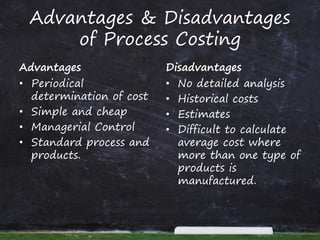
Advantages & Disadvantages
of Process Costing
Advantages
• Periodical
determination of cost
• Simple and cheap
• Managerial Control
• Standard process and
products.
Disadvantages
• No detailed analysis
• Historical costs
• Estimates
• Difficult to calculate
average cost where
more than one type of
products is
manufactured.
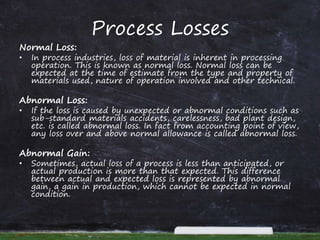
Process Losses
Normal Loss:
• In process industries, loss of material is inherent in processing
operation. This is known as normal loss. Normal loss can be
expected at the time of estimate from the type and property of
materials used, nature of operation involved and other technical.
Abnormal Loss:
• If the loss is caused by unexpected or abnormal conditions such as
sub-standard materials accidents, carelessness, bad plant design,
etc. is called abnormal loss. In fact from accounting point of view,
any loss over and above normal allowance is called abnormal loss.
Abnormal Gain:
• Sometimes, actual loss of a process is less than anticipated, or
actual production is more than that expected. This difference
between actual and expected loss is represented by abnormal
gain, a gain in production, which cannot be expected in normal
condition.
Accounting Treatment
Particulars Process A Process B
Materials (Rs.) 30,000 3,000
Labour (Rs.) 10,000 12,000
Overheads (Rs.) 7,000 8,600
Inputs (units) 20,000 17,500
Normal Loss 10% 4%
Sales value of wastes per unit (Rs.) 1 2
Particular Qty Rate (Rs.) Amount
(Rs.)
Particulars Qty Rate (Rs.) Amount
(Rs.)
To Direct
Materials
20,000 1.50 30,000
To Direct
Labour
10,000 By Normal
loss (10% of
20,000)
2,000 1.00 2,000
To Direct
Overheads
7,000 By
Abnormal
Loss
500 2.50 1,250
By Process B
A/c
(transfer)
17,500 2.50 43,750
20,000 47,000 20,000 47,000
Process A A/c
Dr Cr.
Particular Qty Rate (Rs.) Amount
(Rs.)
Particulars Qty Rate (Rs.) Amount
(Rs.)
To Process
A A/c
17,500 2.50 43,750
To Direct
Materials
3,000
To Direct
Labour
12,000 By Normal
loss (10% of
20,000)
700 2.00 1,400
To Direct
Overheads
8,600 By Finished
Goods A/c
(transfer)
17,000 3.93 66,375
17,500 67,350
Abnormal
Gain
200 785
17,000 68,135 17,000 68,135
Process B A/c
Dr Cr.
Particular Qty Rate (Rs.) Amount
(Rs.)
Particulars Qty Rate (Rs.) Amount
(Rs.)
To Process A
A/c
2,000 1.00 2,000
To Process B
A/c
700 2.00 1,400 By C.L.C. A/c 2,000 1.00 2,000
By C.L.C. A/c 500 2.00 1,000
By Abnormal
Gain A/c
200 2.00 400
2,700 3,400 2,700 3,400
Normal Loss A/c
Dr Cr.
Particular Qty Rate (Rs.) Amount
(Rs.)
Particulars Qty Rate (Rs.) Amount
(Rs.)
To Process A
A/c
500 2.50 1,250
By C.L.C. A/c 500 1.00 500
By Profit &
Loss A/c
(loss)
750
500 1,250 500 1,250
Abnormal Loss A/c
Dr Cr.
Particular Qty Rate
(Rs.)
Amount
(Rs.)
Particulars Qty Rate
(Rs.)
Amount
(Rs.)
To Normal
Loss A/c
(loss of
income)
200 2.00 400 By Process
B A/c
200 3.93 785
By Profit &
Loss A/c
(gain)
385
200 785 200 785
Abnormal Gain A/c
Dr Cr.
Particular Qty Rate (Rs.) Amount (Rs.) Particulars Qty Rate (Rs.) Amount (Rs.)
To Abnormal
Loss A/c
750 By Abnormal
gain A/c
385
Costing Profit and Loss A/c (extract)
Dr Cr.
Notes:
1. Loss of income:
Expected income from expected loss: 700 units @ Rs. 2 = Rs.1,400
Actual income: 500 units @ Rs. 2 = Rs. 1,000
2. CLC A/c stands for Cost Ledger Control A/c

Process costing

  • 1.
  • 2.
    Summary • Meaning • Characteristicsof Process Costing • Application of Process Costing • Procedure • Methods of Process Costing • Advantages & Disadvantages of Process Costing • Process Losses
  • 3.
    Meaning • Process costingis one of the methods of costing. It refers to costing of operations(s) or process(es) involved in converting materials into finished products. Its main object is to provide an average cost of product. • CIMA London defines process costing as “that form of operation costing which applies where standardize goods are produced.”
  • 4.
    Characteristics of processcosting • The products are processed in one or more processes. • The products are standardized and similar. • The products are distinguishable in processing stage. • When a product is produced through different processes, the output of each process is transferred to next process and that of last process is transferred to the finished stock.
  • 5.
    Application of ProcessCosting Process costing may be used in wide number of industries. It is best suited to conditions where the product is manufactured through a continuous sequence of operations. For e.g. Manufacturing industries, Mining industries, Chemical industries, Public utility services, etc. Process costing requires fewer forms and less details than those needed for job costing. But here a closer analysis of operations is needed.
  • 6.
    Procedure • The factoryis divided into process centres and an account is maintained for each process centre or department. • Direct and indirect costs relating to each process or department are recorded at the end of the period. • Daily or weekly production in terms of quantities such as units, tons, etc. are recorded and summarized in process or departments reports. • Average cost per unit is found by dividing total cost of each process by total production. In arriving at average unit cost, (a) normal loss in production and (b) incomplete units at the beginning and at the end of the period are taken into consideration. • If the products are produced by different process, cost of previous process is transferred to the subsequent process, so that total and unit cost of products are accumulated. In short cost of products will comprise all costs incurred in all the processes up to the finished stage.
  • 7.
    Methods of ProcessCosting FIFO Method: • It follows the principle that materials used should carry the actual experienced cost of the specific units used. • It is more complex. • It is more accurate. • It is used where size and costs is large. Weighted Average Method: • It assumes that all costs, whether from a preceding period or the current one are lumped together and assigned to produce units. • It is simple to calculate • It is used where assigning a specific cost to an individual unit impossible.
  • 8.
    Advantages & Disadvantages ofProcess Costing Advantages • Periodical determination of cost • Simple and cheap • Managerial Control • Standard process and products. Disadvantages • No detailed analysis • Historical costs • Estimates • Difficult to calculate average cost where more than one type of products is manufactured.
  • 9.
    Process Losses Normal Loss: •In process industries, loss of material is inherent in processing operation. This is known as normal loss. Normal loss can be expected at the time of estimate from the type and property of materials used, nature of operation involved and other technical. Abnormal Loss: • If the loss is caused by unexpected or abnormal conditions such as sub-standard materials accidents, carelessness, bad plant design, etc. is called abnormal loss. In fact from accounting point of view, any loss over and above normal allowance is called abnormal loss. Abnormal Gain: • Sometimes, actual loss of a process is less than anticipated, or actual production is more than that expected. This difference between actual and expected loss is represented by abnormal gain, a gain in production, which cannot be expected in normal condition.
  • 10.
    Accounting Treatment Particulars ProcessA Process B Materials (Rs.) 30,000 3,000 Labour (Rs.) 10,000 12,000 Overheads (Rs.) 7,000 8,600 Inputs (units) 20,000 17,500 Normal Loss 10% 4% Sales value of wastes per unit (Rs.) 1 2
  • 11.
    Particular Qty Rate(Rs.) Amount (Rs.) Particulars Qty Rate (Rs.) Amount (Rs.) To Direct Materials 20,000 1.50 30,000 To Direct Labour 10,000 By Normal loss (10% of 20,000) 2,000 1.00 2,000 To Direct Overheads 7,000 By Abnormal Loss 500 2.50 1,250 By Process B A/c (transfer) 17,500 2.50 43,750 20,000 47,000 20,000 47,000 Process A A/c Dr Cr.
  • 12.
    Particular Qty Rate(Rs.) Amount (Rs.) Particulars Qty Rate (Rs.) Amount (Rs.) To Process A A/c 17,500 2.50 43,750 To Direct Materials 3,000 To Direct Labour 12,000 By Normal loss (10% of 20,000) 700 2.00 1,400 To Direct Overheads 8,600 By Finished Goods A/c (transfer) 17,000 3.93 66,375 17,500 67,350 Abnormal Gain 200 785 17,000 68,135 17,000 68,135 Process B A/c Dr Cr.
  • 13.
    Particular Qty Rate(Rs.) Amount (Rs.) Particulars Qty Rate (Rs.) Amount (Rs.) To Process A A/c 2,000 1.00 2,000 To Process B A/c 700 2.00 1,400 By C.L.C. A/c 2,000 1.00 2,000 By C.L.C. A/c 500 2.00 1,000 By Abnormal Gain A/c 200 2.00 400 2,700 3,400 2,700 3,400 Normal Loss A/c Dr Cr.
  • 14.
    Particular Qty Rate(Rs.) Amount (Rs.) Particulars Qty Rate (Rs.) Amount (Rs.) To Process A A/c 500 2.50 1,250 By C.L.C. A/c 500 1.00 500 By Profit & Loss A/c (loss) 750 500 1,250 500 1,250 Abnormal Loss A/c Dr Cr.
  • 15.
    Particular Qty Rate (Rs.) Amount (Rs.) ParticularsQty Rate (Rs.) Amount (Rs.) To Normal Loss A/c (loss of income) 200 2.00 400 By Process B A/c 200 3.93 785 By Profit & Loss A/c (gain) 385 200 785 200 785 Abnormal Gain A/c Dr Cr.
  • 16.
    Particular Qty Rate(Rs.) Amount (Rs.) Particulars Qty Rate (Rs.) Amount (Rs.) To Abnormal Loss A/c 750 By Abnormal gain A/c 385 Costing Profit and Loss A/c (extract) Dr Cr. Notes: 1. Loss of income: Expected income from expected loss: 700 units @ Rs. 2 = Rs.1,400 Actual income: 500 units @ Rs. 2 = Rs. 1,000 2. CLC A/c stands for Cost Ledger Control A/c