Time Value of Money
Would you prefer to
have 1 crore now or 1
crore 10 years from
now?
Would you prefer to
have 1 crore now or 1
crore 10 years from
now?
The Terminology of Time ValueThe Terminology of Time Value
 Present Value - An amount of money today, or the
current value of a future cash flow
 Future Value - An amount of money at some future
time period
 Period - A length of time (often a year, but can be a
month, week, day, hour, etc.)
 Interest Rate - The compensation paid to a lender (or
saver) for the use of funds expressed as a percentage
for a period (normally expressed as an annual rate)
 Present Value - An amount of money today, or the
current value of a future cash flow
 Future Value - An amount of money at some future
time period
 Period - A length of time (often a year, but can be a
month, week, day, hour, etc.)
 Interest Rate - The compensation paid to a lender (or
saver) for the use of funds expressed as a percentage
for a period (normally expressed as an annual rate)
Time Value of Money
• The value of money changes with change in
time.
• A rupee received today is more valuable than
a rupee received one year later.
– Present Value concept (PV concept)
– Future or Compounding Value concept (FV
concept)
• The value of money changes with change in
time.
• A rupee received today is more valuable than
a rupee received one year later.
– Present Value concept (PV concept)
– Future or Compounding Value concept (FV
concept)
Reasons for Time Preference of Money
• Uncertain future
• Risk involvement
• Present needs
• Return
• Uncertain future
• Risk involvement
• Present needs
• Return
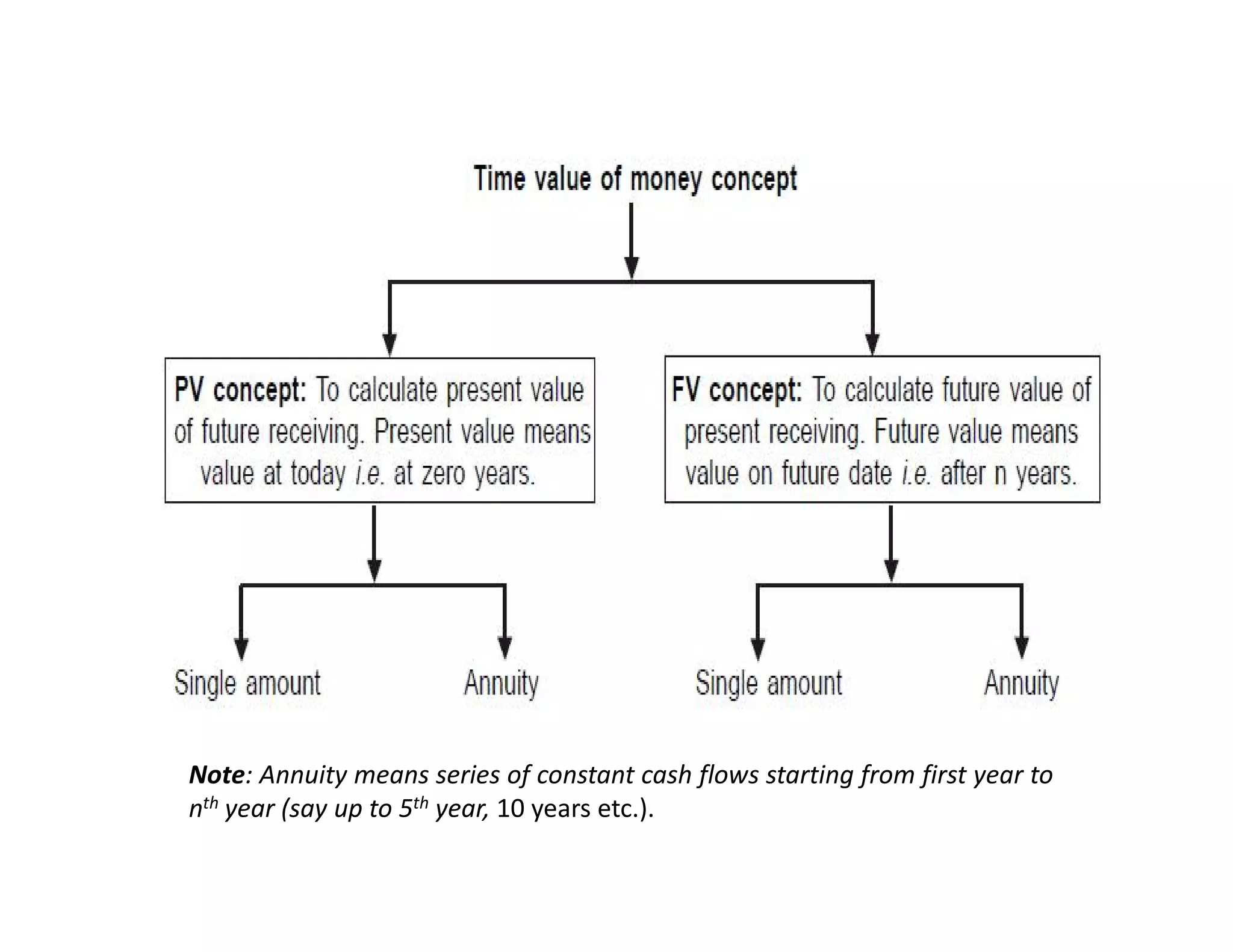
Note: Annuity means series of constant cash flows starting from first year to
nth year (say up to 5th year, 10 years etc.).
Future Value of a Single Amount
Say that you put $1,000 into the bank
today. How much will you have after a
year? After two years? This kind of
problem is called a future value /
compounding problem.
Say that you put $1,000 into the bank
today. How much will you have after a
year? After two years? This kind of
problem is called a future value /
compounding problem.
Compounding vs. Simple Interest
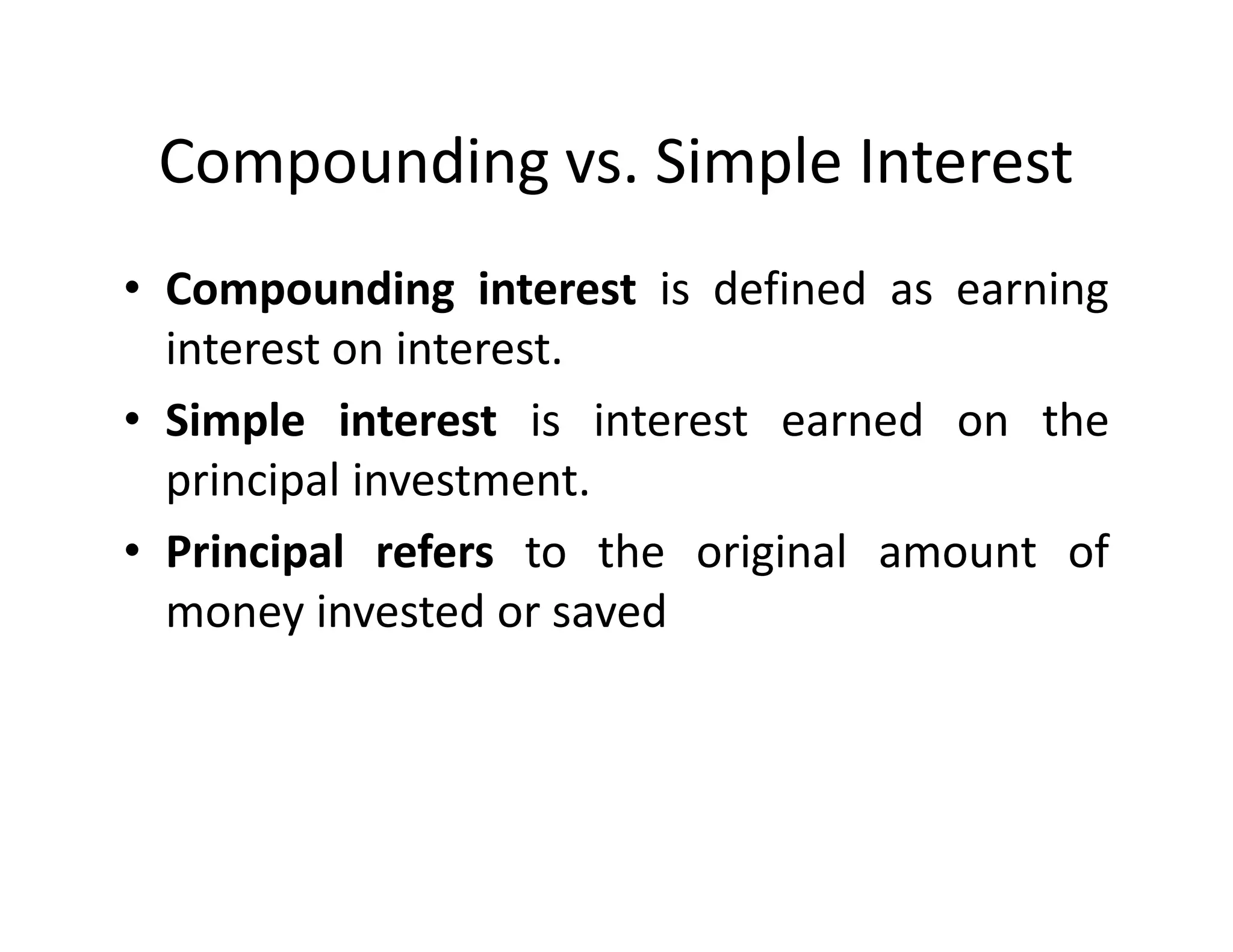
• Compounding interest is defined as earning
interest on interest.
• Simple interest is interest earned on the
principal investment.
• Principal refers to the original amount of
money invested or saved
• Compounding interest is defined as earning
interest on interest.
• Simple interest is interest earned on the
principal investment.
• Principal refers to the original amount of
money invested or saved
Future Value of a Single Amount
You have Rs.1,000 today and you deposit it
with a financial institution, which pays 10
per cent interest compounded annually,
for a period of 3 years. What is the total
amount after 3 years?
You have Rs.1,000 today and you deposit it
with a financial institution, which pays 10
per cent interest compounded annually,
for a period of 3 years. What is the total
amount after 3 years?
Formula
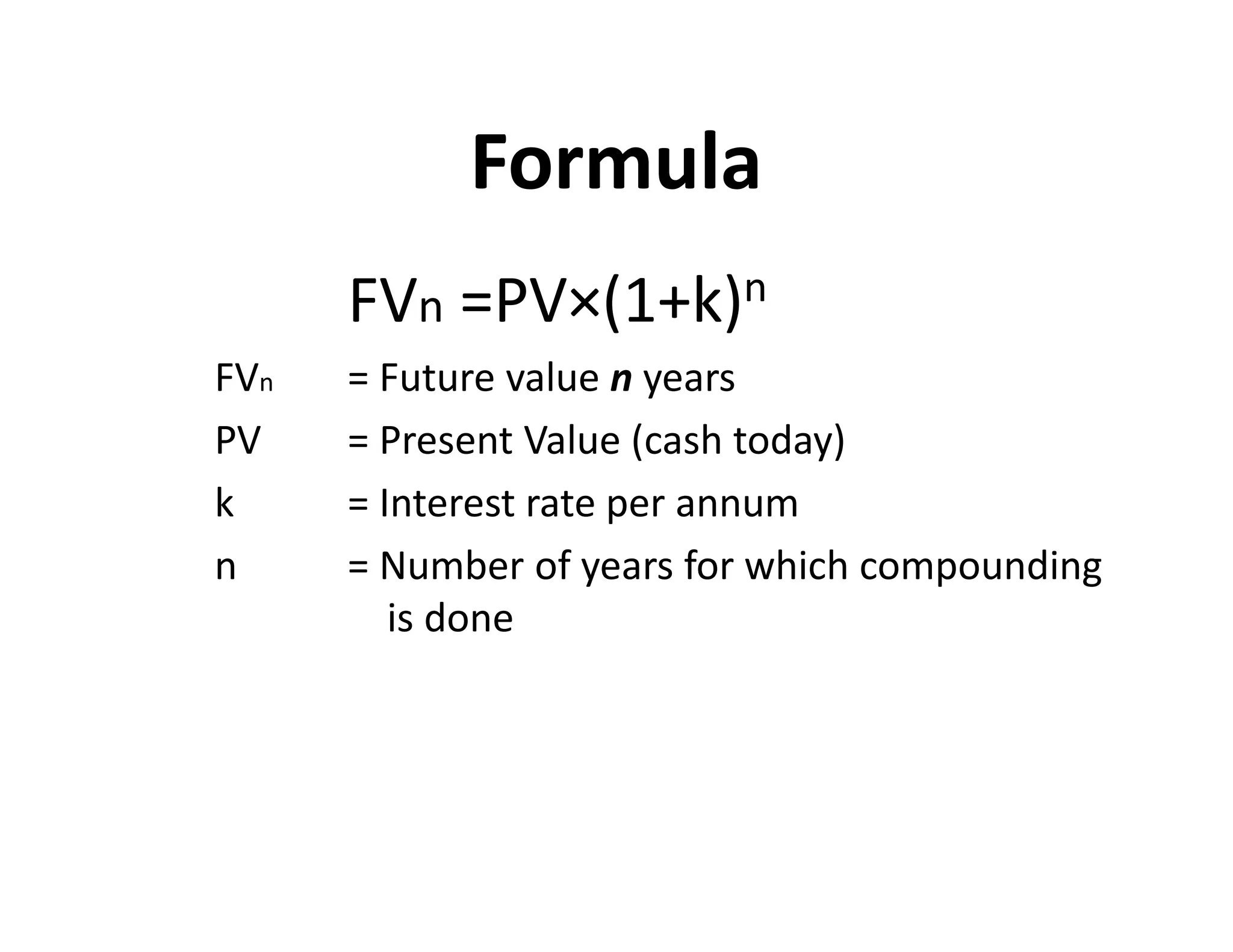
FVn =PV×(1+k)n
FVn = Future value n years
PV = Present Value (cash today)
k = Interest rate per annum
n = Number of years for which compounding
is done
FVn =PV×(1+k)n
FVn = Future value n years
PV = Present Value (cash today)
k = Interest rate per annum
n = Number of years for which compounding
is done
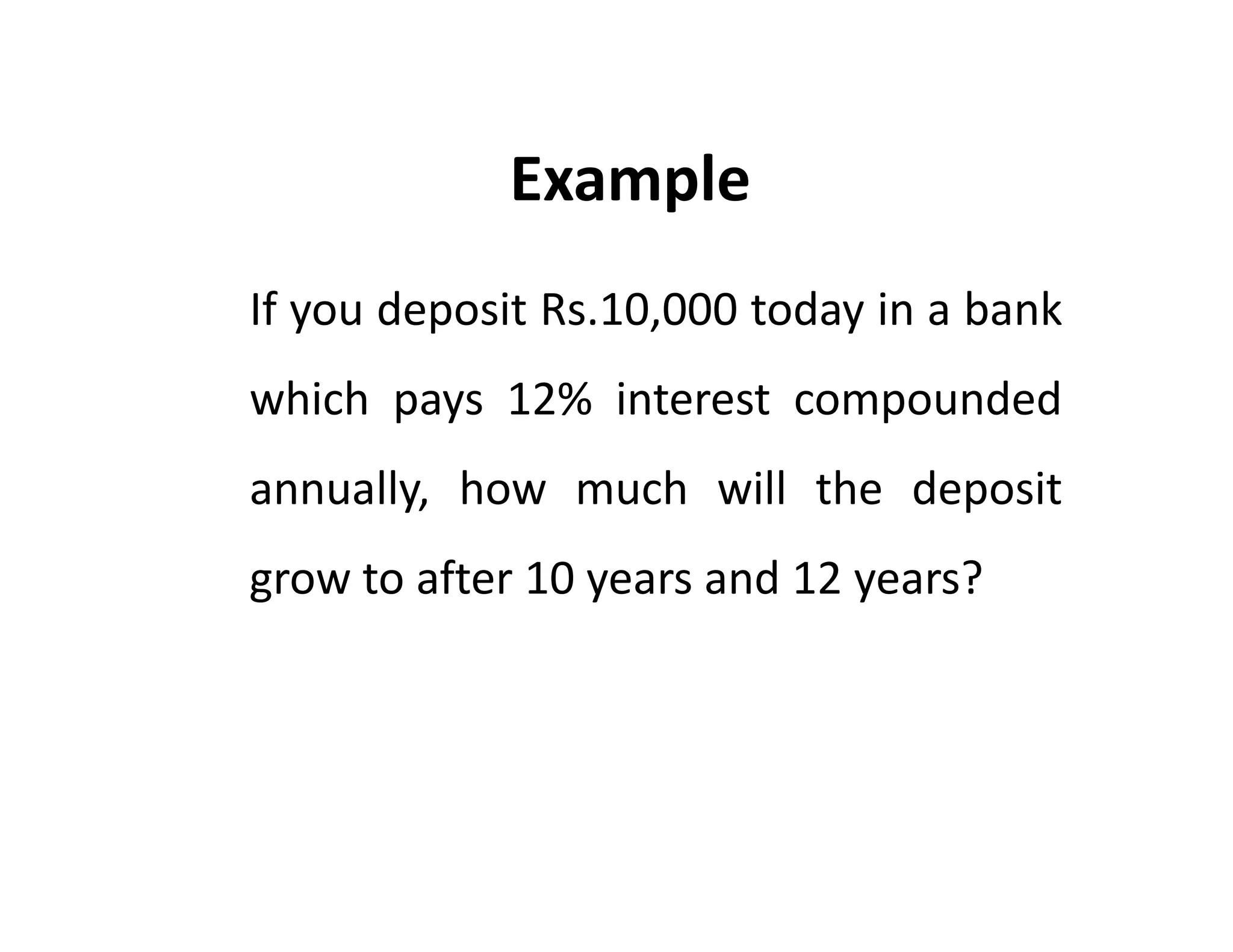
If you deposit Rs.10,000 today in a bank
which pays 12% interest compounded
annually, how much will the deposit
grow to after 10 years and 12 years?
Example
If you deposit Rs.10,000 today in a bank
which pays 12% interest compounded
annually, how much will the deposit
grow to after 10 years and 12 years?
Doubling period
• How much time is required to double my
investment?
• The length of period which an amount is going
to take o double at a certain given rate of
interest.
• How much time is required to double my
investment?
• The length of period which an amount is going
to take o double at a certain given rate of
interest.
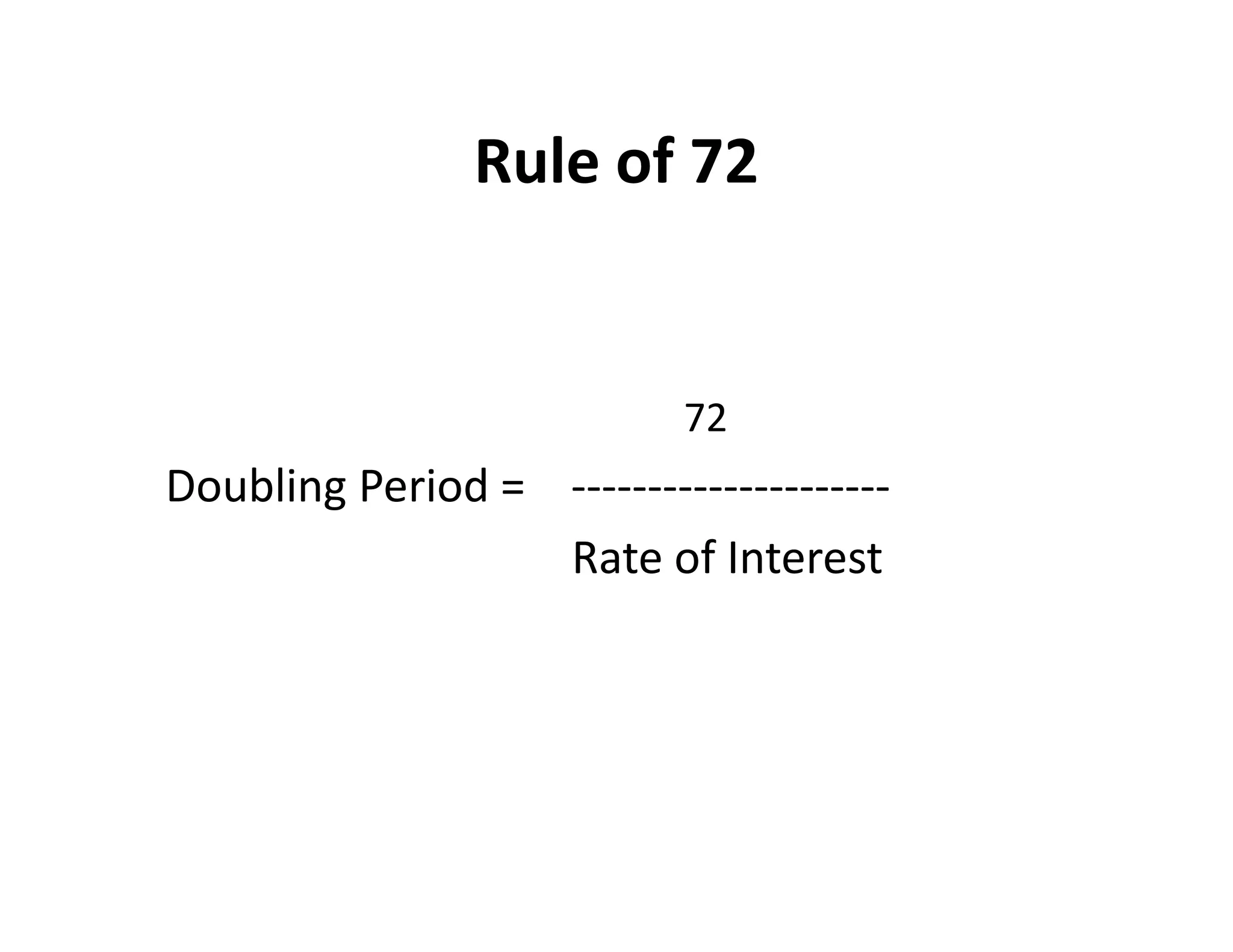
Rule of 72
72
Doubling Period = ---------------------
Rate of Interest
72
Doubling Period = ---------------------
Rate of Interest
If you deposit Rs.10,000 today at 6 per
cent rate of interest, in how many
years will this amount double?
Workout this with the rule of 72.
Example
If you deposit Rs.10,000 today at 6 per
cent rate of interest, in how many
years will this amount double?
Workout this with the rule of 72.
Rule of 69
69
Doubling Period = 0.35 + ---------------------
Rate of Interest
69
Doubling Period = 0.35 + ---------------------
Rate of Interest
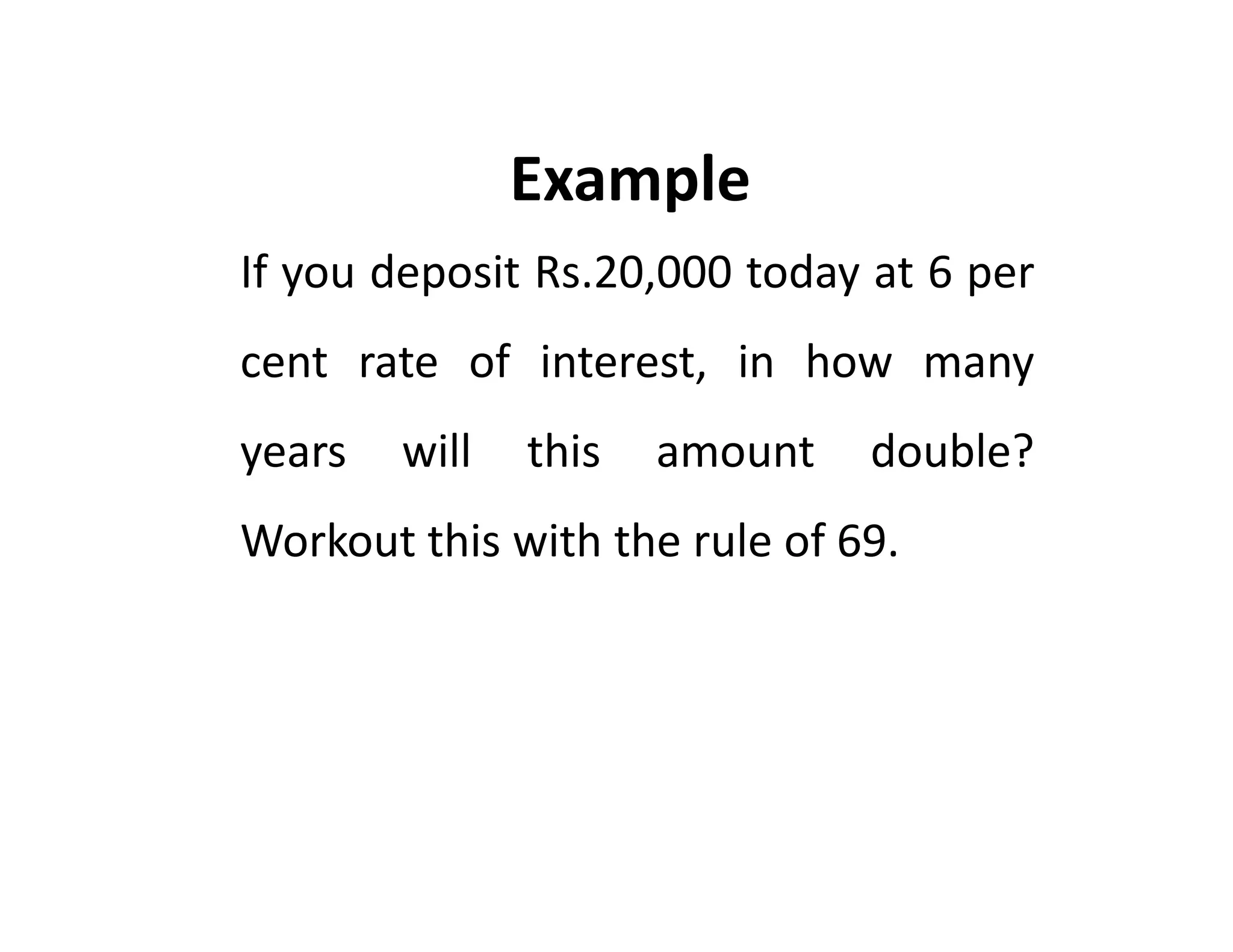
If you deposit Rs.20,000 today at 6 per
cent rate of interest, in how many
years will this amount double?
Workout this with the rule of 69.
Example
If you deposit Rs.20,000 today at 6 per
cent rate of interest, in how many
years will this amount double?
Workout this with the rule of 69.
Multiple Compounding Periods
• Interest may have to be compounded more
than once a year.
• Example: Banks may allow interest on
quarterly or half yearly basis; or a company
may allow compounding of interest twice a
year.
• Interest may have to be compounded more
than once a year.
• Example: Banks may allow interest on
quarterly or half yearly basis; or a company
may allow compounding of interest twice a
year.
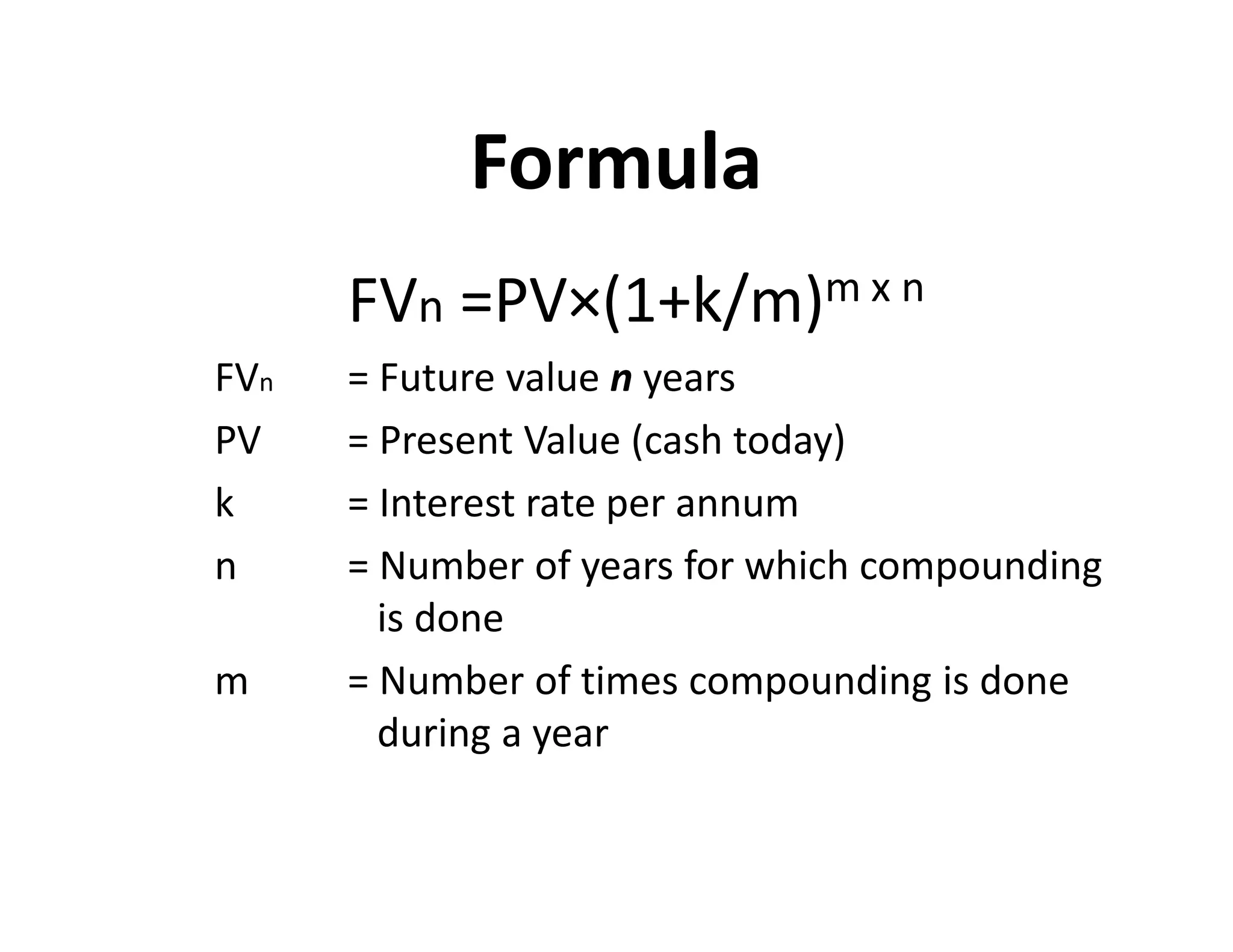
Formula
FVn =PV×(1+k/m)m x n
FVn = Future value n years
PV = Present Value (cash today)
k = Interest rate per annum
n = Number of years for which compounding
is done
m = Number of times compounding is done
during a year
FVn =PV×(1+k/m)m x n
FVn = Future value n years
PV = Present Value (cash today)
k = Interest rate per annum
n = Number of years for which compounding
is done
m = Number of times compounding is done
during a year
Calculate the compound vale of
Rs.10,000 at the end of 3 years at 12%
rate of interest when interest is
calculated on
– Yearly basis
– Half yearly basis
– Quarterly basis
Example
Calculate the compound vale of
Rs.10,000 at the end of 3 years at 12%
rate of interest when interest is
calculated on
– Yearly basis
– Half yearly basis
– Quarterly basis
Effective Vs. Nominal Rate
• Effective Interest rate: The percentage
rate of return on an annual basis. It
reflects the effect of intra-year
compounding. (Ex. 12.36%)
• Nominal Interest rate: Interest rate
expresses in monitory terms. (Ex. 12%)
• Effective Interest rate: The percentage
rate of return on an annual basis. It
reflects the effect of intra-year
compounding. (Ex. 12.36%)
• Nominal Interest rate: Interest rate
expresses in monitory terms. (Ex. 12%)
Formula
ERI = (1 + k/m)m – 1
ERI = Effective Rate of Interest
k = Nominal Rate of Interest
m = Frequency of compounding per year
ERI = (1 + k/m)m – 1
ERI = Effective Rate of Interest
k = Nominal Rate of Interest
m = Frequency of compounding per year
Example
A bank offers 8 per cent nominal rate of
interest on deposits. What is the effective
rate of interest if the compounding is done
i) half yearly
ii) quarterly &
iii) monthly
A bank offers 8 per cent nominal rate of
interest on deposits. What is the effective
rate of interest if the compounding is done
i) half yearly
ii) quarterly &
iii) monthly
Future Value of an Annuity
• Suppose you deposit Rs.1,000 annually in a
bank for 5 years and your deposits earn a
compound interest rate of 10 per cent. What
will be the value of this series of deposits (an
annuity) at the end of 5 years?
• Suppose you deposit Rs.1,000 annually in a
bank for 5 years and your deposits earn a
compound interest rate of 10 per cent. What
will be the value of this series of deposits (an
annuity) at the end of 5 years?
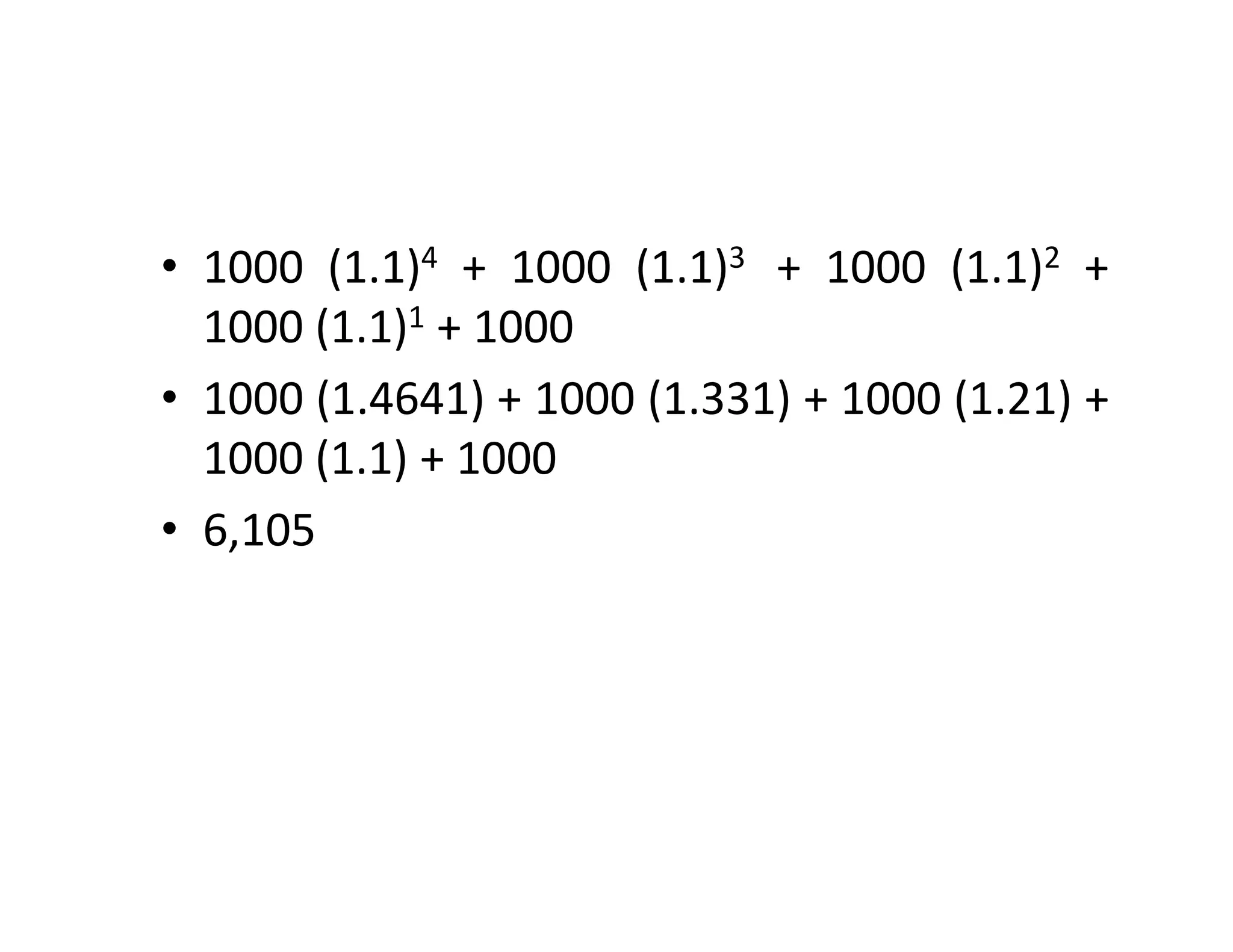
• 1000 (1.1)4 + 1000 (1.1)3 + 1000 (1.1)2 +
1000 (1.1)1 + 1000
• 1000 (1.4641) + 1000 (1.331) + 1000 (1.21) +
1000 (1.1) + 1000
• 6,105
• 1000 (1.1)4 + 1000 (1.1)3 + 1000 (1.1)2 +
1000 (1.1)1 + 1000
• 1000 (1.4641) + 1000 (1.331) + 1000 (1.21) +
1000 (1.1) + 1000
• 6,105
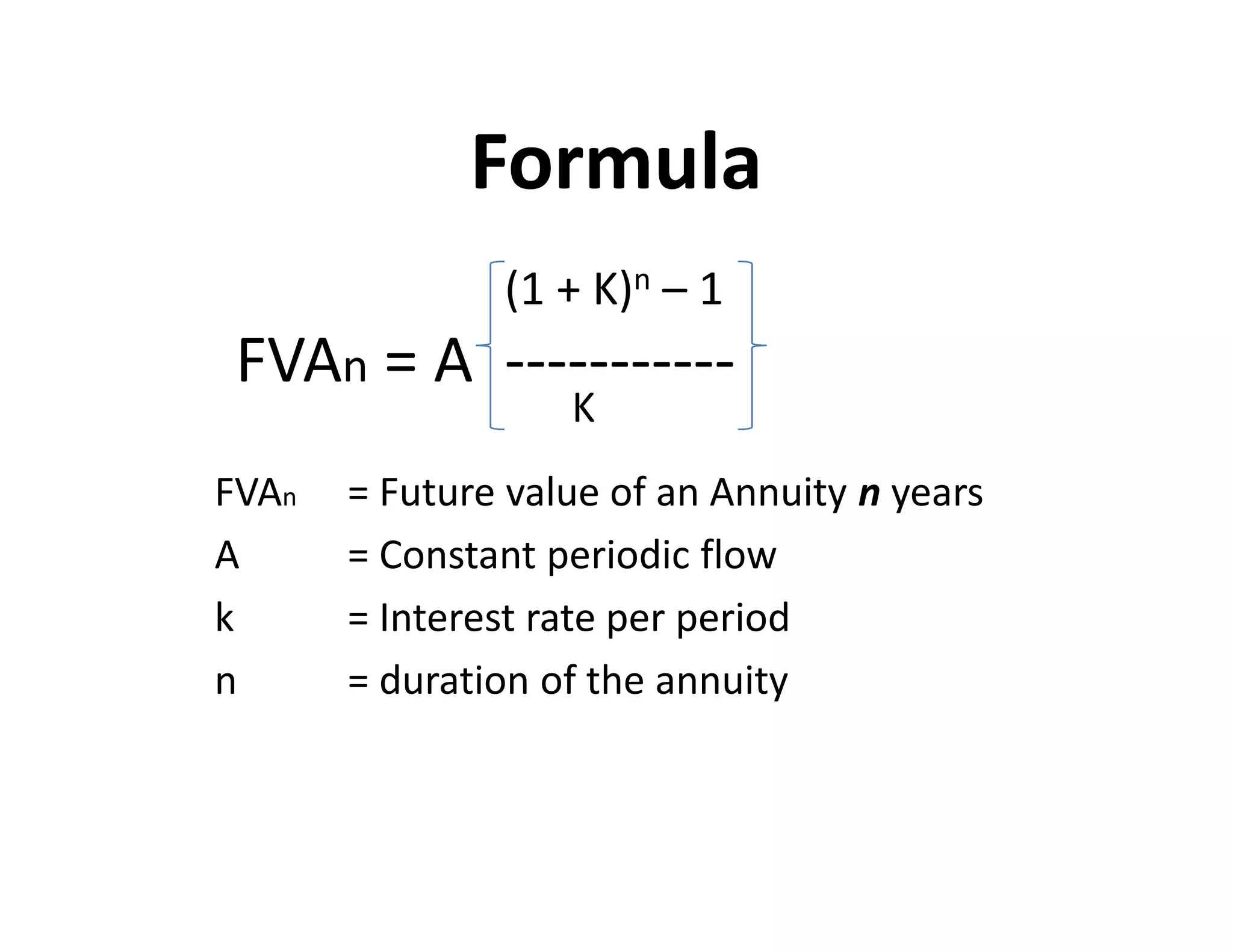
Formula
(1 + K)n – 1
FVAn = A -----------
K
FVAn = Future value of an Annuity n years
A = Constant periodic flow
k = Interest rate per period
n = duration of the annuity
(1 + K)n – 1
FVAn = A -----------
K
FVAn = Future value of an Annuity n years
A = Constant periodic flow
k = Interest rate per period
n = duration of the annuity
(1 +.1)5 – 1
• FVA = 1000 --------------------
.1
(1 +.1)5 – 1
• FVA = 1000 --------------------
.1
Present Value of a Single Amount
• Suppose someone promises to give you
Rs.1,000 three years hence. What is the
present value of this amount if the interest
rate is 10 per cent?
• Suppose someone promises to give you
Rs.1,000 three years hence. What is the
present value of this amount if the interest
rate is 10 per cent?
Formula
n
PV = FVn
Present Value of An Annuity
Suppose you expect to receive Rs.1,000
annually for 3 years, each receipt occurring at
the end of the year. What is the present value
of this stream of benefits I the discount rate is
10 per cent?
Suppose you expect to receive Rs.1,000
annually for 3 years, each receipt occurring at
the end of the year. What is the present value
of this stream of benefits I the discount rate is
10 per cent?
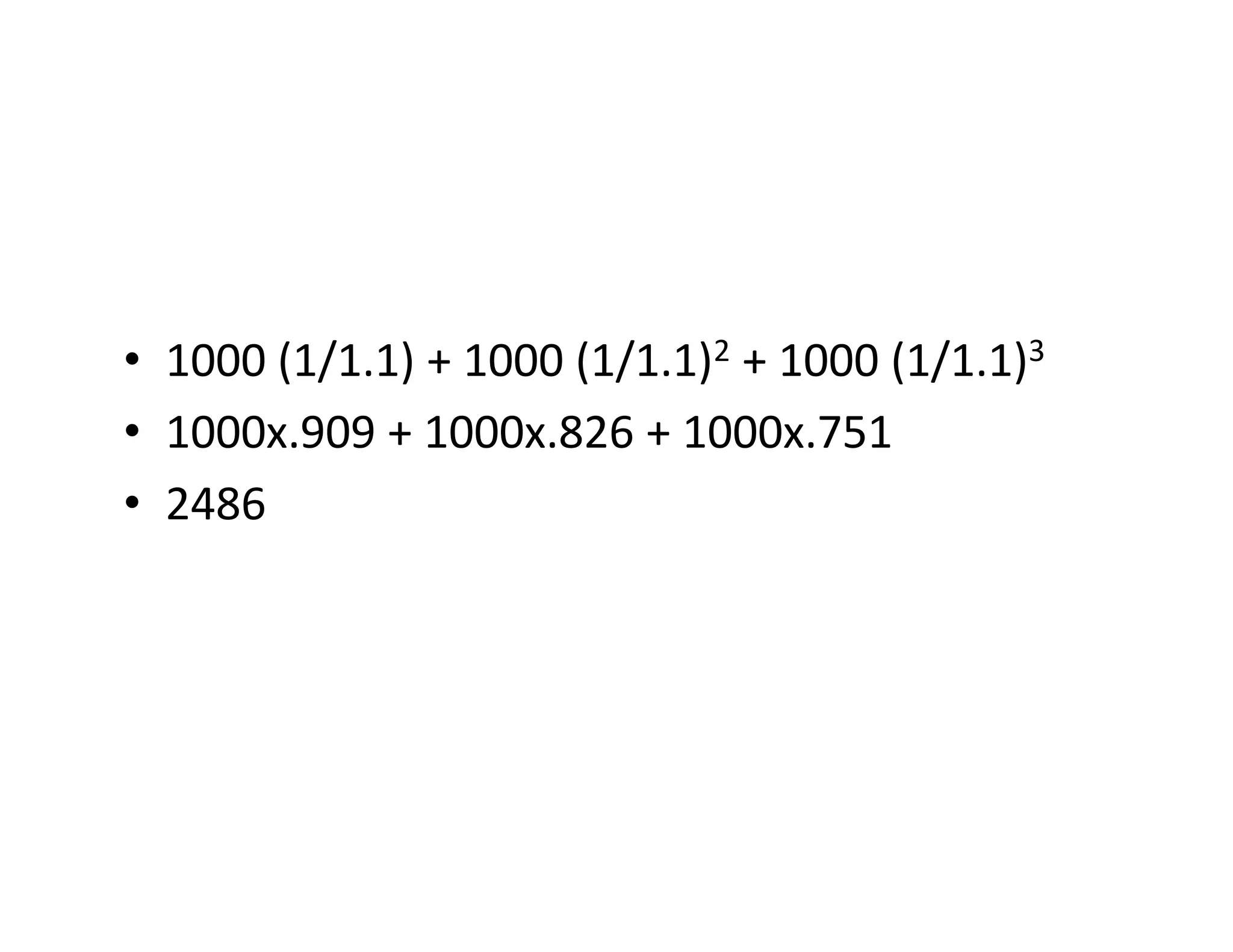
• 1000 (1/1.1) + 1000 (1/1.1)2 + 1000 (1/1.1)3
• 1000x.909 + 1000x.826 + 1000x.751
• 2486
• 1000 (1/1.1) + 1000 (1/1.1)2 + 1000 (1/1.1)3
• 1000x.909 + 1000x.826 + 1000x.751
• 2486

Time value of money

  • 1.
  • 2.
    Would you preferto have 1 crore now or 1 crore 10 years from now? Would you prefer to have 1 crore now or 1 crore 10 years from now?
  • 3.
    The Terminology ofTime ValueThe Terminology of Time Value  Present Value - An amount of money today, or the current value of a future cash flow  Future Value - An amount of money at some future time period  Period - A length of time (often a year, but can be a month, week, day, hour, etc.)  Interest Rate - The compensation paid to a lender (or saver) for the use of funds expressed as a percentage for a period (normally expressed as an annual rate)  Present Value - An amount of money today, or the current value of a future cash flow  Future Value - An amount of money at some future time period  Period - A length of time (often a year, but can be a month, week, day, hour, etc.)  Interest Rate - The compensation paid to a lender (or saver) for the use of funds expressed as a percentage for a period (normally expressed as an annual rate)
  • 4.
    Time Value ofMoney • The value of money changes with change in time. • A rupee received today is more valuable than a rupee received one year later. – Present Value concept (PV concept) – Future or Compounding Value concept (FV concept) • The value of money changes with change in time. • A rupee received today is more valuable than a rupee received one year later. – Present Value concept (PV concept) – Future or Compounding Value concept (FV concept)
  • 5.
    Reasons for TimePreference of Money • Uncertain future • Risk involvement • Present needs • Return • Uncertain future • Risk involvement • Present needs • Return
  • 6.
    Note: Annuity meansseries of constant cash flows starting from first year to nth year (say up to 5th year, 10 years etc.).
  • 7.
    Future Value ofa Single Amount Say that you put $1,000 into the bank today. How much will you have after a year? After two years? This kind of problem is called a future value / compounding problem. Say that you put $1,000 into the bank today. How much will you have after a year? After two years? This kind of problem is called a future value / compounding problem.
  • 8.
    Compounding vs. SimpleInterest • Compounding interest is defined as earning interest on interest. • Simple interest is interest earned on the principal investment. • Principal refers to the original amount of money invested or saved • Compounding interest is defined as earning interest on interest. • Simple interest is interest earned on the principal investment. • Principal refers to the original amount of money invested or saved
  • 9.
    Future Value ofa Single Amount You have Rs.1,000 today and you deposit it with a financial institution, which pays 10 per cent interest compounded annually, for a period of 3 years. What is the total amount after 3 years? You have Rs.1,000 today and you deposit it with a financial institution, which pays 10 per cent interest compounded annually, for a period of 3 years. What is the total amount after 3 years?
  • 10.
    Formula FVn =PV×(1+k)n FVn =Future value n years PV = Present Value (cash today) k = Interest rate per annum n = Number of years for which compounding is done FVn =PV×(1+k)n FVn = Future value n years PV = Present Value (cash today) k = Interest rate per annum n = Number of years for which compounding is done
  • 11.
    If you depositRs.10,000 today in a bank which pays 12% interest compounded annually, how much will the deposit grow to after 10 years and 12 years? Example If you deposit Rs.10,000 today in a bank which pays 12% interest compounded annually, how much will the deposit grow to after 10 years and 12 years?
  • 12.
    Doubling period • Howmuch time is required to double my investment? • The length of period which an amount is going to take o double at a certain given rate of interest. • How much time is required to double my investment? • The length of period which an amount is going to take o double at a certain given rate of interest.
  • 13.
    Rule of 72 72 DoublingPeriod = --------------------- Rate of Interest 72 Doubling Period = --------------------- Rate of Interest
  • 14.
    If you depositRs.10,000 today at 6 per cent rate of interest, in how many years will this amount double? Workout this with the rule of 72. Example If you deposit Rs.10,000 today at 6 per cent rate of interest, in how many years will this amount double? Workout this with the rule of 72.
  • 15.
    Rule of 69 69 DoublingPeriod = 0.35 + --------------------- Rate of Interest 69 Doubling Period = 0.35 + --------------------- Rate of Interest
  • 16.
    If you depositRs.20,000 today at 6 per cent rate of interest, in how many years will this amount double? Workout this with the rule of 69. Example If you deposit Rs.20,000 today at 6 per cent rate of interest, in how many years will this amount double? Workout this with the rule of 69.
  • 17.
    Multiple Compounding Periods •Interest may have to be compounded more than once a year. • Example: Banks may allow interest on quarterly or half yearly basis; or a company may allow compounding of interest twice a year. • Interest may have to be compounded more than once a year. • Example: Banks may allow interest on quarterly or half yearly basis; or a company may allow compounding of interest twice a year.
  • 18.
    Formula FVn =PV×(1+k/m)m xn FVn = Future value n years PV = Present Value (cash today) k = Interest rate per annum n = Number of years for which compounding is done m = Number of times compounding is done during a year FVn =PV×(1+k/m)m x n FVn = Future value n years PV = Present Value (cash today) k = Interest rate per annum n = Number of years for which compounding is done m = Number of times compounding is done during a year
  • 19.
    Calculate the compoundvale of Rs.10,000 at the end of 3 years at 12% rate of interest when interest is calculated on – Yearly basis – Half yearly basis – Quarterly basis Example Calculate the compound vale of Rs.10,000 at the end of 3 years at 12% rate of interest when interest is calculated on – Yearly basis – Half yearly basis – Quarterly basis
  • 20.
    Effective Vs. NominalRate • Effective Interest rate: The percentage rate of return on an annual basis. It reflects the effect of intra-year compounding. (Ex. 12.36%) • Nominal Interest rate: Interest rate expresses in monitory terms. (Ex. 12%) • Effective Interest rate: The percentage rate of return on an annual basis. It reflects the effect of intra-year compounding. (Ex. 12.36%) • Nominal Interest rate: Interest rate expresses in monitory terms. (Ex. 12%)
  • 21.
    Formula ERI = (1+ k/m)m – 1 ERI = Effective Rate of Interest k = Nominal Rate of Interest m = Frequency of compounding per year ERI = (1 + k/m)m – 1 ERI = Effective Rate of Interest k = Nominal Rate of Interest m = Frequency of compounding per year
  • 22.
    Example A bank offers8 per cent nominal rate of interest on deposits. What is the effective rate of interest if the compounding is done i) half yearly ii) quarterly & iii) monthly A bank offers 8 per cent nominal rate of interest on deposits. What is the effective rate of interest if the compounding is done i) half yearly ii) quarterly & iii) monthly
  • 23.
    Future Value ofan Annuity • Suppose you deposit Rs.1,000 annually in a bank for 5 years and your deposits earn a compound interest rate of 10 per cent. What will be the value of this series of deposits (an annuity) at the end of 5 years? • Suppose you deposit Rs.1,000 annually in a bank for 5 years and your deposits earn a compound interest rate of 10 per cent. What will be the value of this series of deposits (an annuity) at the end of 5 years?
  • 24.
    • 1000 (1.1)4+ 1000 (1.1)3 + 1000 (1.1)2 + 1000 (1.1)1 + 1000 • 1000 (1.4641) + 1000 (1.331) + 1000 (1.21) + 1000 (1.1) + 1000 • 6,105 • 1000 (1.1)4 + 1000 (1.1)3 + 1000 (1.1)2 + 1000 (1.1)1 + 1000 • 1000 (1.4641) + 1000 (1.331) + 1000 (1.21) + 1000 (1.1) + 1000 • 6,105
  • 25.
    Formula (1 + K)n– 1 FVAn = A ----------- K FVAn = Future value of an Annuity n years A = Constant periodic flow k = Interest rate per period n = duration of the annuity (1 + K)n – 1 FVAn = A ----------- K FVAn = Future value of an Annuity n years A = Constant periodic flow k = Interest rate per period n = duration of the annuity
  • 26.
    (1 +.1)5 –1 • FVA = 1000 -------------------- .1 (1 +.1)5 – 1 • FVA = 1000 -------------------- .1
  • 27.
    Present Value ofa Single Amount • Suppose someone promises to give you Rs.1,000 three years hence. What is the present value of this amount if the interest rate is 10 per cent? • Suppose someone promises to give you Rs.1,000 three years hence. What is the present value of this amount if the interest rate is 10 per cent?
  • 28.
  • 29.
    Present Value ofAn Annuity Suppose you expect to receive Rs.1,000 annually for 3 years, each receipt occurring at the end of the year. What is the present value of this stream of benefits I the discount rate is 10 per cent? Suppose you expect to receive Rs.1,000 annually for 3 years, each receipt occurring at the end of the year. What is the present value of this stream of benefits I the discount rate is 10 per cent?
  • 30.
    • 1000 (1/1.1)+ 1000 (1/1.1)2 + 1000 (1/1.1)3 • 1000x.909 + 1000x.826 + 1000x.751 • 2486 • 1000 (1/1.1) + 1000 (1/1.1)2 + 1000 (1/1.1)3 • 1000x.909 + 1000x.826 + 1000x.751 • 2486