What is Finance?
• The art and science of managing money,
or management of money.
• It is the study of value.
• It is the study of how to make good
decision that involve money.
–What assets to buy?
–How to pay for the assets you buy?
• The art and science of managing money,
or management of money.
• It is the study of value.
• It is the study of how to make good
decision that involve money.
–What assets to buy?
–How to pay for the assets you buy?
Value Creation Components
• Time
• Uncertainty
Why Study Finance?
• Marketing
– Budgets, marketing research, marketing
financial products
• Accounting
– Dual accounting and finance function,
preparation of financial statements
• Management
– Strategic thinking, job performance,
profitability
• Personal finance
– Budgeting, retirement planning, day-to-
day cash flow issues
• Marketing
– Budgets, marketing research, marketing
financial products
• Accounting
– Dual accounting and finance function,
preparation of financial statements
• Management
– Strategic thinking, job performance,
profitability
• Personal finance
– Budgeting, retirement planning, day-to-
day cash flow issues
Key issues in Finance
• Where to raise financial resources from?
• Wherein to invest the resources?
• How best to manage the production-
distribution function?
• How much of profit to distribute and how
much to retain?
• Where to raise financial resources from?
• Wherein to invest the resources?
• How best to manage the production-
distribution function?
• How much of profit to distribute and how
much to retain?
Finance
1. Financial management
2. Capital markets
3. Investments
1. Financial management
2. Capital markets
3. Investments
1. Financial Management
• Acquisition of fund at optimum cost
and its utilization with minimum
financial risk.
• It is concerned with management of
fund.
• Acquisition of fund at optimum cost
and its utilization with minimum
financial risk.
• It is concerned with management of
fund.
Financial Management or
Corporate Finance
• How much and what types of assets to
acquire?
• How to raise the capital needed to
purchase assets?
• How to run the firm so as to maximize
its value?
• How much and what types of assets to
acquire?
• How to raise the capital needed to
purchase assets?
• How to run the firm so as to maximize
its value?
Goals of Financial Management
• Profit maximization (profit after
tax)
• Maximizing Earnings Per Share
• Shareholder’s Wealth
Maximization
• Profit maximization (profit after
tax)
• Maximizing Earnings Per Share
• Shareholder’s Wealth
Maximization
Profit Maximisation
• Main aim is earning profit.
• Profit is the parameter of the business
operation.
• Profit reduces risk of the business
concern.
• Profit is the main source of finance.
• Profitability meets the social needs also.
• Main aim is earning profit.
• Profit is the parameter of the business
operation.
• Profit reduces risk of the business
concern.
• Profit is the main source of finance.
• Profitability meets the social needs also.
Wealth Maximisation
• This concept is to improve the value or wealth
of the shareholders.
• It considers both time and risk of the business
concern.
• It provides efficient allocation of resources.
• It ensures the economic interest of the
society.
• This concept is to improve the value or wealth
of the shareholders.
• It considers both time and risk of the business
concern.
• It provides efficient allocation of resources.
• It ensures the economic interest of the
society.
2. Capital Markets
• The markets where interest rates,
along with stock and bond prices,
are determined.
• The financial institutions that
supply capital to businesses.
• The markets where interest rates,
along with stock and bond prices,
are determined.
• The financial institutions that
supply capital to businesses.
3. Investments
• Security analysis deals with finding the
proper values of individual securities.
• Portfolio theory deals with the best way
to structure individual/institution
portfolios.
• Market analysis deals with the issue of
whether stock and bond markets at any
given time are too high, too low, or just
right.
• Security analysis deals with finding the
proper values of individual securities.
• Portfolio theory deals with the best way
to structure individual/institution
portfolios.
• Market analysis deals with the issue of
whether stock and bond markets at any
given time are too high, too low, or just
right.
Two pillars of finance
• Risk
• Return
Finance Functions
• Finance is central to all business activities.
• Finance function reconciles the conflicting
interests of:
• varied stakeholders
• different functional units
• Finance is central to all business activities.
• Finance function reconciles the conflicting
interests of:
• varied stakeholders
• different functional units
Finance decisions of the firm
• Financial decision-making involves
procurement of funds and their
optimal utilization through:
1. Investment (utilization of fund)
2. Financing (procurement of fund)
3. Dividend and (distribution of fund)
4. Working capital decisions
• Financial decision-making involves
procurement of funds and their
optimal utilization through:
1. Investment (utilization of fund)
2. Financing (procurement of fund)
3. Dividend and (distribution of fund)
4. Working capital decisions
1. Investment Decisions (1/2)
• Aim at selecting the most productive avenues
that maximize the ROI.
• Examples include:
• Expansion
• Modernization and replacement
• R&D expenditure.
• Also referred to as capital budgeting decisions.
• Are critical for long-term survival and growth.
• Aim at selecting the most productive avenues
that maximize the ROI.
• Examples include:
• Expansion
• Modernization and replacement
• R&D expenditure.
• Also referred to as capital budgeting decisions.
• Are critical for long-term survival and growth.
1. Investment Decisions (2/2)
• Are taken in the light of their
probable impact on the wealth of
shareholders.
• Involve huge capital outlay.
• Have long-term implications.
• Are usually irreversible.
• Are taken in the light of their
probable impact on the wealth of
shareholders.
• Involve huge capital outlay.
• Have long-term implications.
• Are usually irreversible.
2. Financial Management Decision
• Capital budgeting
– What long-term investments or projects
should the business take on?
• Capital structure
– How should we pay for our assets?
– Should we use debt or equity?
• Working capital management
– How do we manage the day-to-day finances of
the firm?
• Capital budgeting
– What long-term investments or projects
should the business take on?
• Capital structure
– How should we pay for our assets?
– Should we use debt or equity?
• Working capital management
– How do we manage the day-to-day finances of
the firm?
• Where from to procure the requisite funds?
• What should be the optimal mix of various
sources of capital?
• How much should be the proportion of short-term
and long-term funds?
• How do the expectations of providers of each
source of capital change with alteration in the
capital mix?
2. Financial Management Decision
• Where from to procure the requisite funds?
• What should be the optimal mix of various
sources of capital?
• How much should be the proportion of short-term
and long-term funds?
• How do the expectations of providers of each
source of capital change with alteration in the
capital mix?
3. Dividend decisions
• Deciding the mix of profits to be distributed as
dividends and those to be ploughed back for future
financing needs of business.
• Depend on trade off between future financing needs
of the firm and current consumption requirements
of the shareholders.
• Determining the payout ratio and the method of
dividend payment.
• The payout ratio is decided in the light of its
probable impact on shareholders’ wealth.
• Deciding the mix of profits to be distributed as
dividends and those to be ploughed back for future
financing needs of business.
• Depend on trade off between future financing needs
of the firm and current consumption requirements
of the shareholders.
• Determining the payout ratio and the method of
dividend payment.
• The payout ratio is decided in the light of its
probable impact on shareholders’ wealth.
Working Capital Decisions
• Are concerned with the management of
current assets.
• The two key decision points in working
capital management are:
• Level of investment in current assets
• Financing of current assets.
• Are concerned with the management of
current assets.
• The two key decision points in working
capital management are:
• Level of investment in current assets
• Financing of current assets.
Key Issues In
Financial Decision-making
Investment
Decision
• What business to be in?
• What growth rate is appropriate?
• What assets to acquire?
Financing
Decision
• What mix of debt and equity to be used?
• Can we change value of the firm by changing the capital
mix?
• Is there an optimal debt–equity mix?
• What mix of debt and equity to be used?
• Can we change value of the firm by changing the capital
mix?
• Is there an optimal debt–equity mix?
Dividend
Decision
• How much of the profit should be distributed as dividends
and how much should be ploughed back
• Can we change value of the firm by changing the amount
of dividend?
• What should be the mode of dividend payment
Working
Capital
Decision
• What level of inventory is ideal?
• What level of credit should be given to the customers?
• What level of cash should be maintained?
• How can the blockage of funds in the current assets be
minimized without compromising with profits?
Organisation of finance function
• Reason for placing the finance
functions in the hands of top
management
– Financial decisions are crucial for the survival
of the firm.
– The financial actions determine solvency of the
firm
– Centralisation of the finance functions can
result in a number of economies to the firm.
• Reason for placing the finance
functions in the hands of top
management
– Financial decisions are crucial for the survival
of the firm.
– The financial actions determine solvency of the
firm
– Centralisation of the finance functions can
result in a number of economies to the firm.
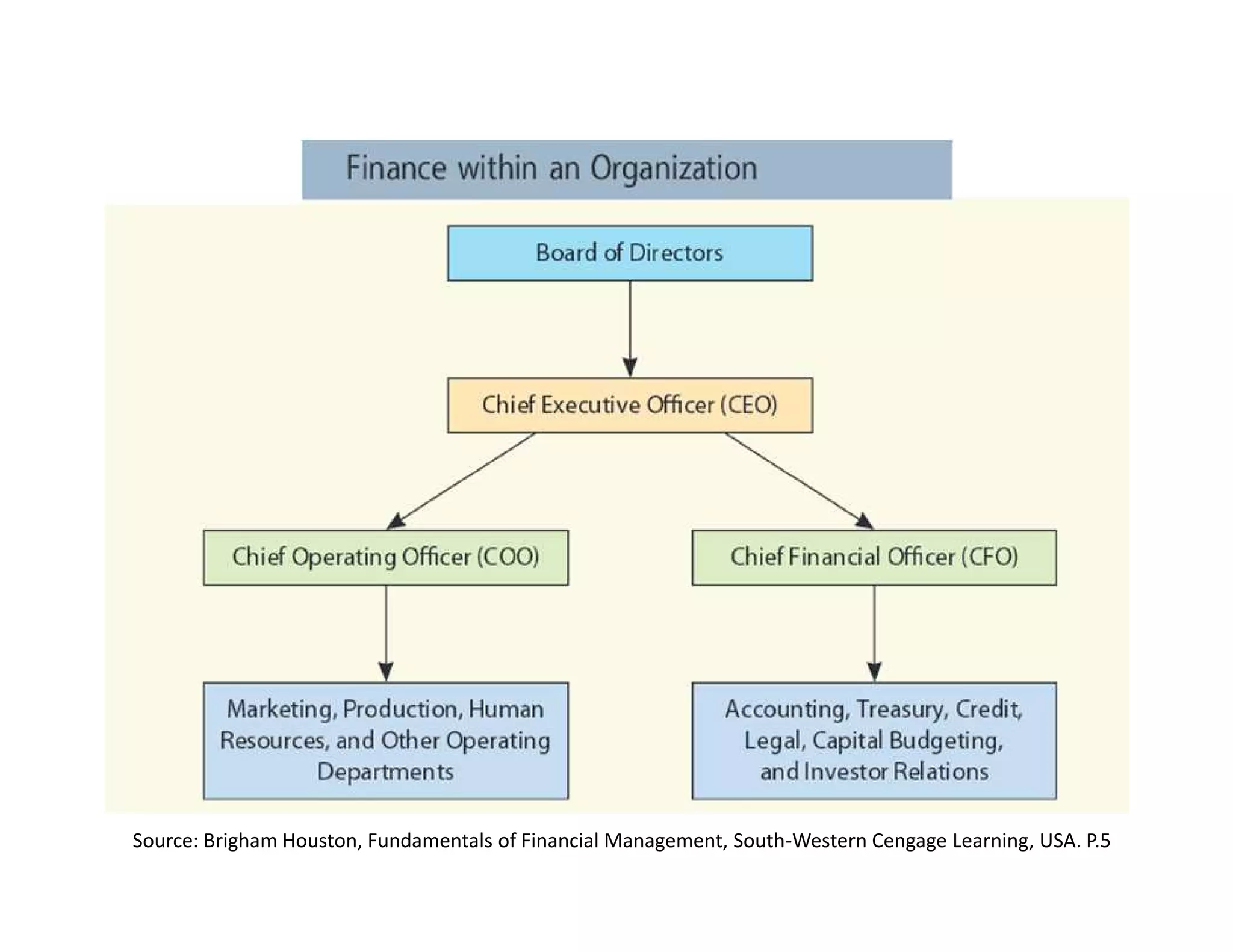
Organisation of finance function
Chief Finance Officer
Treasurer
Cash Manager
Credit Manager
Controller
Financial Accounting
Manager
Cost Accounting
Manager
Credit Manager
Capital Budgeting
Manager
Fund Raising
Manager
Fund Raising
Manager
Cost Accounting
Manager
Tax Manager
Data Processing
Manager
Internal Auditor
Source: Brigham Houston, Fundamentals of Financial Management, South-Western Cengage Learning, USA. P.5
Finance Manager’s Role
• Forecasting of Cash Flows
• Raising Funds
• Allocation of Funds
• Profit Planning
• Understanding Capital Markets
• Managing the Flow of Internal Funds
• Facilitate Pricing of Product
• Measuring Required Return
• Managing Assets
• Forecasting of Cash Flows
• Raising Funds
• Allocation of Funds
• Profit Planning
• Understanding Capital Markets
• Managing the Flow of Internal Funds
• Facilitate Pricing of Product
• Measuring Required Return
• Managing Assets
Functions of Treasurer
• Obtaining finance
• Banking relationship
• Cash Management
• Credit administration
• Capital Budgeting
• Obtaining finance
• Banking relationship
• Cash Management
• Credit administration
• Capital Budgeting
Functions of Controller
• Financial accounting
• Internal auditing
• Taxation
• Management accounting
• Management control
• Financial accounting
• Internal auditing
• Taxation
• Management accounting
• Management control
Forms of Business Organization
• Sole Proprietorship
• Partnership
• Corporation
• Sole Proprietorship
• Partnership
• Corporation
Sole Proprietorship
• Business owned by an individual
• Owner maintains title to assets and
profits
• Unlimited liability
• Termination occurs on owner’s death
or by owner’s choice
• Business owned by an individual
• Owner maintains title to assets and
profits
• Unlimited liability
• Termination occurs on owner’s death
or by owner’s choice
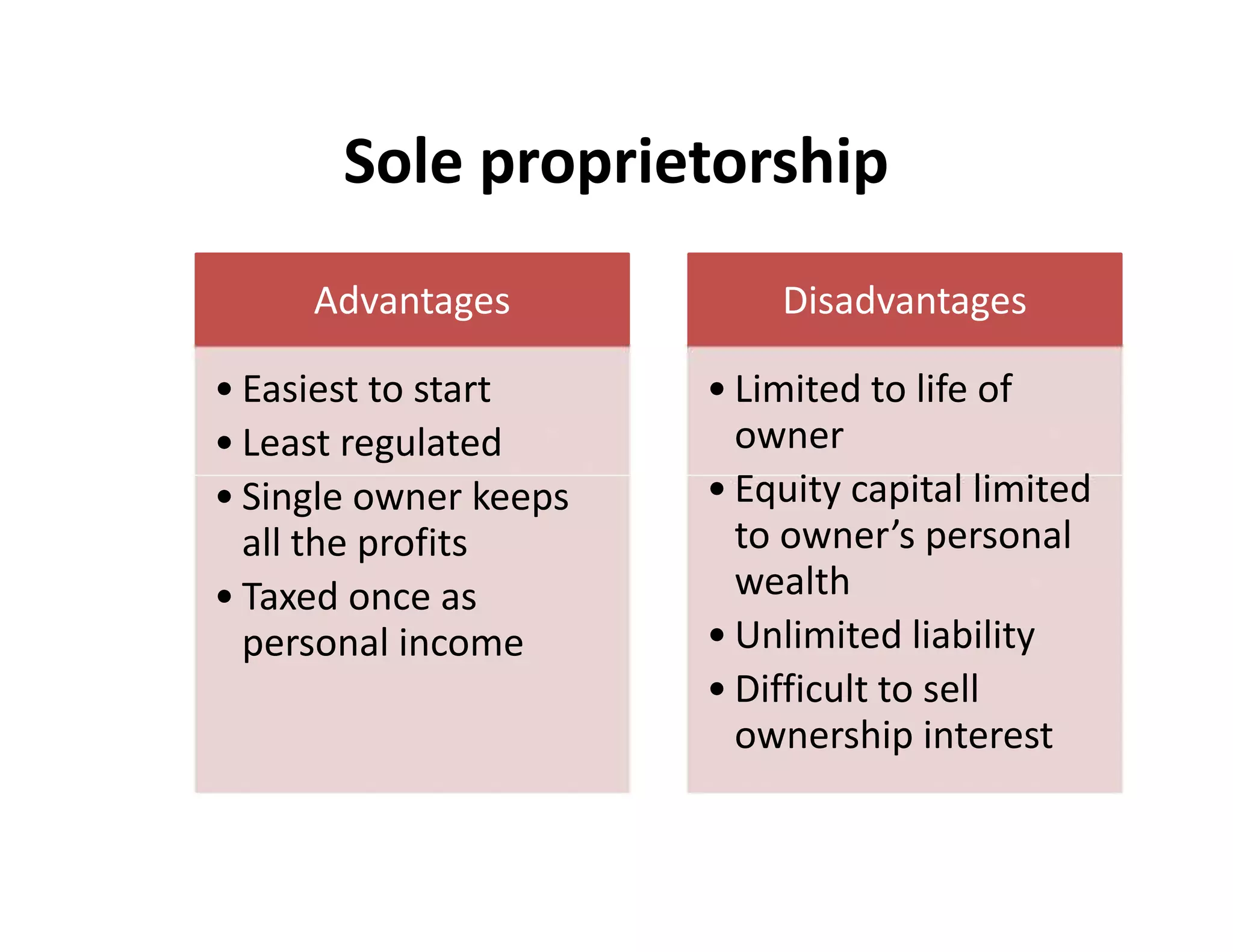
Sole proprietorship
Advantages
• Easiest to start
• Least regulated
• Single owner keeps
all the profits
• Taxed once as
personal income
Disadvantages
• Limited to life of
owner
• Equity capital limited
to owner’s personal
wealth
• Unlimited liability
• Difficult to sell
ownership interest
• Easiest to start
• Least regulated
• Single owner keeps
all the profits
• Taxed once as
personal income
• Limited to life of
owner
• Equity capital limited
to owner’s personal
wealth
• Unlimited liability
• Difficult to sell
ownership interest
Partnerships
• Two or more owners
• General Partnership
– Each partner is fully responsible for liabilities
• Limited Partnerships
– Allows one or more partners limited liability based on
amount of capital invested
– Must have one general partner with unlimited liability
– Names of limited partners may not appear in name of firm
– Limited partners may not participate in management
decisions.
• Two or more owners
• General Partnership
– Each partner is fully responsible for liabilities
• Limited Partnerships
– Allows one or more partners limited liability based on
amount of capital invested
– Must have one general partner with unlimited liability
– Names of limited partners may not appear in name of firm
– Limited partners may not participate in management
decisions.
Partnership
Advantages
• Two or more owners
• More capital available
• Relatively easy to start
• Income taxed once as
personal income
Disadvantages
• Unlimited liability
• General partnership
• Limited partnership
• Partnership dissolves
when one partner dies
or wishes to sell
• Difficult to transfer
ownership
• Two or more owners
• More capital available
• Relatively easy to start
• Income taxed once as
personal income
• Unlimited liability
• General partnership
• Limited partnership
• Partnership dissolves
when one partner dies
or wishes to sell
• Difficult to transfer
ownership
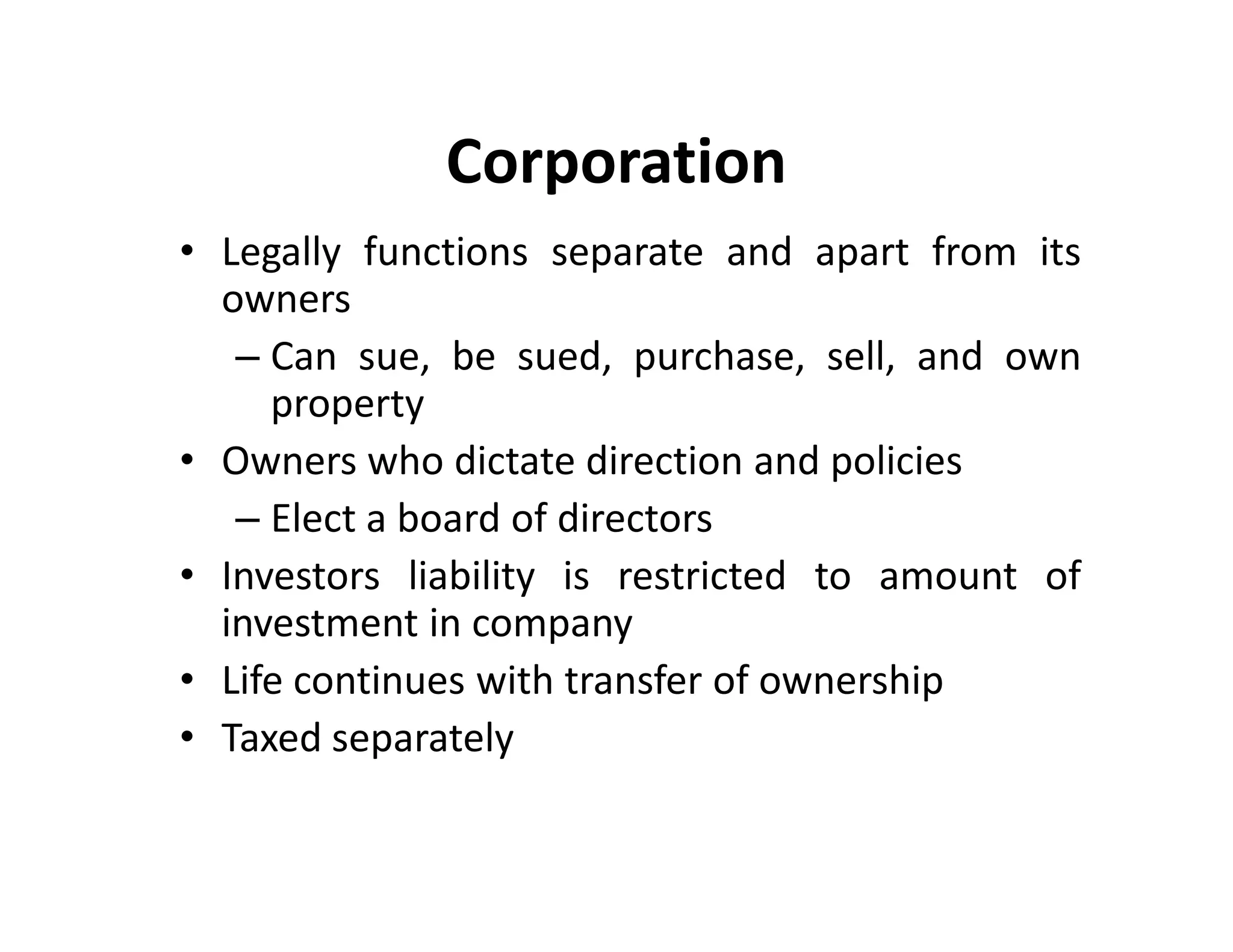
• Legally functions separate and apart from its
owners
– Can sue, be sued, purchase, sell, and own
property
• Owners who dictate direction and policies
– Elect a board of directors
• Investors liability is restricted to amount of
investment in company
• Life continues with transfer of ownership
• Taxed separately
Corporation
• Legally functions separate and apart from its
owners
– Can sue, be sued, purchase, sell, and own
property
• Owners who dictate direction and policies
– Elect a board of directors
• Investors liability is restricted to amount of
investment in company
• Life continues with transfer of ownership
• Taxed separately
Corporation
Advantages
• Limited liability
• Unlimited life
• Separation of
ownership and
management
• Transfer of ownership
is easy
• Easier to raise capital
Disadvantages
• Separation of
ownership and
management
• Taxation of company
profits can be an issue
• Limited liability
• Unlimited life
• Separation of
ownership and
management
• Transfer of ownership
is easy
• Easier to raise capital
• Separation of
ownership and
management
• Taxation of company
profits can be an issue
Subchapter S Corporation (1/2)
• A special designation that allows small
businesses that meet qualifications to
be taxed as if they were a
proprietorship or a partnership rather
than a corporation.
• A firm can have no more than 100
stockholders, which limits their use to
relatively small, privately owned firms.
• A special designation that allows small
businesses that meet qualifications to
be taxed as if they were a
proprietorship or a partnership rather
than a corporation.
• A firm can have no more than 100
stockholders, which limits their use to
relatively small, privately owned firms.
• Larger corporations are known as C
corporations.
• S status is retained until stock is sold
to the public, at which time they
become C corporations.
Subchapter S Corporation (2/2)
• Larger corporations are known as C
corporations.
• S status is retained until stock is sold
to the public, at which time they
become C corporations.
Limited Liability Corporation (LLC)
• It is a hybrid between a partnership and a
corporation.
• LLCs have limited liability like corporations.
• LLCs are taxed like partnerships.
• It is a hybrid between a partnership and a
corporation.
• LLCs have limited liability like corporations.
• LLCs are taxed like partnerships.
Limited Liability Partnership (LLP)
• Similar to an LLC but used for professional
firms in the fields of accounting, law, and
architecture.
• It has limited liability like corporations but is
taxed like partnerships.
• Similar to an LLC but used for professional
firms in the fields of accounting, law, and
architecture.
• It has limited liability like corporations but is
taxed like partnerships.
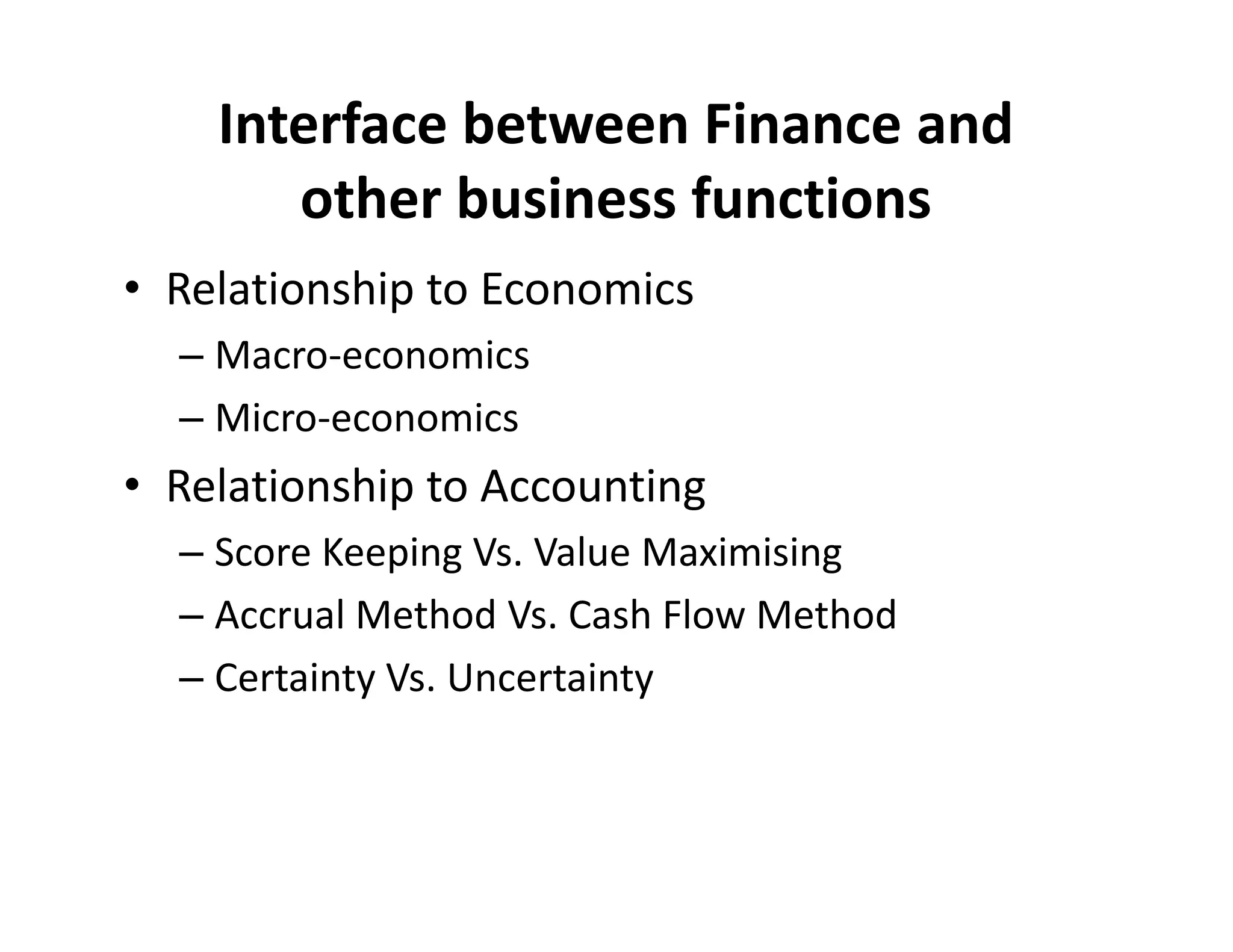
Interface between Finance and
other business functions
• Relationship to Economics
– Macro-economics
– Micro-economics
• Relationship to Accounting
– Score Keeping Vs. Value Maximising
– Accrual Method Vs. Cash Flow Method
– Certainty Vs. Uncertainty
• Relationship to Economics
– Macro-economics
– Micro-economics
• Relationship to Accounting
– Score Keeping Vs. Value Maximising
– Accrual Method Vs. Cash Flow Method
– Certainty Vs. Uncertainty
Introduction to financial management

Introduction to financial management

  • 2.
    What is Finance? •The art and science of managing money, or management of money. • It is the study of value. • It is the study of how to make good decision that involve money. –What assets to buy? –How to pay for the assets you buy? • The art and science of managing money, or management of money. • It is the study of value. • It is the study of how to make good decision that involve money. –What assets to buy? –How to pay for the assets you buy?
  • 3.
    Value Creation Components •Time • Uncertainty
  • 4.
    Why Study Finance? •Marketing – Budgets, marketing research, marketing financial products • Accounting – Dual accounting and finance function, preparation of financial statements • Management – Strategic thinking, job performance, profitability • Personal finance – Budgeting, retirement planning, day-to- day cash flow issues • Marketing – Budgets, marketing research, marketing financial products • Accounting – Dual accounting and finance function, preparation of financial statements • Management – Strategic thinking, job performance, profitability • Personal finance – Budgeting, retirement planning, day-to- day cash flow issues
  • 5.
    Key issues inFinance • Where to raise financial resources from? • Wherein to invest the resources? • How best to manage the production- distribution function? • How much of profit to distribute and how much to retain? • Where to raise financial resources from? • Wherein to invest the resources? • How best to manage the production- distribution function? • How much of profit to distribute and how much to retain?
  • 6.
    Finance 1. Financial management 2.Capital markets 3. Investments 1. Financial management 2. Capital markets 3. Investments
  • 7.
    1. Financial Management •Acquisition of fund at optimum cost and its utilization with minimum financial risk. • It is concerned with management of fund. • Acquisition of fund at optimum cost and its utilization with minimum financial risk. • It is concerned with management of fund.
  • 8.
    Financial Management or CorporateFinance • How much and what types of assets to acquire? • How to raise the capital needed to purchase assets? • How to run the firm so as to maximize its value? • How much and what types of assets to acquire? • How to raise the capital needed to purchase assets? • How to run the firm so as to maximize its value?
  • 9.
    Goals of FinancialManagement • Profit maximization (profit after tax) • Maximizing Earnings Per Share • Shareholder’s Wealth Maximization • Profit maximization (profit after tax) • Maximizing Earnings Per Share • Shareholder’s Wealth Maximization
  • 10.
    Profit Maximisation • Mainaim is earning profit. • Profit is the parameter of the business operation. • Profit reduces risk of the business concern. • Profit is the main source of finance. • Profitability meets the social needs also. • Main aim is earning profit. • Profit is the parameter of the business operation. • Profit reduces risk of the business concern. • Profit is the main source of finance. • Profitability meets the social needs also.
  • 11.
    Wealth Maximisation • Thisconcept is to improve the value or wealth of the shareholders. • It considers both time and risk of the business concern. • It provides efficient allocation of resources. • It ensures the economic interest of the society. • This concept is to improve the value or wealth of the shareholders. • It considers both time and risk of the business concern. • It provides efficient allocation of resources. • It ensures the economic interest of the society.
  • 12.
    2. Capital Markets •The markets where interest rates, along with stock and bond prices, are determined. • The financial institutions that supply capital to businesses. • The markets where interest rates, along with stock and bond prices, are determined. • The financial institutions that supply capital to businesses.
  • 13.
    3. Investments • Securityanalysis deals with finding the proper values of individual securities. • Portfolio theory deals with the best way to structure individual/institution portfolios. • Market analysis deals with the issue of whether stock and bond markets at any given time are too high, too low, or just right. • Security analysis deals with finding the proper values of individual securities. • Portfolio theory deals with the best way to structure individual/institution portfolios. • Market analysis deals with the issue of whether stock and bond markets at any given time are too high, too low, or just right.
  • 14.
    Two pillars offinance • Risk • Return
  • 18.
    Finance Functions • Financeis central to all business activities. • Finance function reconciles the conflicting interests of: • varied stakeholders • different functional units • Finance is central to all business activities. • Finance function reconciles the conflicting interests of: • varied stakeholders • different functional units
  • 19.
    Finance decisions ofthe firm • Financial decision-making involves procurement of funds and their optimal utilization through: 1. Investment (utilization of fund) 2. Financing (procurement of fund) 3. Dividend and (distribution of fund) 4. Working capital decisions • Financial decision-making involves procurement of funds and their optimal utilization through: 1. Investment (utilization of fund) 2. Financing (procurement of fund) 3. Dividend and (distribution of fund) 4. Working capital decisions
  • 20.
    1. Investment Decisions(1/2) • Aim at selecting the most productive avenues that maximize the ROI. • Examples include: • Expansion • Modernization and replacement • R&D expenditure. • Also referred to as capital budgeting decisions. • Are critical for long-term survival and growth. • Aim at selecting the most productive avenues that maximize the ROI. • Examples include: • Expansion • Modernization and replacement • R&D expenditure. • Also referred to as capital budgeting decisions. • Are critical for long-term survival and growth.
  • 21.
    1. Investment Decisions(2/2) • Are taken in the light of their probable impact on the wealth of shareholders. • Involve huge capital outlay. • Have long-term implications. • Are usually irreversible. • Are taken in the light of their probable impact on the wealth of shareholders. • Involve huge capital outlay. • Have long-term implications. • Are usually irreversible.
  • 22.
    2. Financial ManagementDecision • Capital budgeting – What long-term investments or projects should the business take on? • Capital structure – How should we pay for our assets? – Should we use debt or equity? • Working capital management – How do we manage the day-to-day finances of the firm? • Capital budgeting – What long-term investments or projects should the business take on? • Capital structure – How should we pay for our assets? – Should we use debt or equity? • Working capital management – How do we manage the day-to-day finances of the firm?
  • 23.
    • Where fromto procure the requisite funds? • What should be the optimal mix of various sources of capital? • How much should be the proportion of short-term and long-term funds? • How do the expectations of providers of each source of capital change with alteration in the capital mix? 2. Financial Management Decision • Where from to procure the requisite funds? • What should be the optimal mix of various sources of capital? • How much should be the proportion of short-term and long-term funds? • How do the expectations of providers of each source of capital change with alteration in the capital mix?
  • 24.
    3. Dividend decisions •Deciding the mix of profits to be distributed as dividends and those to be ploughed back for future financing needs of business. • Depend on trade off between future financing needs of the firm and current consumption requirements of the shareholders. • Determining the payout ratio and the method of dividend payment. • The payout ratio is decided in the light of its probable impact on shareholders’ wealth. • Deciding the mix of profits to be distributed as dividends and those to be ploughed back for future financing needs of business. • Depend on trade off between future financing needs of the firm and current consumption requirements of the shareholders. • Determining the payout ratio and the method of dividend payment. • The payout ratio is decided in the light of its probable impact on shareholders’ wealth.
  • 25.
    Working Capital Decisions •Are concerned with the management of current assets. • The two key decision points in working capital management are: • Level of investment in current assets • Financing of current assets. • Are concerned with the management of current assets. • The two key decision points in working capital management are: • Level of investment in current assets • Financing of current assets.
  • 26.
    Key Issues In FinancialDecision-making Investment Decision • What business to be in? • What growth rate is appropriate? • What assets to acquire? Financing Decision • What mix of debt and equity to be used? • Can we change value of the firm by changing the capital mix? • Is there an optimal debt–equity mix? • What mix of debt and equity to be used? • Can we change value of the firm by changing the capital mix? • Is there an optimal debt–equity mix? Dividend Decision • How much of the profit should be distributed as dividends and how much should be ploughed back • Can we change value of the firm by changing the amount of dividend? • What should be the mode of dividend payment Working Capital Decision • What level of inventory is ideal? • What level of credit should be given to the customers? • What level of cash should be maintained? • How can the blockage of funds in the current assets be minimized without compromising with profits?
  • 27.
    Organisation of financefunction • Reason for placing the finance functions in the hands of top management – Financial decisions are crucial for the survival of the firm. – The financial actions determine solvency of the firm – Centralisation of the finance functions can result in a number of economies to the firm. • Reason for placing the finance functions in the hands of top management – Financial decisions are crucial for the survival of the firm. – The financial actions determine solvency of the firm – Centralisation of the finance functions can result in a number of economies to the firm.
  • 28.
    Organisation of financefunction Chief Finance Officer Treasurer Cash Manager Credit Manager Controller Financial Accounting Manager Cost Accounting Manager Credit Manager Capital Budgeting Manager Fund Raising Manager Fund Raising Manager Cost Accounting Manager Tax Manager Data Processing Manager Internal Auditor
  • 29.
    Source: Brigham Houston,Fundamentals of Financial Management, South-Western Cengage Learning, USA. P.5
  • 30.
    Finance Manager’s Role •Forecasting of Cash Flows • Raising Funds • Allocation of Funds • Profit Planning • Understanding Capital Markets • Managing the Flow of Internal Funds • Facilitate Pricing of Product • Measuring Required Return • Managing Assets • Forecasting of Cash Flows • Raising Funds • Allocation of Funds • Profit Planning • Understanding Capital Markets • Managing the Flow of Internal Funds • Facilitate Pricing of Product • Measuring Required Return • Managing Assets
  • 31.
    Functions of Treasurer •Obtaining finance • Banking relationship • Cash Management • Credit administration • Capital Budgeting • Obtaining finance • Banking relationship • Cash Management • Credit administration • Capital Budgeting
  • 32.
    Functions of Controller •Financial accounting • Internal auditing • Taxation • Management accounting • Management control • Financial accounting • Internal auditing • Taxation • Management accounting • Management control
  • 33.
    Forms of BusinessOrganization • Sole Proprietorship • Partnership • Corporation • Sole Proprietorship • Partnership • Corporation
  • 34.
    Sole Proprietorship • Businessowned by an individual • Owner maintains title to assets and profits • Unlimited liability • Termination occurs on owner’s death or by owner’s choice • Business owned by an individual • Owner maintains title to assets and profits • Unlimited liability • Termination occurs on owner’s death or by owner’s choice
  • 35.
    Sole proprietorship Advantages • Easiestto start • Least regulated • Single owner keeps all the profits • Taxed once as personal income Disadvantages • Limited to life of owner • Equity capital limited to owner’s personal wealth • Unlimited liability • Difficult to sell ownership interest • Easiest to start • Least regulated • Single owner keeps all the profits • Taxed once as personal income • Limited to life of owner • Equity capital limited to owner’s personal wealth • Unlimited liability • Difficult to sell ownership interest
  • 36.
    Partnerships • Two ormore owners • General Partnership – Each partner is fully responsible for liabilities • Limited Partnerships – Allows one or more partners limited liability based on amount of capital invested – Must have one general partner with unlimited liability – Names of limited partners may not appear in name of firm – Limited partners may not participate in management decisions. • Two or more owners • General Partnership – Each partner is fully responsible for liabilities • Limited Partnerships – Allows one or more partners limited liability based on amount of capital invested – Must have one general partner with unlimited liability – Names of limited partners may not appear in name of firm – Limited partners may not participate in management decisions.
  • 37.
    Partnership Advantages • Two ormore owners • More capital available • Relatively easy to start • Income taxed once as personal income Disadvantages • Unlimited liability • General partnership • Limited partnership • Partnership dissolves when one partner dies or wishes to sell • Difficult to transfer ownership • Two or more owners • More capital available • Relatively easy to start • Income taxed once as personal income • Unlimited liability • General partnership • Limited partnership • Partnership dissolves when one partner dies or wishes to sell • Difficult to transfer ownership
  • 38.
    • Legally functionsseparate and apart from its owners – Can sue, be sued, purchase, sell, and own property • Owners who dictate direction and policies – Elect a board of directors • Investors liability is restricted to amount of investment in company • Life continues with transfer of ownership • Taxed separately Corporation • Legally functions separate and apart from its owners – Can sue, be sued, purchase, sell, and own property • Owners who dictate direction and policies – Elect a board of directors • Investors liability is restricted to amount of investment in company • Life continues with transfer of ownership • Taxed separately
  • 39.
    Corporation Advantages • Limited liability •Unlimited life • Separation of ownership and management • Transfer of ownership is easy • Easier to raise capital Disadvantages • Separation of ownership and management • Taxation of company profits can be an issue • Limited liability • Unlimited life • Separation of ownership and management • Transfer of ownership is easy • Easier to raise capital • Separation of ownership and management • Taxation of company profits can be an issue
  • 40.
    Subchapter S Corporation(1/2) • A special designation that allows small businesses that meet qualifications to be taxed as if they were a proprietorship or a partnership rather than a corporation. • A firm can have no more than 100 stockholders, which limits their use to relatively small, privately owned firms. • A special designation that allows small businesses that meet qualifications to be taxed as if they were a proprietorship or a partnership rather than a corporation. • A firm can have no more than 100 stockholders, which limits their use to relatively small, privately owned firms.
  • 41.
    • Larger corporationsare known as C corporations. • S status is retained until stock is sold to the public, at which time they become C corporations. Subchapter S Corporation (2/2) • Larger corporations are known as C corporations. • S status is retained until stock is sold to the public, at which time they become C corporations.
  • 42.
    Limited Liability Corporation(LLC) • It is a hybrid between a partnership and a corporation. • LLCs have limited liability like corporations. • LLCs are taxed like partnerships. • It is a hybrid between a partnership and a corporation. • LLCs have limited liability like corporations. • LLCs are taxed like partnerships.
  • 43.
    Limited Liability Partnership(LLP) • Similar to an LLC but used for professional firms in the fields of accounting, law, and architecture. • It has limited liability like corporations but is taxed like partnerships. • Similar to an LLC but used for professional firms in the fields of accounting, law, and architecture. • It has limited liability like corporations but is taxed like partnerships.
  • 44.
    Interface between Financeand other business functions • Relationship to Economics – Macro-economics – Micro-economics • Relationship to Accounting – Score Keeping Vs. Value Maximising – Accrual Method Vs. Cash Flow Method – Certainty Vs. Uncertainty • Relationship to Economics – Macro-economics – Micro-economics • Relationship to Accounting – Score Keeping Vs. Value Maximising – Accrual Method Vs. Cash Flow Method – Certainty Vs. Uncertainty