Fundamentals of Ethics in
Business
Ethics
• Why should we know & learn?
• Why should we follow?
• Why these are important?
• Whether we live according to a
standard of “right” and “wrong?”
Unethical Issues in Society
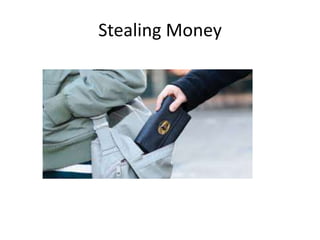
Stealing Money
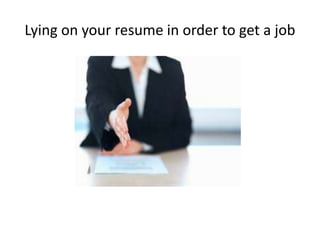
Lying on your resume in order to get a job
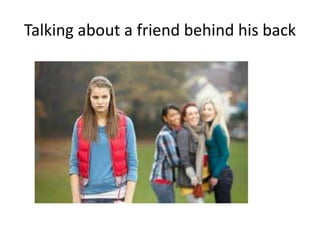
Talking about a friend behind his back
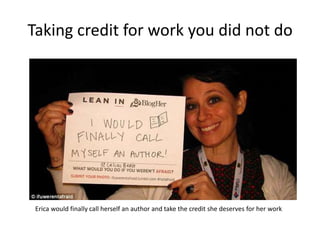
Taking credit for work you did not do
Erica would finally call herself an author and take the credit she deserves for her work
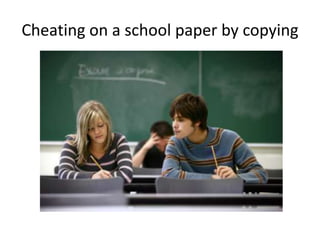
Cheating on a school paper by copying
Other related issues...
• Taking 2000/- out of your friend's wallet
when he/she is sleeping
• Selling a house and not disclosing known
defects to the buyers
• Selling a car and lying about the vehicle's
accident history, etc.
Unethical issues in Business
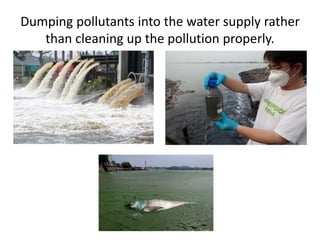
Dumping pollutants into the water supply rather
than cleaning up the pollution properly.
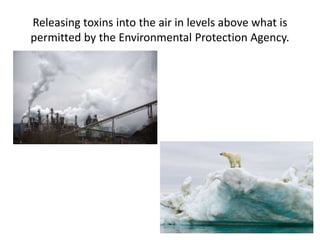
Releasing toxins into the air in levels above what is
permitted by the Environmental Protection Agency.
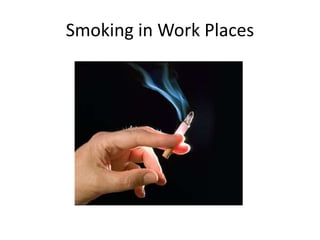
Smoking in Work Places
Other related issues...
• Refusing to give an employee a final
pay check for hours worked after the
employee leaves the company.
• Not paying an employee for all of
the hours worked.
• Engaging in price fixing to force
smaller competitors out of
business.
Contd...
• Using bait and switch or false advertising
tactics to lure customers in or convince
them to buy a product.
• Rolling back the odometer on a vehicle
that is for sale.
• Refusing to honor a warranty claim on a
defective product.
Other related issues...
What are ethics?
Ethics
• Ethics are recognized either as a system
of moral values or principles of conduct
for individuals or groups.
• “Ethics” significantly affects the way in
which the person conducts himself or
herself and applies ethical concepts.
Ethics
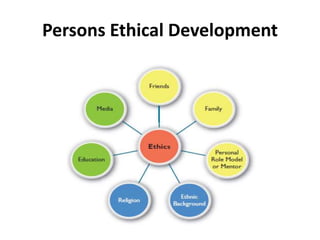
• Ethics are shaped by past personal
experience, family and peer influence,
formal and informal training in ethics,
and a wide variety of variables that are
significantly different from person to
person.
Ethics
• Some years ago, sociologist Raymond Baumhart
asked business people, “What does ethics mean to
you?” Among their replies were the following:
– Ethics has to do with what my feelings tell me is right or
wrong.
– Ethics has to do with my religious beliefs.
– Being ethical is doing what the law requires.
– Ethics consists of the standards of behavior our society
accepts.
– I don't know what the word means.
Ethics
• A social, religious, or civil code of
behaviour considered correct,
especially that of a particular
group, profession, or individual.
• A system or set of moral principles.
• Rules or principles of behaviour.
Ethics can be viewed in three different ways
• As a field of study.
• As a set of rules and guidelines.
• As a set of personal beliefs and
associated behavioral principles.
ETHICS AS A FIELD OF STUDY
• This field is examine how people try
to live their lives according to a
standard of “right” and “wrong.”
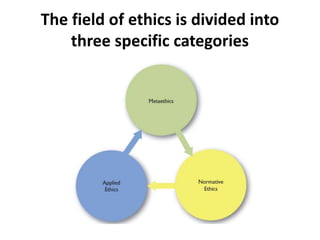
The field of ethics is divided into
three specific categories
Metaethics
• A discipline that investigates where ethical
principles come from and what they mean.
• Are they generated as part of an internal personal
consideration or are they cultural or religion
based?
• Metaethics focuses on issues of universal truths,
the existence of a supreme being, the role of
reason in the behavioral choices that we make,
and the meaning of ethical terms themselves
Normative Ethics
• An attempt to establish “normal” ethical
standards for behavior, based on
metaethical principles.
• This addresses issues such as habits to
which people should aspire, the obligations
that individuals have toward others, and the
consequences of one person’s behavior and
choices on other people.
Applied Ethics
• The application of ethical principles to real-
world situations.
• Specific emphasis on controversial issues such
as abortion, animal rights, environmental
concerns, capital punishment, the justness of
war, and so on.
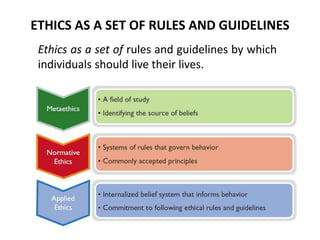
ETHICS AS A SET OF RULES AND GUIDELINES
Ethics as a set of rules and guidelines by which
individuals should live their lives.
ETHICS AS A SET OF PERSONAL BELIEFS
• Ethics are associated with deeply held
personal beliefs that result in behavior
consistent with those beliefs.
– Ethics are beliefs used to analyze and interpret
situations to make decisions regarding behavior.
– Ethics are predetermined planning regarding
potential actions in foreseeable situations.
– “Ethics are about how we meet the challenge of
doing the right thing when that will cost more
than we want to pay”
Persons Ethical Development
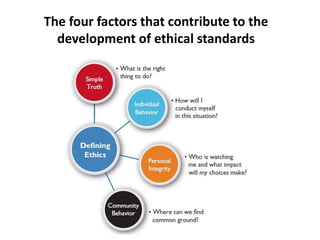
The four factors that contribute to the
development of ethical standards
Thinking It Through
• Describe how the way you define
ethics affects your behavior.
• Which type of ethics (metaethics,
normative ethics, or applied
ethics) is the most important?
Why?
Morals Vs. Ethics
• Morals are individual principles of right and
wrong. Ethics refer to the series of rules
provided to an individual by an external
source, e.g. their profession or religion.
• Morals and morality are about personal
behavior, ethics more grandly philosophical.
Contd ...
Morals Vs. Ethics
• A moral is a lesson to be learned about a
single principle of right and wrong, and an
ethic is a single guiding principle that affects
your criteria for determining what is right
and wrong.
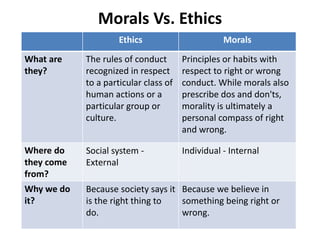
Morals Vs. Ethics
Ethics Morals
What are
they?
The rules of conduct
recognized in respect
to a particular class of
human actions or a
particular group or
culture.
Principles or habits with
respect to right or wrong
conduct. While morals also
prescribe dos and don'ts,
morality is ultimately a
personal compass of right
and wrong.
Where do
they come
from?
Social system -
External
Individual - Internal
Why we do
it?
Because society says it
is the right thing to
do.
Because we believe in
something being right or
wrong.
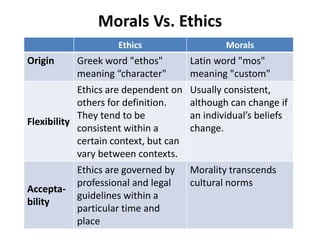
Morals Vs. Ethics
Ethics Morals
Origin Greek word "ethos"
meaning “character"
Latin word "mos"
meaning "custom"
Flexibility
Ethics are dependent on
others for definition.
They tend to be
consistent within a
certain context, but can
vary between contexts.
Usually consistent,
although can change if
an individual’s beliefs
change.
Accepta-
bility
Ethics are governed by
professional and legal
guidelines within a
particular time and
place
Morality transcends
cultural norms
Morals Vs. Ethics
Ethics Morals
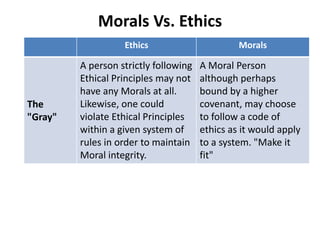
The
"Gray"
A person strictly following
Ethical Principles may not
have any Morals at all.
Likewise, one could
violate Ethical Principles
within a given system of
rules in order to maintain
Moral integrity.
A Moral Person
although perhaps
bound by a higher
covenant, may choose
to follow a code of
ethics as it would apply
to a system. "Make it
fit"
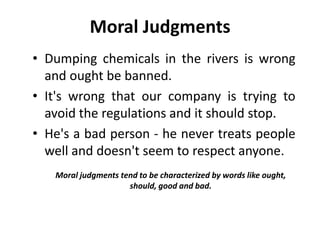
Moral Judgments
• Dumping chemicals in the rivers is wrong
and ought be banned.
• It's wrong that our company is trying to
avoid the regulations and it should stop.
• He's a bad person - he never treats people
well and doesn't seem to respect anyone.
Moral judgments tend to be characterized by words like ought,
should, good and bad.
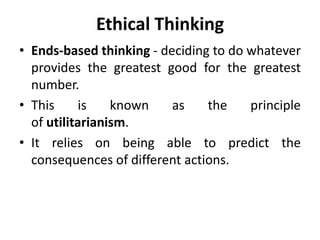
Ethical Thinking
• Ends-based thinking - deciding to do whatever
provides the greatest good for the greatest
number.
• This is known as the principle
of utilitarianism.
• It relies on being able to predict the
consequences of different actions.
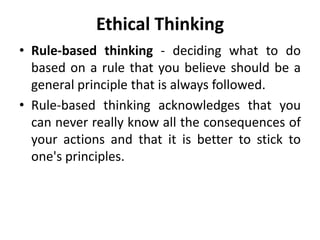
Ethical Thinking
• Rule-based thinking - deciding what to do
based on a rule that you believe should be a
general principle that is always followed.
• Rule-based thinking acknowledges that you
can never really know all the consequences of
your actions and that it is better to stick to
one's principles.
Ethical Thinking
• Care-based thinking - deciding what to do
based on the idea that this is what we
would want others to do to you.
• This is known as the principle
of reversibility and is at the center of most
religious teachings.
Critical principles of ethics
• Ego-based principle
• Rule-based principle
• End-based principle and
• Care-based principle
Ego-based principle
(Ethical or Psychological Egoism)
• Human actions are essentially ego-
centric and selfish.
• Selfishness (share a minimum things)
• Self-centred (nothing is shared)
Rule-based principle
• Ethical actions should be based on certain
given rules of ethics.
• Consequences are not important, but the
open action is crucial.
• Example: Always do good things
End-based principle
• The idea of consequences of actions.
• An action is undertaken only when it
produces some positive results or
utility.
Care-based principle
• The action of an agent is based on care and
compassion.
Beliefs
• These are ideas or principles that are
treasured to people.
• This is the elementary form of mental
representation and is also one of the
fundamental base of conscious thoughts.
• Some are be supported by evidence and some
are not.
• A belief represent a Mental state.
Approaches to Beliefs
• Our Common-sense understanding of belief is
correct.
• Our common-sense understanding of belief
may not be entirely correct, but is useful for
making some relevant predications.
• Our common-sense understanding of beliefs is
entirely wrong and is overridden by a theory
which does not make use of beliefs.
Formation of Beliefs
• Beliefs come out of confidence in the spoken
words of people we respect. (commendatory belief)
• Beliefs can be adopted from our role models.
• In our formative years, somebody else’s
beliefs may be internalised.
• Sudden changes in life may also result in new
beliefs, or cancellation of old beliefs.
• some beliefs are formed on the basis of
knowledge, research or commercials.
Values
• It is anything which has utility or worth.
• A value is a general belief which helps
differentiate good and bad.
• Values guide actions in your personal or social
life.
• Our actions are guided by our values.
• These are desires that have content and
intensify.
Significance of Value
• The value system helps a person in making
clear decisions.
• The value system helps build the perception of
an individual.
• A clear value principle helps a person arrive at
flawless logical deductions and moral
reasoning.
• It gives clarity of understanding to a person
confronted wit a particular situation.
Examples of individual values
• Practice of honesty under all situations
• Hard working
• Sincerity
• Sacrifice
• Kindness
• Care and compassion for the poor
• Simplicity
• Respect for others
Types of Values
Terminal values (to be just or righteous is
instrumental in relization of God) and
Instrumental values (a person wants to
address at the end)
Personal Values
– Egocentric values (satisfying the ego)
– Socio-centric value (adaption to society)
– Existentialist value (conformity with the existing reality)
– Supernatural value (Beyond norms of the physical world to
achieve he ultimate reality)
– Tribalistic value (Submission of oneself to higher power and
authority)
– Deontic value (it consists one’s own duty as the supreme
religion)
– Utilitarian value (realize the net benefits over cost)
– Consequentiality value (important value is assigned to those
actions having good consequences)
Based on Psychologists, Philosophers, etc.
• Religious values
• Economic values
• Social values
• Aesthetic values
• Political values
• Logical values
Individual values
• Practical or pragmatic value
• Moralistic or metaphysical value
• Core values
• Cultural values
• Social values
• Values relating to social responsibilities
• Values relating to civic responsibilities
Other values
• Acquiring and dissemination of knowledge
• Justice, righteousness and fair lay
• Care and compassion
• Universal love
• God-fearing attitude
• Truth and non-violence
• Character-building
• Honesty
• Kindness and sacrifice
Characteristics of values
• Chosen freely without any compulsion
• A value is chosen from number of options
• Value is practiced
• It needs to be applied in many situations
• These are partly genetically determined &
partly acquired through experience and
interaction.
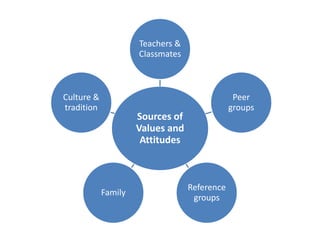
Sources of
Values and
Attitudes
Teachers &
Classmates
Peer
groups
Reference
groups
Family
Culture &
tradition
Values and Business
• Excellence
• Innovation
• Establishing credibility
• Provided consumers with best services
• Gathering market intelligence
• Maintaining external and internal
coordination
• Creation and development of corporate
Creating value for stakeholders
• Regular dividends
• Creating wealth
• Communication
• Suggestions

Business ethics

  • 1.
  • 2.
    Ethics • Why shouldwe know & learn? • Why should we follow? • Why these are important? • Whether we live according to a standard of “right” and “wrong?”
  • 3.
  • 4.
  • 5.
    Lying on yourresume in order to get a job
  • 6.
    Talking about afriend behind his back
  • 7.
    Taking credit forwork you did not do Erica would finally call herself an author and take the credit she deserves for her work
  • 8.
    Cheating on aschool paper by copying
  • 9.
    Other related issues... •Taking 2000/- out of your friend's wallet when he/she is sleeping • Selling a house and not disclosing known defects to the buyers • Selling a car and lying about the vehicle's accident history, etc.
  • 10.
  • 11.
    Dumping pollutants intothe water supply rather than cleaning up the pollution properly.
  • 12.
    Releasing toxins intothe air in levels above what is permitted by the Environmental Protection Agency.
  • 13.
  • 14.
    Other related issues... •Refusing to give an employee a final pay check for hours worked after the employee leaves the company. • Not paying an employee for all of the hours worked. • Engaging in price fixing to force smaller competitors out of business. Contd...
  • 15.
    • Using baitand switch or false advertising tactics to lure customers in or convince them to buy a product. • Rolling back the odometer on a vehicle that is for sale. • Refusing to honor a warranty claim on a defective product. Other related issues...
  • 16.
  • 17.
    Ethics • Ethics arerecognized either as a system of moral values or principles of conduct for individuals or groups. • “Ethics” significantly affects the way in which the person conducts himself or herself and applies ethical concepts.
  • 18.
    Ethics • Ethics areshaped by past personal experience, family and peer influence, formal and informal training in ethics, and a wide variety of variables that are significantly different from person to person.
  • 19.
    Ethics • Some yearsago, sociologist Raymond Baumhart asked business people, “What does ethics mean to you?” Among their replies were the following: – Ethics has to do with what my feelings tell me is right or wrong. – Ethics has to do with my religious beliefs. – Being ethical is doing what the law requires. – Ethics consists of the standards of behavior our society accepts. – I don't know what the word means.
  • 20.
    Ethics • A social,religious, or civil code of behaviour considered correct, especially that of a particular group, profession, or individual. • A system or set of moral principles. • Rules or principles of behaviour.
  • 21.
    Ethics can beviewed in three different ways • As a field of study. • As a set of rules and guidelines. • As a set of personal beliefs and associated behavioral principles.
  • 22.
    ETHICS AS AFIELD OF STUDY • This field is examine how people try to live their lives according to a standard of “right” and “wrong.”
  • 23.
    The field ofethics is divided into three specific categories
  • 24.
    Metaethics • A disciplinethat investigates where ethical principles come from and what they mean. • Are they generated as part of an internal personal consideration or are they cultural or religion based? • Metaethics focuses on issues of universal truths, the existence of a supreme being, the role of reason in the behavioral choices that we make, and the meaning of ethical terms themselves
  • 25.
    Normative Ethics • Anattempt to establish “normal” ethical standards for behavior, based on metaethical principles. • This addresses issues such as habits to which people should aspire, the obligations that individuals have toward others, and the consequences of one person’s behavior and choices on other people.
  • 26.
    Applied Ethics • Theapplication of ethical principles to real- world situations. • Specific emphasis on controversial issues such as abortion, animal rights, environmental concerns, capital punishment, the justness of war, and so on.
  • 27.
    ETHICS AS ASET OF RULES AND GUIDELINES Ethics as a set of rules and guidelines by which individuals should live their lives.
  • 28.
    ETHICS AS ASET OF PERSONAL BELIEFS • Ethics are associated with deeply held personal beliefs that result in behavior consistent with those beliefs. – Ethics are beliefs used to analyze and interpret situations to make decisions regarding behavior. – Ethics are predetermined planning regarding potential actions in foreseeable situations. – “Ethics are about how we meet the challenge of doing the right thing when that will cost more than we want to pay”
  • 29.
  • 30.
    The four factorsthat contribute to the development of ethical standards
  • 31.
    Thinking It Through •Describe how the way you define ethics affects your behavior. • Which type of ethics (metaethics, normative ethics, or applied ethics) is the most important? Why?
  • 32.
    Morals Vs. Ethics •Morals are individual principles of right and wrong. Ethics refer to the series of rules provided to an individual by an external source, e.g. their profession or religion. • Morals and morality are about personal behavior, ethics more grandly philosophical. Contd ...
  • 33.
    Morals Vs. Ethics •A moral is a lesson to be learned about a single principle of right and wrong, and an ethic is a single guiding principle that affects your criteria for determining what is right and wrong.
  • 34.
    Morals Vs. Ethics EthicsMorals What are they? The rules of conduct recognized in respect to a particular class of human actions or a particular group or culture. Principles or habits with respect to right or wrong conduct. While morals also prescribe dos and don'ts, morality is ultimately a personal compass of right and wrong. Where do they come from? Social system - External Individual - Internal Why we do it? Because society says it is the right thing to do. Because we believe in something being right or wrong.
  • 35.
    Morals Vs. Ethics EthicsMorals Origin Greek word "ethos" meaning “character" Latin word "mos" meaning "custom" Flexibility Ethics are dependent on others for definition. They tend to be consistent within a certain context, but can vary between contexts. Usually consistent, although can change if an individual’s beliefs change. Accepta- bility Ethics are governed by professional and legal guidelines within a particular time and place Morality transcends cultural norms
  • 36.
    Morals Vs. Ethics EthicsMorals The "Gray" A person strictly following Ethical Principles may not have any Morals at all. Likewise, one could violate Ethical Principles within a given system of rules in order to maintain Moral integrity. A Moral Person although perhaps bound by a higher covenant, may choose to follow a code of ethics as it would apply to a system. "Make it fit"
  • 37.
    Moral Judgments • Dumpingchemicals in the rivers is wrong and ought be banned. • It's wrong that our company is trying to avoid the regulations and it should stop. • He's a bad person - he never treats people well and doesn't seem to respect anyone. Moral judgments tend to be characterized by words like ought, should, good and bad.
  • 38.
    Ethical Thinking • Ends-basedthinking - deciding to do whatever provides the greatest good for the greatest number. • This is known as the principle of utilitarianism. • It relies on being able to predict the consequences of different actions.
  • 39.
    Ethical Thinking • Rule-basedthinking - deciding what to do based on a rule that you believe should be a general principle that is always followed. • Rule-based thinking acknowledges that you can never really know all the consequences of your actions and that it is better to stick to one's principles.
  • 40.
    Ethical Thinking • Care-basedthinking - deciding what to do based on the idea that this is what we would want others to do to you. • This is known as the principle of reversibility and is at the center of most religious teachings.
  • 41.
    Critical principles ofethics • Ego-based principle • Rule-based principle • End-based principle and • Care-based principle
  • 42.
    Ego-based principle (Ethical orPsychological Egoism) • Human actions are essentially ego- centric and selfish. • Selfishness (share a minimum things) • Self-centred (nothing is shared)
  • 43.
    Rule-based principle • Ethicalactions should be based on certain given rules of ethics. • Consequences are not important, but the open action is crucial. • Example: Always do good things
  • 44.
    End-based principle • Theidea of consequences of actions. • An action is undertaken only when it produces some positive results or utility.
  • 45.
    Care-based principle • Theaction of an agent is based on care and compassion.
  • 46.
    Beliefs • These areideas or principles that are treasured to people. • This is the elementary form of mental representation and is also one of the fundamental base of conscious thoughts. • Some are be supported by evidence and some are not. • A belief represent a Mental state.
  • 47.
    Approaches to Beliefs •Our Common-sense understanding of belief is correct. • Our common-sense understanding of belief may not be entirely correct, but is useful for making some relevant predications. • Our common-sense understanding of beliefs is entirely wrong and is overridden by a theory which does not make use of beliefs.
  • 48.
    Formation of Beliefs •Beliefs come out of confidence in the spoken words of people we respect. (commendatory belief) • Beliefs can be adopted from our role models. • In our formative years, somebody else’s beliefs may be internalised. • Sudden changes in life may also result in new beliefs, or cancellation of old beliefs. • some beliefs are formed on the basis of knowledge, research or commercials.
  • 49.
    Values • It isanything which has utility or worth. • A value is a general belief which helps differentiate good and bad. • Values guide actions in your personal or social life. • Our actions are guided by our values. • These are desires that have content and intensify.
  • 50.
    Significance of Value •The value system helps a person in making clear decisions. • The value system helps build the perception of an individual. • A clear value principle helps a person arrive at flawless logical deductions and moral reasoning. • It gives clarity of understanding to a person confronted wit a particular situation.
  • 51.
    Examples of individualvalues • Practice of honesty under all situations • Hard working • Sincerity • Sacrifice • Kindness • Care and compassion for the poor • Simplicity • Respect for others
  • 52.
    Types of Values Terminalvalues (to be just or righteous is instrumental in relization of God) and Instrumental values (a person wants to address at the end)
  • 53.
    Personal Values – Egocentricvalues (satisfying the ego) – Socio-centric value (adaption to society) – Existentialist value (conformity with the existing reality) – Supernatural value (Beyond norms of the physical world to achieve he ultimate reality) – Tribalistic value (Submission of oneself to higher power and authority) – Deontic value (it consists one’s own duty as the supreme religion) – Utilitarian value (realize the net benefits over cost) – Consequentiality value (important value is assigned to those actions having good consequences)
  • 54.
    Based on Psychologists,Philosophers, etc. • Religious values • Economic values • Social values • Aesthetic values • Political values • Logical values
  • 55.
    Individual values • Practicalor pragmatic value • Moralistic or metaphysical value • Core values • Cultural values • Social values • Values relating to social responsibilities • Values relating to civic responsibilities
  • 56.
    Other values • Acquiringand dissemination of knowledge • Justice, righteousness and fair lay • Care and compassion • Universal love • God-fearing attitude • Truth and non-violence • Character-building • Honesty • Kindness and sacrifice
  • 57.
    Characteristics of values •Chosen freely without any compulsion • A value is chosen from number of options • Value is practiced • It needs to be applied in many situations • These are partly genetically determined & partly acquired through experience and interaction.
  • 58.
    Sources of Values and Attitudes Teachers& Classmates Peer groups Reference groups Family Culture & tradition
  • 59.
    Values and Business •Excellence • Innovation • Establishing credibility • Provided consumers with best services • Gathering market intelligence • Maintaining external and internal coordination • Creation and development of corporate
  • 60.
    Creating value forstakeholders • Regular dividends • Creating wealth • Communication • Suggestions