Standard Costing and
Variance Analysis
Standard and Standard Cost
 Standard is a precise measure of what should
occur if the performance is efficient.
 For example a certain number of products (say
10) in one hour by a shop floor worker is a
standard
or certain marks (absolute or
percentage) to obtain a certain grade say A.
 A worker and student is said to be efficient if
they achieve ( 8 and A) the given conditions.
 Standards are set for repetitive tasks, that is, for
work which is repeated again and again. It can
not be for the task which are not repetitive or
performed regularly or continuously.
Standard and Budget
 Scope of budget is as a whole activity or entire
operation i.e. Rs 5000 for producing 1000
units, on the other hand, standard are on unit
basis, say Rs 5 per unit.
 Standards are prepared by Management
Account in consultation with other people, while
budget are usually prepared by Budget
committee.
 Budgets are used for planning & coordination
purposes, whereas standards are primarily used
as control.
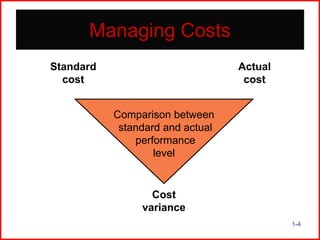
Managing Costs
Standard
cost

Actual
cost
Comparison between
standard and actual
performance
level

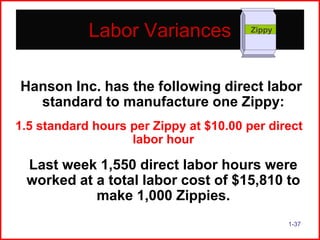
Cost
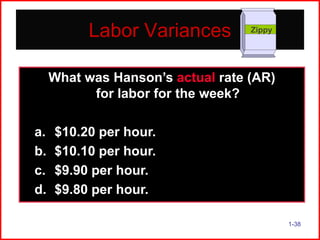
variance
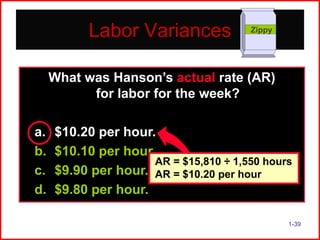
1-4
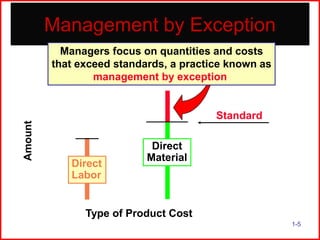
Management by Exception

Amount

Managers focus on quantities and costs
that exceed standards, a practice known as
management by exception.

Standard

Direct
Labor

Direct
Material

Type of Product Cost
1-5
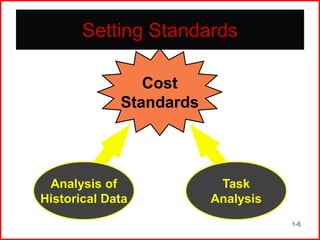
Setting Standards
Cost
Standards

Analysis of
Historical Data

Task
Analysis
1-6
Analysis of Historical Data
One Indicator of future costs is historical cost data.
In a mature production process, where the firm has a lot
of production experience, historical costs can provide a
good basis for predicting future costs.
Cost on the basis of behavior is used to analyze and
making predictions.
These predictions need to be adjusted to reflect
movements in price levels or technological changes in
the production process
1-7
Task Analysis
Another method for setting standards is task analysis,
which is the analysis of a production process to
determine what it should cost to produce a product or
service.
The emphasis shifts from what the product did cost in
the past to what it should cost in the future.
An example of task analysis is a time-and-motion study
conducted to determine how long each step performed
by direct laborers should require.
1-8
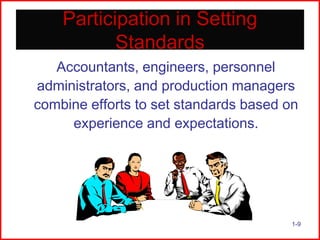
Participation in Setting
Standards
Accountants, engineers, personnel
administrators, and production managers
combine efforts to set standards based on
experience and expectations.

1-9
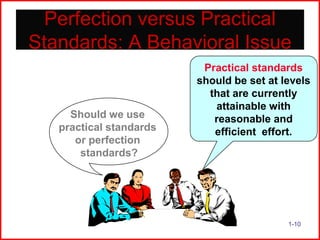
Perfection versus Practical
Standards: A Behavioral Issue

Should we use
practical standards
or perfection
standards?

Practical standards
should be set at levels
that are currently
attainable with
reasonable and
efficient effort.

1-10
Perfection Standard
 A perfection (or ideal) standard is one that can be
attained only under nearly perfect operating conditions.
 Such standard assume peak efficiency, the lowest
possible input prices, the best quality material obtainable
and no disruptions in the production due to such causes
as machine breakdowns or power failures.
 Some managers feel that such standard motivate
employees to achieve the lowest cost possible.
 They claim that since the standard is theoretically
attainable, employees will have an incentive to come as
close as possible to achieving it.
1-11
Practical Standard
 Standard that are as tight as practical, but still are expected to be
attained, are called practical or attainable standard.
 Such standard assume a production process that is as efficient as
practical under normal operating conditions.
 Practical standards allow for such occurrences as occasional
machine breakdowns and normal amounts of raw-material waste.
 Attaining a practical standard keeps employees on their toes,
without demanding miracles.
 Most behavioral theorist believe that such standard encourage more
positive and productive employee attitude than do perfection
standard.

1-12
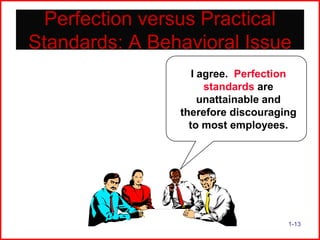
Perfection versus Practical
Standards: A Behavioral Issue
I agree. Perfection
standards are
unattainable and
therefore discouraging
to most employees.

1-13
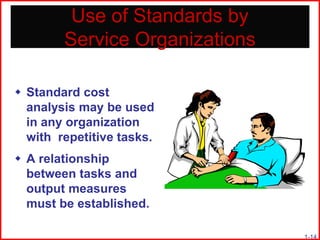
Use of Standards by
Service Organizations
 Standard cost
analysis may be used
in any organization
with repetitive tasks.
 A relationship
between tasks and
output measures
must be established.
1-14
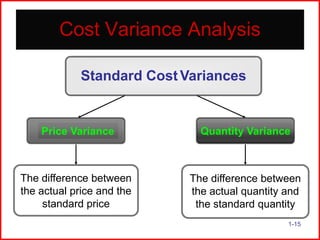
Cost Variance Analysis
Standard Cost Variances

Price Variance

Quantity Variance

The difference between
the actual price and the
standard price

The difference between
the actual quantity and
the standard quantity
1-15
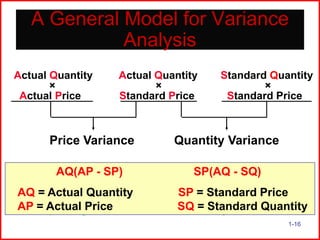
A General Model for Variance
Analysis
Actual Quantity
×
Actual Price

Actual Quantity
×
Standard Price

Price Variance
Materials price SP)
AQ(AP - variance
Labor rate variance
AQ =Variable overhead
Actual Quantity
AP = spending variance
Actual Price

Standard Quantity
×
Standard Price

Quantity Variance
Materials quantity variance
SP(AQ - SQ)
Labor efficiency variance
SP = Standard Price
Variable overhead
SQ = Standard Quantity
efficiency variance
1-16
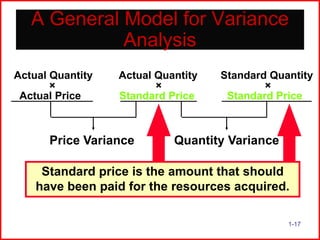
A General Model for Variance
Analysis
Actual Quantity
×
Actual Price

Actual Quantity
×
Standard Price

Price Variance

Standard Quantity
×
Standard Price

Quantity Variance

Standard price is the amount that should
have been paid for the resources acquired.
1-17
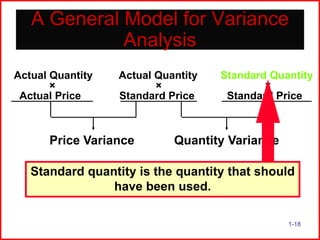
A General Model for Variance
Analysis
Actual Quantity
×
Actual Price

Actual Quantity
×
Standard Price

Price Variance

Standard Quantity
×
Standard Price

Quantity Variance

Standard quantity is the quantity that should
have been used.
1-18
Standard Costs

Let’s use the concepts
of the general model to

calculate standard cost
variances, starting with
direct material.

1-19
Direct Material Standard
 The total amount of direct material
normally required to produce a finished
products, including allowances for normal
waste or inefficiency is called Standard
direct material quantity
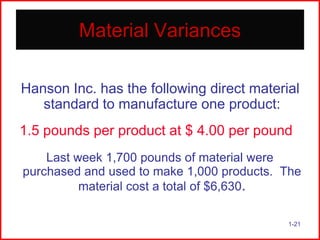
Material Variances
Hanson Inc. has the following direct material
standard to manufacture one product:
1.5 pounds per product at $ 4.00 per pound
Last week 1,700 pounds of material were
purchased and used to make 1,000 products. The
material cost a total of $6,630.
1-21
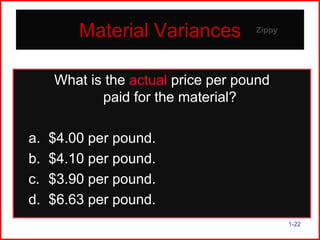
Material Variances

Zippy

What is the actual price per pound
paid for the material?
a.
b.
c.
d.

$4.00 per pound.
$4.10 per pound.
$3.90 per pound.
$6.63 per pound.
1-22
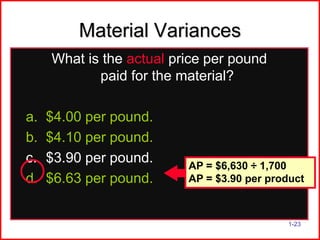
Material Variances
What is the actual price per pound
paid for the material?
a.
b.
c.
d.

$4.00 per pound.
$4.10 per pound.
$3.90 per pound.
$6.63 per pound.

AP = $6,630 ÷ 1,700
AP = $3.90 per product

1-23
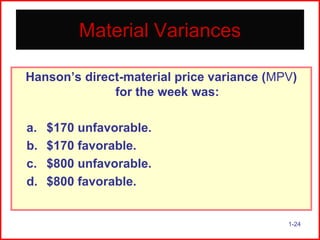
Material Variances
Hanson’s direct-material price variance (MPV)
for the week was:
a.
b.
c.
d.

$170 unfavorable.
$170 favorable.
$800 unfavorable.
$800 favorable.

1-24
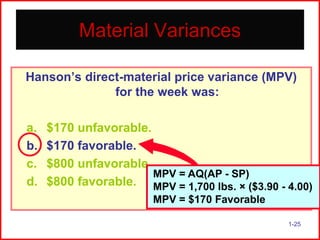
Material Variances
Hanson’s direct-material price variance (MPV)
for the week was:
a.
b.
c.
d.

$170 unfavorable.
$170 favorable.
$800 unfavorable.
MPV = AQ(AP - SP)
$800 favorable. MPV = 1,700 lbs. × ($3.90 - 4.00)
MPV = $170 Favorable
1-25
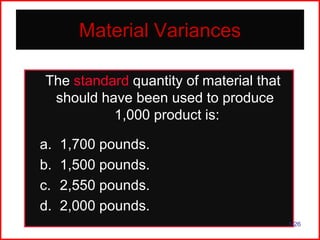
Material Variances
The standard quantity of material that
should have been used to produce
1,000 product is:
a.
b.
c.
d.

1,700 pounds.
1,500 pounds.
2,550 pounds.
2,000 pounds.
1-26
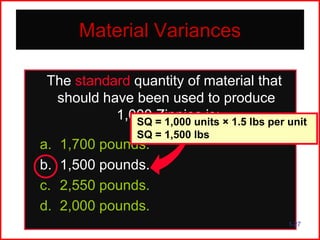
Material Variances
The standard quantity of material that
should have been used to produce
1,000 = 1,000 units × 1.5 lbs per unit
Zippies is:
SQ
a.
b.
c.
d.

SQ = 1,500 lbs

1,700 pounds.
1,500 pounds.
2,550 pounds.
2,000 pounds.

1-27
Material Variances

Zippy

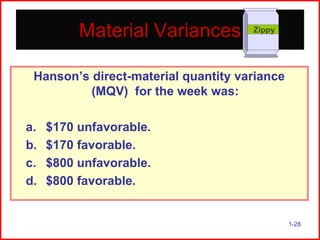
Hanson’s direct-material quantity variance
(MQV) for the week was:
a.
b.
c.
d.

$170 unfavorable.
$170 favorable.
$800 unfavorable.
$800 favorable.

1-28
Material Variances

Zippy

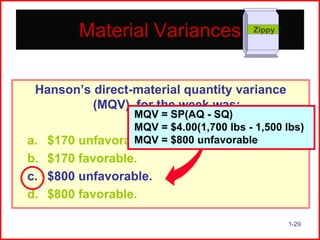
Hanson’s direct-material quantity variance
(MQV) for the week was:

MQV = SP(AQ - SQ)
MQV = $4.00(1,700 lbs - 1,500 lbs)
MQV
a. $170 unfavorable. = $800 unfavorable

b. $170 favorable.
c. $800 unfavorable.
d. $800 favorable.
1-29
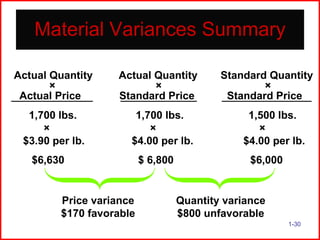
Material Variances Summary
Actual Quantity
×
Actual Price
1,700 lbs.
×
$3.90 per lb.

Actual Quantity
×
Standard Price
1,700 lbs.
×
$4.00 per lb.

$6,630

Price variance
$170 favorable

$ 6,800

Standard Quantity
×
Standard Price
1,500 lbs.
×
$4.00 per lb.
$6,000

Quantity variance
$800 unfavorable
1-30
Material Variances

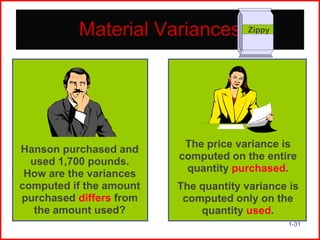
Hanson purchased and
used 1,700 pounds.
How are the variances
computed if the amount
purchased differs from
the amount used?

Zippy

The price variance is
computed on the entire
quantity purchased.
The quantity variance is
computed only on the
quantity used.
1-31
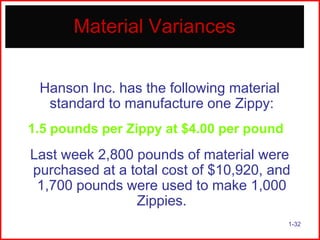
Material Variances
Hanson Inc. has the following material
standard to manufacture one Zippy:
1.5 pounds per Zippy at $4.00 per pound

Last week 2,800 pounds of material were
purchased at a total cost of $10,920, and
1,700 pounds were used to make 1,000
Zippies.
1-32
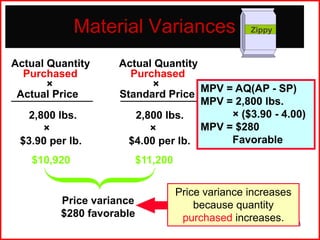
Material Variances
Actual Quantity
Purchased
×
Actual Price
2,800 lbs.
×
$3.90 per lb.

Zippy

Actual Quantity
Purchased
×
MPV = AQ(AP - SP)
Standard Price
MPV = 2,800 lbs.
× ($3.90 - 4.00)
2,800 lbs.
MPV = $280
×
Favorable
$4.00 per lb.

$10,920

Price variance
$280 favorable

$11,200
Price variance increases
because quantity
purchased increases. 1-33
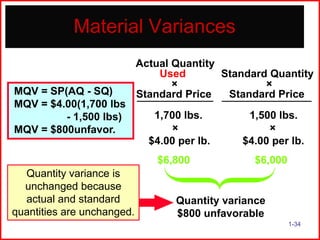
Material Variances

MQV = SP(AQ - SQ)
MQV = $4.00(1,700 lbs
- 1,500 lbs)
MQV = $800unfavor.

Actual Quantity
Used
Standard Quantity
×
×
Standard Price
Standard Price
1,700 lbs.
×
$4.00 per lb.
$6,800

Quantity variance is
unchanged because
actual and standard
quantities are unchanged.

1,500 lbs.
×
$4.00 per lb.
$6,000

Quantity variance
$800 unfavorable
1-34
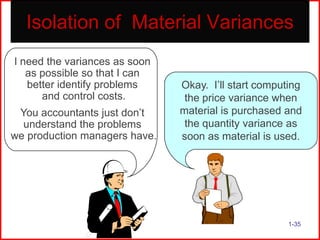
Isolation of Material Variances
I need the variances as soon
as possible so that I can
better identify problems
and control costs.
You accountants just don’t
understand the problems
we production managers have.

Okay. I’ll start computing
the price variance when
material is purchased and
the quantity variance as
soon as material is used.

1-35
Standard Costs

Now let’s calculate
standard cost
variances for
direct labor.

1-36
Labor Variances

Zippy

Hanson Inc. has the following direct labor
standard to manufacture one Zippy:
1.5 standard hours per Zippy at $10.00 per direct
labor hour

Last week 1,550 direct labor hours were
worked at a total labor cost of $15,810 to
make 1,000 Zippies.
1-37
Labor Variances

Zippy

What was Hanson’s actual rate (AR)
for labor for the week?
a.
b.
c.
d.

$10.20 per hour.
$10.10 per hour.
$9.90 per hour.
$9.80 per hour.
1-38
Labor Variances

Zippy

What was Hanson’s actual rate (AR)
for labor for the week?
a.
b.
c.
d.

$10.20 per hour.
$10.10 per hour.
AR = $15,810 ÷ 1,550 hours
$9.90 per hour. AR = $10.20 per hour
$9.80 per hour.
1-39
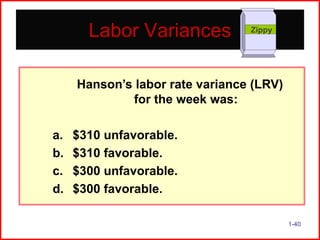
Labor Variances

Zippy

Hanson’s labor rate variance (LRV)
for the week was:
a.
b.
c.
d.

$310 unfavorable.
$310 favorable.
$300 unfavorable.
$300 favorable.
1-40
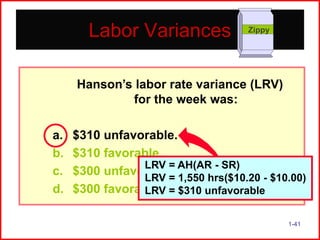
Labor Variances

Zippy

Hanson’s labor rate variance (LRV)
for the week was:
a.
b.
c.
d.

$310 unfavorable.
$310 favorable.
LRV = AH(AR - SR)
$300 unfavorable.
LRV = 1,550 hrs($10.20 - $10.00)
$300 favorable. = $310 unfavorable
LRV
1-41
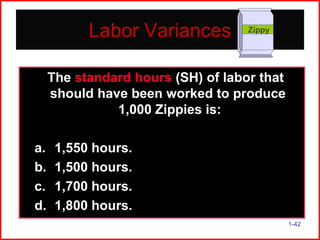
Labor Variances

Zippy

The standard hours (SH) of labor that
should have been worked to produce
1,000 Zippies is:
a.
b.
c.
d.

1,550 hours.
1,500 hours.
1,700 hours.
1,800 hours.
1-42
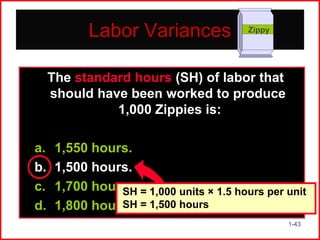
Labor Variances

Zippy

The standard hours (SH) of labor that
should have been worked to produce
1,000 Zippies is:
a.
b.
c.
d.

1,550 hours.
1,500 hours.
1,700 hours. = 1,000 units × 1.5 hours per unit
SH
SH
1,800 hours. = 1,500 hours
1-43
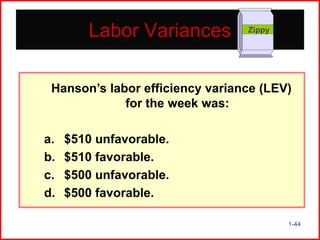
Labor Variances

Zippy

Hanson’s labor efficiency variance (LEV)
for the week was:

a.
b.
c.
d.

$510 unfavorable.
$510 favorable.
$500 unfavorable.
$500 favorable.
1-44
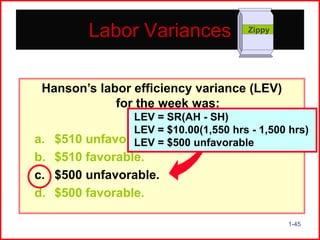
Labor Variances

Zippy

Hanson’s labor efficiency variance (LEV)
for the week was:
LEV = SR(AH - SH)
LEV = $10.00(1,550 hrs - 1,500 hrs)
a. $510 unfavorable.= $500 unfavorable
LEV

b. $510 favorable.
c. $500 unfavorable.
d. $500 favorable.
1-45
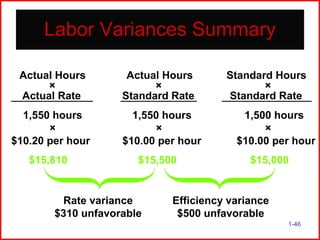
Labor Variances Summary
Actual Hours
×
Actual Rate
1,550 hours
×
$10.20 per hour
$15,810

Actual Hours
×
Standard Rate
1,550 hours
×
$10.00 per hour
$15,500

Rate variance
$310 unfavorable

Standard Hours
×
Standard Rate
1,500 hours
×
$10.00 per hour
$15,000

Efficiency variance
$500 unfavorable
1-46
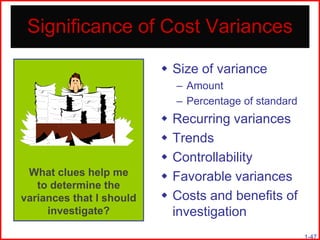
Significance of Cost Variances
 Size of variance
– Amount
– Percentage of standard

What clues help me
to determine the
variances that I should
investigate?







Recurring variances
Trends
Controllability
Favorable variances
Costs and benefits of
investigation
1-47
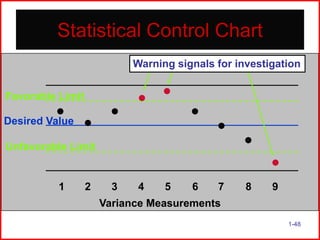
Statistical Control Chart
Warning signals for investigation
Favorable Limit

•
Desired Value

•

•

•
•

•

•

Unfavorable Limit

1

2

3

4

5

6

7

•
8

•
9

Variance Measurements
1-48
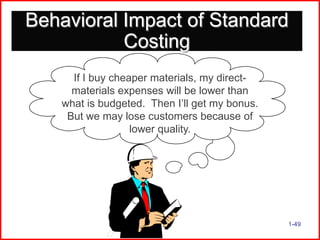
Behavioral Impact of Standard
Costing
If I buy cheaper materials, my directmaterials expenses will be lower than
what is budgeted. Then I’ll get my bonus.
But we may lose customers because of
lower quality.

1-49
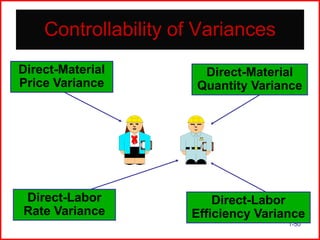
Controllability of Variances
Direct-Material
Price Variance

Direct-Material
Quantity Variance

Direct-Labor
Rate Variance

Direct-Labor
Efficiency Variance
1-50
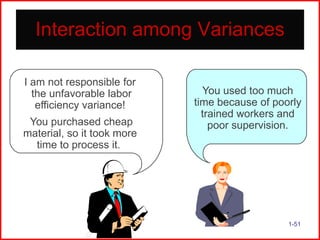
Interaction among Variances
I am not responsible for
the unfavorable labor
efficiency variance!
You purchased cheap
material, so it took more
time to process it.

You used too much
time because of poorly
trained workers and
poor supervision.

1-51
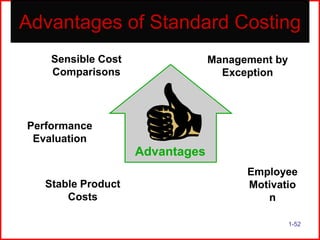
Advantages of Standard Costing
Sensible Cost
Comparisons

Management by
Exception

Performance
Evaluation

Advantages
Stable Product
Costs

Employee
Motivatio
n
1-52
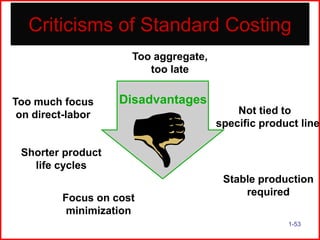
Criticisms of Standard Costing
Too aggregate,
too late
Too much focus
on direct-labor

Disadvantages
Not tied to
specific product line

Shorter product
life cycles

Focus on cost
minimization

Stable production
required
1-53
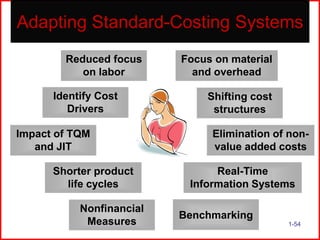
Adapting Standard-Costing Systems
Reduced focus
on labor
Identify Cost
Drivers
Impact of TQM
and JIT
Shorter product
life cycles
Nonfinancial
Measures

Focus on material
and overhead
Shifting cost
structures
Elimination of nonvalue added costs
Real-Time
Information Systems
Benchmarking
1-54

Standrad costing

  • 1.
  • 2.
    Standard and StandardCost  Standard is a precise measure of what should occur if the performance is efficient.  For example a certain number of products (say 10) in one hour by a shop floor worker is a standard or certain marks (absolute or percentage) to obtain a certain grade say A.  A worker and student is said to be efficient if they achieve ( 8 and A) the given conditions.  Standards are set for repetitive tasks, that is, for work which is repeated again and again. It can not be for the task which are not repetitive or performed regularly or continuously.
  • 3.
    Standard and Budget Scope of budget is as a whole activity or entire operation i.e. Rs 5000 for producing 1000 units, on the other hand, standard are on unit basis, say Rs 5 per unit.  Standards are prepared by Management Account in consultation with other people, while budget are usually prepared by Budget committee.  Budgets are used for planning & coordination purposes, whereas standards are primarily used as control.
  • 4.
    Managing Costs Standard cost Actual cost Comparison between standardand actual performance level Cost variance 1-4
  • 5.
    Management by Exception Amount Managersfocus on quantities and costs that exceed standards, a practice known as management by exception. Standard Direct Labor Direct Material Type of Product Cost 1-5
  • 6.
  • 7.
    Analysis of HistoricalData One Indicator of future costs is historical cost data. In a mature production process, where the firm has a lot of production experience, historical costs can provide a good basis for predicting future costs. Cost on the basis of behavior is used to analyze and making predictions. These predictions need to be adjusted to reflect movements in price levels or technological changes in the production process 1-7
  • 8.
    Task Analysis Another methodfor setting standards is task analysis, which is the analysis of a production process to determine what it should cost to produce a product or service. The emphasis shifts from what the product did cost in the past to what it should cost in the future. An example of task analysis is a time-and-motion study conducted to determine how long each step performed by direct laborers should require. 1-8
  • 9.
    Participation in Setting Standards Accountants,engineers, personnel administrators, and production managers combine efforts to set standards based on experience and expectations. 1-9
  • 10.
    Perfection versus Practical Standards:A Behavioral Issue Should we use practical standards or perfection standards? Practical standards should be set at levels that are currently attainable with reasonable and efficient effort. 1-10
  • 11.
    Perfection Standard  Aperfection (or ideal) standard is one that can be attained only under nearly perfect operating conditions.  Such standard assume peak efficiency, the lowest possible input prices, the best quality material obtainable and no disruptions in the production due to such causes as machine breakdowns or power failures.  Some managers feel that such standard motivate employees to achieve the lowest cost possible.  They claim that since the standard is theoretically attainable, employees will have an incentive to come as close as possible to achieving it. 1-11
  • 12.
    Practical Standard  Standardthat are as tight as practical, but still are expected to be attained, are called practical or attainable standard.  Such standard assume a production process that is as efficient as practical under normal operating conditions.  Practical standards allow for such occurrences as occasional machine breakdowns and normal amounts of raw-material waste.  Attaining a practical standard keeps employees on their toes, without demanding miracles.  Most behavioral theorist believe that such standard encourage more positive and productive employee attitude than do perfection standard. 1-12
  • 13.
    Perfection versus Practical Standards:A Behavioral Issue I agree. Perfection standards are unattainable and therefore discouraging to most employees. 1-13
  • 14.
    Use of Standardsby Service Organizations  Standard cost analysis may be used in any organization with repetitive tasks.  A relationship between tasks and output measures must be established. 1-14
  • 15.
    Cost Variance Analysis StandardCost Variances Price Variance Quantity Variance The difference between the actual price and the standard price The difference between the actual quantity and the standard quantity 1-15
  • 16.
    A General Modelfor Variance Analysis Actual Quantity × Actual Price Actual Quantity × Standard Price Price Variance Materials price SP) AQ(AP - variance Labor rate variance AQ =Variable overhead Actual Quantity AP = spending variance Actual Price Standard Quantity × Standard Price Quantity Variance Materials quantity variance SP(AQ - SQ) Labor efficiency variance SP = Standard Price Variable overhead SQ = Standard Quantity efficiency variance 1-16
  • 17.
    A General Modelfor Variance Analysis Actual Quantity × Actual Price Actual Quantity × Standard Price Price Variance Standard Quantity × Standard Price Quantity Variance Standard price is the amount that should have been paid for the resources acquired. 1-17
  • 18.
    A General Modelfor Variance Analysis Actual Quantity × Actual Price Actual Quantity × Standard Price Price Variance Standard Quantity × Standard Price Quantity Variance Standard quantity is the quantity that should have been used. 1-18
  • 19.
    Standard Costs Let’s usethe concepts of the general model to calculate standard cost variances, starting with direct material. 1-19
  • 20.
    Direct Material Standard The total amount of direct material normally required to produce a finished products, including allowances for normal waste or inefficiency is called Standard direct material quantity
  • 21.
    Material Variances Hanson Inc.has the following direct material standard to manufacture one product: 1.5 pounds per product at $ 4.00 per pound Last week 1,700 pounds of material were purchased and used to make 1,000 products. The material cost a total of $6,630. 1-21
  • 22.
    Material Variances Zippy What isthe actual price per pound paid for the material? a. b. c. d. $4.00 per pound. $4.10 per pound. $3.90 per pound. $6.63 per pound. 1-22
  • 23.
    Material Variances What isthe actual price per pound paid for the material? a. b. c. d. $4.00 per pound. $4.10 per pound. $3.90 per pound. $6.63 per pound. AP = $6,630 ÷ 1,700 AP = $3.90 per product 1-23
  • 24.
    Material Variances Hanson’s direct-materialprice variance (MPV) for the week was: a. b. c. d. $170 unfavorable. $170 favorable. $800 unfavorable. $800 favorable. 1-24
  • 25.
    Material Variances Hanson’s direct-materialprice variance (MPV) for the week was: a. b. c. d. $170 unfavorable. $170 favorable. $800 unfavorable. MPV = AQ(AP - SP) $800 favorable. MPV = 1,700 lbs. × ($3.90 - 4.00) MPV = $170 Favorable 1-25
  • 26.
    Material Variances The standardquantity of material that should have been used to produce 1,000 product is: a. b. c. d. 1,700 pounds. 1,500 pounds. 2,550 pounds. 2,000 pounds. 1-26
  • 27.
    Material Variances The standardquantity of material that should have been used to produce 1,000 = 1,000 units × 1.5 lbs per unit Zippies is: SQ a. b. c. d. SQ = 1,500 lbs 1,700 pounds. 1,500 pounds. 2,550 pounds. 2,000 pounds. 1-27
  • 28.
    Material Variances Zippy Hanson’s direct-materialquantity variance (MQV) for the week was: a. b. c. d. $170 unfavorable. $170 favorable. $800 unfavorable. $800 favorable. 1-28
  • 29.
    Material Variances Zippy Hanson’s direct-materialquantity variance (MQV) for the week was: MQV = SP(AQ - SQ) MQV = $4.00(1,700 lbs - 1,500 lbs) MQV a. $170 unfavorable. = $800 unfavorable b. $170 favorable. c. $800 unfavorable. d. $800 favorable. 1-29
  • 30.
    Material Variances Summary ActualQuantity × Actual Price 1,700 lbs. × $3.90 per lb. Actual Quantity × Standard Price 1,700 lbs. × $4.00 per lb. $6,630 Price variance $170 favorable $ 6,800 Standard Quantity × Standard Price 1,500 lbs. × $4.00 per lb. $6,000 Quantity variance $800 unfavorable 1-30
  • 31.
    Material Variances Hanson purchasedand used 1,700 pounds. How are the variances computed if the amount purchased differs from the amount used? Zippy The price variance is computed on the entire quantity purchased. The quantity variance is computed only on the quantity used. 1-31
  • 32.
    Material Variances Hanson Inc.has the following material standard to manufacture one Zippy: 1.5 pounds per Zippy at $4.00 per pound Last week 2,800 pounds of material were purchased at a total cost of $10,920, and 1,700 pounds were used to make 1,000 Zippies. 1-32
  • 33.
    Material Variances Actual Quantity Purchased × ActualPrice 2,800 lbs. × $3.90 per lb. Zippy Actual Quantity Purchased × MPV = AQ(AP - SP) Standard Price MPV = 2,800 lbs. × ($3.90 - 4.00) 2,800 lbs. MPV = $280 × Favorable $4.00 per lb. $10,920 Price variance $280 favorable $11,200 Price variance increases because quantity purchased increases. 1-33
  • 34.
    Material Variances MQV =SP(AQ - SQ) MQV = $4.00(1,700 lbs - 1,500 lbs) MQV = $800unfavor. Actual Quantity Used Standard Quantity × × Standard Price Standard Price 1,700 lbs. × $4.00 per lb. $6,800 Quantity variance is unchanged because actual and standard quantities are unchanged. 1,500 lbs. × $4.00 per lb. $6,000 Quantity variance $800 unfavorable 1-34
  • 35.
    Isolation of MaterialVariances I need the variances as soon as possible so that I can better identify problems and control costs. You accountants just don’t understand the problems we production managers have. Okay. I’ll start computing the price variance when material is purchased and the quantity variance as soon as material is used. 1-35
  • 36.
    Standard Costs Now let’scalculate standard cost variances for direct labor. 1-36
  • 37.
    Labor Variances Zippy Hanson Inc.has the following direct labor standard to manufacture one Zippy: 1.5 standard hours per Zippy at $10.00 per direct labor hour Last week 1,550 direct labor hours were worked at a total labor cost of $15,810 to make 1,000 Zippies. 1-37
  • 38.
    Labor Variances Zippy What wasHanson’s actual rate (AR) for labor for the week? a. b. c. d. $10.20 per hour. $10.10 per hour. $9.90 per hour. $9.80 per hour. 1-38
  • 39.
    Labor Variances Zippy What wasHanson’s actual rate (AR) for labor for the week? a. b. c. d. $10.20 per hour. $10.10 per hour. AR = $15,810 ÷ 1,550 hours $9.90 per hour. AR = $10.20 per hour $9.80 per hour. 1-39
  • 40.
    Labor Variances Zippy Hanson’s laborrate variance (LRV) for the week was: a. b. c. d. $310 unfavorable. $310 favorable. $300 unfavorable. $300 favorable. 1-40
  • 41.
    Labor Variances Zippy Hanson’s laborrate variance (LRV) for the week was: a. b. c. d. $310 unfavorable. $310 favorable. LRV = AH(AR - SR) $300 unfavorable. LRV = 1,550 hrs($10.20 - $10.00) $300 favorable. = $310 unfavorable LRV 1-41
  • 42.
    Labor Variances Zippy The standardhours (SH) of labor that should have been worked to produce 1,000 Zippies is: a. b. c. d. 1,550 hours. 1,500 hours. 1,700 hours. 1,800 hours. 1-42
  • 43.
    Labor Variances Zippy The standardhours (SH) of labor that should have been worked to produce 1,000 Zippies is: a. b. c. d. 1,550 hours. 1,500 hours. 1,700 hours. = 1,000 units × 1.5 hours per unit SH SH 1,800 hours. = 1,500 hours 1-43
  • 44.
    Labor Variances Zippy Hanson’s laborefficiency variance (LEV) for the week was: a. b. c. d. $510 unfavorable. $510 favorable. $500 unfavorable. $500 favorable. 1-44
  • 45.
    Labor Variances Zippy Hanson’s laborefficiency variance (LEV) for the week was: LEV = SR(AH - SH) LEV = $10.00(1,550 hrs - 1,500 hrs) a. $510 unfavorable.= $500 unfavorable LEV b. $510 favorable. c. $500 unfavorable. d. $500 favorable. 1-45
  • 46.
    Labor Variances Summary ActualHours × Actual Rate 1,550 hours × $10.20 per hour $15,810 Actual Hours × Standard Rate 1,550 hours × $10.00 per hour $15,500 Rate variance $310 unfavorable Standard Hours × Standard Rate 1,500 hours × $10.00 per hour $15,000 Efficiency variance $500 unfavorable 1-46
  • 47.
    Significance of CostVariances  Size of variance – Amount – Percentage of standard What clues help me to determine the variances that I should investigate?      Recurring variances Trends Controllability Favorable variances Costs and benefits of investigation 1-47
  • 48.
    Statistical Control Chart Warningsignals for investigation Favorable Limit • Desired Value • • • • • • Unfavorable Limit 1 2 3 4 5 6 7 • 8 • 9 Variance Measurements 1-48
  • 49.
    Behavioral Impact ofStandard Costing If I buy cheaper materials, my directmaterials expenses will be lower than what is budgeted. Then I’ll get my bonus. But we may lose customers because of lower quality. 1-49
  • 50.
    Controllability of Variances Direct-Material PriceVariance Direct-Material Quantity Variance Direct-Labor Rate Variance Direct-Labor Efficiency Variance 1-50
  • 51.
    Interaction among Variances Iam not responsible for the unfavorable labor efficiency variance! You purchased cheap material, so it took more time to process it. You used too much time because of poorly trained workers and poor supervision. 1-51
  • 52.
    Advantages of StandardCosting Sensible Cost Comparisons Management by Exception Performance Evaluation Advantages Stable Product Costs Employee Motivatio n 1-52
  • 53.
    Criticisms of StandardCosting Too aggregate, too late Too much focus on direct-labor Disadvantages Not tied to specific product line Shorter product life cycles Focus on cost minimization Stable production required 1-53
  • 54.
    Adapting Standard-Costing Systems Reducedfocus on labor Identify Cost Drivers Impact of TQM and JIT Shorter product life cycles Nonfinancial Measures Focus on material and overhead Shifting cost structures Elimination of nonvalue added costs Real-Time Information Systems Benchmarking 1-54