1
The Buy or Make Decision
BUYING: If we buy the product, we can make a
quick return with little investment. If the volume
gets too high our supplier will make the most
profit.
2
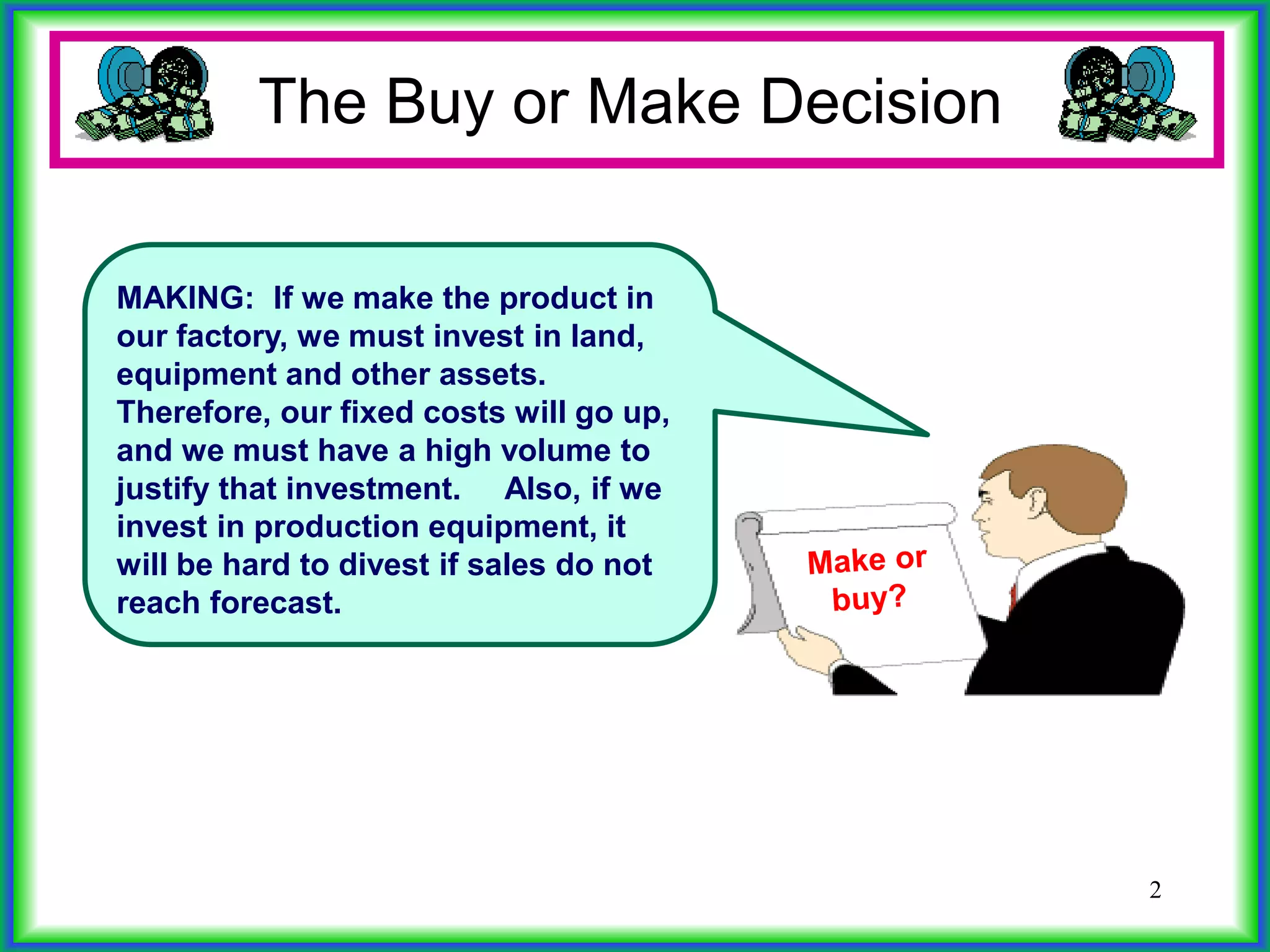
MAKING: If we make the product in
our factory, we must invest in land,
equipment and other assets.
Therefore, our fixed costs will go up,
and we must have a high volume to
justify that investment. Also, if we
invest in production equipment, it
will be hard to divest if sales do not
reach forecast.
The Buy or Make Decision
3
FIXED COSTS: Those costs that do not change greatly with sales, like rent,
electricity, equipment, land, telephone are fixed costs.
Fixed Costs
Fixed
Costs
Units to sell
The Buy or Make Decision
4
VARIABLE COSTS: Those costs that change greatly with sales, like materials
costs, sales commissions, inventory costs, advertising costs, etc. are variable
costs.
Variable Costs
TOTAL
COSTS
Units to sell
Fixed Costs
The Buy or Make Decision
5
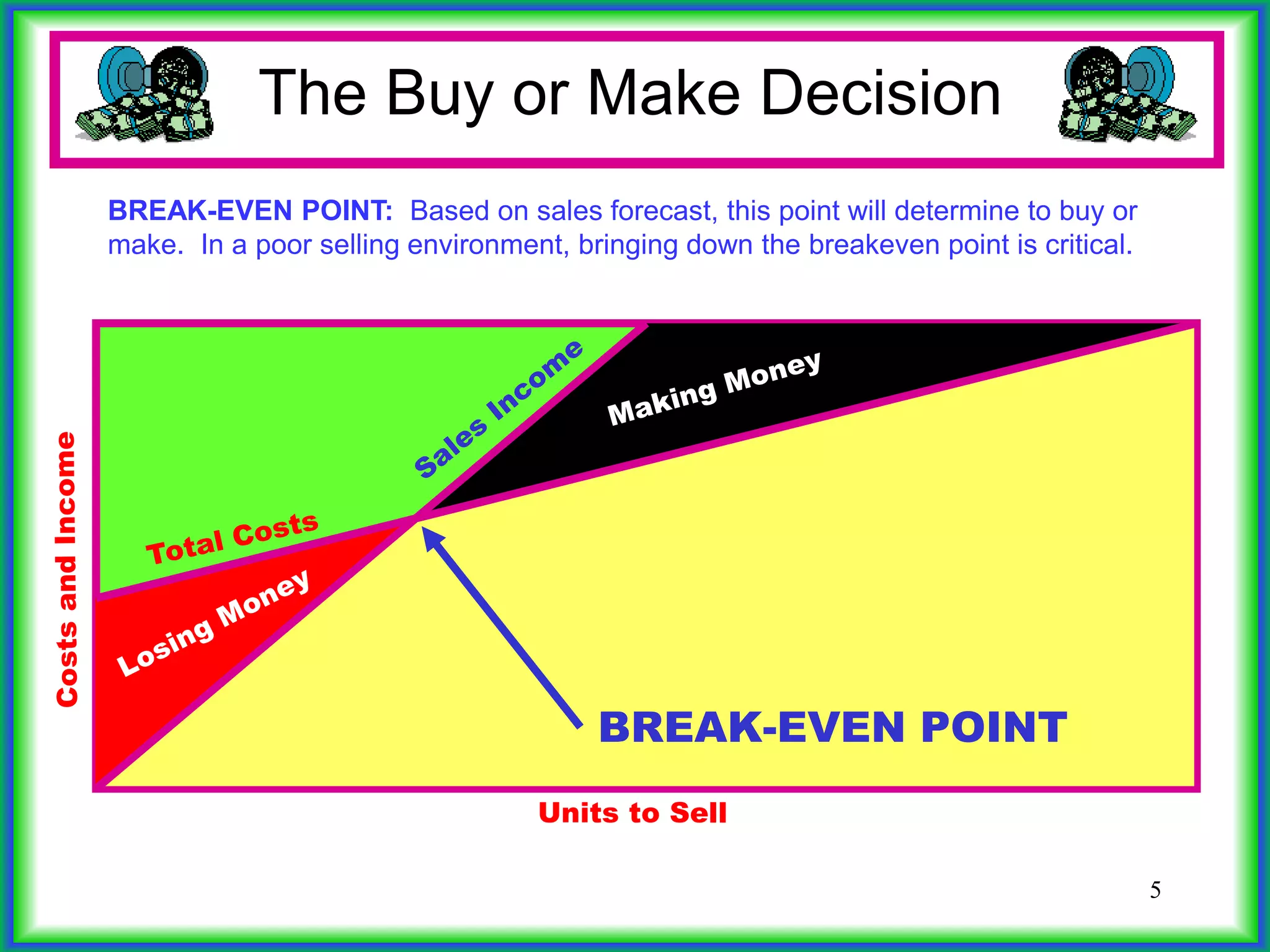
BREAK-EVEN POINT: Based on sales forecast, this point will determine to buy or
make. In a poor selling environment, bringing down the breakeven point is critical.
BREAK-EVEN POINT
Units to Sell
The Buy or Make Decision
6
BREAK-EVEN POINT WHEN BUYING GREATLY: The fixed costs a much lower
and therefore the Break-even point is lower. But, the cost of purchasing the goods
is much higher for volume sales.
Units to sell
LOSS MADE
BREAK-EVEN
POINT
Buying BE
PROFIT MADE
The Buy or Make Decision
7
BREAK-EVEN POINT WHEN MAKING: Based on sales forecast, this point will
determine to buy or make. In a poor selling environment, bringing down the breakeven
point is critical.
Units to sell
Making BE
BREAK-EVEN POINT
LOSS MADE
PROFIT MADE
The Buy or Make Decision
8
The Buy or Make Decision
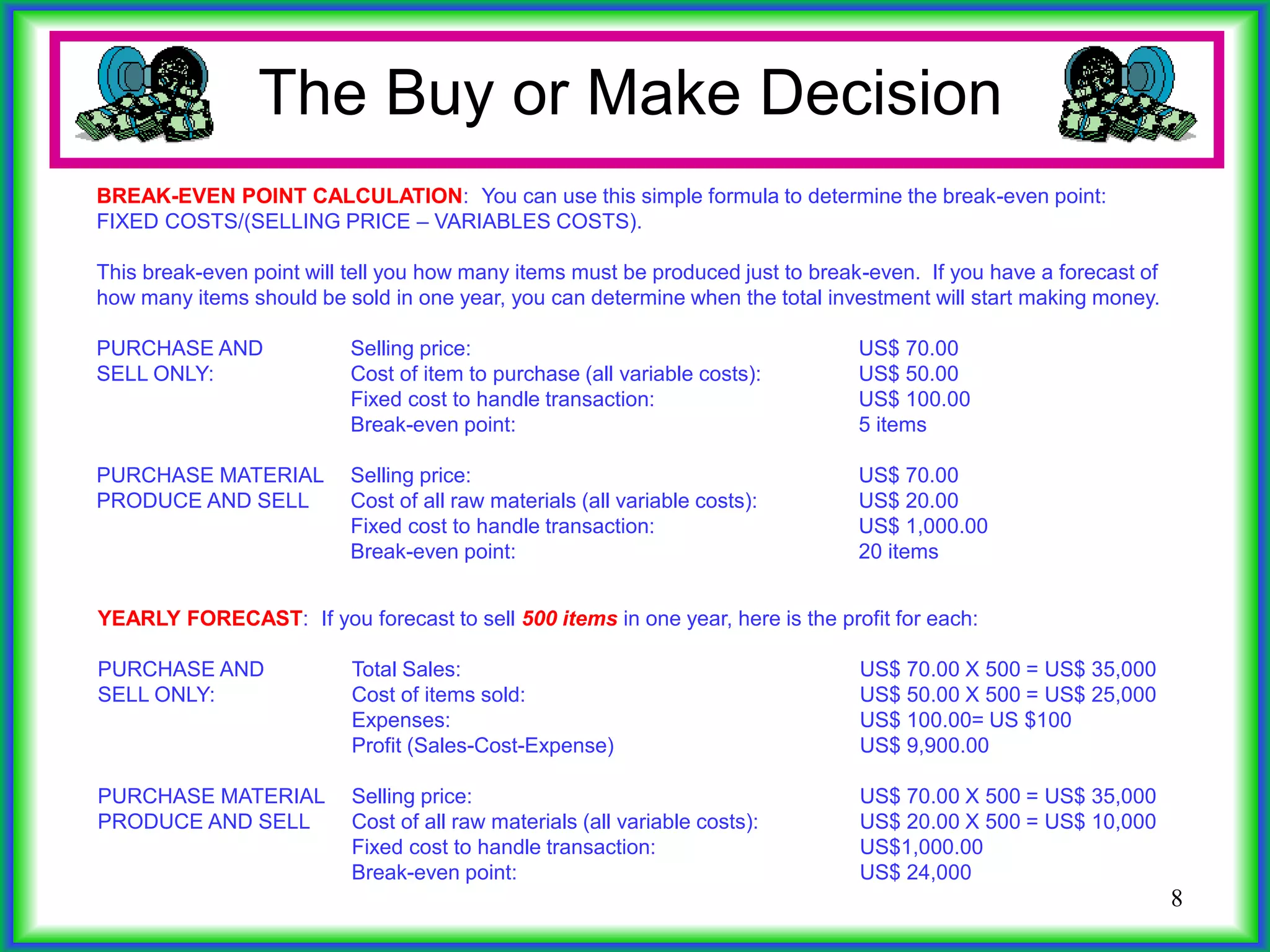
YEARLY FORECAST: If you forecast to sell 500 items in one year, here is the profit for each:
PURCHASE AND Total Sales: US$ 70.00 X 500 = US$ 35,000
SELL ONLY: Cost of items sold: US$ 50.00 X 500 = US$ 25,000
Expenses: US$ 100.00= US $100
Profit (Sales-Cost-Expense) US$ 9,900.00
PURCHASE MATERIAL Selling price: US$ 70.00 X 500 = US$ 35,000
PRODUCE AND SELL Cost of all raw materials (all variable costs): US$ 20.00 X 500 = US$ 10,000
Fixed cost to handle transaction: US$1,000.00
Break-even point: US$ 24,000
BREAK-EVEN POINT CALCULATION: You can use this simple formula to determine the break-even point:
FIXED COSTS/(SELLING PRICE – VARIABLES COSTS).
This break-even point will tell you how many items must be produced just to break-even. If you have a forecast of
how many items should be sold in one year, you can determine when the total investment will start making money.
BREAK-EVEN POINT CALCULATION: You can use this simple formula to determine the break-even point:
FIXED COSTS/(SELLING PRICE – VARIABLES COSTS).
This break-even point will tell you how many items must be produced just to break-even. If you have a forecast of
how many items should be sold in one year, you can determine when the total investment will start making money.
PURCHASE AND Selling price: US$ 70.00
SELL ONLY: Cost of item to purchase (all variable costs): US$ 50.00
Fixed cost to handle transaction: US$ 100.00
Break-even point: 5 items
BREAK-EVEN POINT CALCULATION: You can use this simple formula to determine the break-even point:
FIXED COSTS/(SELLING PRICE – VARIABLES COSTS).
This break-even point will tell you how many items must be produced just to break-even. If you have a forecast of
how many items should be sold in one year, you can determine when the total investment will start making money.
PURCHASE AND Selling price: US$ 70.00
SELL ONLY: Cost of item to purchase (all variable costs): US$ 50.00
Fixed cost to handle transaction: US$ 100.00
Break-even point: 5 items
PURCHASE MATERIAL Selling price: US$ 70.00
PRODUCE AND SELL Cost of all raw materials (all variable costs): US$ 20.00
Fixed cost to handle transaction: US$ 1,000.00
Break-even point: 20 items
9
BREAK-EVEN POINT CALCULATION: You can use this simple formula to determine the break-even point:
FIXED COSTS/(SELLING PRICE – VARIABLES COSTS).
This break-even point will tell you how many items must be produced just to break-even. If you have a forecast of
how many items should be sold in one year, you can determine when the total investment will start making money.
PURCHASE AND Selling price: US$ 70.00
SELL ONLY: Cost of item to purchase (all variable costs): US$ 50.00
Fixed cost to handle transaction: US$ 100.00
Break-even point: 5 items
PURCHASE MATERIAL Selling price: US$ 70.00
PRODUCE AND SELL Cost of all raw materials (all variable costs): US$ 20.00
Fixed cost to handle transaction: US$ 1,000.00
Break-even point: 20 items
The Buy or Make Decision
YEARLY FORECAST: If you forecast to sell 10 items in one year, here is the profit for each:
PURCHASE AND Total Sales: US$ 70.00 X 10 = US$ 1,400
SELL ONLY: Cost of items sold: US$ 50.00 X 10 = US$ 1,000
Expenses: US$ 100.00= US$ 100
Profit (Sales-Cost-Expense) US$ 300.00
PURCHASE MATERIAL Selling price: US$ 70.00 X 10 = US$ 700
PRODUCE AND SELL Cost of all raw materials (all variable costs): US$ 20.00 X 10 = US$ 200
Fixed cost to handle transaction: US$ 1,000.00
Break-even point: - US$ 500
10
What products are fully bought now?
What products are partly made and partly bought (less than 50% of value made)?
What products are fully made now (more than 50% of value made)?
CURRENT PRODUCT STATUS
FULLY BOUGHT PARTLY MADE FULLY MADE
The Buy or Make Decision
11
What semi-finished or finished products should be considered to make (purchase raw materials or process in-house)?
What are the break-even points of those items?
What are the sales forecasts for those products?
PRODUCT NAME
CURRENT
BREAK-EVEN POINT
BUY OR MAKE
DECISION
SALES FORECAST
FOR NEXT TERM
BUY OR MAKE DECISION BY PRODUCT
Should the product be bought or made?
The Buy or Make Decision
12
Are there cheaper and better outside suppliers?
Are there cheaper and better outside materials suppliers?
Is there better and cheaper equipment we can use?
OTHER FACTORS RELATED TO BUY OR MAKE DECISION
Are there ways to share the fixed cost expensive?
Buy from outside
and save the money!
Make inside and
increase profits!
How easily can I divest from my equipment investment?
The Buy or Make Decision
Thank You
Make
Buy

Make or Buy Decisions

  • 1.
    1 The Buy orMake Decision BUYING: If we buy the product, we can make a quick return with little investment. If the volume gets too high our supplier will make the most profit.
  • 2.
    2 MAKING: If wemake the product in our factory, we must invest in land, equipment and other assets. Therefore, our fixed costs will go up, and we must have a high volume to justify that investment. Also, if we invest in production equipment, it will be hard to divest if sales do not reach forecast. The Buy or Make Decision
  • 3.
    3 FIXED COSTS: Thosecosts that do not change greatly with sales, like rent, electricity, equipment, land, telephone are fixed costs. Fixed Costs Fixed Costs Units to sell The Buy or Make Decision
  • 4.
    4 VARIABLE COSTS: Thosecosts that change greatly with sales, like materials costs, sales commissions, inventory costs, advertising costs, etc. are variable costs. Variable Costs TOTAL COSTS Units to sell Fixed Costs The Buy or Make Decision
  • 5.
    5 BREAK-EVEN POINT: Basedon sales forecast, this point will determine to buy or make. In a poor selling environment, bringing down the breakeven point is critical. BREAK-EVEN POINT Units to Sell The Buy or Make Decision
  • 6.
    6 BREAK-EVEN POINT WHENBUYING GREATLY: The fixed costs a much lower and therefore the Break-even point is lower. But, the cost of purchasing the goods is much higher for volume sales. Units to sell LOSS MADE BREAK-EVEN POINT Buying BE PROFIT MADE The Buy or Make Decision
  • 7.
    7 BREAK-EVEN POINT WHENMAKING: Based on sales forecast, this point will determine to buy or make. In a poor selling environment, bringing down the breakeven point is critical. Units to sell Making BE BREAK-EVEN POINT LOSS MADE PROFIT MADE The Buy or Make Decision
  • 8.
    8 The Buy orMake Decision YEARLY FORECAST: If you forecast to sell 500 items in one year, here is the profit for each: PURCHASE AND Total Sales: US$ 70.00 X 500 = US$ 35,000 SELL ONLY: Cost of items sold: US$ 50.00 X 500 = US$ 25,000 Expenses: US$ 100.00= US $100 Profit (Sales-Cost-Expense) US$ 9,900.00 PURCHASE MATERIAL Selling price: US$ 70.00 X 500 = US$ 35,000 PRODUCE AND SELL Cost of all raw materials (all variable costs): US$ 20.00 X 500 = US$ 10,000 Fixed cost to handle transaction: US$1,000.00 Break-even point: US$ 24,000 BREAK-EVEN POINT CALCULATION: You can use this simple formula to determine the break-even point: FIXED COSTS/(SELLING PRICE – VARIABLES COSTS). This break-even point will tell you how many items must be produced just to break-even. If you have a forecast of how many items should be sold in one year, you can determine when the total investment will start making money. BREAK-EVEN POINT CALCULATION: You can use this simple formula to determine the break-even point: FIXED COSTS/(SELLING PRICE – VARIABLES COSTS). This break-even point will tell you how many items must be produced just to break-even. If you have a forecast of how many items should be sold in one year, you can determine when the total investment will start making money. PURCHASE AND Selling price: US$ 70.00 SELL ONLY: Cost of item to purchase (all variable costs): US$ 50.00 Fixed cost to handle transaction: US$ 100.00 Break-even point: 5 items BREAK-EVEN POINT CALCULATION: You can use this simple formula to determine the break-even point: FIXED COSTS/(SELLING PRICE – VARIABLES COSTS). This break-even point will tell you how many items must be produced just to break-even. If you have a forecast of how many items should be sold in one year, you can determine when the total investment will start making money. PURCHASE AND Selling price: US$ 70.00 SELL ONLY: Cost of item to purchase (all variable costs): US$ 50.00 Fixed cost to handle transaction: US$ 100.00 Break-even point: 5 items PURCHASE MATERIAL Selling price: US$ 70.00 PRODUCE AND SELL Cost of all raw materials (all variable costs): US$ 20.00 Fixed cost to handle transaction: US$ 1,000.00 Break-even point: 20 items
  • 9.
    9 BREAK-EVEN POINT CALCULATION:You can use this simple formula to determine the break-even point: FIXED COSTS/(SELLING PRICE – VARIABLES COSTS). This break-even point will tell you how many items must be produced just to break-even. If you have a forecast of how many items should be sold in one year, you can determine when the total investment will start making money. PURCHASE AND Selling price: US$ 70.00 SELL ONLY: Cost of item to purchase (all variable costs): US$ 50.00 Fixed cost to handle transaction: US$ 100.00 Break-even point: 5 items PURCHASE MATERIAL Selling price: US$ 70.00 PRODUCE AND SELL Cost of all raw materials (all variable costs): US$ 20.00 Fixed cost to handle transaction: US$ 1,000.00 Break-even point: 20 items The Buy or Make Decision YEARLY FORECAST: If you forecast to sell 10 items in one year, here is the profit for each: PURCHASE AND Total Sales: US$ 70.00 X 10 = US$ 1,400 SELL ONLY: Cost of items sold: US$ 50.00 X 10 = US$ 1,000 Expenses: US$ 100.00= US$ 100 Profit (Sales-Cost-Expense) US$ 300.00 PURCHASE MATERIAL Selling price: US$ 70.00 X 10 = US$ 700 PRODUCE AND SELL Cost of all raw materials (all variable costs): US$ 20.00 X 10 = US$ 200 Fixed cost to handle transaction: US$ 1,000.00 Break-even point: - US$ 500
  • 10.
    10 What products arefully bought now? What products are partly made and partly bought (less than 50% of value made)? What products are fully made now (more than 50% of value made)? CURRENT PRODUCT STATUS FULLY BOUGHT PARTLY MADE FULLY MADE The Buy or Make Decision
  • 11.
    11 What semi-finished orfinished products should be considered to make (purchase raw materials or process in-house)? What are the break-even points of those items? What are the sales forecasts for those products? PRODUCT NAME CURRENT BREAK-EVEN POINT BUY OR MAKE DECISION SALES FORECAST FOR NEXT TERM BUY OR MAKE DECISION BY PRODUCT Should the product be bought or made? The Buy or Make Decision
  • 12.
    12 Are there cheaperand better outside suppliers? Are there cheaper and better outside materials suppliers? Is there better and cheaper equipment we can use? OTHER FACTORS RELATED TO BUY OR MAKE DECISION Are there ways to share the fixed cost expensive? Buy from outside and save the money! Make inside and increase profits! How easily can I divest from my equipment investment? The Buy or Make Decision Thank You Make Buy