Siilas campus
Presentation-
Cost Accounting
Standard Costing
Submitted to- Presented by-
Harish Sir Vinay kumar verma
BBA- 3rd Sem (Sec –A)
INDEX
• Definition
• Objective of Standard Costing
• Characteristics of Standard Costing
• Types of Standard Costing
• Advantage of Standard Costing
• Limitation of Standard Costing
• Short tricks to remember Formulas
Definition
 Standard cost is the pre-determined cost based on the
technical estimates for materials, labor and overhead for
a selected period of time for a prescribed set of working
conditions.
Objectives of Standard Costing
 To provide a formal basis for assessing performance and
efficiency.
 To control Costs by establishing standards and analysis of
variances
 To assist in setting budgets.
 To motivate staff and management.
 To provide a basis for estimating.
 To provide guidance on possible ways of improving
performance.
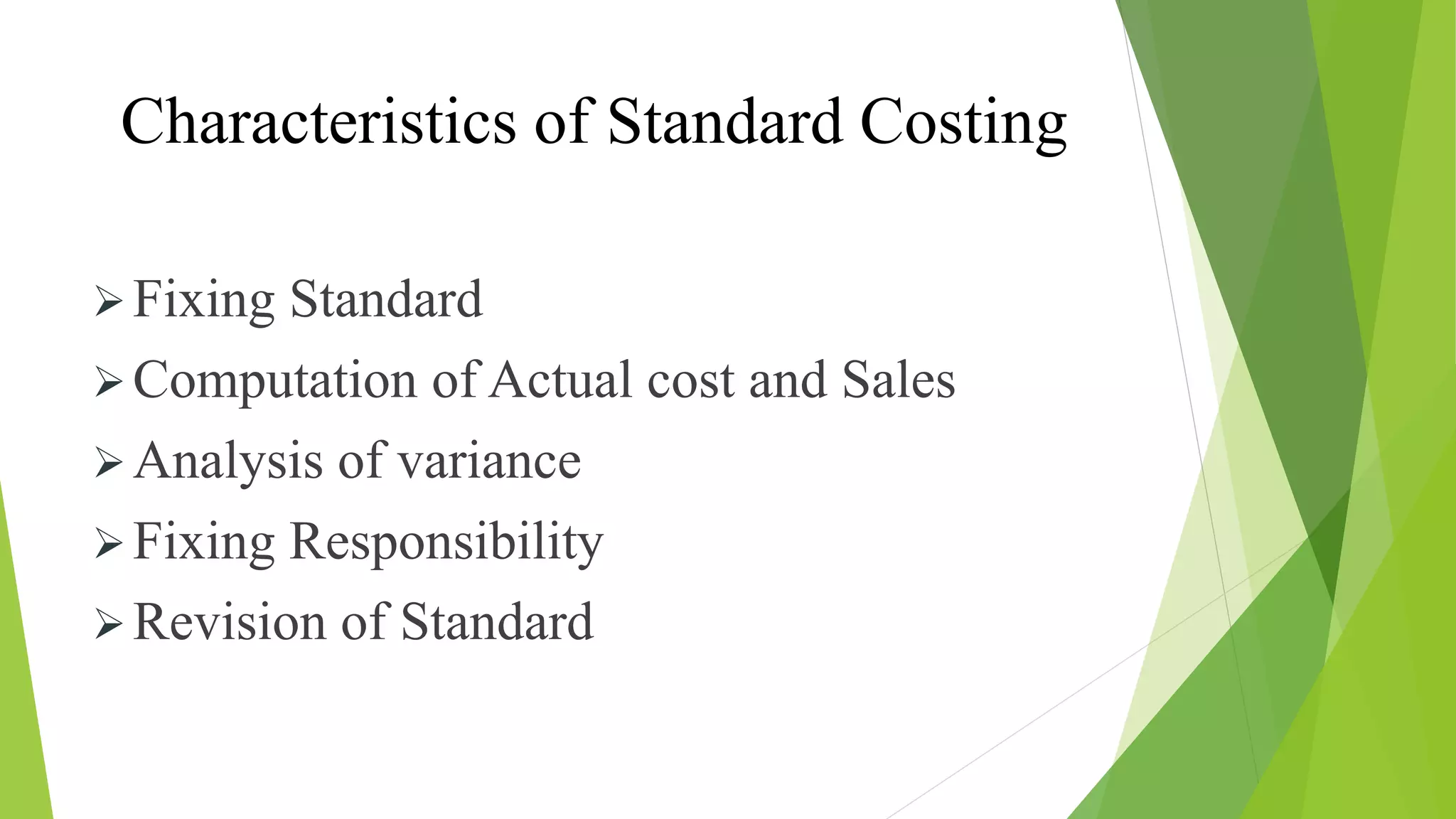
Characteristics of Standard Costing
Fixing Standard
Computation of Actual cost and Sales
Analysis of variance
Fixing Responsibility
Revision of Standard
Types of Standards
 Current Standard-
Current Standard is a Standard established for use over a
short period of time, related to current conditions.
 Basic Standard-
Basic Standard is a Standard established for use over a long
period of time from which a Current Standard can be
developed.
 Ideal Standard -
It is the Standard that can be attained under most favorable
conditions. No provision is made for shrinkage, spoilage or
machine breakdown etc.
Ideal Standards are not generally used because it may
influence employee motivation adversely.
 Attainable Standard -
It is a standard which can be attained if a standard unit of work
is carried out efficiently, on a machine properly utilized or
material properly used.
Advantage of Standard Costing
 Increase in Profit
 Increase In Productivity
 Economical
 Help in cost Control
 Full use of capacity
 Help in valuation of stock
Limitation of Standard Costing
 High degree of technical skill.
 Segregation of variances into controllable and
noncontrollable factors
 Duplication in recording,
 Either too strict or too liberal.
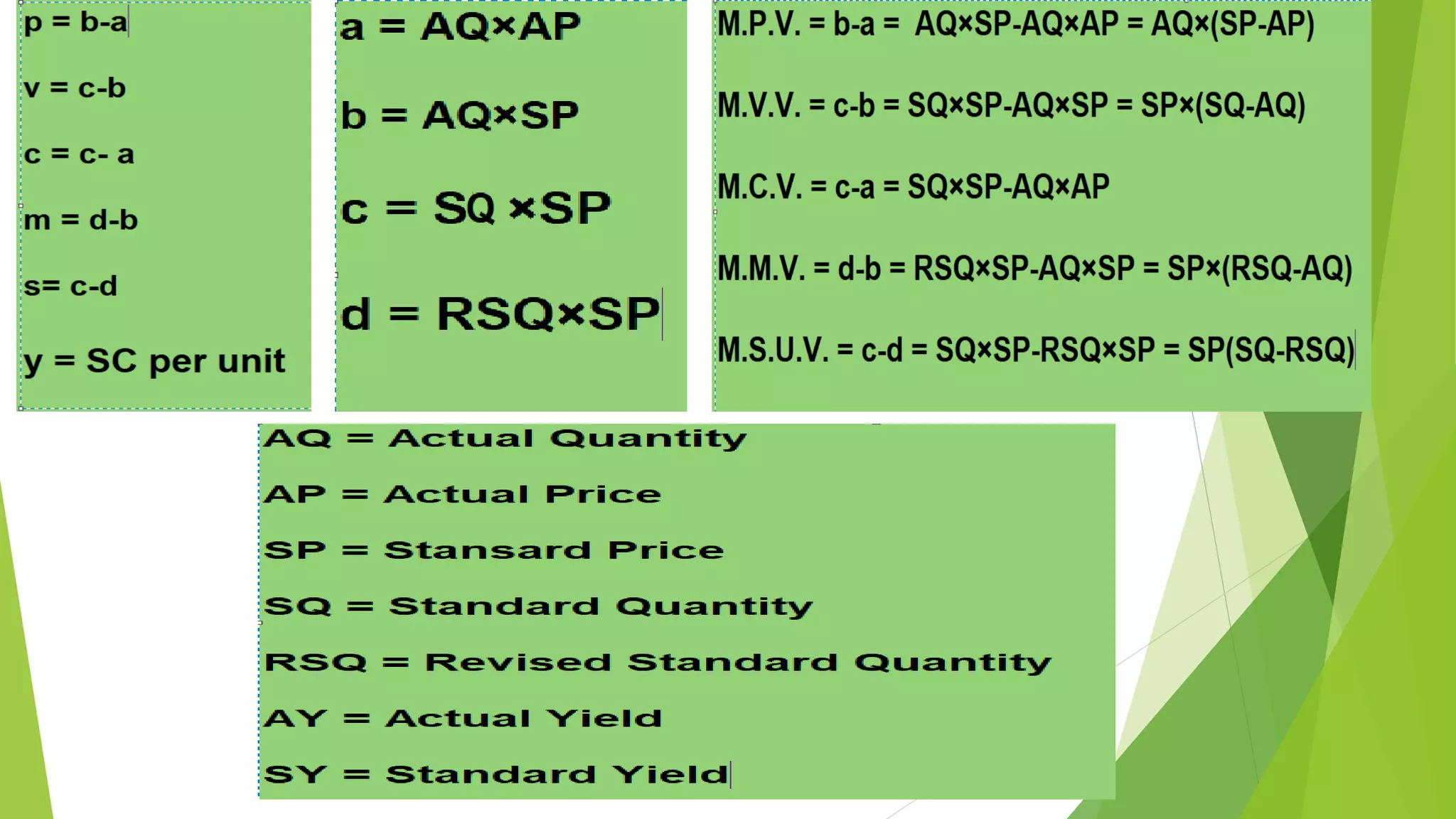
Short Tricks to remember Formulas
Standard costing - cost analysis

Standard costing - cost analysis

  • 1.
    Siilas campus Presentation- Cost Accounting StandardCosting Submitted to- Presented by- Harish Sir Vinay kumar verma BBA- 3rd Sem (Sec –A)
  • 2.
    INDEX • Definition • Objectiveof Standard Costing • Characteristics of Standard Costing • Types of Standard Costing • Advantage of Standard Costing • Limitation of Standard Costing • Short tricks to remember Formulas
  • 3.
    Definition  Standard costis the pre-determined cost based on the technical estimates for materials, labor and overhead for a selected period of time for a prescribed set of working conditions.
  • 4.
    Objectives of StandardCosting  To provide a formal basis for assessing performance and efficiency.  To control Costs by establishing standards and analysis of variances  To assist in setting budgets.  To motivate staff and management.  To provide a basis for estimating.  To provide guidance on possible ways of improving performance.
  • 5.
    Characteristics of StandardCosting Fixing Standard Computation of Actual cost and Sales Analysis of variance Fixing Responsibility Revision of Standard
  • 6.
    Types of Standards Current Standard- Current Standard is a Standard established for use over a short period of time, related to current conditions.  Basic Standard- Basic Standard is a Standard established for use over a long period of time from which a Current Standard can be developed.
  • 7.
     Ideal Standard- It is the Standard that can be attained under most favorable conditions. No provision is made for shrinkage, spoilage or machine breakdown etc. Ideal Standards are not generally used because it may influence employee motivation adversely.  Attainable Standard - It is a standard which can be attained if a standard unit of work is carried out efficiently, on a machine properly utilized or material properly used.
  • 8.
    Advantage of StandardCosting  Increase in Profit  Increase In Productivity  Economical  Help in cost Control  Full use of capacity  Help in valuation of stock
  • 9.
    Limitation of StandardCosting  High degree of technical skill.  Segregation of variances into controllable and noncontrollable factors  Duplication in recording,  Either too strict or too liberal.
  • 10.
    Short Tricks toremember Formulas