GROUP
NO:
7
TOPIC:
DIFFERENCE BETWEEN FINANCIAL
ACCOUNTING,COST ACCOUNTING AND
MANAGEMENT ACCOUNTING.
Financial accounting :
The purpose of this branch of accounting is to keep a record of
keep a record of all financial transactions so that:
Cost Accounting :
The purpose of cost
accounting is to analyse the
expenditure so as to ascertain
the cost of various products
manufactured by the firm and
fix the prices. It also helps in
controlling the costs and
providing necessary costing
information to management
for decision-making
Management Accounting :
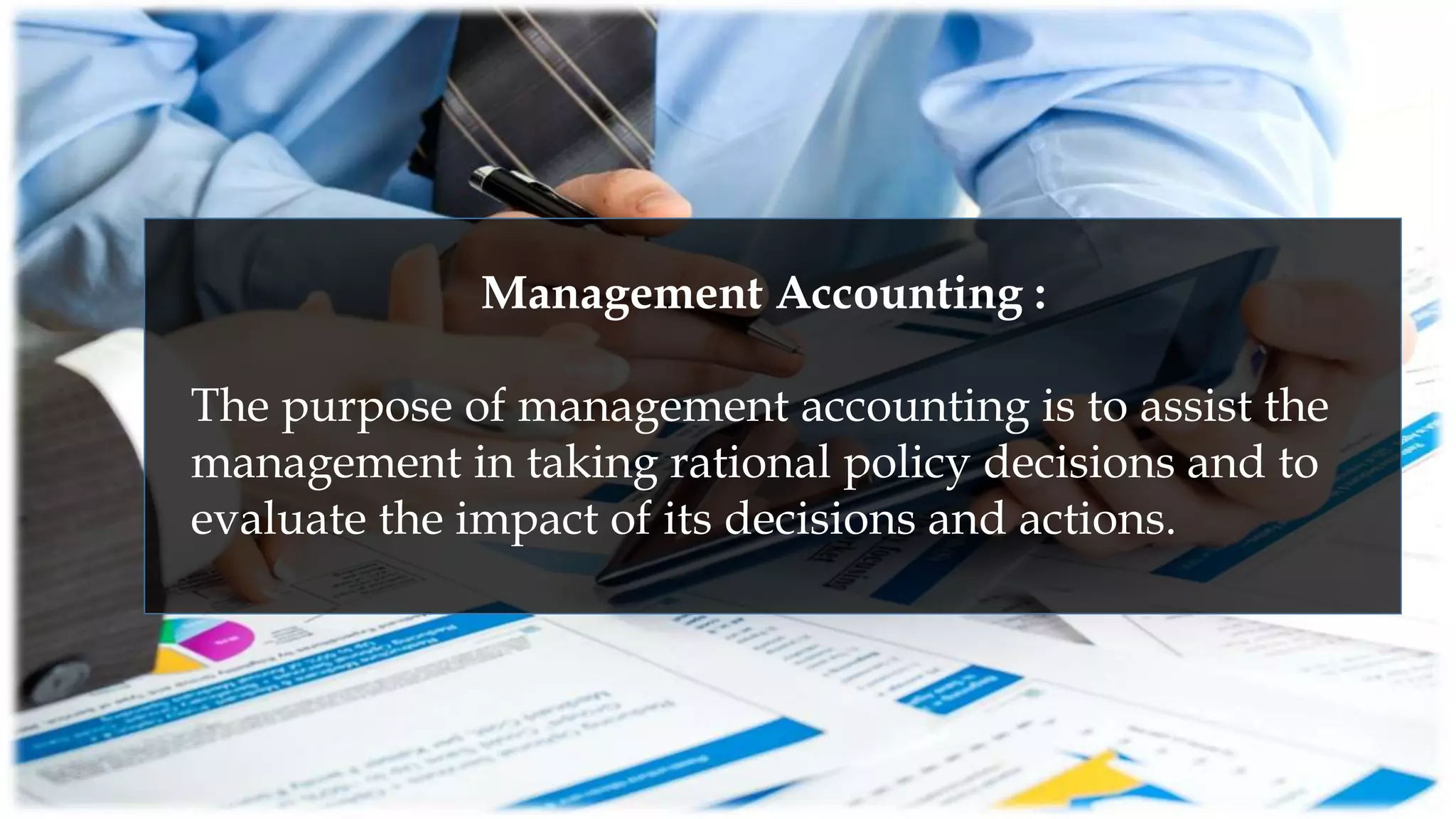
The purpose of management accounting is to assist the
management in taking rational policy decisions and to
evaluate the impact of its decisions and actions.
FINANCIAL ACCOUNTING MANAGEMENT ACCOUNTING
PRIMARY USERS External( Investors, government
authorities, creditors)
Internal(Managers of business, employees)
PURPOSE
OF INFORMATION
Help investors, creditors, and others make
investment, credit, and other decisions
Help managers plan and control business operations
TIMELINES Delayed or historical Current and future oriented
RESTRICTIONS GAAP,FASB AND SEC GAAP does not apply, but information should be
restricted to strategic and operational needs
NATURE OF
INFORMATION
Objective, auditable, reliable, consistent
and precise
More subjective and judgmental, valid, relevant and
accurate
SCOPE Highly aggregated information about the
overall organisation
Disaggregated information to support local decisions
BEHAVIOURAL IMPLICATI
ONS
Concern about adequacy of disclosure Concern about how reports will affect employees
behaviour
FEATURES Must be accurate and timelyCompulsory
under company law Is an end in itself
Usually approximate but relevant and flexible Except
for few companies, it is not mandatory Is a mean to
the end
SEGMENTS
OF ORGANISATION
It is primarily concerned with reporting for
the company as a whole.
Segment reporting is the primary emphasis.
FINANCIAL ACCOUNTING COST ACCOUNTING
OBJECTIVE It provides information about financial
performance and financial position of
the business.
It provides information of ascertainments of
costs to control costs and for decision making
about the costs.
NATURE It classifies records, presents and interprets
transactions in terms of money.
It classifies, records, presents and interprets in a
significant manner materials, labour
and overhead costs.
RECORDING
OF DATA
It records historical data. It records and presents estimated, budgeted
data. It makes use of both historical costs and
predetermined costs.
USERS OF
INFORMATION
External users like shareholders, creditors,
financial analysts, government and its
agencies,etc.
Used by Internal management at different
levels.
ANALYSIS OF COSTS
AND PROFITS
It shows profit/loss of the organization. It provides details of costs and profit of each
product, process, job,etc.
TIME PERIOD They are prepared for a definite period, usually
a year.
They are prepared as and when required.
PRESENTATION OF
INFORMATION
A set format is used for presenting financial
information.
There are no set formats for presenting cost
information's.
T H A N K
Y O U
FASB
The Financial Accounting Standards Board (FASB) is a private, not-for-profit
organization whose primary purpose is to develop generally accepted
accounting principles (GAAP) within the United States in the public's interest
SEC (SECURITIES AND EXCHANGE COMMISSION)
an agency responsible for enforcing the federal securities laws and regulating
the securities industry, the nation's stock and options exchanges, and other
electronic securities markets in the United States.
BACK

Difference between financial,cost and management accounting

  • 1.
  • 2.
    TOPIC: DIFFERENCE BETWEEN FINANCIAL ACCOUNTING,COSTACCOUNTING AND MANAGEMENT ACCOUNTING.
  • 3.
    Financial accounting : Thepurpose of this branch of accounting is to keep a record of keep a record of all financial transactions so that:
  • 4.
    Cost Accounting : Thepurpose of cost accounting is to analyse the expenditure so as to ascertain the cost of various products manufactured by the firm and fix the prices. It also helps in controlling the costs and providing necessary costing information to management for decision-making
  • 5.
    Management Accounting : Thepurpose of management accounting is to assist the management in taking rational policy decisions and to evaluate the impact of its decisions and actions.
  • 6.
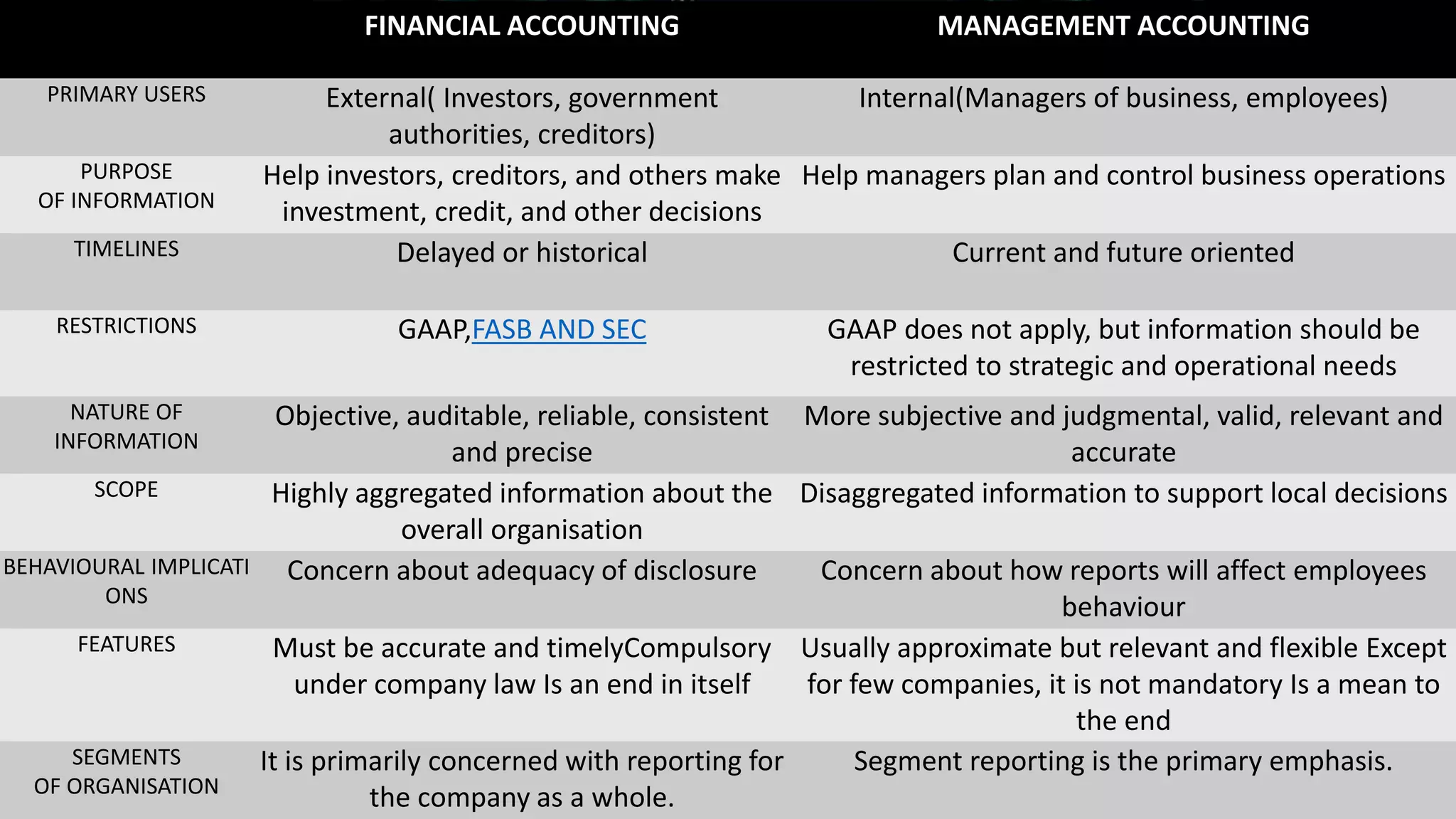
    FINANCIAL ACCOUNTING MANAGEMENTACCOUNTING PRIMARY USERS External( Investors, government authorities, creditors) Internal(Managers of business, employees) PURPOSE OF INFORMATION Help investors, creditors, and others make investment, credit, and other decisions Help managers plan and control business operations TIMELINES Delayed or historical Current and future oriented RESTRICTIONS GAAP,FASB AND SEC GAAP does not apply, but information should be restricted to strategic and operational needs NATURE OF INFORMATION Objective, auditable, reliable, consistent and precise More subjective and judgmental, valid, relevant and accurate SCOPE Highly aggregated information about the overall organisation Disaggregated information to support local decisions BEHAVIOURAL IMPLICATI ONS Concern about adequacy of disclosure Concern about how reports will affect employees behaviour FEATURES Must be accurate and timelyCompulsory under company law Is an end in itself Usually approximate but relevant and flexible Except for few companies, it is not mandatory Is a mean to the end SEGMENTS OF ORGANISATION It is primarily concerned with reporting for the company as a whole. Segment reporting is the primary emphasis.
  • 7.
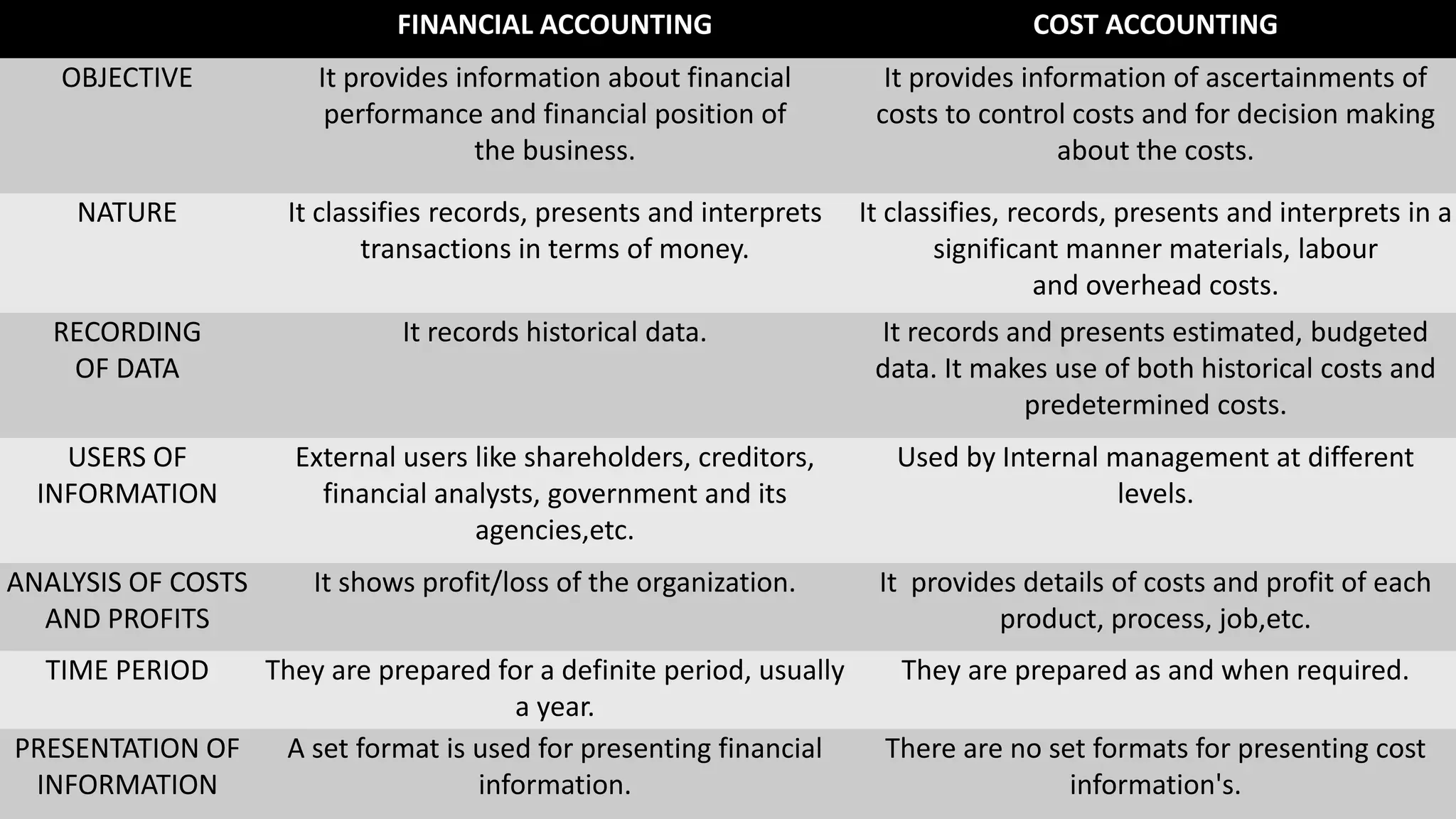
    FINANCIAL ACCOUNTING COSTACCOUNTING OBJECTIVE It provides information about financial performance and financial position of the business. It provides information of ascertainments of costs to control costs and for decision making about the costs. NATURE It classifies records, presents and interprets transactions in terms of money. It classifies, records, presents and interprets in a significant manner materials, labour and overhead costs. RECORDING OF DATA It records historical data. It records and presents estimated, budgeted data. It makes use of both historical costs and predetermined costs. USERS OF INFORMATION External users like shareholders, creditors, financial analysts, government and its agencies,etc. Used by Internal management at different levels. ANALYSIS OF COSTS AND PROFITS It shows profit/loss of the organization. It provides details of costs and profit of each product, process, job,etc. TIME PERIOD They are prepared for a definite period, usually a year. They are prepared as and when required. PRESENTATION OF INFORMATION A set format is used for presenting financial information. There are no set formats for presenting cost information's.
  • 8.
    T H AN K Y O U
  • 9.
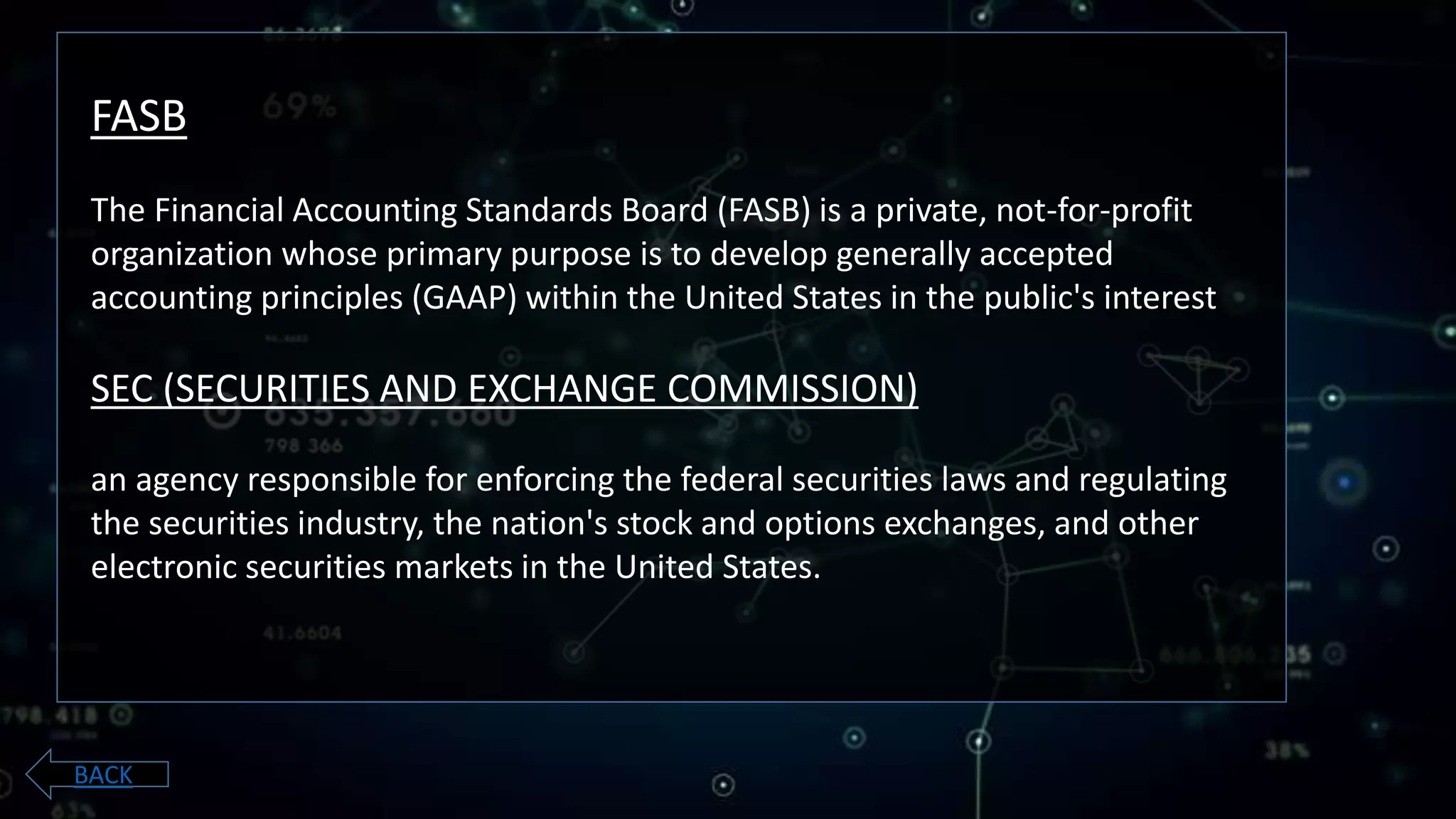
    FASB The Financial AccountingStandards Board (FASB) is a private, not-for-profit organization whose primary purpose is to develop generally accepted accounting principles (GAAP) within the United States in the public's interest SEC (SECURITIES AND EXCHANGE COMMISSION) an agency responsible for enforcing the federal securities laws and regulating the securities industry, the nation's stock and options exchanges, and other electronic securities markets in the United States. BACK