Standard CostingPresented By: AshutoshMishra, Ashok Gupta, AtharJawaid, AvinashTiwari, Chandan Kumar
Flow of PresentationMeaning
Types of Standard & Revision
Procedure of setting standard cost :
	Material
	Labour
	Overhead
Advantages
Limitations
ReferencesWhat is  Costing ?Costing (or cost-benefit analysis) is the process of analyzing the costs and benefits of different options to determinewhat approach should be taken to a particular conflict.
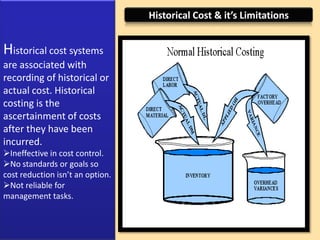
what solution or resolution should be chosen once various options are being considered.Historical cost systems are associated with recording of historical or actual cost. Historical costing is the ascertainment of costs after they have been incurred.Ineffective in cost control.
No standards or goals so cost reduction isn’t an option.
Not reliable for management tasks.Historical Cost & it’s Limitations
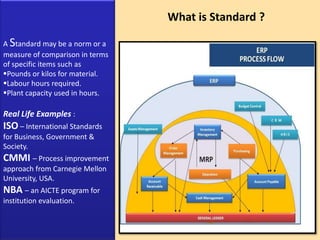
A Standard may be a norm or a measure of comparison in terms of specific items such asPounds or kilos for material.
Labour hours required.
Plant capacity used in hours.Real Life Examples :ISO – International Standards for Business, Government & Society.CMMI – Process improvement approach from Carnegie Mellon University, USA.NBA – an AICTE program for institution evaluation.What is Standard ?
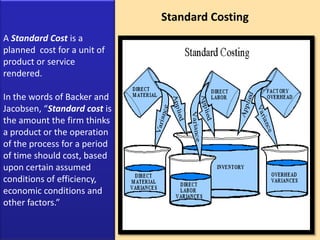
A Standard Cost is a planned  cost for a unit of product or service rendered.In the words of Backer and Jacobsen, “Standard cost is the amount the firm thinks a product or the operation of the process for a period of time should cost, based upon certain assumed conditions of efficiency, economic conditions and other factors.”Standard Costing
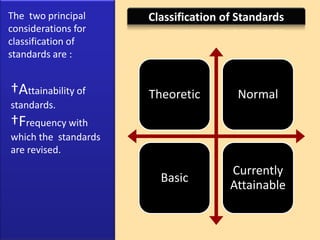
Classification of StandardsThe  two principal considerations for classification of standards are :Attainability of standards.
Frequency with which the  standards are revised.Ideal standard is fixed on the assumption of those conditions which may rarely exist. This standard is not practicable and may not be achieved.This is the standard which represents a high level of efficiency. Ideal standard is fixed on the assumption that favourable conditions will prevail and management will be at its best. The price paid for materials will be lowest and wastes etc. will be minimum possible. The labour time for making the production will be minimum and rates of wages will also be low. The overhead expenses are also set with maximum efficiency in mind. All the conditions, both internal and external, should be favourable and only then ideal standard will be achieved.
The changes in manufacturing costs can be measured by taking basic standard, as a base standard cannot serve as a tool for cost control purpose because the standard is not revised for a long time.BasicBasic standard is established for a long period and is not adjusted to the preset conations. The same standard remains in force for a long period. These standards are revised only on the changes in specification of material and technology productions. It is indeed just like a number against which subsequent process changes can be measured. Basic standard enables the measurement of changes in costs.
The normal standard concept is theoretical and cannot be used for cost control purpose. Normal standard can be properly applied for absorption of overhead cost over a long period of time.NormalNormal standard has been defined as a standard which, it is anticipated, can be attained over a future period of time, preferably long enough to cover one trade cycle. The standard attempts to cover variance in the production from one time to another time. An average is taken from the periods of recession and depression.
It is presumed that conditions of production will remain unchanged. In case there is any change in price or manufacturing condition, the standards are also revised. Current standard may be ideal standard and expected standard.CurrentA current standard is a standard which is established for use over a short period of time and is related to current condition. It reflects the performance that should be attained during the current period. The period for current standard is normally one year.
We need to revise the standards which follow for better control. Even standards are also subjected to change like the production method, environment, raw material, and technology.Standards may need to be changed to accommodate changes in the organization or its environment. When there is a sudden change in economic circumstances, technology or production methods, the standard cost will no longer be accurate.Revision of Standards
If actual costs are greater than standard costs the variance is unfavourable.

Standard Costing:The complete concept.

  • 1.
    Standard CostingPresented By:AshutoshMishra, Ashok Gupta, AtharJawaid, AvinashTiwari, Chandan Kumar
  • 2.
  • 3.
  • 4.
    Procedure of settingstandard cost :
  • 5.
  • 6.
  • 7.
  • 8.
  • 9.
  • 10.
    ReferencesWhat is Costing ?Costing (or cost-benefit analysis) is the process of analyzing the costs and benefits of different options to determinewhat approach should be taken to a particular conflict.
  • 11.
    what solution orresolution should be chosen once various options are being considered.Historical cost systems are associated with recording of historical or actual cost. Historical costing is the ascertainment of costs after they have been incurred.Ineffective in cost control.
  • 12.
    No standards orgoals so cost reduction isn’t an option.
  • 13.
    Not reliable formanagement tasks.Historical Cost & it’s Limitations
  • 14.
    A Standard maybe a norm or a measure of comparison in terms of specific items such asPounds or kilos for material.
  • 15.
  • 16.
    Plant capacity usedin hours.Real Life Examples :ISO – International Standards for Business, Government & Society.CMMI – Process improvement approach from Carnegie Mellon University, USA.NBA – an AICTE program for institution evaluation.What is Standard ?
  • 17.
    A Standard Costis a planned cost for a unit of product or service rendered.In the words of Backer and Jacobsen, “Standard cost is the amount the firm thinks a product or the operation of the process for a period of time should cost, based upon certain assumed conditions of efficiency, economic conditions and other factors.”Standard Costing
  • 18.
    Classification of StandardsThe two principal considerations for classification of standards are :Attainability of standards.
  • 19.
    Frequency with whichthe standards are revised.Ideal standard is fixed on the assumption of those conditions which may rarely exist. This standard is not practicable and may not be achieved.This is the standard which represents a high level of efficiency. Ideal standard is fixed on the assumption that favourable conditions will prevail and management will be at its best. The price paid for materials will be lowest and wastes etc. will be minimum possible. The labour time for making the production will be minimum and rates of wages will also be low. The overhead expenses are also set with maximum efficiency in mind. All the conditions, both internal and external, should be favourable and only then ideal standard will be achieved.
  • 20.
    The changes inmanufacturing costs can be measured by taking basic standard, as a base standard cannot serve as a tool for cost control purpose because the standard is not revised for a long time.BasicBasic standard is established for a long period and is not adjusted to the preset conations. The same standard remains in force for a long period. These standards are revised only on the changes in specification of material and technology productions. It is indeed just like a number against which subsequent process changes can be measured. Basic standard enables the measurement of changes in costs.
  • 21.
    The normal standardconcept is theoretical and cannot be used for cost control purpose. Normal standard can be properly applied for absorption of overhead cost over a long period of time.NormalNormal standard has been defined as a standard which, it is anticipated, can be attained over a future period of time, preferably long enough to cover one trade cycle. The standard attempts to cover variance in the production from one time to another time. An average is taken from the periods of recession and depression.
  • 22.
    It is presumedthat conditions of production will remain unchanged. In case there is any change in price or manufacturing condition, the standards are also revised. Current standard may be ideal standard and expected standard.CurrentA current standard is a standard which is established for use over a short period of time and is related to current condition. It reflects the performance that should be attained during the current period. The period for current standard is normally one year.
  • 23.
    We need torevise the standards which follow for better control. Even standards are also subjected to change like the production method, environment, raw material, and technology.Standards may need to be changed to accommodate changes in the organization or its environment. When there is a sudden change in economic circumstances, technology or production methods, the standard cost will no longer be accurate.Revision of Standards
  • 24.
    If actual costsare greater than standard costs the variance is unfavourable.
  • 25.
    If actual costsare less than standard costs the variance is favourable.The difference between the actual costs and the standard costs are known as variances.Standard costing and the related variances is a valuable management tool. If a variance arises, management becomes aware that manufacturing costs have differed from the standard (planned, expected) costs.Variance analysis involves two phases :Computation of individual variances.
  • 26.
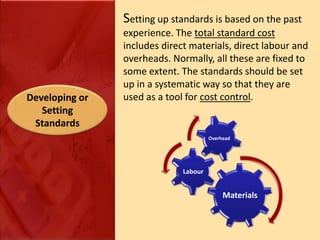
    Determination of thecause of each variance.Setting up standards is based on the past experience. The total standard cost includes direct materials, direct labour and overheads. Normally, all these are fixed to some extent. The standards should be set up in a systematic way so that they are used as a tool for cost control. Developing or Setting Standards
  • 27.
    When we wantto purchase some material what are the factors we consider. If material is used for a product, it is known as direct material. On the other hand, if the material cost cannot be assigned to the manufacturing of the product, it will be called indirect material.Therefore, it involves two things: Quality of material
  • 28.
    Price of thematerial The procedure for purchase of materials, minimum and maximum levels for various materials, discount policy and means of transport are the other factors which have bearing on the materials cost price.It includes:Cost of materials
  • 29.
  • 30.
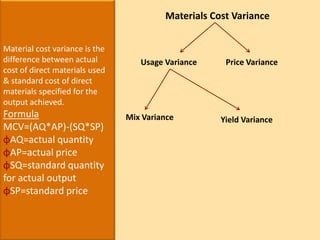
    Carrying costMaterial costvariance is the difference between actual cost of direct materials used & standard cost of direct materials specified for the output achieved.FormulaMCV=(AQ*AP)-(SQ*SP)AQ=actual quantity
  • 31.
  • 32.
  • 33.
    SP=standard priceMaterials CostVarianceUsage VariancePrice VarianceMix VarianceYield Variance
  • 34.
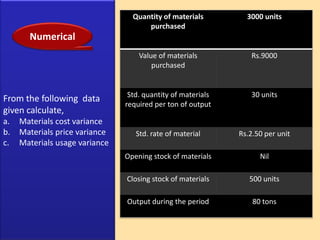
    From the following data given calculate,Materials cost varianceMaterials price varianceMaterials usage varianceNumerical
  • 35.
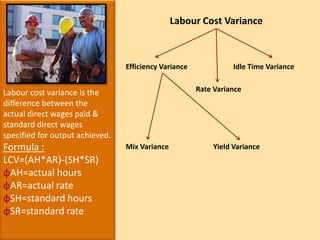
    Labour cost varianceis the difference between the actual direct wages paid & standard direct wages specified for output achieved.Formula :LCV=(AH*AR)-(SH*SR)AH=actual hours
  • 36.
  • 37.
  • 38.
    SR=standard rateLabour CostVarianceEfficiency VarianceIdle Time VarianceRate VarianceMix VarianceYield Variance
  • 39.
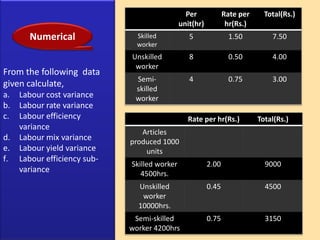
    From the following data given calculate,Labour cost varianceLabour rate varianceLabour efficiency varianceLabour mix varianceLabour yield varianceLabour efficiency sub-varianceNumerical
  • 40.
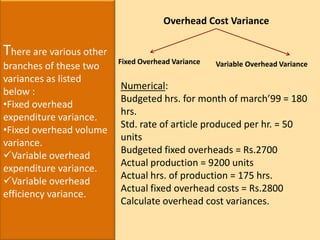
    There are variousother branches of these two variances as listed below :Fixed overhead expenditure variance.
  • 41.
  • 42.
  • 43.
    Variable overhead efficiencyvariance.Overhead Cost VarianceFixed Overhead VarianceVariable Overhead VarianceNumerical:Budgeted hrs. for month of march’99 = 180 hrs.Std. rate of article produced per hr. = 50 unitsBudgeted fixed overheads = Rs.2700Actual production = 9200 unitsActual hrs. of production = 175 hrs.Actual fixed overhead costs = Rs.2800Calculate overhead cost variances.
  • 44.
  • 45.
  • 46.
  • 47.
  • 48.
    Efficiency measurementLimitationsIt cannotbe used in those organizations where non-standard products are produced.
  • 49.
    The process ofsetting standard is a difficult task, as it requires technical skills.
  • 50.
    There are noinset circumstances to be considered for fixing standards.
  • 51.
    The fixing ofresponsibility is not an easy task.ReferencesThe Internet.Management Accounting – James MartinManagement Accounting – D Westra, M Kane & SrikanthAccounting for management – Dr.JawaharLal