Banking Practices and
Obligations
Duties of a banker
a) Duty to maintain secrecy/confidentiality of customers' accounts.
b) Duty to honour cheques drawn by customers on their accounts
and collect cheque, bills on his behalf.
c) Duty to pay bills etc., as per standing instructions of the customer.
d) Duty to provide proper services.
e) Duty to act as per the directions given by the customer. If
directions are not given the banker has to act according to how he
is expected to act.
f) Duty to submit periodical statements i.e. informing customers of
the state of the account
g) Articles/items kept should not be released to a third party without
due authorization by the customer
Clayton’s Rule
• To discharge of the particular debt as per the
instructions of the debtor.
• If debtor does not intimate or the
circumstances do not indicate, as per the
discretion of the creditor.
• When neither party indicates, to discharge of
debts in order of time.
• First to discharge of interest and then principal
in chronological order.
Contd…
Clayton’s Rule
• The rule in Clayton’s Case is generally
described as the "first in, first out" rule.
• It holds that where a trustee mixes money
from two or more trusts in one account and
then removes money from it, the trustee is
deemed to have taken out the money that
was first deposited in the account.
Contd…
Clayton’s Rule
• At the conclusion of these transactions,
$10,000 remains in the account.
• In this scenario, the rule would not permit
trust A to recover anything from the account,
trust B would recover $5,000 and trust C
would recover $5,000.
• Trust A and trust B would have claims against
the trustee personally for amounts not
recovered from the account.
Contd…
Clayton’s Rule
• For example, assume that a trustee deposits
$20,000 belonging to trust A in a bank account.
• One week later, the trustee deposits $10,000
belonging to trust B into the same account.
• Two months later, a deposit of $5,000 belonging
to trust C is made to the same account.
• The following week, the trustee withdraws
$25,000 from the account.
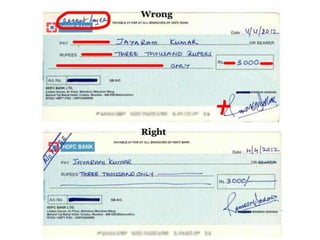
Cheque Writing
• The banking system fully adopted the Cheque
Truncation System (CTS) standards from 2010 .
• This means your cheque will not travel physically from
one location to another, but an electronic image will be
transferred for the bank where the cheque is deposited
to the drawee bank.
• This also means even a small mistake on your cheque
will result in your cheque not getting cleared.
• Most banks have started to charge for extra cheques
you order.
Contd…
• Writing the cheque properly also prevents the
risk of frauds on your cheques.
• Not to mention that banks charge a few
hundred rupees as a fine, for cheques that get
bounced due to non-financial reasons.
Cheque Writing
Cheque Writing Rules
• Always move from left to right: While it’s not
necessary to move from left to right direction, it
just helps your cheque writing task, some
method.
• This helps you cover all details on the cheque in a
structured manner.
• If you randomly fill in the cheque details, you
might just miss filling something.
• That could lead to bouncing of cheque due to
non-financial reasons.
Step 1: Date
• Without a date your cheque will just not be
cleared, period.
• You will be surprised to know, how many actually
forget to write the date, at times the correct date.
• If you want the cheque to be cleared right away,
write the current date.
• If you plan to give a post-dated cheque ensure
you give the right date.
• If by mistake you put in a prior date and there
aren’t sufficient funds in your account, your
cheque might bounce.
Step 2: Gaps
• Leaving space on them increases the risk of
frauds and cheque tampering.
• After the printed word “Payee” on the
cheque, write the name of the person/entity
to whom you want to give the cheque.
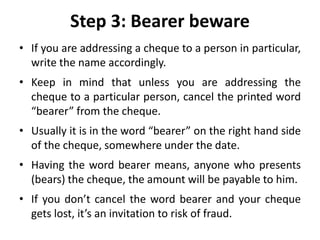
Step 3: Bearer beware
• If you are addressing a cheque to a person in particular,
write the name accordingly.
• Keep in mind that unless you are addressing the
cheque to a particular person, cancel the printed word
“bearer” from the cheque.
• Usually it is in the word “bearer” on the right hand side
of the cheque, somewhere under the date.
• Having the word bearer means, anyone who presents
(bears) the cheque, the amount will be payable to him.
• If you don’t cancel the word bearer and your cheque
gets lost, it’s an invitation to risk of fraud.
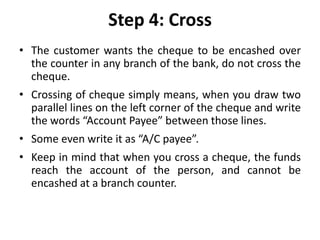
Step 4: Cross
• The customer wants the cheque to be encashed over
the counter in any branch of the bank, do not cross the
cheque.
• Crossing of cheque simply means, when you draw two
parallel lines on the left corner of the cheque and write
the words “Account Payee” between those lines.
• Some even write it as “A/C payee”.
• Keep in mind that when you cross a cheque, the funds
reach the account of the person, and cannot be
encashed at a branch counter.
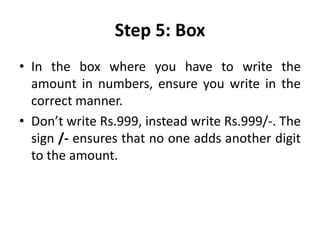
Step 5: Box
• In the box where you have to write the
amount in numbers, ensure you write in the
correct manner.
• Don’t write Rs.999, instead write Rs.999/-. The
sign /- ensures that no one adds another digit
to the amount.
Step 6: Figures
• Also when it comes to writing the amount, do not
leave space.
• For instance, if you want the amount to be
Rs.5,000 don’t leave space before the number
5000 or anyone can simply add the number 3
before the number 5000 and make it 35000.
• Same applies when you write the amount in
words.
• Five thousand can be easily made into thirty five
thousand, if you leave space before the word five.
Step 7: Signature
• After filling all the above mentioned details, you
need to check actually sign in the cheque or not.
• Remember that going forward; you will need to
use darker ink to sign the cheque.
• Sign the cheque above your name, which is
printed on the cheque.
• Never sign blank cheques in the cheque book. If
you lose the cheque book, you know what will
happen next.
Source: http://www.firstpost.com/investing/new-cheque-norms-know-how-to-
write-the-cheques-correctly-516041.html
Banking Ombudsman Scheme, 2006
What is the Banking Ombudsman
Scheme?
– The Banking Ombudsman Scheme enables an
speedy and inexpensive forum to bank customers
for resolution of complaints relating to certain
services rendered by banks.
– The Banking Ombudsman Scheme is introduced
under Section 35 A of the Banking Regulation Act,
1949 by RBI with effect from 1995.
Banking Ombudsman Scheme, 2006
• Who is a Banking Ombudsman?
– The Banking Ombudsman is a senior official appointed by
the Reserve Bank of India to redress customer complaints
against deficiency in certain banking services.
• As on date, fifteen Banking Ombudsmen have been
appointed with their offices located mostly in state
capitals.
• All Scheduled Commercial Banks, Regional Rural
Banks and Scheduled Primary Co-operative Banks are
covered under the Scheme.
When can one file a complaint?
• One can file a complaint before the Banking
Ombudsman if the reply is not received from
the bank within a period of one month after
the bank concerned has received ones
representation, or the bank rejects the
complaint, or if the complainant is not
satisfied with the reply given by the bank.
Procedure for filing the Complaint
• One can file a complaint with the Banking
Ombudsman simply by writing on a plain
paper. One can also file it online or by sending
an email to the Banking Ombudsman.
• There is a form along with details of the
scheme in RBI website.
• However, it is not necessary to use this
format.
Where can one lodge his/her
complaint?
• One may lodge his/ her complaint at the office of
the Banking Ombudsman under whose
jurisdiction, the bank branch complained against
is situated.
• For complaints relating to credit cards and other
types of services with centralized operations,
complaints may be filed before the Banking
Ombudsman within whose territorial jurisdiction
the billing address of the customer is located.
Cost
• The Banking Ombudsman does not charge any
fee for filing and resolving customers’
complaints.
Details required for complaint
• The complaint should have the name and address
of the complainant.
• The name and address of the branch or office of
the bank against which the complaint is made.
• Facts giving rise to the complaint supported by
documents, if any, the nature and extent of the
loss caused to the complainant, the relief sought
from the Banking Ombudsman and a declaration
about the compliance of conditions which are
required to be complied with by the complainant.
References
– http://rbi.org.in/scripts/FAQView.aspx?Id=24

Banking practics

  • 1.
  • 2.
    Duties of abanker a) Duty to maintain secrecy/confidentiality of customers' accounts. b) Duty to honour cheques drawn by customers on their accounts and collect cheque, bills on his behalf. c) Duty to pay bills etc., as per standing instructions of the customer. d) Duty to provide proper services. e) Duty to act as per the directions given by the customer. If directions are not given the banker has to act according to how he is expected to act. f) Duty to submit periodical statements i.e. informing customers of the state of the account g) Articles/items kept should not be released to a third party without due authorization by the customer
  • 3.
    Clayton’s Rule • Todischarge of the particular debt as per the instructions of the debtor. • If debtor does not intimate or the circumstances do not indicate, as per the discretion of the creditor. • When neither party indicates, to discharge of debts in order of time. • First to discharge of interest and then principal in chronological order. Contd…
  • 4.
    Clayton’s Rule • Therule in Clayton’s Case is generally described as the "first in, first out" rule. • It holds that where a trustee mixes money from two or more trusts in one account and then removes money from it, the trustee is deemed to have taken out the money that was first deposited in the account. Contd…
  • 5.
    Clayton’s Rule • Atthe conclusion of these transactions, $10,000 remains in the account. • In this scenario, the rule would not permit trust A to recover anything from the account, trust B would recover $5,000 and trust C would recover $5,000. • Trust A and trust B would have claims against the trustee personally for amounts not recovered from the account. Contd…
  • 6.
    Clayton’s Rule • Forexample, assume that a trustee deposits $20,000 belonging to trust A in a bank account. • One week later, the trustee deposits $10,000 belonging to trust B into the same account. • Two months later, a deposit of $5,000 belonging to trust C is made to the same account. • The following week, the trustee withdraws $25,000 from the account.
  • 7.
    Cheque Writing • Thebanking system fully adopted the Cheque Truncation System (CTS) standards from 2010 . • This means your cheque will not travel physically from one location to another, but an electronic image will be transferred for the bank where the cheque is deposited to the drawee bank. • This also means even a small mistake on your cheque will result in your cheque not getting cleared. • Most banks have started to charge for extra cheques you order. Contd…
  • 8.
    • Writing thecheque properly also prevents the risk of frauds on your cheques. • Not to mention that banks charge a few hundred rupees as a fine, for cheques that get bounced due to non-financial reasons. Cheque Writing
  • 9.
    Cheque Writing Rules •Always move from left to right: While it’s not necessary to move from left to right direction, it just helps your cheque writing task, some method. • This helps you cover all details on the cheque in a structured manner. • If you randomly fill in the cheque details, you might just miss filling something. • That could lead to bouncing of cheque due to non-financial reasons.
  • 10.
    Step 1: Date •Without a date your cheque will just not be cleared, period. • You will be surprised to know, how many actually forget to write the date, at times the correct date. • If you want the cheque to be cleared right away, write the current date. • If you plan to give a post-dated cheque ensure you give the right date. • If by mistake you put in a prior date and there aren’t sufficient funds in your account, your cheque might bounce.
  • 11.
    Step 2: Gaps •Leaving space on them increases the risk of frauds and cheque tampering. • After the printed word “Payee” on the cheque, write the name of the person/entity to whom you want to give the cheque.
  • 13.
    Step 3: Bearerbeware • If you are addressing a cheque to a person in particular, write the name accordingly. • Keep in mind that unless you are addressing the cheque to a particular person, cancel the printed word “bearer” from the cheque. • Usually it is in the word “bearer” on the right hand side of the cheque, somewhere under the date. • Having the word bearer means, anyone who presents (bears) the cheque, the amount will be payable to him. • If you don’t cancel the word bearer and your cheque gets lost, it’s an invitation to risk of fraud.
  • 14.
    Step 4: Cross •The customer wants the cheque to be encashed over the counter in any branch of the bank, do not cross the cheque. • Crossing of cheque simply means, when you draw two parallel lines on the left corner of the cheque and write the words “Account Payee” between those lines. • Some even write it as “A/C payee”. • Keep in mind that when you cross a cheque, the funds reach the account of the person, and cannot be encashed at a branch counter.
  • 15.
    Step 5: Box •In the box where you have to write the amount in numbers, ensure you write in the correct manner. • Don’t write Rs.999, instead write Rs.999/-. The sign /- ensures that no one adds another digit to the amount.
  • 16.
    Step 6: Figures •Also when it comes to writing the amount, do not leave space. • For instance, if you want the amount to be Rs.5,000 don’t leave space before the number 5000 or anyone can simply add the number 3 before the number 5000 and make it 35000. • Same applies when you write the amount in words. • Five thousand can be easily made into thirty five thousand, if you leave space before the word five.
  • 17.
    Step 7: Signature •After filling all the above mentioned details, you need to check actually sign in the cheque or not. • Remember that going forward; you will need to use darker ink to sign the cheque. • Sign the cheque above your name, which is printed on the cheque. • Never sign blank cheques in the cheque book. If you lose the cheque book, you know what will happen next. Source: http://www.firstpost.com/investing/new-cheque-norms-know-how-to- write-the-cheques-correctly-516041.html
  • 18.
  • 19.
    What is theBanking Ombudsman Scheme? – The Banking Ombudsman Scheme enables an speedy and inexpensive forum to bank customers for resolution of complaints relating to certain services rendered by banks. – The Banking Ombudsman Scheme is introduced under Section 35 A of the Banking Regulation Act, 1949 by RBI with effect from 1995.
  • 20.
    Banking Ombudsman Scheme,2006 • Who is a Banking Ombudsman? – The Banking Ombudsman is a senior official appointed by the Reserve Bank of India to redress customer complaints against deficiency in certain banking services. • As on date, fifteen Banking Ombudsmen have been appointed with their offices located mostly in state capitals. • All Scheduled Commercial Banks, Regional Rural Banks and Scheduled Primary Co-operative Banks are covered under the Scheme.
  • 21.
    When can onefile a complaint? • One can file a complaint before the Banking Ombudsman if the reply is not received from the bank within a period of one month after the bank concerned has received ones representation, or the bank rejects the complaint, or if the complainant is not satisfied with the reply given by the bank.
  • 22.
    Procedure for filingthe Complaint • One can file a complaint with the Banking Ombudsman simply by writing on a plain paper. One can also file it online or by sending an email to the Banking Ombudsman. • There is a form along with details of the scheme in RBI website. • However, it is not necessary to use this format.
  • 23.
    Where can onelodge his/her complaint? • One may lodge his/ her complaint at the office of the Banking Ombudsman under whose jurisdiction, the bank branch complained against is situated. • For complaints relating to credit cards and other types of services with centralized operations, complaints may be filed before the Banking Ombudsman within whose territorial jurisdiction the billing address of the customer is located.
  • 24.
    Cost • The BankingOmbudsman does not charge any fee for filing and resolving customers’ complaints.
  • 25.
    Details required forcomplaint • The complaint should have the name and address of the complainant. • The name and address of the branch or office of the bank against which the complaint is made. • Facts giving rise to the complaint supported by documents, if any, the nature and extent of the loss caused to the complainant, the relief sought from the Banking Ombudsman and a declaration about the compliance of conditions which are required to be complied with by the complainant.
  • 26.