VARIANCE ANALYSIS
AND
STANDARD COSTING

1
Outline
• The usage of standard costing
• Setting of standard cost and types of
standard
• Calculation of variance:
– Direct material
– Direct labor
– Factory overhead
2
Standard Costing

The cost that has been pre-determined after
considering other factors.
Those are estimated costs which are considered to
be ideal for each of the cost component ( direct
material, direct labor and factory overhead ).




The standard cost system enable the management
to determine how much a product should cost.

3
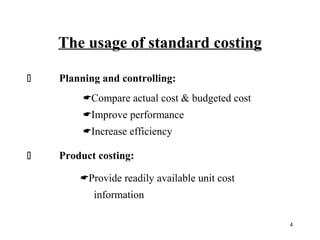
The usage of standard costing


Planning and controlling:
Compare actual cost & budgeted cost
Improve performance
Increase efficiency



Product costing:
Provide readily available unit cost
information
4
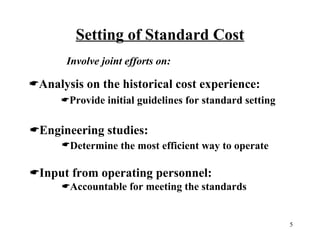
Setting of Standard Cost
Involve joint efforts on:

Analysis on the historical cost experience:
Provide initial guidelines for standard setting

Engineering studies:
Determine the most efficient way to operate

Input from operating personnel:
Accountable for meeting the standards

5
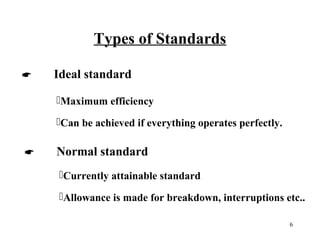
Types of Standards


Ideal standard
Maximum efficiency
Can be achieved if everything operates perfectly.



Normal standard
Currently attainable standard
Allowance is made for breakdown, interruptions etc..
6
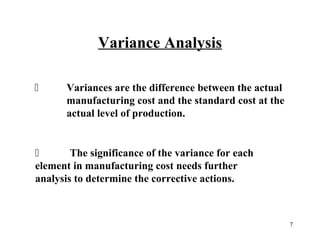
Variance Analysis


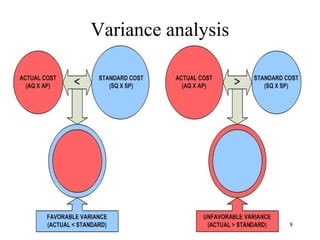
Variances are the difference between the actual
manufacturing cost and the standard cost at the
actual level of production.


The significance of the variance for each
element in manufacturing cost needs further
analysis to determine the corrective actions.

7
Variance analysis

8
Calculation of variance



Direct material


Direct labor


Factory overhead

9
Standard Cost
♣

The expected cost per unit product

Illustration 1:
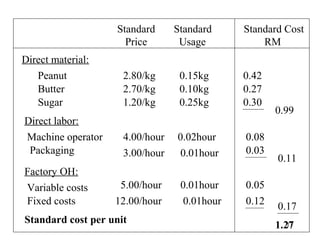
The followings are the standard cost for each unit
(bottle) of peanut butter produced by Syarikat Sedap
Selalu :

10
Standard
Price

Standard
Usage

Direct material:
Peanut
Butter
Sugar

2.80/kg
2.70/kg
1.20/kg

0.15kg
0.10kg
0.25kg

0.42
0.27
0.30

Direct labor:
Machine operator
Packaging

4.00/hour
3.00/hour

0.02hour
0.01hour

0.08
0.03

5.00/hour
12.00/hour

0.01hour
0.01hour

0.05
0.12

Factory OH:
Variable costs
Fixed costs

Standard cost per unit

Standard Cost
RM

0.99

0.11

0.17
11
1.27
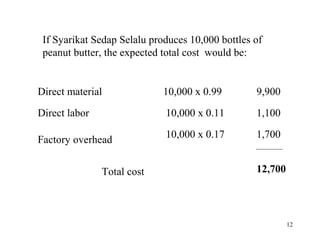
If Syarikat Sedap Selalu produces 10,000 bottles of
peanut butter, the expected total cost would be:

Direct material

10,000 x 0.99

9,900

Direct labor

10,000 x 0.11

1,100

Factory overhead

10,000 x 0.17

1,700

Total cost

12,700

12
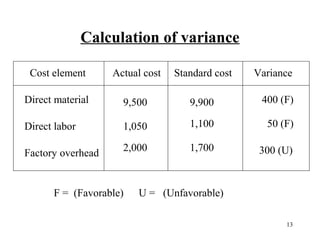
Calculation of variance
Cost element

Actual cost

Standard cost

Direct material

9,500

9,900

400 (F)

Direct labor

1,050

1,100

50 (F)

Factory overhead

2,000

1,700

300 (U)

F = (Favorable)

Variance

U = (Unfavorable)
13
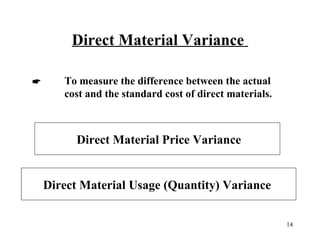
Direct Material Variance


To measure the difference between the actual
cost and the standard cost of direct materials.

Direct Material Price Variance

Direct Material Usage (Quantity) Variance
14
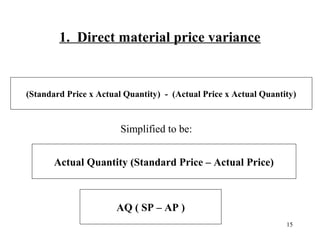
1. Direct material price variance

(Standard Price x Actual Quantity) - (Actual Price x Actual Quantity)

Simplified to be:
Actual Quantity (Standard Price – Actual Price)

AQ ( SP – AP )
15
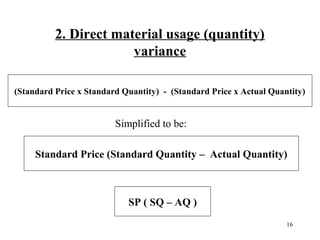
2. Direct material usage (quantity)
variance
(Standard Price x Standard Quantity) - (Standard Price x Actual Quantity)

Simplified to be:
Standard Price (Standard Quantity – Actual Quantity)

SP ( SQ – AQ )
16
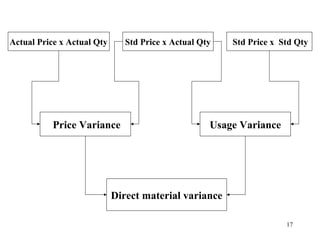
Actual Price x Actual Qty

Std Price x Actual Qty

Price Variance

Std Price x Std Qty

Usage Variance

Direct material variance
17
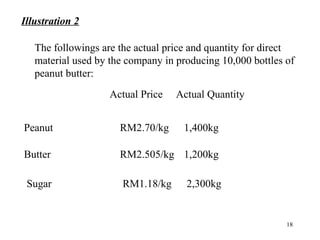
Illustration 2
The followings are the actual price and quantity for direct
material used by the company in producing 10,000 bottles of
peanut butter:
Actual Price

Actual Quantity

Peanut

RM2.70/kg

1,400kg

Butter

RM2.505/kg 1,200kg

Sugar

RM1.18/kg

2,300kg

18
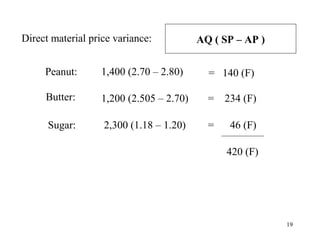
Direct material price variance:

AQ ( SP – AP )

Peanut:

1,400 (2.70 – 2.80)

= 140 (F)

Butter:

1,200 (2.505 – 2.70)

=

234 (F)

Sugar:

2,300 (1.18 – 1.20)

=

46 (F)
420 (F)

19
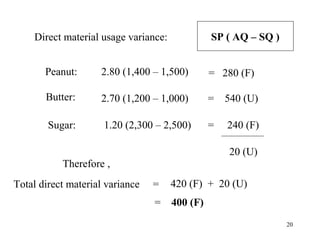
SP ( AQ – SQ )

Direct material usage variance:
Peanut:

2.80 (1,400 – 1,500)

= 280 (F)

Butter:

2.70 (1,200 – 1,000)

=

540 (U)

Sugar:

1.20 (2,300 – 2,500)

=

240 (F)
20 (U)

Therefore ,
Total direct material variance

=

420 (F) + 20 (U)

=

400 (F)
20
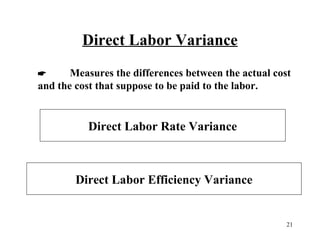
Direct Labor Variance

Measures the differences between the actual cost
and the cost that suppose to be paid to the labor.

Direct Labor Rate Variance

Direct Labor Efficiency Variance

21
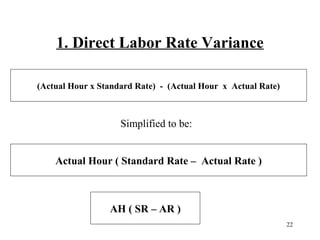
1. Direct Labor Rate Variance
(Actual Hour x Standard Rate) - (Actual Hour x Actual Rate)

Simplified to be:
Actual Hour ( Standard Rate – Actual Rate )

AH ( SR – AR )
22
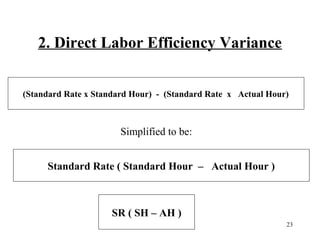
2. Direct Labor Efficiency Variance
(Standard Rate x Standard Hour) - (Standard Rate x Actual Hour)

Simplified to be:
Standard Rate ( Standard Hour – Actual Hour )

SR ( SH – AH )
23
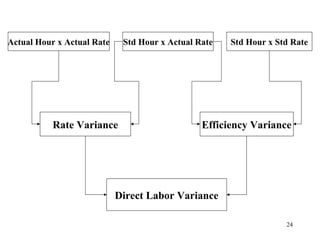
Actual Hour x Actual Rate

Std Hour x Actual Rate

Rate Variance

Std Hour x Std Rate

Efficiency Variance

Direct Labor Variance
24
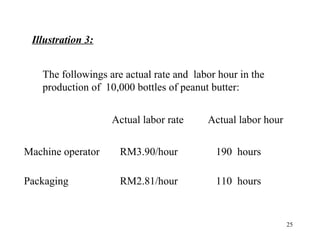
Illustration 3:
The followings are actual rate and labor hour in the
production of 10,000 bottles of peanut butter:
Actual labor rate

Actual labor hour

Machine operator

RM3.90/hour

190 hours

Packaging

RM2.81/hour

110 hours

25
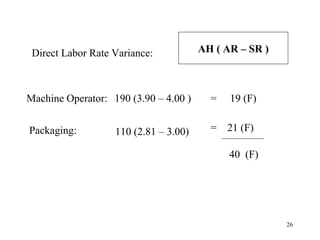
Direct Labor Rate Variance:

AH ( AR – SR )

Machine Operator: 190 (3.90 – 4.00 )

=

19 (F)

Packaging:

=

21 (F)

110 (2.81 – 3.00)

40 (F)

26
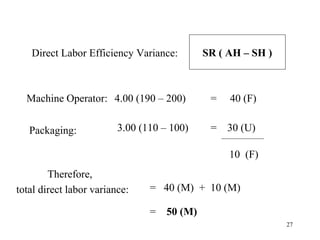
Direct Labor Efficiency Variance:

Machine Operator: 4.00 (190 – 200)
Packaging:

3.00 (110 – 100)

SR ( AH – SH )

=

40 (F)

= 30 (U)
10 (F)

Therefore,
total direct labor variance:

= 40 (M) + 10 (M)
=

50 (M)
27
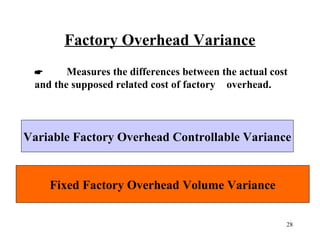
Factory Overhead Variance

Measures the differences between the actual cost
and the supposed related cost of factory overhead.

Variable Factory Overhead Controllable Variance

Fixed Factory Overhead Volume Variance
28
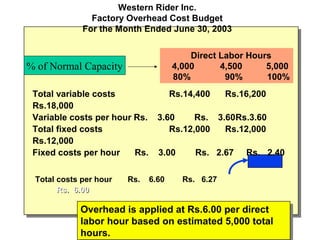
Western Rider Inc.
Factory Overhead Cost Budget
For the Month Ended June 30, 2003
Direct Labor Hours
4,000
4,500
5,000
80%
90%
100%

% of Normal Capacity
Total variable costs
Rs.18,000
Variable costs per hour Rs.
Total fixed costs
Rs.12,000
Fixed costs per hour
Rs.
Total costs per hour
Rs. 6.00

Rs.

Rs.14,400

Rs.16,200

3.60
Rs. 3.60Rs.3.60
Rs.12,000
Rs.12,000
3.00
6.60

Rs. 2.67

Rs. 2.40

Rs. 6.27

Overhead is applied at Rs.6.00 per direct
labor hour based on estimated 5,000 total
hours.
hours.

29
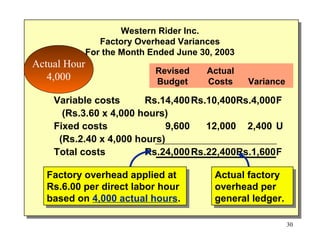
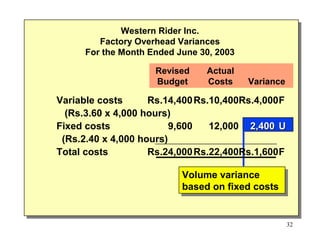
Western Rider Inc.
Factory Overhead Variances
For the Month Ended June 30, 2003

Actual Hour
4,000

Revised
Budget

Actual
Costs

Variance

Variable costs
Rs.14,400 Rs.10,400Rs.4,000F
(Rs.3.60 x 4,000 hours)
Fixed costs
9,600
12,000 2,400 U
(Rs.2.40 x 4,000 hours)
Total costs
Rs.24,000 Rs.22,400Rs.1,600F
Factory overhead applied at
Rs.6.00 per direct labor hour
based on 4,000 actual hours.

Actual factory
Actual factory
overhead per
overhead per
general ledger.
general ledger.
30
Western Rider Inc.
Factory Overhead Variances
For the Month Ended June 30, 2003
Revised
Budget

Actual
Costs

Variance

Variable costs
Rs.14,400 Rs.10,400Rs.4,000 F
(Rs.3.60 x 4,000 hours)
Fixed costs
9,600
12,000 2,400 U
(Rs.2.40 x 4,000 hours)
Total costs
Rs.24,000 Rs.22,400Rs.1,600F
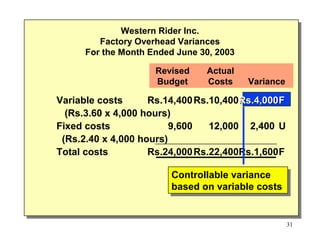
Controllable variance
based on variable costs

31
Western Rider Inc.
Factory Overhead Variances
For the Month Ended June 30, 2003
Revised
Budget

Actual
Costs

Variance

Variable costs
Rs.14,400 Rs.10,400Rs.4,000F
(Rs.3.60 x 4,000 hours)
Fixed costs
9,600
12,000 2,400 U
(Rs.2.40 x 4,000 hours)
Total costs
Rs.24,000 Rs.22,400Rs.1,600F
Volume variance
Volume variance
based on fixed costs

32
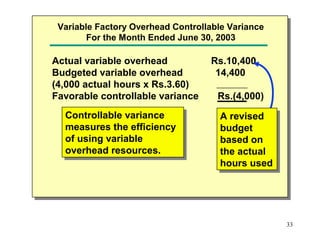
Variable Factory Overhead Controllable Variance
For the Month Ended June 30, 2003

Actual variable overhead
Budgeted variable overhead
(4,000 actual hours x Rs.3.60)
Favorable controllable variance
Controllable variance
measures the efficiency
of using variable
of using variable
overhead resources.
overhead resources.

Rs.10,400
14,400
Rs.(4,000)
A revised
A revised
budget
budget
based on
based on
the actual
the actual
hours used
hours used

33
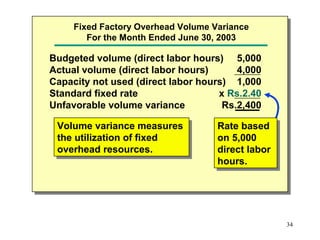
Fixed Factory Overhead Volume Variance
For the Month Ended June 30, 2003

Budgeted volume (direct labor hours) 5,000
Actual volume (direct labor hours)
4,000
Capacity not used (direct labor hours) 1,000
Standard fixed rate
x Rs.2.40
Unfavorable volume variance
Rs.2,400
Volume variance measures
the utilization of fixed
overhead resources.
overhead resources.

Rate based
Rate based
on 5,000
on 5,000
direct labor
direct labor
hours.
hours.

34
35

Standard Costing

  • 1.
  • 2.
    Outline • The usageof standard costing • Setting of standard cost and types of standard • Calculation of variance: – Direct material – Direct labor – Factory overhead 2
  • 3.
    Standard Costing  The costthat has been pre-determined after considering other factors. Those are estimated costs which are considered to be ideal for each of the cost component ( direct material, direct labor and factory overhead ).   The standard cost system enable the management to determine how much a product should cost. 3
  • 4.
    The usage ofstandard costing  Planning and controlling: Compare actual cost & budgeted cost Improve performance Increase efficiency  Product costing: Provide readily available unit cost information 4
  • 5.
    Setting of StandardCost Involve joint efforts on: Analysis on the historical cost experience: Provide initial guidelines for standard setting Engineering studies: Determine the most efficient way to operate Input from operating personnel: Accountable for meeting the standards 5
  • 6.
    Types of Standards  Idealstandard Maximum efficiency Can be achieved if everything operates perfectly.  Normal standard Currently attainable standard Allowance is made for breakdown, interruptions etc.. 6
  • 7.
    Variance Analysis  Variances arethe difference between the actual manufacturing cost and the standard cost at the actual level of production.  The significance of the variance for each element in manufacturing cost needs further analysis to determine the corrective actions. 7
  • 8.
  • 9.
    Calculation of variance  Directmaterial  Direct labor  Factory overhead 9
  • 10.
    Standard Cost ♣ The expectedcost per unit product Illustration 1: The followings are the standard cost for each unit (bottle) of peanut butter produced by Syarikat Sedap Selalu : 10
  • 11.
    Standard Price Standard Usage Direct material: Peanut Butter Sugar 2.80/kg 2.70/kg 1.20/kg 0.15kg 0.10kg 0.25kg 0.42 0.27 0.30 Direct labor: Machineoperator Packaging 4.00/hour 3.00/hour 0.02hour 0.01hour 0.08 0.03 5.00/hour 12.00/hour 0.01hour 0.01hour 0.05 0.12 Factory OH: Variable costs Fixed costs Standard cost per unit Standard Cost RM 0.99 0.11 0.17 11 1.27
  • 12.
    If Syarikat SedapSelalu produces 10,000 bottles of peanut butter, the expected total cost would be: Direct material 10,000 x 0.99 9,900 Direct labor 10,000 x 0.11 1,100 Factory overhead 10,000 x 0.17 1,700 Total cost 12,700 12
  • 13.
    Calculation of variance Costelement Actual cost Standard cost Direct material 9,500 9,900 400 (F) Direct labor 1,050 1,100 50 (F) Factory overhead 2,000 1,700 300 (U) F = (Favorable) Variance U = (Unfavorable) 13
  • 14.
    Direct Material Variance  Tomeasure the difference between the actual cost and the standard cost of direct materials. Direct Material Price Variance Direct Material Usage (Quantity) Variance 14
  • 15.
    1. Direct materialprice variance (Standard Price x Actual Quantity) - (Actual Price x Actual Quantity) Simplified to be: Actual Quantity (Standard Price – Actual Price) AQ ( SP – AP ) 15
  • 16.
    2. Direct materialusage (quantity) variance (Standard Price x Standard Quantity) - (Standard Price x Actual Quantity) Simplified to be: Standard Price (Standard Quantity – Actual Quantity) SP ( SQ – AQ ) 16
  • 17.
    Actual Price xActual Qty Std Price x Actual Qty Price Variance Std Price x Std Qty Usage Variance Direct material variance 17
  • 18.
    Illustration 2 The followingsare the actual price and quantity for direct material used by the company in producing 10,000 bottles of peanut butter: Actual Price Actual Quantity Peanut RM2.70/kg 1,400kg Butter RM2.505/kg 1,200kg Sugar RM1.18/kg 2,300kg 18
  • 19.
    Direct material pricevariance: AQ ( SP – AP ) Peanut: 1,400 (2.70 – 2.80) = 140 (F) Butter: 1,200 (2.505 – 2.70) = 234 (F) Sugar: 2,300 (1.18 – 1.20) = 46 (F) 420 (F) 19
  • 20.
    SP ( AQ– SQ ) Direct material usage variance: Peanut: 2.80 (1,400 – 1,500) = 280 (F) Butter: 2.70 (1,200 – 1,000) = 540 (U) Sugar: 1.20 (2,300 – 2,500) = 240 (F) 20 (U) Therefore , Total direct material variance = 420 (F) + 20 (U) = 400 (F) 20
  • 21.
    Direct Labor Variance  Measuresthe differences between the actual cost and the cost that suppose to be paid to the labor. Direct Labor Rate Variance Direct Labor Efficiency Variance 21
  • 22.
    1. Direct LaborRate Variance (Actual Hour x Standard Rate) - (Actual Hour x Actual Rate) Simplified to be: Actual Hour ( Standard Rate – Actual Rate ) AH ( SR – AR ) 22
  • 23.
    2. Direct LaborEfficiency Variance (Standard Rate x Standard Hour) - (Standard Rate x Actual Hour) Simplified to be: Standard Rate ( Standard Hour – Actual Hour ) SR ( SH – AH ) 23
  • 24.
    Actual Hour xActual Rate Std Hour x Actual Rate Rate Variance Std Hour x Std Rate Efficiency Variance Direct Labor Variance 24
  • 25.
    Illustration 3: The followingsare actual rate and labor hour in the production of 10,000 bottles of peanut butter: Actual labor rate Actual labor hour Machine operator RM3.90/hour 190 hours Packaging RM2.81/hour 110 hours 25
  • 26.
    Direct Labor RateVariance: AH ( AR – SR ) Machine Operator: 190 (3.90 – 4.00 ) = 19 (F) Packaging: = 21 (F) 110 (2.81 – 3.00) 40 (F) 26
  • 27.
    Direct Labor EfficiencyVariance: Machine Operator: 4.00 (190 – 200) Packaging: 3.00 (110 – 100) SR ( AH – SH ) = 40 (F) = 30 (U) 10 (F) Therefore, total direct labor variance: = 40 (M) + 10 (M) = 50 (M) 27
  • 28.
    Factory Overhead Variance  Measuresthe differences between the actual cost and the supposed related cost of factory overhead. Variable Factory Overhead Controllable Variance Fixed Factory Overhead Volume Variance 28
  • 29.
    Western Rider Inc. FactoryOverhead Cost Budget For the Month Ended June 30, 2003 Direct Labor Hours 4,000 4,500 5,000 80% 90% 100% % of Normal Capacity Total variable costs Rs.18,000 Variable costs per hour Rs. Total fixed costs Rs.12,000 Fixed costs per hour Rs. Total costs per hour Rs. 6.00 Rs. Rs.14,400 Rs.16,200 3.60 Rs. 3.60Rs.3.60 Rs.12,000 Rs.12,000 3.00 6.60 Rs. 2.67 Rs. 2.40 Rs. 6.27 Overhead is applied at Rs.6.00 per direct Overhead is applied at Rs.6.00 per direct labor hour based on estimated 5,000 total labor hour based on estimated 5,000 total hours. hours. 29
  • 30.
    Western Rider Inc. FactoryOverhead Variances For the Month Ended June 30, 2003 Actual Hour 4,000 Revised Budget Actual Costs Variance Variable costs Rs.14,400 Rs.10,400Rs.4,000F (Rs.3.60 x 4,000 hours) Fixed costs 9,600 12,000 2,400 U (Rs.2.40 x 4,000 hours) Total costs Rs.24,000 Rs.22,400Rs.1,600F Factory overhead applied at Factory overhead applied at Rs.6.00 per direct labor hour Rs.6.00 per direct labor hour based on 4,000 actual hours. based on 4,000 actual hours. Actual factory Actual factory overhead per overhead per general ledger. general ledger. 30
  • 31.
    Western Rider Inc. FactoryOverhead Variances For the Month Ended June 30, 2003 Revised Budget Actual Costs Variance Variable costs Rs.14,400 Rs.10,400Rs.4,000 F (Rs.3.60 x 4,000 hours) Fixed costs 9,600 12,000 2,400 U (Rs.2.40 x 4,000 hours) Total costs Rs.24,000 Rs.22,400Rs.1,600F Controllable variance Controllable variance based on variable costs based on variable costs 31
  • 32.
    Western Rider Inc. FactoryOverhead Variances For the Month Ended June 30, 2003 Revised Budget Actual Costs Variance Variable costs Rs.14,400 Rs.10,400Rs.4,000F (Rs.3.60 x 4,000 hours) Fixed costs 9,600 12,000 2,400 U (Rs.2.40 x 4,000 hours) Total costs Rs.24,000 Rs.22,400Rs.1,600F Volume variance Volume variance based on fixed costs based on fixed costs 32
  • 33.
    Variable Factory OverheadControllable Variance For the Month Ended June 30, 2003 Actual variable overhead Budgeted variable overhead (4,000 actual hours x Rs.3.60) Favorable controllable variance Controllable variance Controllable variance measures the efficiency measures the efficiency of using variable of using variable overhead resources. overhead resources. Rs.10,400 14,400 Rs.(4,000) A revised A revised budget budget based on based on the actual the actual hours used hours used 33
  • 34.
    Fixed Factory OverheadVolume Variance For the Month Ended June 30, 2003 Budgeted volume (direct labor hours) 5,000 Actual volume (direct labor hours) 4,000 Capacity not used (direct labor hours) 1,000 Standard fixed rate x Rs.2.40 Unfavorable volume variance Rs.2,400 Volume variance measures Volume variance measures the utilization of fixed the utilization of fixed overhead resources. overhead resources. Rate based Rate based on 5,000 on 5,000 direct labor direct labor hours. hours. 34
  • 35.