Stakeholder Management
Advanced Business Analysis Training
Page 1Classification: Restricted
Agenda
• Problem Description
• Stakeholder Management
• Identify your Stakeholders
• Analyze your Stakeholders
• Prioritize your Stakeholders
• Engaging your Stakeholders
• Managing Expectations
Page 2Classification: Restricted
Problem Description
So far one of the most vital but problematic areas within organizations seem to be
stakeholder management.
This action applies to all levels of the organization with different abstraction.
Page 3Classification: Restricted
Objective
• To raise customer and stakeholder
understanding of your product
owner community, teams and
organization.
• Provide a tool in order to
• Understand stakeholder’s
expectations & needs.
• Collaborate in the most efficient
way across the entire chain of
the product development flow
stakeholders.
• Manage autonomously end-to-
end operational responsibilities
• Help building of working networks
with all stakeholders along your
product flow
Page 4Classification: Restricted
Stakeholder
Management
Page 5Classification: Restricted
What do you need?
Page 6Classification: Restricted
You need to
• Develop relationships and trust among stakeholders and individuals that
influence your products.
• Manage relationships among your stakeholders.
• Benefit from powerful stakeholders.
• Ensure requirements are identified and aligned as early as possible.
• Mitigate risks and problems that delay your product.
• Understand stakeholder tolerance in your risks.
• Identify positive existing relationships.
• Identify stakeholders and align with their expectations early enough.
Page 7Classification: Restricted
What is
Stakeholder
Management
Page 8Classification: Restricted
Stakeholder Management
>… is a process of interpreting and
influencing both the external and
internal environments exist in your
product life cycle by creating positive
relationships with stakeholders
through the appropriate management
of their expectations and agreed
objective.
>… Stakeholder management
prepares a strategy based on
information gathered during
identification and the analysis phase
of the process, aiming to support the
strategic objectives of your
organization and products.
Page 9Classification: Restricted
What we want!
• Product Owner
• Scrum Master
• Feature development teams
Page 10Classification: Restricted
Product Owner
By definition, the primary goal of a product owner is to represent the needs
and desires of the stakeholder community
• Help the stakeholders understand
• Product/feature requirements
• Product/feature plans
• Business and product/feature risks
• Listens to all stakeholders
• Report to internal & external product stakeholders
• Negotiate with internal & external product stakeholders
• Collaborate closely with all product stakeholders
• Understand stakeholder needs and expectations
Page 11Classification: Restricted
Scrum Master
As a facilitator,
• To facilitate stakeholder management activities
• To help all roles and functions to collaborate closely
As a coach,
• Educate the Team and Product Owner
• To follow the process
• To remain engaged from the definition to the completion of the feature
• To set the right expectations
• To provide ongoing feedback and support
• To allow all the transparency required and needed towards their
stakeholders
Page 12Classification: Restricted
Scrum master
As a shield,
• To educate others outside the feature about how organization is working
• To manage stakeholder expectations
As an impediment handler,
• To listen
• To remove fear & comfort
• To create and share big picture
• To challenge
Page 13Classification: Restricted
Development team
• Know who feature stakeholders are
• Prioritize feature stakeholders right
• Keep stakeholders satisfied, actively engaged and informed
• Monitor them and be aware if their expectations changed
• Communicate often using the right tools
• Be able to justify their decisions
• Engage feature stakeholders
• Be informed of feature’s risks
• Determine product team interaction points
• Define the objectives
• Set the frequency
Page 14Classification: Restricted
The challenge
Page 15Classification: Restricted
The challenge
• Unidentified stakeholders
• Those who were not identified early in the project
• Unreasonable stakeholders
• Those who do not embrace the feature as required
• Unclear stakeholders
• Those who do not clearly articulate
• Those who are not open and honest about their interests and
expectations
• There’s misalignment
• Conflicting priorities
• Unshared vision
Page 16Classification: Restricted
The challenge
• There are politics
• You may be the messenger…
• At some point, you will need to give bad news
• You will need to say no
• And stakeholders changing over time
• At any given point, you may not know who they all are
• We need systematic approach to identify and prioritize
Page 17Classification: Restricted
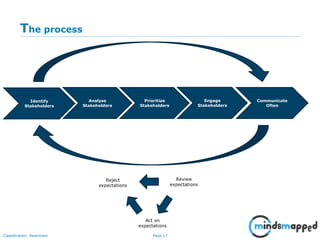
The process
Identify
Stakeholders
Analyse
Stakeholders
Prioritize
Stakeholders
Engage
Stakeholders
Communicate
Often
Act on
expectations
Review
expectations
Reject
expectations
Page 18Classification: Restricted
YOUR TURN NOW
Page 19Classification: Restricted
Identify
your
Stakeholders
Page 20Classification: Restricted
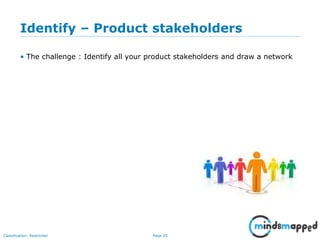
Identify – Product stakeholders
• The challenge : Identify all your product stakeholders and draw a network
Page 21Classification: Restricted
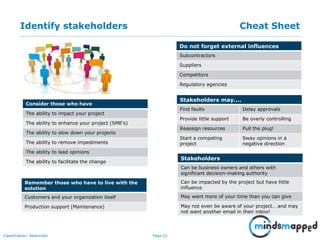
Identify stakeholders Cheat Sheet
Consider those who have
The ability to impact your project
The ability to enhance your project (SME’s)
The ability to slow down your projects
The ability to remove impediments
The ability to lead opinions
The ability to facilitate the change
Remember those who have to live with the
solution
Customers and your organization itself
Production support (Maintenance)
Do not forget external influences
Subcontractors
Suppliers
Competitors
Regulatory agencies
Stakeholders may….
Find faults Delay approvals
Provide little support Be overly controlling
Reassign resources Pull the plug!
Start a competing
project
Sway opinions in a
negative direction
Stakeholders
Can be business owners and others with
significant decision-making authority
Can be impacted by the project but have little
influence
May want more of your time than you can give
May not even be aware of your project… and may
not want another email in their inbox!
Page 22Classification: Restricted
Analyze
your
Stakeholders
Page 23Classification: Restricted
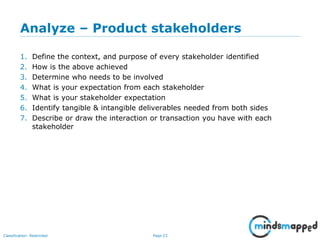
Analyze – Product stakeholders
1. Define the context, and purpose of every stakeholder identified
2. How is the above achieved
3. Determine who needs to be involved
4. What is your expectation from each stakeholder
5. What is your stakeholder expectation
6. Identify tangible & intangible deliverables needed from both sides
7. Describe or draw the interaction or transaction you have with each
stakeholder
Page 24Classification: Restricted
Prioritize
your
Stakeholders
Page 25Classification: Restricted
The stakeholder map
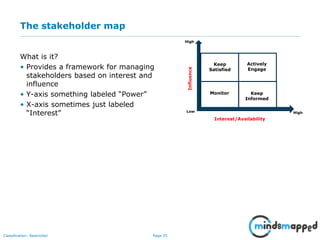
What is it?
• Provides a framework for managing
stakeholders based on interest and
influence
• Y-axis something labeled “Power”
• X-axis sometimes just labeled
“Interest”
High
Low High
Influence
Interest/Availability
Keep
Satisfied
Actively
Engage
Monitor Keep
Informed
Page 26Classification: Restricted
The stakeholder map
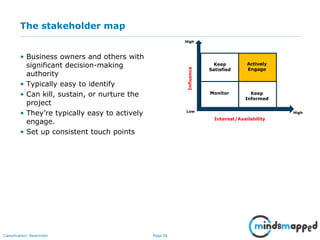
• Business owners and others with
significant decision-making
authority
• Typically easy to identify
• Can kill, sustain, or nurture the
project
• They’re typically easy to actively
engage.
• Set up consistent touch points
High
Low High
Influence
Interest/Availability
Keep
Satisfied
Actively
Engage
Monitor Keep
Informed
Page 27Classification: Restricted
The stakeholder map
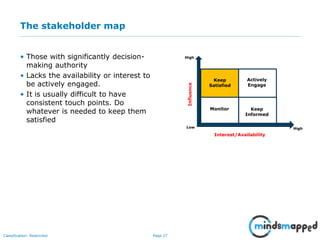
• Those with significantly decision-
making authority
• Lacks the availability or interest to
be actively engaged.
• It is usually difficult to have
consistent touch points. Do
whatever is needed to keep them
satisfied
High
Low High
Influence
Interest/Availability
Keep
Satisfied
Actively
Engage
Monitor Keep
Informed
Page 28Classification: Restricted
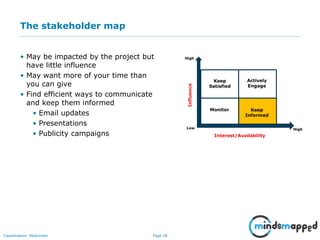
The stakeholder map
• May be impacted by the project but
have little influence
• May want more of your time than
you can give
• Find efficient ways to communicate
and keep them informed
• Email updates
• Presentations
• Publicity campaigns
High
Low High
Influence
Interest/Availability
Keep
Satisfied
Actively
Engage
Monitor Keep
Informed
Page 29Classification: Restricted
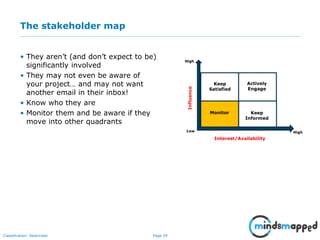
The stakeholder map
• They aren’t (and don’t expect to be)
significantly involved
• They may not even be aware of
your project… and may not want
another email in their inbox!
• Know who they are
• Monitor them and be aware if they
move into other quadrants
High
Low High
Influence
Interest/Availability
Keep
Satisfied
Actively
Engage
Monitor Keep
Informed
Page 30Classification: Restricted
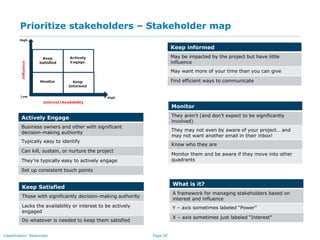
Prioritize stakeholders – Stakeholder map
Actively Engage
Business owners and other with significant
decision-making authority
Typically easy to identify
Can kill, sustain, or nurture the project
They’re typically easy to actively engage
Set up consistent touch points
Keep Satisfied
Those with significantly decision-making authority
Lacks the availability or interest to be actively
engaged
Do whatever is needed to keep them satisfied
Keep informed
May be impacted by the project but have little
influence
May want more of your time than you can give
Find efficient ways to communicate
Monitor
They aren’t (and don’t expect to be significantly
involved)
They may not even by aware of your project… and
may not want another email in their inbox!
Know who they are
Monitor them and be aware if they move into other
quadrants
What is it?
A framework for managing stakeholders based on
interest and influence
Y – axis sometimes labeled “Power”
X – axis sometimes just labeled “Interest”
Page 31Classification: Restricted
Engaging
your
Stakeholders
Page 32Classification: Restricted
Engaging stakeholders
1. Following the analysis made before
• Determine your touch points
• Define the expected objectives and outputs
• Set the frequency
2. In case of a stakeholder alignment need
• Build your alignment agenda
• Questions you have
Page 33Classification: Restricted
Engaging stakeholders
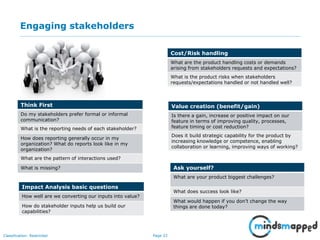
Think First
Do my stakeholders prefer formal or informal
communication?
What is the reporting needs of each stakeholder?
How does reporting generally occur in my
organization? What do reports look like in my
organization?
What are the pattern of interactions used?
What is missing?
Impact Analysis basic questions
How well are we converting our inputs into value?
How do stakeholder inputs help us build our
capabilities?
Cost/Risk handling
What are the product handling costs or demands
arising from stakeholders requests and expectations?
What is the product risks when stakeholders
requests/expectations handled or not handled well?
Value creation (benefit/gain)
Is there a gain, increase or positive impact on our
feature in terms of improving quality, processes,
feature timing or cost reduction?
Does it build strategic capability for the product by
increasing knowledge or competence, enabling
collaboration or learning, improving ways of working?
Ask yourself?
What are your product biggest challenges?
What does success look like?
What would happen if you don’t change the way
things are done today?
Page 34Classification: Restricted
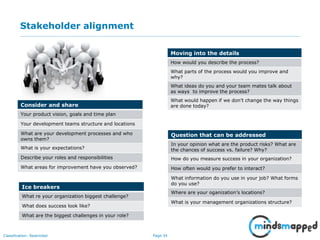
Stakeholder alignment
Consider and share
Your product vision, goals and time plan
Your development teams structure and locations
What are your development processes and who
owns them?
What is your expectations?
Describe your roles and responsibilities
What areas for improvement have you observed?
Ice breakers
What re your organization biggest challenge?
What does success look like?
What are the biggest challenges in your role?
Moving into the details
How would you describe the process?
What parts of the process would you improve and
why?
What ideas do you and your team mates talk about
as ways to improve the process?
What would happen if we don’t change the way things
are done today?
Question that can be addressed
In your opinion what are the product risks? What are
the chances of success vs. failure? Why?
How do you measure success in your organization?
How often would you prefer to interact?
What information do you use in your job? What forms
do you use?
Where are your oganization’s locations?
What is your management organizations structure?
Page 35Classification: Restricted
Managing
Expectations
Page 36Classification: Restricted
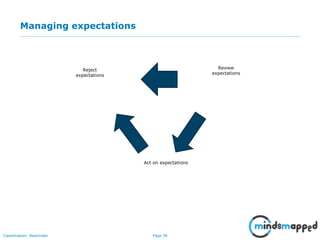
Managing expectations
Act on expectations
Review
expectations
Reject
expectations
Page 37Classification: Restricted
What is needed
• Patience
• Setting the right expectation
• On scope
• And timing
• Prioritize right
• Allocate feature resources and budget right
• Be able to justify your decisions
• Continuous planning and risk assessment
Page 38Classification: Restricted
Be prepared for
• Questions from those not familiar with your practices
• “What do you mean you can’t commit to what I’m getting six months
from now?”
• “Can you squeeze it in? It’s really small”
• “Why are you wasting time on architecture and refactoring?”
Page 39Classification: Restricted
Communicate Often
• Consider
• How
• When
• Objectives
• Resources
Page 40Classification: Restricted
How?
• Audio/Visual
• Video conferencing
• Teleconferencing
• Face to Face
• Project meetings
• Workshops/Presentations
• Briefings
• Ad-hoc meetings for individuals with specific questions
• Online
• Email
• Forums
• Intranet, wikis
• Printed material
Page 41Classification: Restricted
When?
• Proactive communication (preferably)
• Reactive communication
Page 42Classification: Restricted
What objectives?
• Provide reporting material
• Review planning
• Review budget
• Information sharing
• Decision making
• To remain engaged
• Provide feedback and support
• Define and clarify requirements
• Collaborate
• Establish a trusting Agile environment
Page 43Classification: Restricted
Which resources?
• Define spokes-people
• Good to speak with one voice
• Good to know the audience
Page 44Classification: Restricted
Way forward
Page 45Classification: Restricted
Proposals
• Gather all stakeholder intelligence in one place
• After product completion forward or present your feedback and experiences
to your organization and development community
• Share your good practices
Page 46Classification: Restricted
Thank You!

Stakeholder Management

  • 1.
  • 2.
    Page 1Classification: Restricted Agenda •Problem Description • Stakeholder Management • Identify your Stakeholders • Analyze your Stakeholders • Prioritize your Stakeholders • Engaging your Stakeholders • Managing Expectations
  • 3.
    Page 2Classification: Restricted ProblemDescription So far one of the most vital but problematic areas within organizations seem to be stakeholder management. This action applies to all levels of the organization with different abstraction.
  • 4.
    Page 3Classification: Restricted Objective •To raise customer and stakeholder understanding of your product owner community, teams and organization. • Provide a tool in order to • Understand stakeholder’s expectations & needs. • Collaborate in the most efficient way across the entire chain of the product development flow stakeholders. • Manage autonomously end-to- end operational responsibilities • Help building of working networks with all stakeholders along your product flow
  • 5.
  • 6.
  • 7.
    Page 6Classification: Restricted Youneed to • Develop relationships and trust among stakeholders and individuals that influence your products. • Manage relationships among your stakeholders. • Benefit from powerful stakeholders. • Ensure requirements are identified and aligned as early as possible. • Mitigate risks and problems that delay your product. • Understand stakeholder tolerance in your risks. • Identify positive existing relationships. • Identify stakeholders and align with their expectations early enough.
  • 8.
    Page 7Classification: Restricted Whatis Stakeholder Management
  • 9.
    Page 8Classification: Restricted StakeholderManagement >… is a process of interpreting and influencing both the external and internal environments exist in your product life cycle by creating positive relationships with stakeholders through the appropriate management of their expectations and agreed objective. >… Stakeholder management prepares a strategy based on information gathered during identification and the analysis phase of the process, aiming to support the strategic objectives of your organization and products.
  • 10.
    Page 9Classification: Restricted Whatwe want! • Product Owner • Scrum Master • Feature development teams
  • 11.
    Page 10Classification: Restricted ProductOwner By definition, the primary goal of a product owner is to represent the needs and desires of the stakeholder community • Help the stakeholders understand • Product/feature requirements • Product/feature plans • Business and product/feature risks • Listens to all stakeholders • Report to internal & external product stakeholders • Negotiate with internal & external product stakeholders • Collaborate closely with all product stakeholders • Understand stakeholder needs and expectations
  • 12.
    Page 11Classification: Restricted ScrumMaster As a facilitator, • To facilitate stakeholder management activities • To help all roles and functions to collaborate closely As a coach, • Educate the Team and Product Owner • To follow the process • To remain engaged from the definition to the completion of the feature • To set the right expectations • To provide ongoing feedback and support • To allow all the transparency required and needed towards their stakeholders
  • 13.
    Page 12Classification: Restricted Scrummaster As a shield, • To educate others outside the feature about how organization is working • To manage stakeholder expectations As an impediment handler, • To listen • To remove fear & comfort • To create and share big picture • To challenge
  • 14.
    Page 13Classification: Restricted Developmentteam • Know who feature stakeholders are • Prioritize feature stakeholders right • Keep stakeholders satisfied, actively engaged and informed • Monitor them and be aware if their expectations changed • Communicate often using the right tools • Be able to justify their decisions • Engage feature stakeholders • Be informed of feature’s risks • Determine product team interaction points • Define the objectives • Set the frequency
  • 15.
  • 16.
    Page 15Classification: Restricted Thechallenge • Unidentified stakeholders • Those who were not identified early in the project • Unreasonable stakeholders • Those who do not embrace the feature as required • Unclear stakeholders • Those who do not clearly articulate • Those who are not open and honest about their interests and expectations • There’s misalignment • Conflicting priorities • Unshared vision
  • 17.
    Page 16Classification: Restricted Thechallenge • There are politics • You may be the messenger… • At some point, you will need to give bad news • You will need to say no • And stakeholders changing over time • At any given point, you may not know who they all are • We need systematic approach to identify and prioritize
  • 18.
    Page 17Classification: Restricted Theprocess Identify Stakeholders Analyse Stakeholders Prioritize Stakeholders Engage Stakeholders Communicate Often Act on expectations Review expectations Reject expectations
  • 19.
  • 20.
  • 21.
    Page 20Classification: Restricted Identify– Product stakeholders • The challenge : Identify all your product stakeholders and draw a network
  • 22.
    Page 21Classification: Restricted Identifystakeholders Cheat Sheet Consider those who have The ability to impact your project The ability to enhance your project (SME’s) The ability to slow down your projects The ability to remove impediments The ability to lead opinions The ability to facilitate the change Remember those who have to live with the solution Customers and your organization itself Production support (Maintenance) Do not forget external influences Subcontractors Suppliers Competitors Regulatory agencies Stakeholders may…. Find faults Delay approvals Provide little support Be overly controlling Reassign resources Pull the plug! Start a competing project Sway opinions in a negative direction Stakeholders Can be business owners and others with significant decision-making authority Can be impacted by the project but have little influence May want more of your time than you can give May not even be aware of your project… and may not want another email in their inbox!
  • 23.
  • 24.
    Page 23Classification: Restricted Analyze– Product stakeholders 1. Define the context, and purpose of every stakeholder identified 2. How is the above achieved 3. Determine who needs to be involved 4. What is your expectation from each stakeholder 5. What is your stakeholder expectation 6. Identify tangible & intangible deliverables needed from both sides 7. Describe or draw the interaction or transaction you have with each stakeholder
  • 25.
  • 26.
    Page 25Classification: Restricted Thestakeholder map What is it? • Provides a framework for managing stakeholders based on interest and influence • Y-axis something labeled “Power” • X-axis sometimes just labeled “Interest” High Low High Influence Interest/Availability Keep Satisfied Actively Engage Monitor Keep Informed
  • 27.
    Page 26Classification: Restricted Thestakeholder map • Business owners and others with significant decision-making authority • Typically easy to identify • Can kill, sustain, or nurture the project • They’re typically easy to actively engage. • Set up consistent touch points High Low High Influence Interest/Availability Keep Satisfied Actively Engage Monitor Keep Informed
  • 28.
    Page 27Classification: Restricted Thestakeholder map • Those with significantly decision- making authority • Lacks the availability or interest to be actively engaged. • It is usually difficult to have consistent touch points. Do whatever is needed to keep them satisfied High Low High Influence Interest/Availability Keep Satisfied Actively Engage Monitor Keep Informed
  • 29.
    Page 28Classification: Restricted Thestakeholder map • May be impacted by the project but have little influence • May want more of your time than you can give • Find efficient ways to communicate and keep them informed • Email updates • Presentations • Publicity campaigns High Low High Influence Interest/Availability Keep Satisfied Actively Engage Monitor Keep Informed
  • 30.
    Page 29Classification: Restricted Thestakeholder map • They aren’t (and don’t expect to be) significantly involved • They may not even be aware of your project… and may not want another email in their inbox! • Know who they are • Monitor them and be aware if they move into other quadrants High Low High Influence Interest/Availability Keep Satisfied Actively Engage Monitor Keep Informed
  • 31.
    Page 30Classification: Restricted Prioritizestakeholders – Stakeholder map Actively Engage Business owners and other with significant decision-making authority Typically easy to identify Can kill, sustain, or nurture the project They’re typically easy to actively engage Set up consistent touch points Keep Satisfied Those with significantly decision-making authority Lacks the availability or interest to be actively engaged Do whatever is needed to keep them satisfied Keep informed May be impacted by the project but have little influence May want more of your time than you can give Find efficient ways to communicate Monitor They aren’t (and don’t expect to be significantly involved) They may not even by aware of your project… and may not want another email in their inbox! Know who they are Monitor them and be aware if they move into other quadrants What is it? A framework for managing stakeholders based on interest and influence Y – axis sometimes labeled “Power” X – axis sometimes just labeled “Interest”
  • 32.
  • 33.
    Page 32Classification: Restricted Engagingstakeholders 1. Following the analysis made before • Determine your touch points • Define the expected objectives and outputs • Set the frequency 2. In case of a stakeholder alignment need • Build your alignment agenda • Questions you have
  • 34.
    Page 33Classification: Restricted Engagingstakeholders Think First Do my stakeholders prefer formal or informal communication? What is the reporting needs of each stakeholder? How does reporting generally occur in my organization? What do reports look like in my organization? What are the pattern of interactions used? What is missing? Impact Analysis basic questions How well are we converting our inputs into value? How do stakeholder inputs help us build our capabilities? Cost/Risk handling What are the product handling costs or demands arising from stakeholders requests and expectations? What is the product risks when stakeholders requests/expectations handled or not handled well? Value creation (benefit/gain) Is there a gain, increase or positive impact on our feature in terms of improving quality, processes, feature timing or cost reduction? Does it build strategic capability for the product by increasing knowledge or competence, enabling collaboration or learning, improving ways of working? Ask yourself? What are your product biggest challenges? What does success look like? What would happen if you don’t change the way things are done today?
  • 35.
    Page 34Classification: Restricted Stakeholderalignment Consider and share Your product vision, goals and time plan Your development teams structure and locations What are your development processes and who owns them? What is your expectations? Describe your roles and responsibilities What areas for improvement have you observed? Ice breakers What re your organization biggest challenge? What does success look like? What are the biggest challenges in your role? Moving into the details How would you describe the process? What parts of the process would you improve and why? What ideas do you and your team mates talk about as ways to improve the process? What would happen if we don’t change the way things are done today? Question that can be addressed In your opinion what are the product risks? What are the chances of success vs. failure? Why? How do you measure success in your organization? How often would you prefer to interact? What information do you use in your job? What forms do you use? Where are your oganization’s locations? What is your management organizations structure?
  • 36.
  • 37.
    Page 36Classification: Restricted Managingexpectations Act on expectations Review expectations Reject expectations
  • 38.
    Page 37Classification: Restricted Whatis needed • Patience • Setting the right expectation • On scope • And timing • Prioritize right • Allocate feature resources and budget right • Be able to justify your decisions • Continuous planning and risk assessment
  • 39.
    Page 38Classification: Restricted Beprepared for • Questions from those not familiar with your practices • “What do you mean you can’t commit to what I’m getting six months from now?” • “Can you squeeze it in? It’s really small” • “Why are you wasting time on architecture and refactoring?”
  • 40.
    Page 39Classification: Restricted CommunicateOften • Consider • How • When • Objectives • Resources
  • 41.
    Page 40Classification: Restricted How? •Audio/Visual • Video conferencing • Teleconferencing • Face to Face • Project meetings • Workshops/Presentations • Briefings • Ad-hoc meetings for individuals with specific questions • Online • Email • Forums • Intranet, wikis • Printed material
  • 42.
    Page 41Classification: Restricted When? •Proactive communication (preferably) • Reactive communication
  • 43.
    Page 42Classification: Restricted Whatobjectives? • Provide reporting material • Review planning • Review budget • Information sharing • Decision making • To remain engaged • Provide feedback and support • Define and clarify requirements • Collaborate • Establish a trusting Agile environment
  • 44.
    Page 43Classification: Restricted Whichresources? • Define spokes-people • Good to speak with one voice • Good to know the audience
  • 45.
  • 46.
    Page 45Classification: Restricted Proposals •Gather all stakeholder intelligence in one place • After product completion forward or present your feedback and experiences to your organization and development community • Share your good practices
  • 47.