Paradigm Thinking
www.optimumfx.com
Intent & Why
• Get you thinking differently
• Discuss in context of shift towards principle-centred
leadership
• By challenging your existing way of thinking you can reveal
opportunities to approach situations in a different way
• Increasing choice
What is a Paradigm?
• A view of the World – a way of thinking - a norm
• We all see the world around us in accordance with a certain
paradigm - what we believe to be reliable and true
• Confirmation bias – favour information that confirms
preconceptions or hypotheses, whether true or not
– Gather evidence and recall selective memories to support bias
– Particularly strong for emotionally significant issues and beliefs
– Interpret ambiguous evidence as supporting existing position
– Semmelweis Reflex - reflex-like rejection of new knowledge because it
contradicts entrenched norms, beliefs or paradigms
What is a Paradigm?
• Evidence of a limiting paradigm:
– Confusion
– Buried by dilemmas
– Best efforts result in dead ends
• A paradigm is a map - a representation of reality
(territory)
– Change behaviour? Change attitude?
“the significant problems we face today
cannot be solved at the same level of thinking
we were at when we created them”
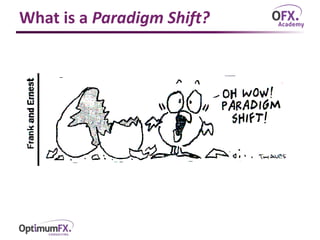
What is a Paradigm Shift?
• Dramatic change in thinking, often with wide-reaching effects
• A fundamental change in basic assumptions
– Making a break with the past
• For slow, incremental improvement -> change your attitude or
behaviour
• For dramatic, revolutionary change -> change your frame of
reference
– change how you see the world, how you think about people, how you view
management and leadership
– change your way of understanding and explaining aspects of reality
 break old ways of thinking -> quantum change in performance
Paradigm Shift in Leadership
Principle-centred Leadership
• Governed by Natural Laws or ‘Principles’ - objective,
internal
– different to Social Values: subjective, external
• The Law of the School v the Law of the Farm
• Can’t fake being able to run a marathon – no quick fix
• Governs our body, our mind, our relationships
– Building blocks of all management and organisational life
Governing Principles
• Natural laws (eg laws of the farm) operate regardless
• Fairness, equity, justice, integrity, honesty and trust
• Principles (objective, external) versus Values (subjective, internal)
• When territory is constantly changing (shifting markets)
any map is soon obsolete.
• Inviolate/“True North” principles are your compass
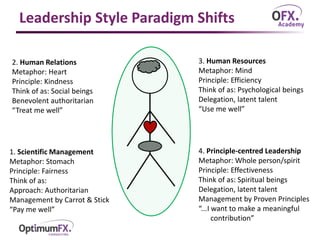
Leadership Style Paradigm Shifts
1. Scientific Management
Metaphor: Stomach
Principle: Fairness
Think of as:
Approach: Authoritarian
Management by Carrot & Stick
“Pay me well”
2. Human Relations
Metaphor: Heart
Principle: Kindness
Think of as: Social beings
Benevolent authoritarian
“Treat me well”
3. Human Resources
Metaphor: Mind
Principle: Efficiency
Think of as: Psychological beings
Delegation, latent talent
“Use me well”
4. Principle-centred Leadership
Metaphor: Whole person/spirit
Principle: Effectiveness
Think of as: Spiritual beings
Delegation, latent talent
Management by Proven Principles
“...I want to make a meaningful
contribution”
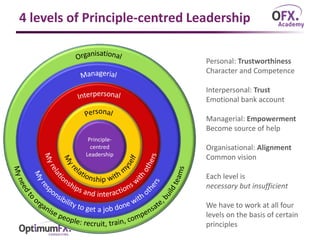
4 levels of Principle-centred Leadership
Principle-
centred
Leadership
Personal: Trustworthiness
Character and Competence
Interpersonal: Trust
Emotional bank account
Managerial: Empowerment
Become source of help
Organisational: Alignment
Common vision
Each level is
necessary but insufficient
We have to work at all four
levels on the basis of certain
principles
Changing Paradigms
• Fastest way to change someone’s paradigm is to change
their name or their role
Q: What changed for you when you were last promoted?
Q: Did you see the same situation in a new way?

Paradigm thinking

  • 1.
  • 2.
    Intent & Why •Get you thinking differently • Discuss in context of shift towards principle-centred leadership • By challenging your existing way of thinking you can reveal opportunities to approach situations in a different way • Increasing choice
  • 3.
    What is aParadigm? • A view of the World – a way of thinking - a norm • We all see the world around us in accordance with a certain paradigm - what we believe to be reliable and true • Confirmation bias – favour information that confirms preconceptions or hypotheses, whether true or not – Gather evidence and recall selective memories to support bias – Particularly strong for emotionally significant issues and beliefs – Interpret ambiguous evidence as supporting existing position – Semmelweis Reflex - reflex-like rejection of new knowledge because it contradicts entrenched norms, beliefs or paradigms
  • 4.
    What is aParadigm? • Evidence of a limiting paradigm: – Confusion – Buried by dilemmas – Best efforts result in dead ends • A paradigm is a map - a representation of reality (territory) – Change behaviour? Change attitude? “the significant problems we face today cannot be solved at the same level of thinking we were at when we created them”
  • 5.
    What is aParadigm Shift?
  • 6.
    What is aParadigm Shift? • Dramatic change in thinking, often with wide-reaching effects • A fundamental change in basic assumptions – Making a break with the past • For slow, incremental improvement -> change your attitude or behaviour • For dramatic, revolutionary change -> change your frame of reference – change how you see the world, how you think about people, how you view management and leadership – change your way of understanding and explaining aspects of reality  break old ways of thinking -> quantum change in performance
  • 7.
    Paradigm Shift inLeadership Principle-centred Leadership • Governed by Natural Laws or ‘Principles’ - objective, internal – different to Social Values: subjective, external • The Law of the School v the Law of the Farm • Can’t fake being able to run a marathon – no quick fix • Governs our body, our mind, our relationships – Building blocks of all management and organisational life
  • 8.
    Governing Principles • Naturallaws (eg laws of the farm) operate regardless • Fairness, equity, justice, integrity, honesty and trust • Principles (objective, external) versus Values (subjective, internal) • When territory is constantly changing (shifting markets) any map is soon obsolete. • Inviolate/“True North” principles are your compass
  • 9.
    Leadership Style ParadigmShifts 1. Scientific Management Metaphor: Stomach Principle: Fairness Think of as: Approach: Authoritarian Management by Carrot & Stick “Pay me well” 2. Human Relations Metaphor: Heart Principle: Kindness Think of as: Social beings Benevolent authoritarian “Treat me well” 3. Human Resources Metaphor: Mind Principle: Efficiency Think of as: Psychological beings Delegation, latent talent “Use me well” 4. Principle-centred Leadership Metaphor: Whole person/spirit Principle: Effectiveness Think of as: Spiritual beings Delegation, latent talent Management by Proven Principles “...I want to make a meaningful contribution”
  • 10.
    4 levels ofPrinciple-centred Leadership Principle- centred Leadership Personal: Trustworthiness Character and Competence Interpersonal: Trust Emotional bank account Managerial: Empowerment Become source of help Organisational: Alignment Common vision Each level is necessary but insufficient We have to work at all four levels on the basis of certain principles
  • 11.
    Changing Paradigms • Fastestway to change someone’s paradigm is to change their name or their role Q: What changed for you when you were last promoted? Q: Did you see the same situation in a new way?

Editor's Notes

  • #4 A way of thinking A mental model A map – a representation on reality. If you are trying to get somewhere and the map is inaccurate and you change your behaviour,: double your speed, you get lost twice as fast If you change your attitude - +ve thinking – you wouldn't care that you were lost, but you’d still be lost. Examine your paradigms – does it reflect the territory accurately? Significant break-throughs are breaks-with Einstein – “the significant problems we face today cannot be solved at the same level of thinking we were at when we created them” How to spot a bad paradigm – confusion, buried by dilemmas – change way of thinking, because this way is getting you to a dead-end Creative routes around paradigms – analogy, Covey – Law of the school v Law of the Farm... Governed by natural laws.
  • #6 Kodak – paradigm shift…
  • #7 Kodak – paradigm shift…
  • #8 How well would it work if you forgot to sew the seeds and then tried to cram it in at harvest time? How about you didn’t milk the cows for a couple of months, because you had some other things to do - and then committed a could week to doing it all in one go.
  • #9 Values are the maps. Principles are the compass (also mentions they are the territory??) More closely values are aligned with the correct principles (the territory) the more useful they will be – however, when territory is constanly changing (shifting markets) any map is soon obsolete. Compass will always point you in the right direction Values reflect cultural background - and can be compartmentalised – parent, child, departmental manager, community leader, sports team member, drinking buddy; reactive people can find themselves trying to meet conflicting expectations and living by different values according to their current role or environment.
  • #10 1 – 1890s Scientific Authoritarianism - physical/economic need – economic man – I am the best, the elite, I will direct you. “How is your pay?” 2 – People are stomachs, but also hearts – social beings – fairness, but also kindness, courtesy, civility, decency – meeting economic and social needs – treated well, liked, respected, to belong – focused on harmony, team spirit, social situations. Kindly father who knows what is best for his children and takes care of them as long as they comply with his wishes – otherwise disloyalty, ingratitude. Democratic society – arguably still the dominant approach now “How are you?” 3 – people also have minds, are cognitive, thinking beings – care about contribution - fairness, kindness and efficiency – talent, creativity, resourcefulness – delegate – psychological beings. Mgs focus on bundles of latent talent. All about how people are developed and used – new world, world economics – quality, consistency, reliability “What’s your opinion?” 4 – Focus on effectiveness – doing something that matters – want meaning – spiritual beings – manage through proven principles. Nothing can be voluntarily committed to – you buy hands and backs, not hearts and minds. (worthwhile work – purpose). What gives people meaning. Not just assets/resources, have worth independent of the organisation and power to make their own choices. Think about digging a hole and then filling it in for 8hrs a day, 5 days week, until your 65 – and I’ll pay you £1million a year, adjusted for cost-of-living. “All of the above & What’s really important to you?” Surveys shown that people want meaning and purpose in their lives - - Want to be treated as a whole person but... I want you up there to ask my opinion, but I want you down there to go along with my opinion that a good soldier. PCL embraces the principles of fairness and kindness and makes better use of the talents of people for greater efficiency but also leads to quantum leaps in personal and organisational effectiveness. (ant story???)
  • #11 Each layer built on the previous key principle – INSIDE-OUT, work on yourself before you can work on interpersonal relationships - trustworthiness, something you control about yourself, is the core. If you are not trustworthy, how can you build interpersonal relationships built on trust? Not enough funds in the emotional bank account. By same token, focus only at Personal level – self-esteem, time management, set & achv goals – system within business don’t fit Focus at Interpersonal – train teams on team building, communication skills, but you have employees with hidden agendas – no fundamental change Focus only at Managerial Level – training others to be empowered, delegating... Culture is fragile – full of loose cannons. Focus only at Organisational Level – new structure, new rules, new compensation packages – what effect on the interdepartmental rivalries? Founded on trust and built upon with each additional key principle you can have a large span of influence and ‘control’ ‘supervision’ If trust doesnt exist – then needs to be control These principles form the culture – like an immune system – protects from disease – able to deal with what comes along – but if you have cells within the system that are weakening the immune system itself, then can’t deal with situations as they arise. Leadership Paradigm must be based on Trust – which comes from Trustworthy people. At the central of the wheel is a set of principles that everyone buys into. Your Compass - - Always know which way you need to be heading. When norms are sufficient – laws aren’t necessary When norms are insufficient – laws are unenforceable Trust and Trustworthiness provide the foundation for empowerment at Managerial Level and Alignment at the Organisational Level If you are a customer somewhere – perhaps the hotel, the airline on way over – and you ask for something out of the ordinary and they quote rules and policies then you know the culture is very fragile – you know the boss has been quoting rules and policies to them. Challenge your environment – think about Organisational Level as starting point – Alignment – you talk about expanding skills, maximising talents, but is training seen as an Expense or an Investment? Do you know businesses who claim to value co-operation – but reward competition Or value innovation, but reward conformity Talk about Long-term strategy, but focus only on short-term wins