
Line Crew Optimisation
The Methodology
www.optimumfx.com
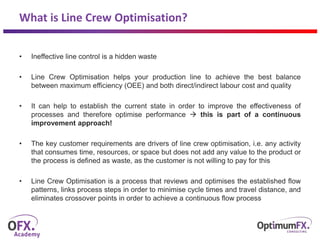
What is Line Crew Optimisation?
• Ineffective line control is a hidden waste
• Line Crew Optimisation helps your production line to achieve the best balance
between maximum efficiency (OEE) and both direct/indirect labour cost and quality
• It can help to establish the current state in order to improve the effectiveness of
processes and therefore optimise performance  this is part of a continuous
improvement approach!
• The key customer requirements are drivers of line crew optimisation, i.e. any activity
that consumes time, resources, or space but does not add any value to the product or
the process is defined as waste, as the customer is not willing to pay for this
• Line Crew Optimisation is a process that reviews and optimises the established flow
patterns, links process steps in order to minimise cycle times and travel distance, and
eliminates crossover points in order to achieve a continuous flow process
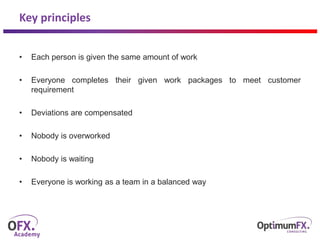
Key principles
• Each person is given the same amount of work
• Everyone completes their given work packages to meet customer
requirement
• Deviations are compensated
• Nobody is overworked
• Nobody is waiting
• Everyone is working as a team in a balanced way
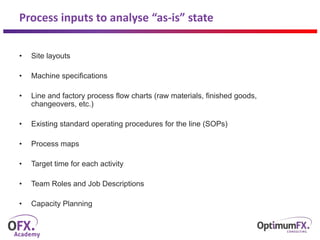
Process inputs to analyse “as-is” state
• Site layouts
• Machine specifications
• Line and factory process flow charts (raw materials, finished goods,
changeovers, etc.)
• Existing standard operating procedures for the line (SOPs)
• Process maps
• Target time for each activity
• Team Roles and Job Descriptions
• Capacity Planning
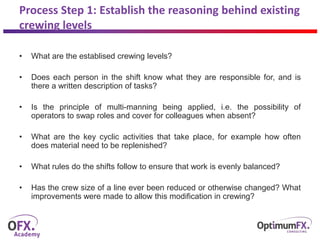
Process Step 1: Establish the reasoning behind existing
crewing levels
• What are the establised crewing levels?
• Does each person in the shift know what they are responsible for, and is
there a written description of tasks?
• Is the principle of multi-manning being applied, i.e. the possibility of
operators to swap roles and cover for colleagues when absent?
• What are the key cyclic activities that take place, for example how often
does material need to be replenished?
• What rules do the shifts follow to ensure that work is evenly balanced?
• Has the crew size of a line ever been reduced or otherwise changed? What
improvements were made to allow this modification in crewing?
Process Step 2: Map the Existing Line processes ‘As is’
• SIPOC is a term that uses the first letter of the five pieces in a process map:
Suppliers to the process
Inputs provided by the suppliers
Process Steps – the main steps of the process
Outputs for the customer
Customers of the process
• A SIPOC “as-is” map will identify the outputs to the customers and the
volumes required
• It will also assign responsibility for the suppliers of required inputs to the
process
It provides a structured way to understand if changes to crewing will have
any impact on processing inputs into the defined outputs for delivery to
customers
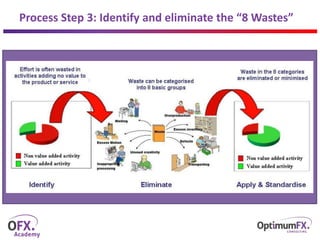
Process Step 3: Identify and eliminate the “8 Wastes”
Process Step 3.1: Focus areas for review
• Motion Economy
Motion economy is maximized by minimising walk patterns, ideally with a U shape machine layout.
Motion can be visually analysed and optimised using a spaghetti diagram
• Time allocation
A DILO ("Day in the Life Of") study helps to highlight where and why non-value add activities occur
within a specific role, over the duration of a day
• Flow Design
Distances between raw material storage areas and secondary lines should be minimal with the
correct amount of materials and spare parts ready and at the operator’s disposal
• Skill Building
Multi-machine training makes it easy to replace any absentee. It is recommended that factory areas
are zoned by colour, and each employee displays on their name badge the colour of the zones they
are qualified to work in. This is a simple visual tool that makes labour allocation and skills balancing
very easy on a day to day basis as the supervisor does not need to refer to skills matrix if they need
to move people around the production line
• Functional Integration
Operators should have skills to solve problems in a structured way in multi-disciplinary teams
• Standard operating procedures (SOPs)
SOPs define how each step of the operation is to be done to minimise process variation
• Activity duration
Record time taken for all activities on a Cycle Time Sheet and consolidate the value-added activities
using an activity listing template to improve workflow by combining, restructuring and automating
processes
Process Step 4: Define the “to-be” state
• Complete a process diagram of the new “to-be” state displaying the revised
organisation and flows
• Standardise work methods and use the process information on other similar
lines
• Complete a closure checklist to ensure all key processes have been
evaluated
• Show the new crewing in a visual way and communicate this to the team,
e.g. SIC, RACI, KPIs, etc.
Process outputs of the newly defined “to-be” state
• Optimised work flows
• Standardised processes
• Optimised crew location and numbers
• Work is balanced between workforce
• Outputs meet customer requirements
• Nobody is overworked or waiting
• Consistent quality of output at minimum cost
• Defined Skills Matrix showing existing skills, as well as highlighting missing skills
• Defined Training Plan according to missing skills

Line Crew Optimisation Methodology

  • 1.
    Line Crew Optimisation TheMethodology www.optimumfx.com
  • 2.
    What is LineCrew Optimisation? • Ineffective line control is a hidden waste • Line Crew Optimisation helps your production line to achieve the best balance between maximum efficiency (OEE) and both direct/indirect labour cost and quality • It can help to establish the current state in order to improve the effectiveness of processes and therefore optimise performance  this is part of a continuous improvement approach! • The key customer requirements are drivers of line crew optimisation, i.e. any activity that consumes time, resources, or space but does not add any value to the product or the process is defined as waste, as the customer is not willing to pay for this • Line Crew Optimisation is a process that reviews and optimises the established flow patterns, links process steps in order to minimise cycle times and travel distance, and eliminates crossover points in order to achieve a continuous flow process
  • 3.
    Key principles • Eachperson is given the same amount of work • Everyone completes their given work packages to meet customer requirement • Deviations are compensated • Nobody is overworked • Nobody is waiting • Everyone is working as a team in a balanced way
  • 4.
    Process inputs toanalyse “as-is” state • Site layouts • Machine specifications • Line and factory process flow charts (raw materials, finished goods, changeovers, etc.) • Existing standard operating procedures for the line (SOPs) • Process maps • Target time for each activity • Team Roles and Job Descriptions • Capacity Planning
  • 5.
    Process Step 1:Establish the reasoning behind existing crewing levels • What are the establised crewing levels? • Does each person in the shift know what they are responsible for, and is there a written description of tasks? • Is the principle of multi-manning being applied, i.e. the possibility of operators to swap roles and cover for colleagues when absent? • What are the key cyclic activities that take place, for example how often does material need to be replenished? • What rules do the shifts follow to ensure that work is evenly balanced? • Has the crew size of a line ever been reduced or otherwise changed? What improvements were made to allow this modification in crewing?
  • 6.
    Process Step 2:Map the Existing Line processes ‘As is’ • SIPOC is a term that uses the first letter of the five pieces in a process map: Suppliers to the process Inputs provided by the suppliers Process Steps – the main steps of the process Outputs for the customer Customers of the process • A SIPOC “as-is” map will identify the outputs to the customers and the volumes required • It will also assign responsibility for the suppliers of required inputs to the process It provides a structured way to understand if changes to crewing will have any impact on processing inputs into the defined outputs for delivery to customers
  • 7.
    Process Step 3:Identify and eliminate the “8 Wastes”
  • 8.
    Process Step 3.1:Focus areas for review • Motion Economy Motion economy is maximized by minimising walk patterns, ideally with a U shape machine layout. Motion can be visually analysed and optimised using a spaghetti diagram • Time allocation A DILO ("Day in the Life Of") study helps to highlight where and why non-value add activities occur within a specific role, over the duration of a day • Flow Design Distances between raw material storage areas and secondary lines should be minimal with the correct amount of materials and spare parts ready and at the operator’s disposal • Skill Building Multi-machine training makes it easy to replace any absentee. It is recommended that factory areas are zoned by colour, and each employee displays on their name badge the colour of the zones they are qualified to work in. This is a simple visual tool that makes labour allocation and skills balancing very easy on a day to day basis as the supervisor does not need to refer to skills matrix if they need to move people around the production line • Functional Integration Operators should have skills to solve problems in a structured way in multi-disciplinary teams • Standard operating procedures (SOPs) SOPs define how each step of the operation is to be done to minimise process variation • Activity duration Record time taken for all activities on a Cycle Time Sheet and consolidate the value-added activities using an activity listing template to improve workflow by combining, restructuring and automating processes
  • 9.
    Process Step 4:Define the “to-be” state • Complete a process diagram of the new “to-be” state displaying the revised organisation and flows • Standardise work methods and use the process information on other similar lines • Complete a closure checklist to ensure all key processes have been evaluated • Show the new crewing in a visual way and communicate this to the team, e.g. SIC, RACI, KPIs, etc.
  • 10.
    Process outputs ofthe newly defined “to-be” state • Optimised work flows • Standardised processes • Optimised crew location and numbers • Work is balanced between workforce • Outputs meet customer requirements • Nobody is overworked or waiting • Consistent quality of output at minimum cost • Defined Skills Matrix showing existing skills, as well as highlighting missing skills • Defined Training Plan according to missing skills