Defining clear Roles &
Responsibilities
The RACI Methodology
How often do you hear this?
• “I don't know what to do here."
• "I don't know whom to go to for authorisation."
• "I find out after it's too late that I should have informed someone."
• "I could help but no one asked me."
• "I have the responsibility but not the power to get the job done."
• "No one is prepared to make a decision."
• "Things are going unnoticed and are therefore being neglected "
• "I am doing work that is part of someone else's job"
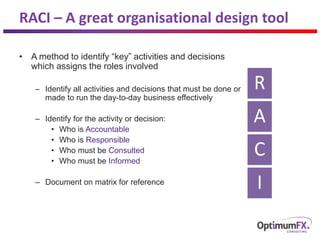
RACI – A great organisational design tool
• A method to identify “key” activities and decisions
which assigns the roles involved
– Identify all activities and decisions that must be done or
made to run the day-to-day business effectively
– Identify for the activity or decision:
• Who is Accountable
• Who is Responsible
• Who must be Consulted
• Who must be Informed
– Document on matrix for reference
R
A
C
I
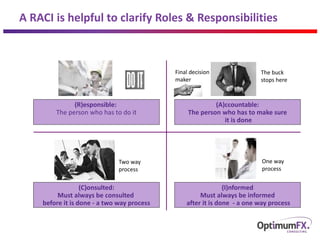
A RACI is helpful to clarify Roles & Responsibilities
(R)esponsible:
The person who has to do it
(A)ccountable:
The person who has to make sure
it is done
(C)onsulted:
Must always be consulted
before it is done - a two way process
Final decision
maker
The buck
stops here
(I)nformed
Must always be informed
after it is done - a one way process
One way
process
Two way
process
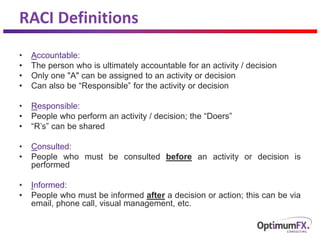
RACI Definitions
• Accountable:
• The person who is ultimately accountable for an activity / decision
• Only one "A" can be assigned to an activity or decision
• Can also be “Responsible” for the activity or decision
• Responsible:
• People who perform an activity / decision; the “Doers”
• “R’s” can be shared
• Consulted:
• People who must be consulted before an activity or decision is
performed
• Informed:
• People who must be informed after a decision or action; this can be via
email, phone call, visual management, etc.
What are the benefits of using RACI charts
• Clarify the connection between the “A” and the “R”
• Ensure accountability is positioned at the right level
• Push responsibilities and accountabilities down to the lowest level
• Clarify the single “A” concept
• Understand the interfaces between business process areas
• Identify gaps in accountabilities and responsibilities
• Provide employees the authority to get the job done
• Increase productivity through well defined responsibilities and
accountability
• Eliminate overlaps, redundancies and misunderstandings
• Eliminate unnecessary interfaces and place accountability where it
belongs
The 5 step RACI process
• Step 1: Define the activities / decisions
• Step 2: Make a list of role players
• Step 3: Design the RACI charts
• Step 4: Analyse and validate the RACI charts
• Step 5: Get feedback and buy-in
Guidelines for developing a RACI chart
• Remember the new way of thinking when defining roles and
responsibilities:
 Eliminate “checkers checking checkers”
 Encourage teamwork
• Authority must accompany accountability
• Place accountability (A) and responsibility (R) at the lowest possible
level
• Minimize the number of consults (C) and informs (I)
• All roles and responsibilities must be documented and communicated

RACI Methodology

  • 1.
    Defining clear Roles& Responsibilities The RACI Methodology
  • 2.
    How often doyou hear this? • “I don't know what to do here." • "I don't know whom to go to for authorisation." • "I find out after it's too late that I should have informed someone." • "I could help but no one asked me." • "I have the responsibility but not the power to get the job done." • "No one is prepared to make a decision." • "Things are going unnoticed and are therefore being neglected " • "I am doing work that is part of someone else's job"
  • 3.
    RACI – Agreat organisational design tool • A method to identify “key” activities and decisions which assigns the roles involved – Identify all activities and decisions that must be done or made to run the day-to-day business effectively – Identify for the activity or decision: • Who is Accountable • Who is Responsible • Who must be Consulted • Who must be Informed – Document on matrix for reference R A C I
  • 4.
    A RACI ishelpful to clarify Roles & Responsibilities (R)esponsible: The person who has to do it (A)ccountable: The person who has to make sure it is done (C)onsulted: Must always be consulted before it is done - a two way process Final decision maker The buck stops here (I)nformed Must always be informed after it is done - a one way process One way process Two way process
  • 5.
    RACI Definitions • Accountable: •The person who is ultimately accountable for an activity / decision • Only one "A" can be assigned to an activity or decision • Can also be “Responsible” for the activity or decision • Responsible: • People who perform an activity / decision; the “Doers” • “R’s” can be shared • Consulted: • People who must be consulted before an activity or decision is performed • Informed: • People who must be informed after a decision or action; this can be via email, phone call, visual management, etc.
  • 6.
    What are thebenefits of using RACI charts • Clarify the connection between the “A” and the “R” • Ensure accountability is positioned at the right level • Push responsibilities and accountabilities down to the lowest level • Clarify the single “A” concept • Understand the interfaces between business process areas • Identify gaps in accountabilities and responsibilities • Provide employees the authority to get the job done • Increase productivity through well defined responsibilities and accountability • Eliminate overlaps, redundancies and misunderstandings • Eliminate unnecessary interfaces and place accountability where it belongs
  • 7.
    The 5 stepRACI process • Step 1: Define the activities / decisions • Step 2: Make a list of role players • Step 3: Design the RACI charts • Step 4: Analyse and validate the RACI charts • Step 5: Get feedback and buy-in
  • 8.
    Guidelines for developinga RACI chart • Remember the new way of thinking when defining roles and responsibilities:  Eliminate “checkers checking checkers”  Encourage teamwork • Authority must accompany accountability • Place accountability (A) and responsibility (R) at the lowest possible level • Minimize the number of consults (C) and informs (I) • All roles and responsibilities must be documented and communicated