STAKEHOLDERS
DEFINITION OF STAKEHOLDERS

 • An individual or group with an interest in an
   organization.

 • Any individual or group who can affect or are
   affected by the achievement of a firms
   objective.
The Importance of Stakeholders

• Long-Term Relationships
• When a company has a long-term relationship
  with its stakeholders, it runs more efficiently and
  can have a better chance of producing profits.

• Feedback and Product Development
• Stakeholders can provide feedback during the
  entire product development process, which can
  positively influence the product's and/or the
  company's success. In turn, a company can earn
  continued and new stakeholder loyalty.
Continue…
• A Sense of Community
• A sense of community among stakeholders can
  positively shape the organizational development
  within a company and increase consumer sales.

• Considerations
• Acting upon stakeholder criticism can actually
  give a company a competitive edge, and help the
  company determine the stakeholders who hold
  the most value for it.
STAKEHOLDERS IN BUSINESS
• Stakeholders in a business are any entity that
  is effected by the operations of that business
  in some way. The most obvious stakeholders
  are employees, owners, and customers. Other
  stakeholders are indirect stakeholders such as
  competitors, the neighborhood the business is
  in, the government, and the environment.
Role of Stakeholders in Business
• Voting and Decision-making
• Stakeholders may be responsible for voting on
  significant changes in the business. Voting can
  take place annually based on the corporate
  structure of the business or during any meeting.

• Management
• Stakeholders can hold significant management
  positions where they may report directly to the
  president, CEO or chief financial officer.
Continue…
• Investing
• Stakeholders are responsible for reviewing the financial
  data of the company to ensure that the business is
  performing well and that they are not losing their
  investment.

• Social and Environmental Responsibilities
• Stakeholders must continuously ensure that decisions
  they are making for the business are doing little to
  harm society and the environment. They may choose
  to use an alternate resource if they realize that current
  resources are becoming scarce.
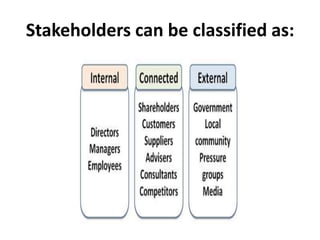
Stakeholders can be classified as:
A. INTERNAL STAKEHOLDERS
    (Directly Involve With Business)

1. DIRECTORS

  Director refers to a rank in management. A
 director is a person who leads, or supervises a
 certain area of a company, a program, or a
 project.
Directors look for:

• Salary

• Share Option

• Job Satisfaction

• Status

• Bonuses & Perks
INTERNAL STAKEHOLDERS
2. MANAGERS

 A Manager is a person who drives the work of
 others in order to run a business efficiently
 and make a large profit.
Managers look for:

• Bonuses

• Profit Maximization

• Pleasing Shareholders

• Growing the business
INTERNAL STAKEHOLDERS
3. EMPLOYEES

 An Employee contributes labor and expertise
 to an endeavor of an employer and is usually
 hired to perform specific duties which are
 packaged into a job.
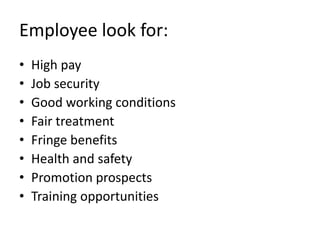
Employee look for:
•   High pay
•   Job security
•   Good working conditions
•   Fair treatment
•   Fringe benefits
•   Health and safety
•   Promotion prospects
•   Training opportunities
B. CONNECTED STAKEHOLDERS
 (Related to business core marketing
      and economic functions )
1. SHAREHOLDERS

  A shareholder or stockholder is an individual
  or institution (including a corporation) that
  legally owns a share of stock in
  a public or private corporation.
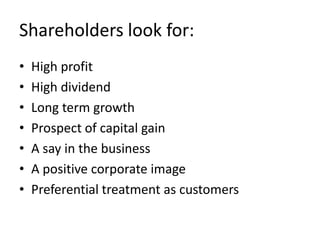
Shareholders look for:
•   High profit
•   High dividend
•   Long term growth
•   Prospect of capital gain
•   A say in the business
•   A positive corporate image
•   Preferential treatment as customers
CONNECTED STAKEHOLDERS
2. CUSTOMER

 A customer (also known as a client, buyer,
 or purchaser) is the recipient of
 a good, service, product, or idea, obtained
 from a seller, vendor, or supplier for a
 monetary or other valuable consideration
Customer look for:
•   Low prices
•   Value for money
•   High quality products
•   Good services
•   Innovation
•   Certain and regular supply
•   Clear and accurate information
CONNECTED STAKEHOLDER
3. SUPPLIERS

  A party that supplies goods or services. A
 supplier may be distinguished from a
 contractor or subcontractor, who commonly
 adds specialized input to deliverables. Also
 called vendor.
Supplier look for:
•   A long term relationship with the firm
•   Large size and value of contracts
•   Frequent and regular orders
•   Prompt payment
•   Fair prices
•   Growth of the firm leading to more orders
CONNECTED STAKEHOLDERS
4. ADVISERS

 An Advisers is normally a person with more
 and deeper knowledge in a specific area i.e. a
 specialist.
Advisers look for:
• Profit maximization

• Returns on money invested

• Repayment of loans
CONNECTED STAKEHOLDERS
5. CONSULTANTS

 A Consultant is usually an expert or a
 professional in a specific field and has a wide
 knowledge of the subject matter.
Consultants look for:
• Wide knowledge of the subject matter

• Medical sphere ( for a grade doctors )

• Improvements in organization strategy

• People management

• Improvement of operational processes
CONNECTED STAKEHOLDERS
6. COMPETITIOR

 Any person or entity which is a rival against
 another. In business, a company in the same
 industry or a similar industry which offers a
 similar product or service.
Competitor look for:
• To compete by all lawful means

• To differentiate its product from those of
  other businesses

• Keeping up with innovation

• Avoiding anti-competitive practices
C. EXTERNAL STAKEHOLDERS
 ( Not Directly Involve With Business
        But Have An Interest )

1. GOVERNMENT

  A Government is the system by which
  a state or community is governed.
  Government normally consists
  of legislators, administrators, and arbitrators.
Government look for:
•   Compliance with laws and regulation
•   Efficient use of resources
•   Employment
•   Contribution to National Economy
•   Payment of taxes
•   To control the business operation
•   To assist business
EXTERNAL STAKEHOLDER
2. LOCAL COMMUNITY

 A Local Community is a group of interacting
 people sharing an environment. In human
 communities, intent, belief, resources,
 preferences, needs, risks, and a number of
 other conditions may be present and
 common, affecting the identity of the
 participants and their degree of cohesiveness.
Local Community look for:
•   Employment prospects
•   Sage guarding the environment
•   Acceptance of social responsibility
•   Road building
•   Pollution control
•   Safety
•   House values
EXTERNAL STAKEHOLDERS
3. PRESSURE GROUPS

  Pressure Groups are organizations that
  want to influence the government to act in
  certain way. For example:
• PETA (People for the Ethical Treatment of
  Animals)
• GREENPEACE
Pressure Groups look for:
• Interest of members

• Trade union

• Peace

• Save animals

• Clean environment
EXTERNAL STAKEHOLDERS
4. MEDIA

 Communication channels through which
 news, entertainment, education, data, or
 promotional messages are disseminated.
Media look for:
• Keep the public informed on all issues
• Monitor the company
• Support freedom of expression
• Independence and accessibility of the mass
  media
• To combat harmful elements in the mass
  media.
THANK YOU

     RAHUL SONAWANE

Stakeholders In Business

  • 1.
  • 2.
    DEFINITION OF STAKEHOLDERS • An individual or group with an interest in an organization. • Any individual or group who can affect or are affected by the achievement of a firms objective.
  • 3.
    The Importance ofStakeholders • Long-Term Relationships • When a company has a long-term relationship with its stakeholders, it runs more efficiently and can have a better chance of producing profits. • Feedback and Product Development • Stakeholders can provide feedback during the entire product development process, which can positively influence the product's and/or the company's success. In turn, a company can earn continued and new stakeholder loyalty.
  • 4.
    Continue… • A Senseof Community • A sense of community among stakeholders can positively shape the organizational development within a company and increase consumer sales. • Considerations • Acting upon stakeholder criticism can actually give a company a competitive edge, and help the company determine the stakeholders who hold the most value for it.
  • 5.
    STAKEHOLDERS IN BUSINESS •Stakeholders in a business are any entity that is effected by the operations of that business in some way. The most obvious stakeholders are employees, owners, and customers. Other stakeholders are indirect stakeholders such as competitors, the neighborhood the business is in, the government, and the environment.
  • 6.
    Role of Stakeholdersin Business • Voting and Decision-making • Stakeholders may be responsible for voting on significant changes in the business. Voting can take place annually based on the corporate structure of the business or during any meeting. • Management • Stakeholders can hold significant management positions where they may report directly to the president, CEO or chief financial officer.
  • 7.
    Continue… • Investing • Stakeholdersare responsible for reviewing the financial data of the company to ensure that the business is performing well and that they are not losing their investment. • Social and Environmental Responsibilities • Stakeholders must continuously ensure that decisions they are making for the business are doing little to harm society and the environment. They may choose to use an alternate resource if they realize that current resources are becoming scarce.
  • 8.
    Stakeholders can beclassified as:
  • 9.
    A. INTERNAL STAKEHOLDERS (Directly Involve With Business) 1. DIRECTORS Director refers to a rank in management. A director is a person who leads, or supervises a certain area of a company, a program, or a project.
  • 10.
    Directors look for: •Salary • Share Option • Job Satisfaction • Status • Bonuses & Perks
  • 11.
    INTERNAL STAKEHOLDERS 2. MANAGERS A Manager is a person who drives the work of others in order to run a business efficiently and make a large profit.
  • 12.
    Managers look for: •Bonuses • Profit Maximization • Pleasing Shareholders • Growing the business
  • 13.
    INTERNAL STAKEHOLDERS 3. EMPLOYEES An Employee contributes labor and expertise to an endeavor of an employer and is usually hired to perform specific duties which are packaged into a job.
  • 14.
    Employee look for: • High pay • Job security • Good working conditions • Fair treatment • Fringe benefits • Health and safety • Promotion prospects • Training opportunities
  • 15.
    B. CONNECTED STAKEHOLDERS (Related to business core marketing and economic functions ) 1. SHAREHOLDERS A shareholder or stockholder is an individual or institution (including a corporation) that legally owns a share of stock in a public or private corporation.
  • 16.
    Shareholders look for: • High profit • High dividend • Long term growth • Prospect of capital gain • A say in the business • A positive corporate image • Preferential treatment as customers
  • 17.
    CONNECTED STAKEHOLDERS 2. CUSTOMER A customer (also known as a client, buyer, or purchaser) is the recipient of a good, service, product, or idea, obtained from a seller, vendor, or supplier for a monetary or other valuable consideration
  • 18.
    Customer look for: • Low prices • Value for money • High quality products • Good services • Innovation • Certain and regular supply • Clear and accurate information
  • 19.
    CONNECTED STAKEHOLDER 3. SUPPLIERS A party that supplies goods or services. A supplier may be distinguished from a contractor or subcontractor, who commonly adds specialized input to deliverables. Also called vendor.
  • 20.
    Supplier look for: • A long term relationship with the firm • Large size and value of contracts • Frequent and regular orders • Prompt payment • Fair prices • Growth of the firm leading to more orders
  • 21.
    CONNECTED STAKEHOLDERS 4. ADVISERS An Advisers is normally a person with more and deeper knowledge in a specific area i.e. a specialist.
  • 22.
    Advisers look for: •Profit maximization • Returns on money invested • Repayment of loans
  • 23.
    CONNECTED STAKEHOLDERS 5. CONSULTANTS A Consultant is usually an expert or a professional in a specific field and has a wide knowledge of the subject matter.
  • 24.
    Consultants look for: •Wide knowledge of the subject matter • Medical sphere ( for a grade doctors ) • Improvements in organization strategy • People management • Improvement of operational processes
  • 25.
    CONNECTED STAKEHOLDERS 6. COMPETITIOR Any person or entity which is a rival against another. In business, a company in the same industry or a similar industry which offers a similar product or service.
  • 26.
    Competitor look for: •To compete by all lawful means • To differentiate its product from those of other businesses • Keeping up with innovation • Avoiding anti-competitive practices
  • 27.
    C. EXTERNAL STAKEHOLDERS ( Not Directly Involve With Business But Have An Interest ) 1. GOVERNMENT A Government is the system by which a state or community is governed. Government normally consists of legislators, administrators, and arbitrators.
  • 28.
    Government look for: • Compliance with laws and regulation • Efficient use of resources • Employment • Contribution to National Economy • Payment of taxes • To control the business operation • To assist business
  • 29.
    EXTERNAL STAKEHOLDER 2. LOCALCOMMUNITY A Local Community is a group of interacting people sharing an environment. In human communities, intent, belief, resources, preferences, needs, risks, and a number of other conditions may be present and common, affecting the identity of the participants and their degree of cohesiveness.
  • 30.
    Local Community lookfor: • Employment prospects • Sage guarding the environment • Acceptance of social responsibility • Road building • Pollution control • Safety • House values
  • 31.
    EXTERNAL STAKEHOLDERS 3. PRESSUREGROUPS Pressure Groups are organizations that want to influence the government to act in certain way. For example: • PETA (People for the Ethical Treatment of Animals) • GREENPEACE
  • 32.
    Pressure Groups lookfor: • Interest of members • Trade union • Peace • Save animals • Clean environment
  • 33.
    EXTERNAL STAKEHOLDERS 4. MEDIA Communication channels through which news, entertainment, education, data, or promotional messages are disseminated.
  • 34.
    Media look for: •Keep the public informed on all issues • Monitor the company • Support freedom of expression • Independence and accessibility of the mass media • To combat harmful elements in the mass media.
  • 35.
    THANK YOU RAHUL SONAWANE