
Improving Packaging Line Performance –
Using the correct Data and Drill Down Analysis
Actionable Information III
www.optimumfx.com
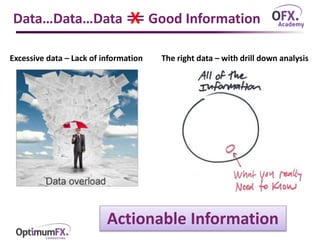
Data…Data…Data == Good Information
Excessive data – Lack of information The right data – with drill down analysis
X
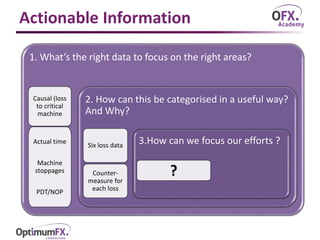
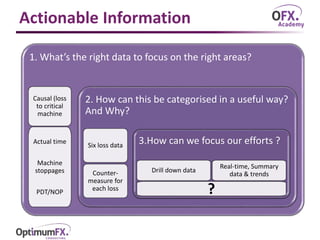
Actionable Information
1. What’s the right data to focus on the right areas?
Causal (loss
to critical
machine
Actual time
Machine
stoppages
PDT/NOP
2. How can this be categorised in a useful way?
And Why?
Six loss data
Counter-
measure for
each loss
3.How can we focus our efforts ?
?
Site
Line
Loss
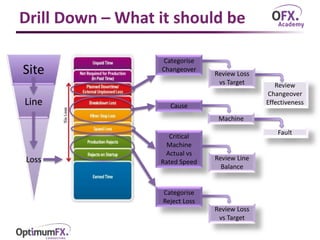
Drill Down – What it should be
Categorise
Changeover
Review Loss
vs Target
Cause
Machine
Fault
Review
Changeover
Effectiveness
Critical
Machine
Actual vs
Rated Speed
Review Line
Balance
Categorise
Reject Loss
Review Loss
vs Target
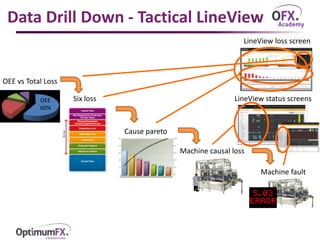
Data Drill Down - Tactical LineView
Six loss
Cause pareto
Machine causal loss
Machine fault
OEE vs Total Loss
OEE
60%
LineView loss screen
LineView status screens
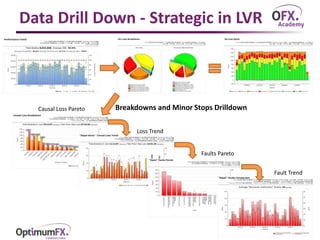
Data Drill Down - Strategic in LVR
Breakdowns and Minor Stops DrilldownCausal Loss Pareto
Loss Trend
Faults Pareto
Fault Trend
Actionable Information
1. What’s the right data to focus on the right areas?
Causal (loss
to critical
machine
Actual time
Machine
stoppages
PDT/NOP
2. How can this be categorised in a useful way?
And Why?
Six loss data
Counter-
measure for
each loss
3.How can we focus our efforts ?
Drill down data
Real-time, Summary
data & trends
?
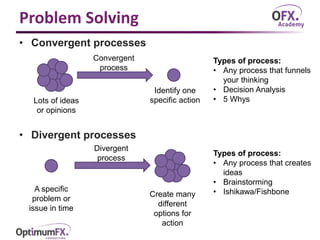
Problem Solving
• Convergent processes
• Divergent processes
Lots of ideas
or opinions
Convergent
process
A specific
problem or
issue in time
Divergent
process
Create many
different
options for
action
Identify one
specific action
Types of process:
• Any process that funnels
your thinking
• Decision Analysis
• 5 Whys
Types of process:
• Any process that creates
ideas
• Brainstorming
• Ishikawa/Fishbone
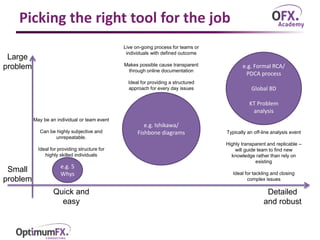
Picking the right tool for the job
Quick and
easy
Detailed
and robust
Large
problem
Small
problem
e.g. 5
Whys
May be an individual or team event
Can be highly subjective and
unrepeatable.
Ideal for providing structure for
highly skilled individuals
e.g. Ishikawa/
Fishbone diagrams
Live on-going process for teams or
individuals with defined outcome
Makes possible cause transparent
through online documentation
Ideal for providing a structured
approach for every day issues
e.g. Formal RCA/
PDCA process
Global 8D
KT Problem
analysis
Typically an off-line analysis event
Highly transparent and replicable –
will guide team to find new
knowledge rather than rely on
existing
Ideal for tackling and closing
complex issues
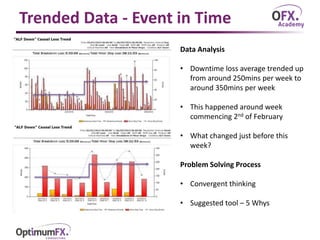
Trended Data - Event in Time
Data Analysis
• Downtime loss average trended up
from around 250mins per week to
around 350mins per week
• This happened around week
commencing 2nd of February
• What changed just before this
week?
Problem Solving Process
• Convergent thinking
• Suggested tool – 5 Whys
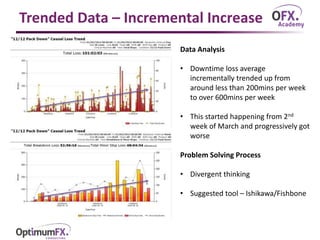
Trended Data – Incremental Increase
Data Analysis
• Downtime loss average
incrementally trended up from
around less than 200mins per week
to over 600mins per week
• This started happening from 2nd
week of March and progressively got
worse
Problem Solving Process
• Divergent thinking
• Suggested tool – Ishikawa/Fishbone
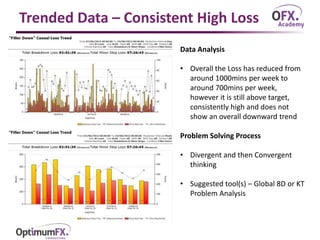
Trended Data – Consistent High Loss
Data Analysis
• Overall the Loss has reduced from
around 1000mins per week to
around 700mins per week,
however it is still above target,
consistently high and does not
show an overall downward trend
Problem Solving Process
• Divergent and then Convergent
thinking
• Suggested tool(s) – Global 8D or KT
Problem Analysis
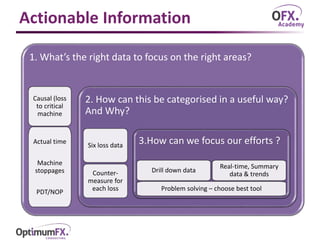
Actionable Information
1. What’s the right data to focus on the right areas?
Causal (loss
to critical
machine
Actual time
Machine
stoppages
PDT/NOP
2. How can this be categorised in a useful way?
And Why?
Six loss data
Counter-
measure for
each loss
3.How can we focus our efforts ?
Drill down data
Real-time, Summary
data & trends
Problem solving – choose best tool

Actionable information 3

  • 1.
    Improving Packaging LinePerformance – Using the correct Data and Drill Down Analysis Actionable Information III www.optimumfx.com
  • 2.
    Data…Data…Data == GoodInformation Excessive data – Lack of information The right data – with drill down analysis X Actionable Information
  • 3.
    Actionable Information 1. What’sthe right data to focus on the right areas? Causal (loss to critical machine Actual time Machine stoppages PDT/NOP 2. How can this be categorised in a useful way? And Why? Six loss data Counter- measure for each loss 3.How can we focus our efforts ? ?
  • 4.
    Site Line Loss Drill Down –What it should be Categorise Changeover Review Loss vs Target Cause Machine Fault Review Changeover Effectiveness Critical Machine Actual vs Rated Speed Review Line Balance Categorise Reject Loss Review Loss vs Target
  • 5.
    Data Drill Down- Tactical LineView Six loss Cause pareto Machine causal loss Machine fault OEE vs Total Loss OEE 60% LineView loss screen LineView status screens
  • 6.
    Data Drill Down- Strategic in LVR Breakdowns and Minor Stops DrilldownCausal Loss Pareto Loss Trend Faults Pareto Fault Trend
  • 7.
    Actionable Information 1. What’sthe right data to focus on the right areas? Causal (loss to critical machine Actual time Machine stoppages PDT/NOP 2. How can this be categorised in a useful way? And Why? Six loss data Counter- measure for each loss 3.How can we focus our efforts ? Drill down data Real-time, Summary data & trends ?
  • 8.
    Problem Solving • Convergentprocesses • Divergent processes Lots of ideas or opinions Convergent process A specific problem or issue in time Divergent process Create many different options for action Identify one specific action Types of process: • Any process that funnels your thinking • Decision Analysis • 5 Whys Types of process: • Any process that creates ideas • Brainstorming • Ishikawa/Fishbone
  • 9.
    Picking the righttool for the job Quick and easy Detailed and robust Large problem Small problem e.g. 5 Whys May be an individual or team event Can be highly subjective and unrepeatable. Ideal for providing structure for highly skilled individuals e.g. Ishikawa/ Fishbone diagrams Live on-going process for teams or individuals with defined outcome Makes possible cause transparent through online documentation Ideal for providing a structured approach for every day issues e.g. Formal RCA/ PDCA process Global 8D KT Problem analysis Typically an off-line analysis event Highly transparent and replicable – will guide team to find new knowledge rather than rely on existing Ideal for tackling and closing complex issues
  • 10.
    Trended Data -Event in Time Data Analysis • Downtime loss average trended up from around 250mins per week to around 350mins per week • This happened around week commencing 2nd of February • What changed just before this week? Problem Solving Process • Convergent thinking • Suggested tool – 5 Whys
  • 11.
    Trended Data –Incremental Increase Data Analysis • Downtime loss average incrementally trended up from around less than 200mins per week to over 600mins per week • This started happening from 2nd week of March and progressively got worse Problem Solving Process • Divergent thinking • Suggested tool – Ishikawa/Fishbone
  • 12.
    Trended Data –Consistent High Loss Data Analysis • Overall the Loss has reduced from around 1000mins per week to around 700mins per week, however it is still above target, consistently high and does not show an overall downward trend Problem Solving Process • Divergent and then Convergent thinking • Suggested tool(s) – Global 8D or KT Problem Analysis
  • 13.
    Actionable Information 1. What’sthe right data to focus on the right areas? Causal (loss to critical machine Actual time Machine stoppages PDT/NOP 2. How can this be categorised in a useful way? And Why? Six loss data Counter- measure for each loss 3.How can we focus our efforts ? Drill down data Real-time, Summary data & trends Problem solving – choose best tool

Editor's Notes

  • #2 Overall introduction: Check in on time frame – 3 hrs ish – short break at some point I’m where a different cap for next few hours – not Mr LineView – although there are some references here Some / quite a bit you may already know – apologies, such eggs, etc Empty your cup Be here fully Be interactive – up for challenge, ask questions as we go, you’ll get out what you put in Secondary outcome: Agree how to go allocate to fault level (for now)
  • #4 40% loss - what kind of problems, where, when, what exactly happened. Getting better or worse. Top level - Answer series of questions as glue Add new slide as top level overview – include vision Get prepared with some real data on faults, loss, etc Start with a mini session on LineView What’s the right data ensure we focus on the right areas? How can this be categorised in a useful way? How should the data be logged to make it most useful? How can we drill down to focus our efforts? How is machine data useful (over and above loss data)? What tools apply to what kind of problems?
  • #8 40% loss - what kind of problems, where, when, what exactly happened. Getting better or worse. Top level - Answer series of questions as glue Add new slide as top level overview – include vision Get prepared with some real data on faults, loss, etc Start with a mini session on LineView What’s the right data ensure we focus on the right areas? How can this be categorised in a useful way? How should the data be logged to make it most useful? How can we drill down to focus our efforts? How is machine data useful (over and above loss data)? What tools apply to what kind of problems?
  • #14 40% loss - what kind of problems, where, when, what exactly happened. Getting better or worse. Top level - Answer series of questions as glue Add new slide as top level overview – include vision Get prepared with some real data on faults, loss, etc Start with a mini session on LineView What’s the right data ensure we focus on the right areas? How can this be categorised in a useful way? How should the data be logged to make it most useful? How can we drill down to focus our efforts? How is machine data useful (over and above loss data)? What tools apply to what kind of problems?