Spurious and Stability Analysis
  under Large-Signal Conditions

      using your Vector Network
              Analyser


An application of ICE


                                    June 2012
Outline
   ●   Why combining Large-Signal and Small-Signal Measurements


   ●   Block Diagram


   ●   Practical Setup


   ●   S-parameters


   ●   Stability Criteria


   ●   Large-Signal Measurements


   ●   References and Acknowledgements
   ●   Conclusions

© NMDG 2012                                                       2
Why combining Large-Signal and Small-Signal Measurements

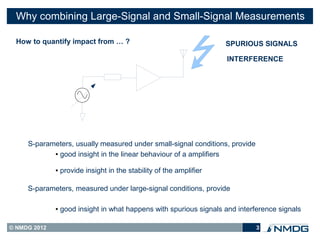
  How to quantify impact from … ?                                     SPURIOUS SIGNALS

                                                                      INTERFERENCE


     S-parameters, usually measured under small-signal conditions, provide
            ● good insight in the linear behaviour of a amplifiers


              ●   provide insight in the stability of the amplifier

     S-parameters, measured under large-signal conditions, provide

              ●   good insight in what happens with spurious signals and interference signals

© NMDG 2012                                                                    3
Why combining Large-Signal and Small-Signal Measurements

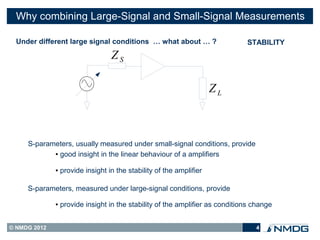
  Under different large signal conditions … what about … ?                     STABILITY
                                   ZS

                                                                      ZL


     S-parameters, usually measured under small-signal conditions, provide
            ● good insight in the linear behaviour of a amplifiers


              ●   provide insight in the stability of the amplifier

     S-parameters, measured under large-signal conditions, provide

              ●   provide insight in the stability of the amplifier as conditions change


© NMDG 2012                                                                       4
Block Diagram
                            Measure at large-signal frequency grid and
                                    at small-signal frequency grid, sweeping source 2


                                        Network Analyzer Receivers
 Large Signal     ` (*)                                                         (*)
 Conditions
                    ZS
     f0                                           DUT

 External RF source 1                                                                  ZL
       or
 VNA RF source 1                   “Measure S-par”      50 Ohm
                                                                                      Large Signal
 (depends on VNA)
                                                                                      Conditions
                       VNA couplers
                              or                         VNA RF source 2
                 external (low-loss) couplers            [similar to S-par measurement]

          Absolute Calibration Planes
 (*) Other configurations possible, e.g. position couplers, use of splitters,
                                                          depending on power requirements
© NMDG 2012                                                                 5
© NMDG 2012   6
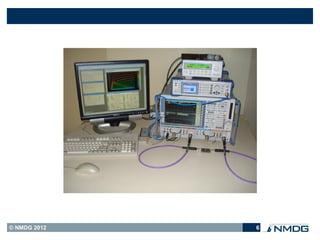
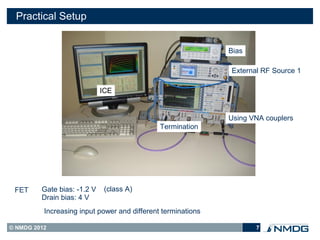
Practical Setup


                                                              Bias

                                                              External RF Source 1

                             ICE


                                                              Using VNA couplers
                                              Termination


 FET     Gate bias: -1.2 V    (class A)
         Drain bias: 4 V
          Increasing input power and different terminations

© NMDG 2012                                                          7
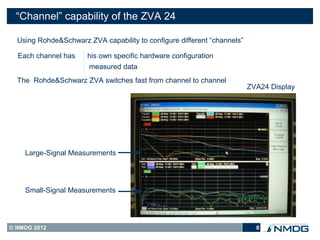
“Channel” capability of the ZVA 24

  Using Rohde&Schwarz ZVA capability to configure different “channels”

  Each channel has     his own specific hardware configuration
                       measured data
  The Rohde&Schwarz ZVA switches fast from channel to channel
                                                                         ZVA24 Display


    Large-Signal Measurements


    Small-Signal Measurements


© NMDG 2012                                                                8
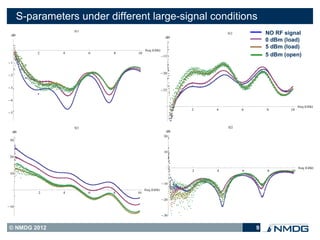
S-parameters under different large-signal conditions
                     S11
  dB
                                                                     S12           NO RF signal
                                                        dB
                                                                                   0 dBm (load)
                                        freq GHz
                                                                                   5 dBm (load)
           2     4         6   8   10
                                                      15                          5 dBm (open)
1

                                                      20
2


3
                                                      25

4
                                                                                                freq GHz
                                                             2   4         6       8       10
5


                     S21                                             S22
   dB                                                  dB
                                                      20
 30


                                                      10
 20


                                                                                                freq GHz
                                                             2   4         6       8       10
 10


                                                      10
                                        freq GHz
           2     4         6   8   10

                                                      20
 10

                                                      30


 © NMDG 2012                                                                   9
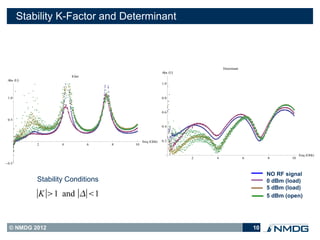
Stability K-Factor and Determinant


                                                          Abs U
                                                                            Determinant


 Abs U
                        Kfact

                                                          1.0


 1.0                                                      0.8


                                                          0.6

 0.5

                                                          0.4


                                             freq GHz   0.2
            2       4           6   8   10


                                                                                                                freq GHz
                                                                    2   4                 6        8       10
 0.5


                                                                                                   NO RF signal
            Stability Conditions                                                                   0 dBm (load)
                                                                                                   5 dBm (load)
            ∣K∣1 and ∣∣1                                                                        5 dBm (open)


  © NMDG 2012                                                                                 10
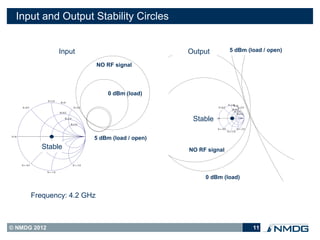
Input and Output Stability Circles


                            Input                                      Output               5 dBm (load / open)

                                                 NO RF signal


                                                     0 dBm (load)
                   X1.0
                            R0
                                                                                           X1.0
                                                                                               R0
      X0.5                             X2.0                                      X0.5          X2.0
                                                                                              R0.5
                            R0.5                                                               R1.0
                                                                                                 R2.0
                                R1.0
                                                                        Stable   X0

                                    R2.0
                                                                                  X0.5            X2.0
                                                                                           X1.0

X0
                                                 5 dBm (load / open)
                  Stable                                               NO RF signal

      X0.5                            X2.0

                   X1.0

                                                                            0 dBm (load)


               Frequency: 4.2 GHz


© NMDG 2012                                                                                                  11
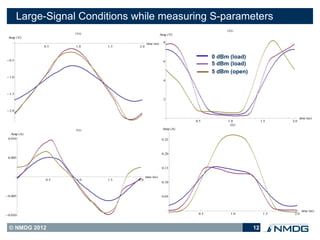
Large-Signal Conditions while measuring S-parameters
                                                                            v2t 
                    v1t                            Amp  V
 Amp  V
                                         time ns     8
             0.5    1.0      1.5   2.0


                                                                       0 dBm (load)
 0.5                                                  6
                                                                       5 dBm (load)
                                                                       5 dBm (open)
 1.0
                                                       4


 1.5
                                                       2


 2.0

                                                                                                        time ns

                                                                             i2t 
                                                                0.5         1.0            1.5    2.0

                    i1t                             Amp A
   Amp A
 0.010                                                0.25


                                                      0.20
 0.005


                                                      0.15

                                         time ns
              0.5    1.0     1.5   2.0
                                                      0.10


 0.005                                               0.05


                                                                                                         time ns
 0.010                                                          0.5           1.0          1.5    2.0


  © NMDG 2012                                                                         12
References and Acknowledgements
   ●   “A New Characterization Technique of “Four Hot S-parameters” for the
       Study of Nonlinear Parametric Behaviors of Microwave Devices”, T.
       Gasseling, D. Barataud, et alii, 2003 IEEE MTT-S Digest, p. 1663


   ●   Thanks to Rohde & Schwarz for providing the R&S ZVA network analyzer
       equipment and the support around the network analyzer


   ●   Thanks to Focus Microwaves for providing the tuners and the good
       cooperation


© NMDG 2012                                                        13
Conclusions
   ●   It is straightforward with a Rohde & Schwarz network analyzer to measure
       the small-signal behaviour while applying and measuring the large-signal
       conditions


   ●   With the S-parameters it is possible to get better insight when spurious
       signals are applied to the component or interference signals are picked up,
       e.g. RF front-end picking up signals


   ●   The S-parameters result in different stability criteria. This is evenly important
       as the large-signal performance, designing active circuits, like amplifiers


 For more information       info@nmdg.be
                            www.nmdg.be


© NMDG 2012                                                              14

Stability under Large-Signal Conditions Presentation

  • 1.
    Spurious and StabilityAnalysis under Large-Signal Conditions using your Vector Network Analyser An application of ICE June 2012
  • 2.
    Outline ● Why combining Large-Signal and Small-Signal Measurements ● Block Diagram ● Practical Setup ● S-parameters ● Stability Criteria ● Large-Signal Measurements ● References and Acknowledgements ● Conclusions © NMDG 2012 2
  • 3.
    Why combining Large-Signaland Small-Signal Measurements How to quantify impact from … ? SPURIOUS SIGNALS INTERFERENCE S-parameters, usually measured under small-signal conditions, provide ● good insight in the linear behaviour of a amplifiers ● provide insight in the stability of the amplifier S-parameters, measured under large-signal conditions, provide ● good insight in what happens with spurious signals and interference signals © NMDG 2012 3
  • 4.
    Why combining Large-Signaland Small-Signal Measurements Under different large signal conditions … what about … ? STABILITY ZS ZL S-parameters, usually measured under small-signal conditions, provide ● good insight in the linear behaviour of a amplifiers ● provide insight in the stability of the amplifier S-parameters, measured under large-signal conditions, provide ● provide insight in the stability of the amplifier as conditions change © NMDG 2012 4
  • 5.
    Block Diagram Measure at large-signal frequency grid and at small-signal frequency grid, sweeping source 2 Network Analyzer Receivers Large Signal ` (*) (*) Conditions ZS f0 DUT External RF source 1 ZL or VNA RF source 1 “Measure S-par” 50 Ohm Large Signal (depends on VNA) Conditions VNA couplers or VNA RF source 2 external (low-loss) couplers [similar to S-par measurement] Absolute Calibration Planes (*) Other configurations possible, e.g. position couplers, use of splitters, depending on power requirements © NMDG 2012 5
  • 6.
  • 7.
    Practical Setup Bias External RF Source 1 ICE Using VNA couplers Termination FET Gate bias: -1.2 V (class A) Drain bias: 4 V Increasing input power and different terminations © NMDG 2012 7
  • 8.
    “Channel” capability ofthe ZVA 24 Using Rohde&Schwarz ZVA capability to configure different “channels” Each channel has his own specific hardware configuration measured data The Rohde&Schwarz ZVA switches fast from channel to channel ZVA24 Display Large-Signal Measurements Small-Signal Measurements © NMDG 2012 8
  • 9.
    S-parameters under differentlarge-signal conditions S11 dB S12 NO RF signal dB 0 dBm (load) freq GHz 5 dBm (load) 2 4 6 8 10  15 5 dBm (open) 1  20 2 3  25 4 freq GHz 2 4 6 8 10 5 S21 S22 dB dB 20 30 10 20 freq GHz 2 4 6 8 10 10  10 freq GHz 2 4 6 8 10  20  10  30 © NMDG 2012 9
  • 10.
    Stability K-Factor andDeterminant Abs U Determinant Abs U Kfact 1.0 1.0 0.8 0.6 0.5 0.4 freq GHz 0.2 2 4 6 8 10 freq GHz 2 4 6 8 10  0.5 NO RF signal Stability Conditions 0 dBm (load) 5 dBm (load) ∣K∣1 and ∣∣1 5 dBm (open) © NMDG 2012 10
  • 11.
    Input and OutputStability Circles Input Output 5 dBm (load / open) NO RF signal 0 dBm (load) X1.0 R0 X1.0 R0 X0.5 X2.0 X0.5 X2.0 R0.5 R0.5 R1.0 R2.0 R1.0 Stable X0 R2.0 X0.5 X2.0 X1.0 X0 5 dBm (load / open) Stable NO RF signal X0.5 X2.0 X1.0 0 dBm (load) Frequency: 4.2 GHz © NMDG 2012 11
  • 12.
    Large-Signal Conditions whilemeasuring S-parameters v2t  v1t  Amp  V Amp  V time ns 8 0.5 1.0 1.5 2.0 0 dBm (load)  0.5 6 5 dBm (load) 5 dBm (open)  1.0 4  1.5 2  2.0 time ns i2t  0.5 1.0 1.5 2.0 i1t  Amp A Amp A 0.010 0.25 0.20 0.005 0.15 time ns 0.5 1.0 1.5 2.0 0.10  0.005 0.05 time ns  0.010 0.5 1.0 1.5 2.0 © NMDG 2012 12
  • 13.
    References and Acknowledgements ● “A New Characterization Technique of “Four Hot S-parameters” for the Study of Nonlinear Parametric Behaviors of Microwave Devices”, T. Gasseling, D. Barataud, et alii, 2003 IEEE MTT-S Digest, p. 1663 ● Thanks to Rohde & Schwarz for providing the R&S ZVA network analyzer equipment and the support around the network analyzer ● Thanks to Focus Microwaves for providing the tuners and the good cooperation © NMDG 2012 13
  • 14.
    Conclusions ● It is straightforward with a Rohde & Schwarz network analyzer to measure the small-signal behaviour while applying and measuring the large-signal conditions ● With the S-parameters it is possible to get better insight when spurious signals are applied to the component or interference signals are picked up, e.g. RF front-end picking up signals ● The S-parameters result in different stability criteria. This is evenly important as the large-signal performance, designing active circuits, like amplifiers For more information info@nmdg.be www.nmdg.be © NMDG 2012 14