2011


WURTH ELECTRONICS MIDCOM
     SMPS EMI SEMINAR
            2011
       Introduction to
        Concepts and
         Techniques
                © 2011 – Wurth Midcom   1 1
Our Products


               © 2011 – Wurth Midcom   2
http://www.we-online.com/
http://www.we-online.com/web/en/passive_bauelemente_-
           _standard/toolbox_pbs/Toolbox.php

             Wurth Electronics Midcom Inc. Headquarters
                       Phone: (605) 886-4385
                         Fax: (605) 886-4486
                   E-Mail: midcom@we-online.com
                          121 Airport Drive
                        Watertown, SD 57201
                            United States
An Excellent Resource for EMC


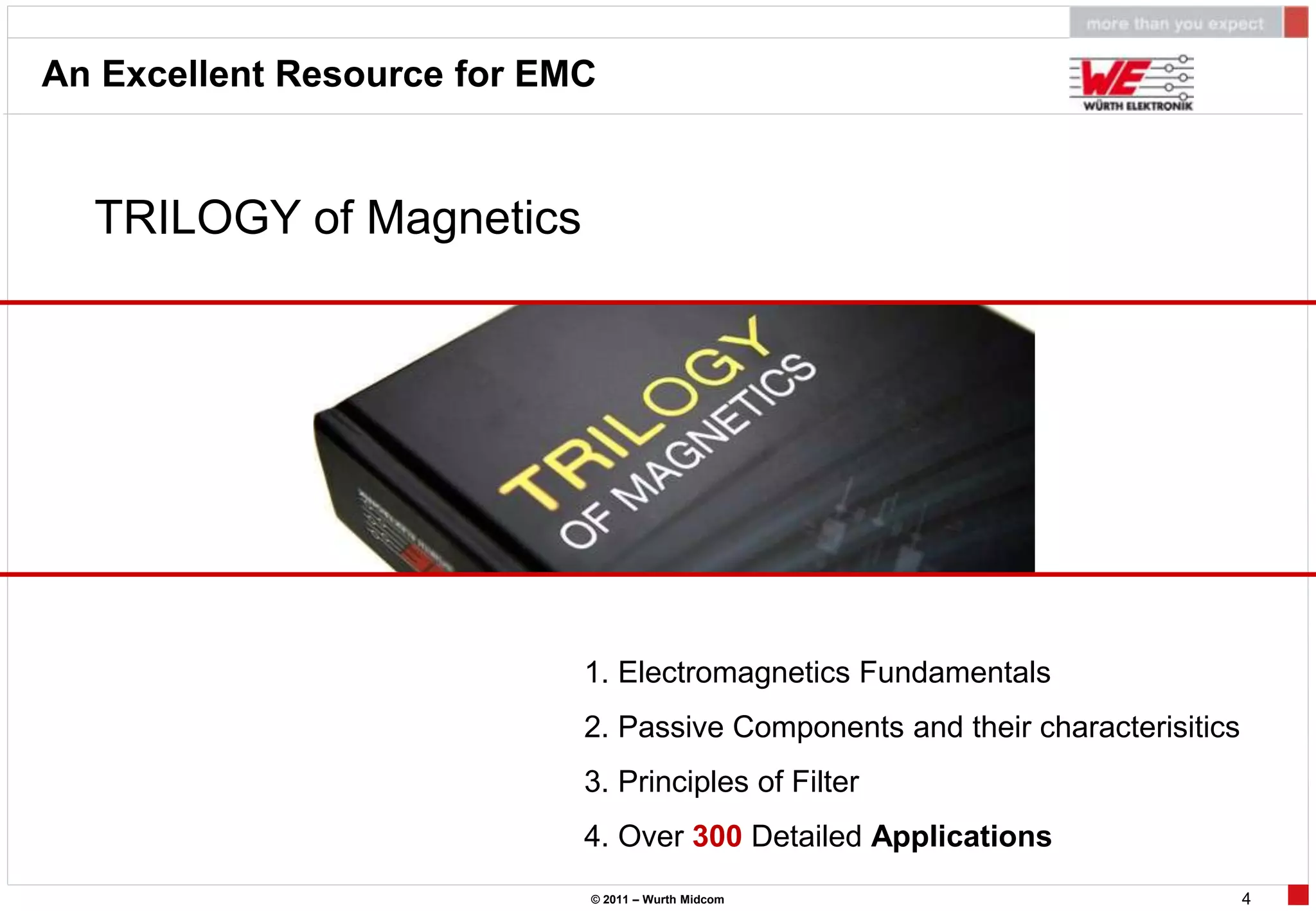
  TRILOGY of Magnetics


                            1. Electromagnetics Fundamentals
                            2. Passive Components and their characterisitics
                            3. Principles of Filter
                            4. Over 300 Detailed Applications
                            © 2011 – Wurth Midcom                              4
Basics


  EMI = Electromagnetic Interference
                      How much a device„s own noise affects other components


  EMC = Electromagnetic Compatibiltiy
                      How well a device can handle noise from other components


     NOT THIS: E=  2                               OR THIS: HipHop Band


                               © 2011 – Wurth Midcom                           5
EMI / EMC (CISPR vs. FCC)

CISPR* (22)
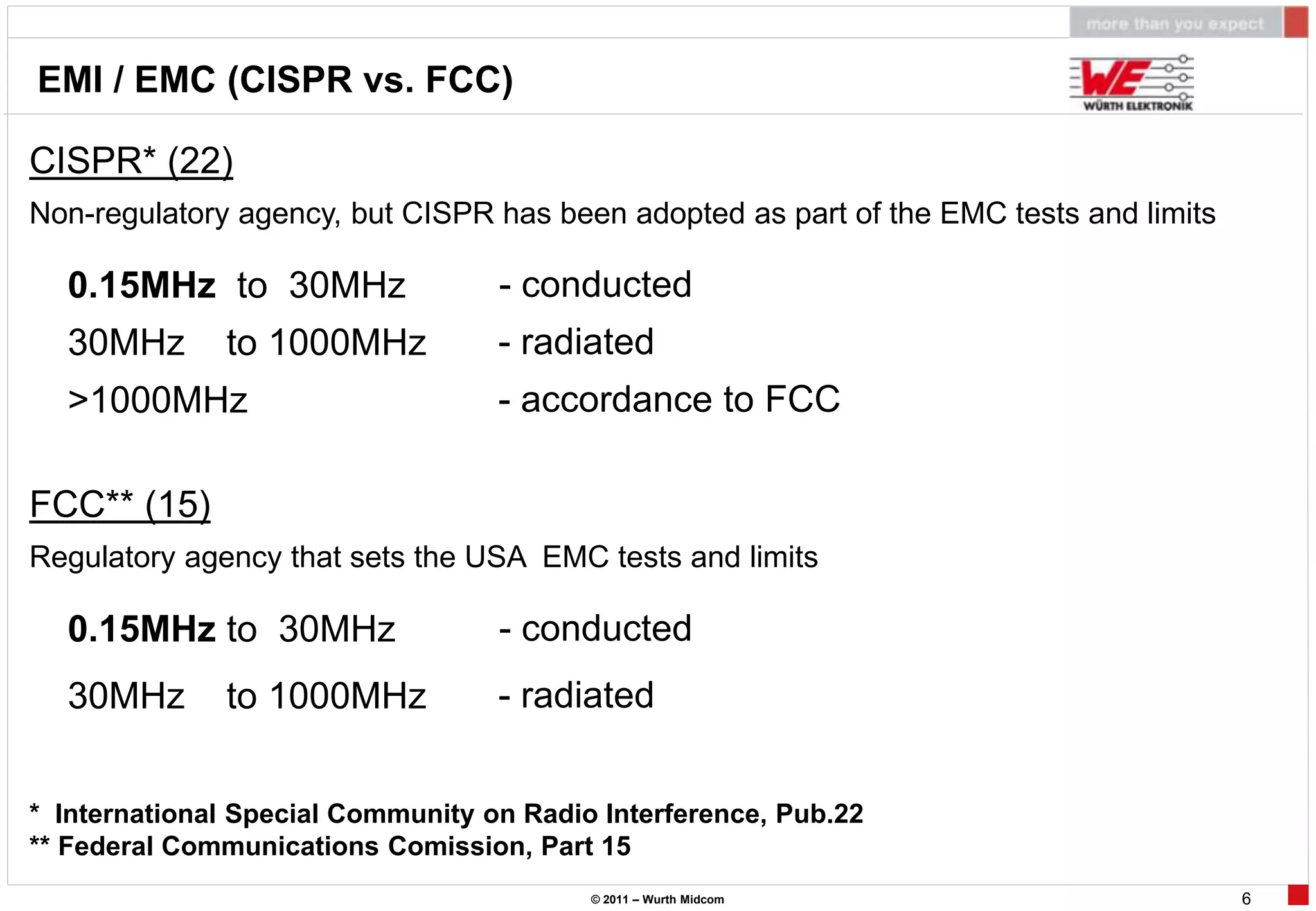
Non-regulatory agency, but CISPR has been adopted as part of the EMC tests and limits

  0.15MHz to 30MHz                 - conducted
  30MHz       to 1000MHz           - radiated
  >1000MHz                         - accordance to FCC

FCC** (15)
Regulatory agency that sets the USA EMC tests and limits

  0.15MHz to 30MHz                 - conducted
  30MHz       to 1000MHz           - radiated


* International Special Community on Radio Interference, Pub.22
** Federal Communications Comission, Part 15
                                          © 2011 – Wurth Midcom                         6
CISPR vs. FCC
                                                                                                                                                                    960-1000
 Class A
                               0.5                           1.6              5                               30             88                216
           0.15 - 0.5                                              0.5 - 30                                        30 - 88          88 - 216          216 - 960                >1000

                                     0.45 – 1.6                                   1.6 - 30                         30 - 88          88 - 216           216 - 1000              >1000

 Class B
           0.15 - 0.5                              0.5 - 5                                   5 - 30                30 - 88          88 - 216          216 - 960                >1000

                                     0.455 – 1.6                                  1.6 - 30                         30 - 88          88 - 216           216 - 1000              >1000


                                                                                                                                                                                 f [MHz]
0.1                                     1                                             10                                      100                                     1000
                        differential mode noise                                                                        common mode noise


 • Class A
    commercial, industrial, business environment equipment

 • Class B
    residential environment equipment
                                                                                                                              f [MHz]                CISPR 22 - conducted

                                                                                                                              f [MHz]                FCC 15         - conducted

                                                                                                                              f [MHz]                CISPR 22 - radiated

                                                                                                                              f [MHz]                FCC 15         - radiated
                                                                                      © 2011 – Wurth Midcom                                                                            7
Basics
 Why 30Mhz the cutoff between the conducted and radiated emissions?

  30 MHz is roughly equivalent to a wavelenght of ~32 feet (10 meters)

900 MHz is roughly equivalent to a wavelenght of 1 foot (~.33 meters)

 In practical terms, the wavelength of a signal and the length of its an antenna need
 to be equal to radiate the signal at full power

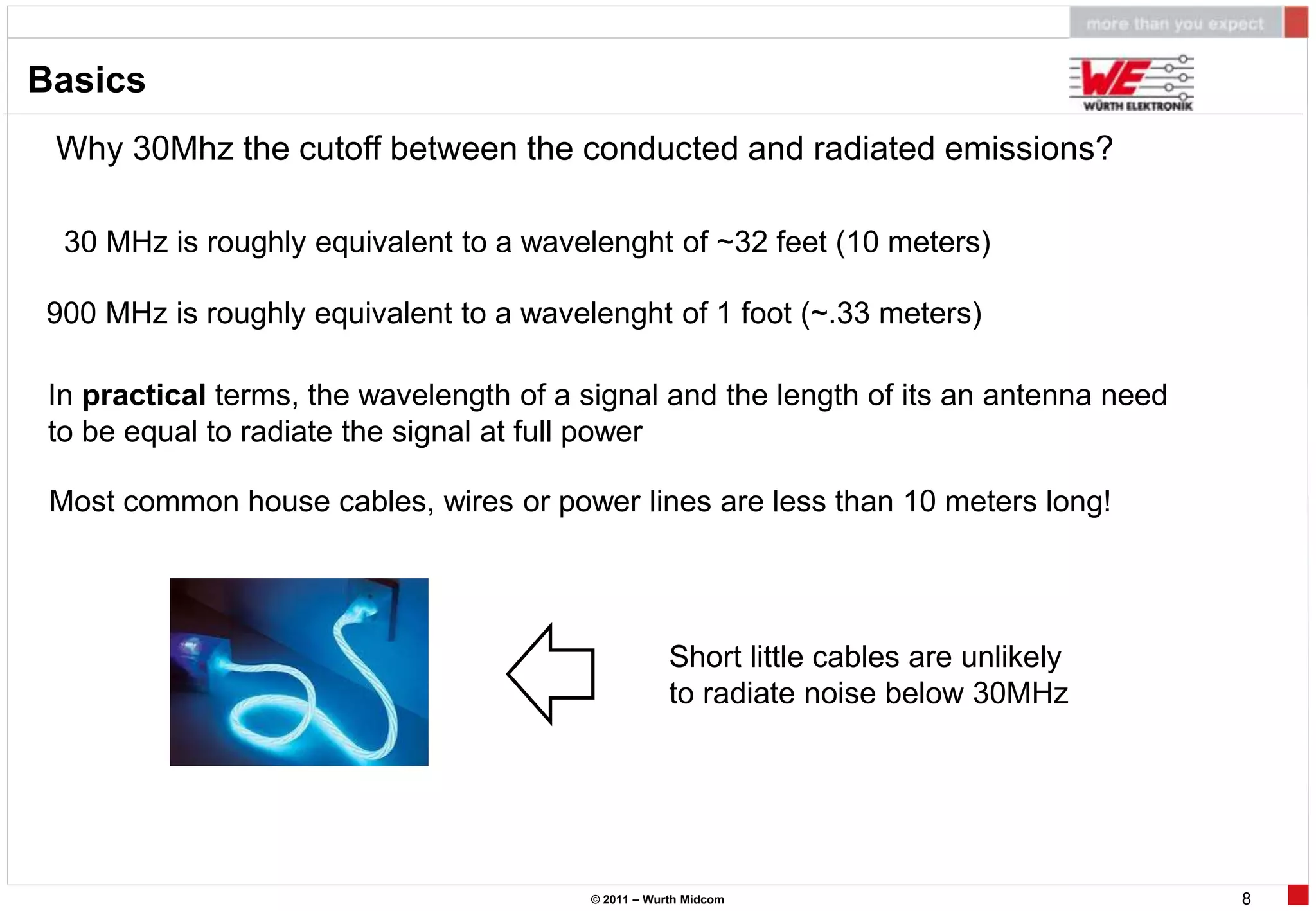
 Most common house cables, wires or power lines are less than 10 meters long!


                                                     Short little cables are unlikely
                                                     to radiate noise below 30MHz


                                         © 2011 – Wurth Midcom                          8
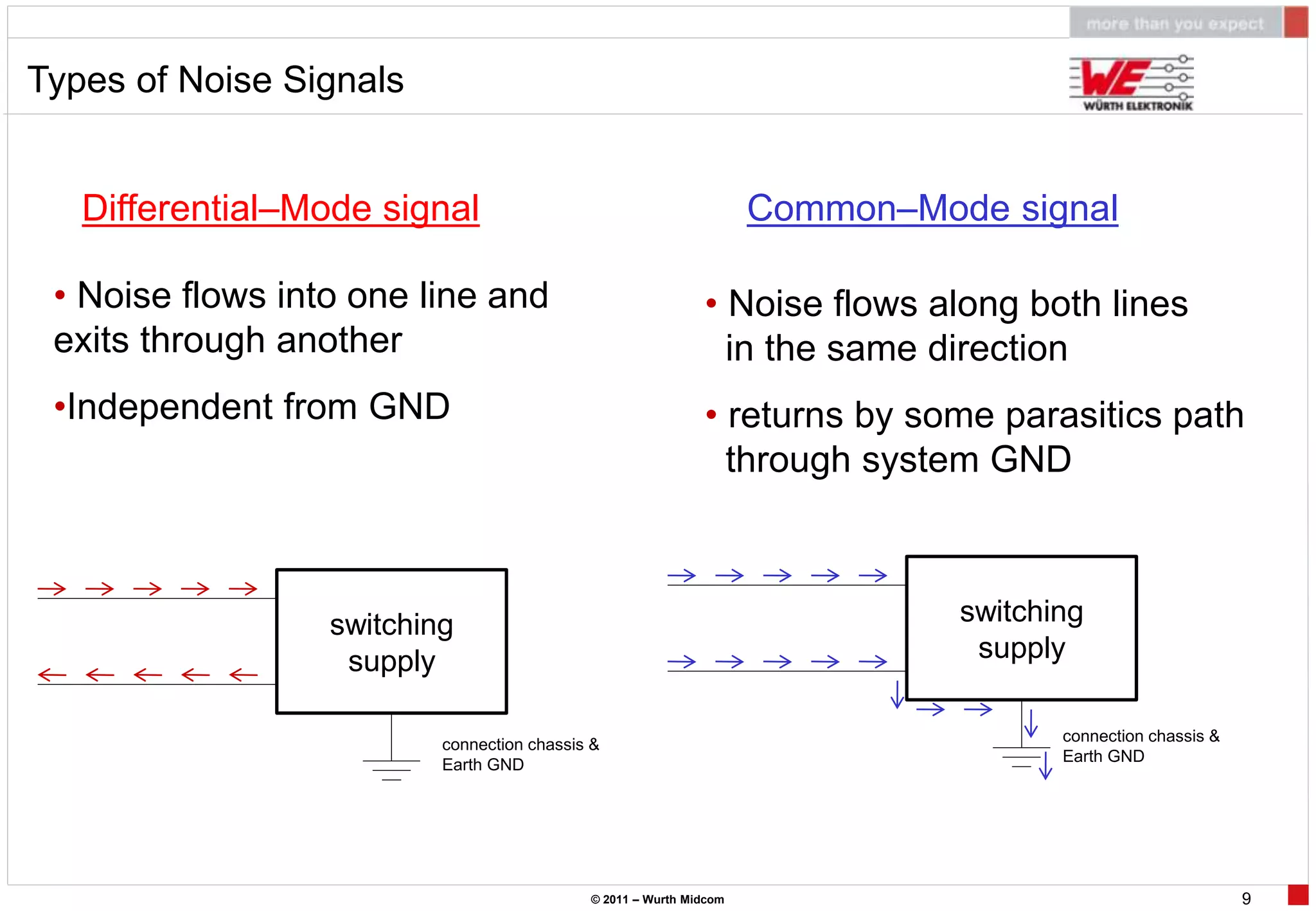
Types of Noise Signals


   Differential–Mode signal                                         Common–Mode signal

 • Noise flows into one line and                             • Noise flows along both lines
 exits through another                                         in the same direction
 •Independent from GND                                       • returns by some parasitics path
                                                               through system GND


                  switching                                                   switching
                   supply                                                      supply

                                                                                     connection chassis &
                          connection chassis &
                                                                                     Earth GND
                          Earth GND


                                            © 2011 – Wurth Midcom                                           9
CISPR vs. FCC
                                                                                                                                                                    960-1000
 Class A
                               0.5                           1.6              5                               30             88                216
           0.15 - 0.5                                              0.5 - 30                                        30 - 88          88 - 216          216 - 960                >1000

                                     0.45 – 1.6                                   1.6 - 30                         30 - 88          88 - 216           216 - 1000              >1000

 Class B
           0.15 - 0.5                              0.5 - 5                                   5 - 30                30 - 88          88 - 216          216 - 960                >1000

                                     0.455 – 1.6                                  1.6 - 30                         30 - 88          88 - 216           216 - 1000              >1000


                                                                                                                                                                                 f [MHz]
0.1                                     1                                             10                                      100                                     1000
                        differential mode noise                                                                        common mode noise


 • Class A
    commercial, industrial, business environment equipment
 • Class B
    residential environment equipment
                                                                                                                              f [MHz]                CISPR 22 - conducted

                                                                                                                              f [MHz]                FCC 15         - conducted

                                                                                                                              f [MHz]                CISPR 22 - radiated

                                                                                                                              f [MHz]                FCC 15         - radiated
                                                                                      © 2011 – Wurth Midcom                                                                        10
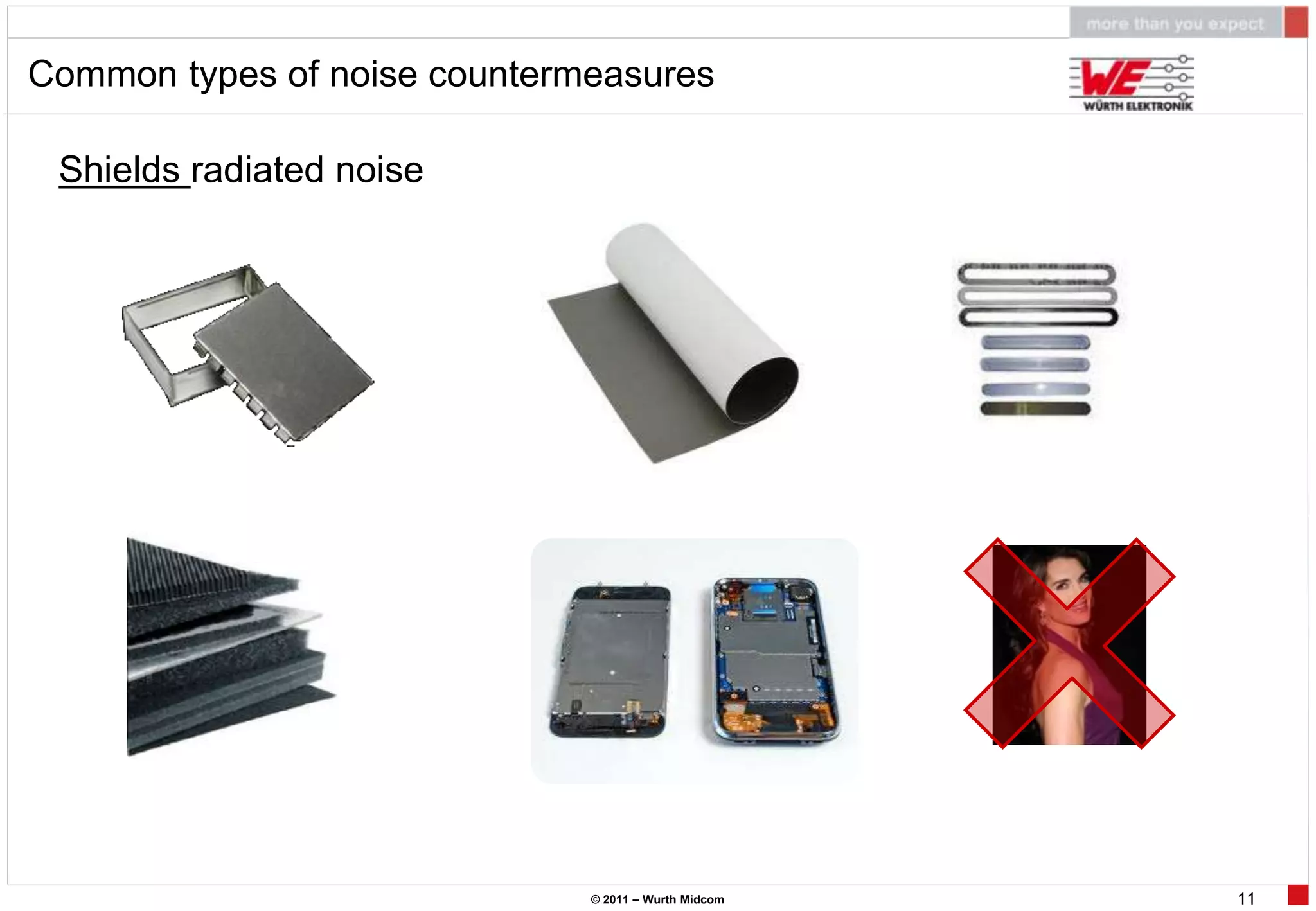
Common types of noise countermeasures

 Shields radiated noise


                              © 2011 – Wurth Midcom   11
Common types of noise countermeasures
Filtering for conducted and radiated noise

                                                          Low Pass Filter


                                                          High Pass Filter


                                                            Band Pass
                                                              Filter


                                                           Band Reject
                                                              Filter


                                  © 2011 – Wurth Midcom                      12
The Magnetic Field (H)

Field model

                          Magnetic field H


                                                 N
                                                               S
                                                 O
                                                               O
                                                 R
                                                               U
                                                 T
                                                               T
                                                 H
                                                               H


              Current I


                                       © 2011 – Wurth Midcom   1313
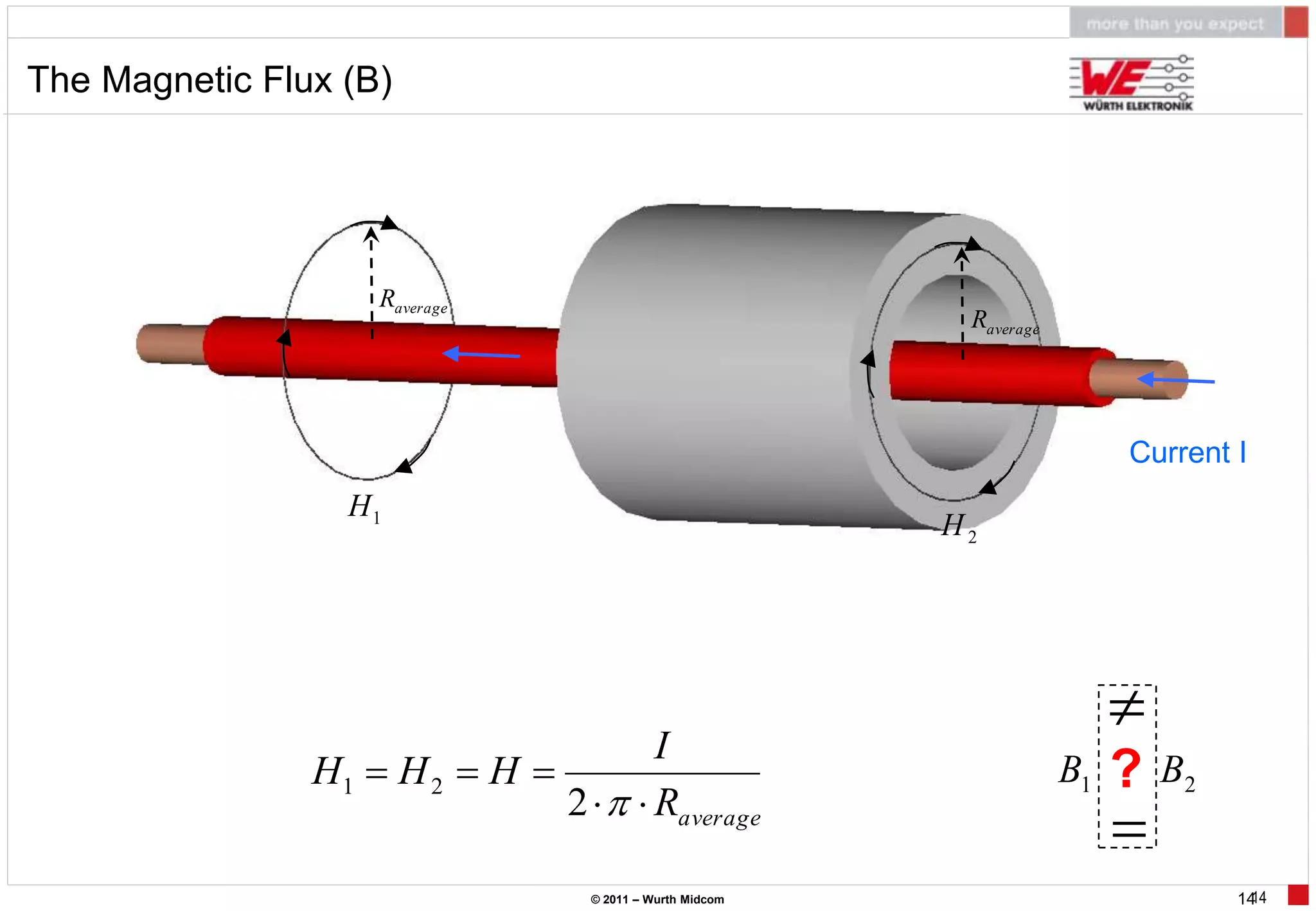
The Magnetic Flux (B)


                    Raverage
                                                            Raverage


                                                                            Current I
                  H1
                                                           H2


                                                                            
                                       I
                H1  H 2  H                                          B1   ?   B2
                               2    Raverage
                                                                            
                                   © 2011 – Wurth Midcom                             1414
The Magnetic Field


     The H field corresponds to what is called the magnetic field strength. It is
                         measured in amps / meter (A/m).


     In free space or in air the B field represents magnetic flux density which is
       given in units of Tesla byB = μₒ H            where μₒ is the absolute
                         magnetic permeability of free space


   More magnetic flux can be produced by the same H value in certain (magnetic)
   materials, notably iron, and this is accounted by introducing another factor, the

      relative permeability μr, giving   B = μₒμr H                for magnetic
                                         materials.


                                          © 2011 – Wurth Midcom                        1515
What is Permeability? µ

   Relative Permeability
   Describes the capacity of concentration of the                                   1 B
                                                                               r 
   magnetic flux in the material                                                    0 H
   Is a factor of energy needed to magnetize


   Typical permeability µr :


            • Iron power / Superflux :                           50 ~ 150
            • Nickel Zinc :                                      40 ~ 1500
            • Manganese Zinc :                                   300 ~ 20000


                                         © 2011 – Wurth Midcom                              1616
The Magnetic Field (H)


                                                 The magnetic field strength
                                                 depends on:
                                            I
Straight wire
                         H                      • dimensions
                                     2   R    • Number of turns
                 R
                                                 • current


                             N I
Toroidal                 H                      but
                 R          2   R
                                                  NOT ON THE MATERIAL
                                                   THROUGH WHICH IT
                                                        FLOWS
                            N I
Rod choke
                         H
                             l
                 l
                         © 2011 – Wurth Midcom                             1717
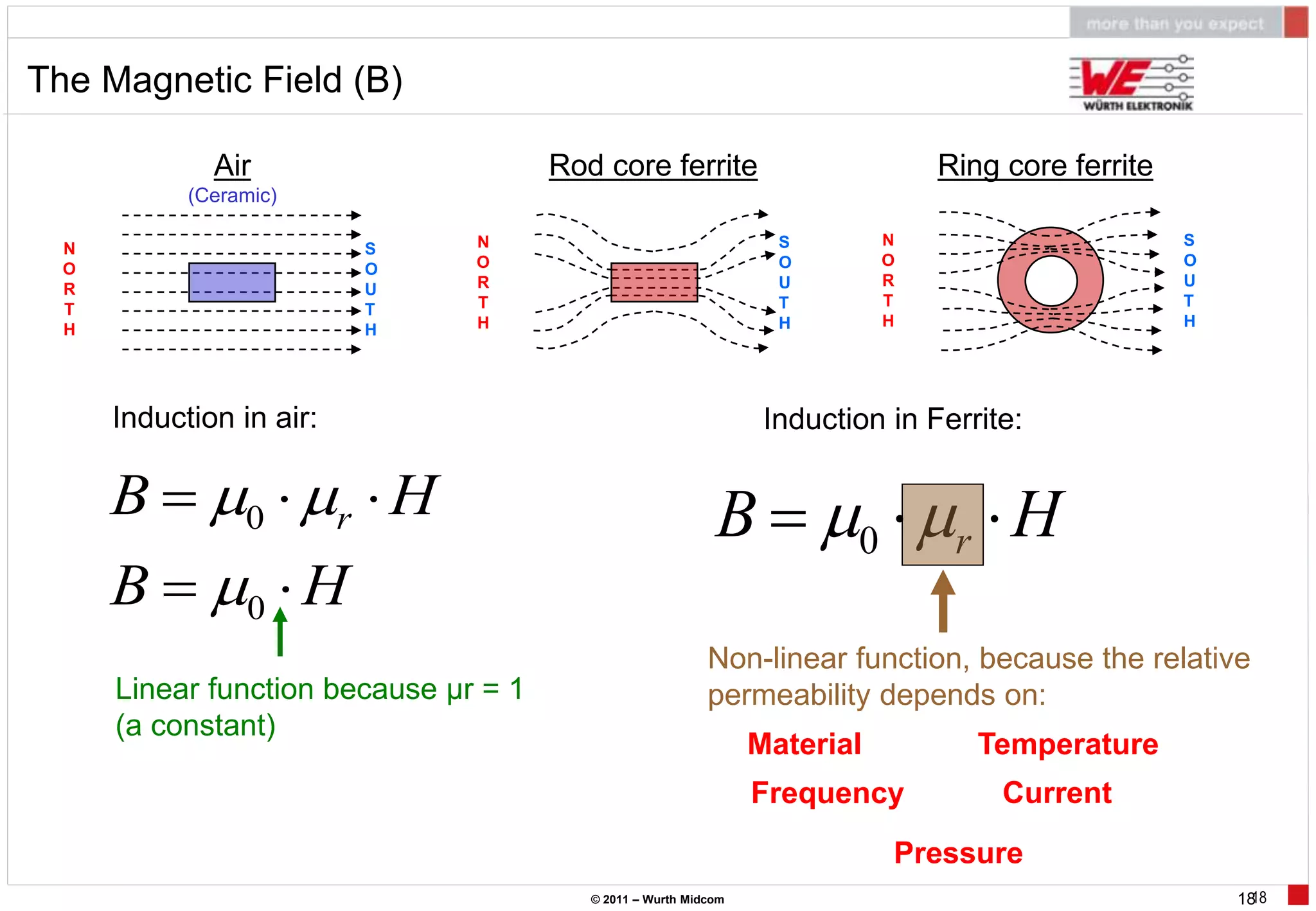
The Magnetic Field (B)

              Air                      Rod core ferrite                          Ring core ferrite
            (Ceramic)

                                N                                   S        N                       S
  N                       S
                                O                                   O        O                       O
  O                       O
                                R                                   U        R                       U
  R                       U
                                T                                   T        T                       T
  T                       T
                                H                                   H        H                       H
  H                       H


      Induction in air:                                            Induction in Ferrite:

      B  0  r  H                                        B  0   r  H
      B  0  H
                                                            Non-linear function, because the relative
      Linear function because µr = 1                        permeability depends on:
      (a constant)
                                                                  Material          Temperature
                                                                  Frequency           Current
                                                                             Pressure
                                          © 2011 – Wurth Midcom                                          1818
Reluctance ( A measure of stored magnetic energy)
Characteristics Magnetic Parameters H and B (Linear & Hysterises Models)
Area of Operation for a Flyback Transformer
Area of Operation for a Filter Inductor
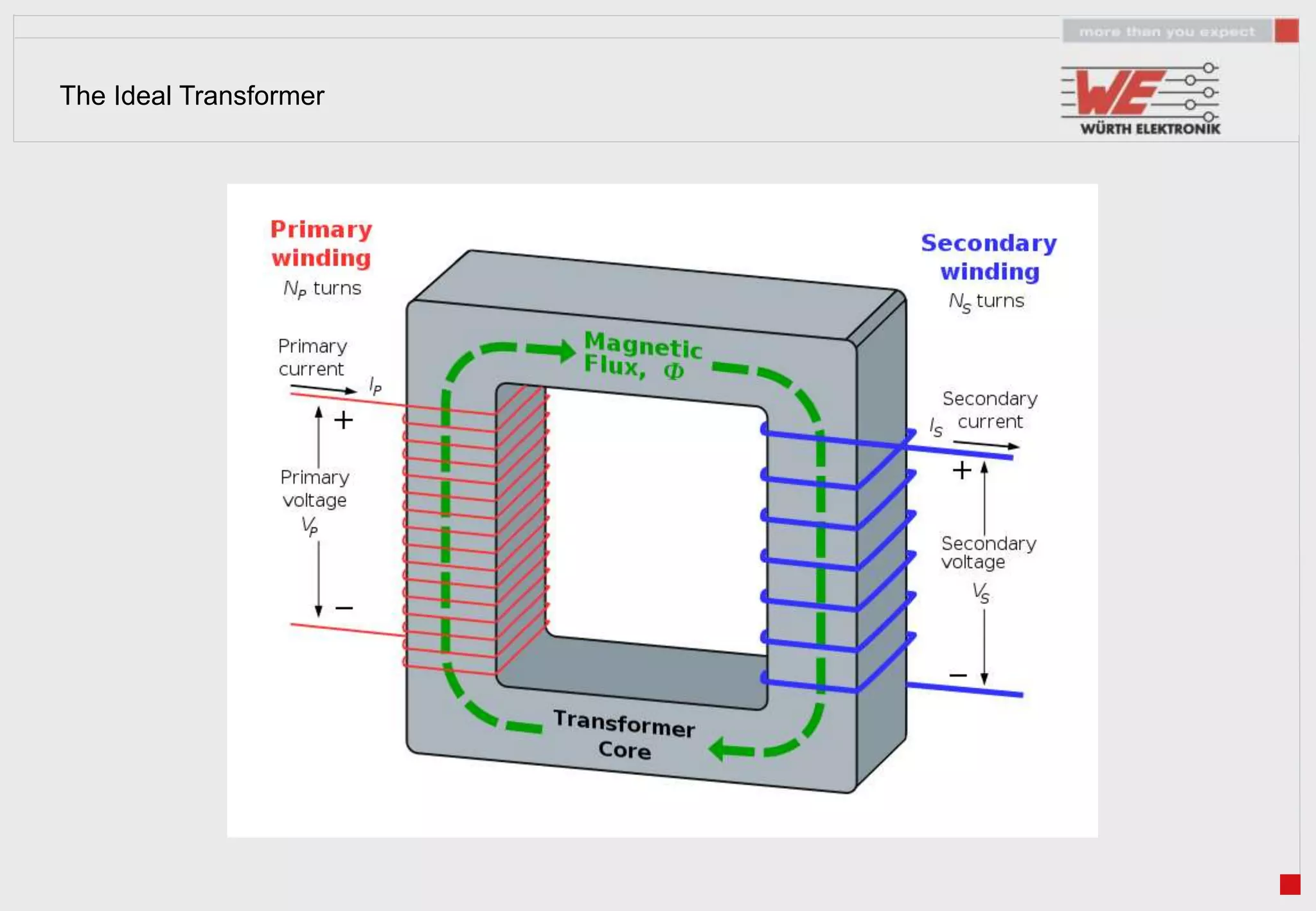
The Ideal Transformer
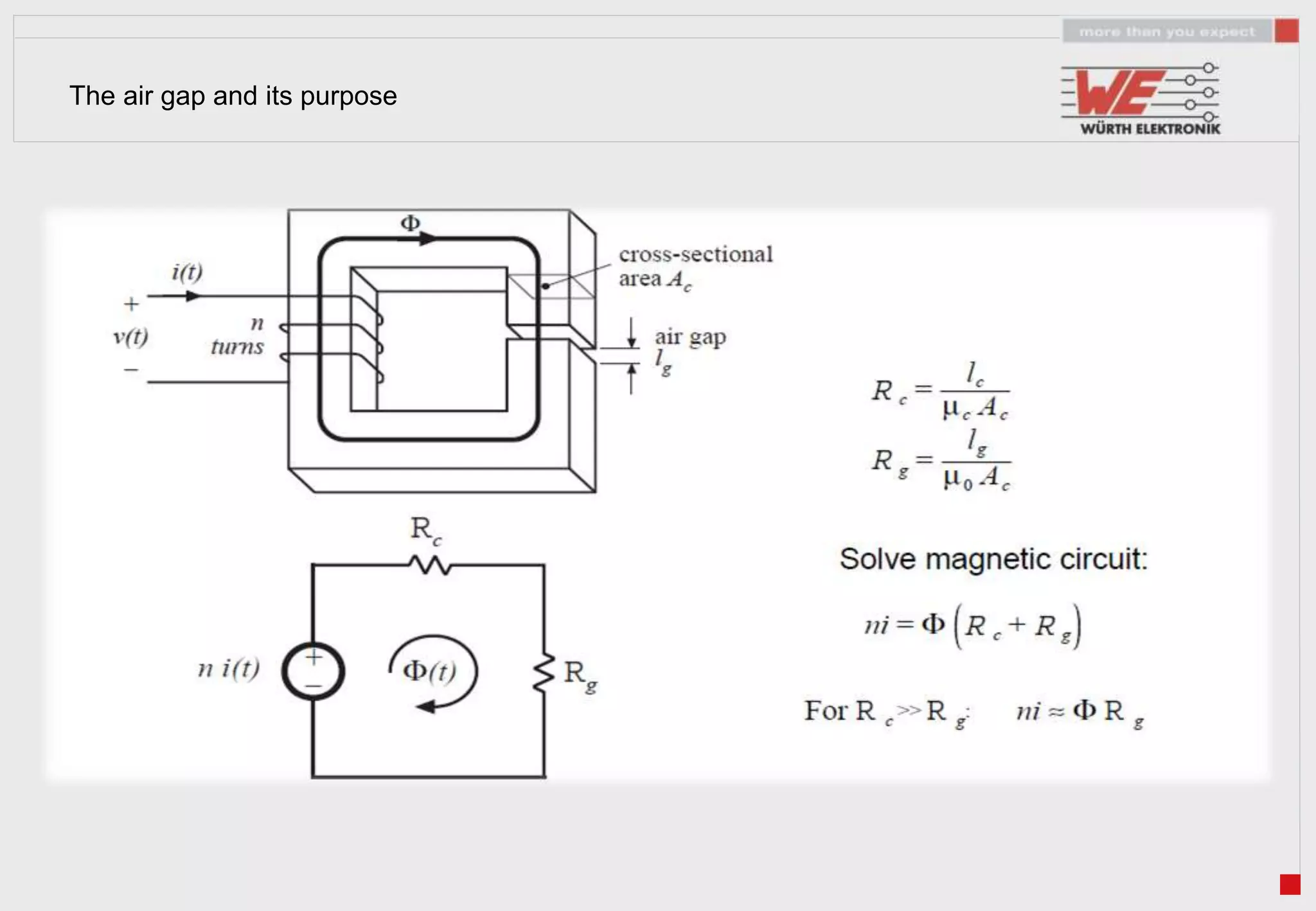
The air gap and its purpose
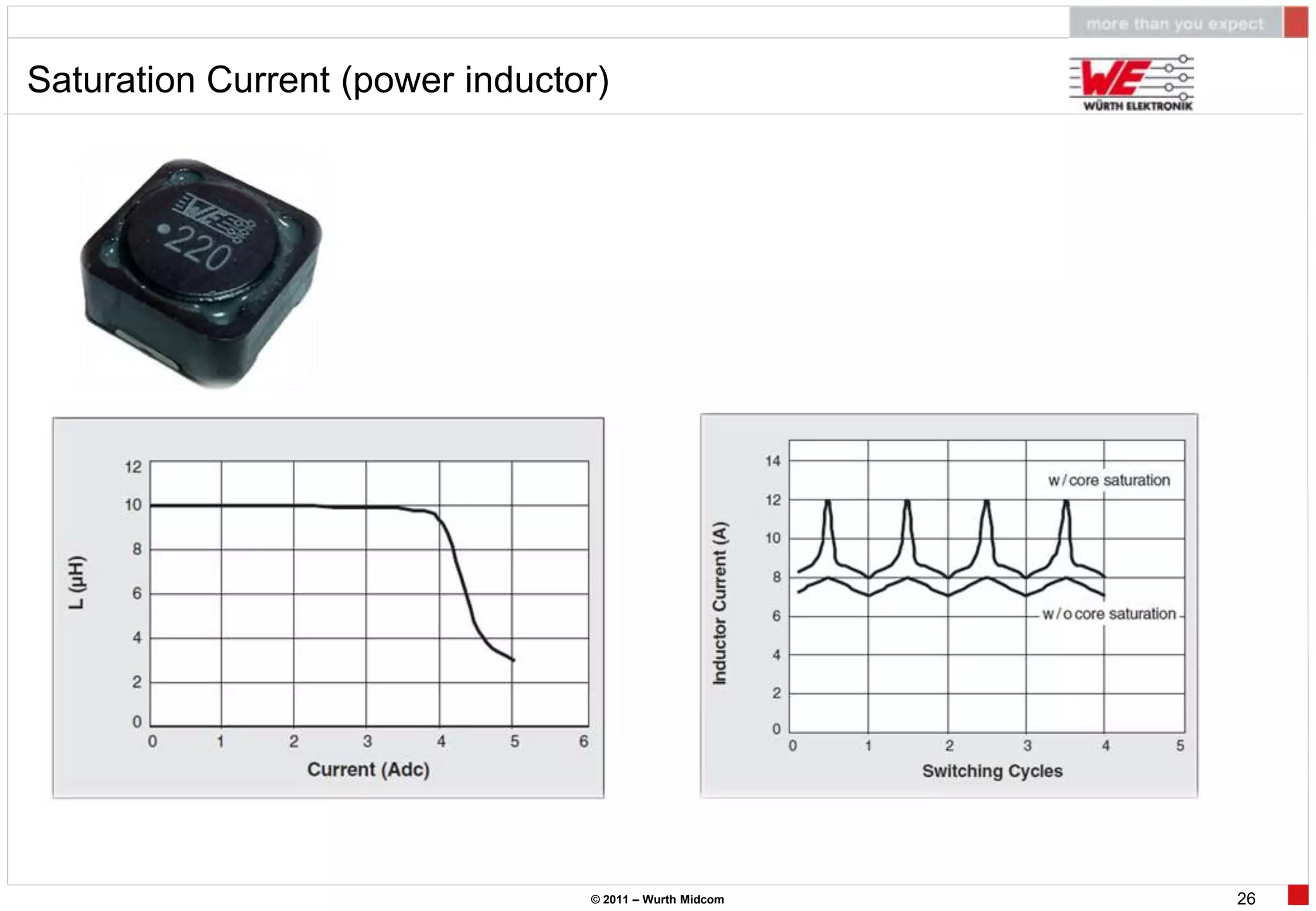
Saturation Current (power inductor)


                                 © 2011 – Wurth Midcom   26
Permeability and Core Material Properties
   Permeability depends on temperature


                                                                                               Curie
                                                                                            Temperature
                             µr


              1000
                                                                                             µr = 1
                                                                                                  ?
        770
+15 %
        670
-20 %
        540
              500


                 -50 -40°C        23°C   50   85°C            150            250   T / °C


                                                     © 2011 – Wurth Midcom                            2727
Permeability – complex Permeability


                     j j j
                                             j
 Impedance of winding with     Impedance of winding
                                       |           || |
                 
                         |     |     ||    ||Core material
      core material             without corematerial


               Z  j L   j j  RjX jX 
                          | L |  ||  ||   j jX
                  Z  j L 0 j    R   
                    Z  j        |         || |            ||
                                                   R
                               0       0


          R
                                   L 0
          L

                                     © 2011 – Wurth Midcom   28
|
                                  j
                               ||
Permeability – complex permeability

                                            
                              Z  jL0   j  R  jX
                                                |                   ||
                                                                         
                   10000
                                                                                      µr=350


                       1000

                                  µ`


X L  jL0        |
                        100
                                                                                                       RReihe1 L0  ||
                                                                                                          
Inductance reactance                                                         µ``                  Frequency dependent
(energy storage)
                                                                                                  core losses
                                                                                                  (hysteresis & eddy current losses)

                         10


                          1                                                                            f/MHz
                              1        10              100                     1000            10000
                                                © 2011 – Wurth Midcom                                                         2929
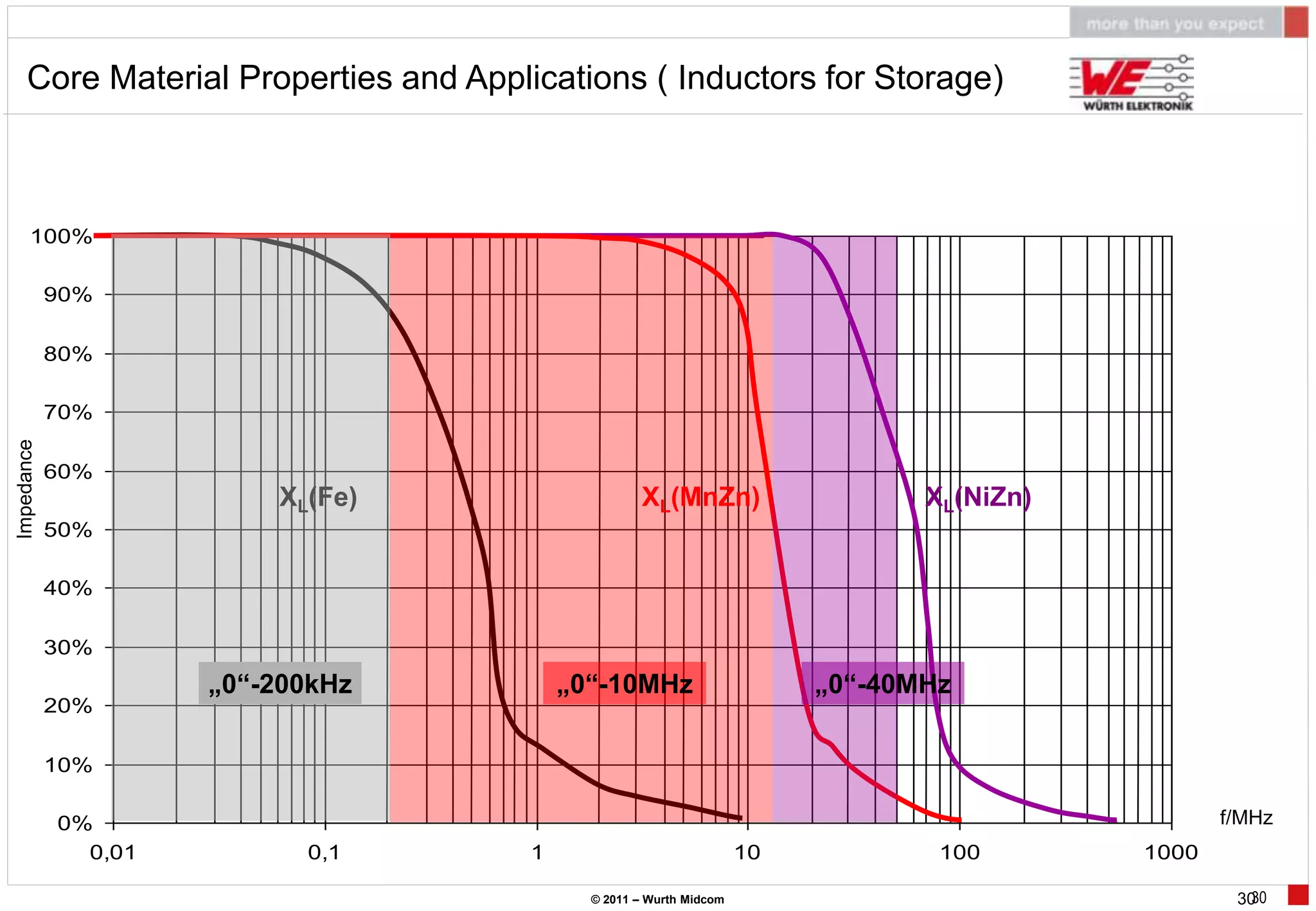
Core Material Properties and Applications ( Inductors for Storage)


      100%

            90%

            80%

            70%
Impedance


            60%
                         XL(Fe)                    XL(MnZn)                     XL(NiZn)
            50%

            40%

            30%
                     „0“-200kHz           „0“-10MHz                      „0“-40MHz
            20%

            10%

            0%                                                                                    f/MHz
              0,01         0,1        1                             10           100       1000

                                            © 2011 – Wurth Midcom                                  3030
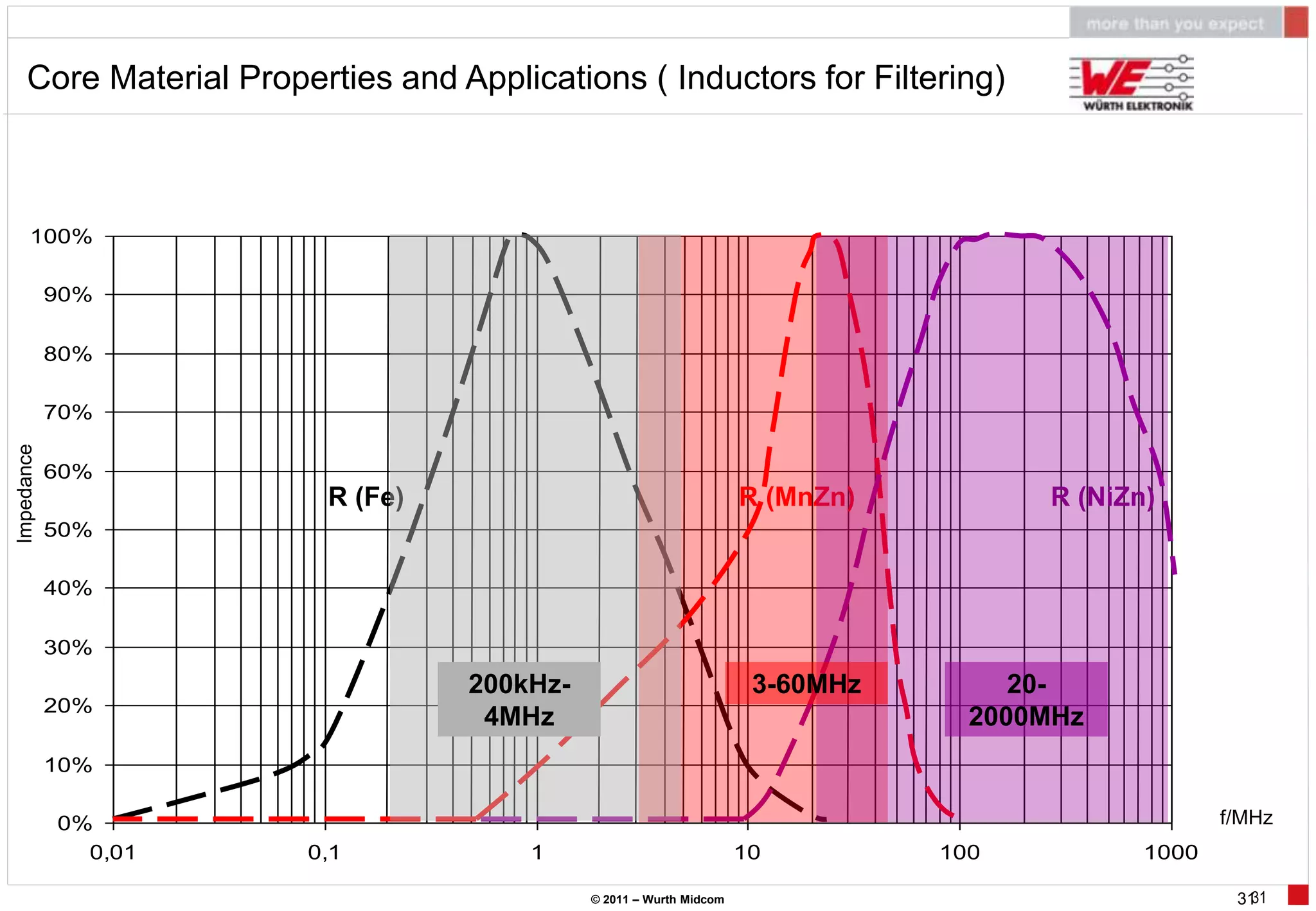
Core Material Properties and Applications ( Inductors for Filtering)


      100%

            90%

            80%

            70%
Impedance


            60%
                        R (Fe)                                      R (MnZn)         R (NiZn)
            50%

            40%

            30%
                                  200kHz-                            3-60MHz        20-
            20%
                                   4MHz                                          2000MHz
            10%

            0%                                                                                     f/MHz
              0,01     0,1             1                            10         100          1000

                                            © 2011 – Wurth Midcom                                   3131
Common Mode Filter

Reduction of noise
• From device to environment
• From environment to device


Conclusion:
• “Almost” no influencing of the signal  Differential mode
• High attenuation of noise                    Common mode
                                  © 2011 – Wurth Midcom       3232
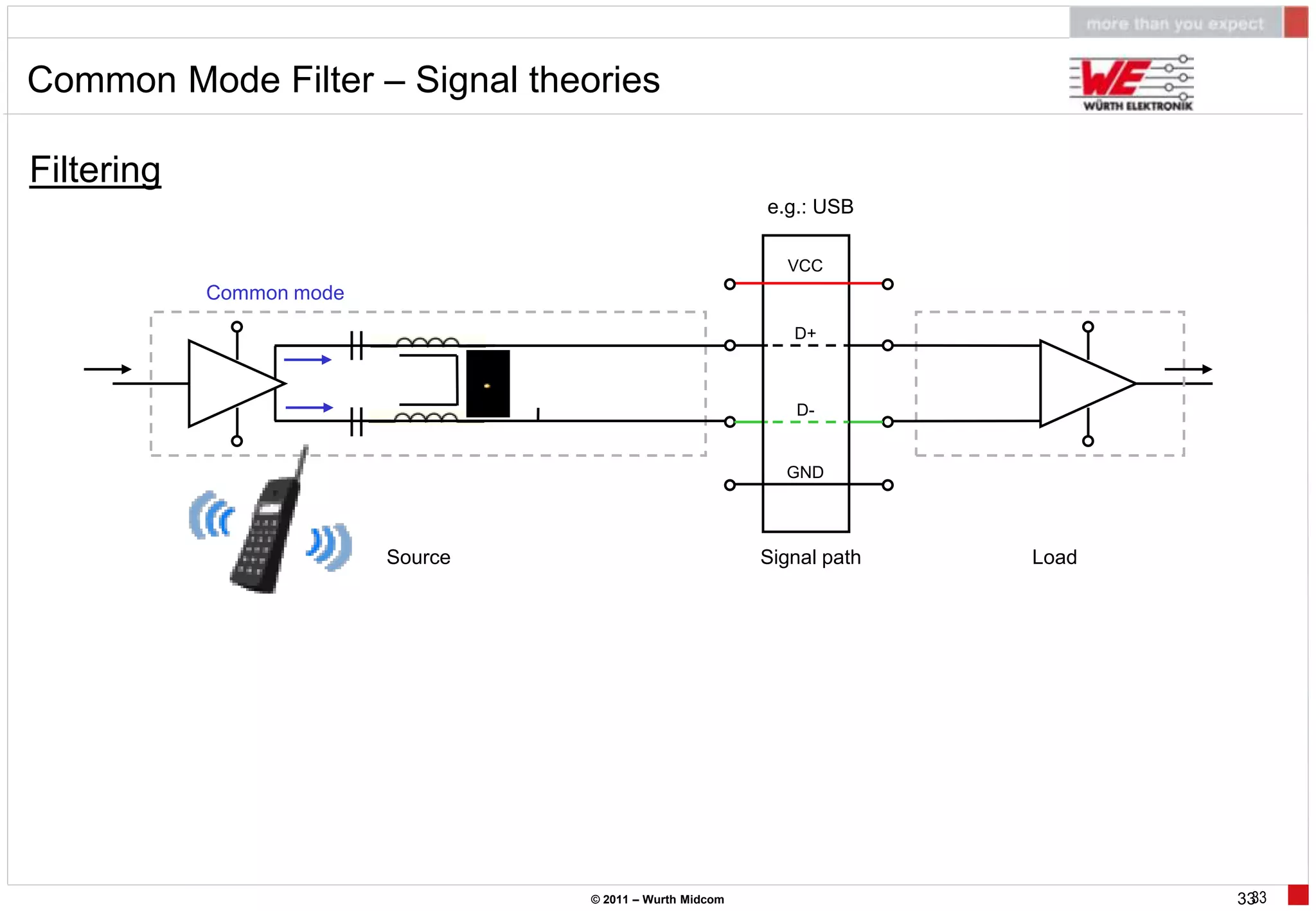
Common Mode Filter – Signal theories

Filtering
                                                           e.g.: USB

                                                             VCC
            Common mode
                                                              D+


                                                              D-


                                                             GND


                          Source                           Signal path   Load


                                   © 2011 – Wurth Midcom                        3333
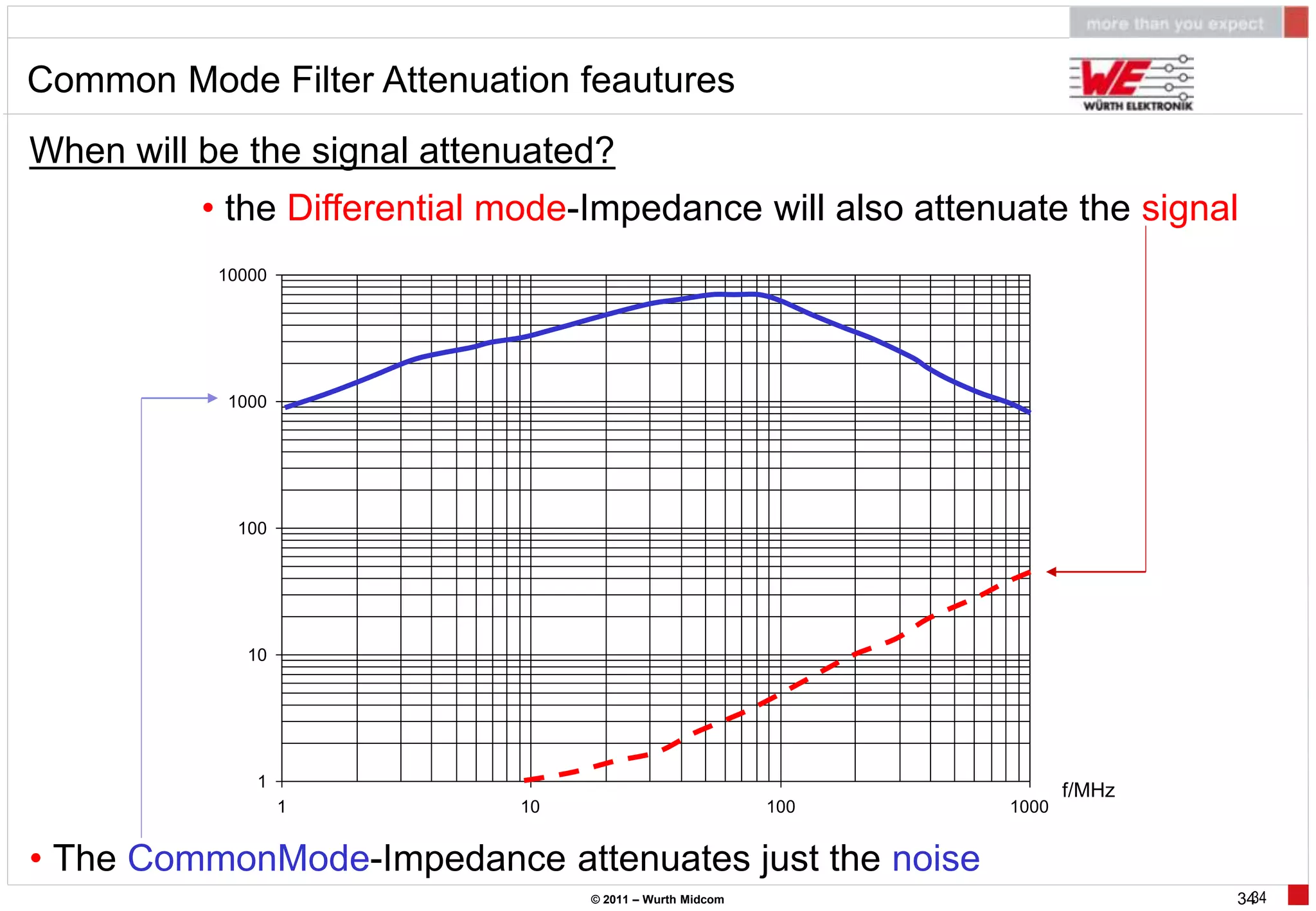
Common Mode Filter Attenuation feautures
When will be the signal attenuated?
          • the Differential mode-Impedance will also attenuate the signal
           10000


            1000


             100


              10


               1
                                                                       f/MHz
                   1         10                           100   1000


• The CommonMode-Impedance attenuates just the noise
                                  © 2011 – Wurth Midcom                        3434
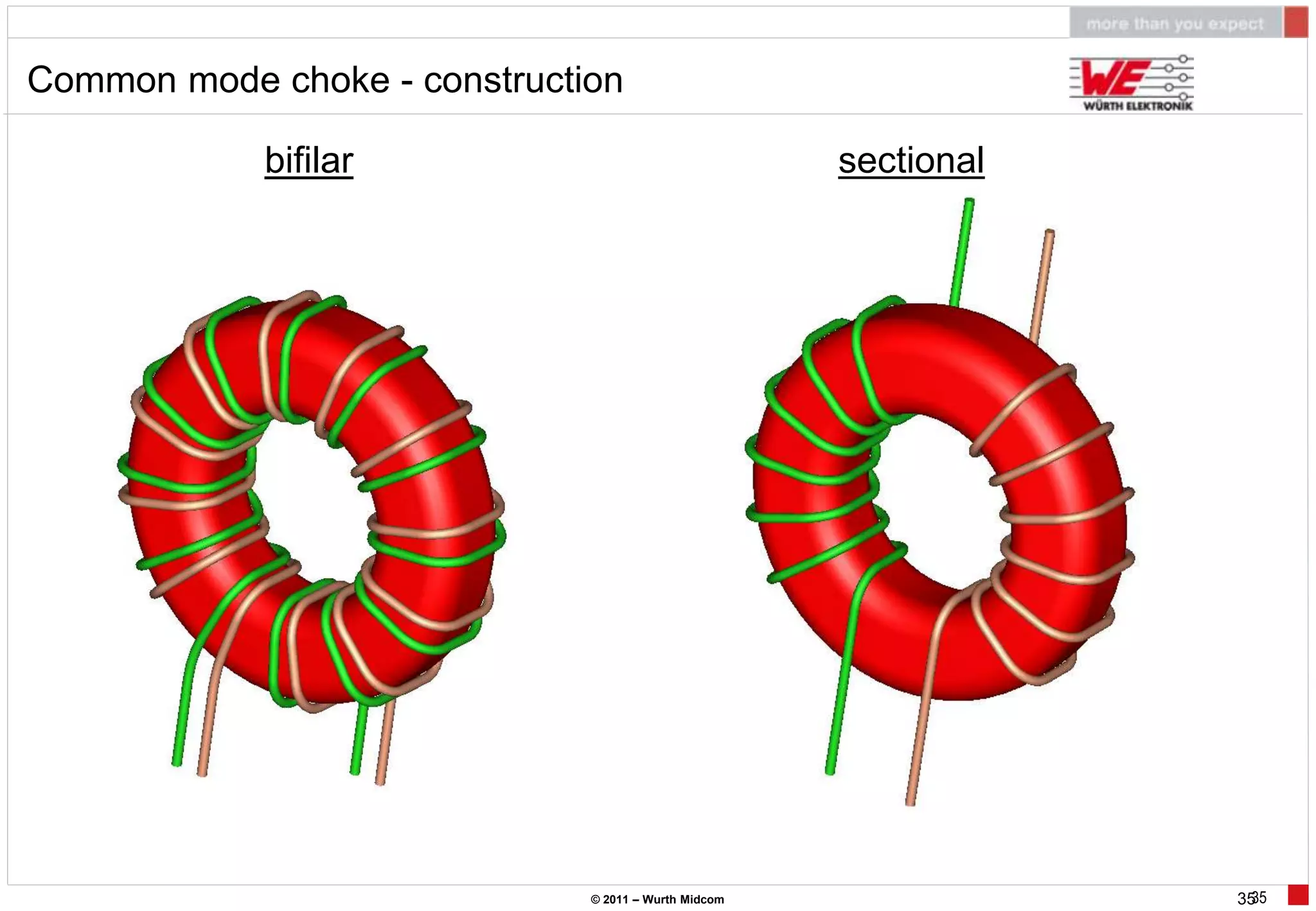
Common mode choke - construction

            bifilar                                   sectional


                              © 2011 – Wurth Midcom               3535
Common mode choke - construction

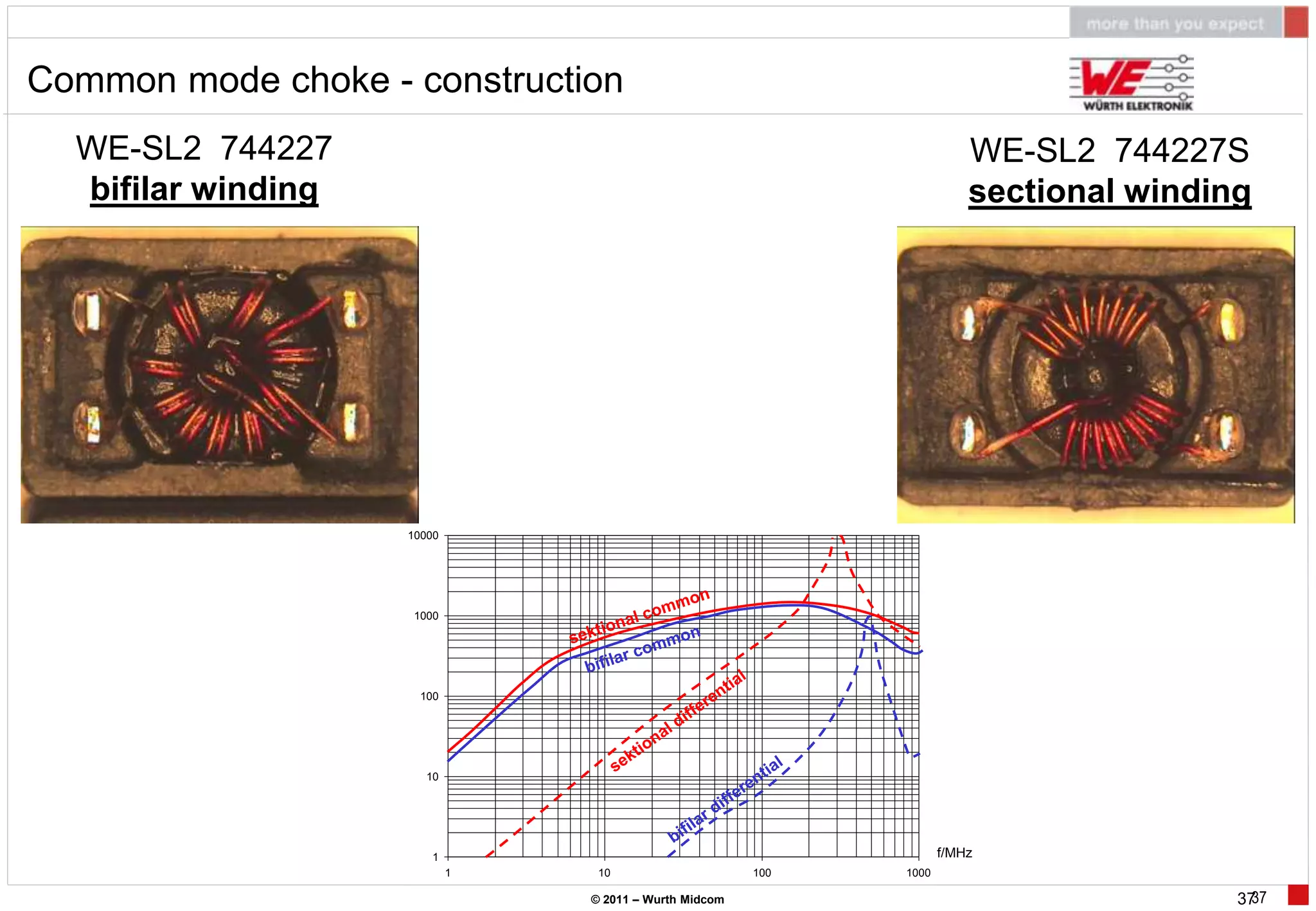
              Bifilar                                                     Sectional
        • Less differential impedance                           • Low capacitive coupling
        • High capacitive coupling                              • High leakage inductance
        • Less leakage inductance                               • High differential impedance


        • Data lines                                              • Power supply input /output filter
          USB, Fire-wire, CAN, etc.                                CMC for mains power
        • Power supply                                            • High voltage application
        • Measuring lines                                         • Measuring lines
        • Sensor lines                                            • Switching power supply decoupling


                                        © 2011 – Wurth Midcom                                           3636
Common mode choke - construction
  WE-SL2 744227                                                          WE-SL2 744227S
  bifilar winding                                                        sectional winding


                    10000


                     1000


                      100


                       10


                        1                                            f/MHz
                            1    10                     100   1000

                                © 2011 – Wurth Midcom                                    3737
Common mode choke - construction

WE-split ferrite – Is it a CMC?
• Yes, CMC with one winding

             e.g. 74271712                       comparable with bifilar winding CMC


• both will absorb Common Mode interferences
                                  © 2011 – Wurth Midcom                                3838
Common mode choke: ferrite core

Increase the number of turns means:


        2000

        1800

        1600

        1400

        1200

        1000

         800

         600

         400

         200

           0
                                                                 f/MHz
               1       10                  100            1000

                                  © 2011 – Wurth Midcom                  3939
40
Why Filter? – example: Fly back-Converter


Which filter we need?


   L1


   N


   P
   E


Parasitic capacities
  e.g.: collector to cooling element
Transformers
Transformers and EMI


• Center leg gap only
   – Windings shield
• No gaps in outer legs
   – Nothing to shield


        No Gaps here
           Gap here

   No external gaps
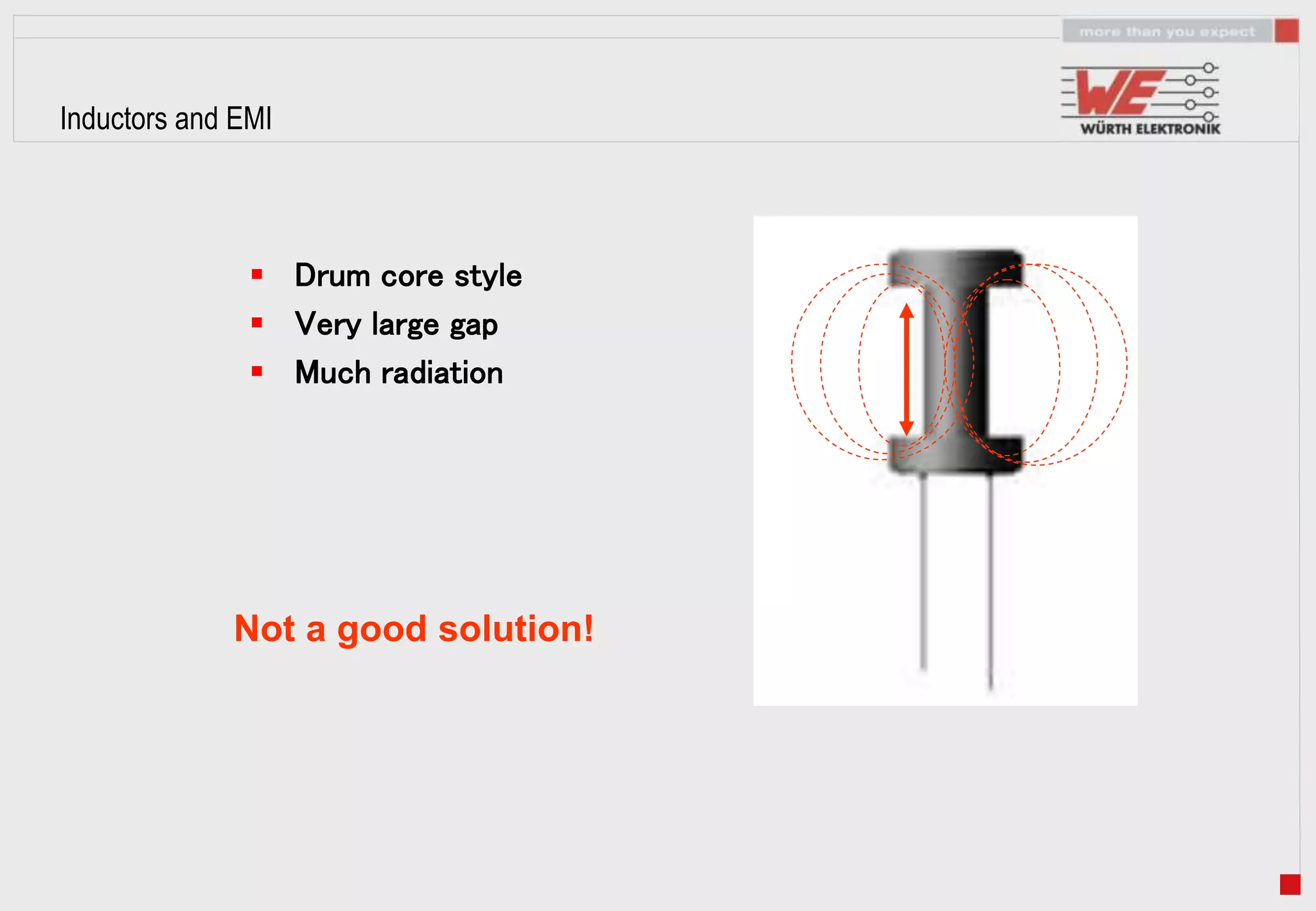
Inductors and EMI


                Drum core style
                Very large gap
                Much radiation


             Not a good solution!
Transformers for EMI – Gap issues


• Gap must be perpendicular to flux lines
• Uneven gaps are inefficient. => Why?
   – Core saturates at minimum gap
   – Requires a larger gap
• Also larger gap – More potential EMI
Transformers and EMI – Internal shields


• Shield both conducted and radiated noise
• Copper foil or wound magnet wire?
• Copper foil shields – Expensive, => Why?
     – Must build shield
     – Must be covered with tape
     – Winding machine stopped to apply
• All shields take away from winding area


                                             Internal
                                              shield
Transformers and EMI
  Y-Cap termination


  Noise couples through the transformer via
   CParasitic
    • Noise seeks path to primary circuit
    • Without path, noise may become conducted
       emissions


• Y-Cap across transformer reduces noise
   • Tune the capacitor for optimum loss vs. noise
     reduction
   • Capacitor usually in the 470pF to 4.7nF range
   • Place as close to transformer as possible
Transformers for EMI – Power Supply


Current CompensatedSnubber                Y-Cap
Choke WE-FC                            Transformer


                                             Output filter
                                             WE-TI


                                               Switch IC
Transformers for EMC – Schematic

  Current Compensated              Snubber   Transformer   Y-Cap   Output filter
  Choke WE-FC                                                      WE-TI


                Switch IC
Transformers for EMC – Example 1


                                   • With adjusted Snubber
                                   • Without common mode choke
                                   • Without adjusted Y-Cap


                                     QPeak
                                                Avg.
                                     Peak
                                                Avg.


        EMC- Test Failed
Transformers for EMC – Example 2


                                   • With adjusted Snubber
                                   • With common mode choke
                                   • Without adjusted Y-Cap


                                   QPeak
                                            Avg.
                                   Peak
                                            Avg.


     EMC- Test Failed
Transformers for EMC – Example 3


                                   • With adjusted Snubber
                                   • With common mode choke
                                   • Without adjusted Y-Cap

                                   QPeak
                                             Avg.
                                   Peak
                                             Avg.


   EMC- Passed
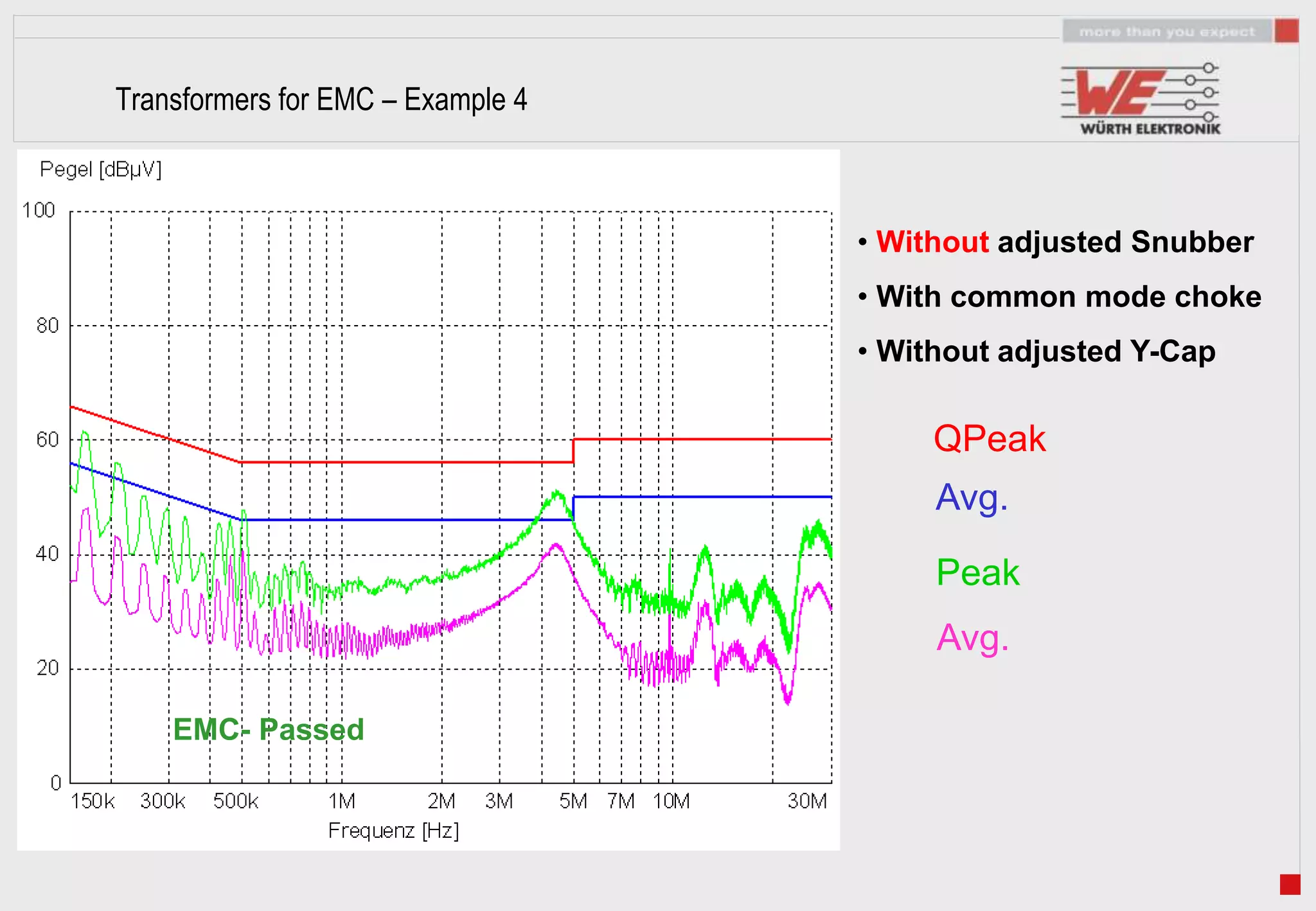
Transformers for EMC – Example 4


                                   • Without adjusted Snubber
                                   • With common mode choke
                                   • Without adjusted Y-Cap

                                        QPeak
                                        Avg.

                                        Peak
                                        Avg.

    EMC- Passed
Transformer for EMC – Conclusion for this power supply


•   Necessary to pass EMI:
     – Current compensated Choke
        (CMC)
     – Y-Caps
•   Not necessary to pass EMI
     – Optimized Snubber
Simple EMI detector

Seminario - Würth Elektronik

  • 1.
    2011 WURTH ELECTRONICS MIDCOM SMPS EMI SEMINAR 2011 Introduction to Concepts and Techniques © 2011 – Wurth Midcom 1 1
  • 2.
    Our Products © 2011 – Wurth Midcom 2
  • 3.
    http://www.we-online.com/ http://www.we-online.com/web/en/passive_bauelemente_- _standard/toolbox_pbs/Toolbox.php Wurth Electronics Midcom Inc. Headquarters Phone: (605) 886-4385 Fax: (605) 886-4486 E-Mail: midcom@we-online.com 121 Airport Drive Watertown, SD 57201 United States
  • 4.
    An Excellent Resourcefor EMC TRILOGY of Magnetics 1. Electromagnetics Fundamentals 2. Passive Components and their characterisitics 3. Principles of Filter 4. Over 300 Detailed Applications © 2011 – Wurth Midcom 4
  • 5.
    Basics EMI= Electromagnetic Interference How much a device„s own noise affects other components EMC = Electromagnetic Compatibiltiy How well a device can handle noise from other components NOT THIS: E= 2 OR THIS: HipHop Band © 2011 – Wurth Midcom 5
  • 6.
    EMI / EMC(CISPR vs. FCC) CISPR* (22) Non-regulatory agency, but CISPR has been adopted as part of the EMC tests and limits 0.15MHz to 30MHz - conducted 30MHz to 1000MHz - radiated >1000MHz - accordance to FCC FCC** (15) Regulatory agency that sets the USA EMC tests and limits 0.15MHz to 30MHz - conducted 30MHz to 1000MHz - radiated * International Special Community on Radio Interference, Pub.22 ** Federal Communications Comission, Part 15 © 2011 – Wurth Midcom 6
  • 7.
    CISPR vs. FCC 960-1000 Class A 0.5 1.6 5 30 88 216 0.15 - 0.5 0.5 - 30 30 - 88 88 - 216 216 - 960 >1000 0.45 – 1.6 1.6 - 30 30 - 88 88 - 216 216 - 1000 >1000 Class B 0.15 - 0.5 0.5 - 5 5 - 30 30 - 88 88 - 216 216 - 960 >1000 0.455 – 1.6 1.6 - 30 30 - 88 88 - 216 216 - 1000 >1000 f [MHz] 0.1 1 10 100 1000 differential mode noise common mode noise • Class A  commercial, industrial, business environment equipment • Class B  residential environment equipment f [MHz] CISPR 22 - conducted f [MHz] FCC 15 - conducted f [MHz] CISPR 22 - radiated f [MHz] FCC 15 - radiated © 2011 – Wurth Midcom 7
  • 8.
    Basics Why 30Mhzthe cutoff between the conducted and radiated emissions? 30 MHz is roughly equivalent to a wavelenght of ~32 feet (10 meters) 900 MHz is roughly equivalent to a wavelenght of 1 foot (~.33 meters) In practical terms, the wavelength of a signal and the length of its an antenna need to be equal to radiate the signal at full power Most common house cables, wires or power lines are less than 10 meters long! Short little cables are unlikely to radiate noise below 30MHz © 2011 – Wurth Midcom 8
  • 9.
    Types of NoiseSignals Differential–Mode signal Common–Mode signal • Noise flows into one line and • Noise flows along both lines exits through another in the same direction •Independent from GND • returns by some parasitics path through system GND switching switching supply supply connection chassis & connection chassis & Earth GND Earth GND © 2011 – Wurth Midcom 9
  • 10.
    CISPR vs. FCC 960-1000 Class A 0.5 1.6 5 30 88 216 0.15 - 0.5 0.5 - 30 30 - 88 88 - 216 216 - 960 >1000 0.45 – 1.6 1.6 - 30 30 - 88 88 - 216 216 - 1000 >1000 Class B 0.15 - 0.5 0.5 - 5 5 - 30 30 - 88 88 - 216 216 - 960 >1000 0.455 – 1.6 1.6 - 30 30 - 88 88 - 216 216 - 1000 >1000 f [MHz] 0.1 1 10 100 1000 differential mode noise common mode noise • Class A  commercial, industrial, business environment equipment • Class B  residential environment equipment f [MHz] CISPR 22 - conducted f [MHz] FCC 15 - conducted f [MHz] CISPR 22 - radiated f [MHz] FCC 15 - radiated © 2011 – Wurth Midcom 10
  • 11.
    Common types ofnoise countermeasures Shields radiated noise © 2011 – Wurth Midcom 11
  • 12.
    Common types ofnoise countermeasures Filtering for conducted and radiated noise Low Pass Filter High Pass Filter Band Pass Filter Band Reject Filter © 2011 – Wurth Midcom 12
  • 13.
    The Magnetic Field(H) Field model Magnetic field H N S O O R U T T H H Current I © 2011 – Wurth Midcom 1313
  • 14.
    The Magnetic Flux(B) Raverage Raverage Current I H1 H2  I H1  H 2  H  B1 ? B2 2    Raverage  © 2011 – Wurth Midcom 1414
  • 15.
    The Magnetic Field The H field corresponds to what is called the magnetic field strength. It is measured in amps / meter (A/m). In free space or in air the B field represents magnetic flux density which is given in units of Tesla byB = μₒ H where μₒ is the absolute magnetic permeability of free space More magnetic flux can be produced by the same H value in certain (magnetic) materials, notably iron, and this is accounted by introducing another factor, the relative permeability μr, giving B = μₒμr H for magnetic materials. © 2011 – Wurth Midcom 1515
  • 16.
    What is Permeability?µ Relative Permeability Describes the capacity of concentration of the 1 B r  magnetic flux in the material 0 H Is a factor of energy needed to magnetize Typical permeability µr : • Iron power / Superflux : 50 ~ 150 • Nickel Zinc : 40 ~ 1500 • Manganese Zinc : 300 ~ 20000 © 2011 – Wurth Midcom 1616
  • 17.
    The Magnetic Field(H) The magnetic field strength depends on: I Straight wire H • dimensions 2   R • Number of turns R • current N I Toroidal H but R 2   R NOT ON THE MATERIAL THROUGH WHICH IT FLOWS N I Rod choke H l l © 2011 – Wurth Midcom 1717
  • 18.
    The Magnetic Field(B) Air Rod core ferrite Ring core ferrite (Ceramic) N S N S N S O O O O O O R U R U R U T T T T T T H H H H H H Induction in air: Induction in Ferrite: B  0  r  H B  0   r  H B  0  H Non-linear function, because the relative Linear function because µr = 1 permeability depends on: (a constant) Material Temperature Frequency Current Pressure © 2011 – Wurth Midcom 1818
  • 19.
    Reluctance ( Ameasure of stored magnetic energy)
  • 20.
    Characteristics Magnetic ParametersH and B (Linear & Hysterises Models)
  • 21.
    Area of Operationfor a Flyback Transformer
  • 22.
    Area of Operationfor a Filter Inductor
  • 23.
  • 24.
    The air gapand its purpose
  • 25.
    The air gapand its purpose
  • 26.
    Saturation Current (powerinductor) © 2011 – Wurth Midcom 26
  • 27.
    Permeability and CoreMaterial Properties Permeability depends on temperature Curie Temperature µr 1000 µr = 1 ? 770 +15 % 670 -20 % 540 500 -50 -40°C 23°C 50 85°C 150 250 T / °C © 2011 – Wurth Midcom 2727
  • 28.
    Permeability – complexPermeability  j j j       j Impedance of winding with Impedance of winding | || |     | | || ||Core material core material without corematerial Z  j L   j j  RjX jX  | L |  ||  ||   j jX Z  j L 0 j    R    Z  j | || | || R 0 0 R L 0 L © 2011 – Wurth Midcom 28
  • 29.
    |     j || Permeability – complex permeability  Z  jL0   j  R  jX | ||  10000 µr=350 1000 µ` X L  jL0  | 100 RReihe1 L0  ||  Inductance reactance µ`` Frequency dependent (energy storage) core losses (hysteresis & eddy current losses) 10 1 f/MHz 1 10 100 1000 10000 © 2011 – Wurth Midcom 2929
  • 30.
    Core Material Propertiesand Applications ( Inductors for Storage) 100% 90% 80% 70% Impedance 60% XL(Fe) XL(MnZn) XL(NiZn) 50% 40% 30% „0“-200kHz „0“-10MHz „0“-40MHz 20% 10% 0% f/MHz 0,01 0,1 1 10 100 1000 © 2011 – Wurth Midcom 3030
  • 31.
    Core Material Propertiesand Applications ( Inductors for Filtering) 100% 90% 80% 70% Impedance 60% R (Fe) R (MnZn) R (NiZn) 50% 40% 30% 200kHz- 3-60MHz 20- 20% 4MHz 2000MHz 10% 0% f/MHz 0,01 0,1 1 10 100 1000 © 2011 – Wurth Midcom 3131
  • 32.
    Common Mode Filter Reductionof noise • From device to environment • From environment to device Conclusion: • “Almost” no influencing of the signal  Differential mode • High attenuation of noise  Common mode © 2011 – Wurth Midcom 3232
  • 33.
    Common Mode Filter– Signal theories Filtering e.g.: USB VCC Common mode D+ D- GND Source Signal path Load © 2011 – Wurth Midcom 3333
  • 34.
    Common Mode FilterAttenuation feautures When will be the signal attenuated? • the Differential mode-Impedance will also attenuate the signal 10000 1000 100 10 1 f/MHz 1 10 100 1000 • The CommonMode-Impedance attenuates just the noise © 2011 – Wurth Midcom 3434
  • 35.
    Common mode choke- construction bifilar sectional © 2011 – Wurth Midcom 3535
  • 36.
    Common mode choke- construction Bifilar Sectional • Less differential impedance • Low capacitive coupling • High capacitive coupling • High leakage inductance • Less leakage inductance • High differential impedance • Data lines • Power supply input /output filter  USB, Fire-wire, CAN, etc.  CMC for mains power • Power supply • High voltage application • Measuring lines • Measuring lines • Sensor lines • Switching power supply decoupling © 2011 – Wurth Midcom 3636
  • 37.
    Common mode choke- construction WE-SL2 744227 WE-SL2 744227S bifilar winding sectional winding 10000 1000 100 10 1 f/MHz 1 10 100 1000 © 2011 – Wurth Midcom 3737
  • 38.
    Common mode choke- construction WE-split ferrite – Is it a CMC? • Yes, CMC with one winding e.g. 74271712 comparable with bifilar winding CMC • both will absorb Common Mode interferences © 2011 – Wurth Midcom 3838
  • 39.
    Common mode choke:ferrite core Increase the number of turns means: 2000 1800 1600 1400 1200 1000 800 600 400 200 0 f/MHz 1 10 100 1000 © 2011 – Wurth Midcom 3939
  • 40.
    40 Why Filter? –example: Fly back-Converter Which filter we need? L1 N P E Parasitic capacities e.g.: collector to cooling element
  • 41.
  • 42.
    Transformers and EMI •Center leg gap only – Windings shield • No gaps in outer legs – Nothing to shield No Gaps here Gap here No external gaps
  • 43.
    Inductors and EMI  Drum core style  Very large gap  Much radiation Not a good solution!
  • 44.
    Transformers for EMI– Gap issues • Gap must be perpendicular to flux lines • Uneven gaps are inefficient. => Why? – Core saturates at minimum gap – Requires a larger gap • Also larger gap – More potential EMI
  • 45.
    Transformers and EMI– Internal shields • Shield both conducted and radiated noise • Copper foil or wound magnet wire? • Copper foil shields – Expensive, => Why? – Must build shield – Must be covered with tape – Winding machine stopped to apply • All shields take away from winding area Internal shield
  • 46.
    Transformers and EMI Y-Cap termination  Noise couples through the transformer via CParasitic • Noise seeks path to primary circuit • Without path, noise may become conducted emissions • Y-Cap across transformer reduces noise • Tune the capacitor for optimum loss vs. noise reduction • Capacitor usually in the 470pF to 4.7nF range • Place as close to transformer as possible
  • 47.
    Transformers for EMI– Power Supply Current CompensatedSnubber Y-Cap Choke WE-FC Transformer Output filter WE-TI Switch IC
  • 48.
    Transformers for EMC– Schematic Current Compensated Snubber Transformer Y-Cap Output filter Choke WE-FC WE-TI Switch IC
  • 49.
    Transformers for EMC– Example 1 • With adjusted Snubber • Without common mode choke • Without adjusted Y-Cap QPeak Avg. Peak Avg. EMC- Test Failed
  • 50.
    Transformers for EMC– Example 2 • With adjusted Snubber • With common mode choke • Without adjusted Y-Cap QPeak Avg. Peak Avg. EMC- Test Failed
  • 51.
    Transformers for EMC– Example 3 • With adjusted Snubber • With common mode choke • Without adjusted Y-Cap QPeak Avg. Peak Avg. EMC- Passed
  • 52.
    Transformers for EMC– Example 4 • Without adjusted Snubber • With common mode choke • Without adjusted Y-Cap QPeak Avg. Peak Avg. EMC- Passed
  • 53.
    Transformer for EMC– Conclusion for this power supply • Necessary to pass EMI: – Current compensated Choke (CMC) – Y-Caps • Not necessary to pass EMI – Optimized Snubber
  • 54.