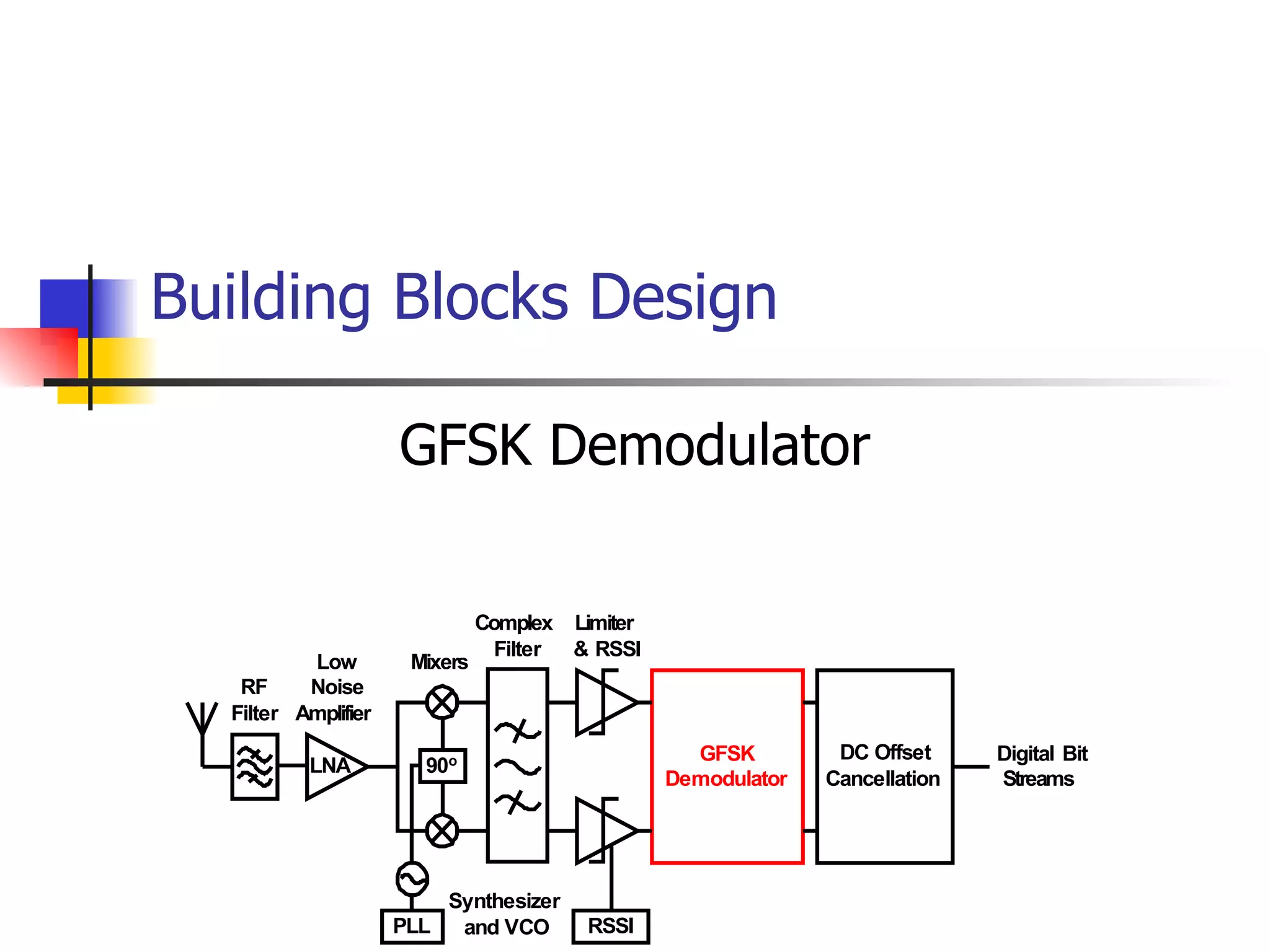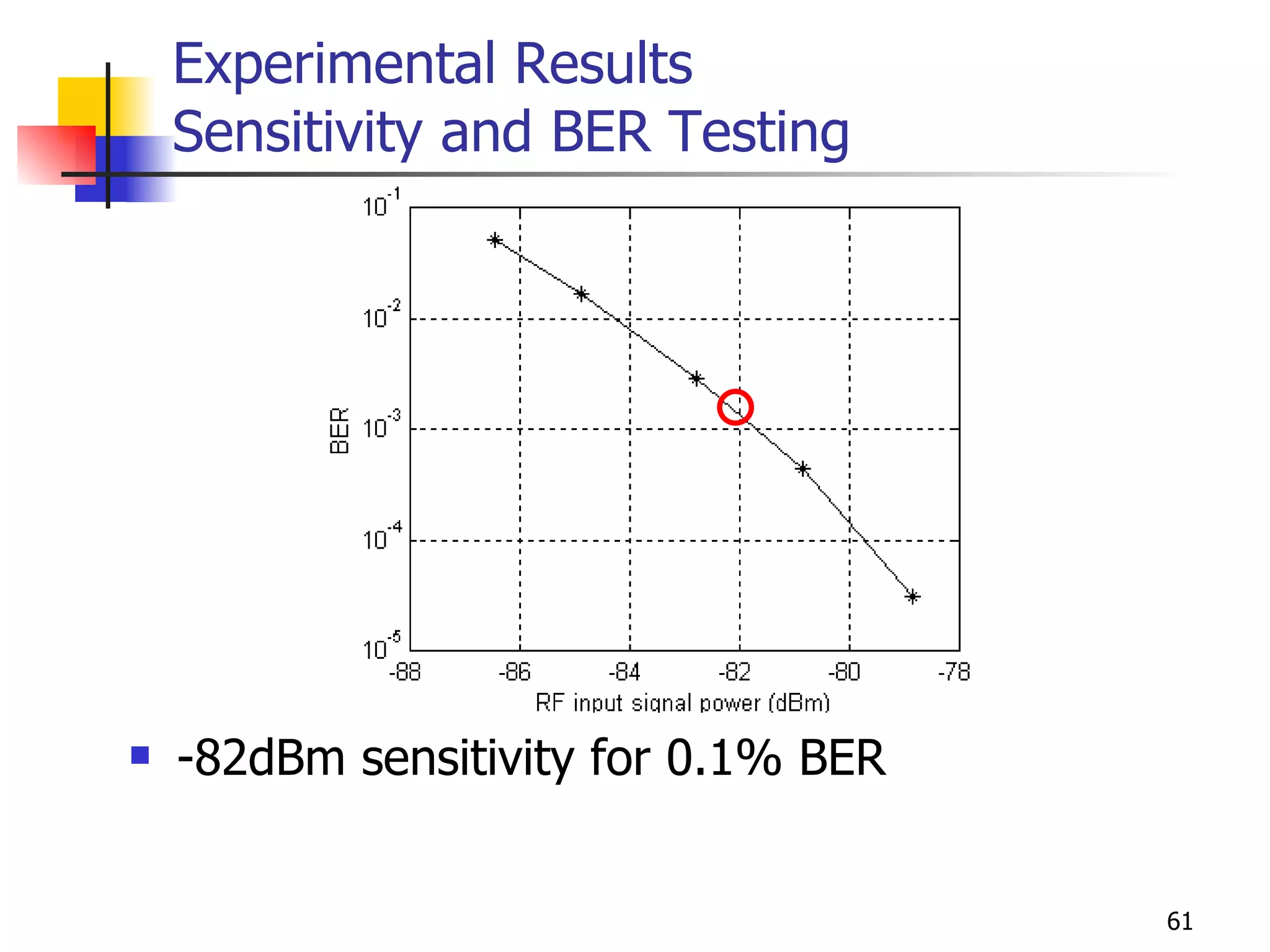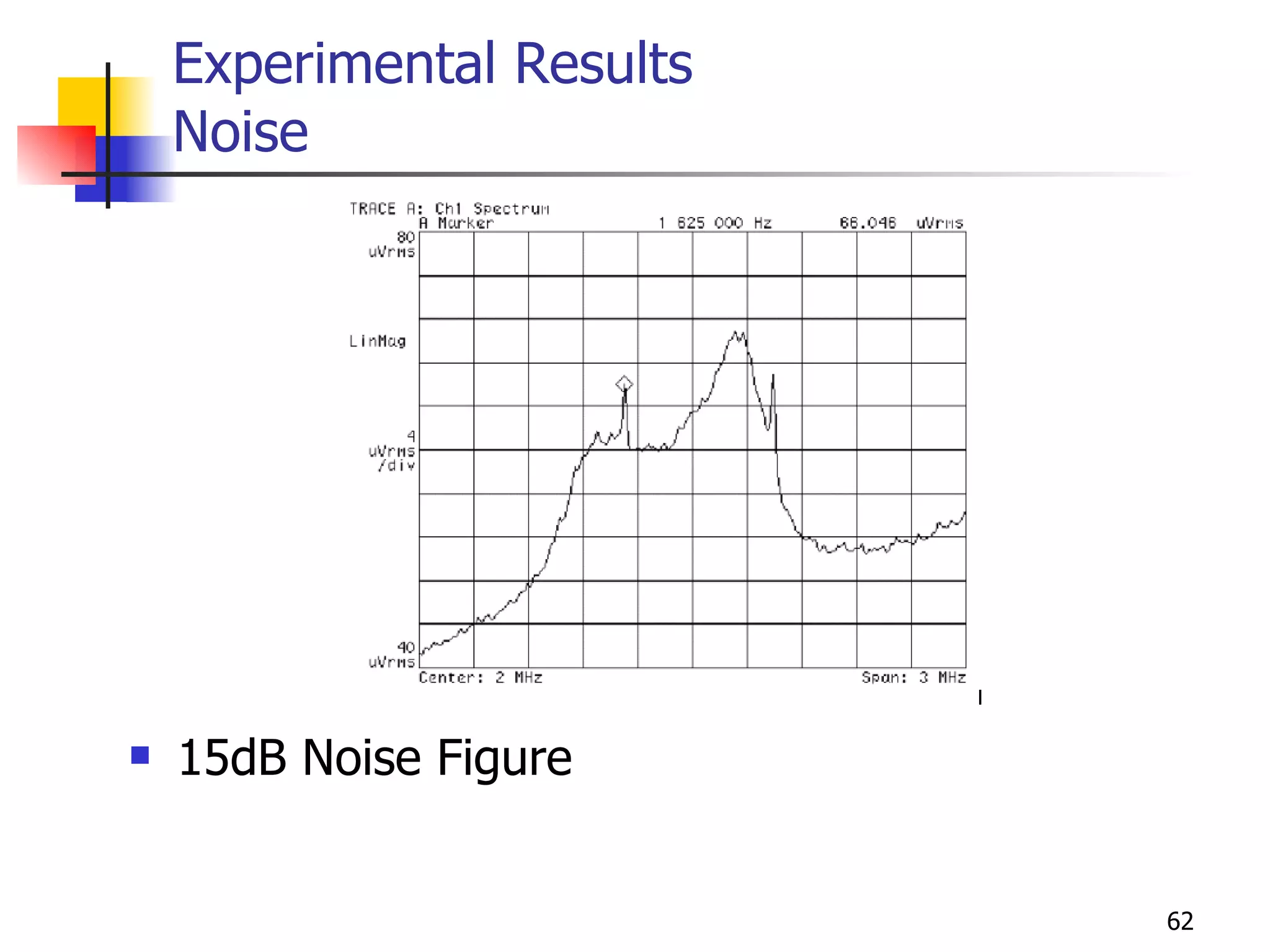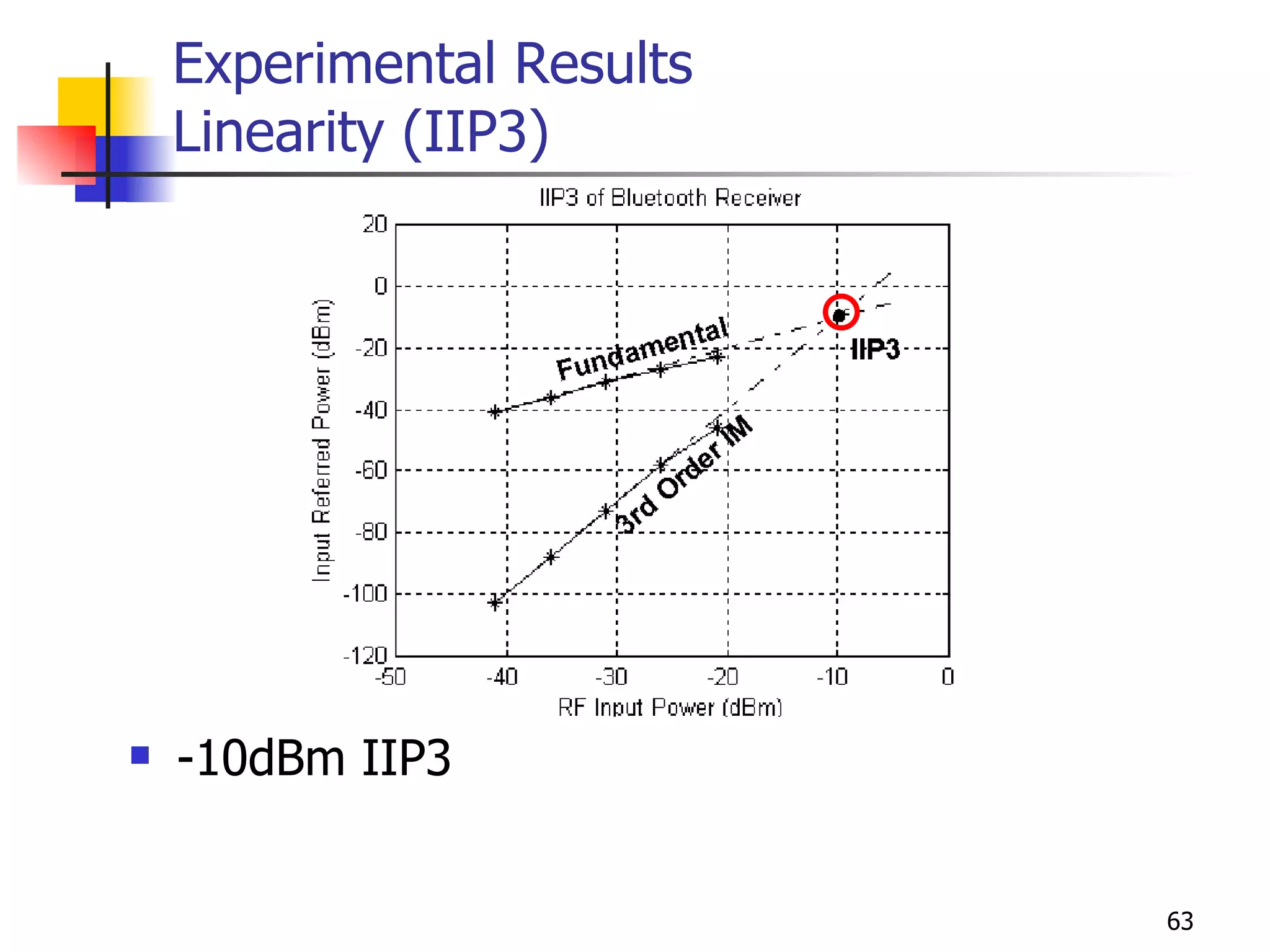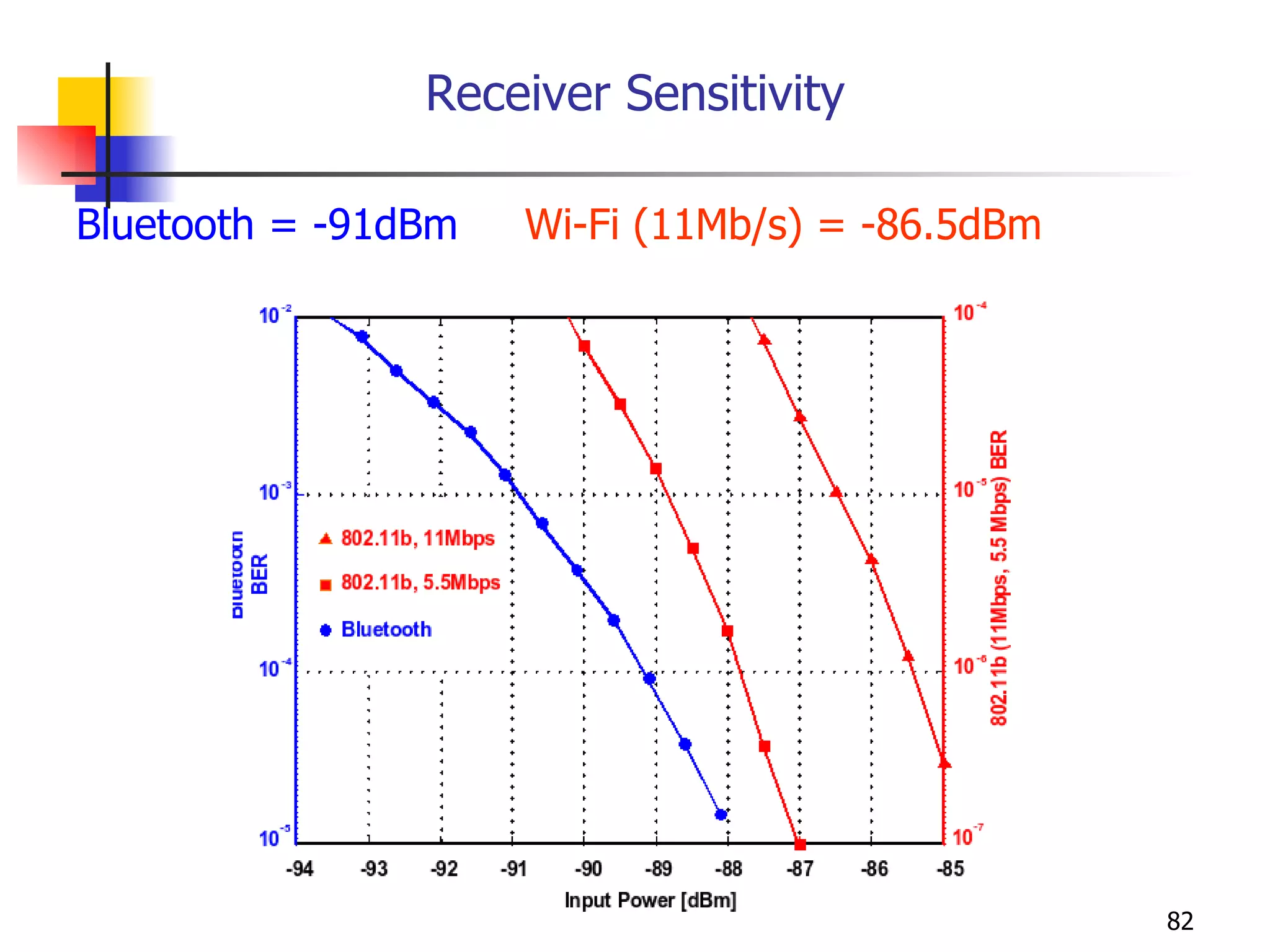

The document describes several receiver designs developed at the Analog and Mixed-Signal Center between 2000-2008, including a Bluetooth receiver, a dual-standard Bluetooth/Wi-Fi receiver ("Chameleon" receiver), and others. It provides details on the system design and individual building blocks for the Bluetooth and Chameleon receivers, such as the low-IF architecture, active complex filter, GFSK demodulator, and time-interleaved pipeline ADC. Experimental results showed the Bluetooth receiver achieved -82dBm sensitivity while the Chameleon receiver achieved -91dBm and -86.5dBm for Bluetooth and Wi-Fi modes respectively.
Receivers Design: CasesStudies Edgar Sánchez-Sinencio TI J. Kilby Chair Professor Department of Electrical Engineering Analog and Mixed-Signal Center Texas A&M University http://amesp02.tamu.edu/~sanchez/
2.
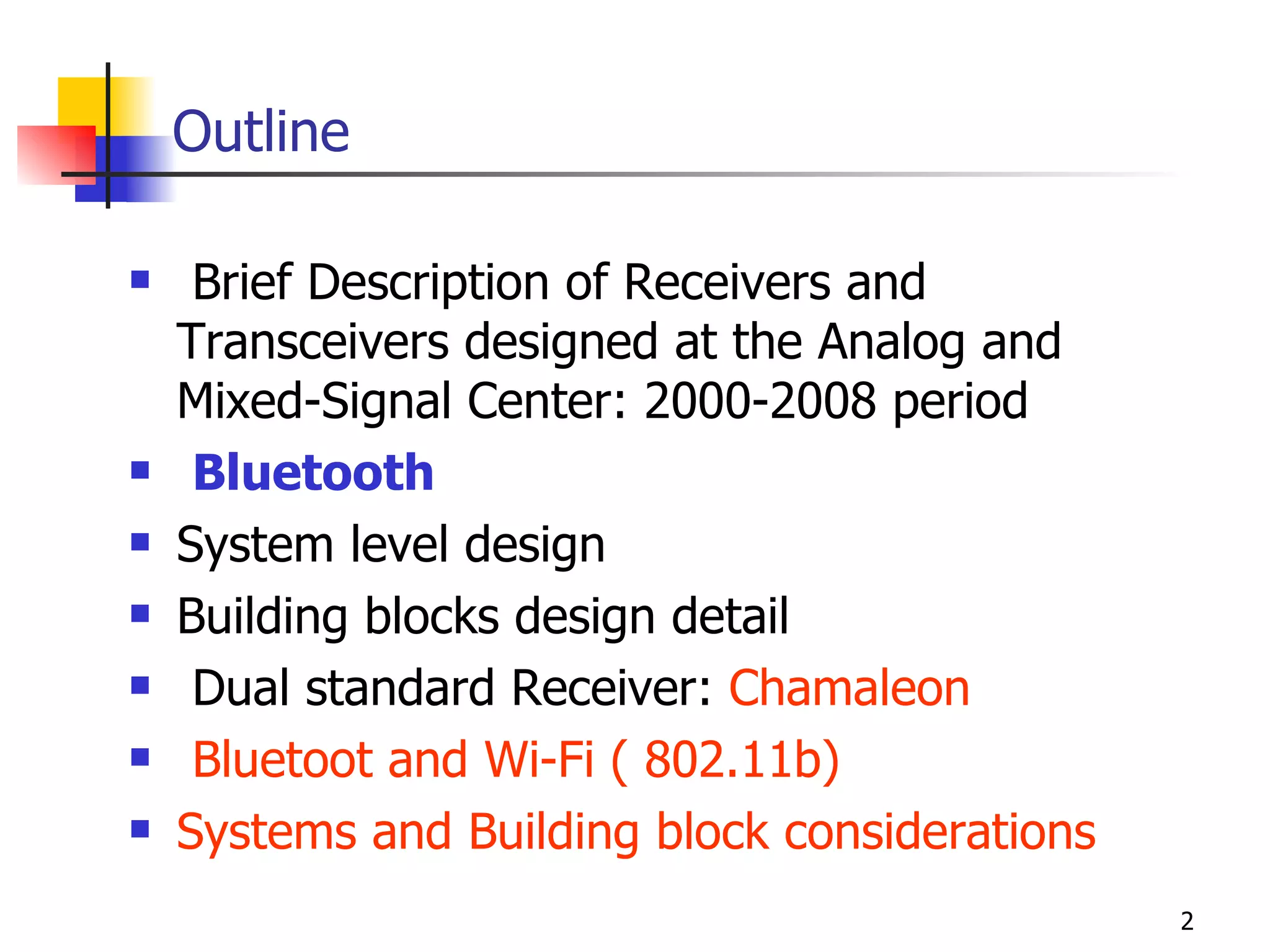
Outline Brief Descriptionof Receivers and Transceivers designed at the Analog and Mixed-Signal Center: 2000-2008 period Bluetooth System level design Building blocks design detail Dual standard Receiver: Chamaleon Bluetoot and Wi-Fi ( 802.11b) Systems and Building block considerations
3.
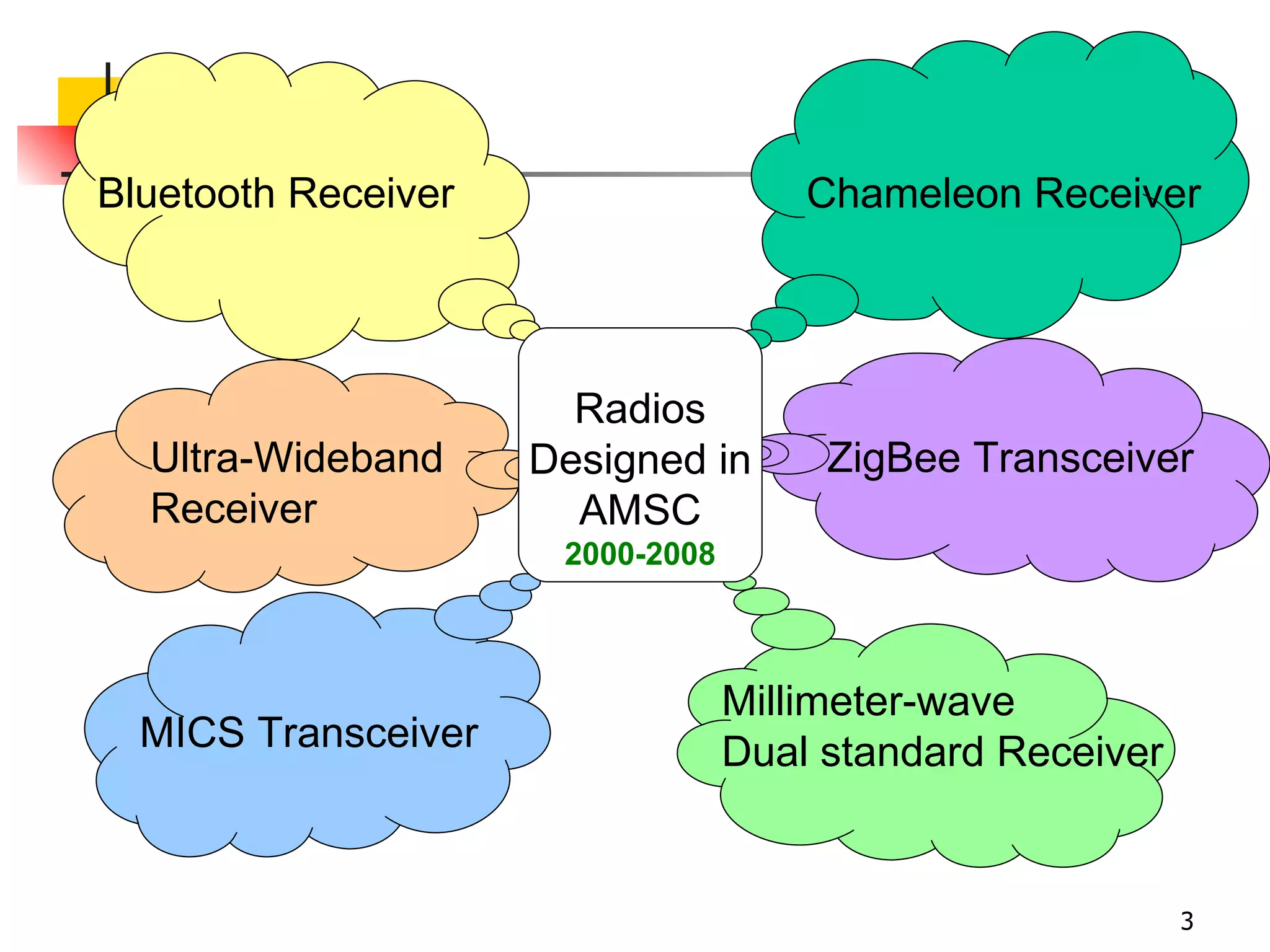
Bluetooth Receiver ChameleonReceiver Ultra-Wideband Receiver ZigBee Transceiver MICS Transceiver Millimeter-wave Dual standard Receiver Radios Designed in AMSC 2000-2008
4.
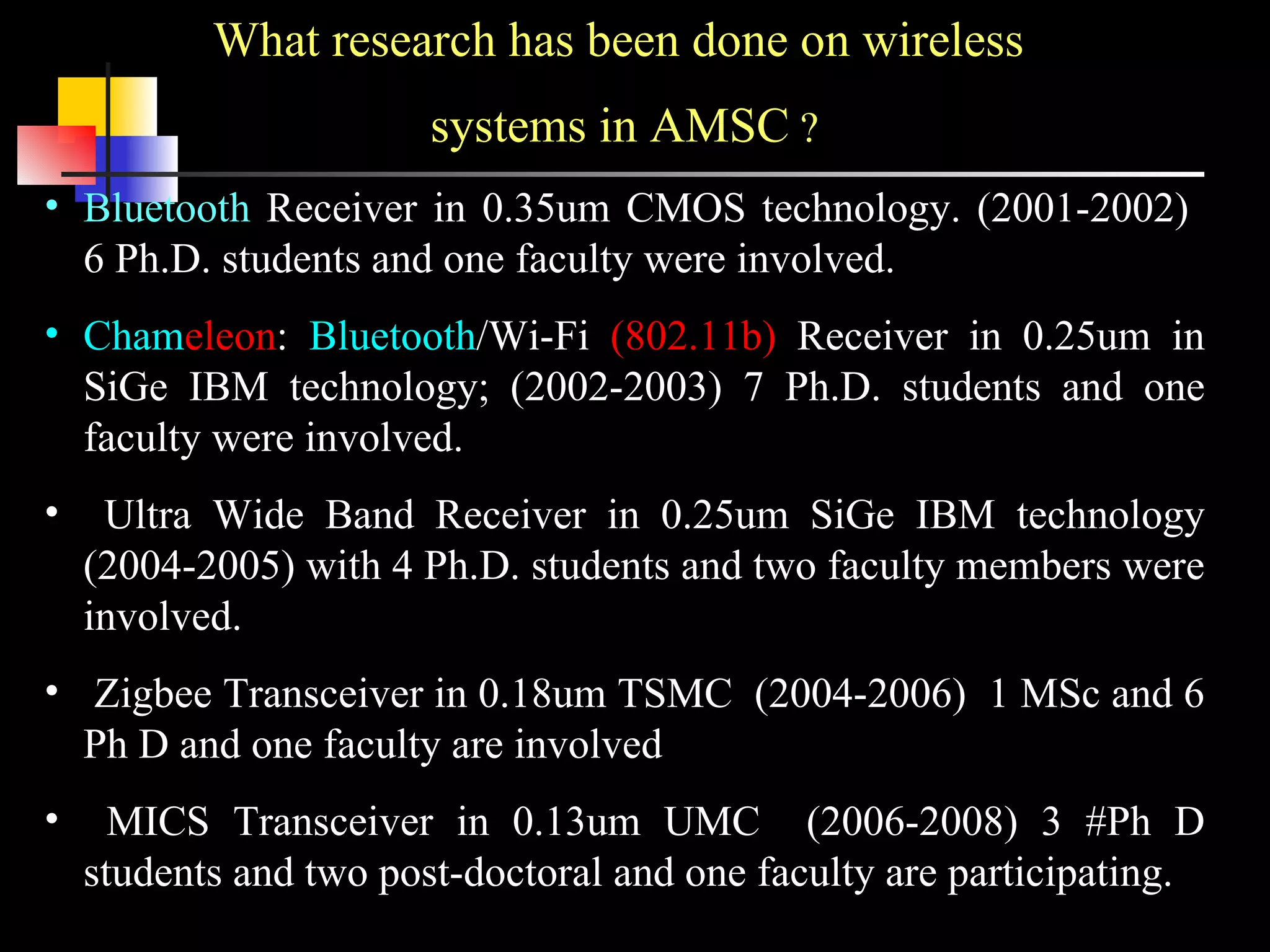
What research hasbeen done on wireless systems in AMSC ? Bluetooth Receiver in 0.35um CMOS technology. (2001-2002) 6 Ph.D. students and one faculty were involved. Cham eleon : Bluetooth /Wi-Fi (802.11b) Receiver in 0.25um in SiGe IBM technology; (2002-2003) 7 Ph.D. students and one faculty were involved. Ultra Wide Band Receiver in 0.25um SiGe IBM technology (2004-2005) with 4 Ph.D. students and two faculty members were involved. Zigbee Transceiver in 0.18um TSMC (2004-2006) 1 MSc and 6 Ph D and one faculty are involved MICS Transceiver in 0.13um UMC (2006-2008) 3 #Ph D students and two post-doctoral and one faculty are participating.
5.
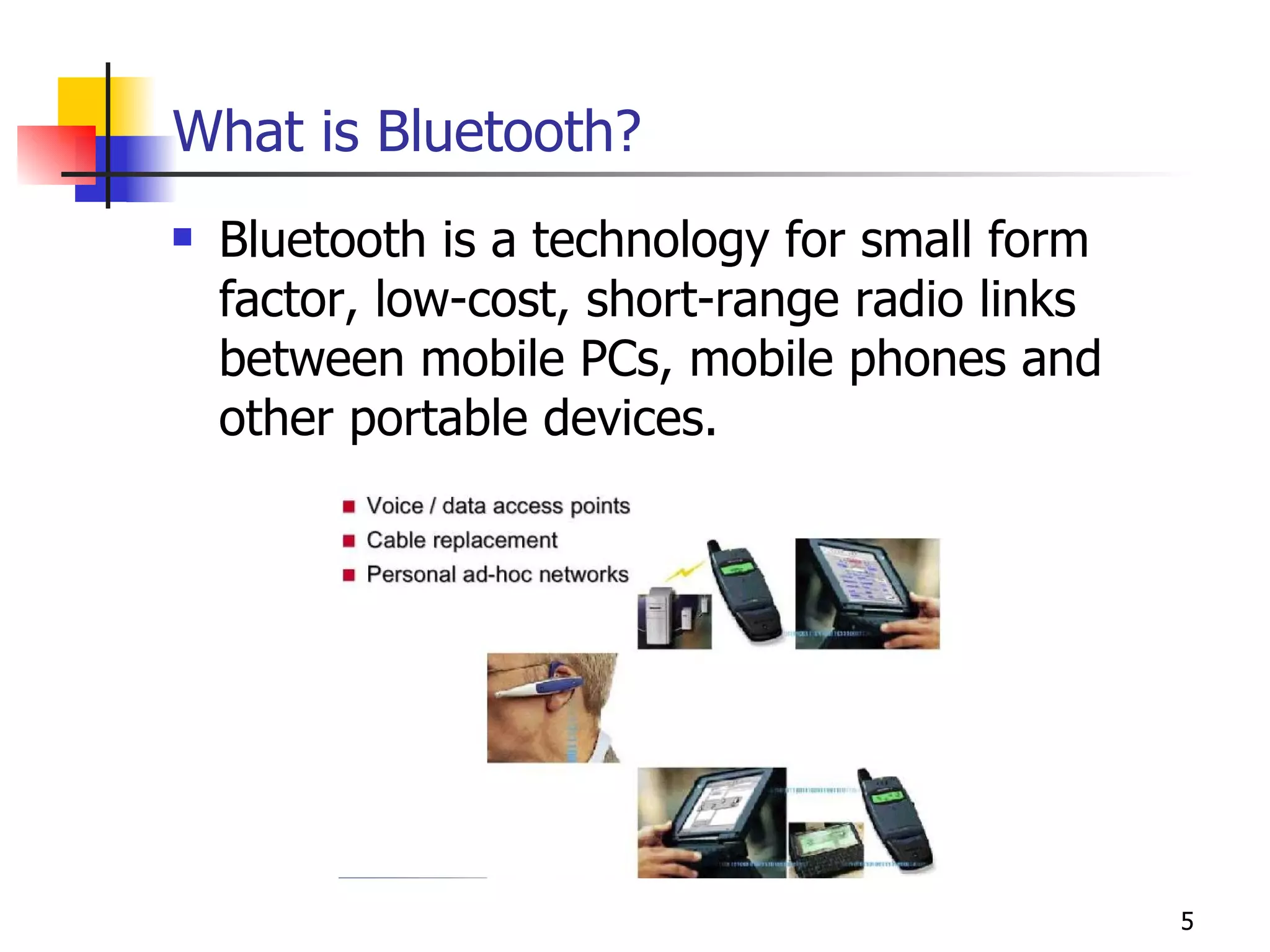
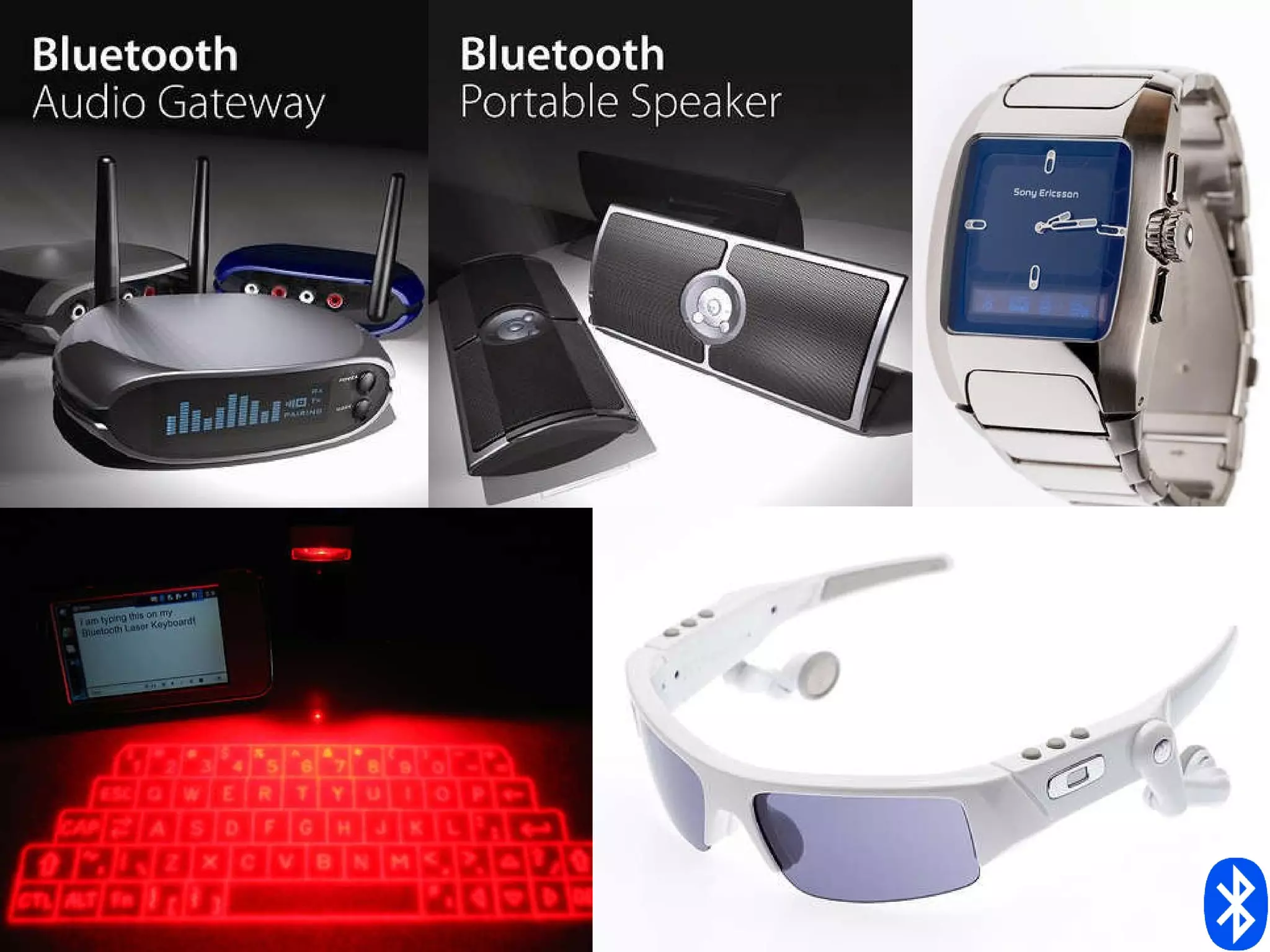
What is Bluetooth?Bluetooth is a technology for small form factor, low-cost, short-range radio links between mobile PCs, mobile phones and other portable devices.
6.
7.
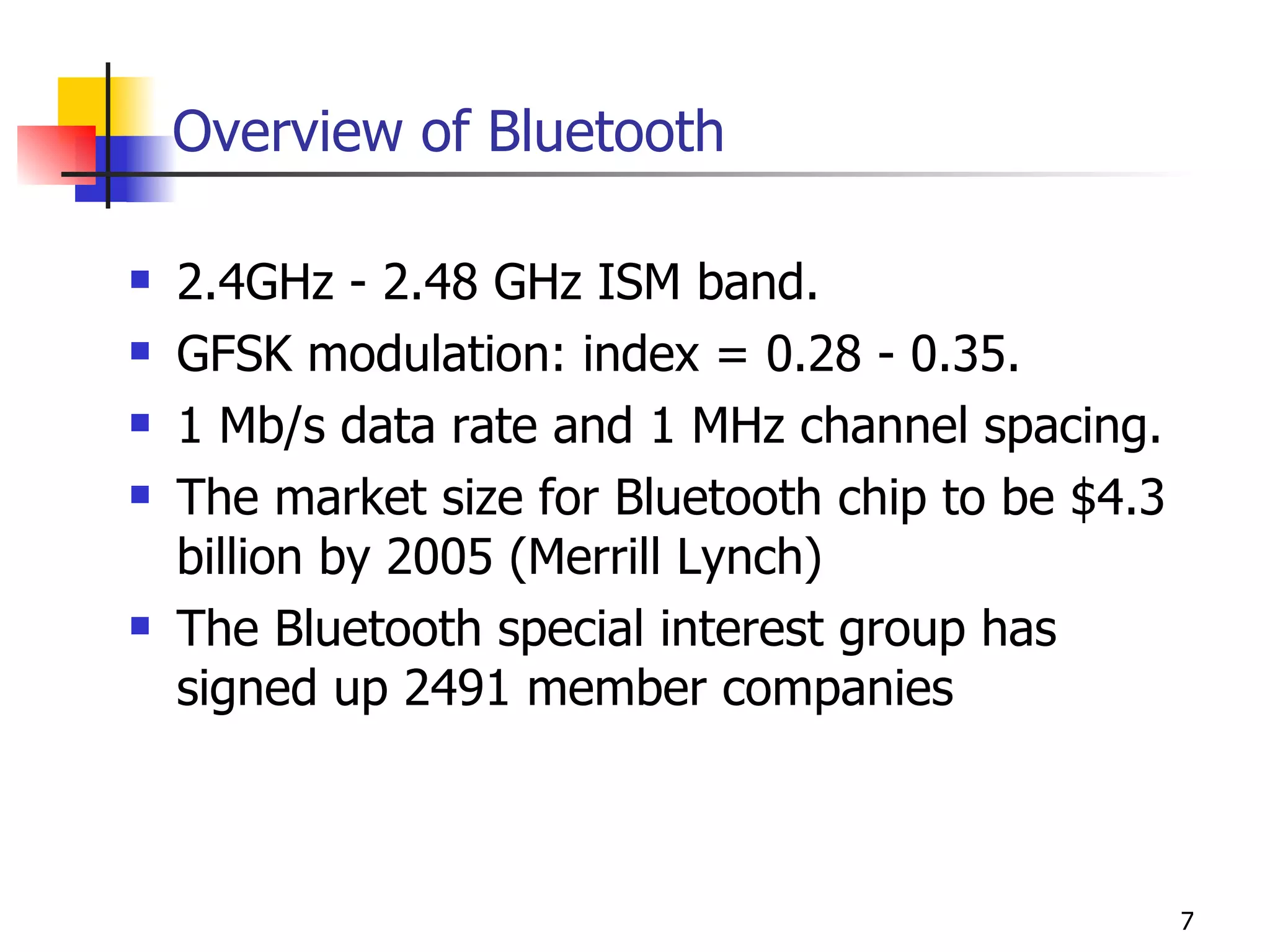
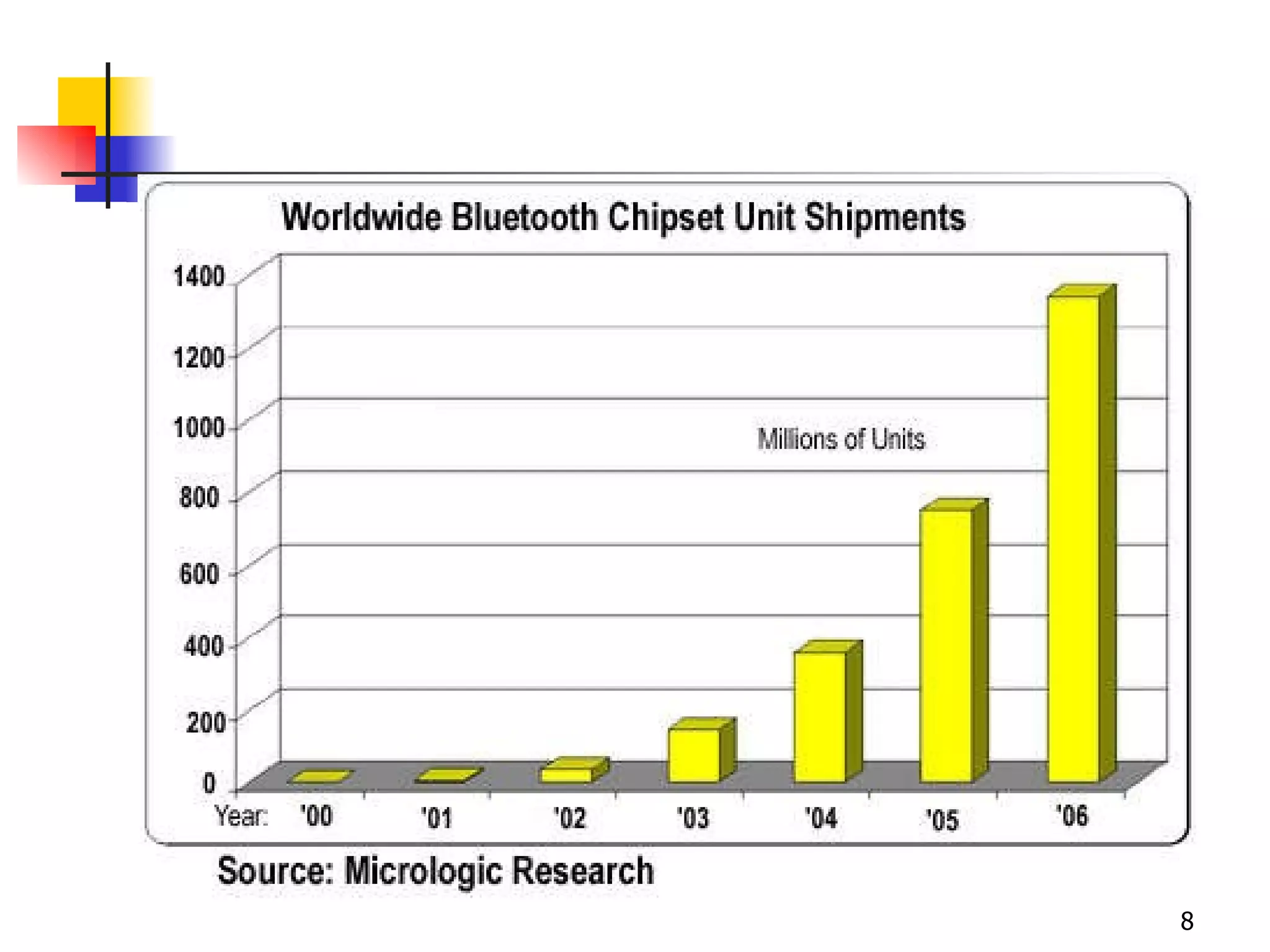
Overview of Bluetooth2.4GHz - 2.48 GHz ISM band. GFSK modulation: index = 0.28 - 0.35. 1 Mb/s data rate and 1 MHz channel spacing. The market size for Bluetooth chip to be $4.3 billion by 2005 (Merrill Lynch) The Bluetooth special interest group has signed up 2491 member companies
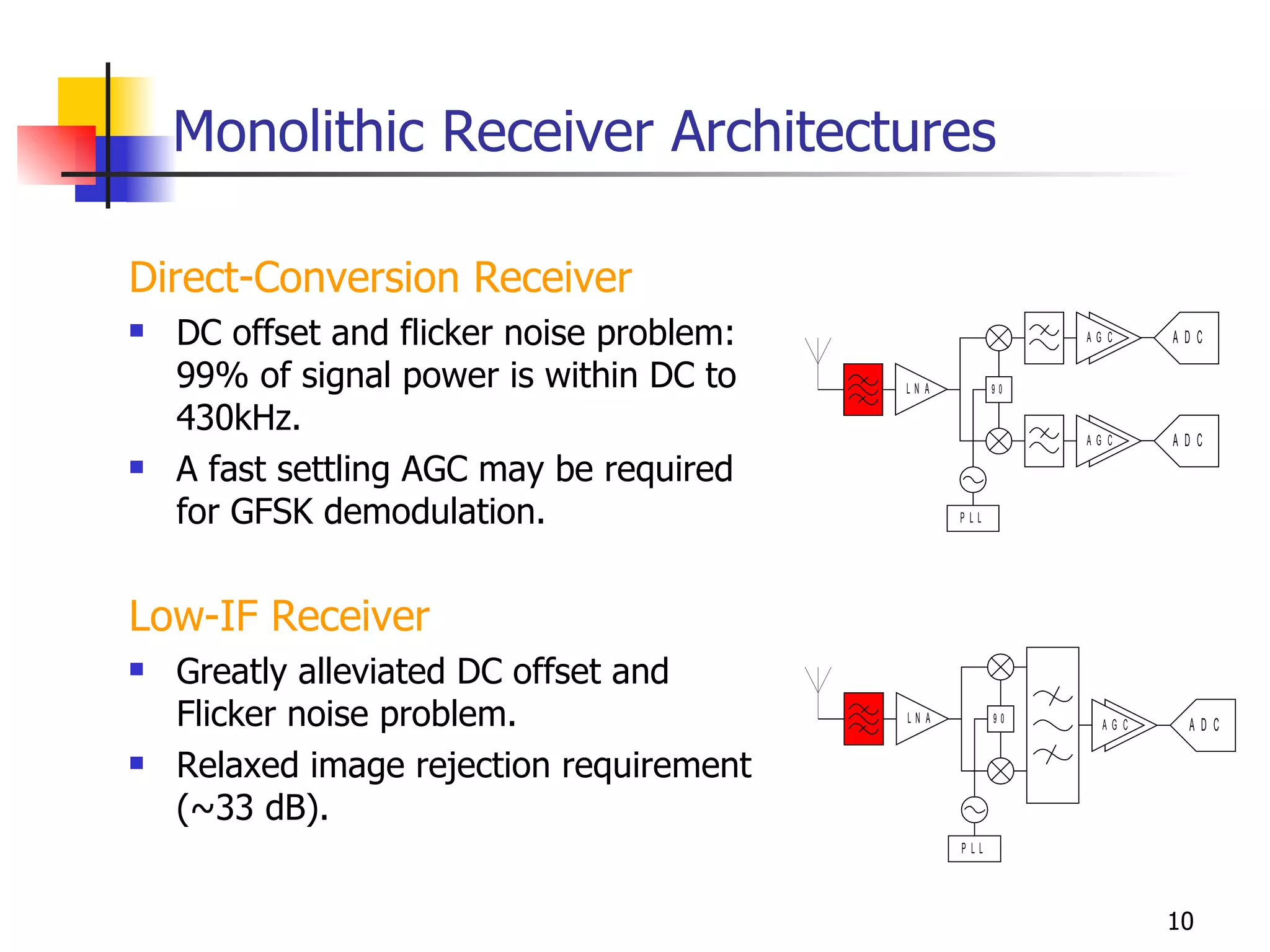
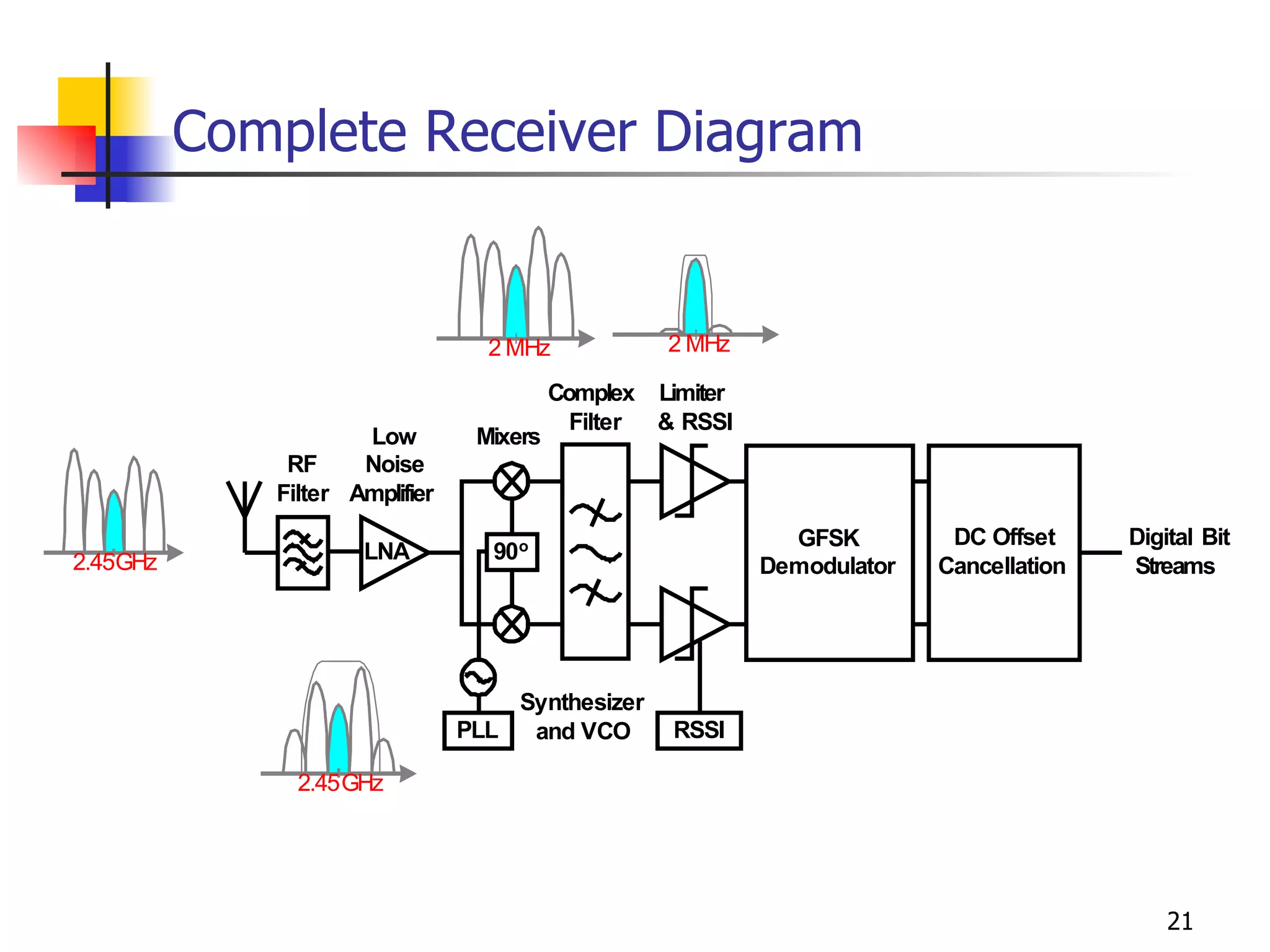
Monolithic Receiver ArchitecturesDirect-Conversion Receiver DC offset and flicker noise problem: 99% of signal power is within DC to 430kHz. A fast settling AGC may be required for GFSK demodulation. Low-IF Receiver Greatly alleviated DC offset and Flicker noise problem. Relaxed image rejection requirement (~33 dB).
11.
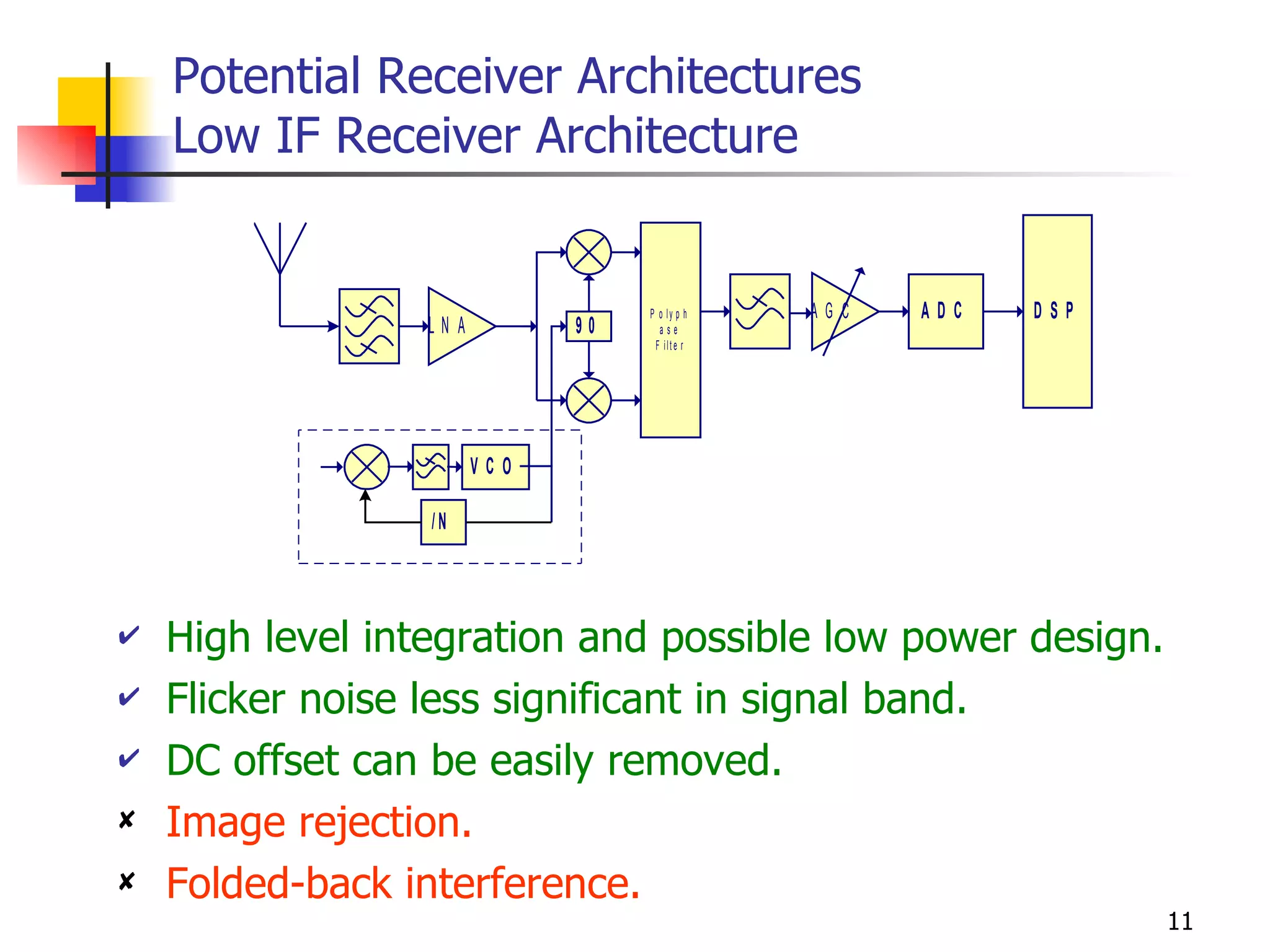
Potential Receiver Architectures Low IF Receiver Architecture High level integration and possible low power design. Flicker noise less significant in signal band. DC offset can be easily removed. Image rejection. Folded-back interference.
12.
What other receiverstructures alternatives can be considered and with what properties ? Can we make the IF very low, say to DC ? How and at what price ? Direct Conversion (IF=0)
13.
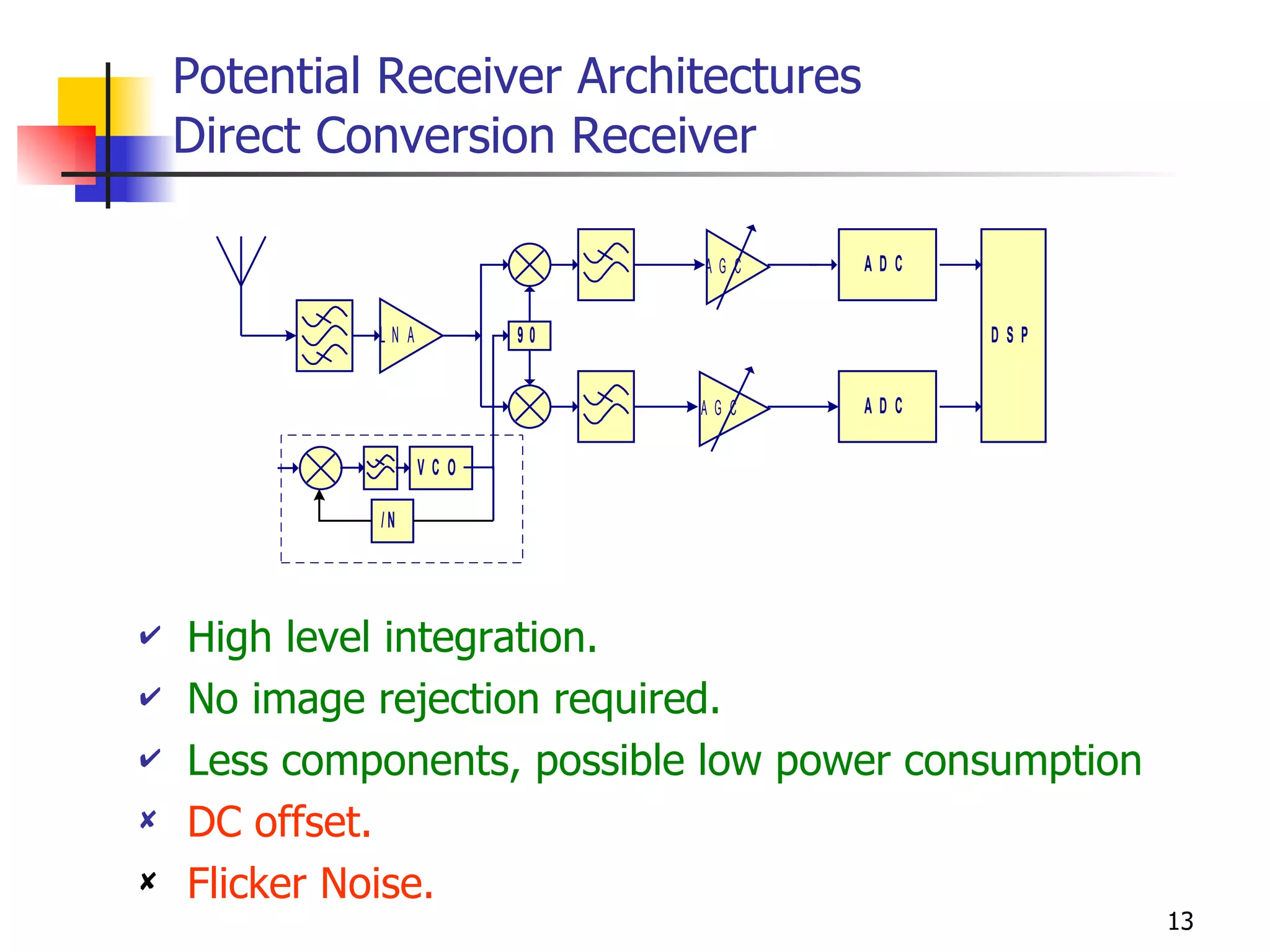
Potential Receiver Architectures Direct Conversion Receiver High level integration. No image rejection required. Less components, possible low power consumption DC offset. Flicker Noise.
14.
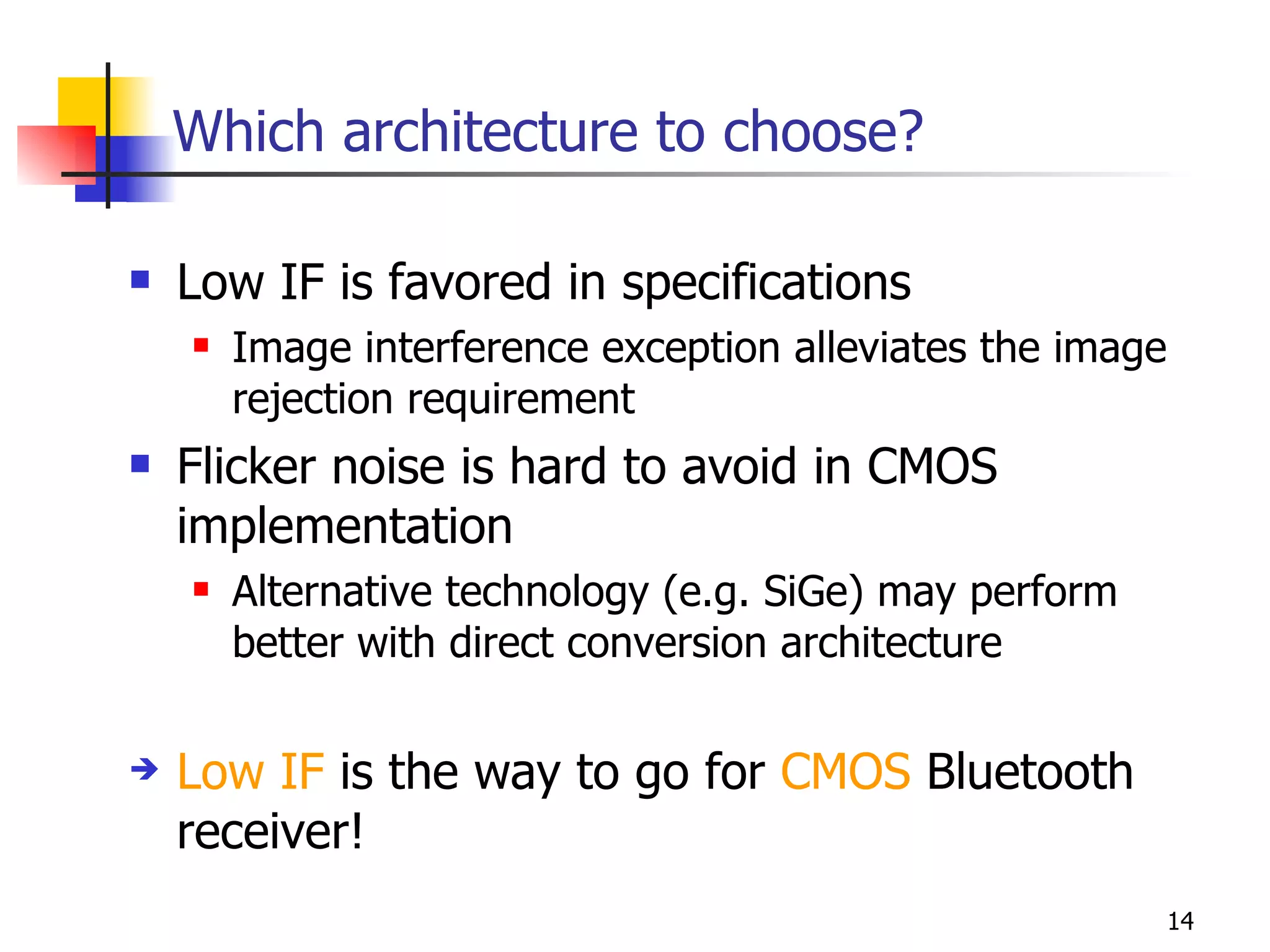
Which architecture tochoose? Low IF is favored in specifications Image interference exception alleviates the image rejection requirement Flicker noise is hard to avoid in CMOS implementation Alternative technology (e.g. SiGe) may perform better with direct conversion architecture Low IF is the way to go for CMOS Bluetooth receiver!
15.
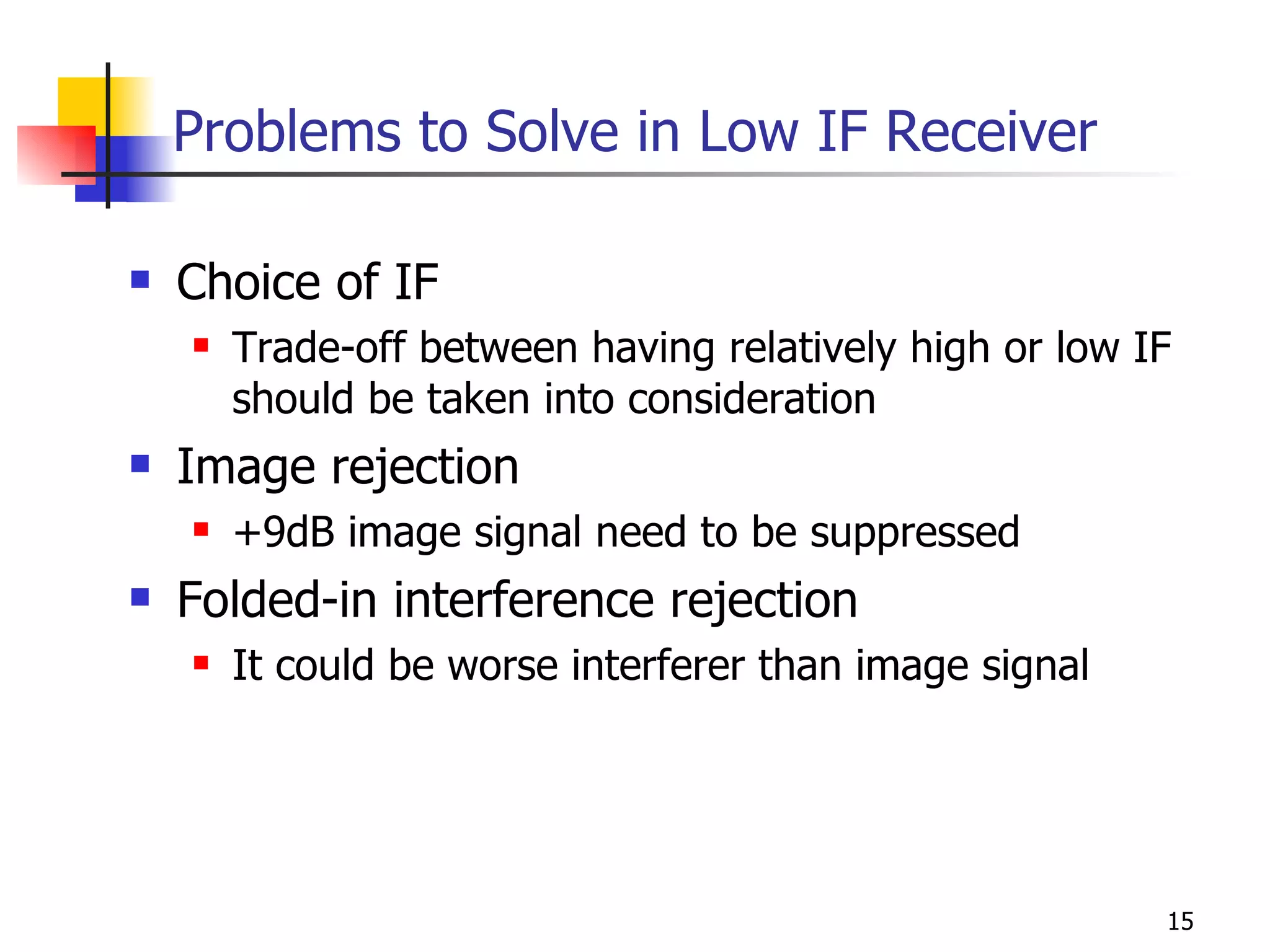
Problems to Solvein Low IF Receiver Choice of IF Trade-off between having relatively high or low IF should be taken into consideration Image rejection +9dB image signal need to be suppressed Folded-in interference rejection It could be worse interferer than image signal
16.
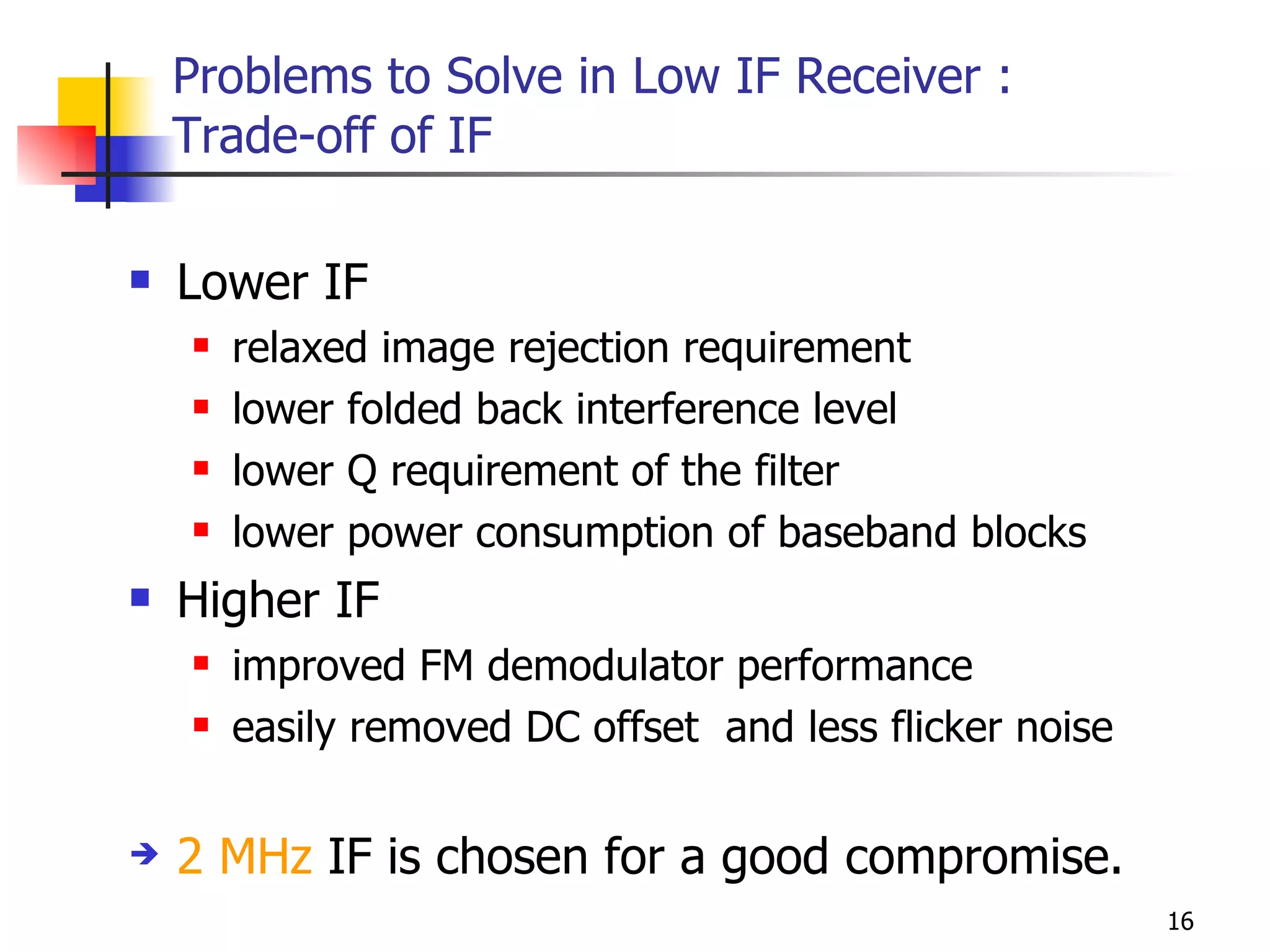
Problems to Solvein Low IF Receiver : Trade-off of IF Lower IF relaxed image rejection requirement lower folded back interference level lower Q requirement of the filter lower power consumption of baseband blocks Higher IF improved FM demodulator performance easily removed DC offset and less flicker noise 2 MHz IF is chosen for a good compromise.
17.
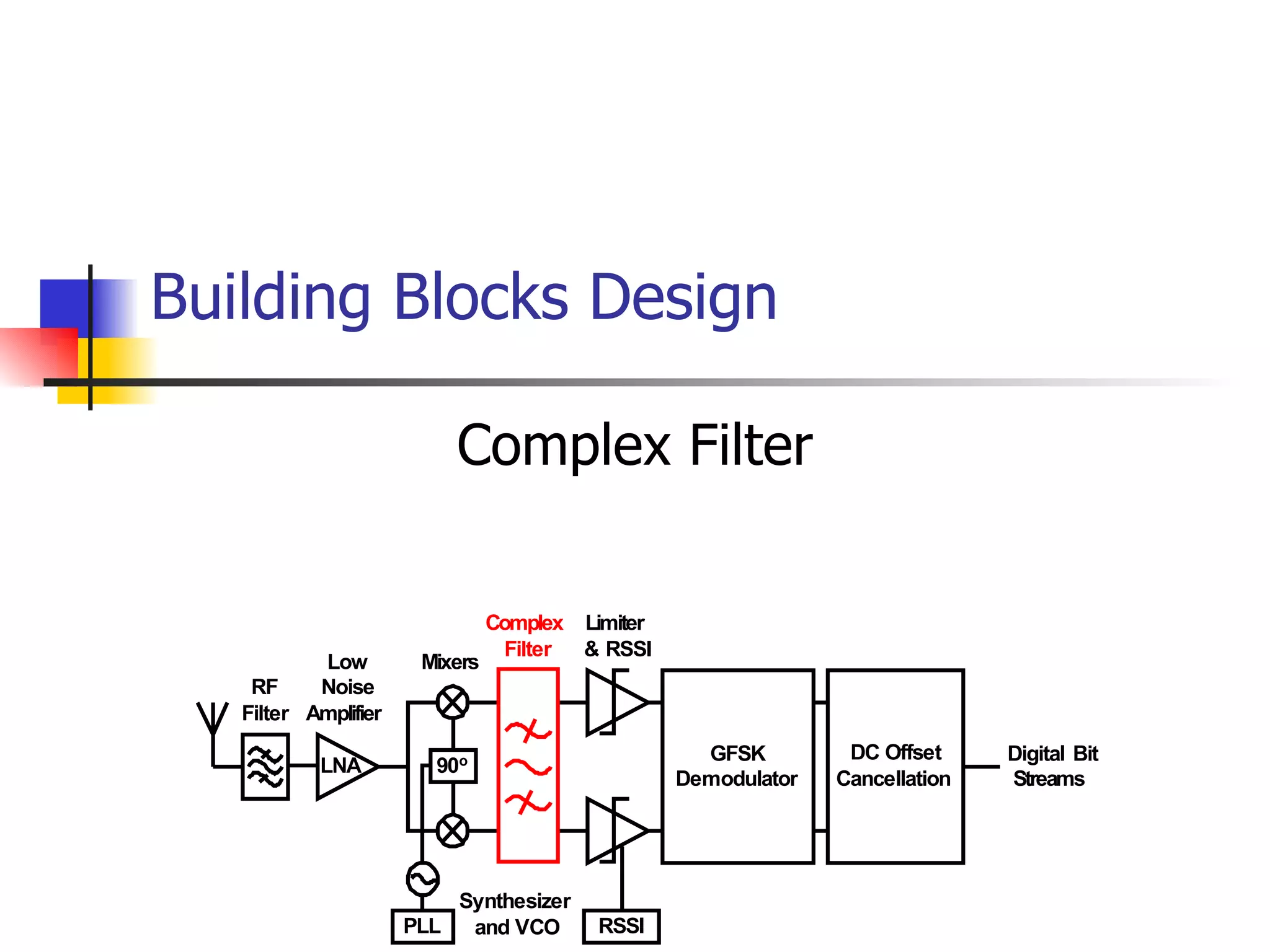
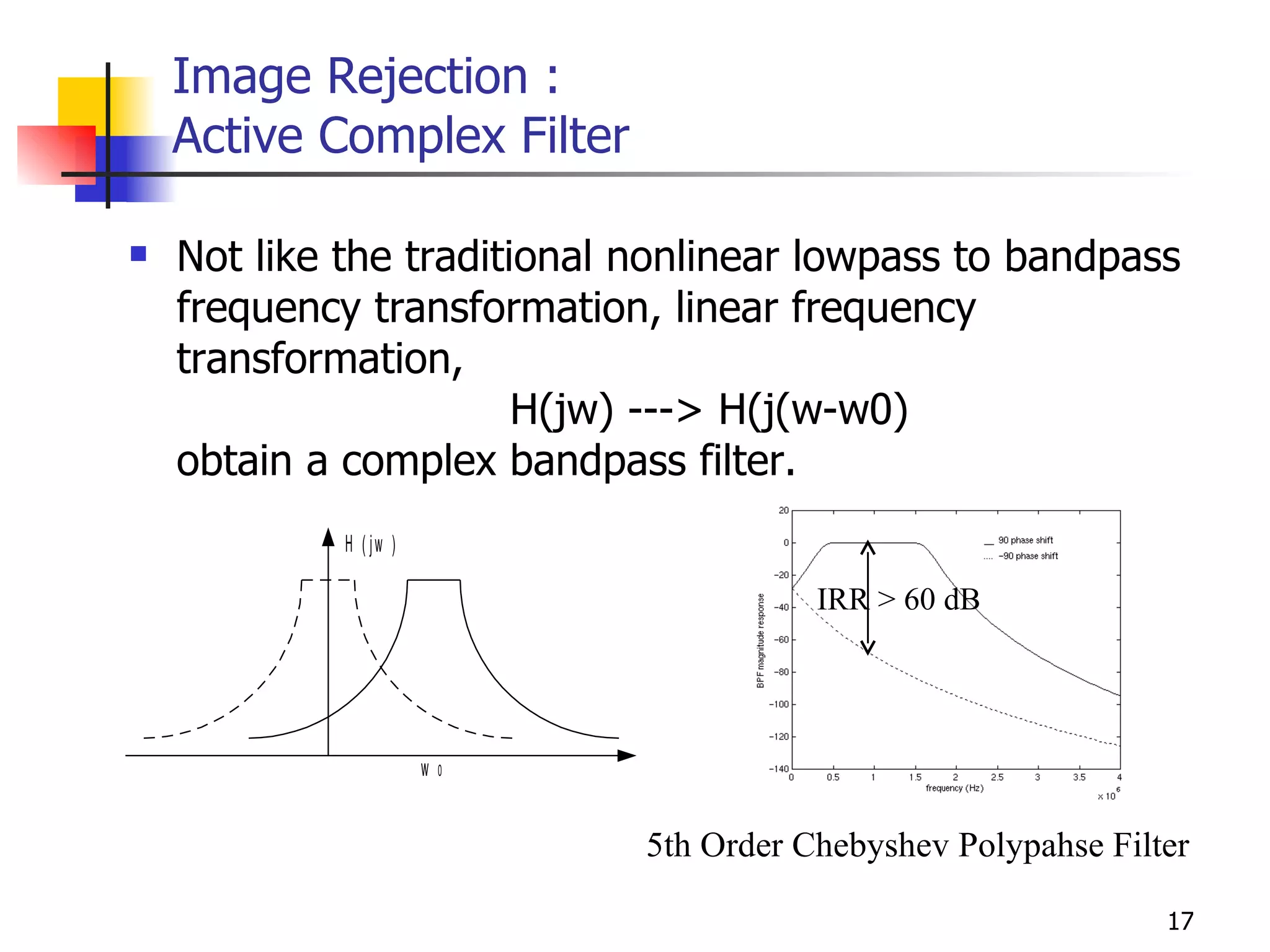
Image Rejection :Active Complex Filter Not like the traditional nonlinear lowpass to bandpass frequency transformation, linear frequency transformation, H(jw) ---> H(j(w-w0) obtain a complex bandpass filter. 5th Order Chebyshev Polypahse Filter IRR > 60 dB
18.
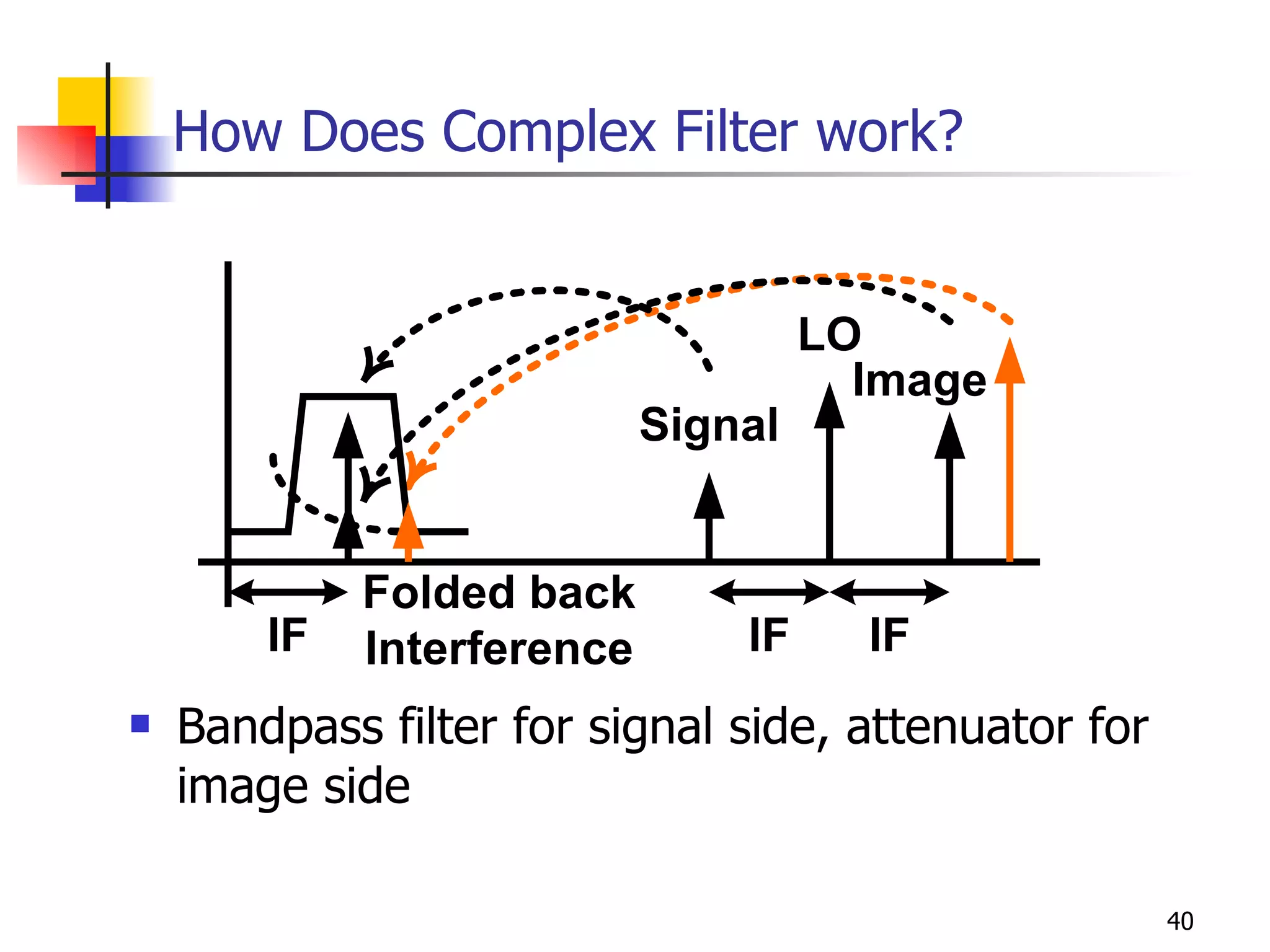
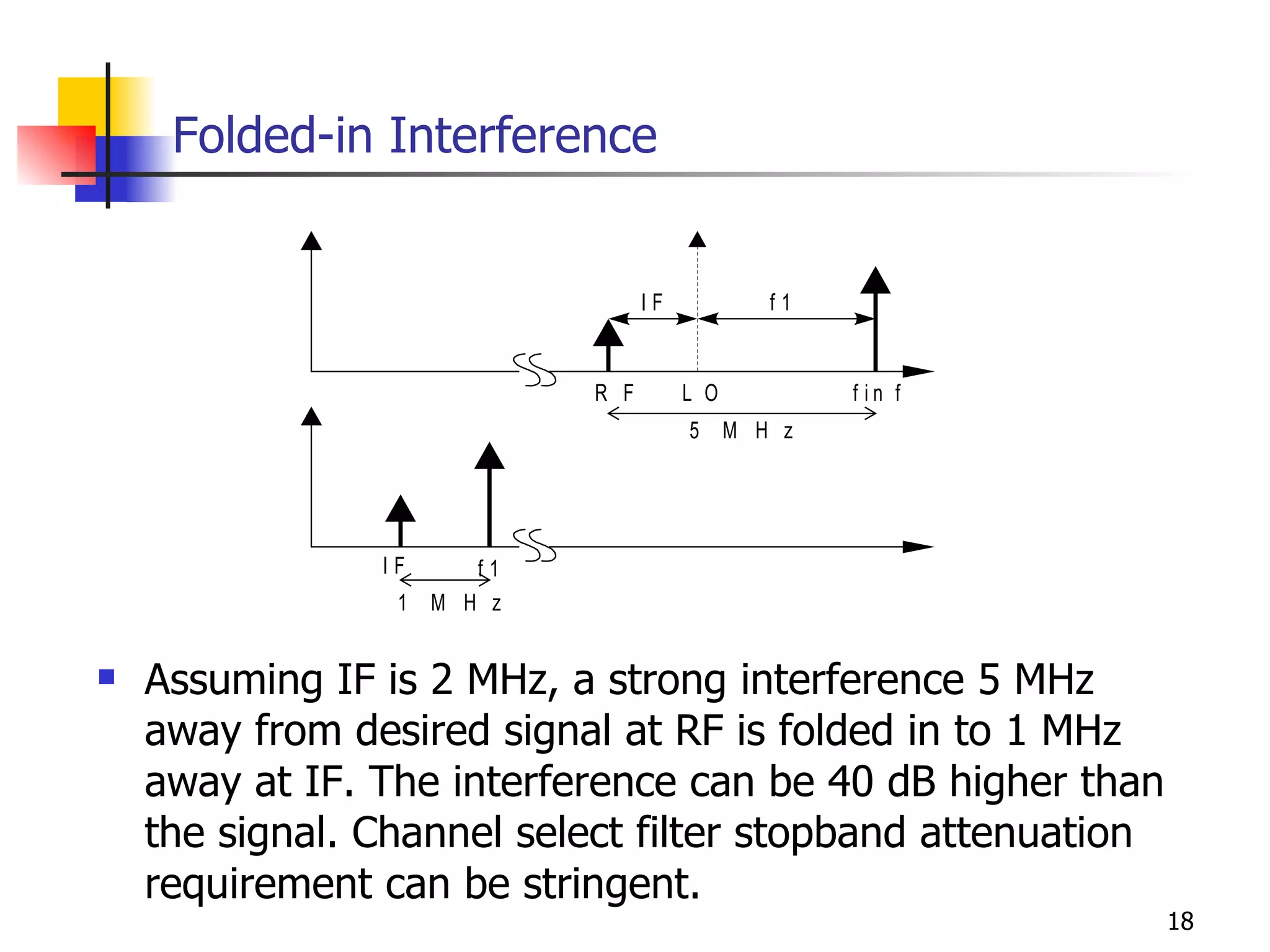
Folded-in Interference AssumingIF is 2 MHz, a strong interference 5 MHz away from desired signal at RF is folded in to 1 MHz away at IF. The interference can be 40 dB higher than the signal. Channel select filter stopband attenuation requirement can be stringent.
19.
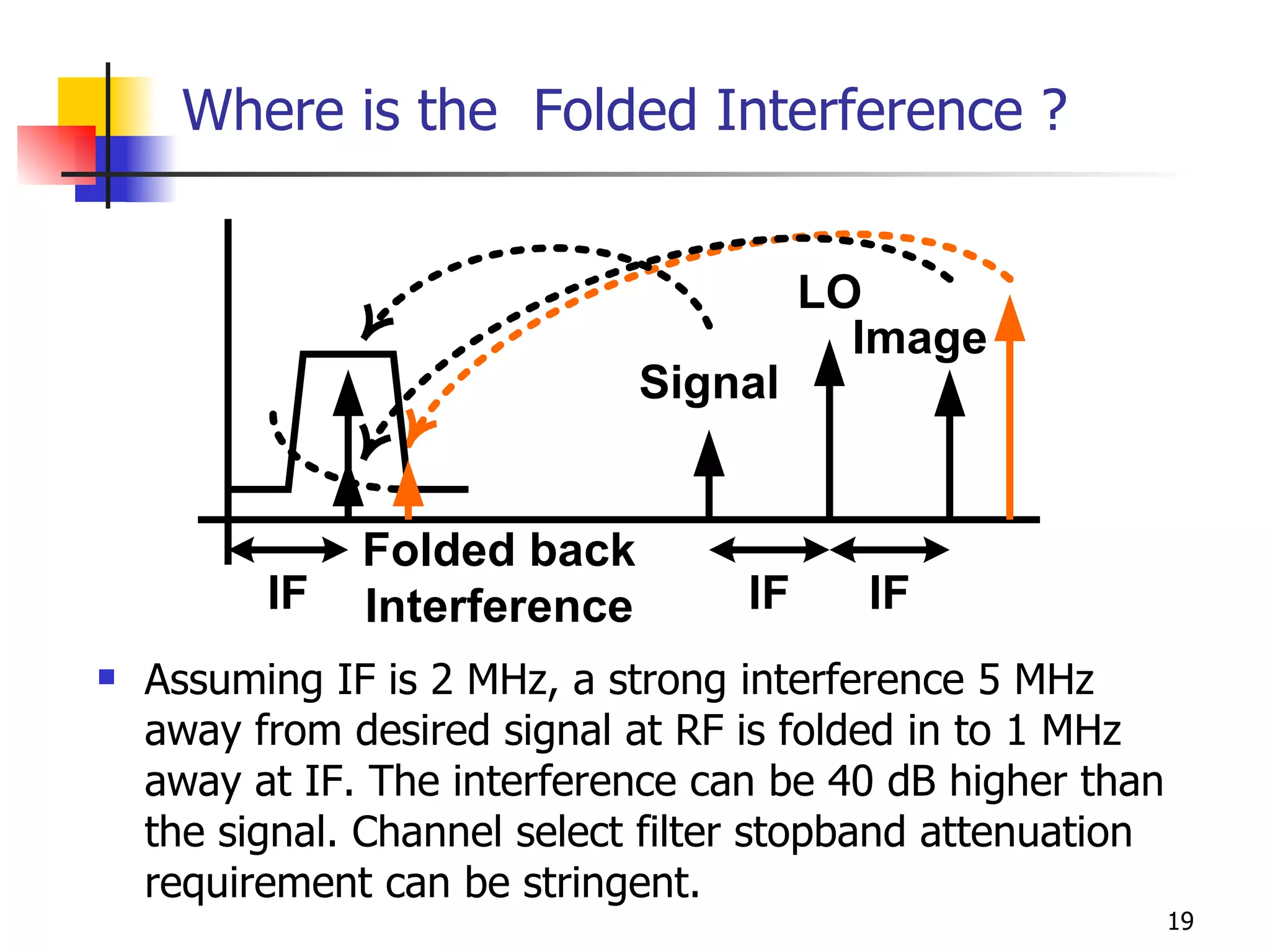
Where is the Folded Interference ? Assuming IF is 2 MHz, a strong interference 5 MHz away from desired signal at RF is folded in to 1 MHz away at IF. The interference can be 40 dB higher than the signal. Channel select filter stopband attenuation requirement can be stringent.
20.
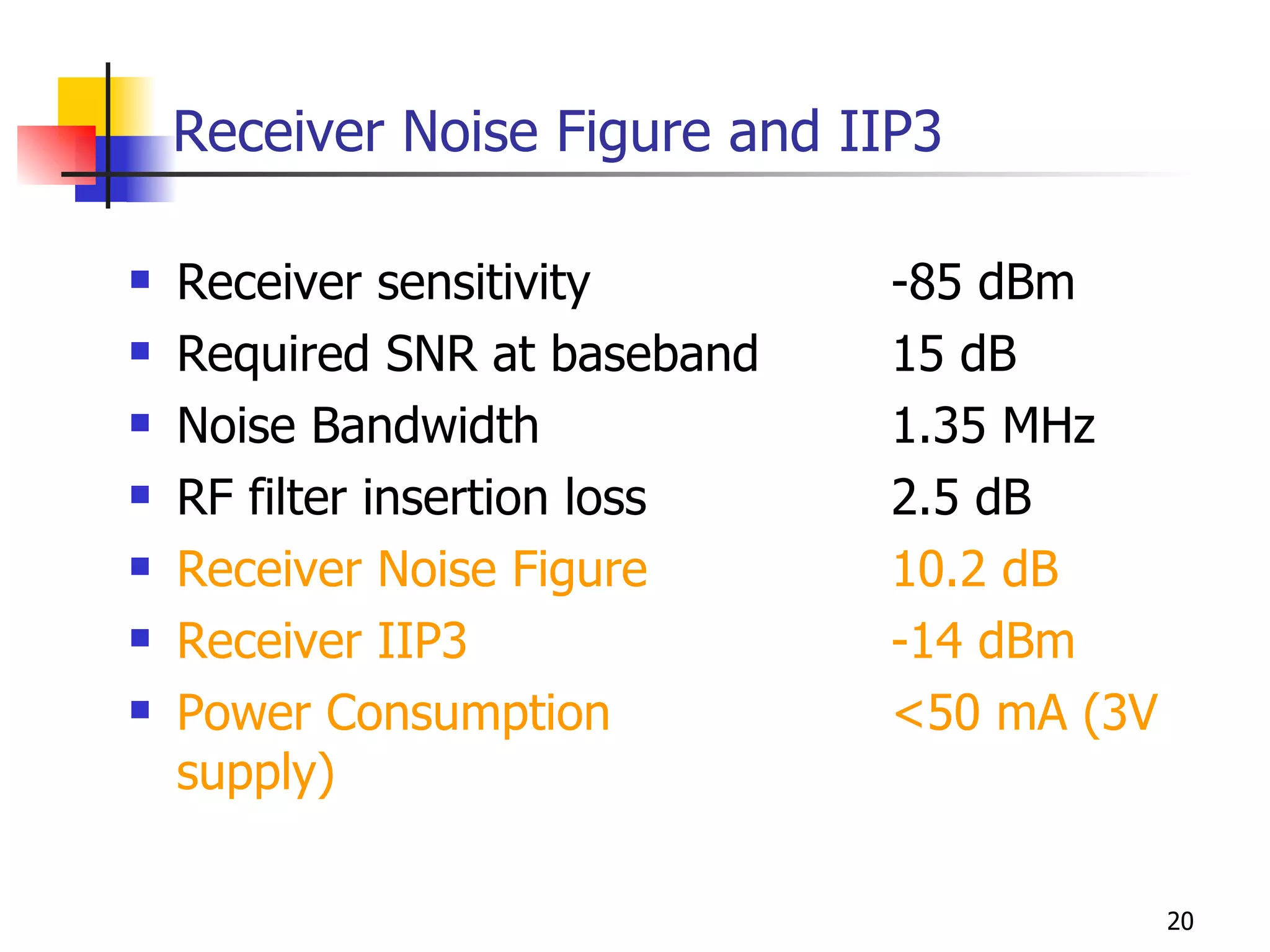
Receiver Noise Figureand IIP3 Receiver sensitivity -85 dBm Required SNR at baseband 15 dB Noise Bandwidth 1.35 MHz RF filter insertion loss 2.5 dB Receiver Noise Figure 10.2 dB Receiver IIP3 -14 dBm Power Consumption <50 mA (3V supply)
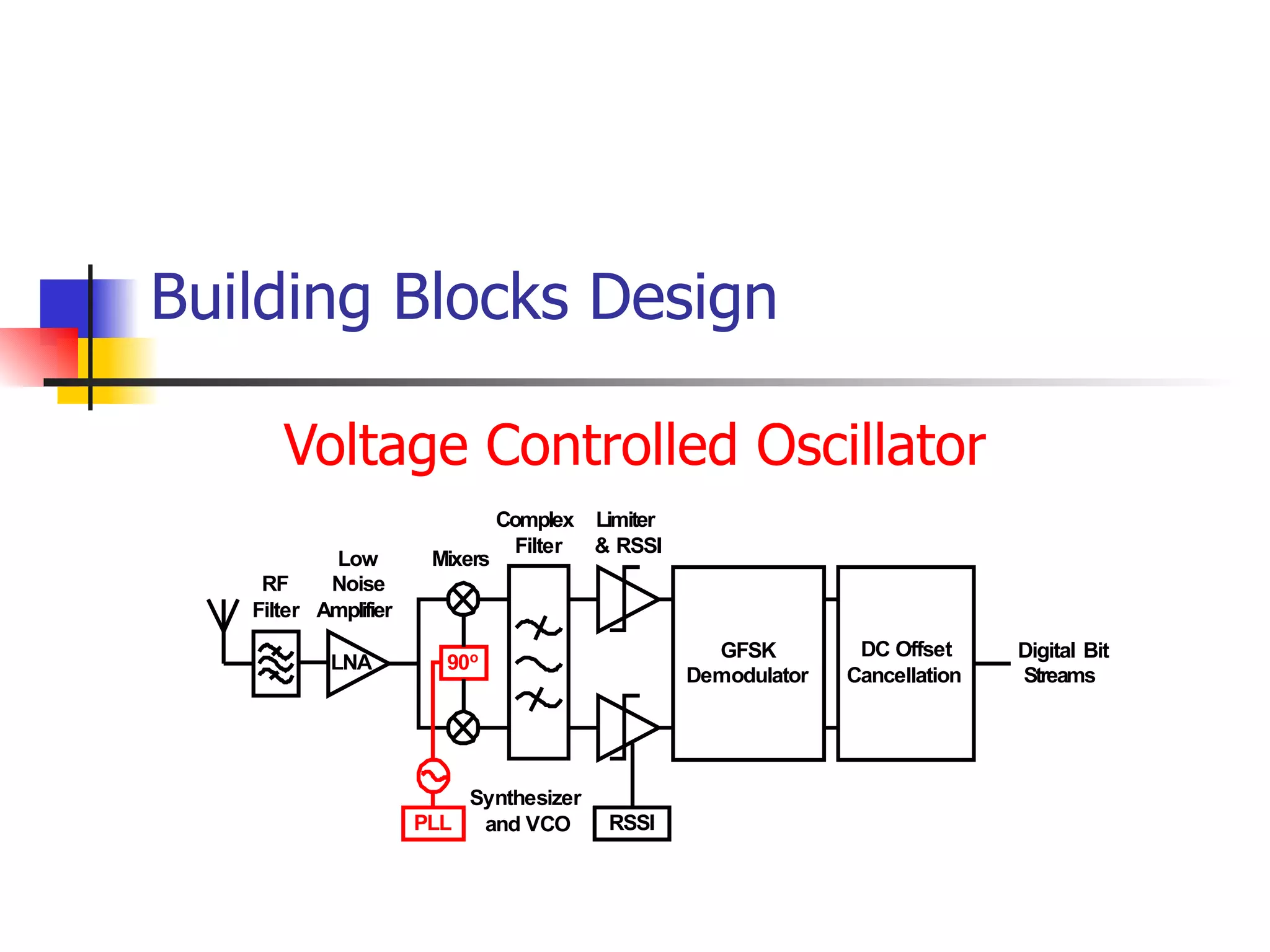
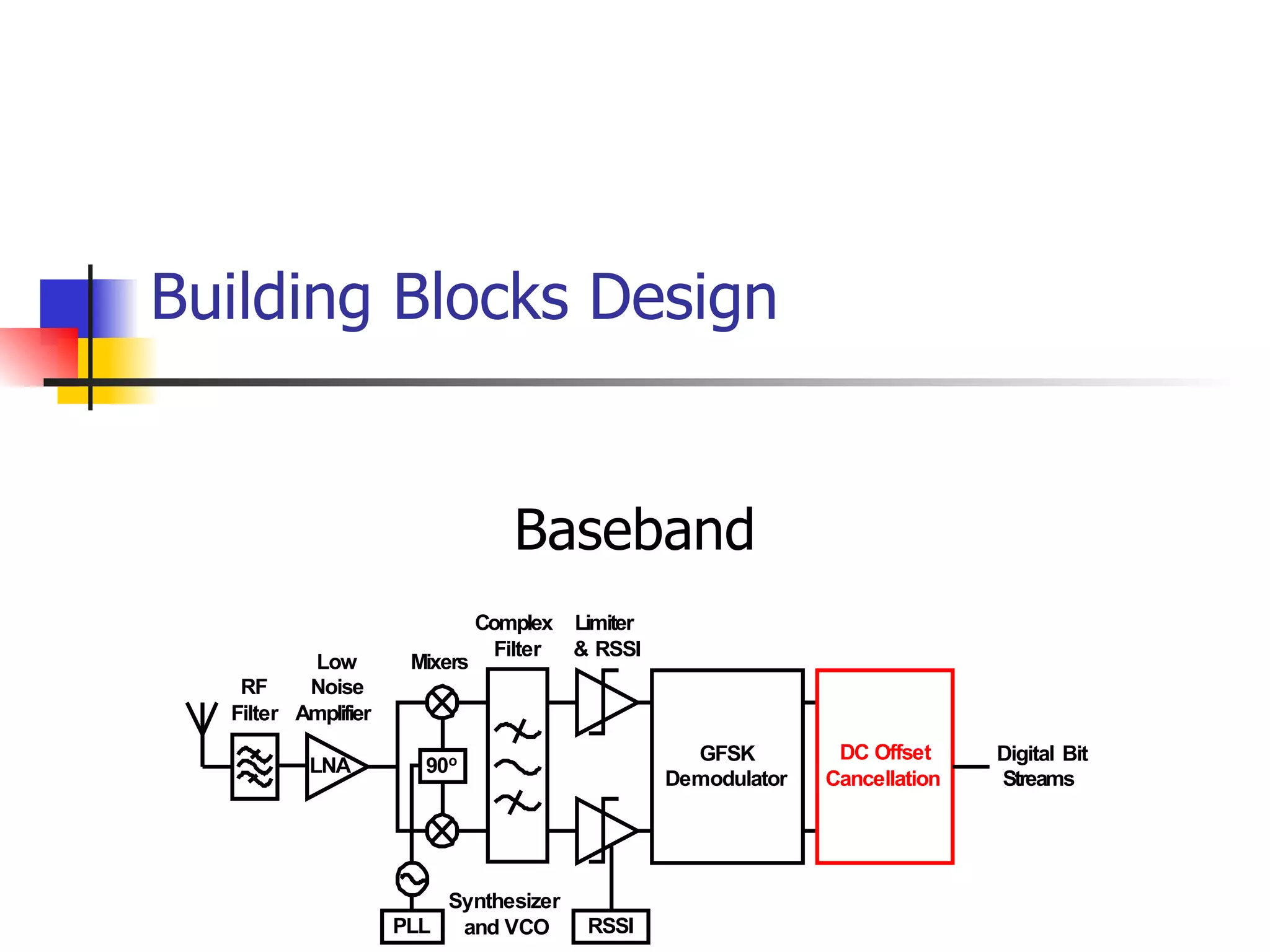
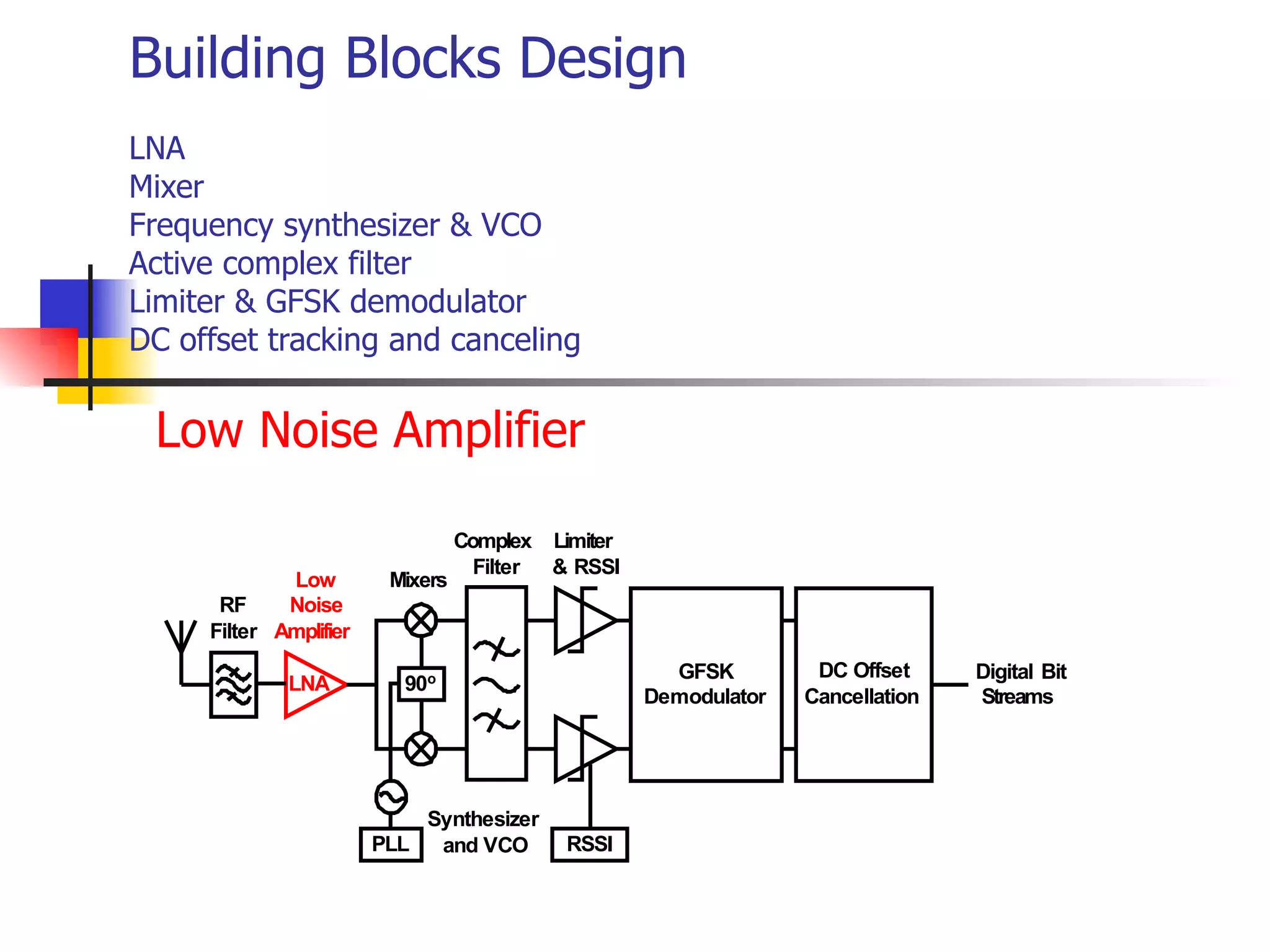
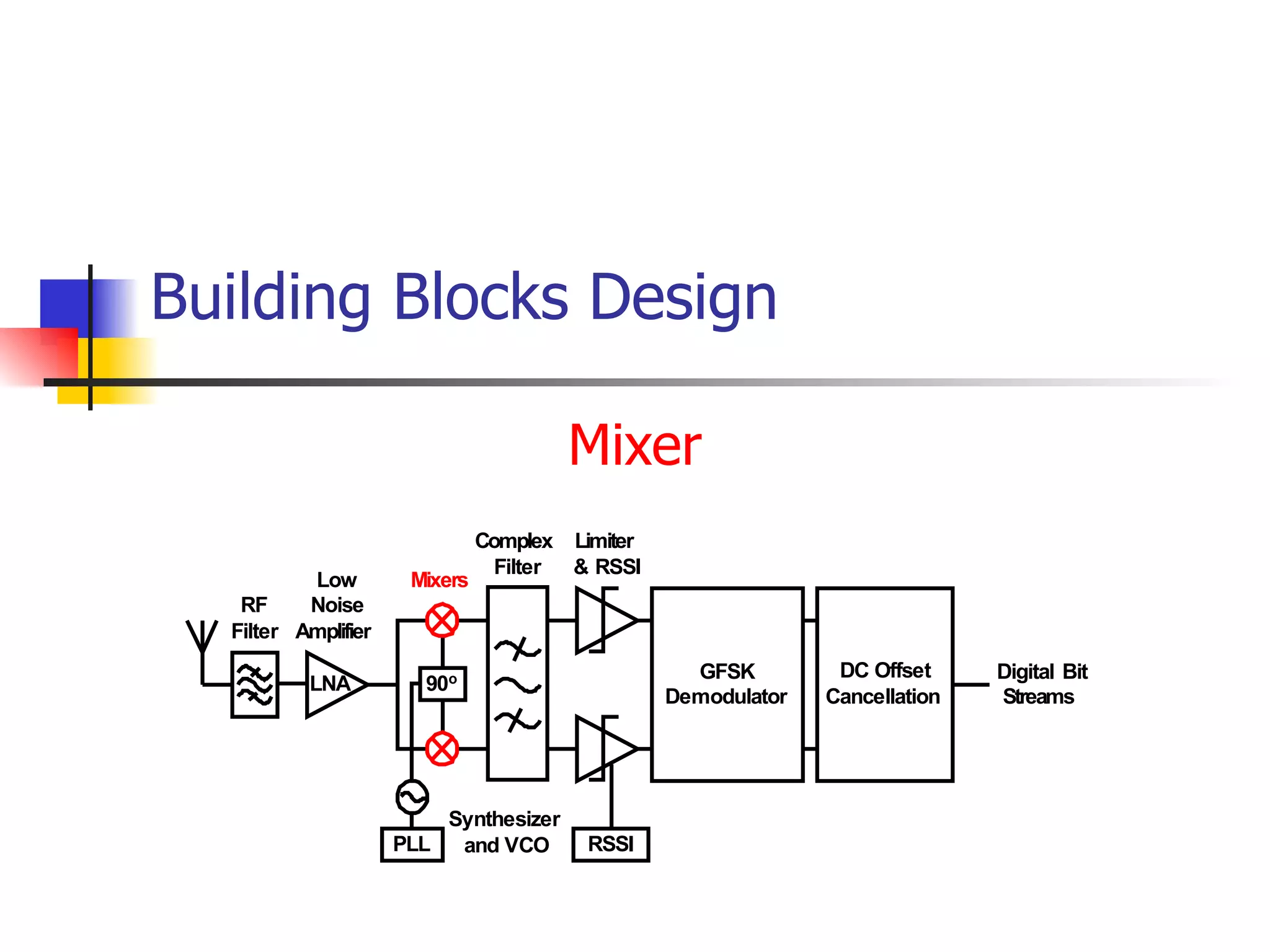
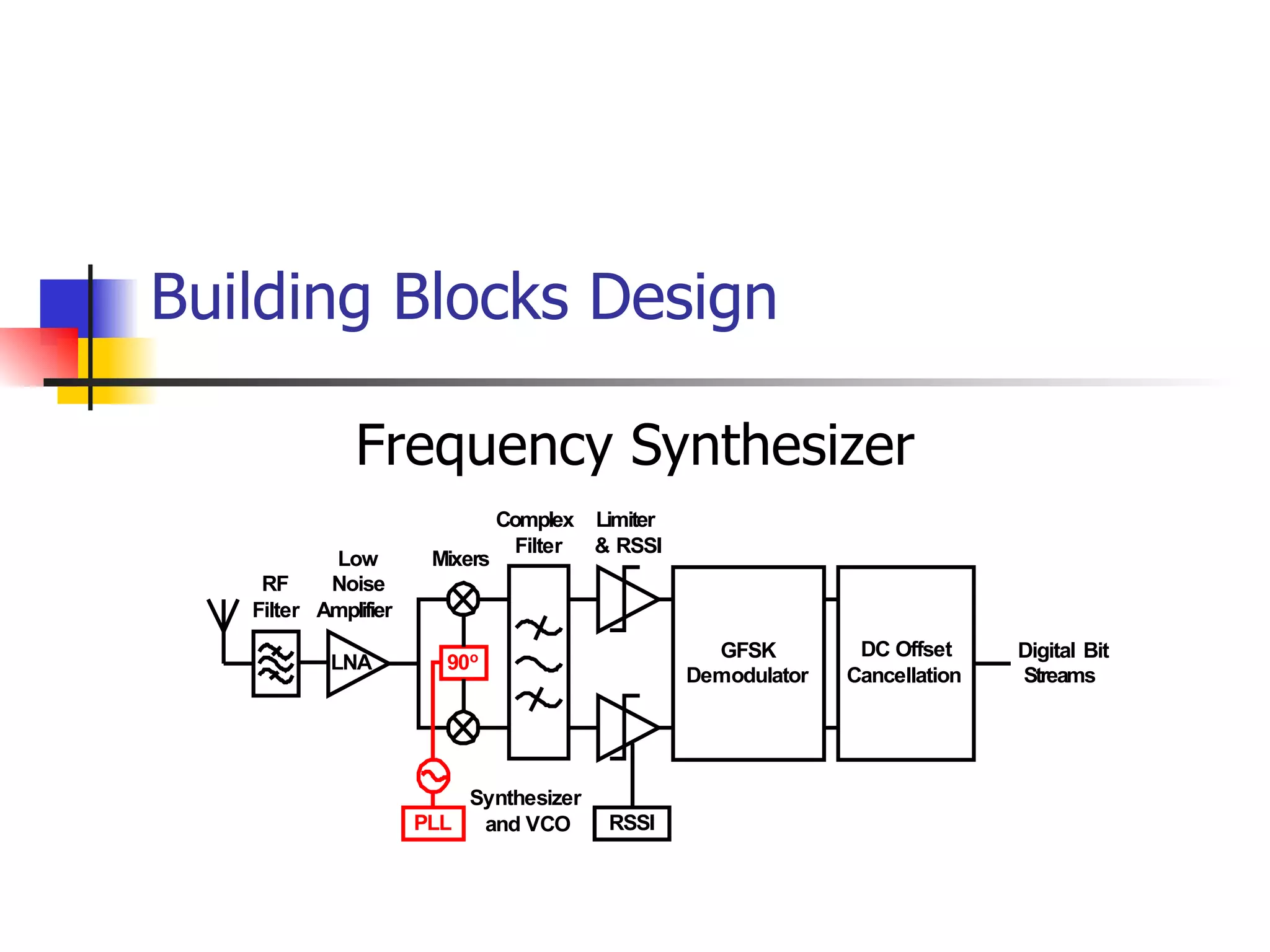
Building Blocks DesignLNA Mixer Frequency synthesizer & VCO Active complex filter Limiter & GFSK demodulator DC offset tracking and canceling Low Noise Amplifier
23.
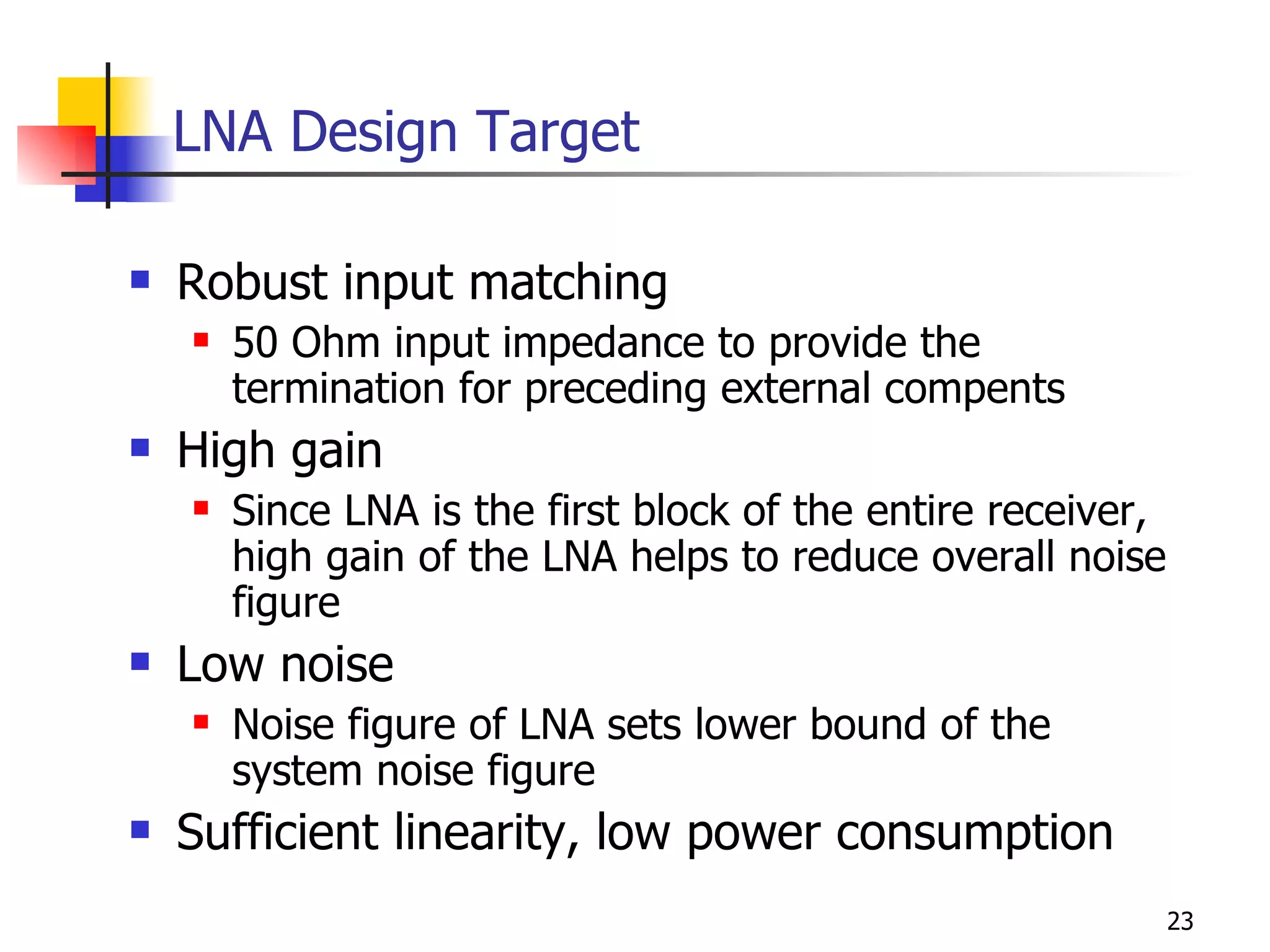
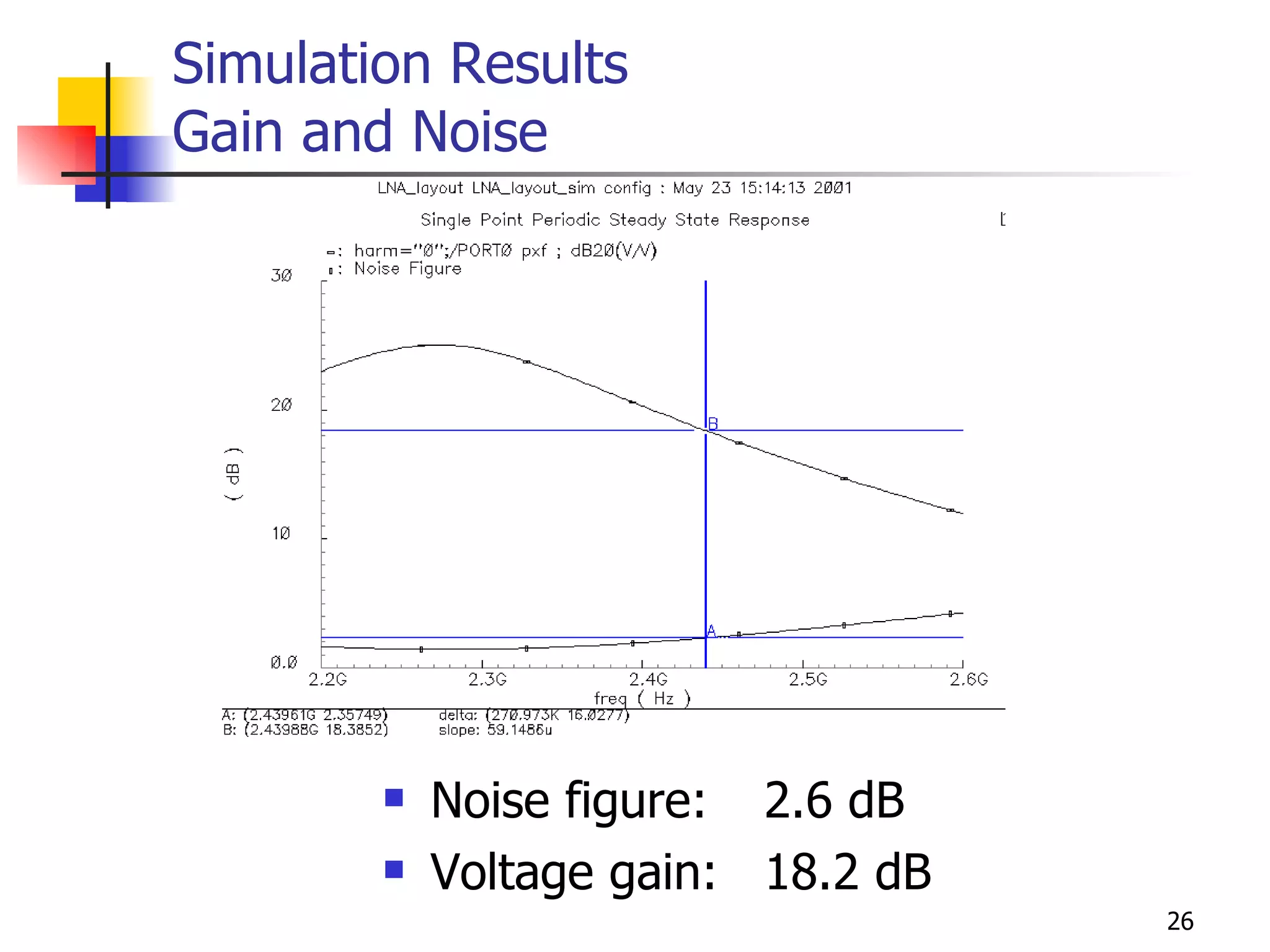
LNA Design TargetRobust input matching 50 Ohm input impedance to provide the termination for preceding external compents High gain Since LNA is the first block of the entire receiver, high gain of the LNA helps to reduce overall noise figure Low noise Noise figure of LNA sets lower bound of the system noise figure Sufficient linearity, low power consumption
24.
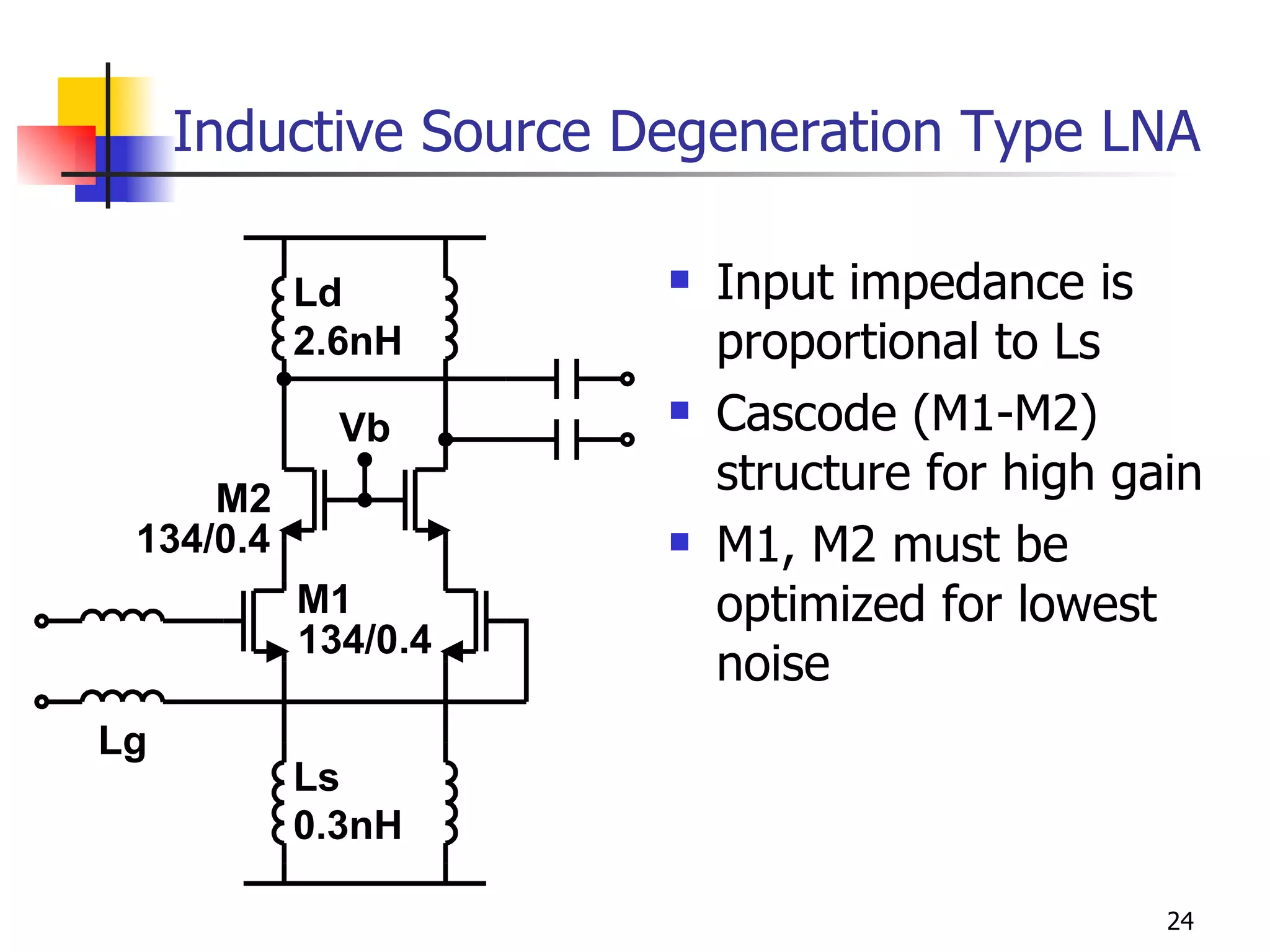
Inductive Source DegenerationType LNA Input impedance is proportional to Ls Cascode (M1-M2) structure for high gain M1, M2 must be optimized for lowest noise
25.
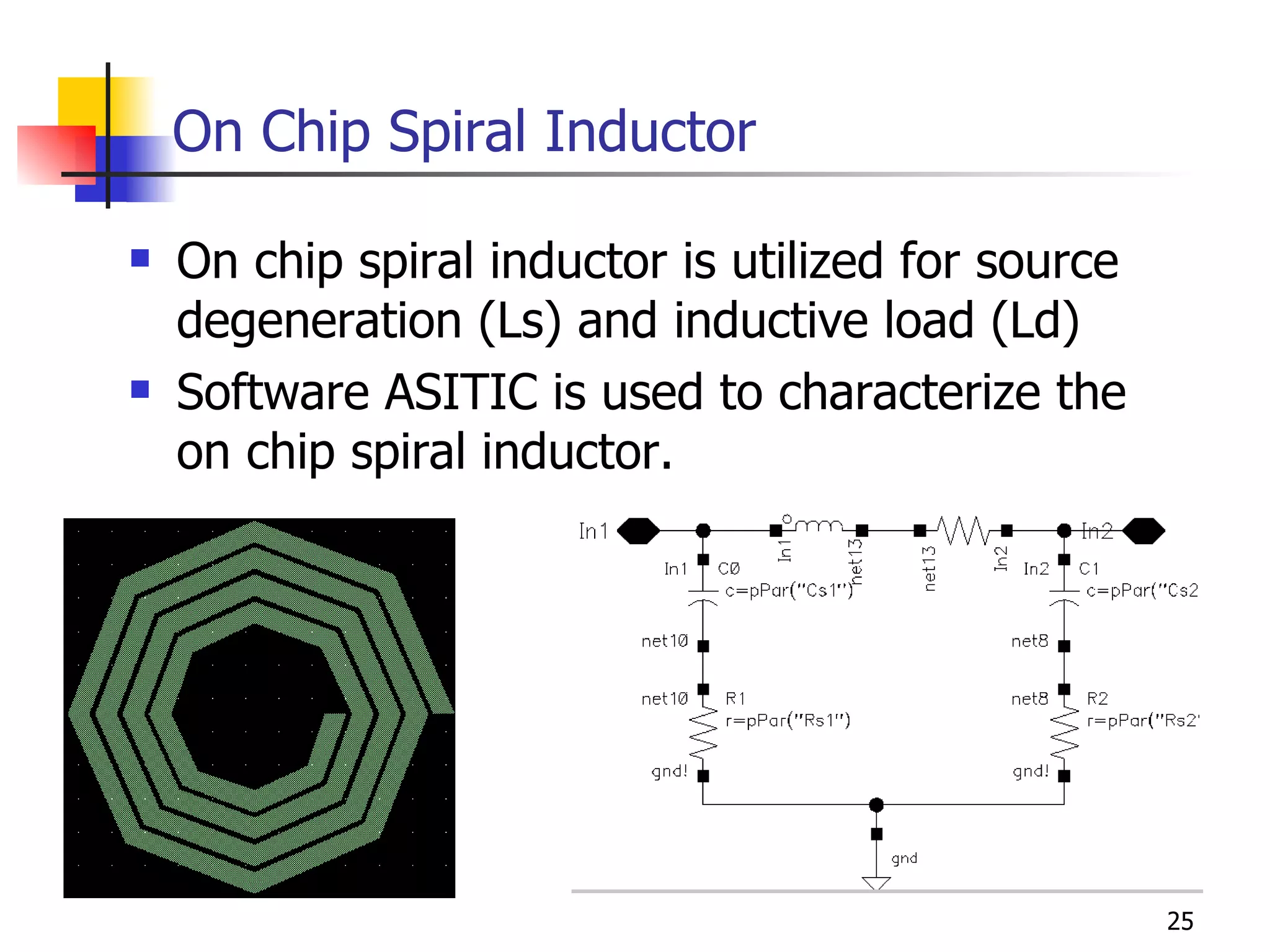
On Chip SpiralInductor On chip spiral inductor is utilized for source degeneration (Ls) and inductive load (Ld) Software ASITIC is used to characterize the on chip spiral inductor.
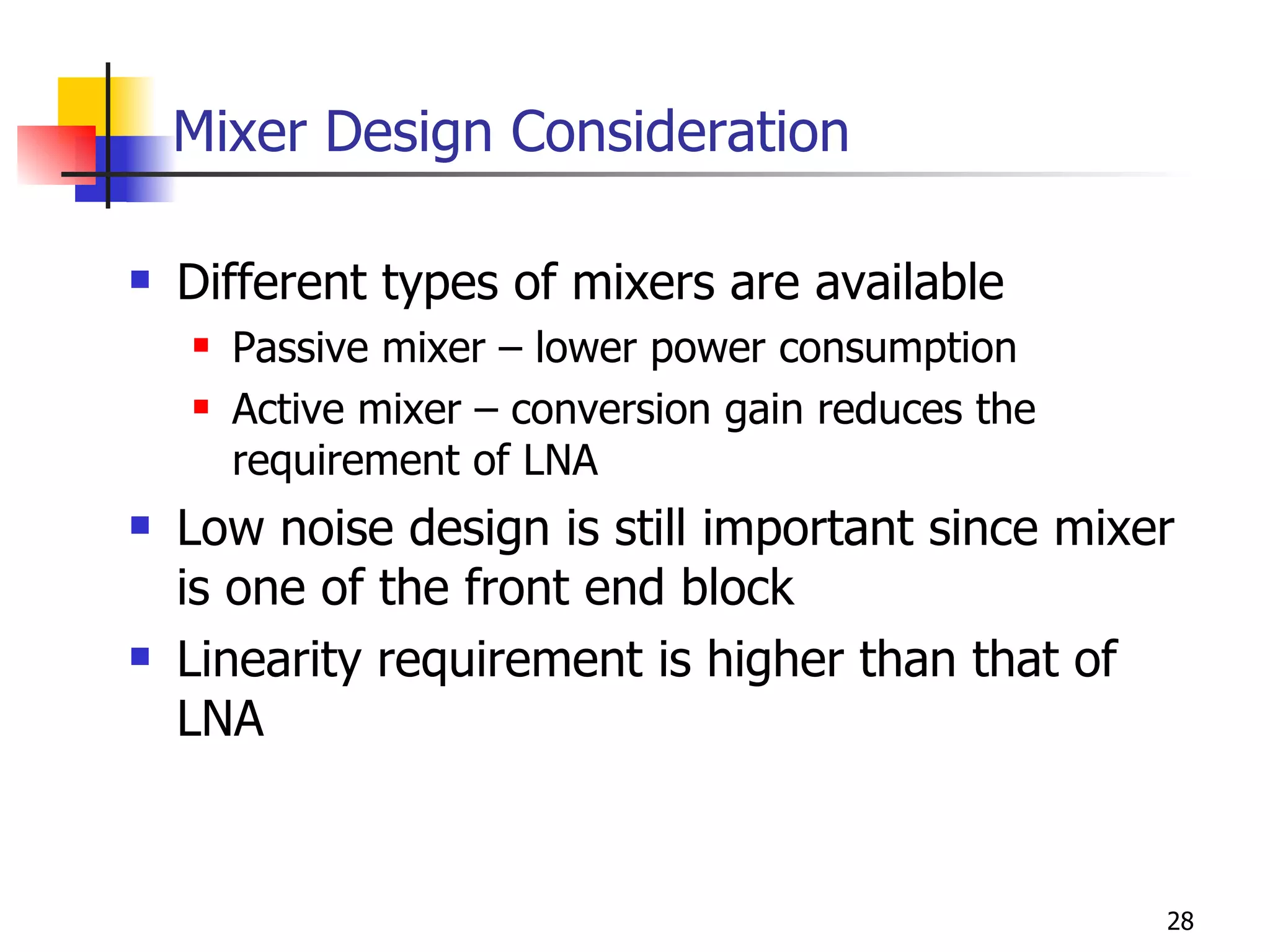
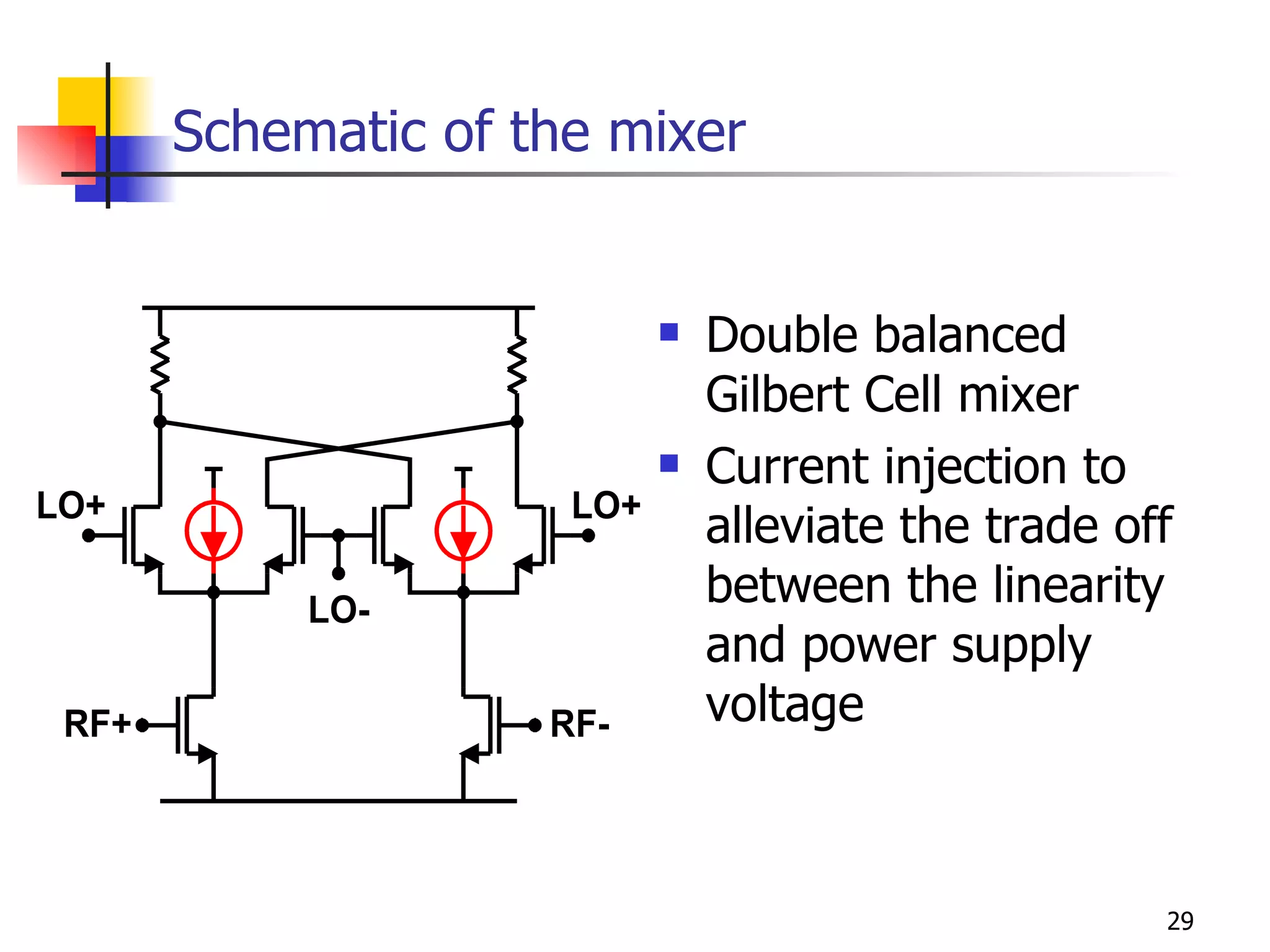
Mixer Design ConsiderationDifferent types of mixers are available Passive mixer – lower power consumption Active mixer – conversion gain reduces the requirement of LNA Low noise design is still important since mixer is one of the front end block Linearity requirement is higher than that of LNA
29.
Schematic of themixer Double balanced Gilbert Cell mixer Current injection to alleviate the trade off between the linearity and power supply voltage
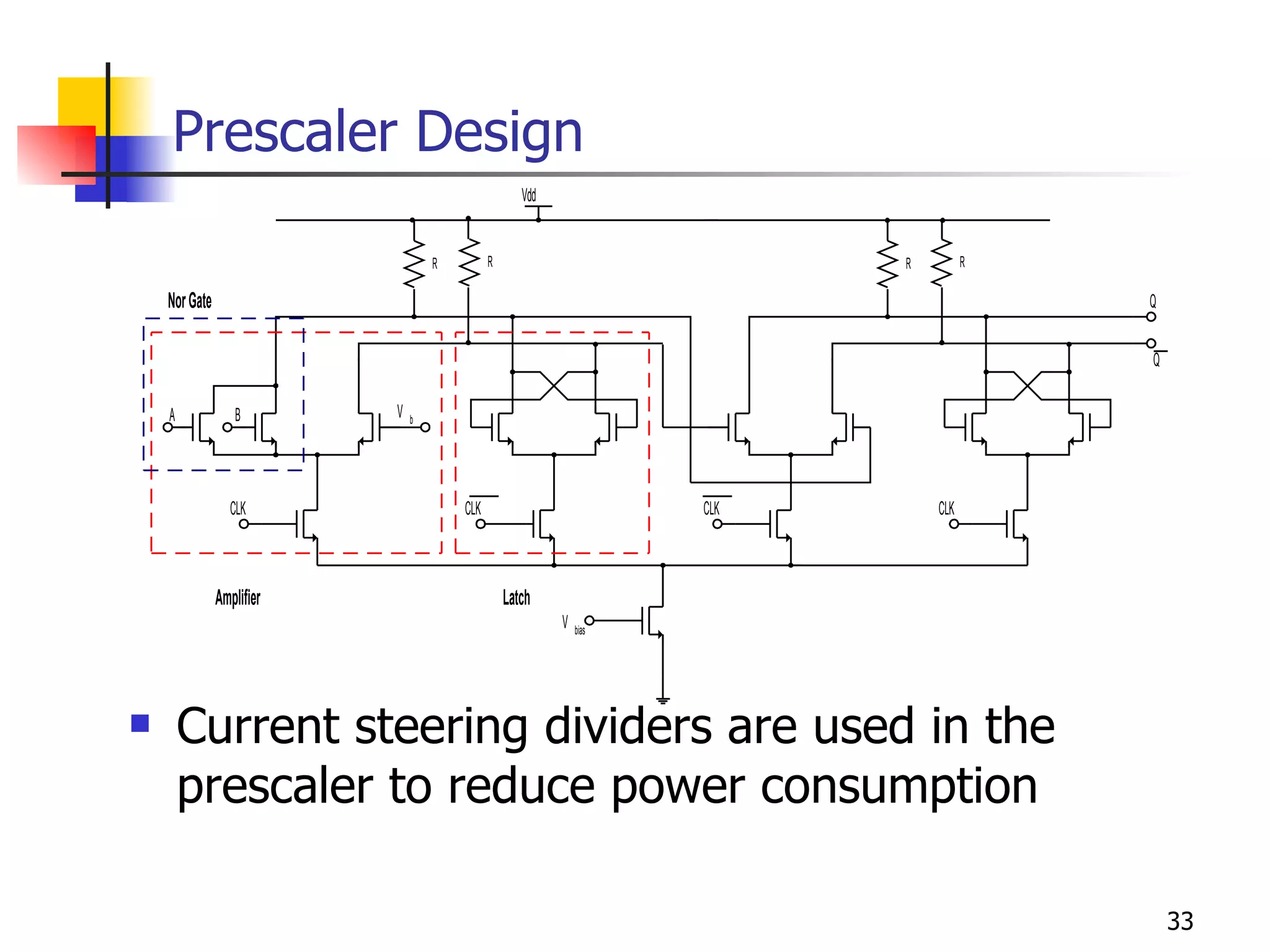
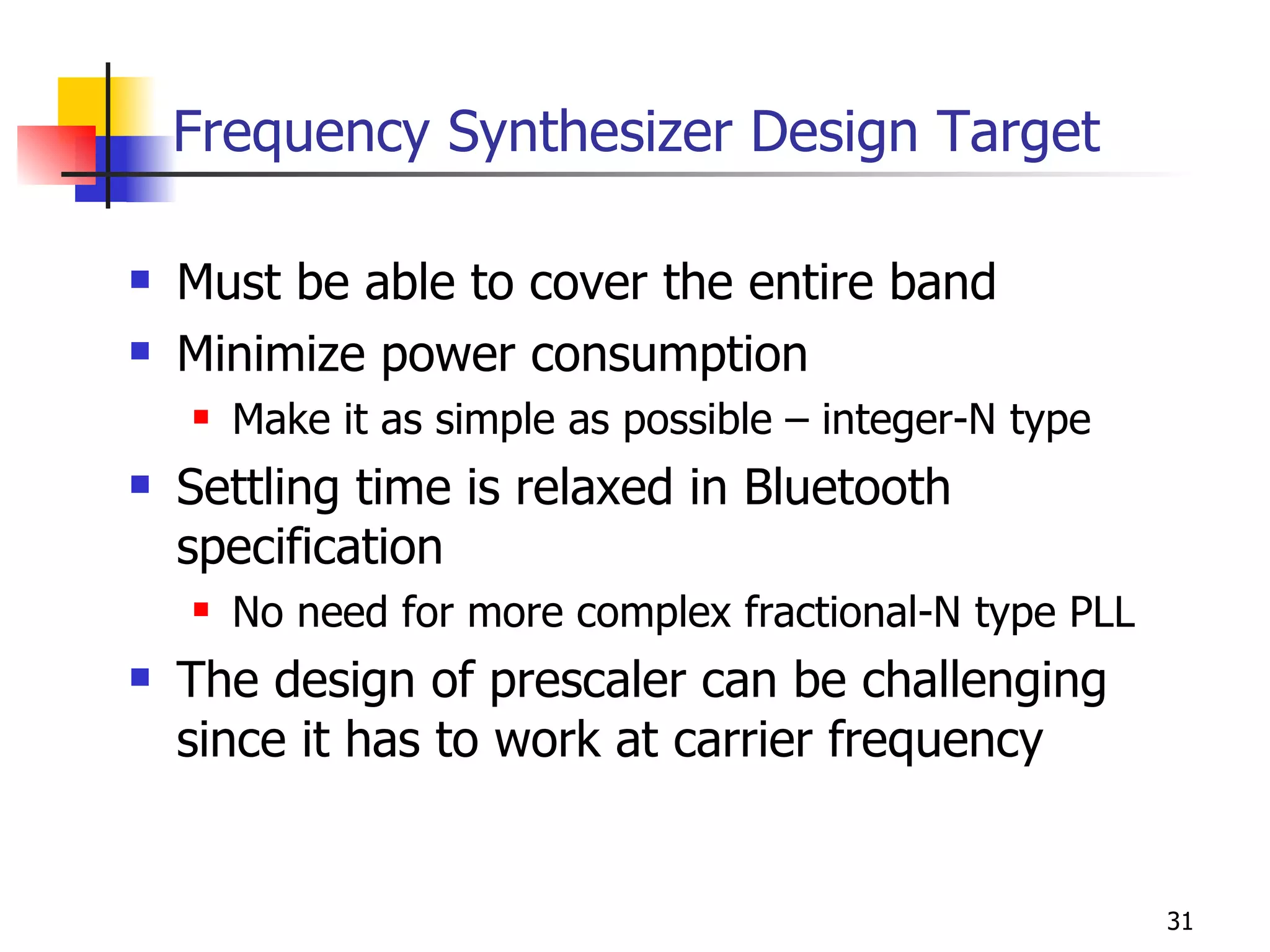
Frequency Synthesizer DesignTarget Must be able to cover the entire band Minimize power consumption Make it as simple as possible – integer-N type Settling time is relaxed in Bluetooth specification No need for more complex fractional-N type PLL The design of prescaler can be challenging since it has to work at carrier frequency
32.
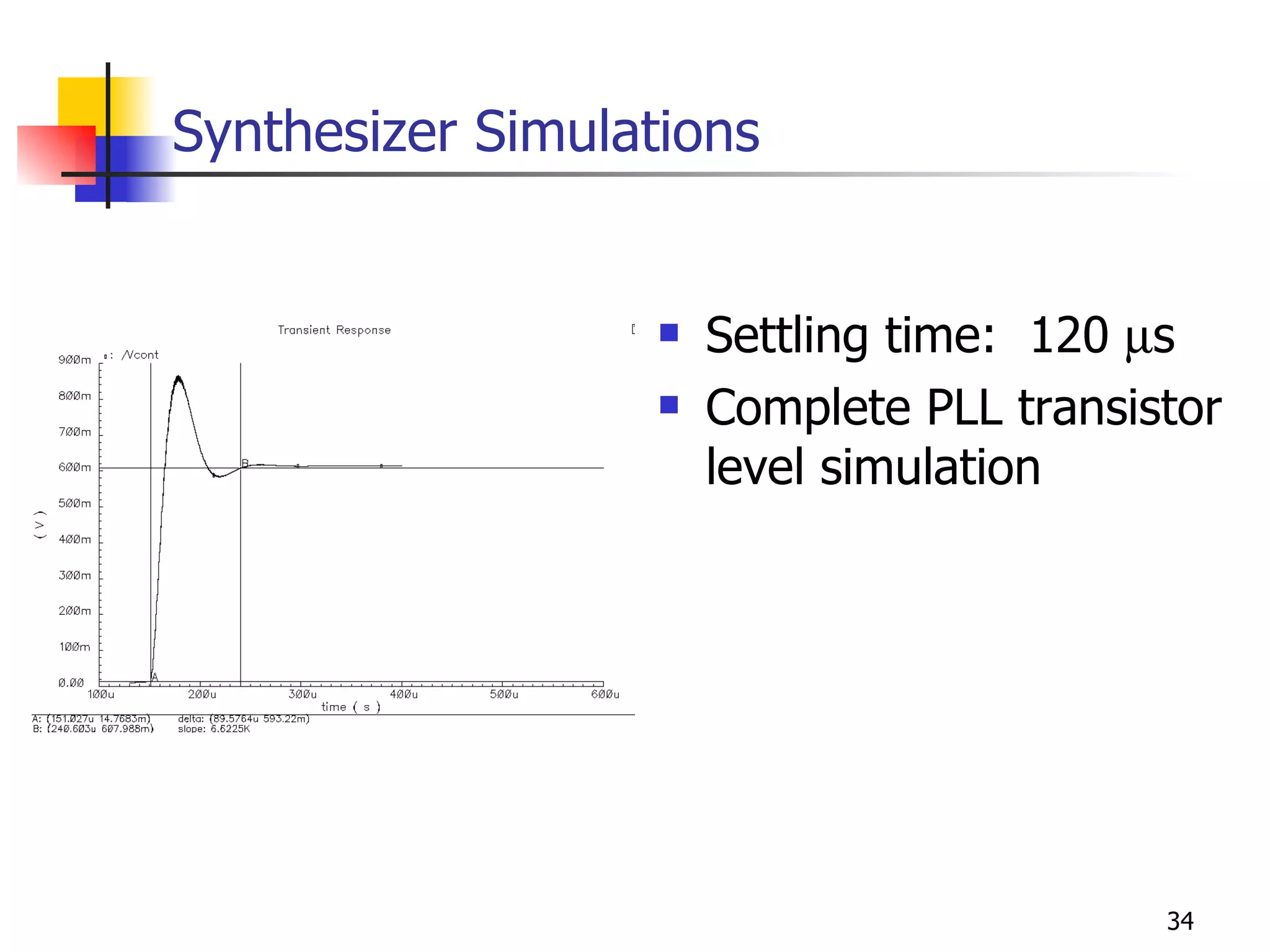
The Synthesizer StructureAn integer N architecture is preferred for the synthesizer to minimize power consumption Current steering logic prescaler Settling time 120 s Phase noise [email_address]
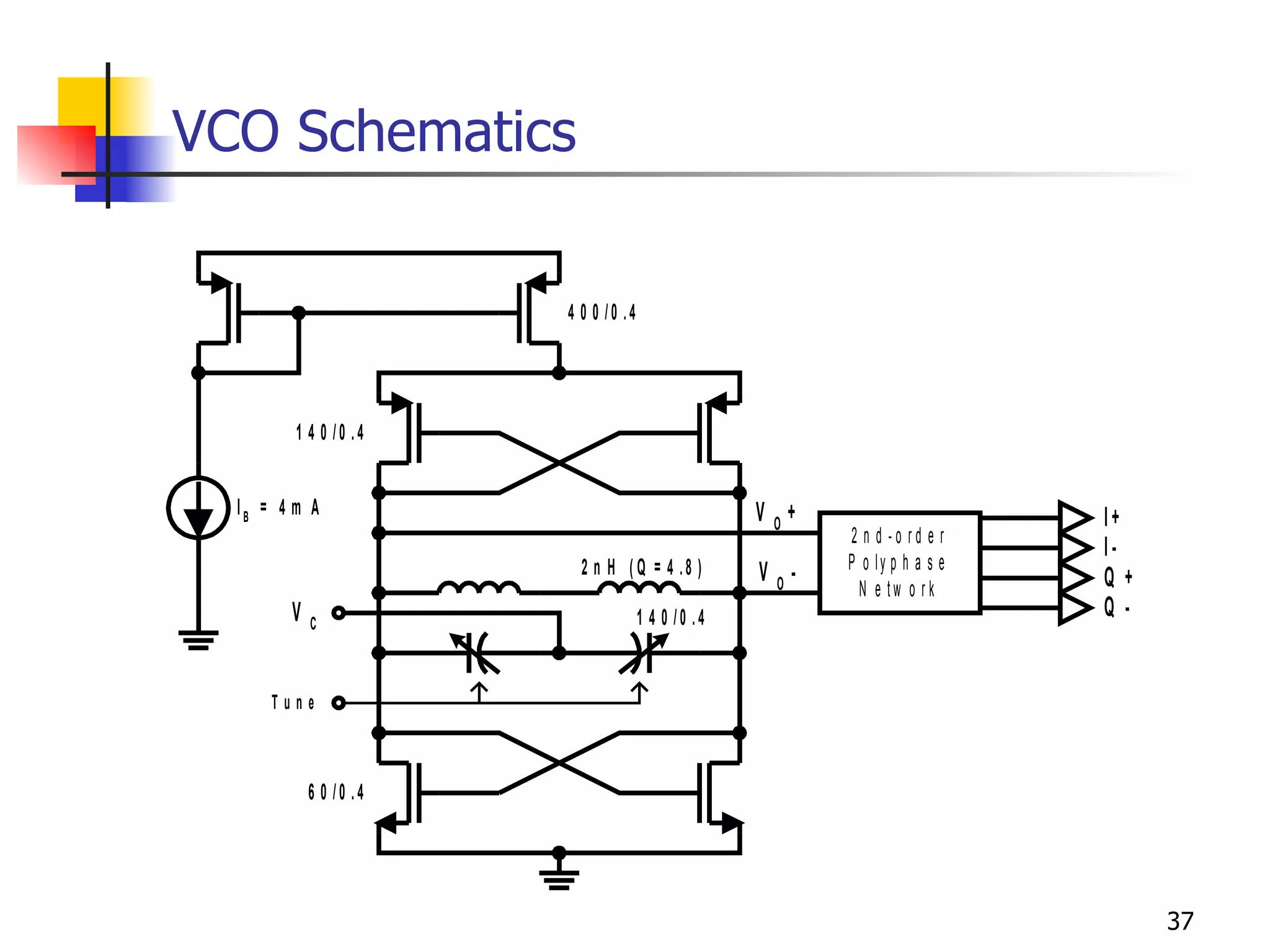
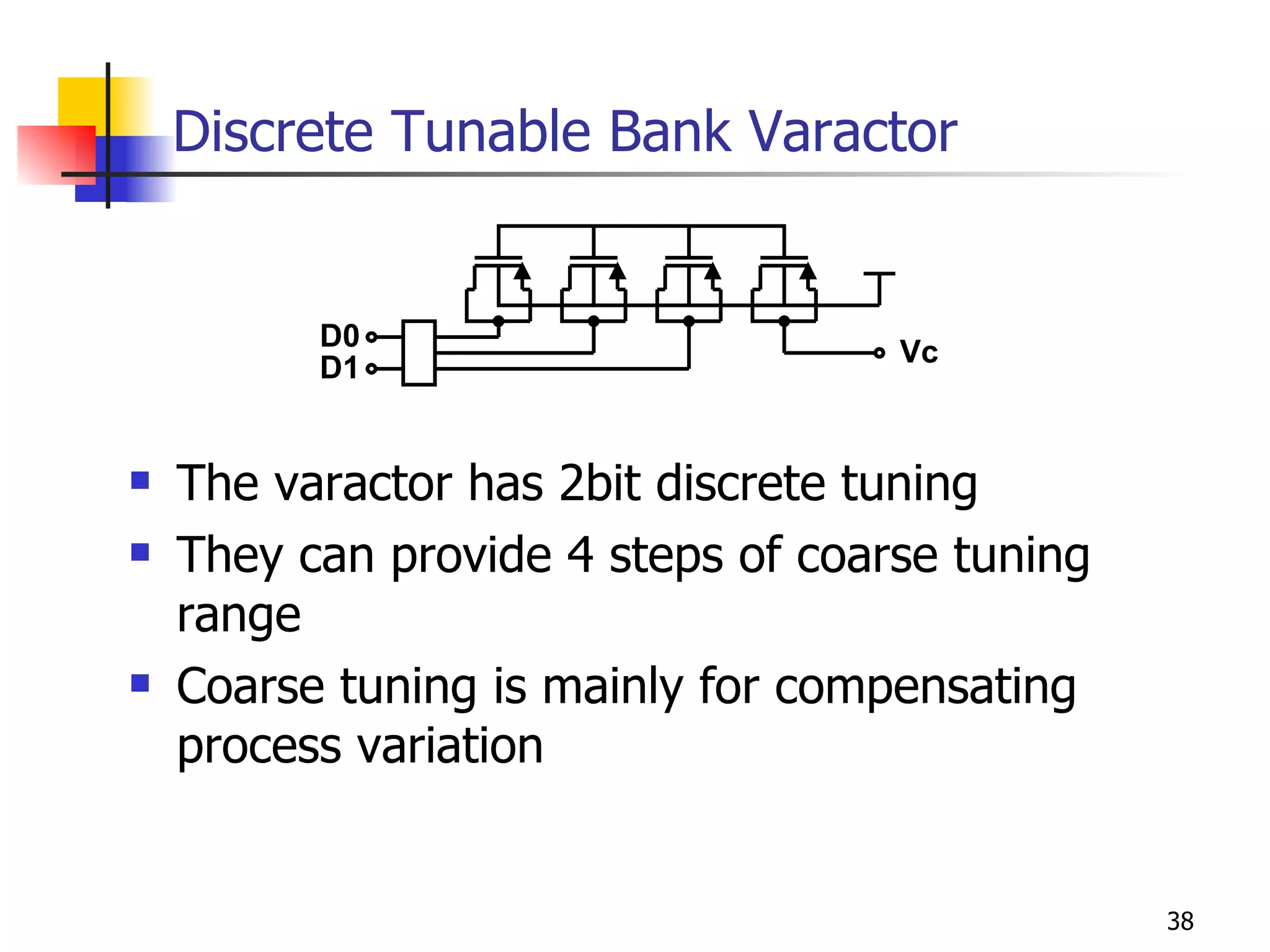
VCO Design TargetMust be able to cover the entire band and some more to compensate process variation Quadrature (I/Q) output is required for modulation Tuning sensitivity must be high enough to cover the range but low enough to reduce noise due to control signal Phase noise requirement came from third and higher interference specifications
Discrete Tunable BankVaractor The varactor has 2bit discrete tuning They can provide 4 steps of coarse tuning range Coarse tuning is mainly for compensating process variation
How Does ComplexFilter work? Bandpass filter for signal side, attenuator for image side
41.
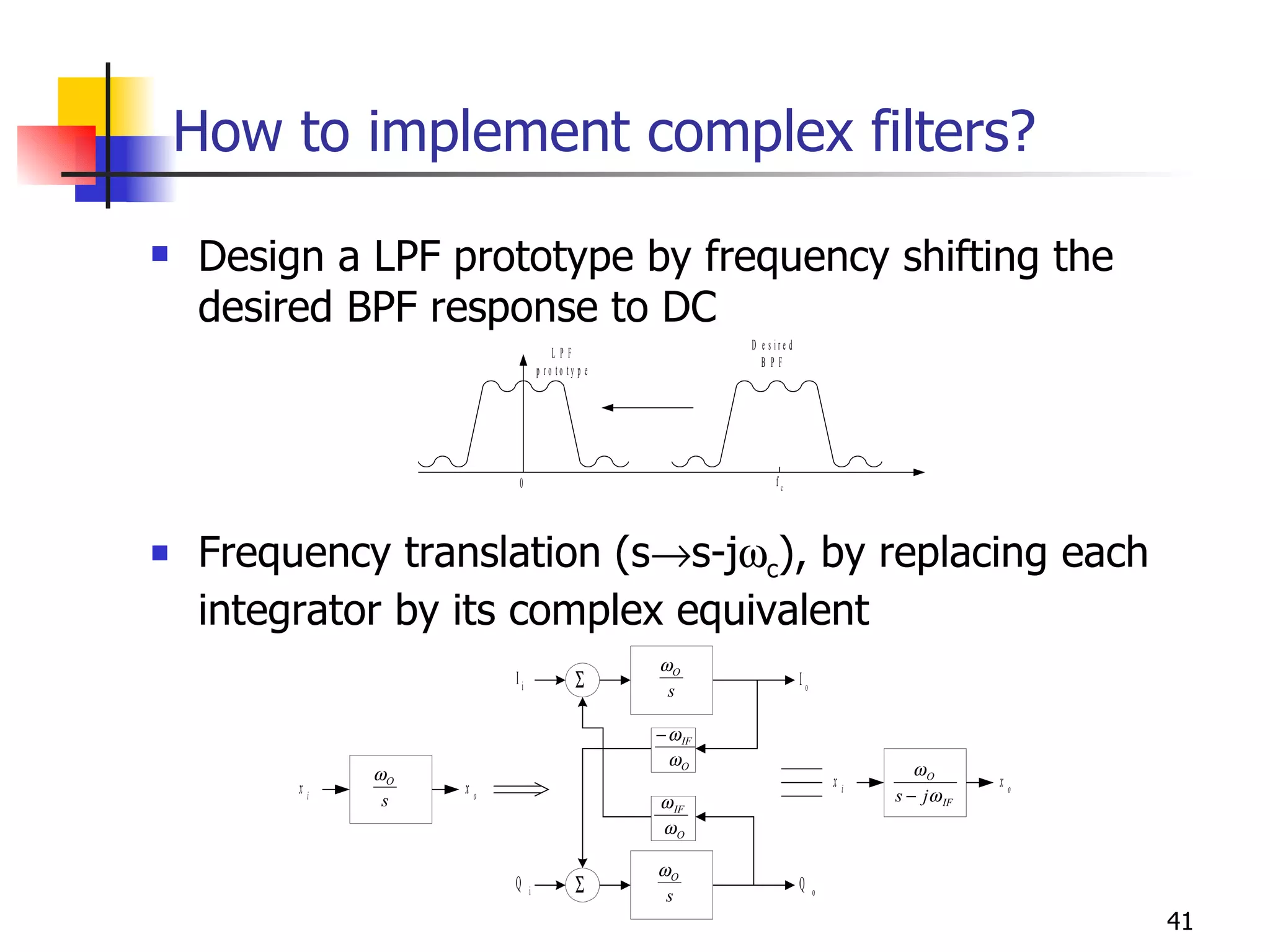
How to implementcomplex filters? Design a LPF prototype by frequency shifting the desired BPF response to DC Frequency translation (s s-j c ), by replacing each integrator by its complex equivalent
42.
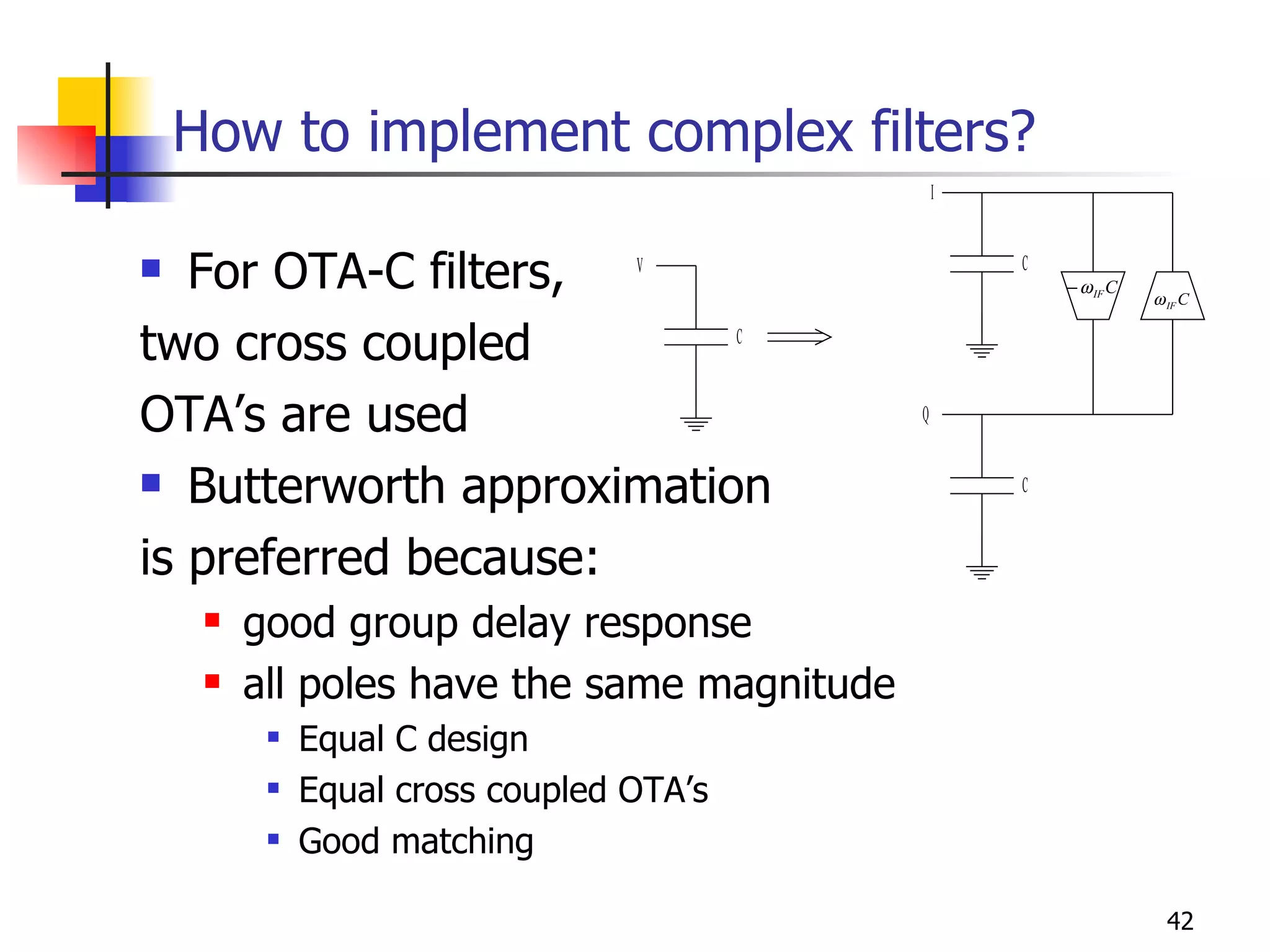
How to implementcomplex filters? For OTA-C filters, two cross coupled OTA’s are used Butterworth approximation is preferred because: good group delay response all poles have the same magnitude Equal C design Equal cross coupled OTA’s Good matching
43.
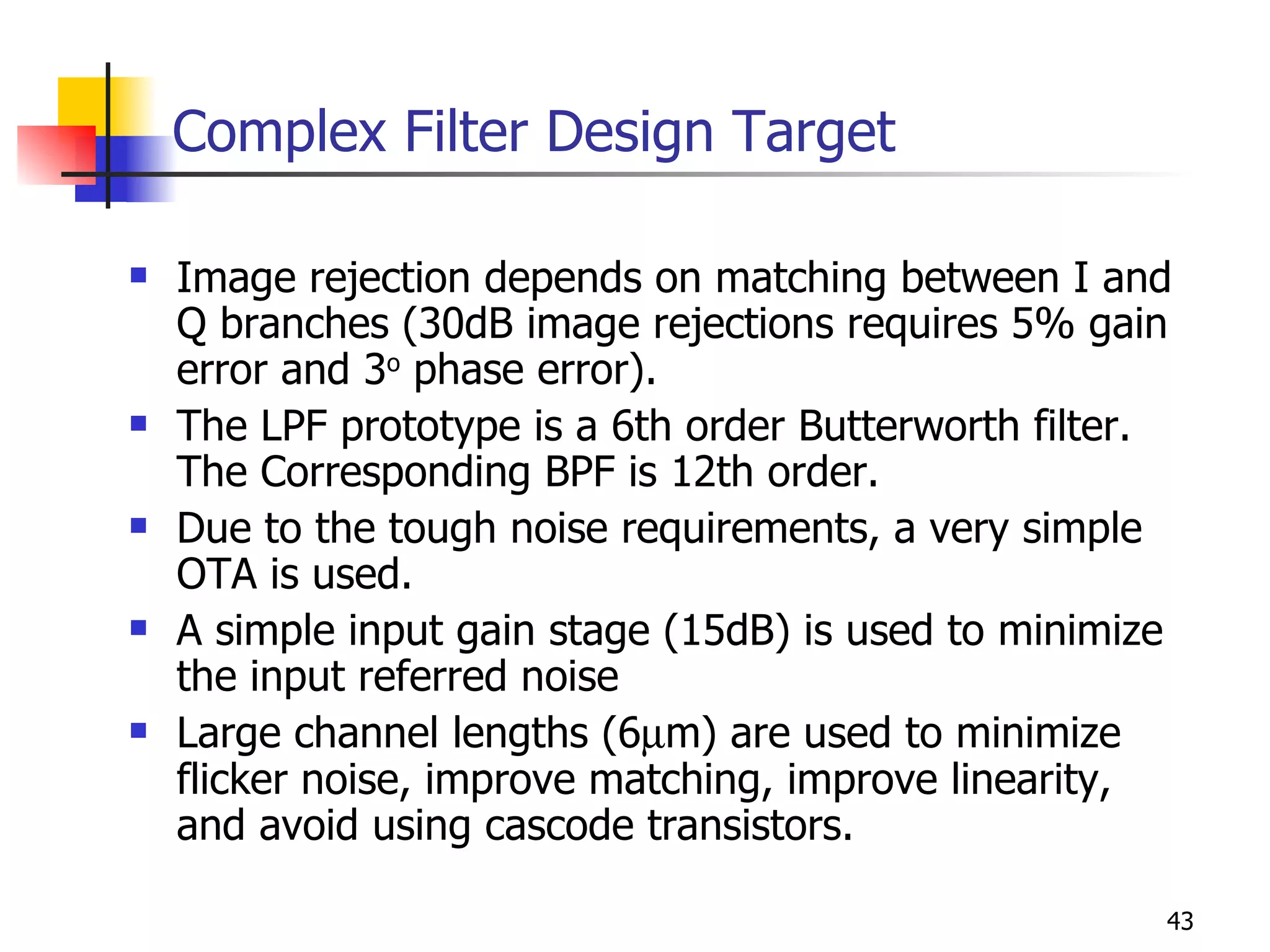
Complex Filter DesignTarget Image rejection depends on matching between I and Q branches (30dB image rejections requires 5% gain error and 3 o phase error). The LPF prototype is a 6th order Butterworth filter. The Corresponding BPF is 12th order. Due to the tough noise requirements, a very simple OTA is used. A simple input gain stage (15dB) is used to minimize the input referred noise Large channel lengths (6 m) are used to minimize flicker noise, improve matching, improve linearity, and avoid using cascode transistors.
44.
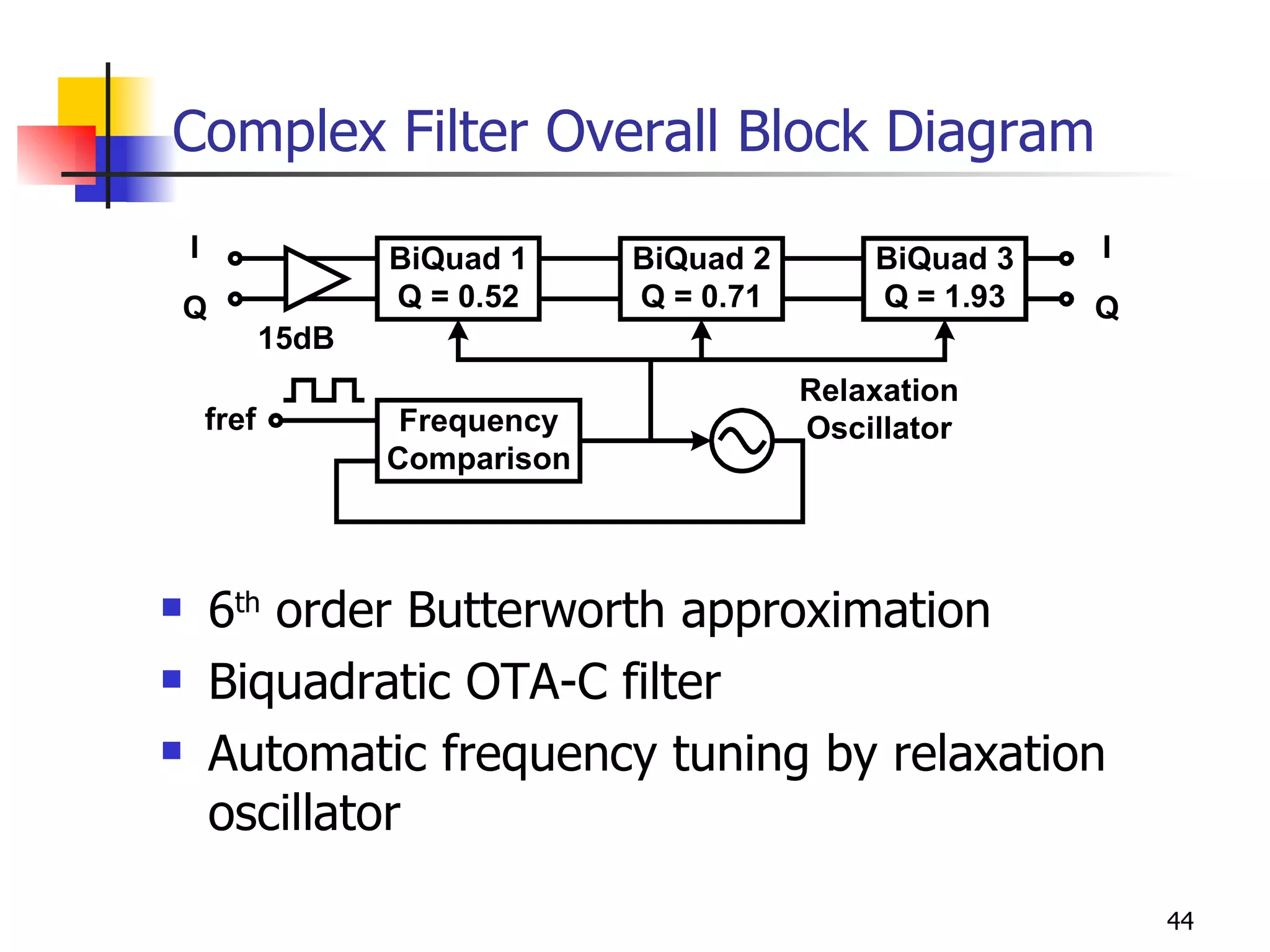
Complex Filter OverallBlock Diagram 6 th order Butterworth approximation Biquadratic OTA-C filter Automatic frequency tuning by relaxation oscillator
45.
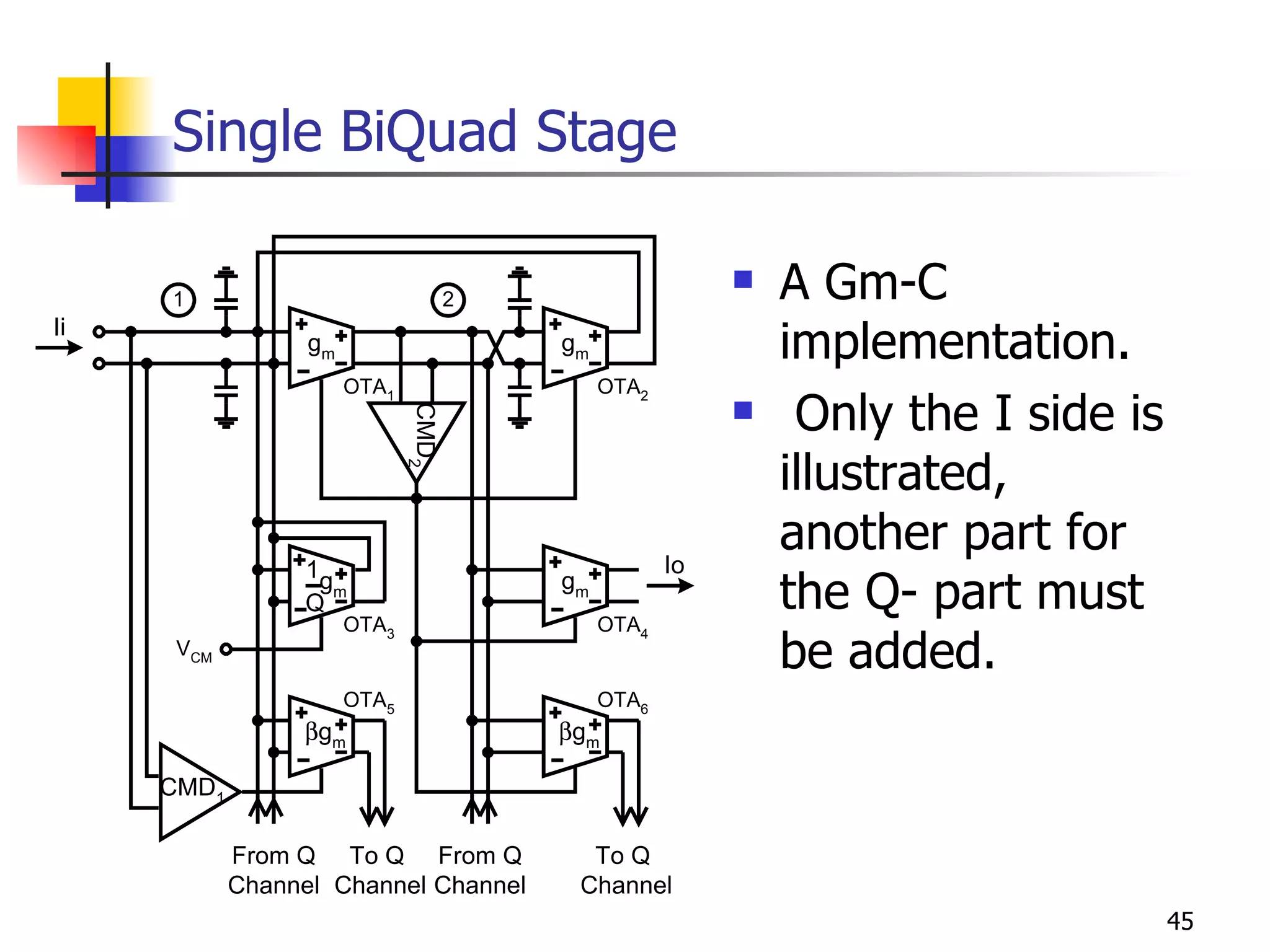
Single BiQuad StageA Gm-C implementation. Only the I side is illustrated, another part for the Q- part must be added.
46.
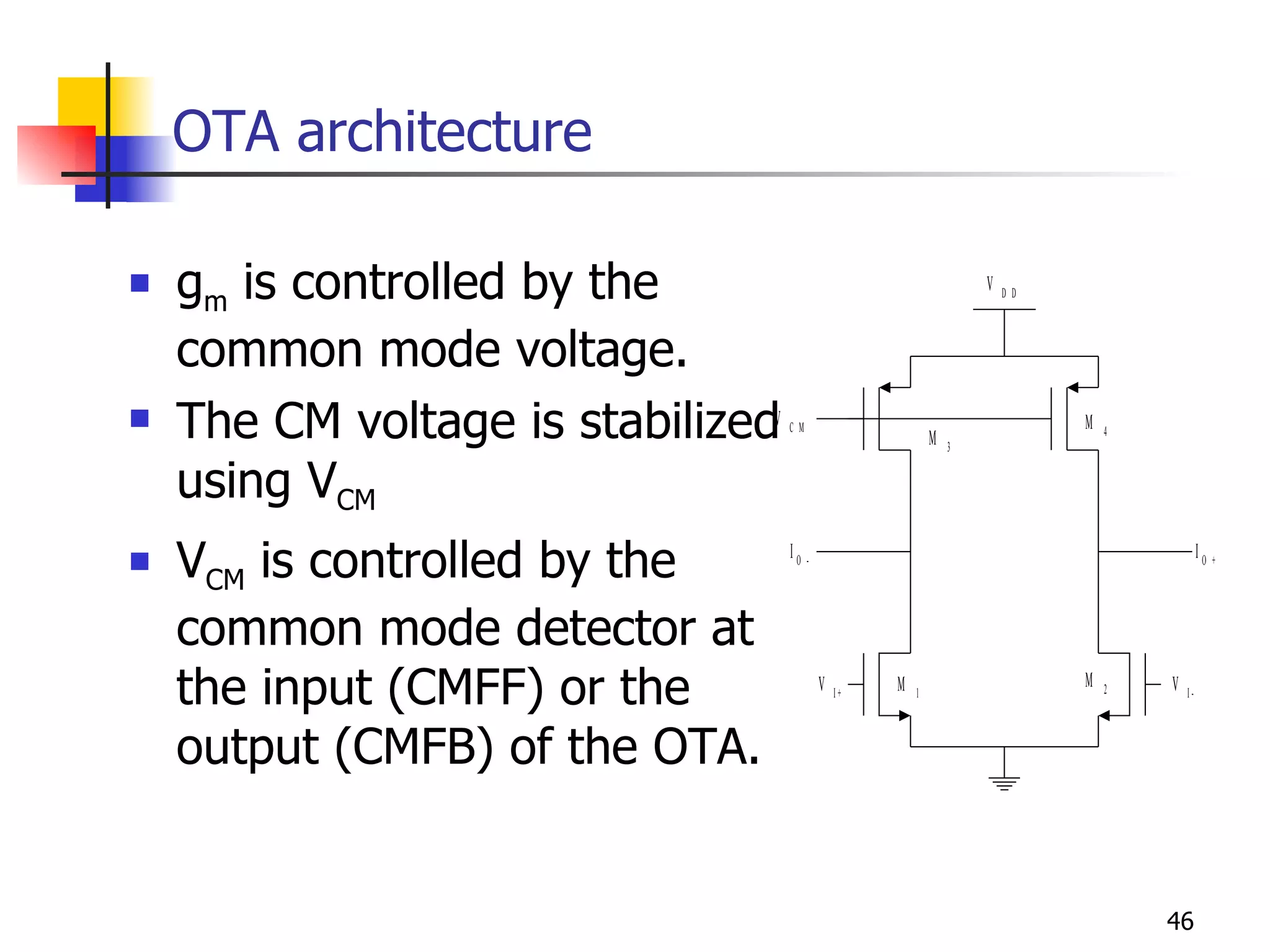
OTA architecture gm is controlled by the common mode voltage. The CM voltage is stabilized using V CM V CM is controlled by the common mode detector at the input (CMFF) or the output (CMFB) of the OTA.
47.
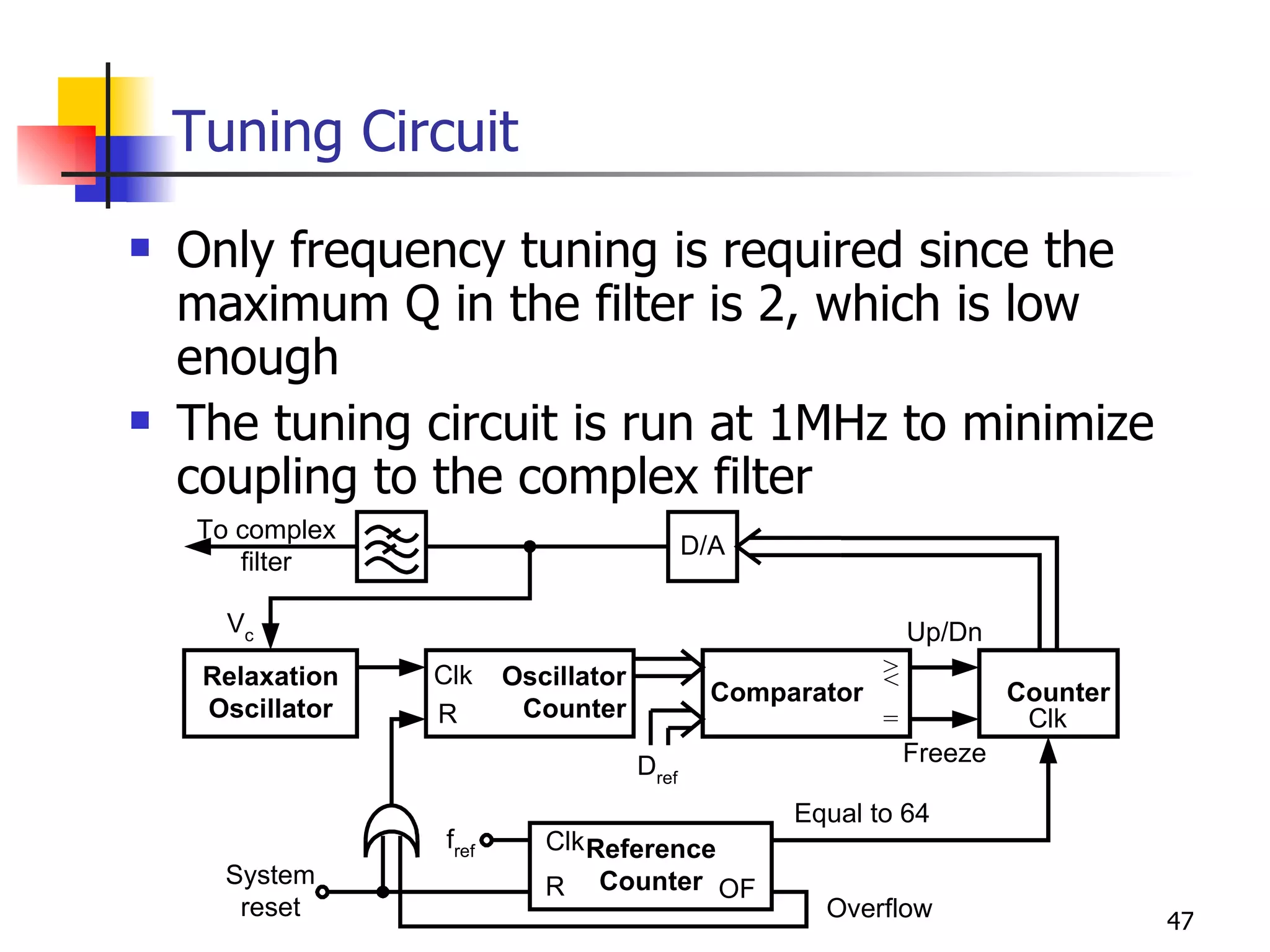
Tuning Circuit Onlyfrequency tuning is required since the maximum Q in the filter is 2, which is low enough The tuning circuit is run at 1MHz to minimize coupling to the complex filter
48.
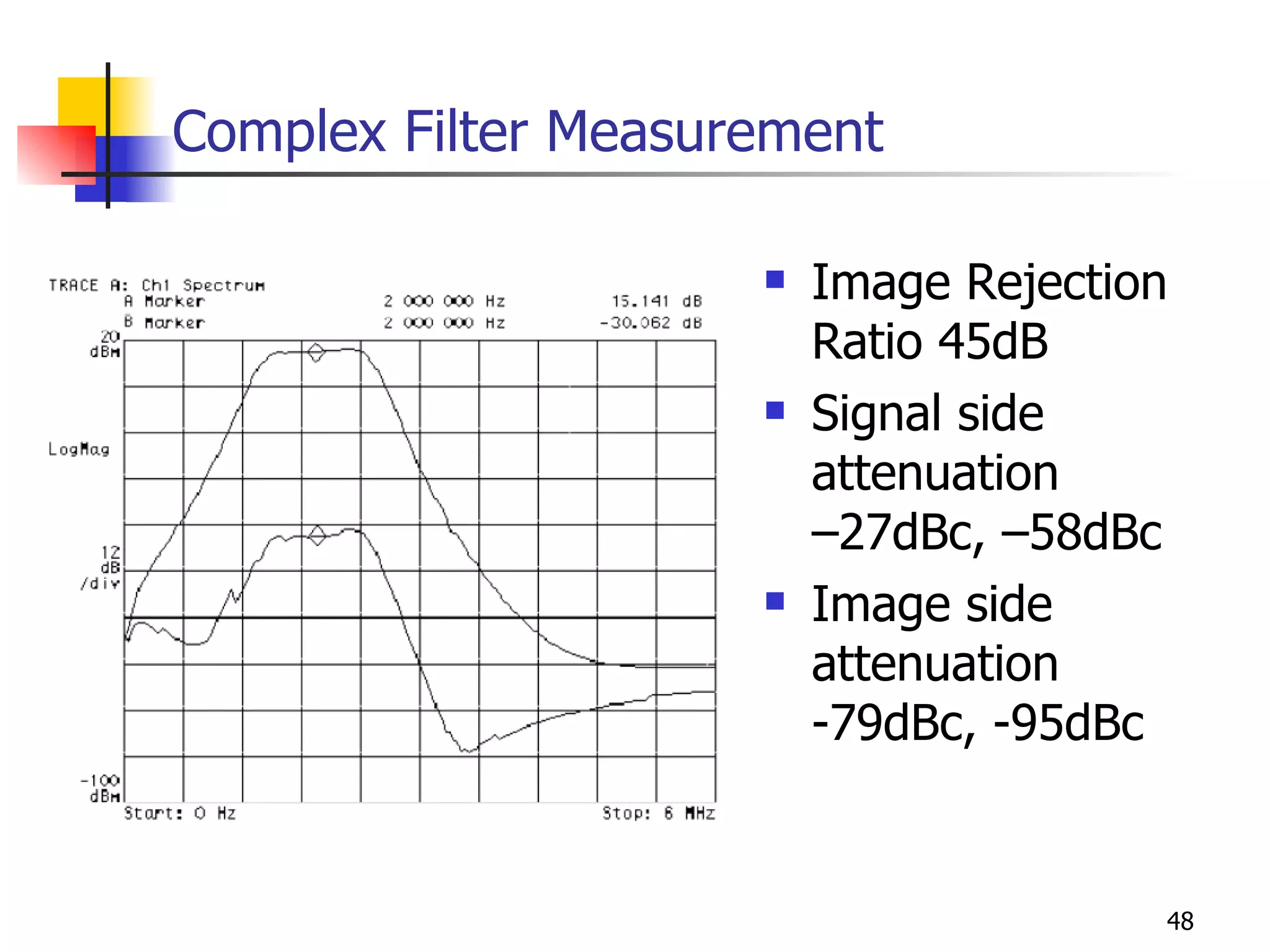
Complex Filter MeasurementImage Rejection Ratio 45dB Signal side attenuation –27dBc, –58dBc Image side attenuation -79dBc, -95dBc
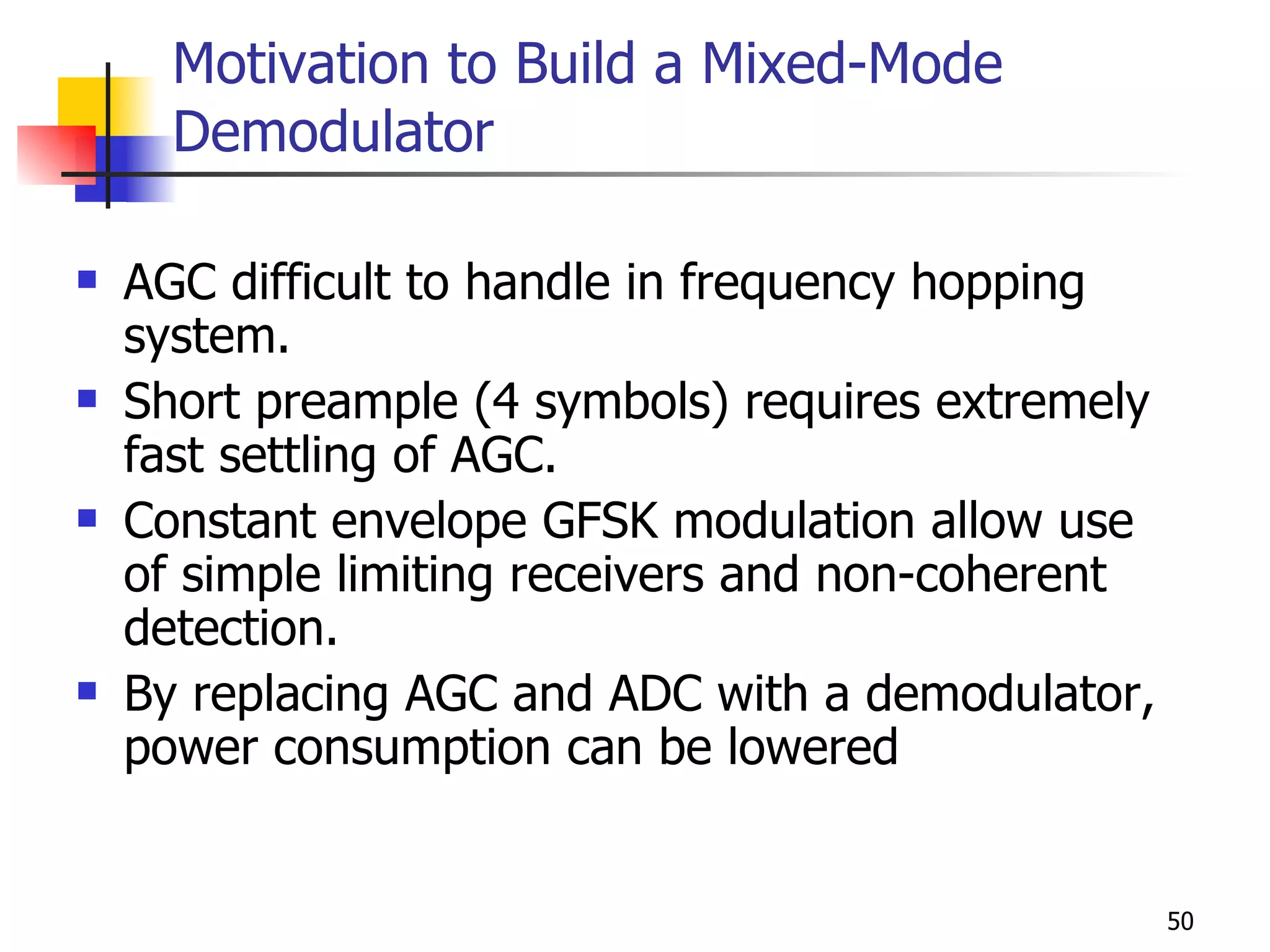
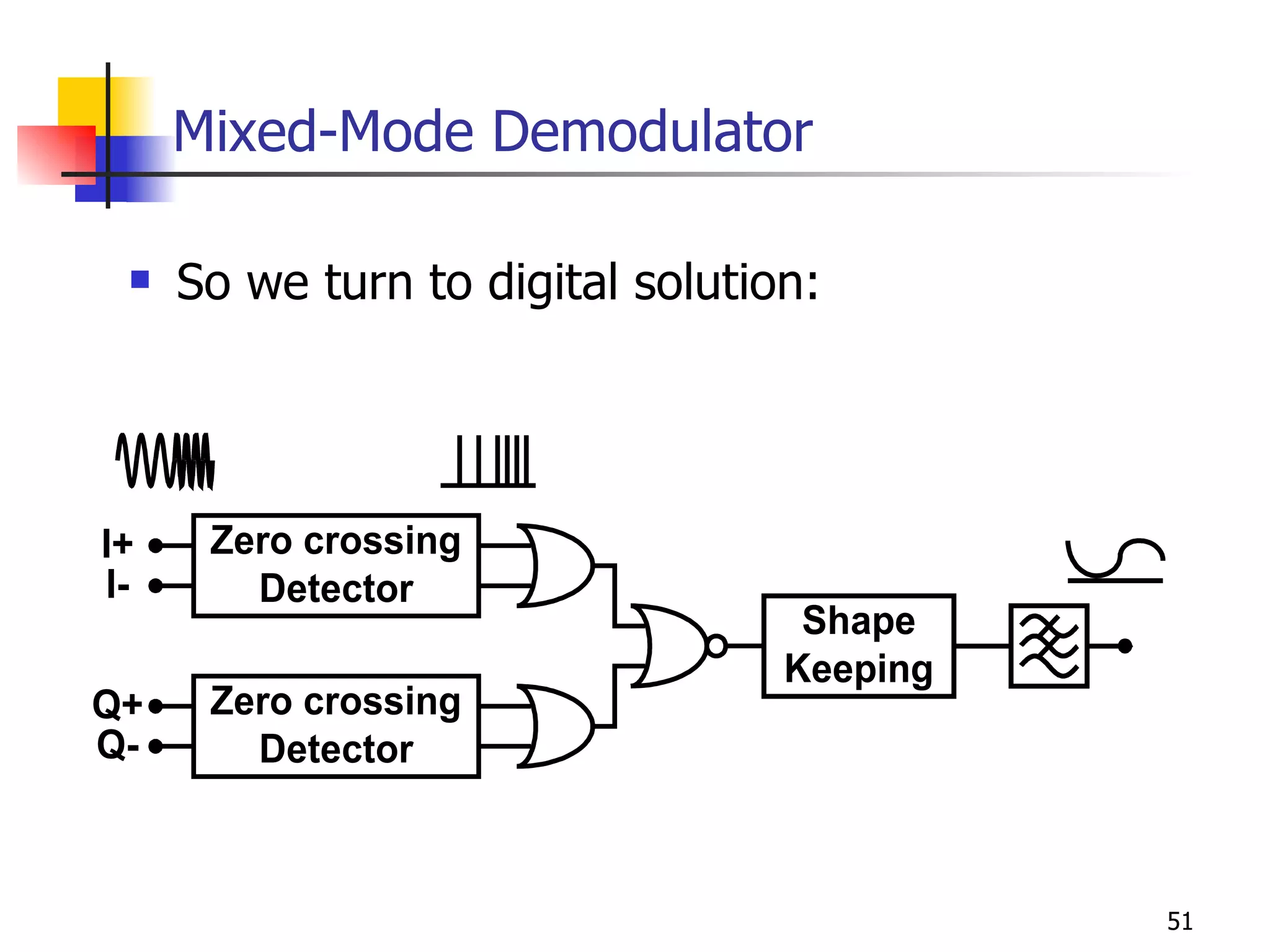
Motivation to Builda Mixed-Mode Demodulator AGC difficult to handle in frequency hopping system. Short preample (4 symbols) requires extremely fast settling of AGC. Constant envelope GFSK modulation allow use of simple limiting receivers and non-coherent detection. By replacing AGC and ADC with a demodulator, power consumption can be lowered
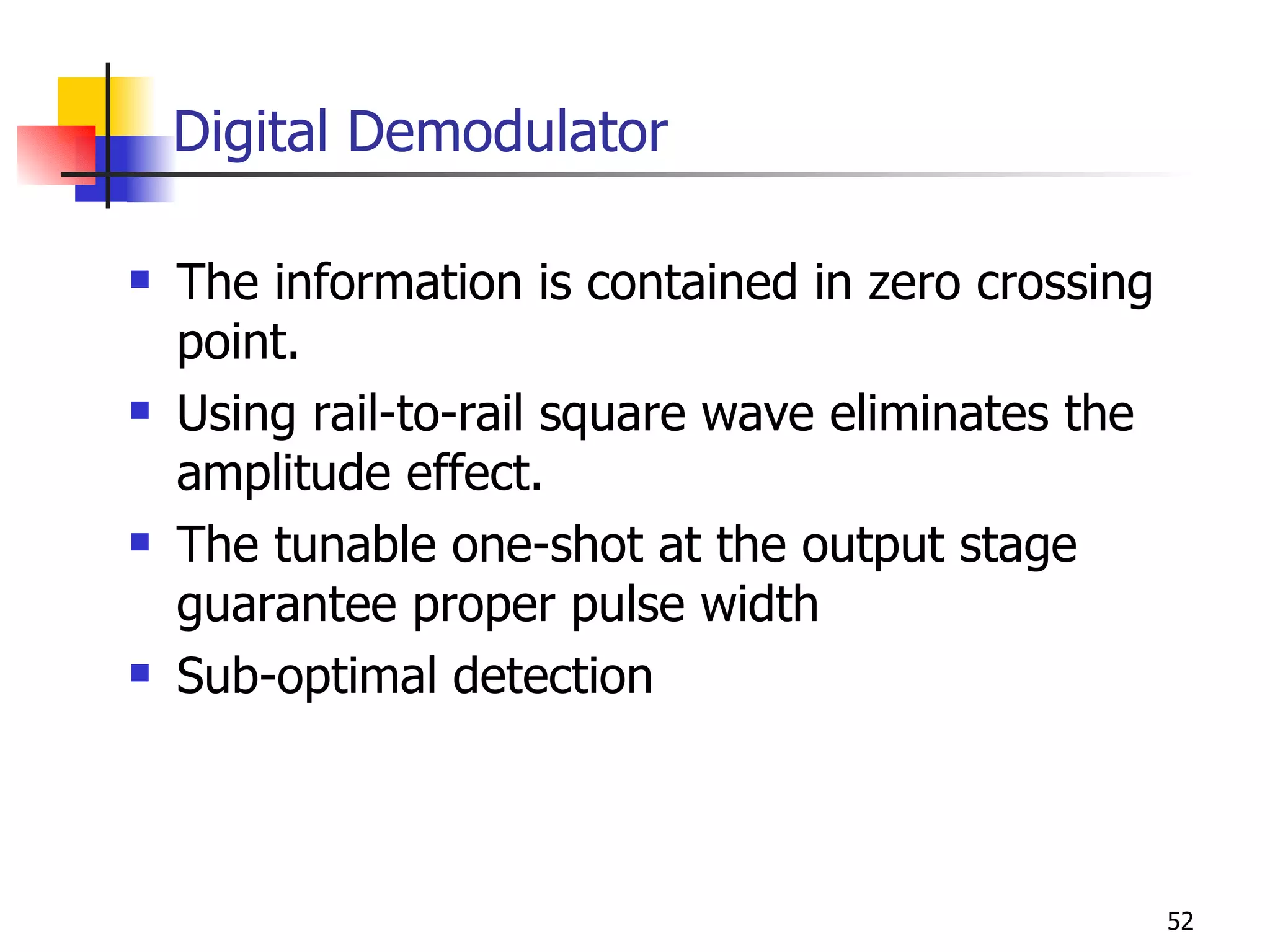
Digital Demodulator Theinformation is contained in zero crossing point. Using rail-to-rail square wave eliminates the amplitude effect. The tunable one-shot at the output stage guarantee proper pulse width Sub-optimal detection
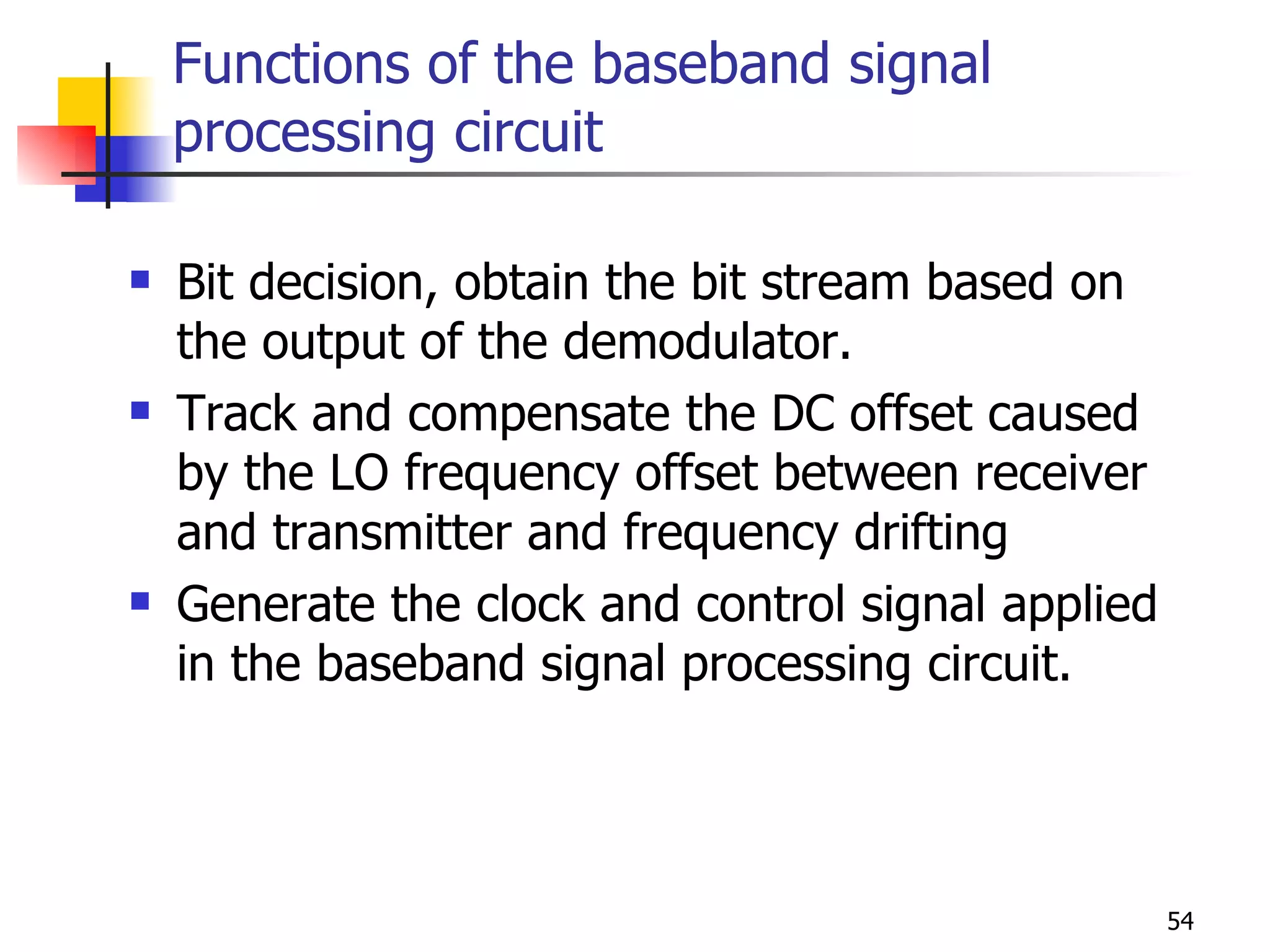
Functions of thebaseband signal processing circuit Bit decision, obtain the bit stream based on the output of the demodulator. Track and compensate the DC offset caused by the LO frequency offset between receiver and transmitter and frequency drifting Generate the clock and control signal applied in the baseband signal processing circuit.
55.
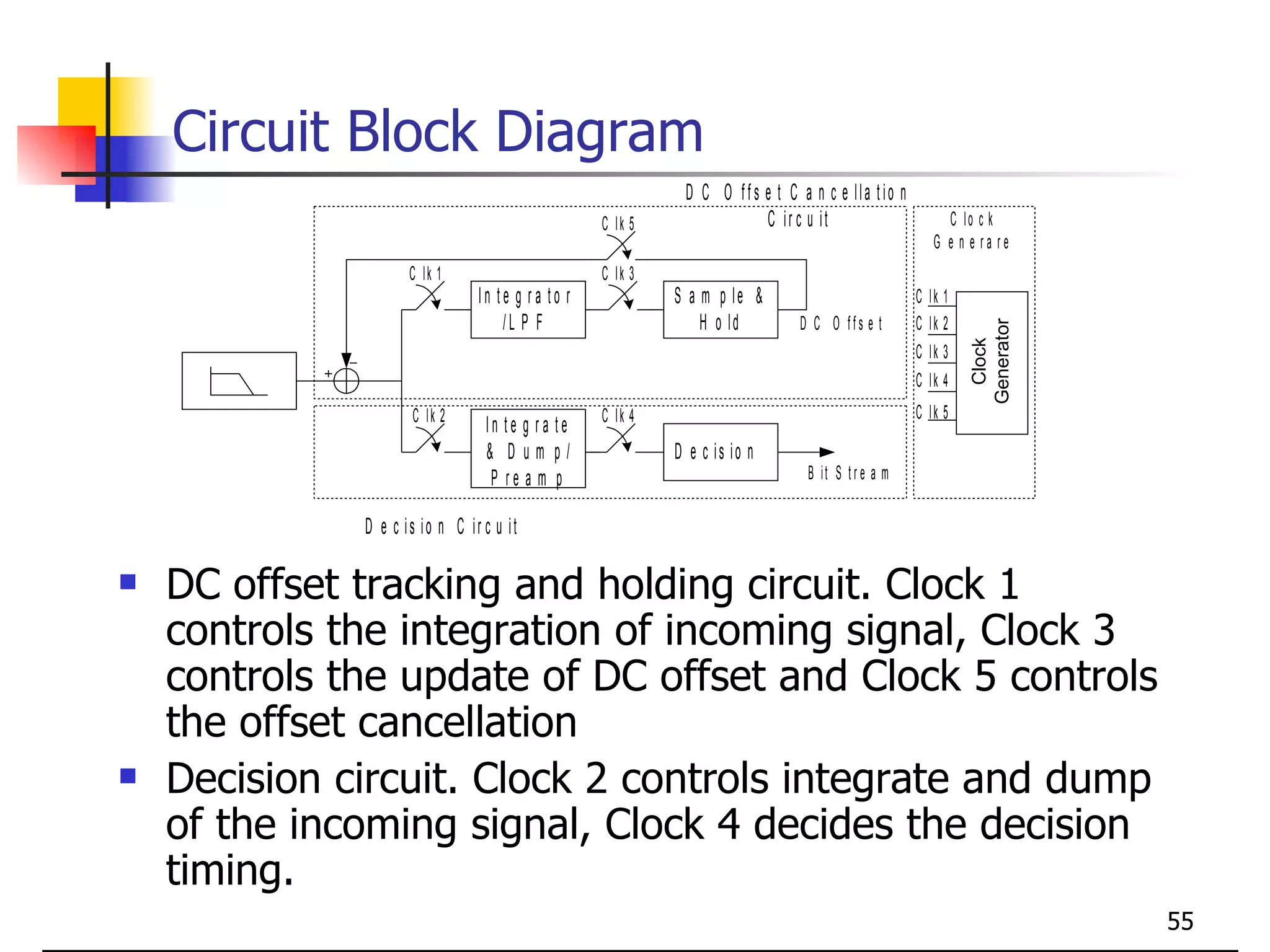
Circuit Block DiagramDC offset tracking and holding circuit. Clock 1 controls the integration of incoming signal, Clock 3 controls the update of DC offset and Clock 5 controls the offset cancellation Decision circuit. Clock 2 controls integrate and dump of the incoming signal, Clock 4 decides the decision timing.
56.
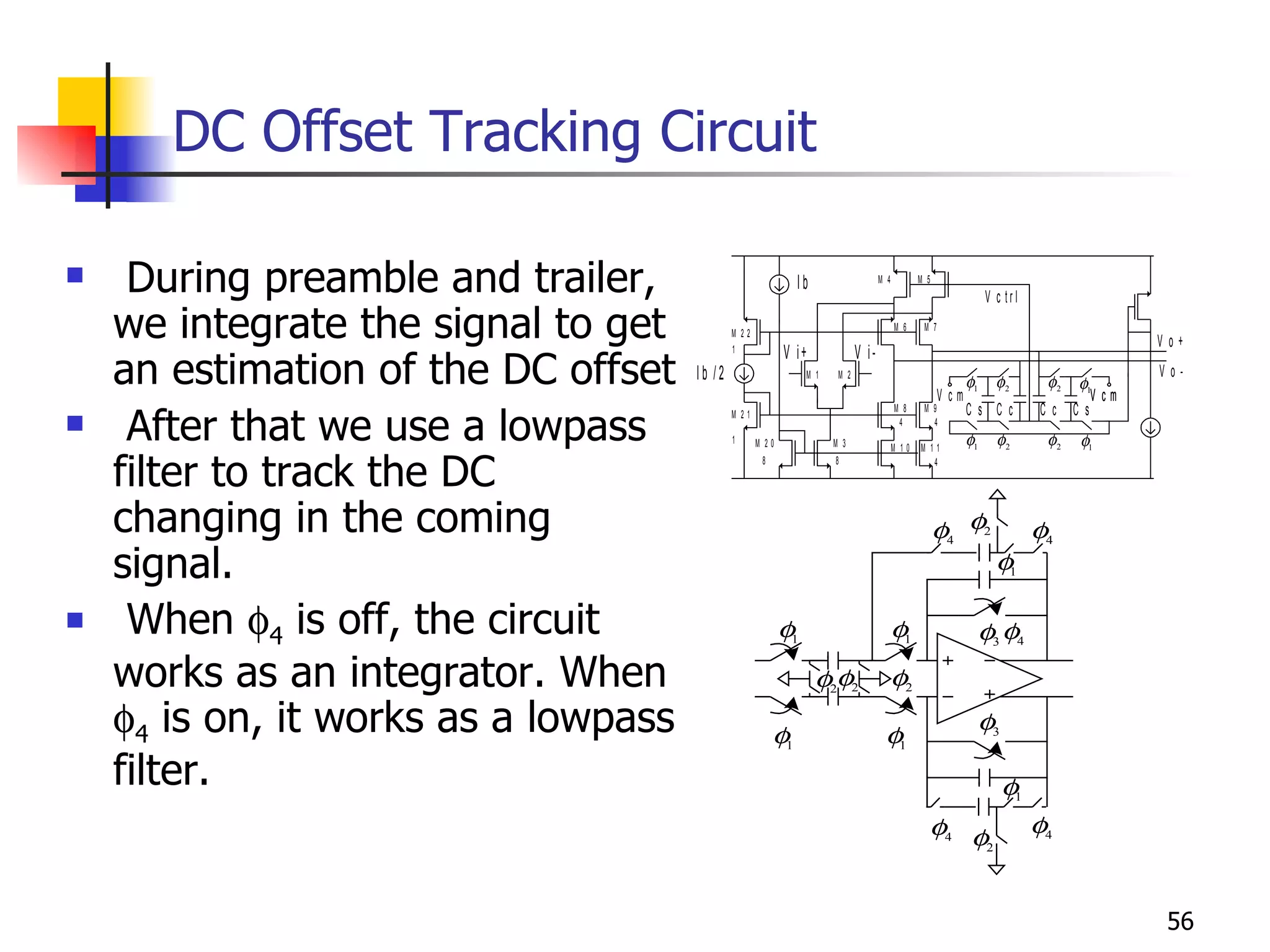
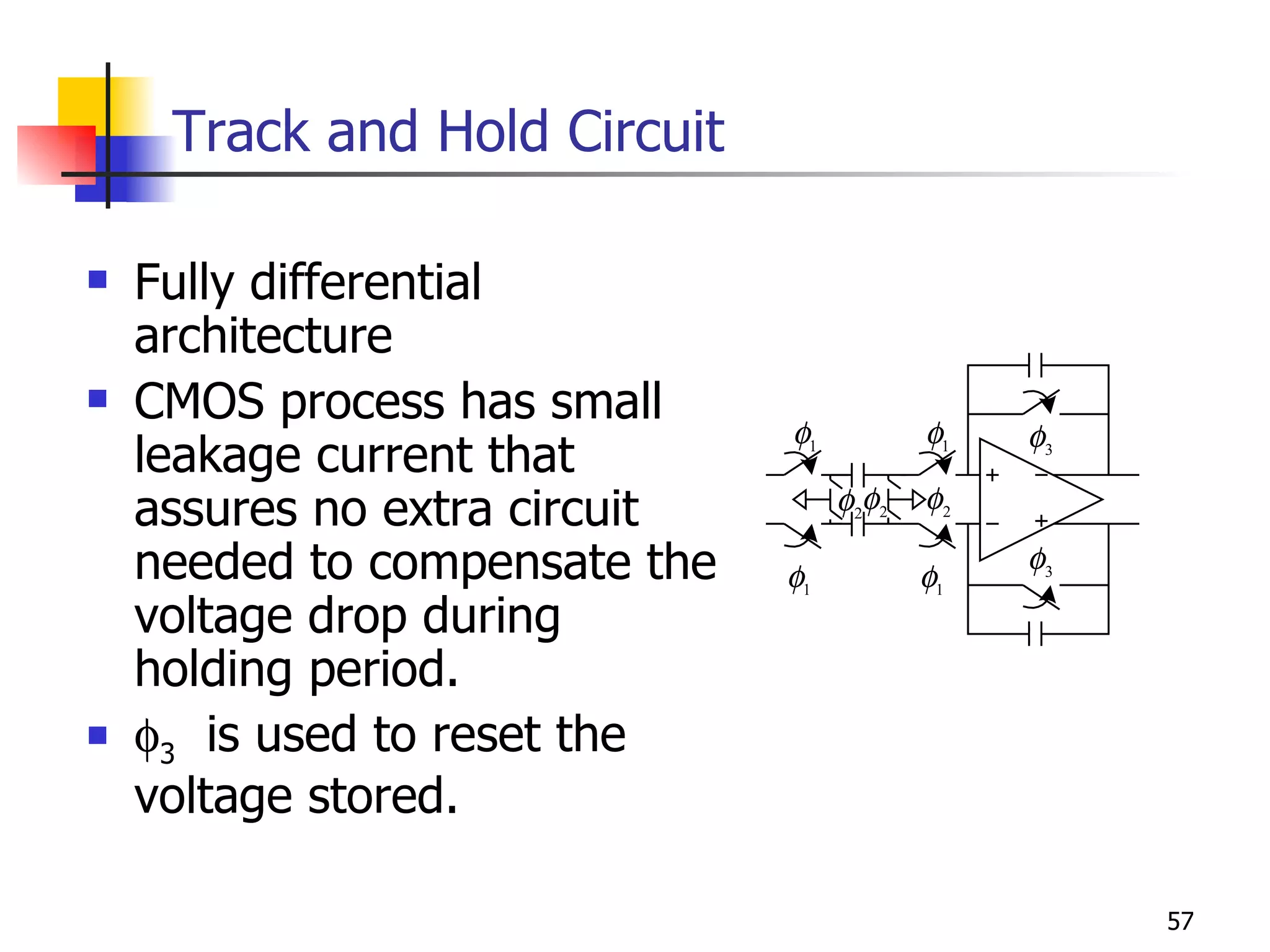
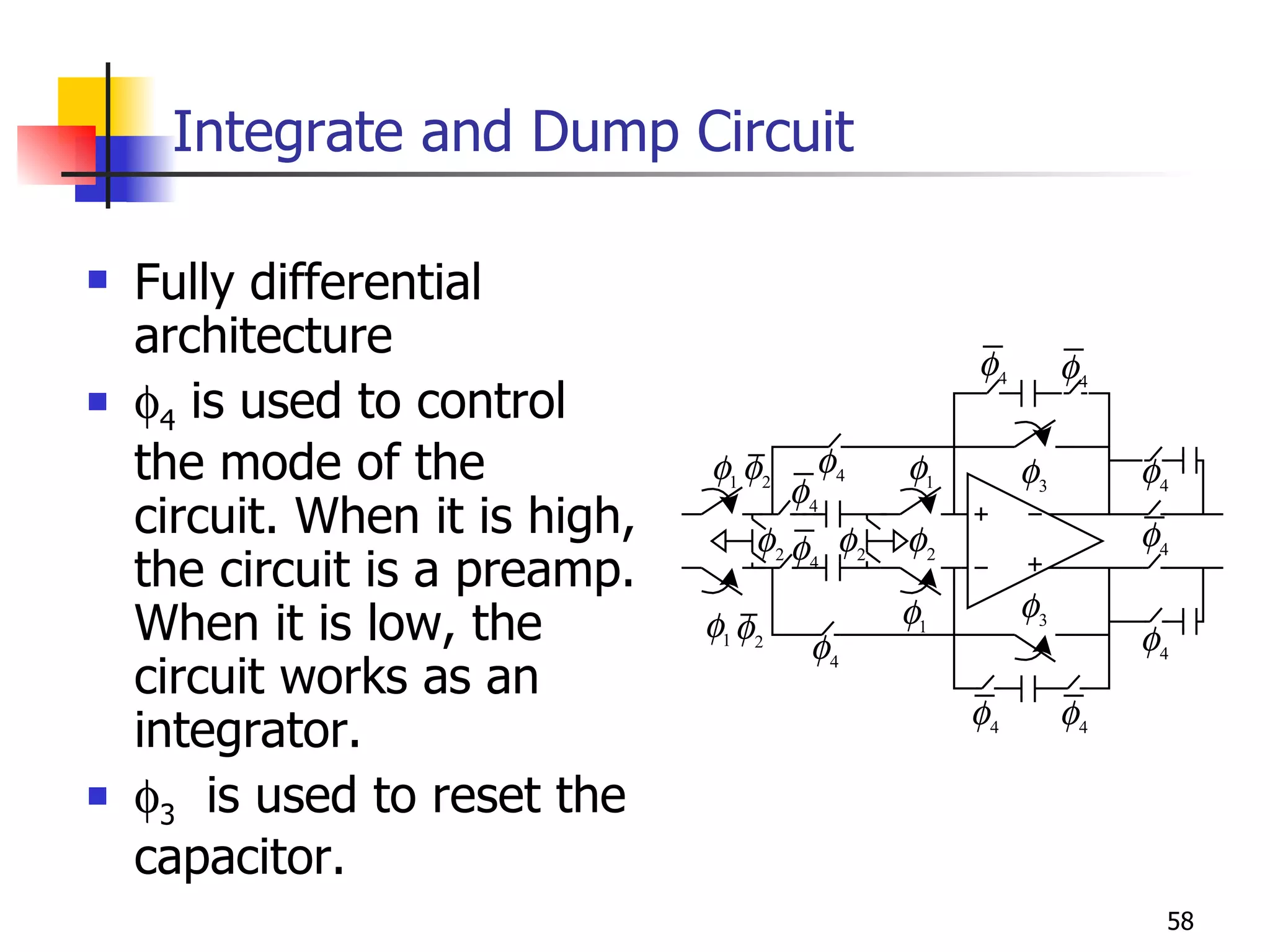
DC Offset TrackingCircuit During preamble and trailer, we integrate the signal to get an estimation of the DC offset After that we use a lowpass filter to track the DC changing in the coming signal. When 4 is off, the circuit works as an integrator. When 4 is on, it works as a lowpass filter.
57.
Track and HoldCircuit Fully differential architecture CMOS process has small leakage current that assures no extra circuit needed to compensate the voltage drop during holding period. 3 is used to reset the voltage stored.
58.
Integrate and DumpCircuit Fully differential architecture 4 is used to control the mode of the circuit. When it is high, the circuit is a preamp. When it is low, the circuit works as an integrator. 3 is used to reset the capacitor.
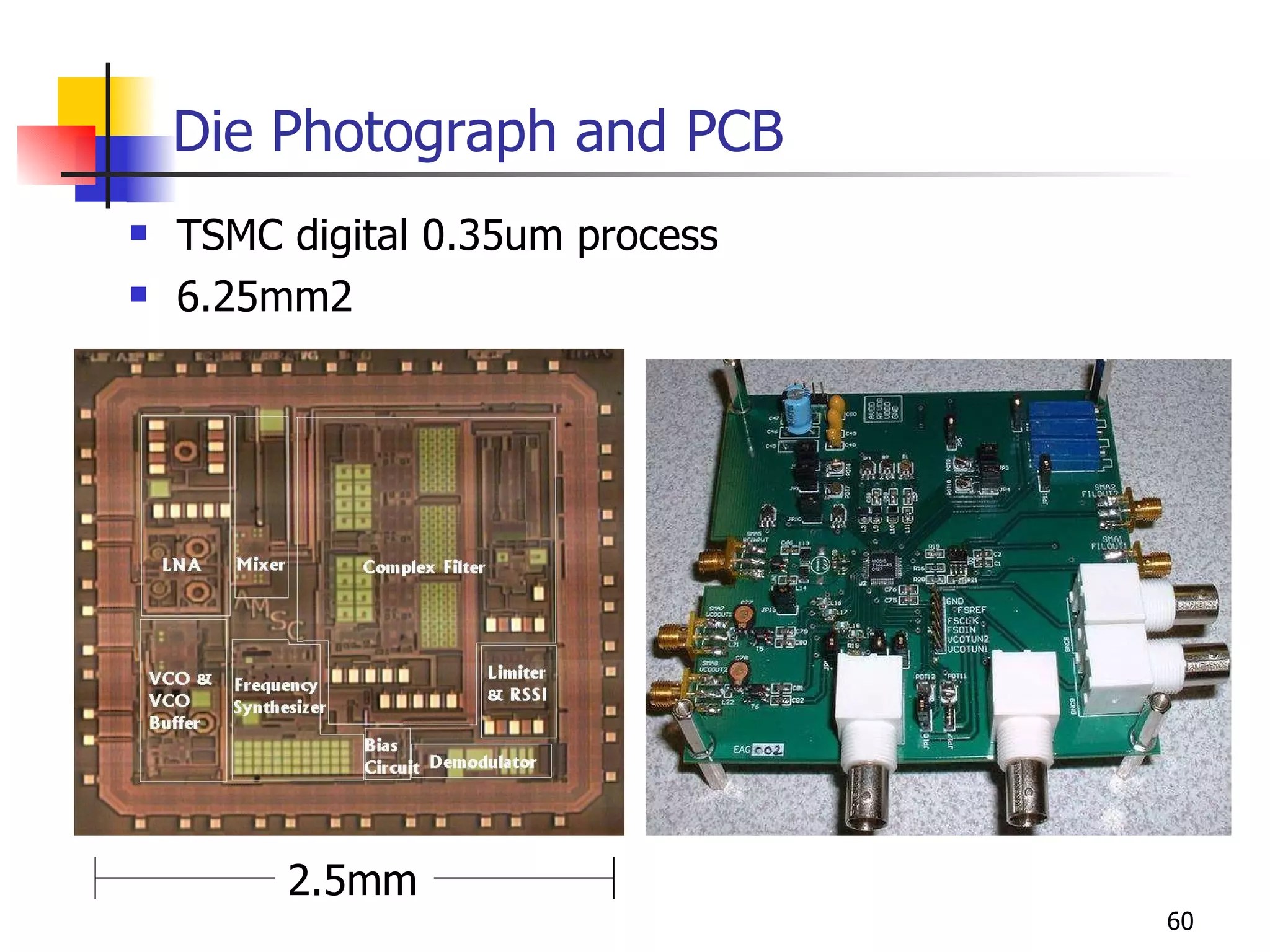
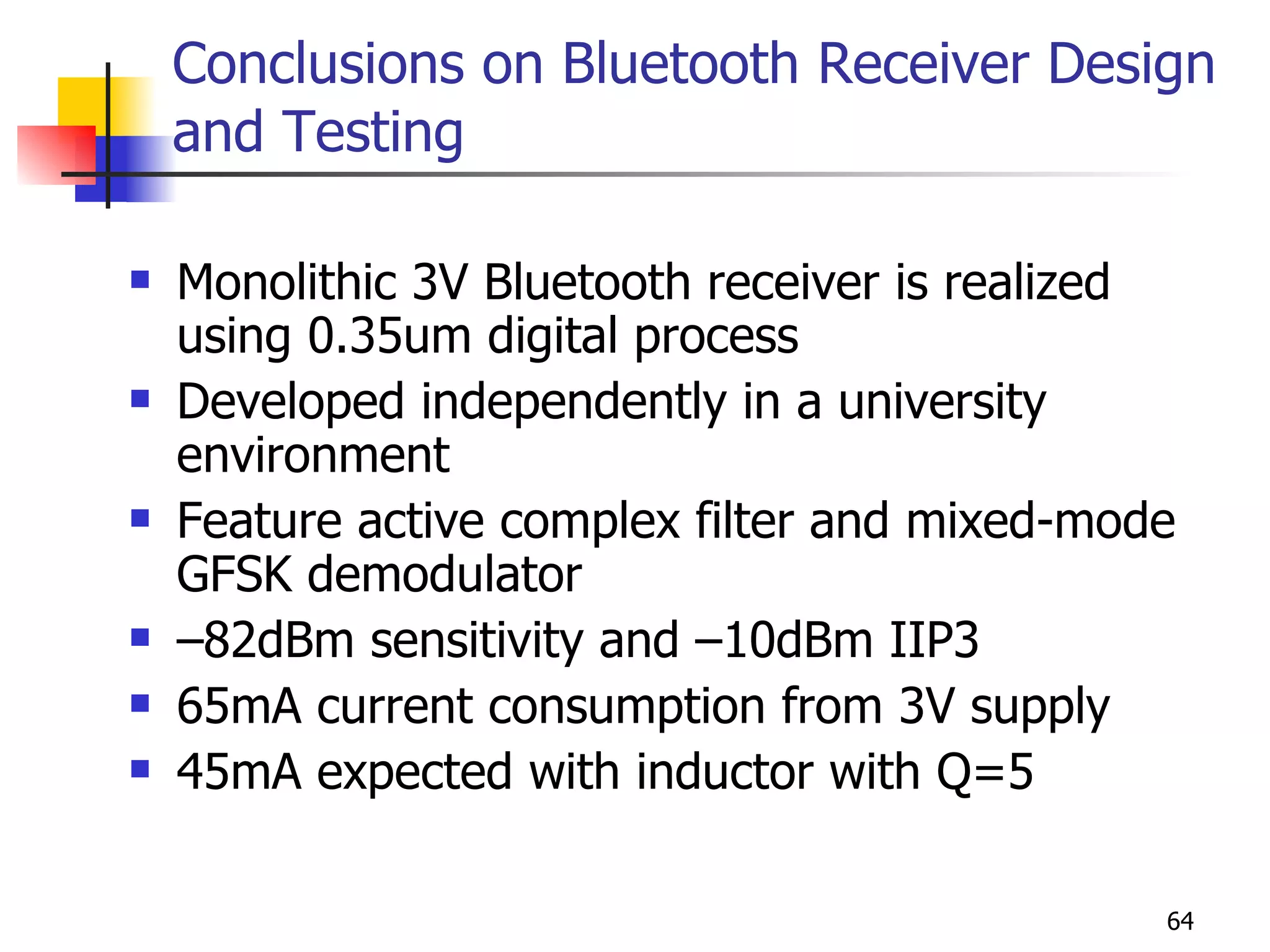
Conclusions on BluetoothReceiver Design and Testing Monolithic 3V Bluetooth receiver is realized using 0.35um digital process Developed independently in a university environment Feature active complex filter and mixed-mode GFSK demodulator –82dBm sensitivity and –10dBm IIP3 65mA current consumption from 3V supply 45mA expected with inductor with Q=5
65.
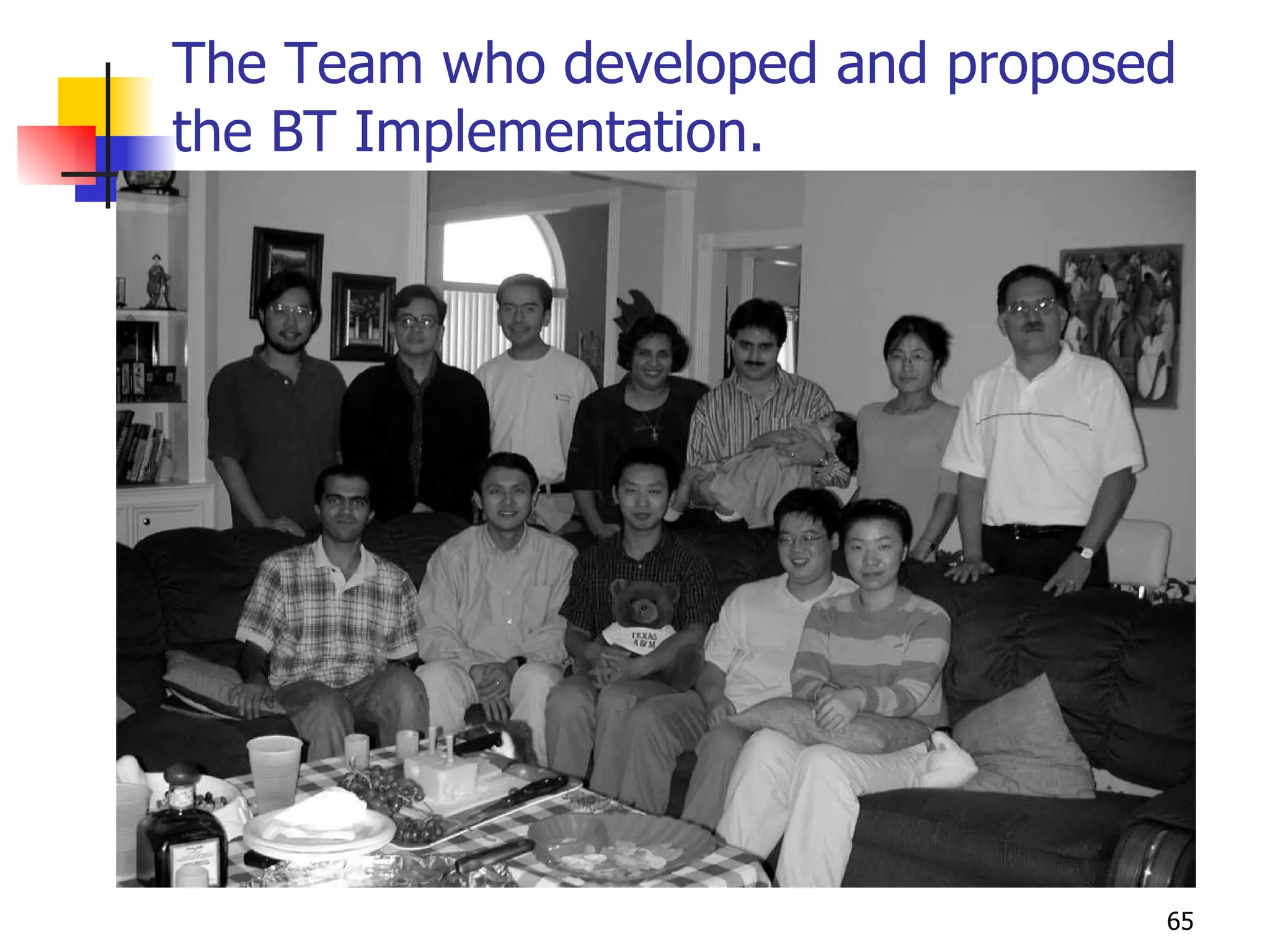
The Team whodeveloped and proposed the BT Implementation.
66.
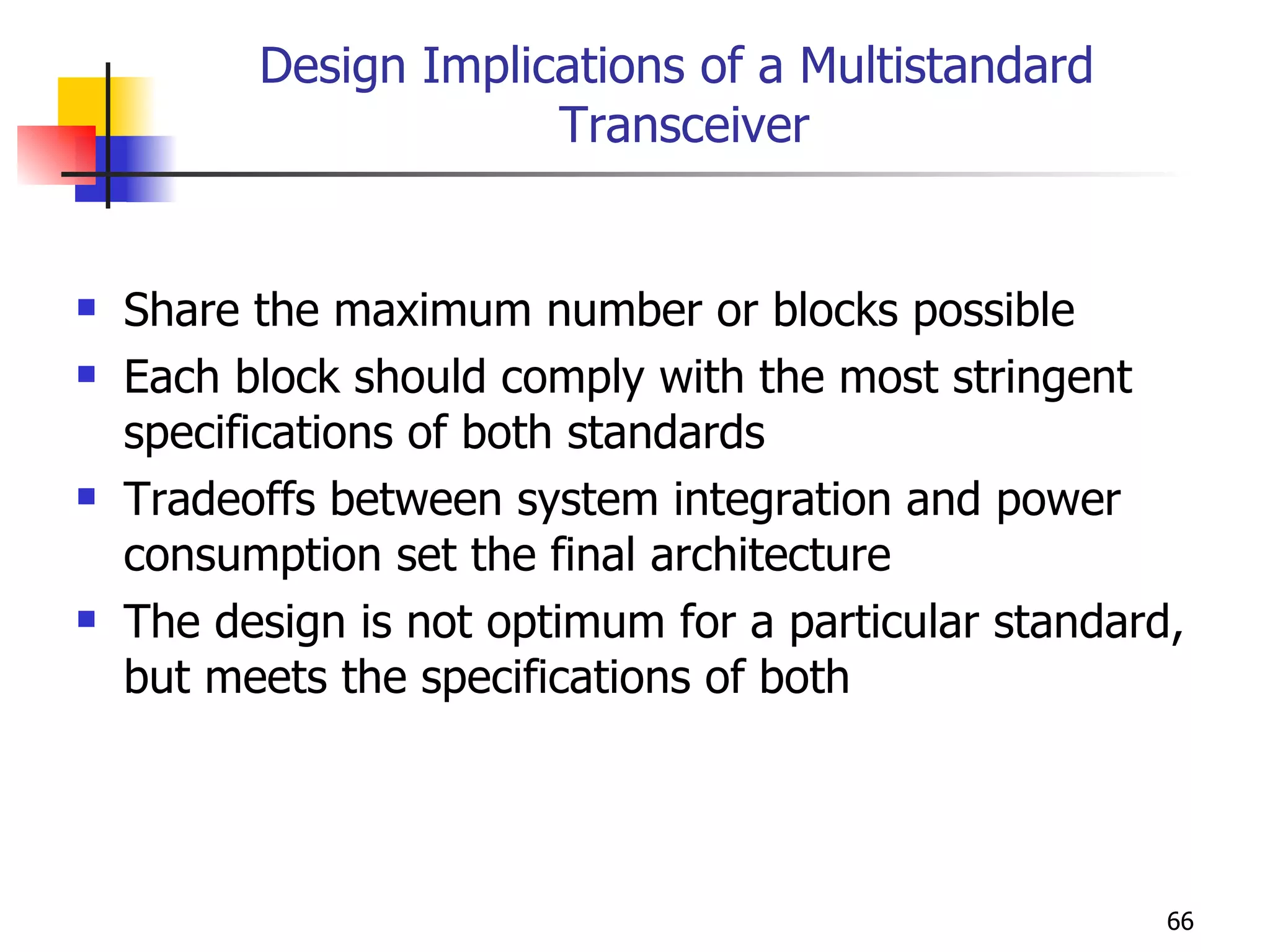
Design Implications ofa Multistandard Transceiver Share the maximum number or blocks possible Each block should comply with the most stringent specifications of both standards Tradeoffs between system integration and power consumption set the final architecture The design is not optimum for a particular standard, but meets the specifications of both
67.
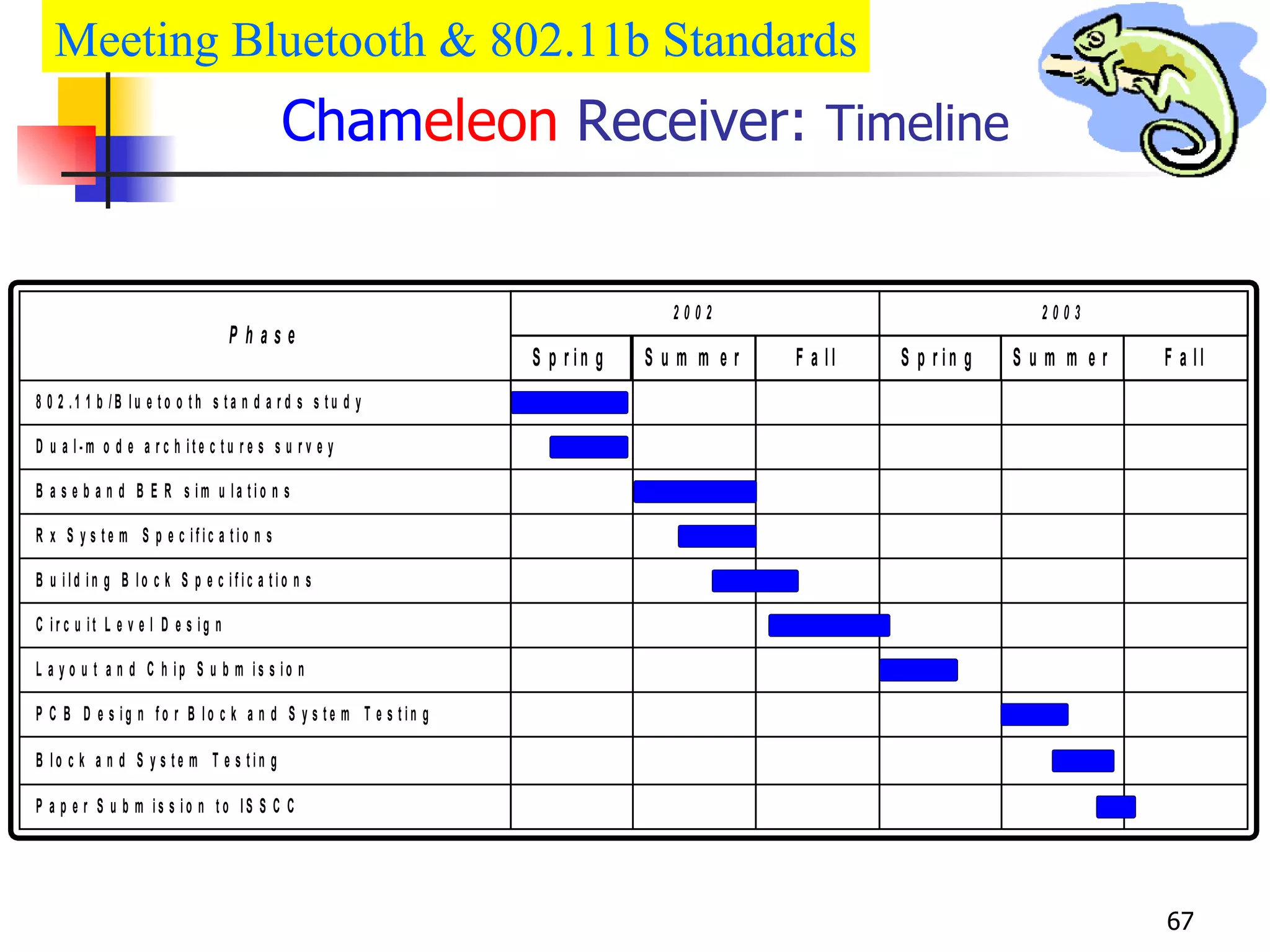
Cham eleon Receiver: Timeline Meeting Bluetooth & 802.11b Standards
68.
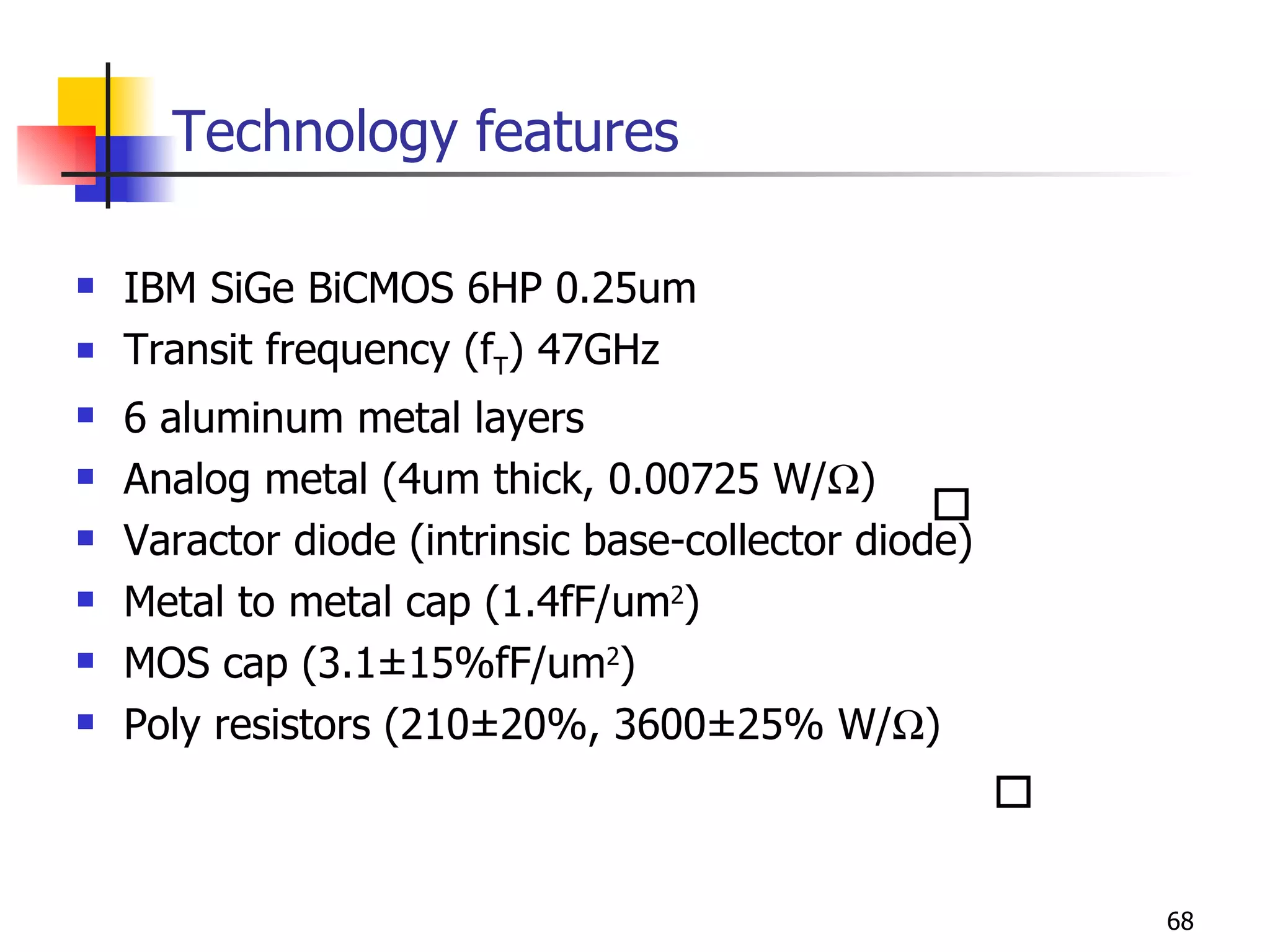
Technology features IBMSiGe BiCMOS 6HP 0.25um Transit frequency (f T ) 47GHz 6 aluminum metal layers Analog metal (4um thick, 0.00725 W/ ) Varactor diode (intrinsic base-collector diode) Metal to metal cap (1.4fF/um 2 ) MOS cap (3.1±15%fF/um 2 ) Poly resistors (210±20%, 3600±25% W/ )
69.
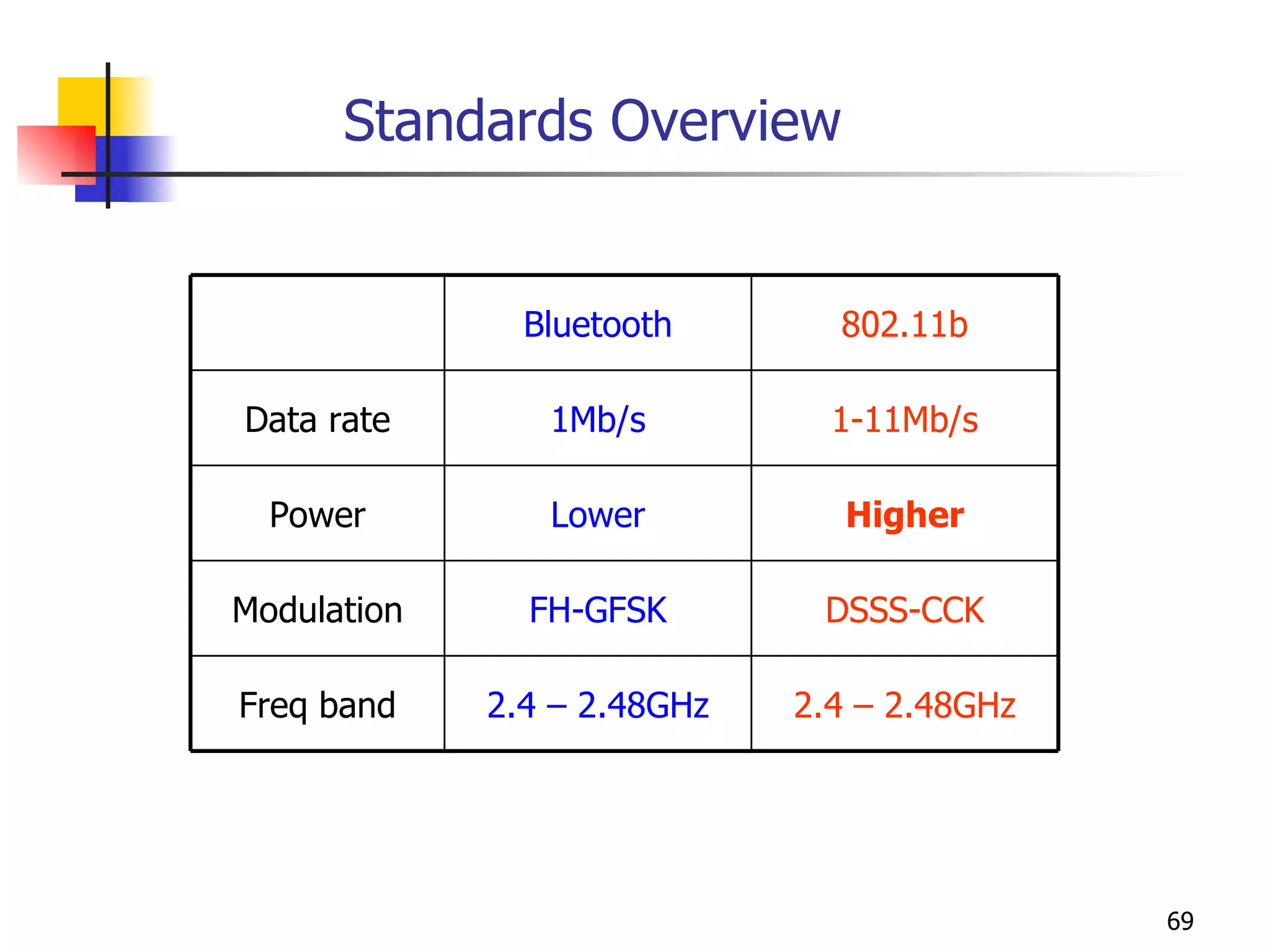
Standards Overview 2.4– 2.48GHz 2.4 – 2.48GHz Freq band DSSS-CCK FH-GFSK Modulation Higher Lower Power 1-11Mb/s 1Mb/s Data rate 802.11b Bluetooth
70.
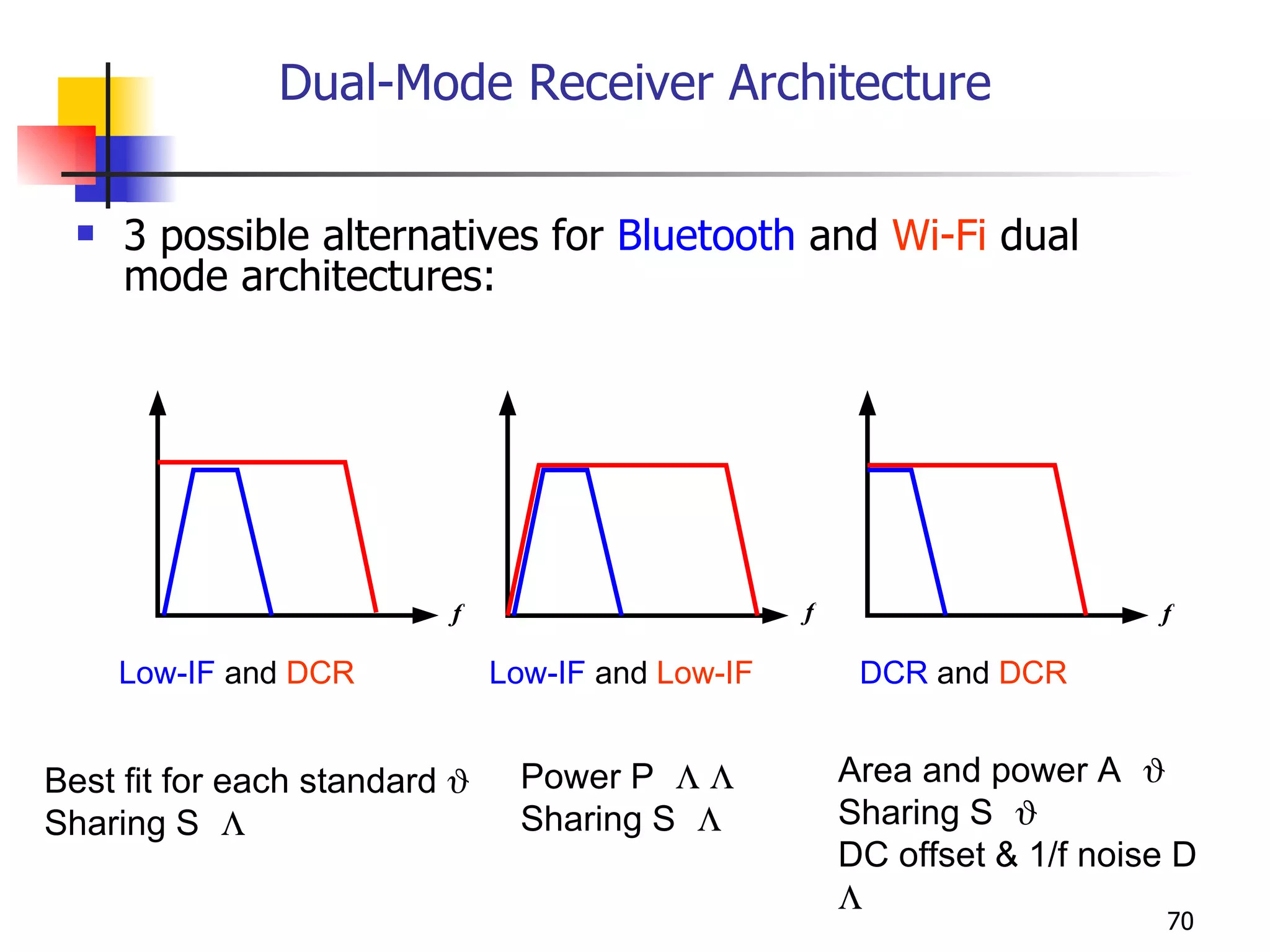
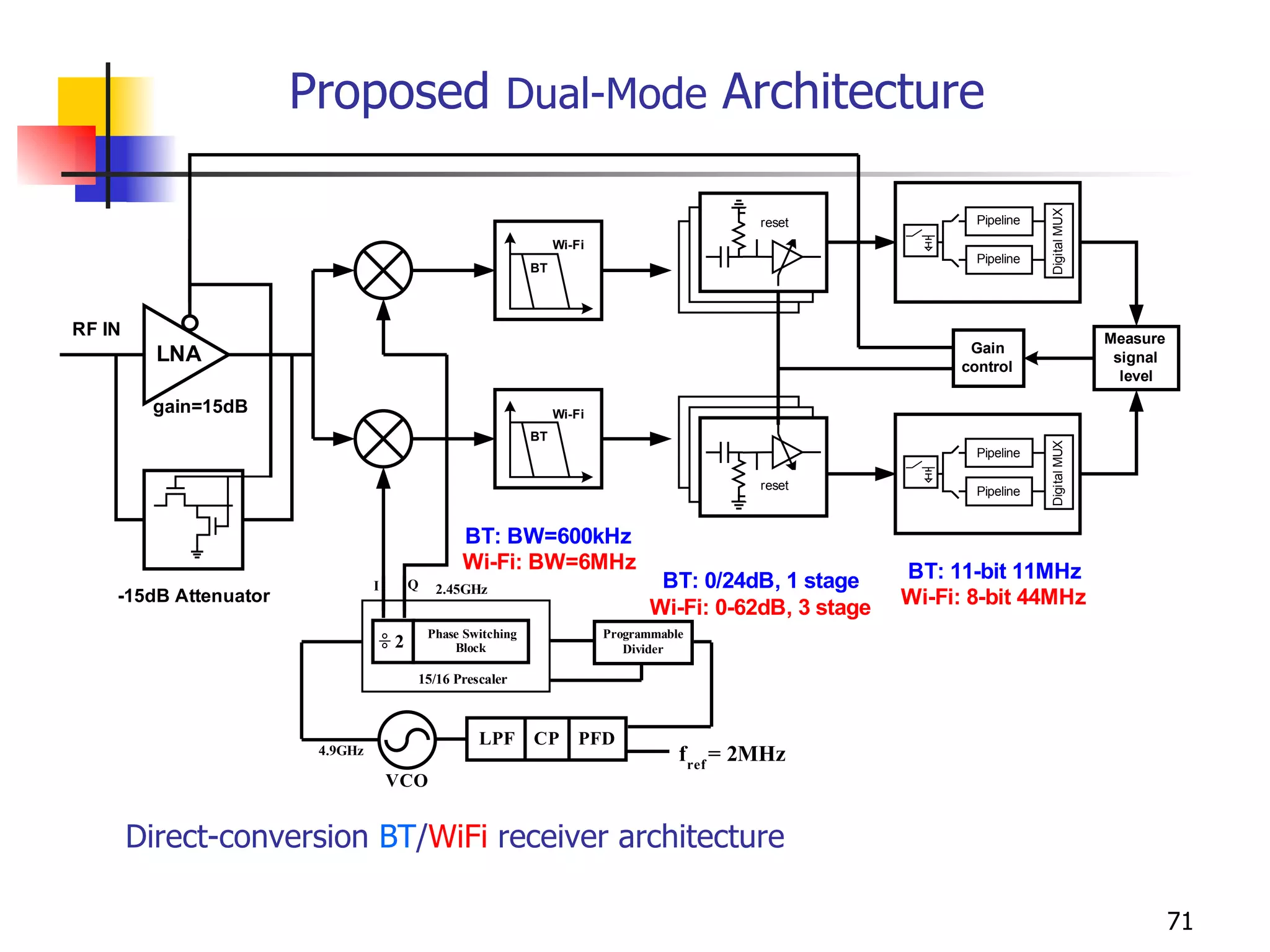
Dual-Mode Receiver Architecture3 possible alternatives for Bluetooth and Wi-Fi dual mode architectures: Area and power Sharing DC offset & 1/f noise Low-IF and DCR Best fit for each standard Sharing Power Sharing Low-IF and Low-IF DCR and DCR
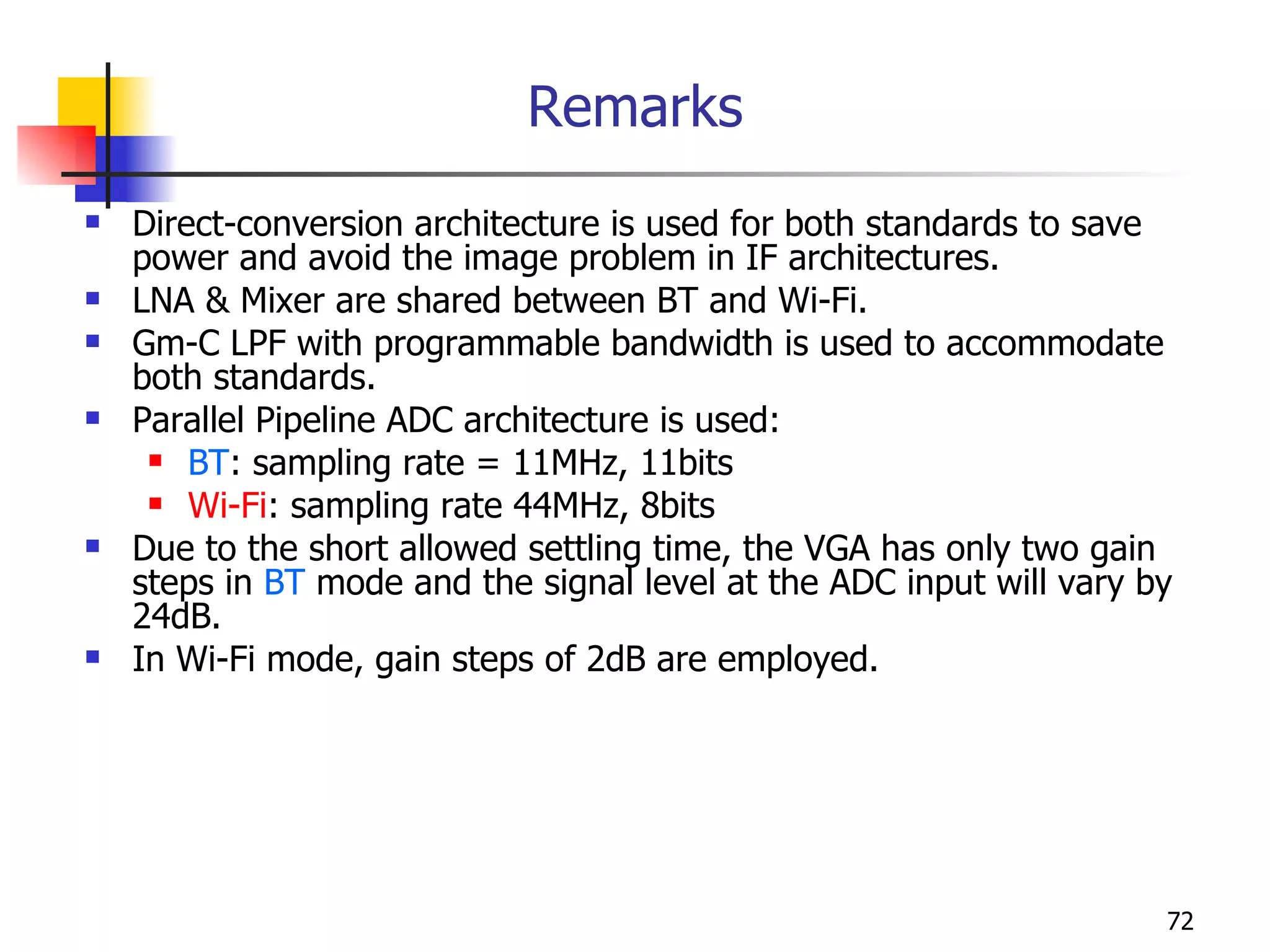
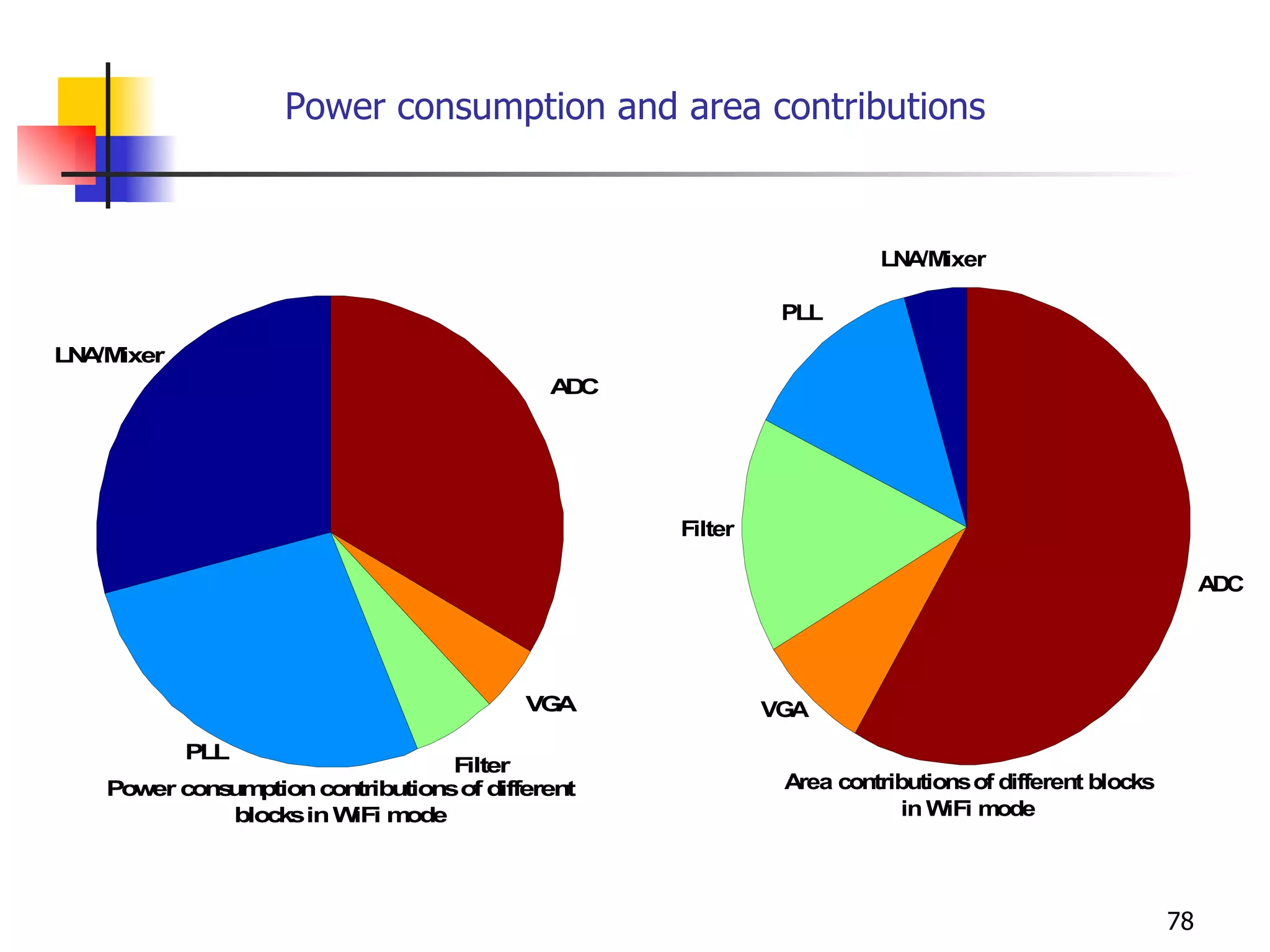
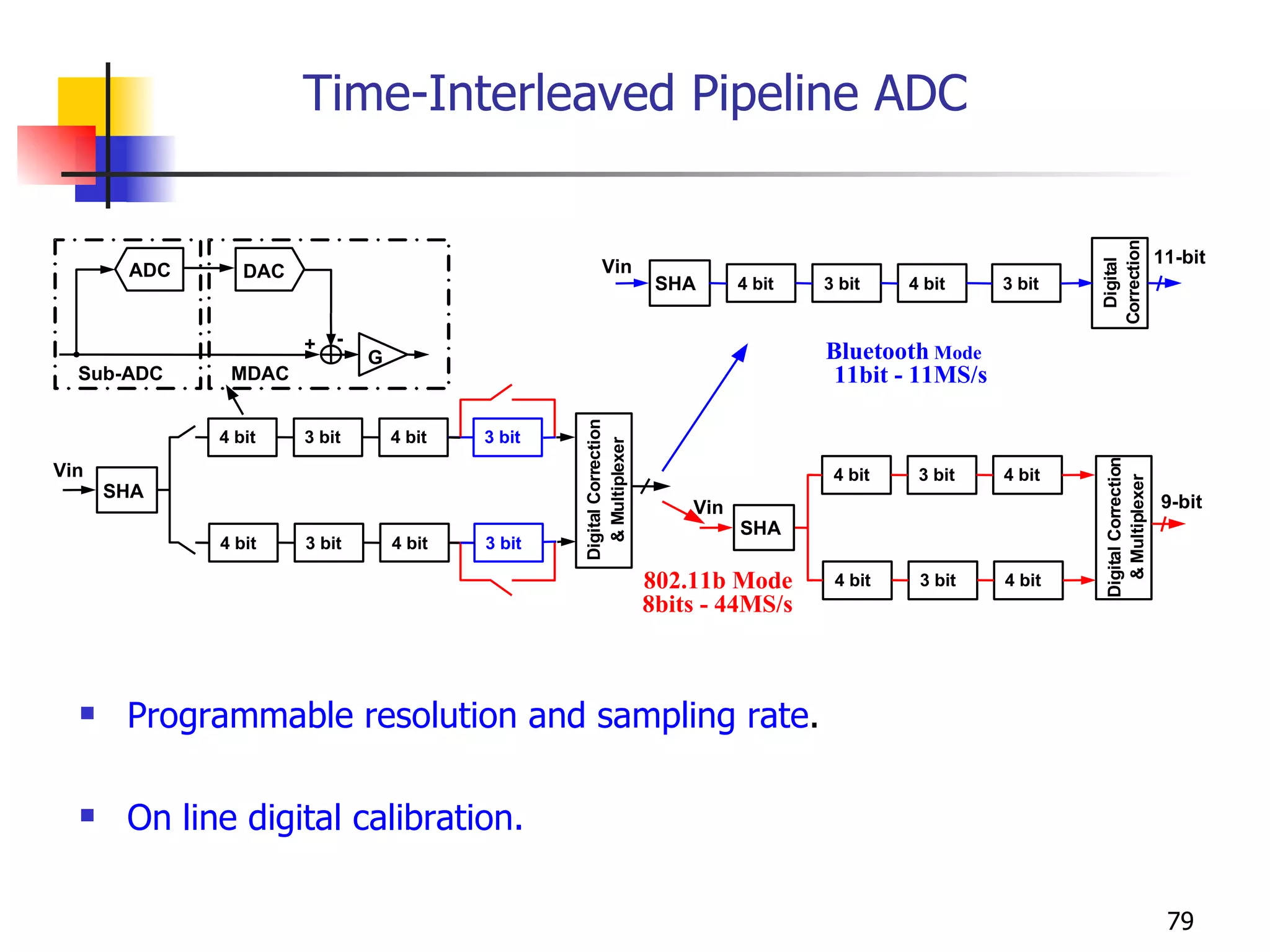
Remarks Direct-conversion architectureis used for both standards to save power and avoid the image problem in IF architectures. LNA & Mixer are shared between BT and Wi-Fi. Gm-C LPF with programmable bandwidth is used to accommodate both standards. Parallel Pipeline ADC architecture is used: BT : sampling rate = 11MHz, 11bits Wi-Fi : sampling rate 44MHz, 8bits Due to the short allowed settling time, the VGA has only two gain steps in BT mode and the signal level at the ADC input will vary by 24dB. In Wi-Fi mode, gain steps of 2dB are employed.
73.
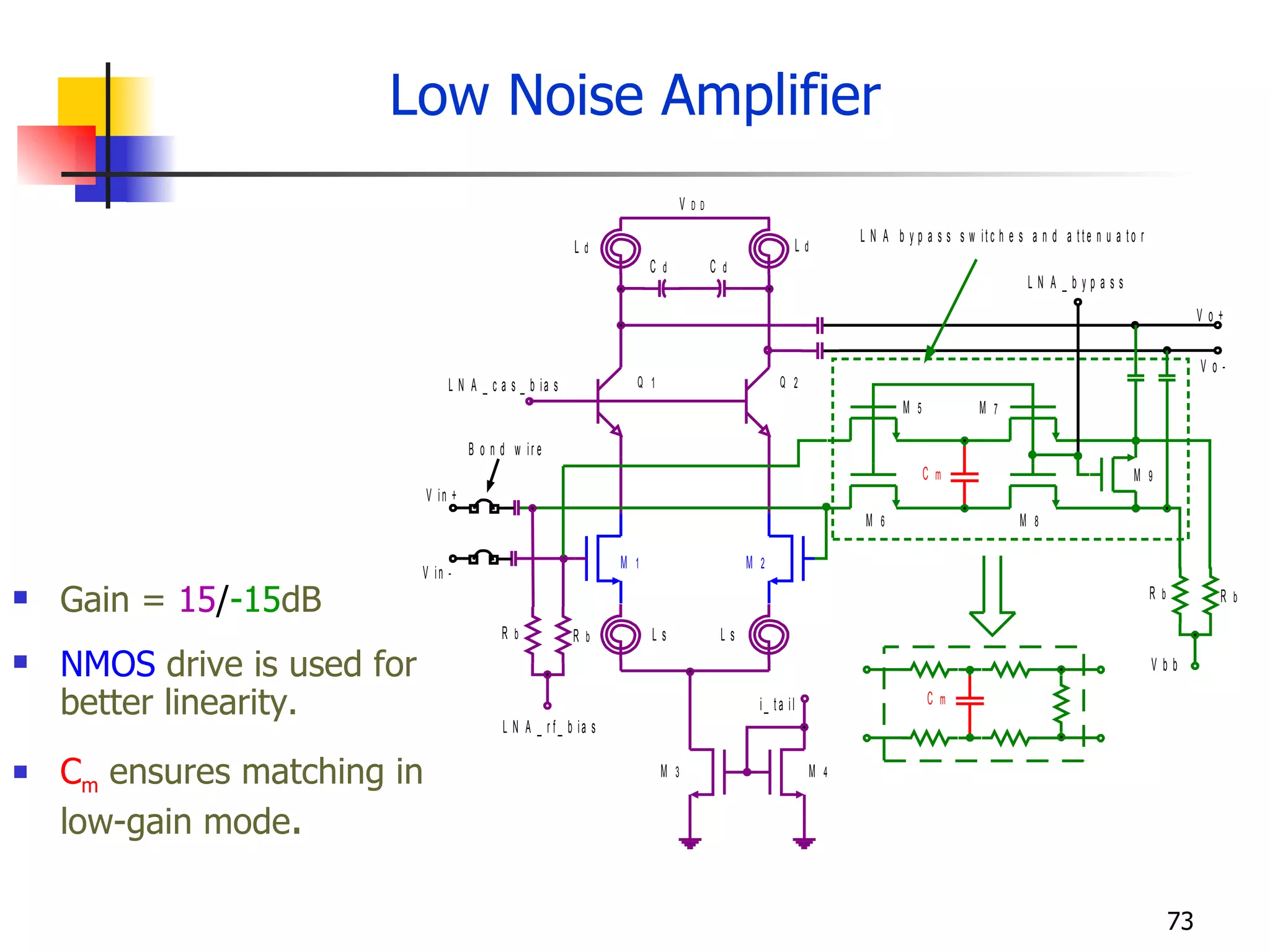
Low Noise AmplifierGain = 15 / -15 dB NMOS drive is used for better linearity. C m ensures matching in low-gain mode .
74.
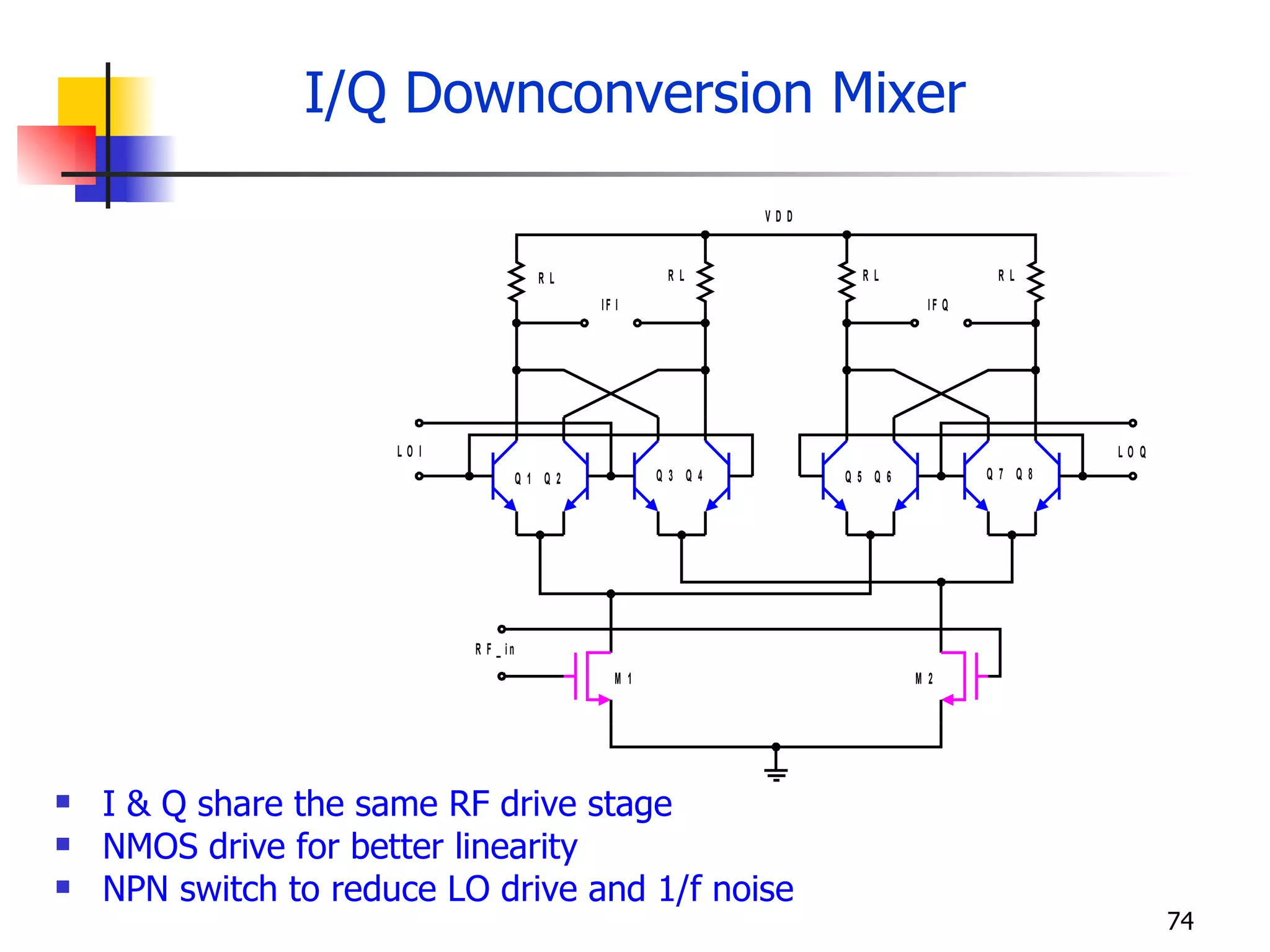
I/Q Downconversion MixerI & Q share the same RF drive stage NMOS drive for better linearity NPN switch to reduce LO drive and 1/f noise
75.
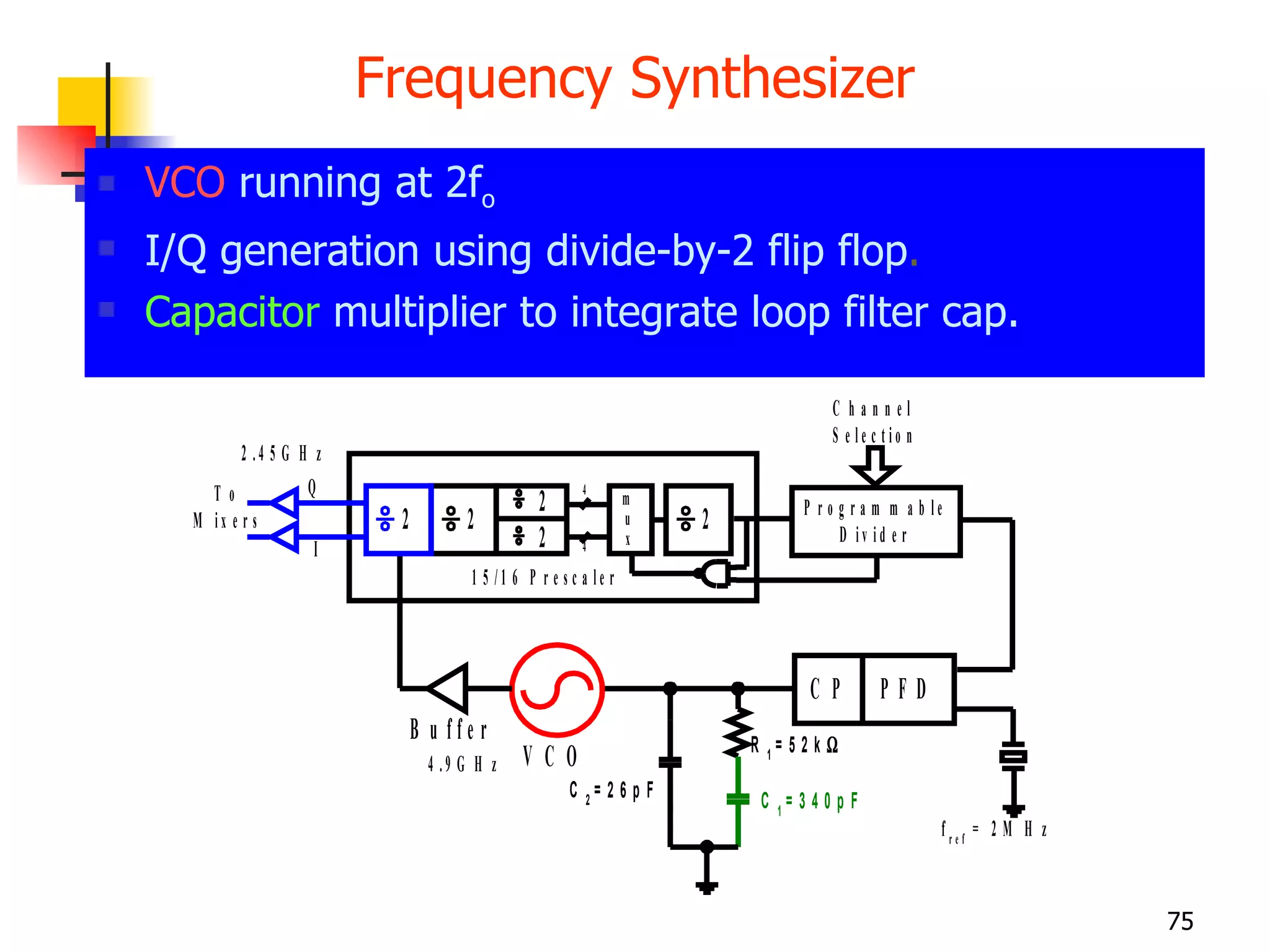
Frequency Synthesizer VCO running at 2f o I/Q generation using divide-by-2 flip flop . Capacitor multiplier to integrate loop filter cap.
76.
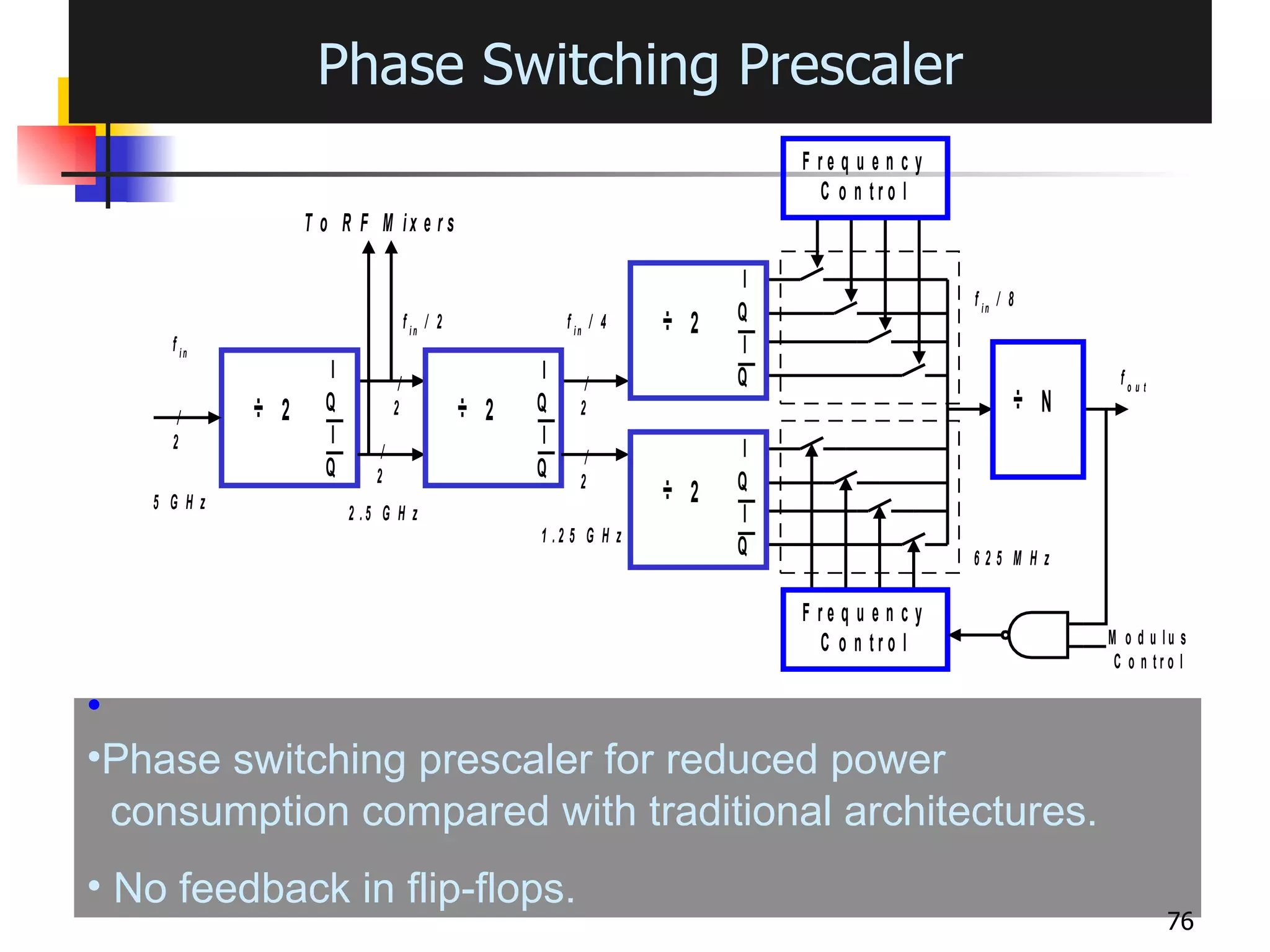
Phase Switching PrescalerPhase switching prescaler for reduced power consumption compared with traditional architectures. No feedback in flip-flops.
Time-Interleaved Pipeline ADCProgrammable resolution and sampling rate . On line digital calibration. D i g i t a l C o r r e c t i o n SHA Vin 4 bit 3 bit 4 bit 3 bit 4 bit 3 bit 4 bit 3 bit D i g i t a l C o r r e c t i o n SHA Vin 4 bit 3 bit 4 bit 3 bit Bluetooth Mode 11bit - 11MS/s 11-bit DAC ADC - + G MDAC Sub-ADC & M u l t i p l e x e r D i g i t a l C o r r e c t i o n & M u l t i p l e x e r SHA Vin 4 bit 3 bit 4 bit 4 bit 3 bit 4 bit 802.11b Mode 8bits - 44MS/s 9-bit
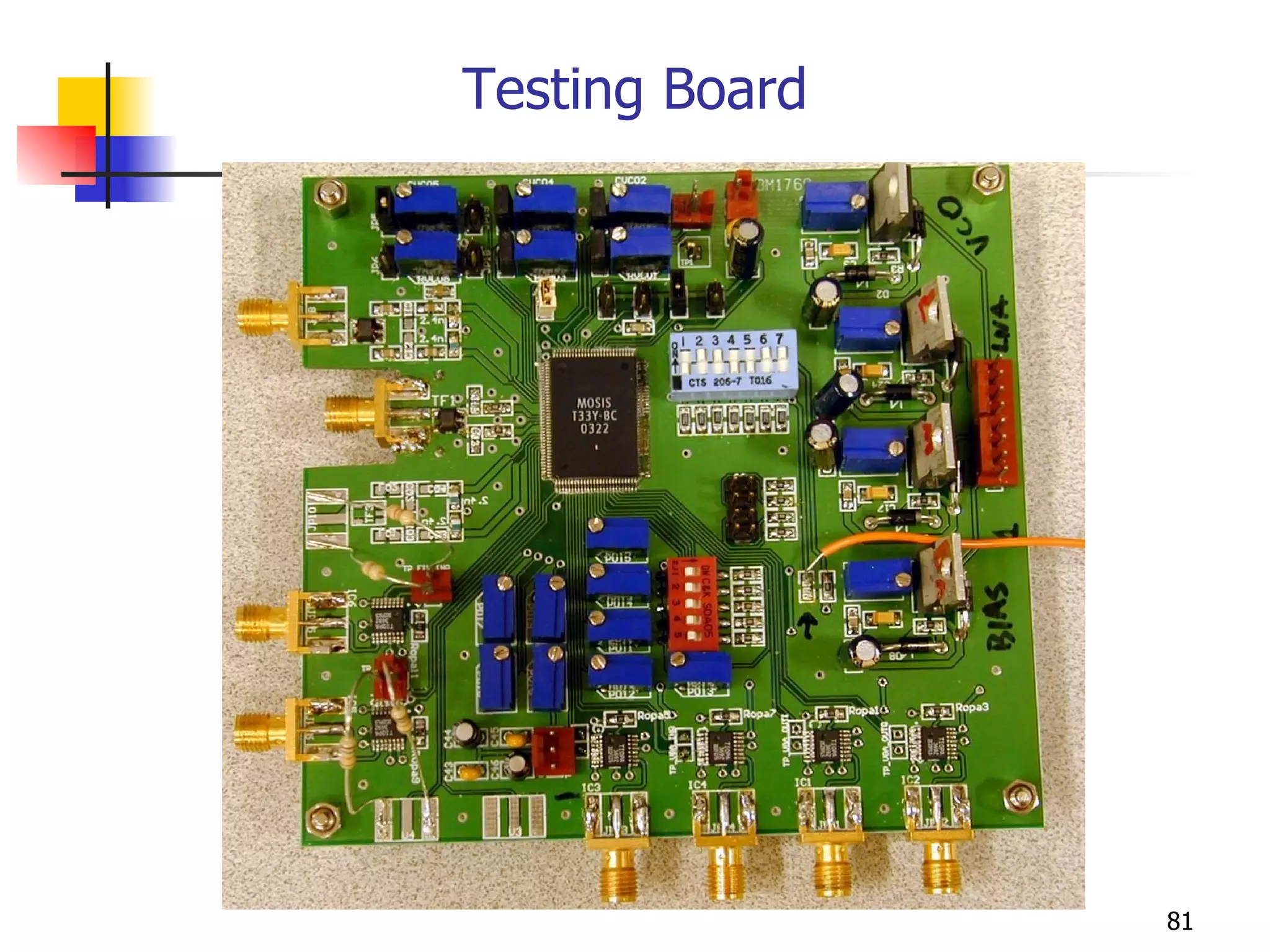
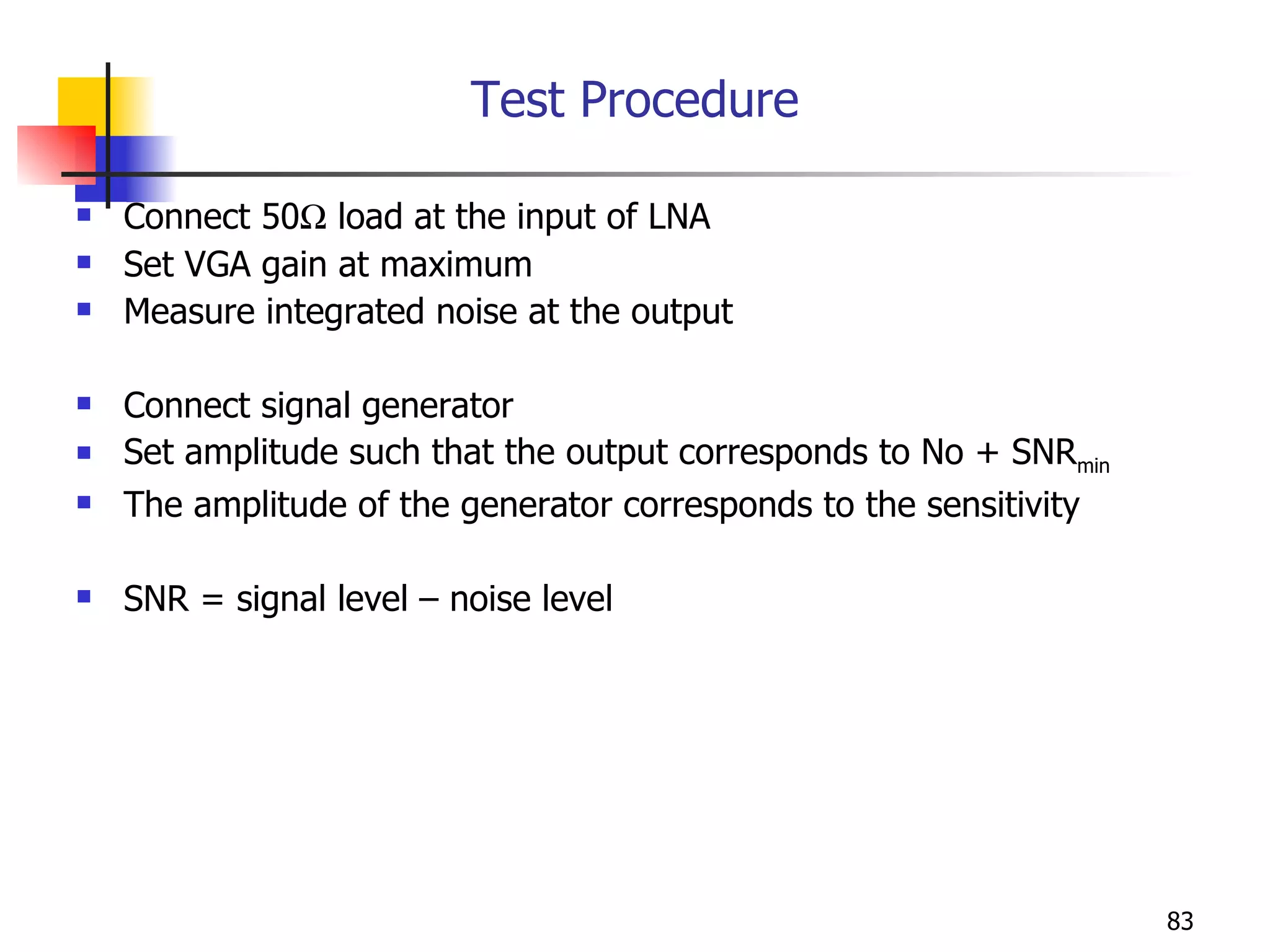
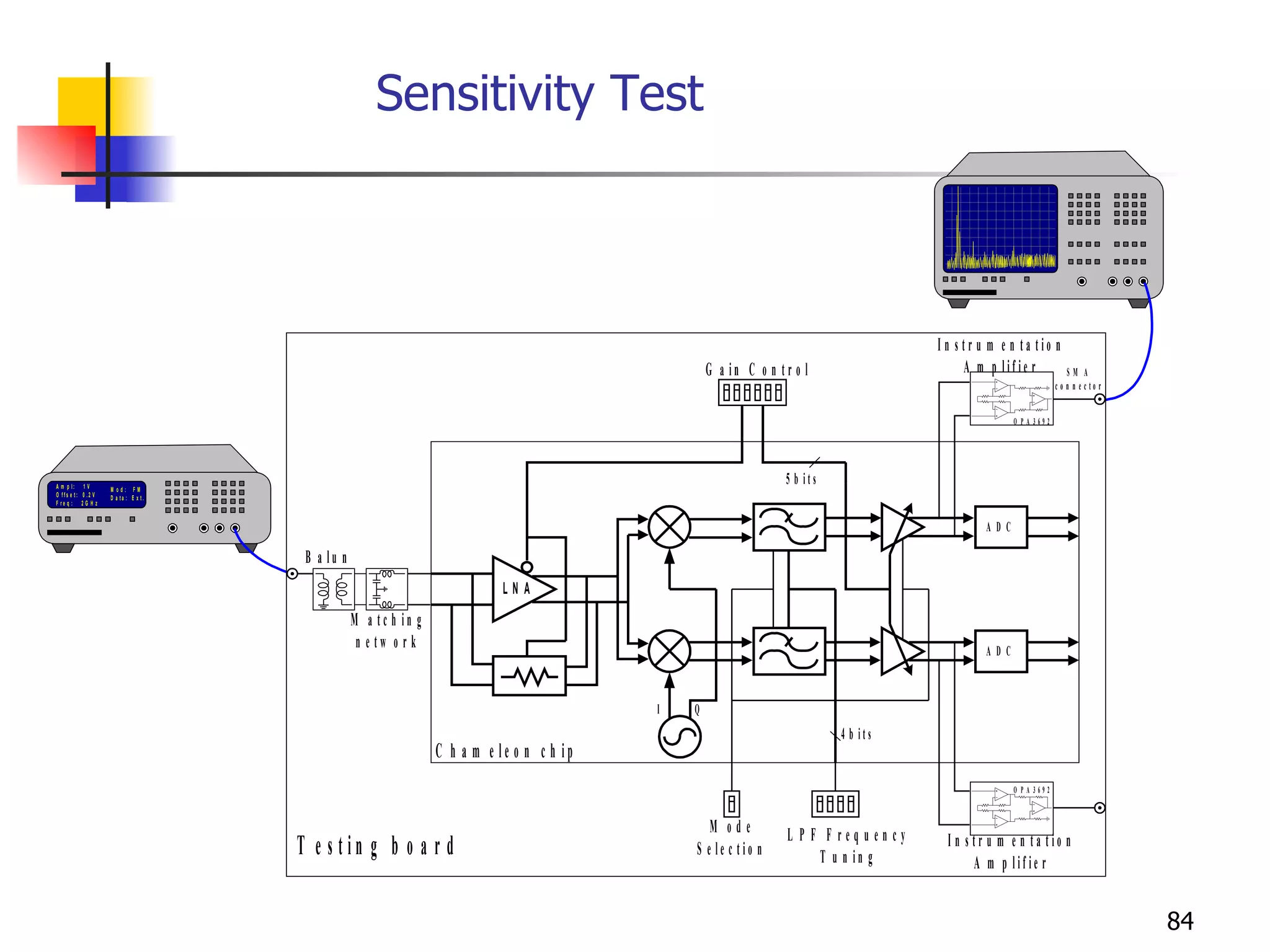
Test Procedure Connect50 load at the input of LNA Set VGA gain at maximum Measure integrated noise at the output Connect signal generator Set amplitude such that the output corresponds to No + SNR min The amplitude of the generator corresponds to the sensitivity SNR = signal level – noise level
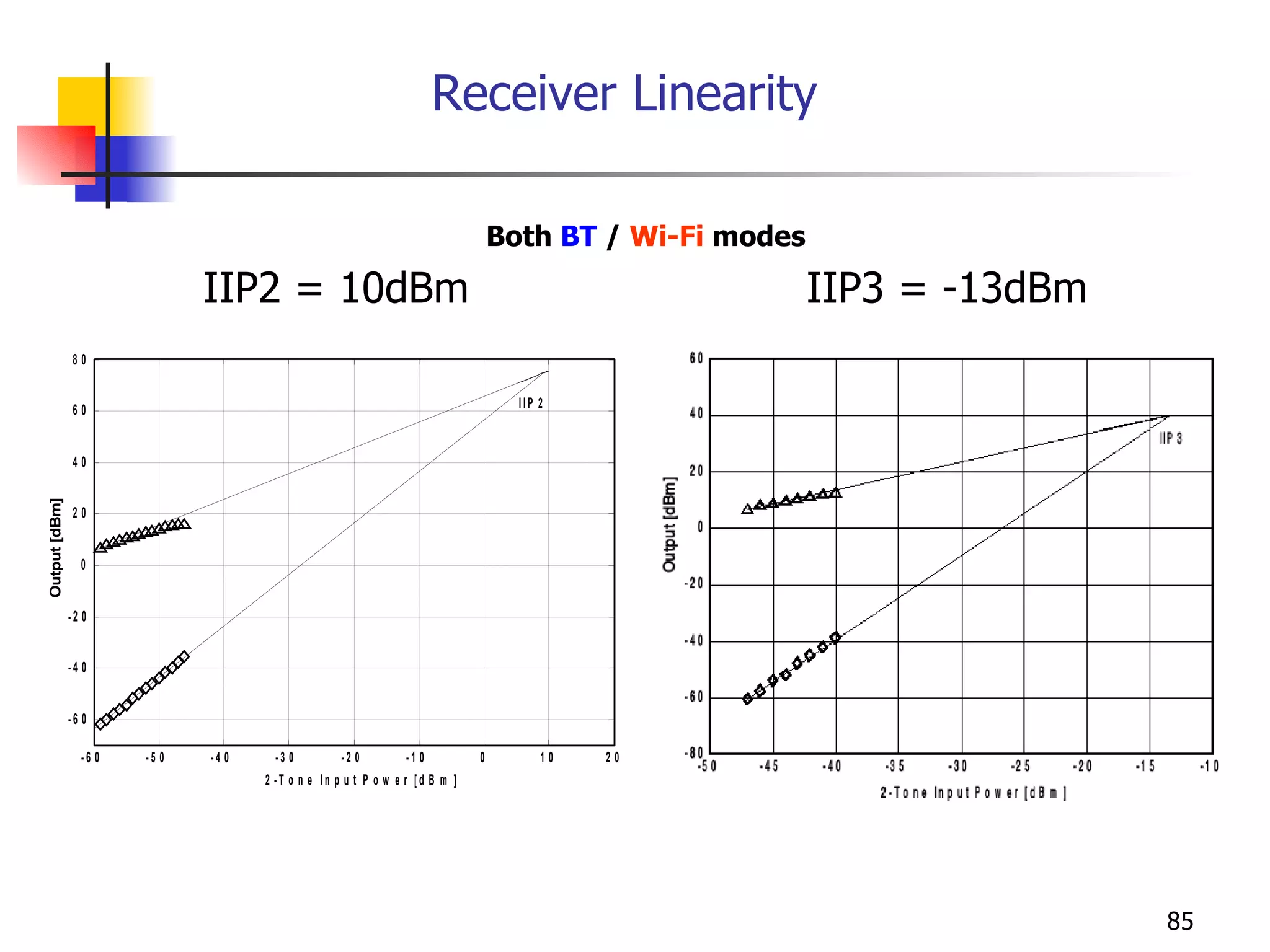
Comparison Table 2.5V1.8V 2.7V Supply voltage 10mm 2 - - - - ADC area (w/ pads) 9mm 2 (w/o ADC) 16mm 2 (transceiver) N/A Rx area (w/ pads) 10dBm 20dBm N/A N/A IIP2 -13dBm -12dBm -8dBm -7dBm IIP3 15.6mA 13.4mA - - - - ADC active current 30mA (w/o ADC) 27.9mA (w/o ADC) 60mA 65mA 46mA Rx active current 0.25m BiCMOS 0.18 m CMOS 0.35 m CMOS Technology -86dBm -91dBm -92dBm (0dB SNR) -80dBm -88dBm -82dbm Sensitivity 6MHz (LPF) 600kHz (LPF) 7.5MHz (LPF) 1MHz (BPF) 7.5MHz (LPF) 1MHz (BPF) Filter bandwidth Included Not included Not included ADC Shared shared separate Baseband amplifier Programmable programmable separate Channel select filter AC coupling Injection at AGC input Programmable loop Offset cancellation DCR DCR DCR Low-IF DCR Low-IF Receiver Architecture Wi-Fi BT WiFi BT WiFi BT This design [2] [1]
87.
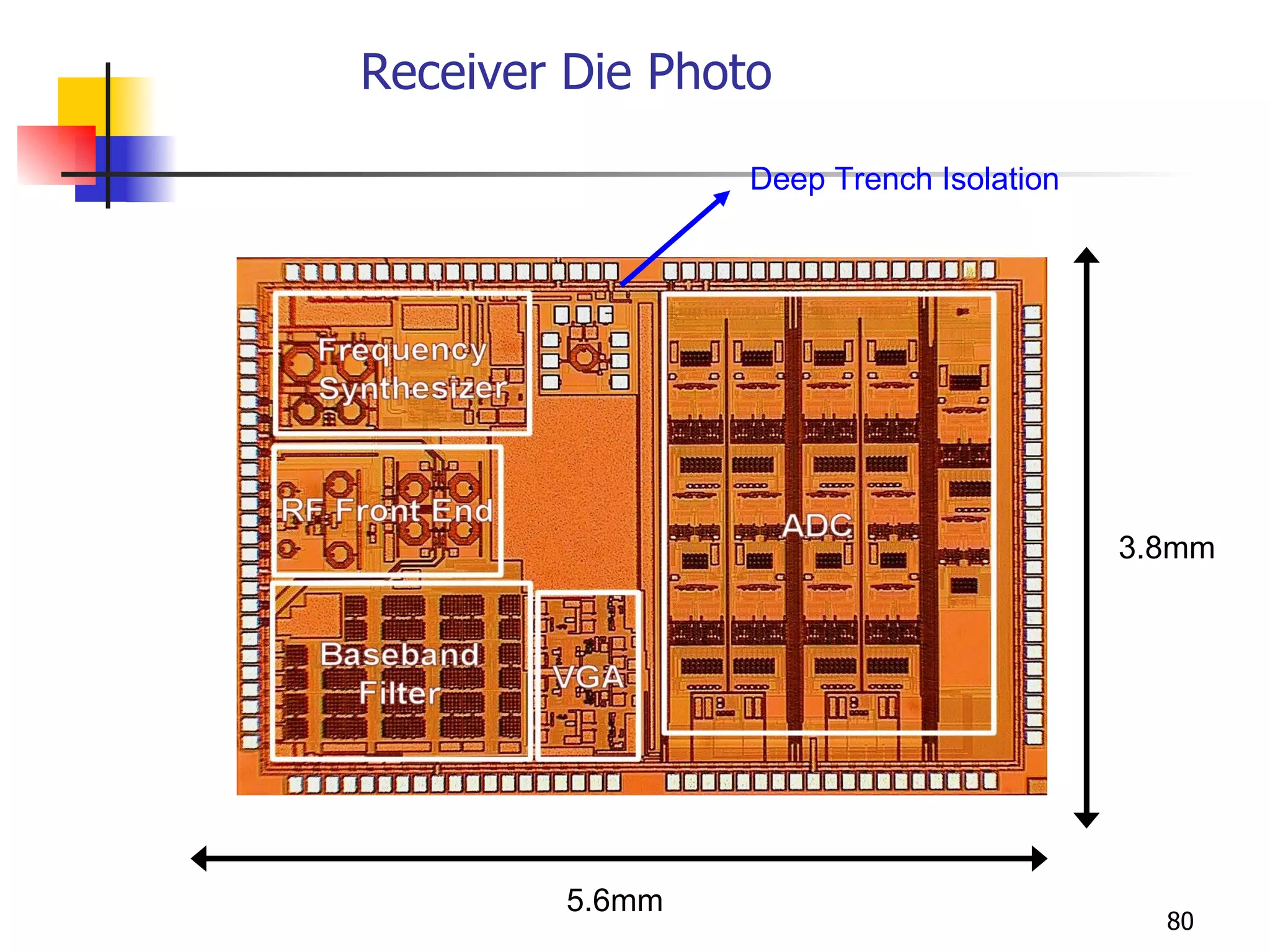
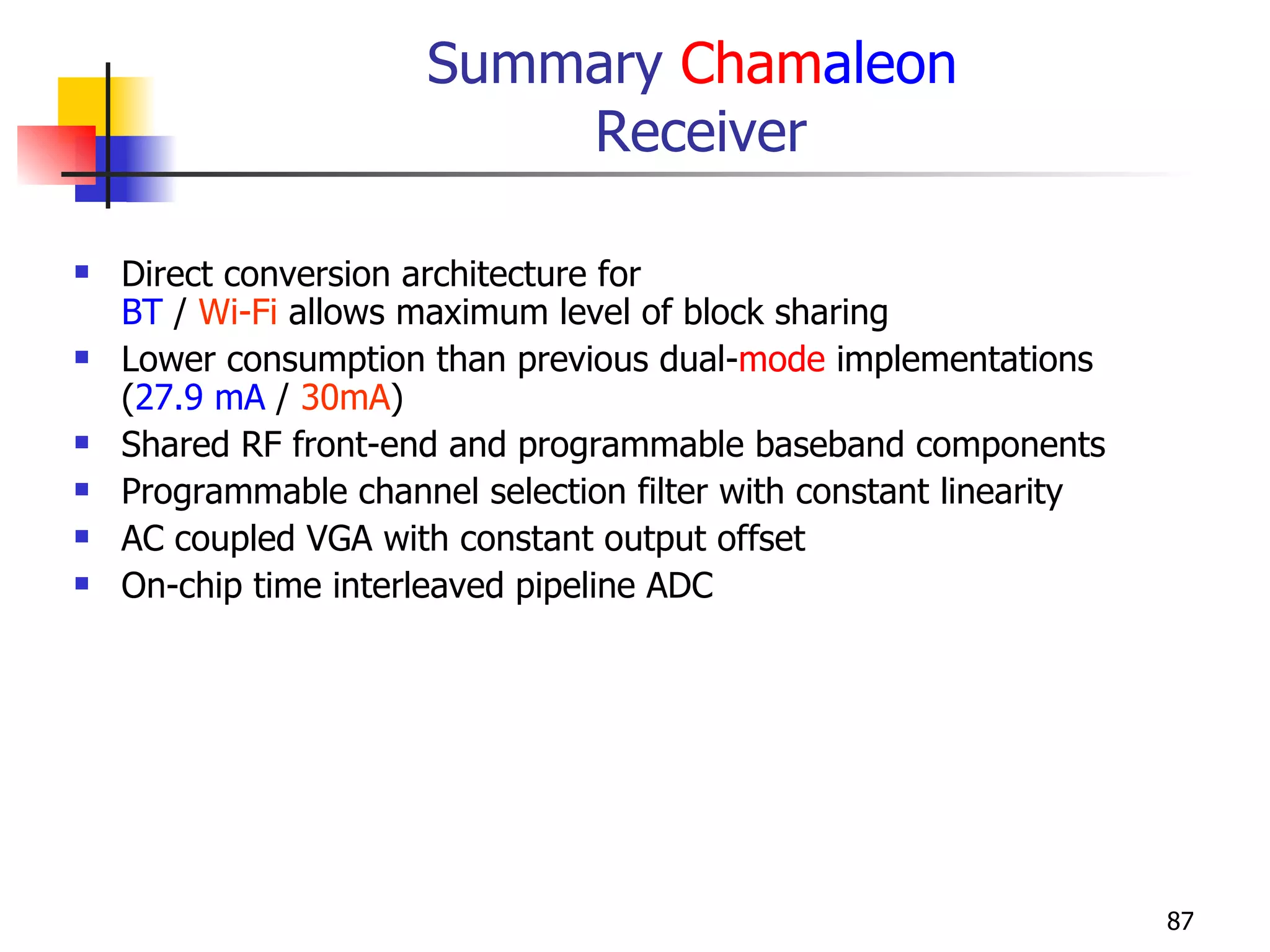
Summary Chamaleon Receiver Direct conversion architecture for BT / Wi-Fi allows maximum level of block sharing Lower consumption than previous dual- mode implementations ( 27.9 mA / 30mA ) Shared RF front-end and programmable baseband components Programmable channel selection filter with constant linearity AC coupled VGA with constant output offset On-chip time interleaved pipeline ADC
88.
Refer ences [1]W. Sheng, B. Xia, A.E.Emira, C. Xin, A.Y. Valero-Lopez, S.T. Moon, and E. Sanchez-Sinencio, “ A 3-V, 0.35 um CMOS Bluetooth Receiver IC ,” IEEE J. of Solid-State Circuits , Vol. 38, pp. 30-42, January 2003 [2] B. Xia, C. Xin, W. Sheng, A.Y. Valero-Lopez, and E. Sanchez-Sinencio, “ A GFSK Demodulator for Low-IF Bluetooth Receiver,” IEEE J. Solid-State Circuits , Vol. 38, pp. 1397-1400, August 2003. [3] A.A Emira,.; E.Sánchez-Sinencio, “A pseudo differential complex filter for Bluetooth with frequency tuning” IEEE Circuits and Systems II ,Volume: 50, pp. 742 - 754 Oct. 2003 [4] K. Shu, E. Sanchez-Sinencio, J. Silva-Martinez, S.H.K. Embabi, S.H” A 2.4-GHz monolithic fractional-N frequency synthesizer with robust phase-switching prescaler and loop capacitance multiplier. “ IEEEJ. of Solid-State Circuits , Vol. 38 , pp. 866-874, June 2003. [5] A. Emira, A. Valdes-Garcia, B. Xia, A. Mohieldin, A. Valero-Lopez, S. Moon, C. Xin, and E. Sánchez-Sinencio, “A Dual-Mode 802.11b/Bluetooth Receiver in 0.25mm BiCMOS,” IEEE International Solid-State Circuits Conference (ISSCC)I, pp. 270-271,527, Wireless Consumer Papers, San Francisco, CA, February 2004.
89.
Thank you foryour attention Any question ? Analog and Mixed-Signal Center, TAMU Department of Electrical and Computer Engineering