3
CHAPTER 7
4
POWER AMPLIFIERS
• Those amplifiers that have the objective
of delivering power to a load.
• Rated more than 1 W
• Leads to power dissipation problem
• Resolved using heat sink
• In case of transistor collector is critical
terminal
5
CLASS A POWER AMPLIFIER
• Transistor always operates in linear region
• Current flows for 360˚
• Output is the amplified replica of input signal
• Large signal type
• When output signal is large and approaches the
limits of ac load line
• Both large and small signal type comes under class A if
the operate throughout in linear region
• Efficiency nearly equal to 25%
6
CLASS A POWER AMPLIFIER
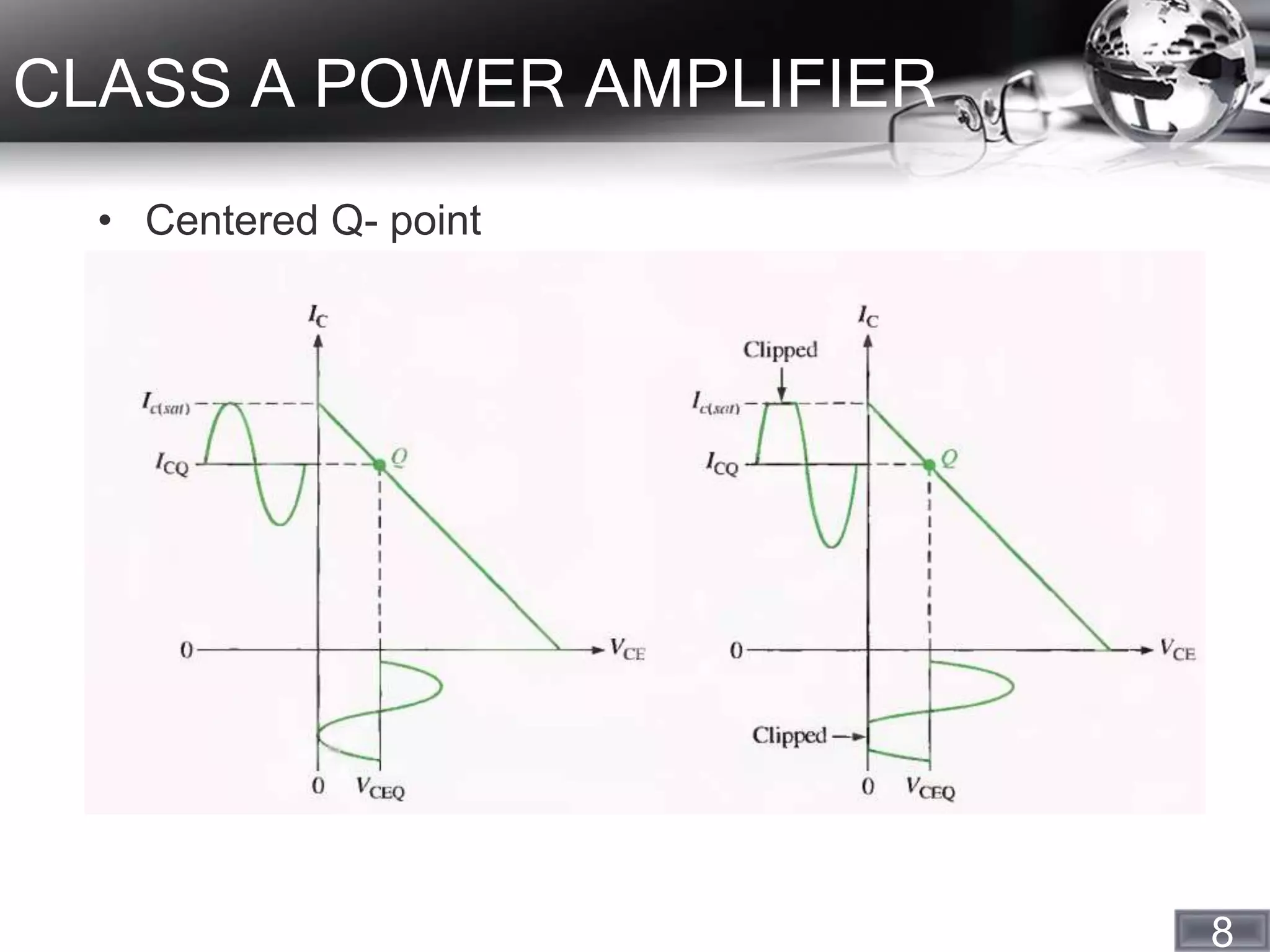
• Centered Q- point
• Point where DC and AC load line intersects
• For Class A it must be at the center
7
CLASS A POWER AMPLIFIER
• Centered Q- point
8
CLASS A POWER AMPLIFIER
• Centered Q- point
9
CLASS B AND AB PUSH PULL
POWER AMPLIFIER
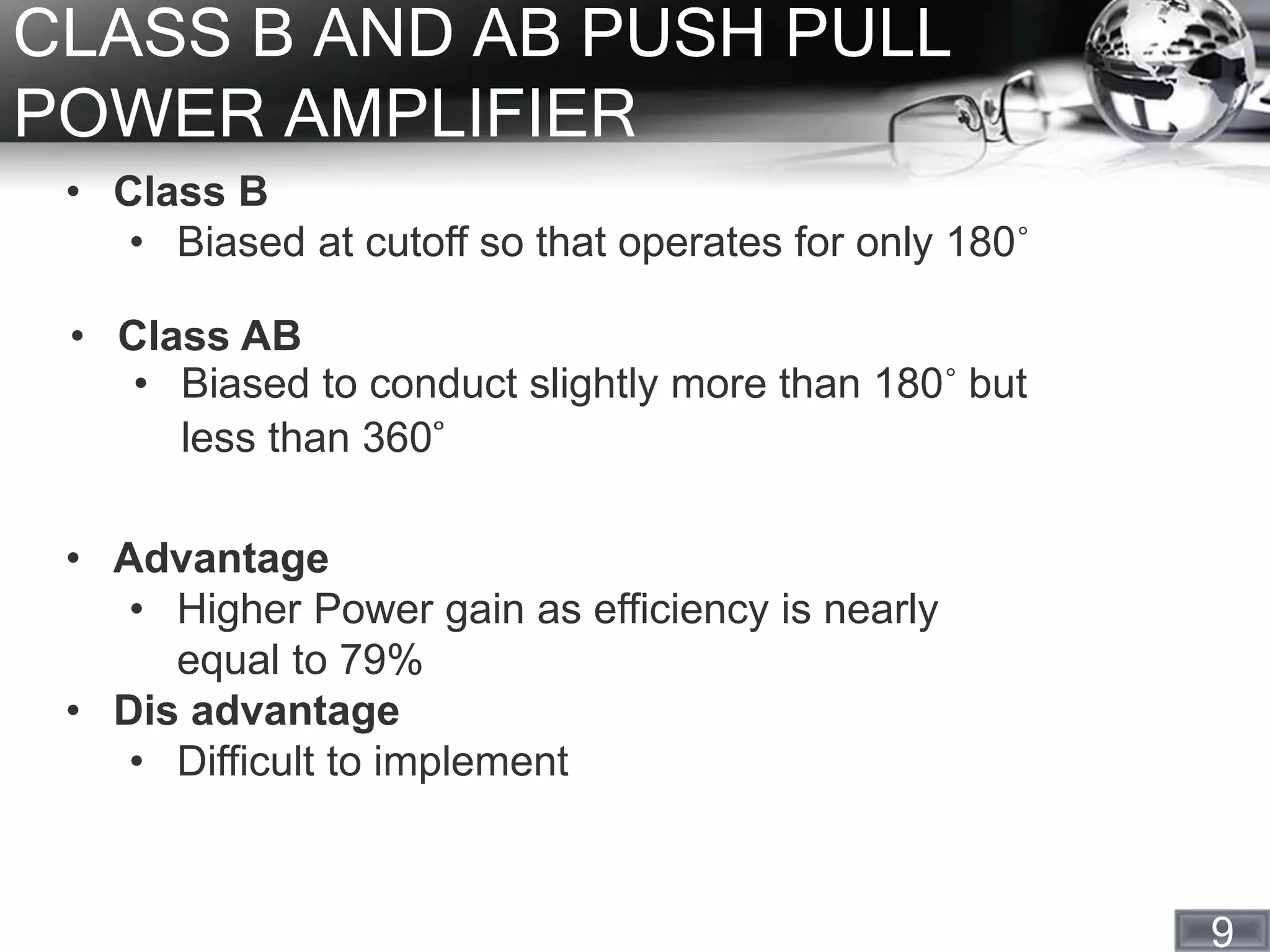
• Class B
• Biased at cutoff so that operates for only 180˚
• Class AB
• Biased to conduct slightly more than 180˚ but
less than 360˚
• Advantage
• Higher Power gain as efficiency is nearly
equal to 79%
• Dis advantage
• Difficult to implement
10
CLASS B AND AB PUSH PULL
POWER AMPLIFIER
• Class B operation
• Biased at cutoff so that operates for only 180˚
• Q point at cutoff ICQ = 0 and VCEQ = VCE(Sat)
11
CLASS B AND AB PUSH PULL
POWER AMPLIFIER
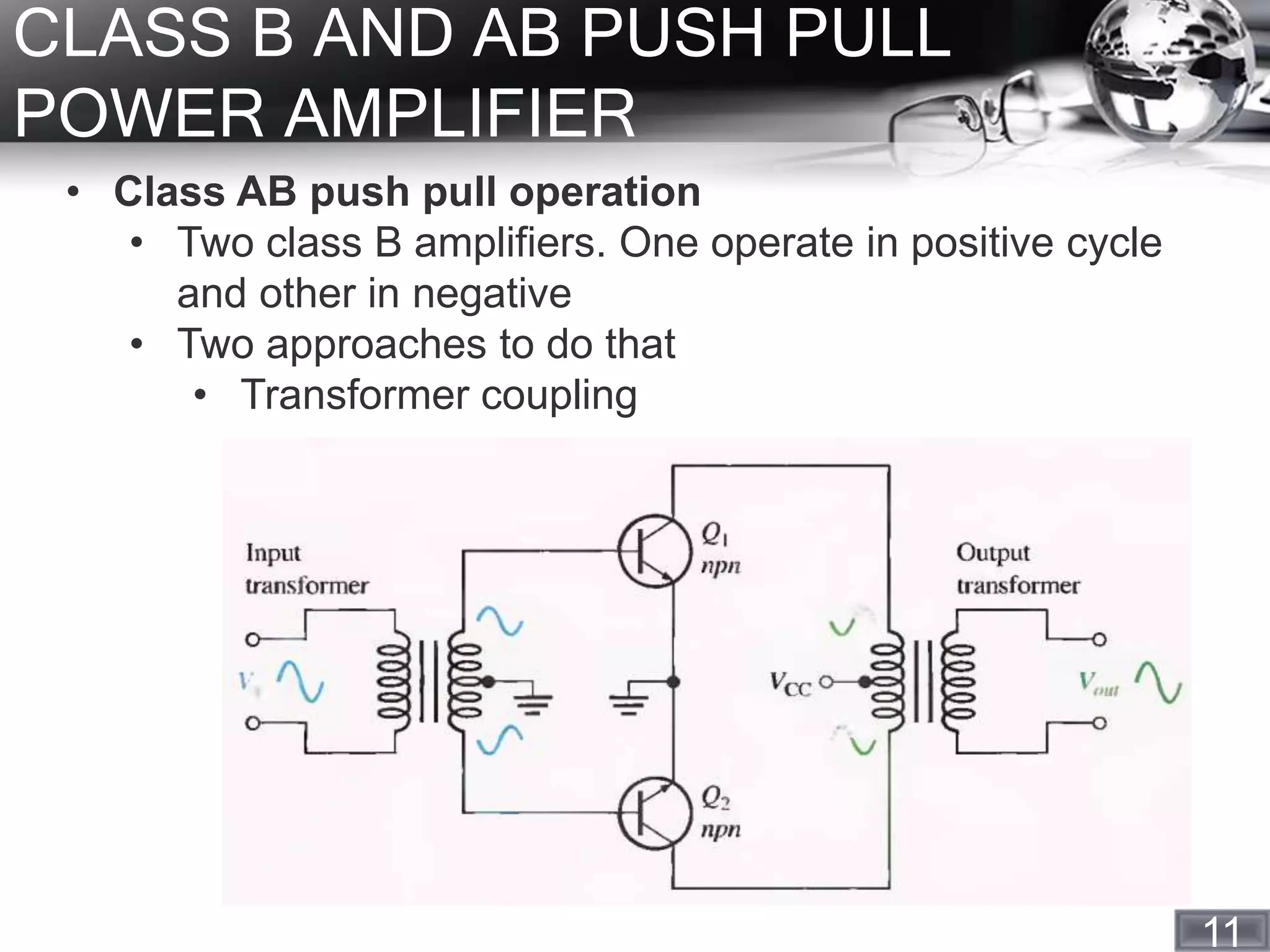
• Class AB push pull operation
• Two class B amplifiers. One operate in positive cycle
and other in negative
• Two approaches to do that
• Transformer coupling
12
CLASS B AND AB PUSH PULL
POWER AMPLIFIER
• Class AB push pull operation
• Two class B amplifiers. One operate in positive cycle
and other in negative
• Two approaches to do that
• Complementary symmetry transistor
13
CLASS C POWER AMPLIFIER
• Operates for less than 180˚ of input cycle
• Ideal maximum collector current is Ic(sat) and ideal
minimum collector voltage is Vce(cutoff)
• Provides more power gain as compared to Class A, B
and AB as its efficiency in nearly equal to 100%
• Out amplitude is non-linear
• Used in RF applications , oscillators, modulator
14
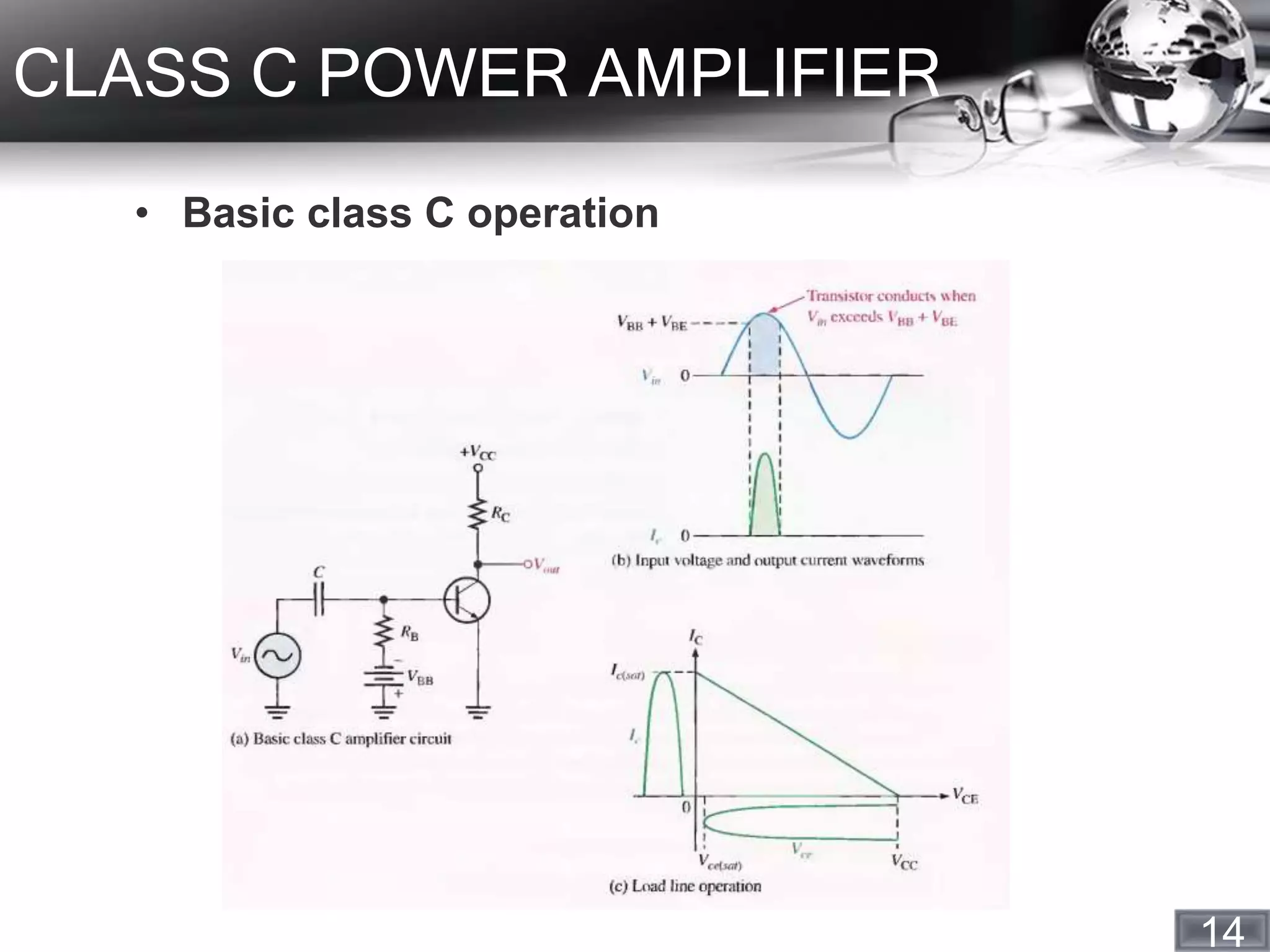
CLASS C POWER AMPLIFIER
• Basic class C operation
15

Lec11 Power Amplifiers

  • 3.
  • 4.
    4 POWER AMPLIFIERS • Thoseamplifiers that have the objective of delivering power to a load. • Rated more than 1 W • Leads to power dissipation problem • Resolved using heat sink • In case of transistor collector is critical terminal
  • 5.
    5 CLASS A POWERAMPLIFIER • Transistor always operates in linear region • Current flows for 360˚ • Output is the amplified replica of input signal • Large signal type • When output signal is large and approaches the limits of ac load line • Both large and small signal type comes under class A if the operate throughout in linear region • Efficiency nearly equal to 25%
  • 6.
    6 CLASS A POWERAMPLIFIER • Centered Q- point • Point where DC and AC load line intersects • For Class A it must be at the center
  • 7.
    7 CLASS A POWERAMPLIFIER • Centered Q- point
  • 8.
    8 CLASS A POWERAMPLIFIER • Centered Q- point
  • 9.
    9 CLASS B ANDAB PUSH PULL POWER AMPLIFIER • Class B • Biased at cutoff so that operates for only 180˚ • Class AB • Biased to conduct slightly more than 180˚ but less than 360˚ • Advantage • Higher Power gain as efficiency is nearly equal to 79% • Dis advantage • Difficult to implement
  • 10.
    10 CLASS B ANDAB PUSH PULL POWER AMPLIFIER • Class B operation • Biased at cutoff so that operates for only 180˚ • Q point at cutoff ICQ = 0 and VCEQ = VCE(Sat)
  • 11.
    11 CLASS B ANDAB PUSH PULL POWER AMPLIFIER • Class AB push pull operation • Two class B amplifiers. One operate in positive cycle and other in negative • Two approaches to do that • Transformer coupling
  • 12.
    12 CLASS B ANDAB PUSH PULL POWER AMPLIFIER • Class AB push pull operation • Two class B amplifiers. One operate in positive cycle and other in negative • Two approaches to do that • Complementary symmetry transistor
  • 13.
    13 CLASS C POWERAMPLIFIER • Operates for less than 180˚ of input cycle • Ideal maximum collector current is Ic(sat) and ideal minimum collector voltage is Vce(cutoff) • Provides more power gain as compared to Class A, B and AB as its efficiency in nearly equal to 100% • Out amplitude is non-linear • Used in RF applications , oscillators, modulator
  • 14.
    14 CLASS C POWERAMPLIFIER • Basic class C operation
  • 15.