AUTOMATED
         RETICULOCYTE
           ANALYSIS


Fery Soedewo
Dept.of Clinical Pathology Airlangga University
Medical School/ Sutomo General Hospital
2011


                                          7/18/2011   1
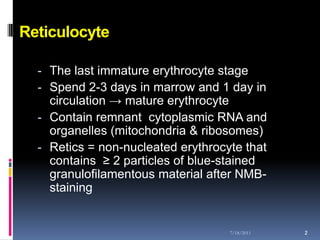
Reticulocyte

  - The last immature erythrocyte stage
  - Spend 2-3 days in marrow and 1 day in
    circulation → mature erythrocyte
  - Contain remnant cytoplasmic RNA and
    organelles (mitochondria & ribosomes)
  - Retics = non-nucleated erythrocyte that
    contains ≥ 2 particles of blue-stained
    granulofilamentous material after NMB-
    staining


                                    7/18/2011   2
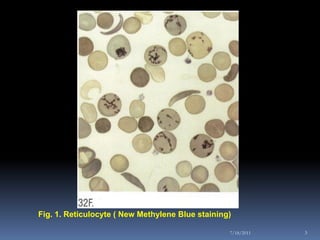
Fig. 1. Reticulocyte ( New Methylene Blue staining)
                                                  7/18/2011   3
- The amount of reticulocytes in circulation
  reflects erythropoietic activity .

- Retic.maturation started from extrusion of
  orthochromatic normoblast nucleus , to
  complete loss of ribosomes and RNA ,is thought
  to take 4 days (only the last day occurs in the
  circulation )


                                         7/18/2011   4
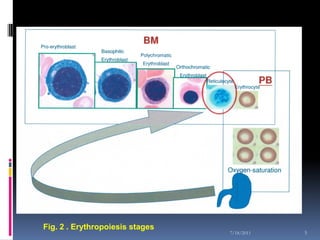
Fig. 2 . Erythropoiesis stages
                                 7/18/2011   5
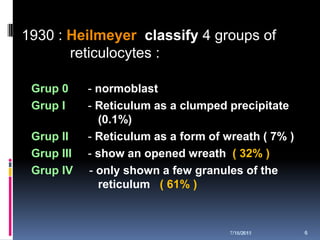
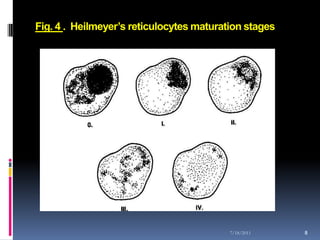
1930 : Heilmeyer classify 4 groups of
       reticulocytes :

 Grup 0     - normoblast
 Grup I     - Reticulum as a clumped precipitate
              (0.1%)
 Grup II    - Reticulum as a form of wreath ( 7% )
 Grup III   - show an opened wreath ( 32% )
 Grup IV    - only shown a few granules of the
              reticulum ( 61% )


                                      7/18/2011
                                      7/18/2011      6
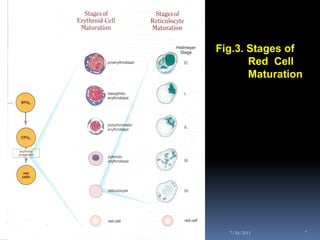
Fig.3. Stages of
       Red Cell
       Maturation


  7/18/2011         7
Fig. 4 . Heilmeyer’s reticulocytes maturation stages


                                          7/18/2011    8
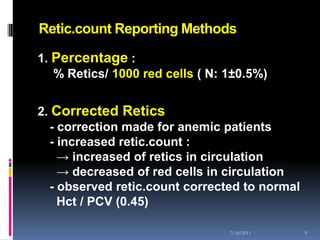
Retic.count Reporting Methods

1. Percentage :
   % Retics/ 1000 red cells ( N: 1±0.5%)


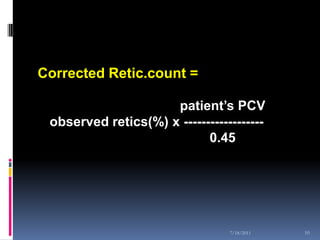
2. Corrected Retics
  - correction made for anemic patients
  - increased retic.count :
    → increased of retics in circulation
    → decreased of red cells in circulation
  - observed retic.count corrected to normal
    Hct / PCV (0.45)

                                 7/18/2011     9
Corrected Retic.count =

                     patient’s PCV
 observed retics(%) x ------------------
                            0.45


                                 7/18/2011   10
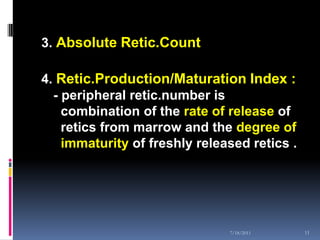
3. Absolute Retic.Count

4. Retic.Production/Maturation Index :
  - peripheral retic.number is
    combination of the rate of release of
    retics from marrow and the degree of
    immaturity of freshly released retics .


                               7/18/2011      11
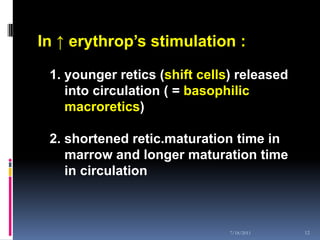
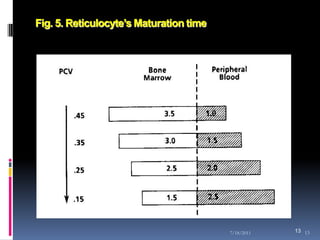
In ↑ erythrop’s stimulation :

 1. younger retics (shift cells) released
    into circulation ( = basophilic
    macroretics)

 2. shortened retic.maturation time in
    marrow and longer maturation time
    in circulation


                               7/18/2011    12
Fig. 5. Reticulocyte’s Maturation time


                                         7/18/2011   13 13
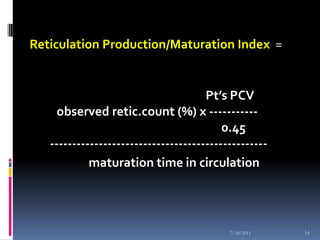
Reticulation Production/Maturation Index =


                                      Pt’s PCV
     observed retic.count (%) x -----------
                                          0.45
   -------------------------------------------------
            maturation time in circulation


                                           7/18/2011   14
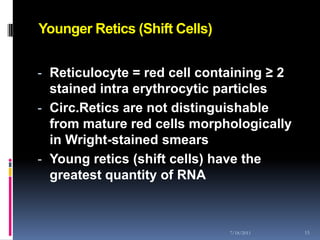
Younger Retics (Shift Cells)


- Reticulocyte = red cell containing ≥ 2
  stained intra erythrocytic particles
- Circ.Retics are not distinguishable
  from mature red cells morphologically
  in Wright-stained smears
- Young retics (shift cells) have the
  greatest quantity of RNA


                               7/18/2011   15
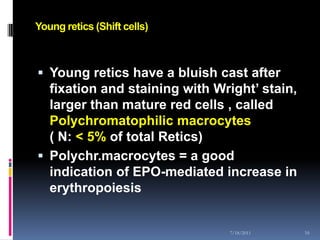
Young retics (Shift cells)


 Young retics have a bluish cast after
  fixation and staining with Wright’ stain,
  larger than mature red cells , called
  Polychromatophilic macrocytes
  ( N: < 5% of total Retics)
 Polychr.macrocytes = a good
  indication of EPO-mediated increase in
  erythropoiesis


                               7/18/2011      16
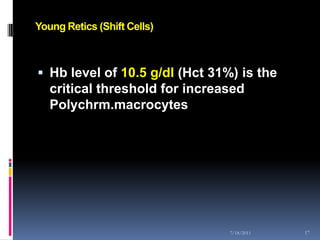
Young Retics (Shift Cells)


 Hb level of 10.5 g/dl (Hct 31%) is the
  critical threshold for increased
  Polychrm.macrocytes


                                7/18/2011   17
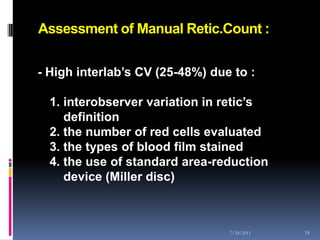
Assessment of Manual Retic.Count :


- High interlab’s CV (25-48%) due to :

  1. interobserver variation in retic’s
     definition
  2. the number of red cells evaluated
  3. the types of blood film stained
  4. the use of standard area-reduction
     device (Miller disc)


                                 7/18/2011   18
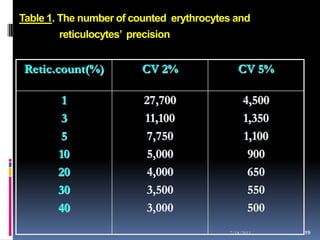
Table 1. The number of counted erythrocytes and
        reticulocytes’ precision


Retic.count(%)           CV 2%               CV 5%

        1                 27,700               4,500
        3                 11,100               1,350
        5                  7,750               1,100
       10                  5,000                900
       20                  4,000                650
       30                  3,500                550
       40                  3,000                500
                                          7/18/2011    19
                                                       19
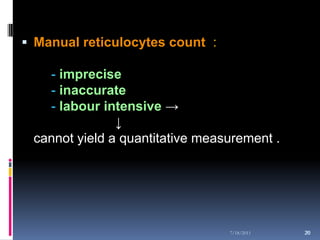
 Manual reticulocytes count :

   - imprecise
   - inaccurate
   - labour intensive →
               ↓
 cannot yield a quantitative measurement .


                                 7/18/2011   20
                                             20
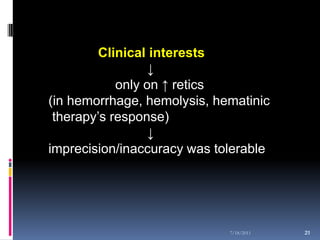
Clinical interests
                  ↓
            only on ↑ retics
(in hemorrhage, hemolysis, hematinic
 therapy’s response)
                  ↓
imprecision/inaccuracy was tolerable


                             7/18/2011   21
                                         21
 Modern medicine →
 increase of reticulocyte’s clinical
 utilities → need more precise &
 accurate retic.counts


                              7/18/2011   22
                                          22
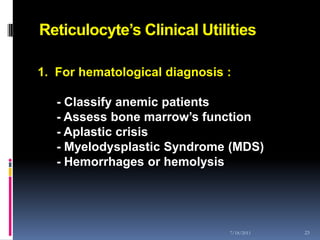
Reticulocyte’s Clinical Utilities

1. For hematological diagnosis :

   - Classify anemic patients
   - Assess bone marrow’s function
   - Aplastic crisis
   - Myelodysplastic Syndrome (MDS)
   - Hemorrhages or hemolysis


                               7/18/2011   23
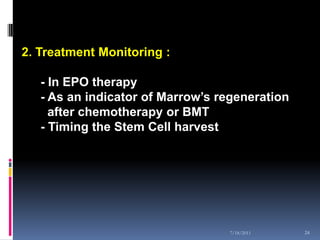
2. Treatment Monitoring :

   - In EPO therapy
   - As an indicator of Marrow’s regeneration
     after chemotherapy or BMT
   - Timing the Stem Cell harvest


                                  7/18/2011     24
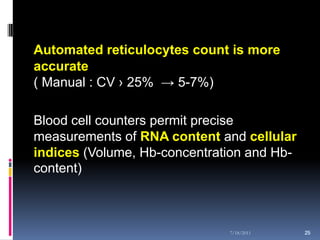
Automated reticulocytes count is more
accurate
( Manual : CV › 25% → 5-7%)

Blood cell counters permit precise
measurements of RNA content and cellular
indices (Volume, Hb-concentration and Hb-
content)


                              7/18/2011     25
                                            25
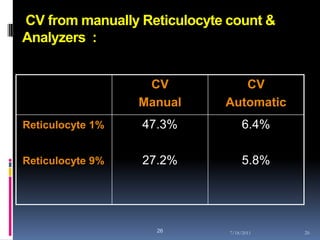
CV from manually Reticulocyte count &
Analyzers :


                   CV           CV
                  Manual     Automatic
Reticulocyte 1%   47.3%            6.4%

Reticulocyte 9%   27.2%            5.8%


                    26        7/18/2011   26
Hematology’s Automation

- 2 basic principles operation of
  Hematology Analyzers :

  1. Electronic Impedance / low-voltage DC
     resistance (Coulter, 1950s)

  2. Optical Scatter


                                    7/18/2011   27
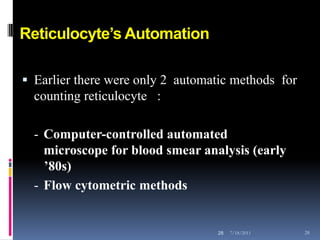
Reticulocyte’s Automation

 Earlier there were only 2 automatic methods for
  counting reticulocyte :

  - Computer-controlled automated
    microscope for blood smear analysis (early
    ’80s)
  - Flow cytometric methods


                                  28   7/18/2011    28
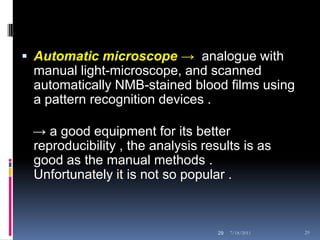
 Automatic microscope → analogue with
 manual light-microscope, and scanned
 automatically NMB-stained blood films using
 a pattern recognition devices .

 → a good equipment for its better
 reproducibility , the analysis results is as
 good as the manual methods .
 Unfortunately it is not so popular .


                                   29   7/18/2011   29
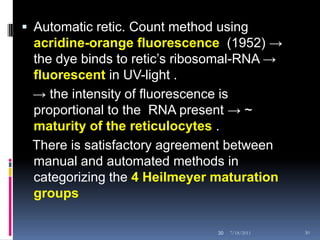
 Automatic retic. Count method using
 acridine-orange fluorescence (1952) →
 the dye binds to retic’s ribosomal-RNA →
 fluorescent in UV-light .
 → the intensity of fluorescence is
 proportional to the RNA present → ~
 maturity of the reticulocytes .
 There is satisfactory agreement between
 manual and automated methods in
 categorizing the 4 Heilmeyer maturation
 groups

                                30   7/18/2011   30
 Fluorescence staining combined with
  flow-cytometry → led to the new automated
  systems for reticulocyte counting .

 Several different dyes have been used for
  flow cytometric retics count .


                                   31   7/18/2011   31
Flow cytometric Retic.counting

- Many fluorochromes have been used , i.e :

 - Acridine orange
 - Auramine O
 - Di-methyloxacarbocyanide
 - Ethidine bromide
 - Pyronin -Y
 - Thioflavine-T
 - Thiazole orange
 most require 30 minutes incubation → semi-
 automated ?

                                  7/18/2011   32
                                              32
- Ethidium bromide at relatively high pH
  require only few minutes to enter the cells

- Auramine O requires only a few seconds


                                 7/18/2011      33
                                                33
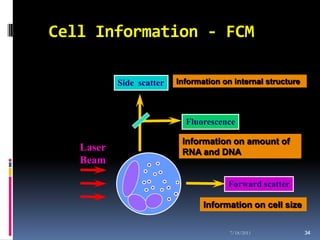
Cell Information - FCM

             Side scatter   Information on internal structure


  Dichroic mirror             Fluorescence

                             Information on amount of
   Laser                     RNA and DNA
   Beam

                                         Forward scatter

                                   Information on cell size


                                          7/18/2011             34
                                                                34
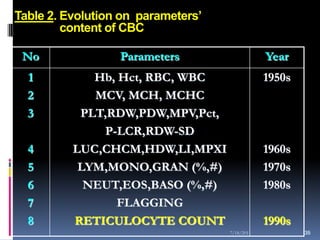
Table 2. Evolution on parameters’
         content of CBC

 No               Parameters                    Year
  1          Hb, Hct, RBC, WBC                  1950s
  2          MCV, MCH, MCHC
  3        PLT,RDW,PDW,MPV,Pct,
               P-LCR,RDW-SD
  4       LUC,CHCM,HDW,LI,MPXI                  1960s
  5        LYM,MONO,GRAN (%,#)                  1970s
  6         NEUT,EOS,BASO (%,#)                 1980s
  7              FLAGGING
  8       RETICULOCYTE COUNT                    1990s
                                    7/18/2011           35
                                                        35
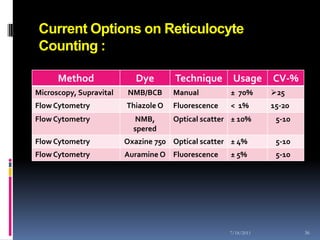
Current Options on Reticulocyte
Counting :

      Method                Dye       Technique       Usage      CV-%
Microscopy, Supravital   NMB/BCB      Manual         ± 70%       25
Flow Cytometry           Thiazole O   Fluorescence   < 1%        15-20
Flow Cytometry             NMB,       Optical scatter ± 10%       5-10
                           spered
Flow Cytometry           Oxazine 750 Optical scatter ± 4%         5-10
Flow Cytometry           Auramine O Fluorescence     ± 5%         5-10


                                                     7/18/2011           36
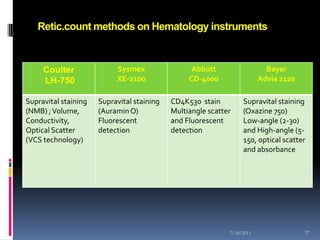
Retic.count methods on Hematology instruments


     Coulter               Sysmex                Abbott                    Bayer
     LH-750                XE-2100               CD-4000                 Advia 2120

Supravital staining   Supravital staining   CD4K530 stain         Supravital staining
(NMB) ; Volume,       (Auramin O)           Multiangle scatter    (Oxazine 750)
Conductivity,         Fluorescent           and Fluorescent       Low-angle (2-30)
Optical Scatter       detection             detection             and High-angle (5-
(VCS technology)                                                  150, optical scatter
                                                                  and absorbance


                                                             7/18/2011                37
The improved precision for Flow
Cytometric methods arises from :

1. Removal of inter-observer variation

2. The larger number of cells counted (10000
   – 30000 RBC events , compare to 1000 for
   the visual method)

3. The fluorescence measured is
   proportional to the amount of RNA
   present in the cell
                                7/18/2011      38
                                               38
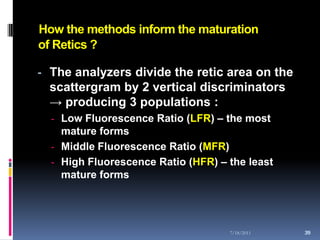
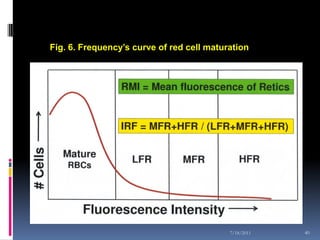
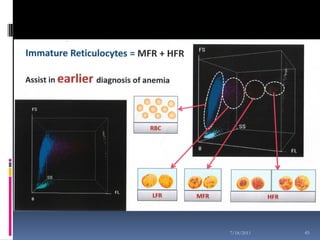
How the methods inform the maturation
of Retics ?

- The analyzers divide the retic area on the
  scattergram by 2 vertical discriminators
  → producing 3 populations :
  - Low Fluorescence Ratio (LFR) – the most
    mature forms
  - Middle Fluorescence Ratio (MFR)
  - High Fluorescence Ratio (HFR) – the least
    mature forms


                                    7/18/2011   39
                                                39
Fig. 6. Frequency’s curve of red cell maturation


                                           7/18/2011   40
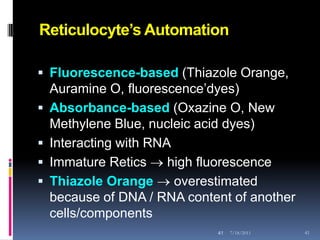
Reticulocyte’s Automation

 Fluorescence-based (Thiazole Orange,
  Auramine O, fluorescence’dyes)
 Absorbance-based (Oxazine O, New
  Methylene Blue, nucleic acid dyes)
 Interacting with RNA
 Immature Retics  high fluorescence
 Thiazole Orange  overestimated
  because of DNA / RNA content of another
  cells/components
                            41   7/18/2011   41
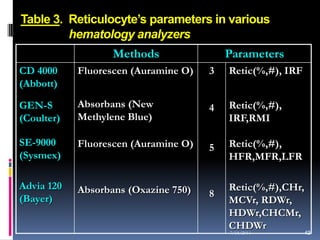
Table 3. Reticulocyte’s parameters in various
         hematology analyzers
                   Methods                Parameters
CD 4000     Fluorescen (Auramine O)   3   Retic(%,#), IRF
(Abbott)

GEN-S       Absorbans (New            4   Retic(%,#),
(Coulter)   Methylene Blue)               IRF,RMI

SE-9000     Fluorescen (Auramine O)   5   Retic(%,#),
(Sysmex)                                  HFR,MFR,LFR

Advia 120   Absorbans (Oxazine 750)       Retic(%,#),CHr,
(Bayer)                               8
                                          MCVr, RDWr,
                                          HDWr,CHCMr,
                                          CHDWr
                                          7/18/2011         42
                                                            42
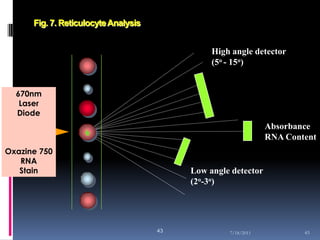
Fig. 7. Reticulocyte Analysis


                                                High angle detector
                                                (5o - 15o)


  670nm
   Laser
  Diode
                                                                Absorbance
                                                                RNA Content
Oxazine 750
   RNA
   Stain                                   Low angle detector
                                           (2o-3o)


                                      43            7/18/2011           43
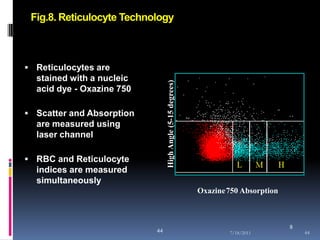
Fig.8. Reticulocyte Technology


 Reticulocytes are
  stained with a nucleic


                                High Angle (5-15 degrees)
  acid dye - Oxazine 750

 Scatter and Absorption
  are measured using
  laser channel

 RBC and Reticulocyte
  indices are measured
  simultaneously
                                                            Oxazine 750 Absorption


                                                                                     8
                           44                                       7/18/2011            44
7/18/2011   45
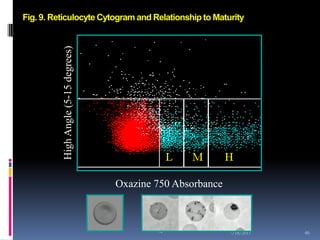
Fig. 9. Reticulocyte Cytogram and Relationship to Maturity


          High Angle (5-15 degrees)


                                      Oxazine 750 Absorbance


                                              46               7/18/2011   46
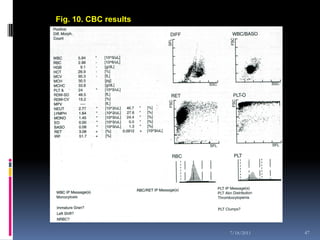
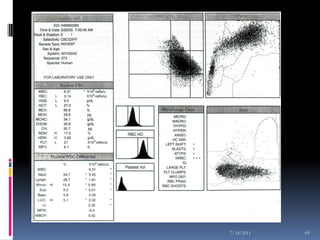
Fig. 10. CBC results


                       7/18/2011   47
- Sysmex methods (R-3000/3500) :
   Sysmex use supravitally-fluorescence dye
    , Auramine-O .


   Forward-scatter (measuring size) and
    side-fluorescence intensity(measure
    RNA’s content)


                               48   7/18/2011   48
 forward light scatter & side fluorescence 
  scattergram  red cells, reticulocytes,
  platelets area
 Reticulocytes area :
  LFR (low fluorescence ratio)
  MFR (middle fluorescence ratio)
  HFR (high fluorescence ratio)
  IRF (Immature Retic.Fraction) = MFR + HFR

LFR : Heilmeyer III and IV
Flow-cytometry increase retics.count precision
  Retic. 1% -- CV manl= 47.3%; automt = 6.4%
  Retic. 9% -- CV manl= 27.2%; automt = 5.8%
                                49   7/18/2011   49
- Bayer’s method (Advia-120) :

   Bayer uses Oxazine-750 , a Nucleic-acid-
    binding dye .
   Erythrocyte changed into spherical-isovolumic
   Measurement using 3 detectors :
    1. Low-angle-scatter (2-3o)
    2. High-angle-scatter (5-15o)
    3. Absorbance


                                    50   7/18/2011   50
 From these 3 detectors → 3 cytograms :

 1. High-angle scatter vs Absorbans →
    LAC/MAC/HAC , IRF (MAC + HAC)
 2. High-angle vs Low-angle-scatter (RBC
   map) → Reticulocyte’s indices
 3. Volume vs Hb-concentration → CHr


                                51   7/18/2011   51
- Automated Reticulocyte’s Parameters :


   Retics # and %

   HAC, MAC, LAC (Absorbance/Fluorescence
    Ratio)

   IRF (Immature Retics Fraction = HAC + MAC)


   Retic’s indices (MCVr, MCHr, CHCMr, CHr,
    RDWr, HDWr)


                        52           7/18/2011   52
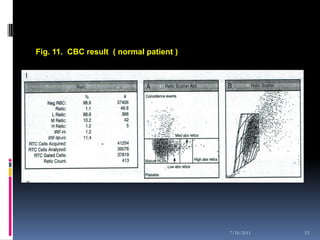
Fig. 11. CBC result ( normal patient )


                                         7/18/2011   53
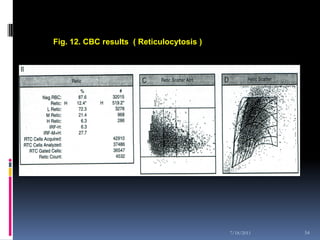
Fig. 12. CBC results ( Reticulocytosis )


                                           7/18/2011   54
- Content of Retic’s Hb (CHr) :

 Content of retic’s Hb never changed as long as the
  survival of Retics and red cells

 The CHr’s mean : 28.5 pg

 CHr/CH ratio ± 1 ( range : 0.96-1.03)

 The meaningful of CHr :
  - indicate Iron availability real-time .
  - as a strong predictor for Iron Deficiency
  - Early indicator for Iron therapy in Iron Deficiency
     Anemia .


                           55             7/18/2011       55
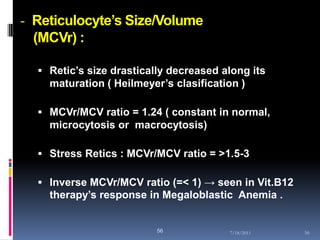
- Reticulocyte’s Size/Volume
  (MCVr) :

   Retic’s size drastically decreased along its
    maturation ( Heilmeyer’s clasification )

   MCVr/MCV ratio = 1.24 ( constant in normal,
    microcytosis or macrocytosis)

   Stress Retics : MCVr/MCV ratio = >1.5-3

   Inverse MCVr/MCV ratio (=< 1) → seen in Vit.B12
    therapy’s response in Megaloblastic Anemia .


                          56            7/18/2011     56
7/18/2011   57
            57
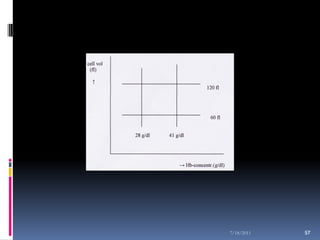
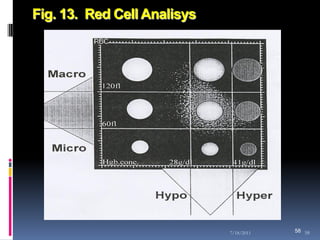
Fig. 13. Red Cell Analisys


                             7/18/2011   58 58
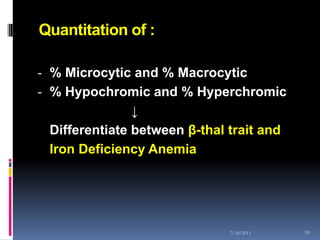
Quantitation of :

- % Microcytic and % Macrocytic
- % Hypochromic and % Hyperchromic
               ↓
 Differentiate between β-thal trait and
 Iron Deficiency Anemia


                              7/18/2011   59
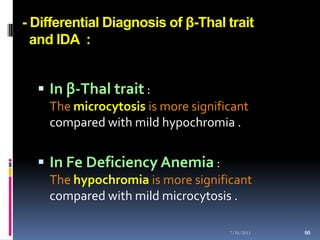
- Differential Diagnosis of β-Thal trait
  and IDA :


   In β-Thal trait :
    The microcytosis is more significant
    compared with mild hypochromia .


   In Fe Deficiency Anemia :
    The hypochromia is more significant
    compared with mild microcytosis .

                                    7/18/2011   60
                                                60
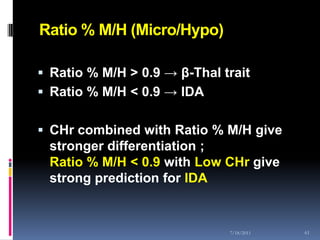
Ratio % M/H (Micro/Hypo)

 Ratio % M/H > 0.9 → β-Thal trait
 Ratio % M/H < 0.9 → IDA


 CHr combined with Ratio % M/H give
 stronger differentiation ;
 Ratio % M/H < 0.9 with Low CHr give
 strong prediction for IDA


                              7/18/2011   61
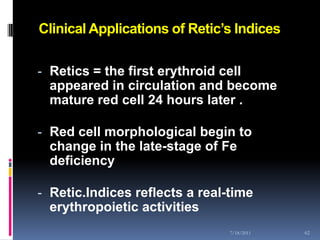
Clinical Applications of Retic’s Indices

- Retics = the first erythroid cell
  appeared in circulation and become
  mature red cell 24 hours later .

- Red cell morphological begin to
  change in the late-stage of Fe
  deficiency

- Retic.Indices reflects a real-time
  erythropoietic activities
                                7/18/2011   62
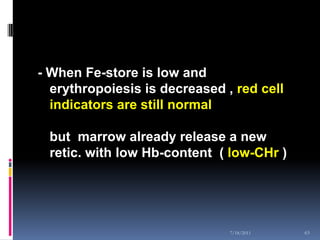
- When Fe-store is low and
  erythropoiesis is decreased , red cell
  indicators are still normal

 but marrow already release a new
 retic. with low Hb-content ( low-CHr )


                               7/18/2011   63
- Early detection of Functional Fe
  Deficiency is by measuring %-
  Hypochromic and CHr
 %-Hypochromic reflects Hb
 concentration during 8-12 weeks .

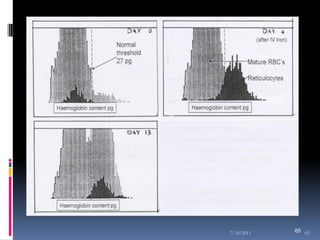
- Fe-therapy responses have already
  seen from the CHr in 4 days (1-2
  weeks) when normally it’s only seen
 from the increament of Hb after 1
 month therapy
                              7/18/2011   64
7/18/2011   65 65
7/18/2011   66
            66
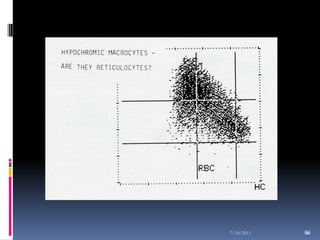
- Hypochromic Macrocytic Cells ?


   Reticulocyte ?


   Dyserythropoiesis / Myelodysplastic
    syndrome / Sideroblastic anemia

   Fe-deficient megaloblastic anemia


                                 7/18/2011   67
                                             67
7/18/2011   68
Limitations

- Most dyes stain also other blood
  components containing DNA/RNA, so
  assessed as reticulocytes, i.e :
   Howell-Jolly bodies, Cabot’s ring,
   Malaria parasites, white cell’s
   fragments in Leukemia
- Retics may “mature” during storage
  especially if not refrigerated


                             7/18/2011   69
Thank U


          7/18/2011   70

Ss4

  • 1.
    AUTOMATED RETICULOCYTE ANALYSIS Fery Soedewo Dept.of Clinical Pathology Airlangga University Medical School/ Sutomo General Hospital 2011 7/18/2011 1
  • 2.
    Reticulocyte -The last immature erythrocyte stage - Spend 2-3 days in marrow and 1 day in circulation → mature erythrocyte - Contain remnant cytoplasmic RNA and organelles (mitochondria & ribosomes) - Retics = non-nucleated erythrocyte that contains ≥ 2 particles of blue-stained granulofilamentous material after NMB- staining 7/18/2011 2
  • 3.
    Fig. 1. Reticulocyte( New Methylene Blue staining) 7/18/2011 3
  • 4.
    - The amountof reticulocytes in circulation reflects erythropoietic activity . - Retic.maturation started from extrusion of orthochromatic normoblast nucleus , to complete loss of ribosomes and RNA ,is thought to take 4 days (only the last day occurs in the circulation ) 7/18/2011 4
  • 5.
    Fig. 2 .Erythropoiesis stages 7/18/2011 5
  • 6.
    1930 : Heilmeyerclassify 4 groups of reticulocytes : Grup 0 - normoblast Grup I - Reticulum as a clumped precipitate (0.1%) Grup II - Reticulum as a form of wreath ( 7% ) Grup III - show an opened wreath ( 32% ) Grup IV - only shown a few granules of the reticulum ( 61% ) 7/18/2011 7/18/2011 6
  • 7.
    Fig.3. Stages of Red Cell Maturation 7/18/2011 7
  • 8.
    Fig. 4 .Heilmeyer’s reticulocytes maturation stages 7/18/2011 8
  • 9.
    Retic.count Reporting Methods 1.Percentage : % Retics/ 1000 red cells ( N: 1±0.5%) 2. Corrected Retics - correction made for anemic patients - increased retic.count : → increased of retics in circulation → decreased of red cells in circulation - observed retic.count corrected to normal Hct / PCV (0.45) 7/18/2011 9
  • 10.
    Corrected Retic.count = patient’s PCV observed retics(%) x ------------------ 0.45 7/18/2011 10
  • 11.
    3. Absolute Retic.Count 4.Retic.Production/Maturation Index : - peripheral retic.number is combination of the rate of release of retics from marrow and the degree of immaturity of freshly released retics . 7/18/2011 11
  • 12.
    In ↑ erythrop’sstimulation : 1. younger retics (shift cells) released into circulation ( = basophilic macroretics) 2. shortened retic.maturation time in marrow and longer maturation time in circulation 7/18/2011 12
  • 13.
    Fig. 5. Reticulocyte’sMaturation time 7/18/2011 13 13
  • 14.
    Reticulation Production/Maturation Index= Pt’s PCV observed retic.count (%) x ----------- 0.45 ------------------------------------------------- maturation time in circulation 7/18/2011 14
  • 15.
    Younger Retics (ShiftCells) - Reticulocyte = red cell containing ≥ 2 stained intra erythrocytic particles - Circ.Retics are not distinguishable from mature red cells morphologically in Wright-stained smears - Young retics (shift cells) have the greatest quantity of RNA 7/18/2011 15
  • 16.
    Young retics (Shiftcells)  Young retics have a bluish cast after fixation and staining with Wright’ stain, larger than mature red cells , called Polychromatophilic macrocytes ( N: < 5% of total Retics)  Polychr.macrocytes = a good indication of EPO-mediated increase in erythropoiesis 7/18/2011 16
  • 17.
    Young Retics (ShiftCells)  Hb level of 10.5 g/dl (Hct 31%) is the critical threshold for increased Polychrm.macrocytes 7/18/2011 17
  • 18.
    Assessment of ManualRetic.Count : - High interlab’s CV (25-48%) due to : 1. interobserver variation in retic’s definition 2. the number of red cells evaluated 3. the types of blood film stained 4. the use of standard area-reduction device (Miller disc) 7/18/2011 18
  • 19.
    Table 1. Thenumber of counted erythrocytes and reticulocytes’ precision Retic.count(%) CV 2% CV 5% 1 27,700 4,500 3 11,100 1,350 5 7,750 1,100 10 5,000 900 20 4,000 650 30 3,500 550 40 3,000 500 7/18/2011 19 19
  • 20.
     Manual reticulocytescount : - imprecise - inaccurate - labour intensive → ↓ cannot yield a quantitative measurement . 7/18/2011 20 20
  • 21.
    Clinical interests ↓ only on ↑ retics (in hemorrhage, hemolysis, hematinic therapy’s response) ↓ imprecision/inaccuracy was tolerable 7/18/2011 21 21
  • 22.
     Modern medicine→ increase of reticulocyte’s clinical utilities → need more precise & accurate retic.counts 7/18/2011 22 22
  • 23.
    Reticulocyte’s Clinical Utilities 1.For hematological diagnosis : - Classify anemic patients - Assess bone marrow’s function - Aplastic crisis - Myelodysplastic Syndrome (MDS) - Hemorrhages or hemolysis 7/18/2011 23
  • 24.
    2. Treatment Monitoring: - In EPO therapy - As an indicator of Marrow’s regeneration after chemotherapy or BMT - Timing the Stem Cell harvest 7/18/2011 24
  • 25.
    Automated reticulocytes countis more accurate ( Manual : CV › 25% → 5-7%) Blood cell counters permit precise measurements of RNA content and cellular indices (Volume, Hb-concentration and Hb- content) 7/18/2011 25 25
  • 26.
    CV from manuallyReticulocyte count & Analyzers : CV CV Manual Automatic Reticulocyte 1% 47.3% 6.4% Reticulocyte 9% 27.2% 5.8% 26 7/18/2011 26
  • 27.
    Hematology’s Automation - 2basic principles operation of Hematology Analyzers : 1. Electronic Impedance / low-voltage DC resistance (Coulter, 1950s) 2. Optical Scatter 7/18/2011 27
  • 28.
    Reticulocyte’s Automation  Earlierthere were only 2 automatic methods for counting reticulocyte : - Computer-controlled automated microscope for blood smear analysis (early ’80s) - Flow cytometric methods 28 7/18/2011 28
  • 29.
     Automatic microscope→ analogue with manual light-microscope, and scanned automatically NMB-stained blood films using a pattern recognition devices . → a good equipment for its better reproducibility , the analysis results is as good as the manual methods . Unfortunately it is not so popular . 29 7/18/2011 29
  • 30.
     Automatic retic.Count method using acridine-orange fluorescence (1952) → the dye binds to retic’s ribosomal-RNA → fluorescent in UV-light . → the intensity of fluorescence is proportional to the RNA present → ~ maturity of the reticulocytes . There is satisfactory agreement between manual and automated methods in categorizing the 4 Heilmeyer maturation groups 30 7/18/2011 30
  • 31.
     Fluorescence stainingcombined with flow-cytometry → led to the new automated systems for reticulocyte counting .  Several different dyes have been used for flow cytometric retics count . 31 7/18/2011 31
  • 32.
    Flow cytometric Retic.counting -Many fluorochromes have been used , i.e : - Acridine orange - Auramine O - Di-methyloxacarbocyanide - Ethidine bromide - Pyronin -Y - Thioflavine-T - Thiazole orange most require 30 minutes incubation → semi- automated ? 7/18/2011 32 32
  • 33.
    - Ethidium bromideat relatively high pH require only few minutes to enter the cells - Auramine O requires only a few seconds 7/18/2011 33 33
  • 34.
    Cell Information -FCM Side scatter Information on internal structure Dichroic mirror Fluorescence Information on amount of Laser RNA and DNA Beam Forward scatter Information on cell size 7/18/2011 34 34
  • 35.
    Table 2. Evolutionon parameters’ content of CBC No Parameters Year 1 Hb, Hct, RBC, WBC 1950s 2 MCV, MCH, MCHC 3 PLT,RDW,PDW,MPV,Pct, P-LCR,RDW-SD 4 LUC,CHCM,HDW,LI,MPXI 1960s 5 LYM,MONO,GRAN (%,#) 1970s 6 NEUT,EOS,BASO (%,#) 1980s 7 FLAGGING 8 RETICULOCYTE COUNT 1990s 7/18/2011 35 35
  • 36.
    Current Options onReticulocyte Counting : Method Dye Technique Usage CV-% Microscopy, Supravital NMB/BCB Manual ± 70% 25 Flow Cytometry Thiazole O Fluorescence < 1% 15-20 Flow Cytometry NMB, Optical scatter ± 10% 5-10 spered Flow Cytometry Oxazine 750 Optical scatter ± 4% 5-10 Flow Cytometry Auramine O Fluorescence ± 5% 5-10 7/18/2011 36
  • 37.
    Retic.count methods onHematology instruments Coulter Sysmex Abbott Bayer LH-750 XE-2100 CD-4000 Advia 2120 Supravital staining Supravital staining CD4K530 stain Supravital staining (NMB) ; Volume, (Auramin O) Multiangle scatter (Oxazine 750) Conductivity, Fluorescent and Fluorescent Low-angle (2-30) Optical Scatter detection detection and High-angle (5- (VCS technology) 150, optical scatter and absorbance 7/18/2011 37
  • 38.
    The improved precisionfor Flow Cytometric methods arises from : 1. Removal of inter-observer variation 2. The larger number of cells counted (10000 – 30000 RBC events , compare to 1000 for the visual method) 3. The fluorescence measured is proportional to the amount of RNA present in the cell 7/18/2011 38 38
  • 39.
    How the methodsinform the maturation of Retics ? - The analyzers divide the retic area on the scattergram by 2 vertical discriminators → producing 3 populations : - Low Fluorescence Ratio (LFR) – the most mature forms - Middle Fluorescence Ratio (MFR) - High Fluorescence Ratio (HFR) – the least mature forms 7/18/2011 39 39
  • 40.
    Fig. 6. Frequency’scurve of red cell maturation 7/18/2011 40
  • 41.
    Reticulocyte’s Automation  Fluorescence-based(Thiazole Orange, Auramine O, fluorescence’dyes)  Absorbance-based (Oxazine O, New Methylene Blue, nucleic acid dyes)  Interacting with RNA  Immature Retics  high fluorescence  Thiazole Orange  overestimated because of DNA / RNA content of another cells/components 41 7/18/2011 41
  • 42.
    Table 3. Reticulocyte’sparameters in various hematology analyzers Methods Parameters CD 4000 Fluorescen (Auramine O) 3 Retic(%,#), IRF (Abbott) GEN-S Absorbans (New 4 Retic(%,#), (Coulter) Methylene Blue) IRF,RMI SE-9000 Fluorescen (Auramine O) 5 Retic(%,#), (Sysmex) HFR,MFR,LFR Advia 120 Absorbans (Oxazine 750) Retic(%,#),CHr, (Bayer) 8 MCVr, RDWr, HDWr,CHCMr, CHDWr 7/18/2011 42 42
  • 43.
    Fig. 7. ReticulocyteAnalysis High angle detector (5o - 15o) 670nm Laser Diode Absorbance RNA Content Oxazine 750 RNA Stain Low angle detector (2o-3o) 43 7/18/2011 43
  • 44.
    Fig.8. Reticulocyte Technology Reticulocytes are stained with a nucleic High Angle (5-15 degrees) acid dye - Oxazine 750  Scatter and Absorption are measured using laser channel  RBC and Reticulocyte indices are measured simultaneously Oxazine 750 Absorption 8 44 7/18/2011 44
  • 45.
  • 46.
    Fig. 9. ReticulocyteCytogram and Relationship to Maturity High Angle (5-15 degrees) Oxazine 750 Absorbance 46 7/18/2011 46
  • 47.
    Fig. 10. CBCresults 7/18/2011 47
  • 48.
    - Sysmex methods(R-3000/3500) :  Sysmex use supravitally-fluorescence dye , Auramine-O .  Forward-scatter (measuring size) and side-fluorescence intensity(measure RNA’s content) 48 7/18/2011 48
  • 49.
     forward lightscatter & side fluorescence  scattergram  red cells, reticulocytes, platelets area  Reticulocytes area : LFR (low fluorescence ratio) MFR (middle fluorescence ratio) HFR (high fluorescence ratio) IRF (Immature Retic.Fraction) = MFR + HFR LFR : Heilmeyer III and IV Flow-cytometry increase retics.count precision Retic. 1% -- CV manl= 47.3%; automt = 6.4% Retic. 9% -- CV manl= 27.2%; automt = 5.8% 49 7/18/2011 49
  • 50.
    - Bayer’s method(Advia-120) :  Bayer uses Oxazine-750 , a Nucleic-acid- binding dye .  Erythrocyte changed into spherical-isovolumic  Measurement using 3 detectors : 1. Low-angle-scatter (2-3o) 2. High-angle-scatter (5-15o) 3. Absorbance 50 7/18/2011 50
  • 51.
     From these3 detectors → 3 cytograms : 1. High-angle scatter vs Absorbans → LAC/MAC/HAC , IRF (MAC + HAC) 2. High-angle vs Low-angle-scatter (RBC map) → Reticulocyte’s indices 3. Volume vs Hb-concentration → CHr 51 7/18/2011 51
  • 52.
    - Automated Reticulocyte’sParameters :  Retics # and %  HAC, MAC, LAC (Absorbance/Fluorescence Ratio)  IRF (Immature Retics Fraction = HAC + MAC)  Retic’s indices (MCVr, MCHr, CHCMr, CHr, RDWr, HDWr) 52 7/18/2011 52
  • 53.
    Fig. 11. CBCresult ( normal patient ) 7/18/2011 53
  • 54.
    Fig. 12. CBCresults ( Reticulocytosis ) 7/18/2011 54
  • 55.
    - Content ofRetic’s Hb (CHr) :  Content of retic’s Hb never changed as long as the survival of Retics and red cells  The CHr’s mean : 28.5 pg  CHr/CH ratio ± 1 ( range : 0.96-1.03)  The meaningful of CHr : - indicate Iron availability real-time . - as a strong predictor for Iron Deficiency - Early indicator for Iron therapy in Iron Deficiency Anemia . 55 7/18/2011 55
  • 56.
    - Reticulocyte’s Size/Volume (MCVr) :  Retic’s size drastically decreased along its maturation ( Heilmeyer’s clasification )  MCVr/MCV ratio = 1.24 ( constant in normal, microcytosis or macrocytosis)  Stress Retics : MCVr/MCV ratio = >1.5-3  Inverse MCVr/MCV ratio (=< 1) → seen in Vit.B12 therapy’s response in Megaloblastic Anemia . 56 7/18/2011 56
  • 57.
  • 58.
    Fig. 13. RedCell Analisys 7/18/2011 58 58
  • 59.
    Quantitation of : -% Microcytic and % Macrocytic - % Hypochromic and % Hyperchromic ↓ Differentiate between β-thal trait and Iron Deficiency Anemia 7/18/2011 59
  • 60.
    - Differential Diagnosisof β-Thal trait and IDA :  In β-Thal trait : The microcytosis is more significant compared with mild hypochromia .  In Fe Deficiency Anemia : The hypochromia is more significant compared with mild microcytosis . 7/18/2011 60 60
  • 61.
    Ratio % M/H(Micro/Hypo)  Ratio % M/H > 0.9 → β-Thal trait  Ratio % M/H < 0.9 → IDA  CHr combined with Ratio % M/H give stronger differentiation ; Ratio % M/H < 0.9 with Low CHr give strong prediction for IDA 7/18/2011 61
  • 62.
    Clinical Applications ofRetic’s Indices - Retics = the first erythroid cell appeared in circulation and become mature red cell 24 hours later . - Red cell morphological begin to change in the late-stage of Fe deficiency - Retic.Indices reflects a real-time erythropoietic activities 7/18/2011 62
  • 63.
    - When Fe-storeis low and erythropoiesis is decreased , red cell indicators are still normal but marrow already release a new retic. with low Hb-content ( low-CHr ) 7/18/2011 63
  • 64.
    - Early detectionof Functional Fe Deficiency is by measuring %- Hypochromic and CHr %-Hypochromic reflects Hb concentration during 8-12 weeks . - Fe-therapy responses have already seen from the CHr in 4 days (1-2 weeks) when normally it’s only seen from the increament of Hb after 1 month therapy 7/18/2011 64
  • 65.
  • 66.
  • 67.
    - Hypochromic MacrocyticCells ?  Reticulocyte ?  Dyserythropoiesis / Myelodysplastic syndrome / Sideroblastic anemia  Fe-deficient megaloblastic anemia 7/18/2011 67 67
  • 68.
  • 69.
    Limitations - Most dyesstain also other blood components containing DNA/RNA, so assessed as reticulocytes, i.e : Howell-Jolly bodies, Cabot’s ring, Malaria parasites, white cell’s fragments in Leukemia - Retics may “mature” during storage especially if not refrigerated 7/18/2011 69
  • 70.
    Thank U 7/18/2011 70