PERIPHERAL SMEAR
PERIPHERAL SMEAR
The role Examination of a well-made
peripheral blood smear is
a) Estimate approximately the numbers of
each of the three cellular elements
Red blood cells
White blood cells
Platelets
b)Study the morphology of these
c)See blood parasites
RED CELL MORPHOLOGY
a) SIZE
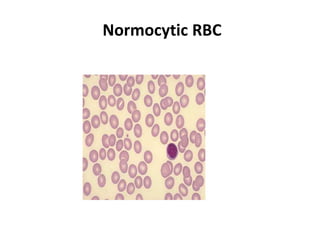
 A Normal red blood cell is about 7.2micrometer
in diameter
A normal red blood cell should be approximately
the same size as a normal lymphocyte nucleus
 When the variation in size is greater than the
normal , this is referred to as Anisocytosis
Normocytic RBC
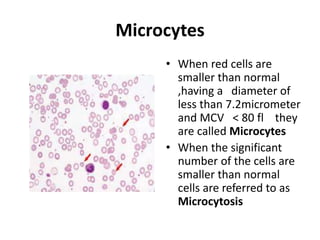
Microcytes
• When red cells are
smaller than normal
,having a diameter of
less than 7.2micrometer
and MCV < 80 fl they
are called Microcytes
• When the significant
number of the cells are
smaller than normal
cells are referred to as
Microcytosis
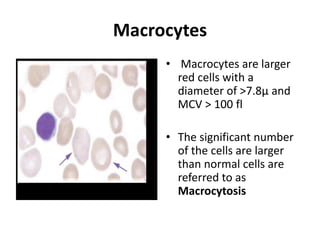
Macrocytes
• Macrocytes are larger
red cells with a
diameter of >7.8µ and
MCV > 100 fl
• The significant number
of the cells are larger
than normal cells are
referred to as
Macrocytosis
..
b) SHAPE
Normal red cells are biconcave discs and
appear circular on a smear
When the variation in shape is greater than
the normal this is referred to as
Poikilocytosis
POIKILOCYTOSIS
 They larger variety of specific abnormal shapes
are present including
• OVALOCYTES OR ELLIPTOCYTES
• PENCIL SHAPED CELLS
• SPHEROCYTES
• TARGET CELLS OR LEPTOCYTES
• SICKLE CELLS
• SCHISTOCYTES
• CRENATED CELLS
• ACANTHOCYTES
• BURR CELLS
• STOMATOCYTES etc
ACANTHOCYTES
• Irregularly spiculated
• Hypochromic RBCs
CONDITIONS:
-Alcoholic liver disease
-Lipoprotineamia
-Post splenectomy
-pyruvate kinase
deficiency
TARGET CELLS OR LEPTOCYTES
• Hb is redistributed
• Center and periphery of
the cell appear
haemoglobinised.
CONDITIONS:
-Thalassemia
-Obstructive liver disease
DACROCYTE(TEAR DROP CELL
• Cells with single
elongated or pointed
extremity
• Shaped like a tear drop
CONDITIONS :
-Myelofibrosis
-Severe haemolytic
anaemia
SICKLE CELLS
• Thin,elongated,slightly
curved red cells
• Sickle shaped
• No central pallor area
CONDITIONS:
-Sickle cell disorders
ECHINOCYTES(CRENATED CELL)
• Crenation is the shrinkage
of red cells through loss of
water in a hypertonic
medium.
• Cell membrane appear
wrinkled.
CONDITIONS:
-As an artifact due to slow
drying of smear.
-Seen in smears made several
hours later after collection
-Uremia
BURR CELLS
• Numerous , uniform
sized and irregularly
spaced red cell
projections.
CONDITIONS:
-Uremia
-Chronic liver disease
-pyruvate kinase
deficiency
ELLIPTOCYTES(OVALOCYTES)
• Elongated or oval cells
CONDITIONS:
-Hereditary elliptocytosis
-Thalassemia
-Iron deficiency
SPHEROCYTES
 Spherical red cells
 Lack of central pallor area
2types
 Macrosperocytes
 Microspherocytes
CONDITIONS :
 -Hereditary spherocytosis
 -Auto immune haemolytic
anaemia
STOMATOCYTE
• Central pallor area
appear like a slit.
CONDITIONS:
-Hereditary
stomatocytosis
-Obstructive liver diseases
SCHISTOCYTE(fragmented cell)
• Irregular shaped
triangular spiculated
cells due to
fragmentation.
CONDITIONS:
-DIC
-Hemolytic anemia
KERATOCYTE(Helmet cell)
• Have 1 or 2 projections
which may vary in
length.
CONDITIONS:
-Hemolytic anemia
-Intravascular coagulation
-Iron deficiency anemia
RED CELL INCLUSIONS
Red cell cytoplasm may contain various
inclusions which pick up some stain and visible
Basophilic stippling
Howell –jolly bodies
Cabot rings
 Pappenheimer bodies
Cabot rings
 Pale staining rings or
figures of eight in the RBC
 These are probably
artifacts resulting from
damage to lipoprotein of
the stroma of red cells
 Seen in Haemolytic
anaemia,megaloblastic
anaemia,leukaemia and
after splenctomy
Basophilic stippling
 RBCs show presence of
numerous basophilic
granules distributed through
the cell cytoplasm
 These inclusions are
precipitated ribosomal RNA
 This is found in metal
poisoning
 megaloblastic anemia
 Hemolytic anemia
 thalassemia
Howell –jolly bodies
 Small round densely
stained dark blue
particles 1µm in
diameter in the
periphery of red cells
 These are remnants of
nucleus (aggregates of
chromatin material
)Feuglen positive for
DNA
Pappenheimer bodies
 These are aggregates of
ferritin and are located
close to cell membrane .
 During erythropoesis
when hemoglobin
synthesis is not complete
some iron granules are
left behind in the red cell
forming siderotic
granules or Pappen -
heimer bodies
Pappenheimer bodies
• With Romanowsky stain
these appear pale blue
but easily demonstrable
with Perl’s stain.such
red cells with
Pappenheimer bodies
are called siderocytes
• Sideroblastic aneamias
• Megaloblastic anaemia
• Hemolytic anaemia
• Post splenectomy
COLOUR
 When RBC are stained with one of the Romanowsky
stains,they take up pink colour Because of the biconcave
shape the stain darker at the periphery and lighter at the
centre (ie, area of the central pallor)
NORMOCHROMIC RBC
 When RBC show this
typical staining ,they are
said to be
Normochromic
 area of central pallor
which may be up to a
third of the diameter of
the cell
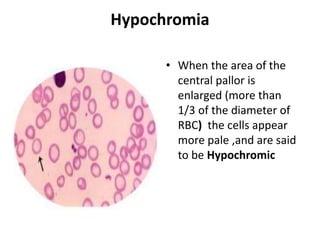
Hypochromia
• When the area of the
central pallor is
enlarged (more than
1/3 of the diameter of
RBC) the cells appear
more pale ,and are said
to be Hypochromic
Polychromasia
 Cells may appear a little
bluish colour amidst the red
cells of the haemoglobin, so
they appear a little purplish
or greish , known as
Polychromotophilic
 This staining is found in
young erythrocytes ,just
after their release from
bone marrow,when they
still contain RNA in the
cytoplasm .RNA picks b lue
colour ,reticulocytes
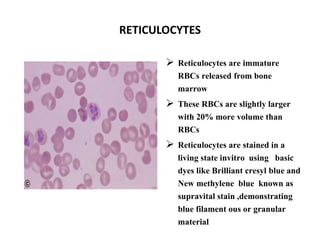
RETICULOCYTES
 Reticulocytes are immature
RBCs released from bone
marrow
 These RBCs are slightly larger
with 20% more volume than
RBCs
 Reticulocytes are stained in a
living state invitro using basic
dyes like Brilliant cresyl blue and
New methylene blue known as
supravital stain ,demonstrating
blue filament ous or granular
material
Morphology of WBC
 Leukocytes or white blood cells are another formed
elements of blood .There is usually 1 WBC for every 500 RBC
present .
WBCs are divided into two types
Granulocyte : cytoplasm contain granules
Agranulocyte : No granules in the cytoplasm
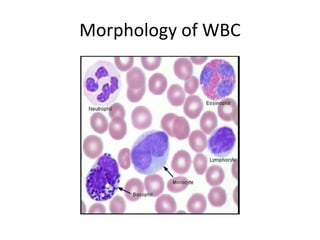
 There are three types of granulocyte named according to
their staining characteristics in blood films. They are
neutrophils,eosinophils and basophils.
Mononuclear cells are divided into lymphocytes and
monocytes.
Morphology of WBC
NEUTROPHIL
 Diameter: 12-16µm
 pink/orange cytoplasm
with fine granulation
 Nucleus: dark purple
blue
 dense heterogeneous
chromatin
 2-5 lobes
EOSINOPHIL
 Diameter: 14-16µm
 Cytoplasm : full of
granules
 Granules: large
retractile orange-red
 Nucleus: blue dense
chromatin
 Normally 2 lobes
BASOPHIL
• Diameter: 14-16µm
• Cytoplasm: pink
• Granules: dark blue –
black obscure nucleus
• Nucleus: blue
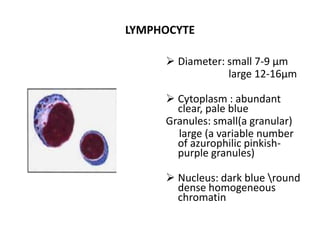
LYMPHOCYTE
 Diameter: small 7-9 µm
large 12-16µm
 Cytoplasm : abundant
clear, pale blue
Granules: small(a granular)
large (a variable number
of azurophilic pinkish-
purple granules)
 Nucleus: dark blue round
dense homogeneous
chromatin
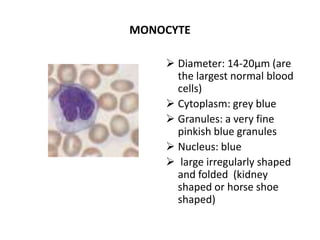
MONOCYTE
 Diameter: 14-20µm (are
the largest normal blood
cells)
 Cytoplasm: grey blue
 Granules: a very fine
pinkish blue granules
 Nucleus: blue
 large irregularly shaped
and folded (kidney
shaped or horse shoe
shaped)
…
TC 4,000-11,000 cells/cu mm
Neutrophil = 40-75%
Lymphocyte = 20-40%
DC Eosinophil = 1-6%
Basophil = 0-1%
Monocyte = 2-10%
Variations in the WBC count
Total WBC count
 Increase in Total WBC count > 11,000 /µl is known as
Leukocytosis
 Decrease in Total WBC count < 4,000 / µl is known
as Leukocytopoenia
CORRECTION FOR NUCLEATED RBCs
 10 or > NRBCs - Make correction
uncorrected WBC count X 100
number of nRBC’s per 100 WBC’s + 100
Variations in Neutrophils
 Neutrophila ;- Increase in the percentage of
neutrophils in the differential count .it may be
 Relative Neutrophila ;-the total count is lowered by
decreased numbers of lymphocytes
 Absolute Neutrophila;- the total number as well as
the percentage of neutrophils
 Neutropoenia ;- Decrease in the percentage of
neutrophils in the differential count
Variations in lymphocytes
 Lymphocytosis
 Relative Lymphocytosis ; Absolute number of lymphocytes
in blood may not be increased ,but due to a decrease in the
number of other cells esp. Neutrophils ,the percentage of
lymphocytes in the DC is increased
 Absolute Lymphocytosis ; an actual increase in the total
number of lymphocytes in the blood as well as the percentage
of lymphocytes in the DC is increased
 Lymphopoenia ; Decrease in the percentage of lymphocytes
in the differential count
Variations other white blood cells
 Monocytosis
 Eosinophilia
 Basophilia
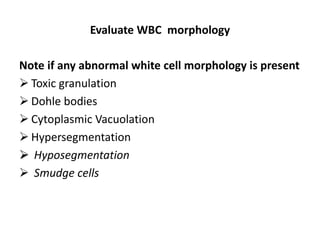
Evaluate WBC morphology
Note if any abnormal white cell morphology is present
 Toxic granulation
 Dohle bodies
 Cytoplasmic Vacuolation
 Hypersegmentation
 Hyposegmentation
 Smudge cells
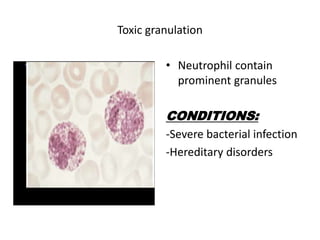
Toxic granulation
• Neutrophil contain
prominent granules
CONDITIONS:
-Severe bacterial infection
-Hereditary disorders
Dohle bodies
• Presence of small round
or oval light blue
stained bodies in the
periphery of the
neutrophilic cytoplasm.
CONDITIONS:
-Severe infections
-Burns
-Exposure to toxic agents
Cytoplasmic Vacuolation
• Occurrence of vacuoles in
the cytoplasm and
nucleus,due to the
reactive changes seen in
infections
CONDITIONS:
-Severe infections
-Burns
-Chemical poisoning
-Malignancy
Hyper segmentation
• More than 4 lobes in
neutrophils.
CONDITIONS:
-May due to inherited
disorders
-macrocytic anemia
Hypo segmentation
• Failure of normal lobe
development(<3 lobes).
CONDITIONS:
-Acute myelocytic
leukemia
-Severe infections
-Toxic states
-Hereditary disorders
LEFT SHIFT
SMUDGE CELLS
• Degenerated
lymphocytes with out
cell wall.
CONDITIONS:
-Presence of few-> faulty
technique
-Large amount-> chronic
lymphocytic leukemia
PLATELETS
 Examine blood smear for thrombocytopenia –
confirm counts, cause
 Platelet count – – about 10 – 20 per oil
 immersion field or number of platelets in 10 oil.imm.
fields X 15,000
 select area where RBCs barely touch
 Falsely low platelet ct – small clots, Platelet
aggregates
 platelet satellitism, abnormally large platelets
PLATELETS
 Blood smear for high platelet counts – confirm
counts, cause
 Spurious thrombocytosis – red cell fragments,
fragments of leukaemic cells, fungi, bacteria
 NORMAL PLATELETS: 1.5 – 4 lakhs/ cu mm
. ABNORMALITIES OF PLATELET
• GIANT PLATELET
• Larger plateles upto 7
micrometers in size
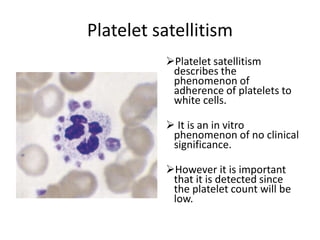
Platelet satellitism
Platelet satellitism
describes the
phenomenon of
adherence of platelets to
white cells.
 It is an in vitro
phenomenon of no clinical
significance.
However it is important
that it is detected since
the platelet count will be
low.
Platelet aggregates
• Platelet aggregates may
becomposed of
apparently intact
platelets, degranulated
pale grey platelets or a
mixture of both, as in
this example. If the
platelet count is low it is
essential to examine the
blood film carefully for
platelet aggregates.
HAEMOPARASITES
Examine carefully for the presence of of any
haemoparasite
 Malaria
 Microfilaria
 Trypanosoma
 LD bodies in monocytes
 Borrelia in relapsing fever
 Leptospira inWeils disease
HAEMOPARASITES
Malarial Parasite Microfilaria
..
Trypanosoma LD bodies in monocytes
..
Borrelia in relapsing fever
.
REPORTING FORMAT
Normal blood picture
• RBC: Normocytic and Normochromic
• WBC: Count and distribution within normal
limits
• Platelets : seen adequate
• Haemoparasite: Not seen
• Impressioin: Normocytic Normochromic blood
picture.
References
CMC manual
 A Practical manual -clinical Pathology, Sabitri
Sanyal & AparnaBhattacharyya 2 Edition
Clinical Pathology; Thejendra singh
Dacie and Lewis: PRACTICAL HAEMATOLOGY
..

Peripheral smear

  • 1.
  • 2.
    PERIPHERAL SMEAR The roleExamination of a well-made peripheral blood smear is a) Estimate approximately the numbers of each of the three cellular elements Red blood cells White blood cells Platelets b)Study the morphology of these c)See blood parasites
  • 3.
    RED CELL MORPHOLOGY a)SIZE  A Normal red blood cell is about 7.2micrometer in diameter A normal red blood cell should be approximately the same size as a normal lymphocyte nucleus  When the variation in size is greater than the normal , this is referred to as Anisocytosis
  • 4.
  • 5.
    Microcytes • When redcells are smaller than normal ,having a diameter of less than 7.2micrometer and MCV < 80 fl they are called Microcytes • When the significant number of the cells are smaller than normal cells are referred to as Microcytosis
  • 6.
    Macrocytes • Macrocytes arelarger red cells with a diameter of >7.8µ and MCV > 100 fl • The significant number of the cells are larger than normal cells are referred to as Macrocytosis
  • 7.
    .. b) SHAPE Normal redcells are biconcave discs and appear circular on a smear When the variation in shape is greater than the normal this is referred to as Poikilocytosis
  • 8.
    POIKILOCYTOSIS  They largervariety of specific abnormal shapes are present including • OVALOCYTES OR ELLIPTOCYTES • PENCIL SHAPED CELLS • SPHEROCYTES • TARGET CELLS OR LEPTOCYTES • SICKLE CELLS • SCHISTOCYTES • CRENATED CELLS • ACANTHOCYTES • BURR CELLS • STOMATOCYTES etc
  • 9.
    ACANTHOCYTES • Irregularly spiculated •Hypochromic RBCs CONDITIONS: -Alcoholic liver disease -Lipoprotineamia -Post splenectomy -pyruvate kinase deficiency
  • 10.
    TARGET CELLS ORLEPTOCYTES • Hb is redistributed • Center and periphery of the cell appear haemoglobinised. CONDITIONS: -Thalassemia -Obstructive liver disease
  • 11.
    DACROCYTE(TEAR DROP CELL •Cells with single elongated or pointed extremity • Shaped like a tear drop CONDITIONS : -Myelofibrosis -Severe haemolytic anaemia
  • 12.
    SICKLE CELLS • Thin,elongated,slightly curvedred cells • Sickle shaped • No central pallor area CONDITIONS: -Sickle cell disorders
  • 13.
    ECHINOCYTES(CRENATED CELL) • Crenationis the shrinkage of red cells through loss of water in a hypertonic medium. • Cell membrane appear wrinkled. CONDITIONS: -As an artifact due to slow drying of smear. -Seen in smears made several hours later after collection -Uremia
  • 14.
    BURR CELLS • Numerous, uniform sized and irregularly spaced red cell projections. CONDITIONS: -Uremia -Chronic liver disease -pyruvate kinase deficiency
  • 15.
    ELLIPTOCYTES(OVALOCYTES) • Elongated oroval cells CONDITIONS: -Hereditary elliptocytosis -Thalassemia -Iron deficiency
  • 16.
    SPHEROCYTES  Spherical redcells  Lack of central pallor area 2types  Macrosperocytes  Microspherocytes CONDITIONS :  -Hereditary spherocytosis  -Auto immune haemolytic anaemia
  • 17.
    STOMATOCYTE • Central pallorarea appear like a slit. CONDITIONS: -Hereditary stomatocytosis -Obstructive liver diseases
  • 18.
    SCHISTOCYTE(fragmented cell) • Irregularshaped triangular spiculated cells due to fragmentation. CONDITIONS: -DIC -Hemolytic anemia
  • 19.
    KERATOCYTE(Helmet cell) • Have1 or 2 projections which may vary in length. CONDITIONS: -Hemolytic anemia -Intravascular coagulation -Iron deficiency anemia
  • 20.
    RED CELL INCLUSIONS Redcell cytoplasm may contain various inclusions which pick up some stain and visible Basophilic stippling Howell –jolly bodies Cabot rings  Pappenheimer bodies
  • 21.
    Cabot rings  Palestaining rings or figures of eight in the RBC  These are probably artifacts resulting from damage to lipoprotein of the stroma of red cells  Seen in Haemolytic anaemia,megaloblastic anaemia,leukaemia and after splenctomy
  • 22.
    Basophilic stippling  RBCsshow presence of numerous basophilic granules distributed through the cell cytoplasm  These inclusions are precipitated ribosomal RNA  This is found in metal poisoning  megaloblastic anemia  Hemolytic anemia  thalassemia
  • 23.
    Howell –jolly bodies Small round densely stained dark blue particles 1µm in diameter in the periphery of red cells  These are remnants of nucleus (aggregates of chromatin material )Feuglen positive for DNA
  • 24.
    Pappenheimer bodies  Theseare aggregates of ferritin and are located close to cell membrane .  During erythropoesis when hemoglobin synthesis is not complete some iron granules are left behind in the red cell forming siderotic granules or Pappen - heimer bodies
  • 25.
    Pappenheimer bodies • WithRomanowsky stain these appear pale blue but easily demonstrable with Perl’s stain.such red cells with Pappenheimer bodies are called siderocytes • Sideroblastic aneamias • Megaloblastic anaemia • Hemolytic anaemia • Post splenectomy
  • 26.
    COLOUR  When RBCare stained with one of the Romanowsky stains,they take up pink colour Because of the biconcave shape the stain darker at the periphery and lighter at the centre (ie, area of the central pallor)
  • 27.
    NORMOCHROMIC RBC  WhenRBC show this typical staining ,they are said to be Normochromic  area of central pallor which may be up to a third of the diameter of the cell
  • 28.
    Hypochromia • When thearea of the central pallor is enlarged (more than 1/3 of the diameter of RBC) the cells appear more pale ,and are said to be Hypochromic
  • 29.
    Polychromasia  Cells mayappear a little bluish colour amidst the red cells of the haemoglobin, so they appear a little purplish or greish , known as Polychromotophilic  This staining is found in young erythrocytes ,just after their release from bone marrow,when they still contain RNA in the cytoplasm .RNA picks b lue colour ,reticulocytes
  • 30.
    RETICULOCYTES  Reticulocytes areimmature RBCs released from bone marrow  These RBCs are slightly larger with 20% more volume than RBCs  Reticulocytes are stained in a living state invitro using basic dyes like Brilliant cresyl blue and New methylene blue known as supravital stain ,demonstrating blue filament ous or granular material
  • 31.
    Morphology of WBC Leukocytes or white blood cells are another formed elements of blood .There is usually 1 WBC for every 500 RBC present . WBCs are divided into two types Granulocyte : cytoplasm contain granules Agranulocyte : No granules in the cytoplasm  There are three types of granulocyte named according to their staining characteristics in blood films. They are neutrophils,eosinophils and basophils. Mononuclear cells are divided into lymphocytes and monocytes.
  • 32.
  • 33.
    NEUTROPHIL  Diameter: 12-16µm pink/orange cytoplasm with fine granulation  Nucleus: dark purple blue  dense heterogeneous chromatin  2-5 lobes
  • 34.
    EOSINOPHIL  Diameter: 14-16µm Cytoplasm : full of granules  Granules: large retractile orange-red  Nucleus: blue dense chromatin  Normally 2 lobes
  • 35.
    BASOPHIL • Diameter: 14-16µm •Cytoplasm: pink • Granules: dark blue – black obscure nucleus • Nucleus: blue
  • 36.
    LYMPHOCYTE  Diameter: small7-9 µm large 12-16µm  Cytoplasm : abundant clear, pale blue Granules: small(a granular) large (a variable number of azurophilic pinkish- purple granules)  Nucleus: dark blue round dense homogeneous chromatin
  • 37.
    MONOCYTE  Diameter: 14-20µm(are the largest normal blood cells)  Cytoplasm: grey blue  Granules: a very fine pinkish blue granules  Nucleus: blue  large irregularly shaped and folded (kidney shaped or horse shoe shaped)
  • 38.
    … TC 4,000-11,000 cells/cumm Neutrophil = 40-75% Lymphocyte = 20-40% DC Eosinophil = 1-6% Basophil = 0-1% Monocyte = 2-10%
  • 39.
    Variations in theWBC count Total WBC count  Increase in Total WBC count > 11,000 /µl is known as Leukocytosis  Decrease in Total WBC count < 4,000 / µl is known as Leukocytopoenia CORRECTION FOR NUCLEATED RBCs  10 or > NRBCs - Make correction uncorrected WBC count X 100 number of nRBC’s per 100 WBC’s + 100
  • 40.
    Variations in Neutrophils Neutrophila ;- Increase in the percentage of neutrophils in the differential count .it may be  Relative Neutrophila ;-the total count is lowered by decreased numbers of lymphocytes  Absolute Neutrophila;- the total number as well as the percentage of neutrophils  Neutropoenia ;- Decrease in the percentage of neutrophils in the differential count
  • 41.
    Variations in lymphocytes Lymphocytosis  Relative Lymphocytosis ; Absolute number of lymphocytes in blood may not be increased ,but due to a decrease in the number of other cells esp. Neutrophils ,the percentage of lymphocytes in the DC is increased  Absolute Lymphocytosis ; an actual increase in the total number of lymphocytes in the blood as well as the percentage of lymphocytes in the DC is increased  Lymphopoenia ; Decrease in the percentage of lymphocytes in the differential count
  • 42.
    Variations other whiteblood cells  Monocytosis  Eosinophilia  Basophilia
  • 43.
    Evaluate WBC morphology Noteif any abnormal white cell morphology is present  Toxic granulation  Dohle bodies  Cytoplasmic Vacuolation  Hypersegmentation  Hyposegmentation  Smudge cells
  • 44.
    Toxic granulation • Neutrophilcontain prominent granules CONDITIONS: -Severe bacterial infection -Hereditary disorders
  • 45.
    Dohle bodies • Presenceof small round or oval light blue stained bodies in the periphery of the neutrophilic cytoplasm. CONDITIONS: -Severe infections -Burns -Exposure to toxic agents
  • 46.
    Cytoplasmic Vacuolation • Occurrenceof vacuoles in the cytoplasm and nucleus,due to the reactive changes seen in infections CONDITIONS: -Severe infections -Burns -Chemical poisoning -Malignancy
  • 47.
    Hyper segmentation • Morethan 4 lobes in neutrophils. CONDITIONS: -May due to inherited disorders -macrocytic anemia
  • 48.
    Hypo segmentation • Failureof normal lobe development(<3 lobes). CONDITIONS: -Acute myelocytic leukemia -Severe infections -Toxic states -Hereditary disorders
  • 49.
  • 50.
    SMUDGE CELLS • Degenerated lymphocyteswith out cell wall. CONDITIONS: -Presence of few-> faulty technique -Large amount-> chronic lymphocytic leukemia
  • 51.
    PLATELETS  Examine bloodsmear for thrombocytopenia – confirm counts, cause  Platelet count – – about 10 – 20 per oil  immersion field or number of platelets in 10 oil.imm. fields X 15,000  select area where RBCs barely touch  Falsely low platelet ct – small clots, Platelet aggregates  platelet satellitism, abnormally large platelets
  • 52.
    PLATELETS  Blood smearfor high platelet counts – confirm counts, cause  Spurious thrombocytosis – red cell fragments, fragments of leukaemic cells, fungi, bacteria  NORMAL PLATELETS: 1.5 – 4 lakhs/ cu mm
  • 53.
    . ABNORMALITIES OFPLATELET • GIANT PLATELET • Larger plateles upto 7 micrometers in size
  • 54.
    Platelet satellitism Platelet satellitism describesthe phenomenon of adherence of platelets to white cells.  It is an in vitro phenomenon of no clinical significance. However it is important that it is detected since the platelet count will be low.
  • 55.
    Platelet aggregates • Plateletaggregates may becomposed of apparently intact platelets, degranulated pale grey platelets or a mixture of both, as in this example. If the platelet count is low it is essential to examine the blood film carefully for platelet aggregates.
  • 56.
    HAEMOPARASITES Examine carefully forthe presence of of any haemoparasite  Malaria  Microfilaria  Trypanosoma  LD bodies in monocytes  Borrelia in relapsing fever  Leptospira inWeils disease
  • 57.
  • 58.
  • 59.
  • 60.
    REPORTING FORMAT Normal bloodpicture • RBC: Normocytic and Normochromic • WBC: Count and distribution within normal limits • Platelets : seen adequate • Haemoparasite: Not seen • Impressioin: Normocytic Normochromic blood picture.
  • 61.
    References CMC manual  APractical manual -clinical Pathology, Sabitri Sanyal & AparnaBhattacharyya 2 Edition Clinical Pathology; Thejendra singh Dacie and Lewis: PRACTICAL HAEMATOLOGY
  • 62.