

Antigen-Antibody Reaction
             BSMT- 4C
             Group 10
            Bacalla, faith
        David, Trisha Kamille
          Pingul, Anabelle
            Sotto, Jonell
Procedure
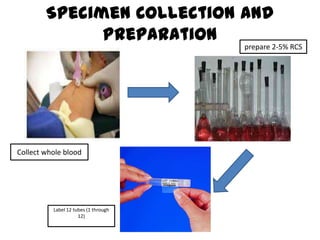
Specimen Collection and
              Preparation
                                      prepare 2-5% RCS


Collect whole blood


          Label 12 tubes (1 through
                     12)
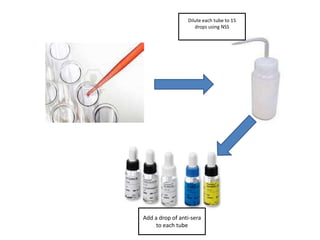
Dilute each tube to 15
                    drops using NSS


Add a drop of anti-sera
     to each tube
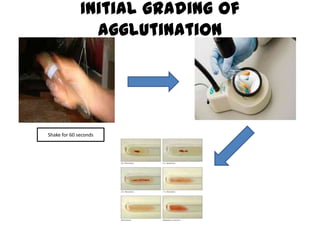
Initial grading of
                agglutination


Shake for 60 seconds
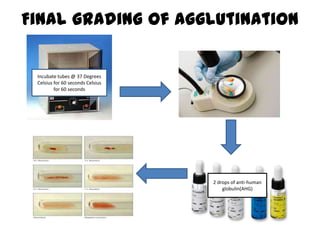
Final grading of agglutination

 Incubate tubes @ 37 Degrees
 Celsius for 60 seconds Celsius
         for 60 seconds


                                  2 drops of anti-human
                                      globulin(AHG)
Question for Research
Differentiate naturally occurring
  antibodies from immune antibodies.

Natural Antibodies                         Natural antibodies
• RBC antibodies found in the serum of     • RBC antibodies are considered
   individuals never been previously
   exposed to RBC antigens by                 immune when found in the serum of
   transfusion, injection, or pregnancy.      individuals who have been
• Produced in response to substances          transfused or pregnant.
   in the environment that are highly      • Not generally found in nature
   similar to RBC antigen such as pollen
   grains and parts of bacteria            • Molecular makeup is unique to
   membranes.                                 human RBCs.
• Found in nature                          • IgG antibodies that react best at 37˚C
• Have a repetitive complex pattern.
                                           • Require the use of antihuman
• IgM cold agglutinins, which reacts
   best at room temperature or lower,         globulin sera (Coombs sera) for
   activate complement, and when              detection.
   active at 37˚C maybe hemolytic.         • React with the Rh, Kell, Duffy, Kidd,
• Antigens of the ABH, Hh, Ii, Lewis,         and Ss blood groups systems.
   MN, and P blood group systems
What is zeta potential? Discuss it’s
     effect in the blood banking test
                  results
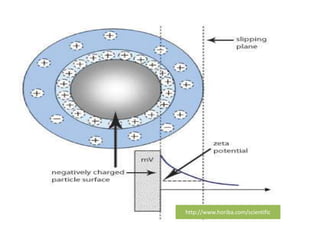
ZETA POTENTIAL

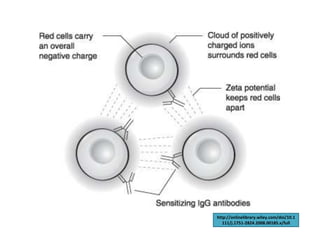
•   A potential is created because of the ionic cloud of cations (positively charged ions) that are
    attracted to the zone of negative charges on the RBC membrane.
•   The potential around the RBC is called the zeta potential.
•   The difference in electrostatic potential between the net charge at the cell membrane and
    the charge at the surface of the shear.
•    Zeta potential is the difference in charge density between the inner and outer layers of the
    ionic cloud that surrounds red blood cells in an electrolyte solution.
•   Its the electron cloud that surrounds the RBC and with it there would be less sentization and
    resulting to no subsequent agglutination.
•   IgM and IgG antibodies have differences in how they react to the same zeta potential.
    Reducing the zeta potential allows the more positively charged antibodies to get closer to the
    negatively charged RBCs
•   Increases RBC agglutination by IgG molecules.
http://www.horiba.com/scientific
http://onlinelibrary.wiley.com/doi/10.1
   111/j.1751-2824.2008.00185.x/full
What is zone phenomenon? How does it
  affect blood banking tests? How do we
               remedy this?
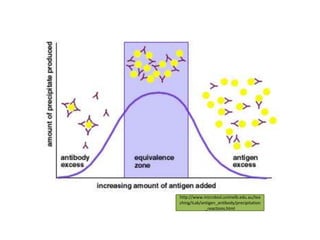
Prozone phenomenon
• An excessive amount of antibody in
  serum, relative to the constant antigen in the
  testing well. In the presence of excessive
  antibody, cross-linking of antigen is not
  observed because there are so many
  antibodies that each antigen molecule can
  bind to a single antibody, such that cross-
  linking and lattice formation do not occur.
What is zone phenomenon? How does it
  affect blood banking tests? How do we
               remedy this?

Postzone phenomenon,
• Excessive antigen in serum.
• Serum that are very dilute show little or no
  agglutination because there are insufficient
  antibodies for cross-linking to occur.
What is zone phenomenon? How does it
  affect blood banking tests? How do we
               remedy this?
Zone of equivalence
• Optimum precipitation occurs because the
  number of multivalent site of antigens and
  antibodies are approximately equal.
• For a precipitation reaction to be detectable, the
  reaction must occur in the zone of equivalence.
• In this zone, each antibody or antigen binds too
  more than one antigen or antibody, respectively,
  forming a stable lattice or network.
What is zone phenomenon? How does it
  affect blood banking tests? How do we
               remedy this?
• This phenomenon can overcome by serial
  diluting of antibody containing serum until
  optimum amounts of antigen and antibody
  are present in the test system.
• To correct the phenomenon , a repeat blood
  specimen be collected a week or more.
• In either situation, the lattice formation and
  subsequent agglutination may not occur,
  which can give false-negative results.
http://www.microbiol.unimelb.edu.au/tea
ching/iLab/antigen_antibody/precipitation
             _reactions.html
What are the stages of an agglutination
reaction? What steps/ techniques will help
           enhance each stage?

Sensitization- the first phase

• Represents the physical attachment of antibody molecules to antigens
  on the erythrocytic membrane.
• In this initial reversible interaction, antibodies combine rapidly with
  antigenic particles.
• The amount of antibody that will react is affected by the equilibrium
  constant, or affinity constant, of the antibody.
• In most cases, the higher the equilibrium constant, the higher the rate
  of association and the slower the rate of dissociation of antibody
  molecules.
• The degree of association of antigen with antibody is affected by a
  variety of factors and can be altered in some cases in vitro by altering
  some of the factors.
Lattice formation-the second phase

• Establishment of cross-links between sensitized
  particles such as erythrocytes and antibodies
• Resulting in aggregation (clumping)
• Much slower process than the sensitization phase
• Depend on the ability of a cell with attached
  antibody on its surface to come close enough to
  another cell to permit the antibody molecules to
  bridge the gap and combine with the antigen
  receptor site on the second cell.
• Cross-linking is influenced by factors such as zeta
  potential.
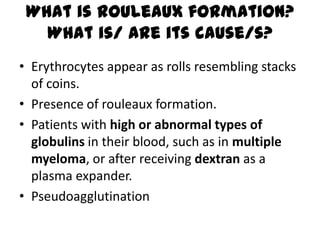
What is Rouleaux formation?
   What is/ are its cause/s?
• Erythrocytes appear as rolls resembling stacks
  of coins.
• Presence of rouleaux formation.
• Patients with high or abnormal types of
  globulins in their blood, such as in multiple
  myeloma, or after receiving dextran as a
  plasma expander.
• Pseudoagglutination
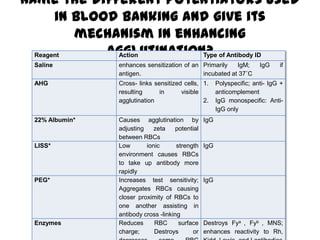
Name the different potentiators used
       in blood banking and give its
          mechanism in enhancing
  Reagent     agglutination? of Antibody ID
               Action      Type
  Saline         enhances sensitization of an Primarily   IgM;          IgG    if
                 antigen.                     incubated at 37˚C
  AHG            Cross- links sensitized cells, 1.      Polyspecific; anti- IgG +
                 resulting      in      visible         anticomplement
                 agglutination                  2.      IgG monospecific: Anti-
                                                        IgG only
  22% Albumin*   Causes agglutination by          IgG
                 adjusting    zeta    potential
                 between RBCs
  LISS*          Low       ionic       strength   IgG
                 environment causes RBCs
                 to take up antibody more
                 rapidly
  PEG*           Increases test sensitivity;      IgG
                 Aggregates RBCs causing
                 closer proximity of RBCs to
                 one another assisting in
                 antibody cross -linking
  Enzymes        Reduces      RBC       surface   Destroys Fya , Fyb , MNS;
                 charge;      Destroys       or   enhances reactivity to Rh,
Reference/s:
Mary Louise Turgeon: Immunology and Serology in
  Laboratory Medicine, 4th Edition 2009.
Denise M. Harmening: Modern Blood Banking and
  Transfusion Practices, 4th Edition 1999.
Denise M. Harmening: Modern Blood Banking and
  transfusion Practices, 5th Edition 2005.
Mary Louise Turgeon: Fundamentals of
  Immunohematology, 2th Edition 1995.

Immunohema

  • 1.
    Antigen-Antibody Reaction BSMT- 4C Group 10 Bacalla, faith David, Trisha Kamille Pingul, Anabelle Sotto, Jonell
  • 2.
  • 3.
    Specimen Collection and Preparation prepare 2-5% RCS Collect whole blood Label 12 tubes (1 through 12)
  • 4.
    Dilute each tubeto 15 drops using NSS Add a drop of anti-sera to each tube
  • 5.
    Initial grading of agglutination Shake for 60 seconds
  • 6.
    Final grading ofagglutination Incubate tubes @ 37 Degrees Celsius for 60 seconds Celsius for 60 seconds 2 drops of anti-human globulin(AHG)
  • 7.
  • 8.
    Differentiate naturally occurring antibodies from immune antibodies. Natural Antibodies Natural antibodies • RBC antibodies found in the serum of • RBC antibodies are considered individuals never been previously exposed to RBC antigens by immune when found in the serum of transfusion, injection, or pregnancy. individuals who have been • Produced in response to substances transfused or pregnant. in the environment that are highly • Not generally found in nature similar to RBC antigen such as pollen grains and parts of bacteria • Molecular makeup is unique to membranes. human RBCs. • Found in nature • IgG antibodies that react best at 37˚C • Have a repetitive complex pattern. • Require the use of antihuman • IgM cold agglutinins, which reacts best at room temperature or lower, globulin sera (Coombs sera) for activate complement, and when detection. active at 37˚C maybe hemolytic. • React with the Rh, Kell, Duffy, Kidd, • Antigens of the ABH, Hh, Ii, Lewis, and Ss blood groups systems. MN, and P blood group systems
  • 9.
    What is zetapotential? Discuss it’s effect in the blood banking test results ZETA POTENTIAL • A potential is created because of the ionic cloud of cations (positively charged ions) that are attracted to the zone of negative charges on the RBC membrane. • The potential around the RBC is called the zeta potential. • The difference in electrostatic potential between the net charge at the cell membrane and the charge at the surface of the shear. • Zeta potential is the difference in charge density between the inner and outer layers of the ionic cloud that surrounds red blood cells in an electrolyte solution. • Its the electron cloud that surrounds the RBC and with it there would be less sentization and resulting to no subsequent agglutination. • IgM and IgG antibodies have differences in how they react to the same zeta potential. Reducing the zeta potential allows the more positively charged antibodies to get closer to the negatively charged RBCs • Increases RBC agglutination by IgG molecules.
  • 10.
  • 11.
    http://onlinelibrary.wiley.com/doi/10.1 111/j.1751-2824.2008.00185.x/full
  • 12.
    What is zonephenomenon? How does it affect blood banking tests? How do we remedy this? Prozone phenomenon • An excessive amount of antibody in serum, relative to the constant antigen in the testing well. In the presence of excessive antibody, cross-linking of antigen is not observed because there are so many antibodies that each antigen molecule can bind to a single antibody, such that cross- linking and lattice formation do not occur.
  • 13.
    What is zonephenomenon? How does it affect blood banking tests? How do we remedy this? Postzone phenomenon, • Excessive antigen in serum. • Serum that are very dilute show little or no agglutination because there are insufficient antibodies for cross-linking to occur.
  • 14.
    What is zonephenomenon? How does it affect blood banking tests? How do we remedy this? Zone of equivalence • Optimum precipitation occurs because the number of multivalent site of antigens and antibodies are approximately equal. • For a precipitation reaction to be detectable, the reaction must occur in the zone of equivalence. • In this zone, each antibody or antigen binds too more than one antigen or antibody, respectively, forming a stable lattice or network.
  • 15.
    What is zonephenomenon? How does it affect blood banking tests? How do we remedy this? • This phenomenon can overcome by serial diluting of antibody containing serum until optimum amounts of antigen and antibody are present in the test system. • To correct the phenomenon , a repeat blood specimen be collected a week or more. • In either situation, the lattice formation and subsequent agglutination may not occur, which can give false-negative results.
  • 16.
  • 17.
    What are thestages of an agglutination reaction? What steps/ techniques will help enhance each stage? Sensitization- the first phase • Represents the physical attachment of antibody molecules to antigens on the erythrocytic membrane. • In this initial reversible interaction, antibodies combine rapidly with antigenic particles. • The amount of antibody that will react is affected by the equilibrium constant, or affinity constant, of the antibody. • In most cases, the higher the equilibrium constant, the higher the rate of association and the slower the rate of dissociation of antibody molecules. • The degree of association of antigen with antibody is affected by a variety of factors and can be altered in some cases in vitro by altering some of the factors.
  • 18.
    Lattice formation-the secondphase • Establishment of cross-links between sensitized particles such as erythrocytes and antibodies • Resulting in aggregation (clumping) • Much slower process than the sensitization phase • Depend on the ability of a cell with attached antibody on its surface to come close enough to another cell to permit the antibody molecules to bridge the gap and combine with the antigen receptor site on the second cell. • Cross-linking is influenced by factors such as zeta potential.
  • 19.
    What is Rouleauxformation? What is/ are its cause/s? • Erythrocytes appear as rolls resembling stacks of coins. • Presence of rouleaux formation. • Patients with high or abnormal types of globulins in their blood, such as in multiple myeloma, or after receiving dextran as a plasma expander. • Pseudoagglutination
  • 20.
    Name the differentpotentiators used in blood banking and give its mechanism in enhancing Reagent agglutination? of Antibody ID Action Type Saline enhances sensitization of an Primarily IgM; IgG if antigen. incubated at 37˚C AHG Cross- links sensitized cells, 1. Polyspecific; anti- IgG + resulting in visible anticomplement agglutination 2. IgG monospecific: Anti- IgG only 22% Albumin* Causes agglutination by IgG adjusting zeta potential between RBCs LISS* Low ionic strength IgG environment causes RBCs to take up antibody more rapidly PEG* Increases test sensitivity; IgG Aggregates RBCs causing closer proximity of RBCs to one another assisting in antibody cross -linking Enzymes Reduces RBC surface Destroys Fya , Fyb , MNS; charge; Destroys or enhances reactivity to Rh,
  • 21.
    Reference/s: Mary Louise Turgeon:Immunology and Serology in Laboratory Medicine, 4th Edition 2009. Denise M. Harmening: Modern Blood Banking and Transfusion Practices, 4th Edition 1999. Denise M. Harmening: Modern Blood Banking and transfusion Practices, 5th Edition 2005. Mary Louise Turgeon: Fundamentals of Immunohematology, 2th Edition 1995.