Reticulocyte count
By dr Abdiasis Omar Mohamed
MBBS
Introduction
• Reticulocytes are juvenile red cells; they contain remnants of
the ribosomal RNA which was present in large amounts in the
cytoplasm of the nucleated precursors from which they were
derived.
• The number of reticulocytes in the peripheral blood is a fairly
accurate reflection of erythropoietic activity assuming that
the reticulocytes are released normally from the bone marrow
and that they remain in the circulation for the normal period
of time.
• The ripening process is thought to take 2-3 days of which
about 24 hours are spent in the circulation.
• When there is an increased erythropoietic stimulus as in
hemolytic anemia there will be premature release of
reticulocytes into the circulation as their transit time in the
bone marrow is reduced, the so-called 'stress' or 'shift'
reticulocytosis.
Principle of reticulocyte count
• The count is based on the property of ribosomal RNA to react
with basic dyes such as new methylene blue or brilliant cresyl
blue to form a blue precipitate of granules or filaments.
• Although reticulocytes are larger than mature red cells and
show diffuse basophilic staining (polychromasia) in
Romanowsky stained films, only supravital staining
techniques enable their number to be determined with
sufficient accuracy.
• Staining
• Solution New methylene blue (1%) or Brilliant cresyl blue
(1%). Better and more reliable results are obtained with new
methylene blue than brilliant cresyl blue as the former stains
the reticulo-filamentous material in the reticulocytes more
deeply and more uniformly than does the latter.
• Method
• Deliver 2-3 drops of the dye solution into 75 X 10mm glass
or plastic tube using a Pasteur pipette.
• Add 2-4 drops the patient’s EDTA anticoagulated blood to the
dye solution and mix.
• Stopper the tube and incubate at 37C for 10-15 minutes.
• The exact volume of blood to be added to the dye solution for
optimal staining depends upon the red cell count.
• A larger proportion of anemic blood and a smaller proportion
polycythemic blood should be added than normal blood.
• After incubation, resuspend the cells by gentle mixing and
make films on glass slides in the usual way.
• When dry, examine the films without fixing staining.
• In a successful preparation, the reticulofilamentous material
should be stained deep blue and the non-reticulated cells
stained diffuse shades of pale greenish blue.
• Counting
• An area of the film should be chosen for the count where the
cells are undistorted and where the staining is good.
• To count the cells, the oil immersion objective and if possible
eye pieces provided with an adjustable diaphragm are used.
• If such eyepieces are not available, a paper or cardboard
diaphragm in the center of which has been cut a small square
with sides about 4mm in length can be inserted into an
eyepiece and used as a substitute.
• The counting procedure should be appropriate to the number
of reticulocytes as estimated on the stained blood film.
• Very large numbers of cells have to be surveyed if a
reasonably accurate count is to be obtained when the
reticulocyte number is small.
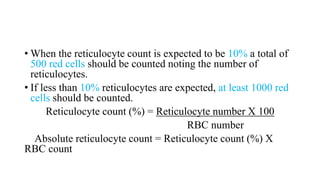
• When the reticulocyte count is expected to be 10% a total of
500 red cells should be counted noting the number of
reticulocytes.
• If less than 10% reticulocytes are expected, at least 1000 red
cells should be counted.
Reticulocyte count (%) = Reticulocyte number X 100
RBC number
Absolute reticulocyte count = Reticulocyte count (%) X
RBC count
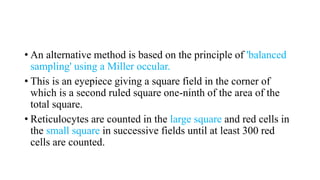
• An alternative method is based on the principle of 'balanced
sampling' using a Miller occular.
• This is an eyepiece giving a square field in the corner of
which is a second ruled square one-ninth of the area of the
total square.
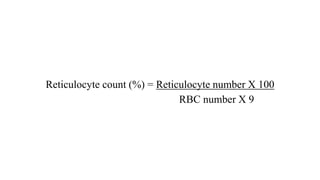
• Reticulocytes are counted in the large square and red cells in
the small square in successive fields until at least 300 red
cells are counted.
Reticulocyte count (%) = Reticulocyte number X 100
RBC number X 9
The Reticulocyte Production Index (RPI)
• In the presence of anemia the reticulocyte percentage does
not accurately reflect reticulocyte production, since each
reticulocyte released is being diluted into fewer adult red
cells.
• A better measure of erythroid production is the reticulocyte
production index (RPI).
• The reticulocyte percentage is first corrected to a normal
hematocrit of 0.45 (l/l).
• For example, a reticulocyte percentage of 10% in a patient
with a hematocrit of 0.23 (l/l) would be equivalent to a
percentage of 5% in a patient with a hematocrit of 0.45% (l/l).
This is equivalent to calculating the absolute reticulocyte
count in terms of red cell number.
• The RPI is an approximate measure of effective red cell
production in the marrow.
• A normal marrow has an index of 1.0.
• In hemolytic anemia with excessive destruction of red cells in
the peripheral blood in a functionally normal marrow, this
index may be 3-7 times higher than normal.
• When there is marrow damage, erythropoietin suppression or
a deficiency of iron, vitamin B12 or folic acid, the index is
less than expected for the degree of anemia, i.e., 2 or less.
• Ineffective erythropoiesis, with intramedullary (marrow)
destruction of erythroid precursors can be deduced if the
marrow contains many normoblasts but the RPI is low
• Sources of error in the reticulocyte count
• Insufficient number of cells counted.
• Confusion of reticulocytes with red cell inclusions like
Pappenheimer bodies and Heinz bodies.
• Interpretation of results
• Reference value 0.5 - 2.5% of total erythrocytes (or 25 - 85 X
109/l)
• Increased numbers: Reticulocytosis
• This means that hyperactive erythropoiesis is occurring as the
bone marrow replaces cells lost or prematurely destroyed.
• Identifying reticulocytosis may lead to the recognition of an
otherwise occult disease such as hidden chronic hemorrhage
or unrecognized hemolysis.
• An increase in the reticulocyte number is seen in the
following conditions:
- Hemolytic anemias (Immune HA, Primary RBC membrane
defects, sickle cell disease, RBC enzyme deficits, exposure to
toxins).
- Following hemorrhage
- Following treatment of anemias
- Physiologic increase in pregnancy and in infants
• Decreased levels
• This means that the bone marrow is not producing enough
erythrocytes.
• A decrease in the reticulocyte number is seen in iron
deficiency anemia, aplastic anemia, radiation therapy,
untreated pernicious anemia, tumor in marrow.
THE END

reticulocyte count.pptx

  • 1.
    Reticulocyte count By drAbdiasis Omar Mohamed MBBS
  • 2.
    Introduction • Reticulocytes arejuvenile red cells; they contain remnants of the ribosomal RNA which was present in large amounts in the cytoplasm of the nucleated precursors from which they were derived. • The number of reticulocytes in the peripheral blood is a fairly accurate reflection of erythropoietic activity assuming that the reticulocytes are released normally from the bone marrow and that they remain in the circulation for the normal period of time.
  • 3.
    • The ripeningprocess is thought to take 2-3 days of which about 24 hours are spent in the circulation. • When there is an increased erythropoietic stimulus as in hemolytic anemia there will be premature release of reticulocytes into the circulation as their transit time in the bone marrow is reduced, the so-called 'stress' or 'shift' reticulocytosis.
  • 4.
    Principle of reticulocytecount • The count is based on the property of ribosomal RNA to react with basic dyes such as new methylene blue or brilliant cresyl blue to form a blue precipitate of granules or filaments. • Although reticulocytes are larger than mature red cells and show diffuse basophilic staining (polychromasia) in Romanowsky stained films, only supravital staining techniques enable their number to be determined with sufficient accuracy.
  • 5.
    • Staining • SolutionNew methylene blue (1%) or Brilliant cresyl blue (1%). Better and more reliable results are obtained with new methylene blue than brilliant cresyl blue as the former stains the reticulo-filamentous material in the reticulocytes more deeply and more uniformly than does the latter.
  • 6.
    • Method • Deliver2-3 drops of the dye solution into 75 X 10mm glass or plastic tube using a Pasteur pipette. • Add 2-4 drops the patient’s EDTA anticoagulated blood to the dye solution and mix. • Stopper the tube and incubate at 37C for 10-15 minutes. • The exact volume of blood to be added to the dye solution for optimal staining depends upon the red cell count.
  • 7.
    • A largerproportion of anemic blood and a smaller proportion polycythemic blood should be added than normal blood. • After incubation, resuspend the cells by gentle mixing and make films on glass slides in the usual way. • When dry, examine the films without fixing staining.
  • 8.
    • In asuccessful preparation, the reticulofilamentous material should be stained deep blue and the non-reticulated cells stained diffuse shades of pale greenish blue.
  • 9.
    • Counting • Anarea of the film should be chosen for the count where the cells are undistorted and where the staining is good. • To count the cells, the oil immersion objective and if possible eye pieces provided with an adjustable diaphragm are used. • If such eyepieces are not available, a paper or cardboard diaphragm in the center of which has been cut a small square with sides about 4mm in length can be inserted into an eyepiece and used as a substitute.
  • 10.
    • The countingprocedure should be appropriate to the number of reticulocytes as estimated on the stained blood film. • Very large numbers of cells have to be surveyed if a reasonably accurate count is to be obtained when the reticulocyte number is small.
  • 11.
    • When thereticulocyte count is expected to be 10% a total of 500 red cells should be counted noting the number of reticulocytes. • If less than 10% reticulocytes are expected, at least 1000 red cells should be counted. Reticulocyte count (%) = Reticulocyte number X 100 RBC number Absolute reticulocyte count = Reticulocyte count (%) X RBC count
  • 12.
    • An alternativemethod is based on the principle of 'balanced sampling' using a Miller occular. • This is an eyepiece giving a square field in the corner of which is a second ruled square one-ninth of the area of the total square. • Reticulocytes are counted in the large square and red cells in the small square in successive fields until at least 300 red cells are counted.
  • 13.
    Reticulocyte count (%)= Reticulocyte number X 100 RBC number X 9
  • 15.
    The Reticulocyte ProductionIndex (RPI) • In the presence of anemia the reticulocyte percentage does not accurately reflect reticulocyte production, since each reticulocyte released is being diluted into fewer adult red cells. • A better measure of erythroid production is the reticulocyte production index (RPI).
  • 16.
    • The reticulocytepercentage is first corrected to a normal hematocrit of 0.45 (l/l). • For example, a reticulocyte percentage of 10% in a patient with a hematocrit of 0.23 (l/l) would be equivalent to a percentage of 5% in a patient with a hematocrit of 0.45% (l/l). This is equivalent to calculating the absolute reticulocyte count in terms of red cell number.
  • 17.
    • The RPIis an approximate measure of effective red cell production in the marrow. • A normal marrow has an index of 1.0. • In hemolytic anemia with excessive destruction of red cells in the peripheral blood in a functionally normal marrow, this index may be 3-7 times higher than normal.
  • 18.
    • When thereis marrow damage, erythropoietin suppression or a deficiency of iron, vitamin B12 or folic acid, the index is less than expected for the degree of anemia, i.e., 2 or less. • Ineffective erythropoiesis, with intramedullary (marrow) destruction of erythroid precursors can be deduced if the marrow contains many normoblasts but the RPI is low
  • 19.
    • Sources oferror in the reticulocyte count • Insufficient number of cells counted. • Confusion of reticulocytes with red cell inclusions like Pappenheimer bodies and Heinz bodies.
  • 20.
    • Interpretation ofresults • Reference value 0.5 - 2.5% of total erythrocytes (or 25 - 85 X 109/l)
  • 21.
    • Increased numbers:Reticulocytosis • This means that hyperactive erythropoiesis is occurring as the bone marrow replaces cells lost or prematurely destroyed. • Identifying reticulocytosis may lead to the recognition of an otherwise occult disease such as hidden chronic hemorrhage or unrecognized hemolysis.
  • 22.
    • An increasein the reticulocyte number is seen in the following conditions: - Hemolytic anemias (Immune HA, Primary RBC membrane defects, sickle cell disease, RBC enzyme deficits, exposure to toxins). - Following hemorrhage - Following treatment of anemias - Physiologic increase in pregnancy and in infants
  • 23.
    • Decreased levels •This means that the bone marrow is not producing enough erythrocytes. • A decrease in the reticulocyte number is seen in iron deficiency anemia, aplastic anemia, radiation therapy, untreated pernicious anemia, tumor in marrow.
  • 24.