RETICULOCYTE COUNT
30/1/2019
OBJECTIVES
• Define reticulocyte.
• Explain the principle of reticulocyte count.
• Describe the procedure of reticulocyte count test.
• Interpret the results of the test.
• Describe quality assurance of the test.
DEFINITION
• Reticulocytes are juvenile/young red blood cells.
They contain remnants of ribosomes and ribonucleic
acids which were present in larger amounts in their
nucleated precursors.
• Because the number of reticulocytes in the
pheripheral blood is a fairly accurate reflection of
erythropoetic activity, a reticulocyte count is one of
the essential procedures diagnostic haematology.
• Ribosomes have the property of reacting with certain
dyes (e.g azure B or New methylene blue) to form a
blue precipitate of granules or filaments.
This reaction will only take a place in supravitally
stained, unfixed preparation.
• The most immature reticulocytes are those with the
largest amount of precipitable ribosomal material,
while the least immature only a few dots or strands
are seen.
PRINCIPLE
• An isotonic solution of supravital stain(one that stain
living material) such as new methylene blue or
brilliant crystal blue is incubated with a few drops of
blood.
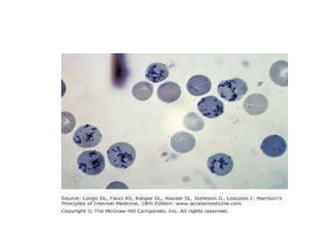
• To detect ribosomal RNA in reticulocytes, the red
cells must be stained while they are still alive(not
fixed). A thin preparation is made and the
reticulocytes counted microscopically. Reticulocytes
are recognized by the violet-blue stained granules.
METHODS OF RETICULOCYTE COUNT
• Staining solution:
• 1.0gm of new methylene blue or Brilliant crestal blue
is dissolved in 100ml of ctitrate-saline solution 1 part
3% tri-sodium citrate to 4 parts 0.85% saline)
• After dissolving the dye, the solution is filtered and is
then ready for use. Store at 2-8˚C.
Staining method
• Deliver two or three drops of stain into a tube, and
add approximately equal volume of patient’s
blood(EDTA blood). If anaemic use a larger
proportion of blood; use a smaller proportion of
blood if blood is polycythaemic.
• Mix and leave in water bath or incubator at 37˚C for
15-20 minutes.
• At the end of this time, resuspend the red cells by
mixing and make a thin film in the usual way.
• Dry the film without counter staining.
• The reticular material should be stained deep blue
and non-reticulated cells shades of pale greenish-
blue.
COUNTING THE RETICULOCYTES
• Choose an area of the field where the cells are
undistorted and the staining is good using X10 objective.
• Using the X100 oil-immersion lens, count the number of
reticulocytes seen per 1000 red cells.
• Counting the red cells can be helped by inserting into the
eye piece a paper or cardboard diaphram in the centre of
which has been cut a small square to reduce the optical
field.
• As long as the red cells are evenly distributed, the red
cells need to be counted only in the small square.
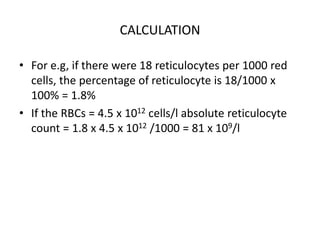
CALCULATION
• For e.g, if there were 18 reticulocytes per 1000 red
cells, the percentage of reticulocyte is 18/1000 x
100% = 1.8%
• If the RBCs = 4.5 x 10¹² cells/l absolute reticulocyte
count = 1.8 x 4.5 x 1012 /1000 = 81 x 109/l
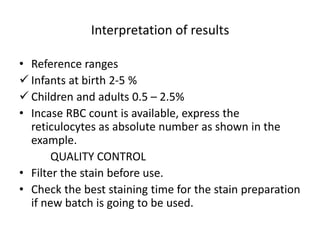
Interpretation of results
• Reference ranges
 Infants at birth 2-5 %
 Children and adults 0.5 – 2.5%
• Incase RBC count is available, express the
reticulocytes as absolute number as shown in the
example.
QUALITY CONTROL
• Filter the stain before use.
• Check the best staining time for the stain preparation
if new batch is going to be used.
• Always use duplicate counts(preferably using a different
person for each count) the two counts should agree within
20% of each other.
INCREASE IN RBC PRODUCTION OCCURS IN
• Haemolytic anaemias(with evidence of erythropoeisis
• Following acute blood loss.
• After iron therapy for iron deficiency anaemia or specific
therapy for megaloblastic anaemia.
• Reticulocytes respond is higher in haemolysis than in
haemorrhage.
•
• Decreased counts are associated with ineffective
Erythropoiesis or decreased production of red cells.
• Qn what is the significant of reticulocyte count test?

RETICULOCYTE_COUNT DAVIDMANYIELAGOK.pptx

  • 1.
  • 2.
    OBJECTIVES • Define reticulocyte. •Explain the principle of reticulocyte count. • Describe the procedure of reticulocyte count test. • Interpret the results of the test. • Describe quality assurance of the test.
  • 3.
    DEFINITION • Reticulocytes arejuvenile/young red blood cells. They contain remnants of ribosomes and ribonucleic acids which were present in larger amounts in their nucleated precursors. • Because the number of reticulocytes in the pheripheral blood is a fairly accurate reflection of erythropoetic activity, a reticulocyte count is one of the essential procedures diagnostic haematology. • Ribosomes have the property of reacting with certain dyes (e.g azure B or New methylene blue) to form a blue precipitate of granules or filaments.
  • 4.
    This reaction willonly take a place in supravitally stained, unfixed preparation. • The most immature reticulocytes are those with the largest amount of precipitable ribosomal material, while the least immature only a few dots or strands are seen.
  • 5.
    PRINCIPLE • An isotonicsolution of supravital stain(one that stain living material) such as new methylene blue or brilliant crystal blue is incubated with a few drops of blood. • To detect ribosomal RNA in reticulocytes, the red cells must be stained while they are still alive(not fixed). A thin preparation is made and the reticulocytes counted microscopically. Reticulocytes are recognized by the violet-blue stained granules.
  • 7.
    METHODS OF RETICULOCYTECOUNT • Staining solution: • 1.0gm of new methylene blue or Brilliant crestal blue is dissolved in 100ml of ctitrate-saline solution 1 part 3% tri-sodium citrate to 4 parts 0.85% saline) • After dissolving the dye, the solution is filtered and is then ready for use. Store at 2-8˚C.
  • 8.
    Staining method • Delivertwo or three drops of stain into a tube, and add approximately equal volume of patient’s blood(EDTA blood). If anaemic use a larger proportion of blood; use a smaller proportion of blood if blood is polycythaemic. • Mix and leave in water bath or incubator at 37˚C for 15-20 minutes. • At the end of this time, resuspend the red cells by mixing and make a thin film in the usual way. • Dry the film without counter staining.
  • 9.
    • The reticularmaterial should be stained deep blue and non-reticulated cells shades of pale greenish- blue.
  • 10.
    COUNTING THE RETICULOCYTES •Choose an area of the field where the cells are undistorted and the staining is good using X10 objective. • Using the X100 oil-immersion lens, count the number of reticulocytes seen per 1000 red cells. • Counting the red cells can be helped by inserting into the eye piece a paper or cardboard diaphram in the centre of which has been cut a small square to reduce the optical field. • As long as the red cells are evenly distributed, the red cells need to be counted only in the small square.
  • 11.
    CALCULATION • For e.g,if there were 18 reticulocytes per 1000 red cells, the percentage of reticulocyte is 18/1000 x 100% = 1.8% • If the RBCs = 4.5 x 10¹² cells/l absolute reticulocyte count = 1.8 x 4.5 x 1012 /1000 = 81 x 109/l
  • 12.
    Interpretation of results •Reference ranges  Infants at birth 2-5 %  Children and adults 0.5 – 2.5% • Incase RBC count is available, express the reticulocytes as absolute number as shown in the example. QUALITY CONTROL • Filter the stain before use. • Check the best staining time for the stain preparation if new batch is going to be used.
  • 13.
    • Always useduplicate counts(preferably using a different person for each count) the two counts should agree within 20% of each other. INCREASE IN RBC PRODUCTION OCCURS IN • Haemolytic anaemias(with evidence of erythropoeisis • Following acute blood loss. • After iron therapy for iron deficiency anaemia or specific therapy for megaloblastic anaemia. • Reticulocytes respond is higher in haemolysis than in haemorrhage. •
  • 14.
    • Decreased countsare associated with ineffective Erythropoiesis or decreased production of red cells. • Qn what is the significant of reticulocyte count test?