System of a cell By: Bradley Brenning Must click threw show
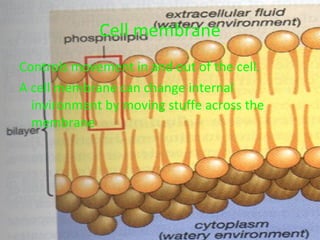
Cell membrane Controls movement in and out of the cell. A cell membrane can change internal invironment by moving stuffe across the membrane
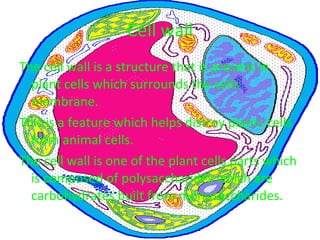
Cell wall The cell wall is a structure that is present in plant cells which surrounds the cells membrane.  This is a feature which helps distroy plants cells from animal cells.  The cell wall is one of the plant cells parts which is composed of polysaccharides which are carbohydrates built from monosaccharides.
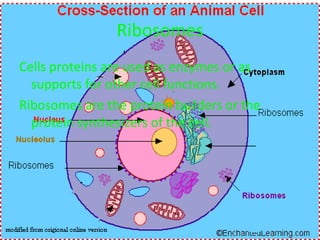
Ribosomes Cells proteins are used as enzymes or as supports for other cell functions.  Ribosomes are the protein builders or the protein synthesizers of the cell.
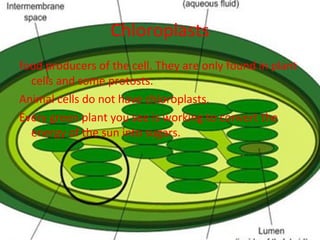
Chloroplasts food producers of the cell. They are only found in plant cells and some protosts.  Animal cells do not have chloroplasts.  Every green plant you see is working to convert the energy of the sun into sugars.
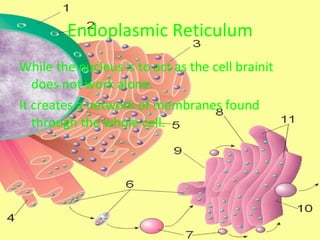
Endoplasmic Reticulum While the nucleus is to act as the cell brainit does not work alone.  It creates a network of membranes found through the whole cell.
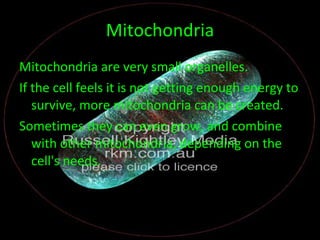
Mitochondria Mitochondria are very small organelles.  If the cell feels it is not getting enough energy to survive, more mitochondria can be created.  Sometimes they can even grow, and combine with other mitochondria, depending on the cell's needs.
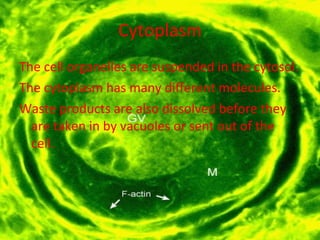
Cytoplasm The cell organelles are suspended in the cytosol.  The cytoplasm has many different molecules.  Waste products are also dissolved before they are taken in by vacuoles or sent out of the cell.
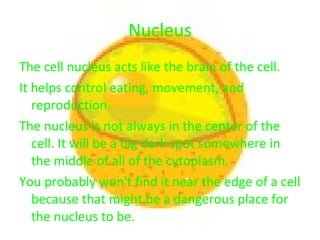
Nucleus The cell nucleus acts like the brain of the cell.  It helps control eating, movement, and reproduction.  The nucleus is not always in the center of the cell. It will be a big dark spot somewhere in the middle of all of the cytoplasm.  You probably won't find it near the edge of a cell because that might be a dangerous place for the nucleus to be.
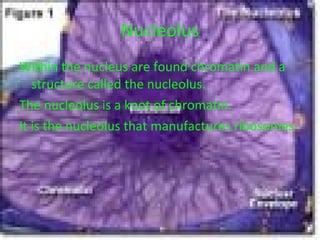
Nucleolus Within the nucleus are found chromatin and a structure called the nucleolus.  The nucleolus is a knot of chromatin.  It is the nucleolus that manufactures ribosomes
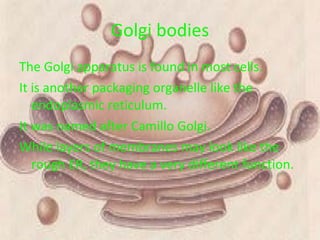
Golgi bodies The Golgi apparatus is found in most cells.  It is another packaging organelle like the endoplasmic reticulum.  It was named after Camillo Golgi.  While layers of membranes may look like the rough ER, they have a very different function.
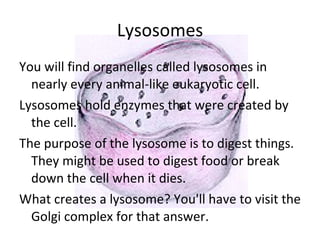
Lysosomes You will find organelles called lysosomes in nearly every animal-like eukaryotic cell.  Lysosomes hold enzymes that were created by the cell.  The purpose of the lysosome is to digest things. They might be used to digest food or break down the cell when it dies.  What creates a lysosome? You'll have to visit the Golgi complex for that answer.
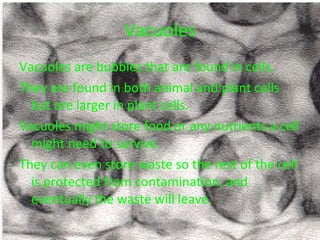
Vacuoles Vacuoles are bubbles that are found in cells.  They are found in both animal and plant cells but are larger in plant cells.  Vacuoles might store food or any nutrients a cell might need to survive.  They can even store waste so the rest of the cell is protected from contamination, and eventually the waste will leave.
Resources &quot;Biology4Kids.com: Cell Structure: Cell Membrane.&quot;  Rader's BIOLOGY 4 KIDS.COM . N.p., n.d. Web. 10 Mar. 2011.  http://www.biology4kids.com/files/cell_membrane.html . &quot;Biology4Kids.com: Cell Structure: Cell Nucleus.&quot;  Rader's BIOLOGY 4 KIDS.COM . N.p., n.d. Web. 14 Mar. 2011. <http://www.biology4kids.com/files/cell_nucleus.html>.  &quot;Biology4Kids.com: Cell Structure: Chloroplasts.&quot;  Rader's BIOLOGY 4 KIDS.COM . N.p., n.d. Web. 14 Mar. 2011. <http://www.biology4kids.com/files/cell_chloroplast.html>.  &quot;Biology4Kids.com: Cell Structure: Cytoplasm.&quot;  Rader's BIOLOGY 4 KIDS.COM . N.p., n.d. Web. 14 Mar. 2011. <http://www.biology4kids.com/files/cell_cytoplasm.html>.  &quot;Biology4Kids.com: Cell Structure: Endoplasmic Reticulum.&quot;  Rader's BIOLOGY 4 KIDS.COM . N.p., n.d. Web. 14 Mar. 2011. <http://www.biology4kids.com/files/cell_er.html>.  &quot;Biology4Kids.com: Cell Structure: Golgi Complex.&quot;  Rader's BIOLOGY 4 KIDS.COM . N.p., n.d. Web. 14 Mar. 2011. <http://www.biology4kids.com/files/cell_golgi.html>.  &quot;Biology4Kids.com: Cell Structure: Lysosomes.&quot;  Rader's BIOLOGY 4 KIDS.COM . N.p., n.d. Web. 14 Mar. 2011. <http://www.biology4kids.com/files/cell_lysosome.html>.  &quot;Biology4Kids.com: Cell Structure: Mitochondria.&quot;  Rader's BIOLOGY 4 KIDS.COM . N.p., n.d. Web. 14 Mar. 2011. <http://www.biology4kids.com/files/cell_mito.html>.  &quot;Biology4Kids.com: Cell Structure: Ribosomes.&quot;  Rader's BIOLOGY 4 KIDS.COM . N.p., n.d. Web. 14 Mar. 2011. <http://www.biology4kids.com/files/cell_ribos.html>.  &quot;Biology4Kids.com: Cell Structure: Vacuoles.&quot;  Rader's BIOLOGY 4 KIDS.COM . N.p., n.d. Web. 14 Mar. 2011. <http://www.biology4kids.com/files/cell_vacuole.html>..

System of a cell

  • 1.
    System of acell By: Bradley Brenning Must click threw show
  • 2.
    Cell membrane Controlsmovement in and out of the cell. A cell membrane can change internal invironment by moving stuffe across the membrane
  • 3.
    Cell wall Thecell wall is a structure that is present in plant cells which surrounds the cells membrane. This is a feature which helps distroy plants cells from animal cells. The cell wall is one of the plant cells parts which is composed of polysaccharides which are carbohydrates built from monosaccharides.
  • 4.
    Ribosomes Cells proteinsare used as enzymes or as supports for other cell functions. Ribosomes are the protein builders or the protein synthesizers of the cell.
  • 5.
    Chloroplasts food producersof the cell. They are only found in plant cells and some protosts. Animal cells do not have chloroplasts. Every green plant you see is working to convert the energy of the sun into sugars.
  • 6.
    Endoplasmic Reticulum Whilethe nucleus is to act as the cell brainit does not work alone. It creates a network of membranes found through the whole cell.
  • 7.
    Mitochondria Mitochondria arevery small organelles. If the cell feels it is not getting enough energy to survive, more mitochondria can be created. Sometimes they can even grow, and combine with other mitochondria, depending on the cell's needs.
  • 8.
    Cytoplasm The cellorganelles are suspended in the cytosol. The cytoplasm has many different molecules. Waste products are also dissolved before they are taken in by vacuoles or sent out of the cell.
  • 9.
    Nucleus The cellnucleus acts like the brain of the cell. It helps control eating, movement, and reproduction. The nucleus is not always in the center of the cell. It will be a big dark spot somewhere in the middle of all of the cytoplasm. You probably won't find it near the edge of a cell because that might be a dangerous place for the nucleus to be.
  • 10.
    Nucleolus Within thenucleus are found chromatin and a structure called the nucleolus. The nucleolus is a knot of chromatin. It is the nucleolus that manufactures ribosomes
  • 11.
    Golgi bodies TheGolgi apparatus is found in most cells. It is another packaging organelle like the endoplasmic reticulum. It was named after Camillo Golgi. While layers of membranes may look like the rough ER, they have a very different function.
  • 12.
    Lysosomes You willfind organelles called lysosomes in nearly every animal-like eukaryotic cell. Lysosomes hold enzymes that were created by the cell. The purpose of the lysosome is to digest things. They might be used to digest food or break down the cell when it dies. What creates a lysosome? You'll have to visit the Golgi complex for that answer.
  • 13.
    Vacuoles Vacuoles arebubbles that are found in cells. They are found in both animal and plant cells but are larger in plant cells. Vacuoles might store food or any nutrients a cell might need to survive. They can even store waste so the rest of the cell is protected from contamination, and eventually the waste will leave.
  • 14.
    Resources &quot;Biology4Kids.com: CellStructure: Cell Membrane.&quot; Rader's BIOLOGY 4 KIDS.COM . N.p., n.d. Web. 10 Mar. 2011. http://www.biology4kids.com/files/cell_membrane.html . &quot;Biology4Kids.com: Cell Structure: Cell Nucleus.&quot; Rader's BIOLOGY 4 KIDS.COM . N.p., n.d. Web. 14 Mar. 2011. <http://www.biology4kids.com/files/cell_nucleus.html>. &quot;Biology4Kids.com: Cell Structure: Chloroplasts.&quot; Rader's BIOLOGY 4 KIDS.COM . N.p., n.d. Web. 14 Mar. 2011. <http://www.biology4kids.com/files/cell_chloroplast.html>. &quot;Biology4Kids.com: Cell Structure: Cytoplasm.&quot; Rader's BIOLOGY 4 KIDS.COM . N.p., n.d. Web. 14 Mar. 2011. <http://www.biology4kids.com/files/cell_cytoplasm.html>. &quot;Biology4Kids.com: Cell Structure: Endoplasmic Reticulum.&quot; Rader's BIOLOGY 4 KIDS.COM . N.p., n.d. Web. 14 Mar. 2011. <http://www.biology4kids.com/files/cell_er.html>. &quot;Biology4Kids.com: Cell Structure: Golgi Complex.&quot; Rader's BIOLOGY 4 KIDS.COM . N.p., n.d. Web. 14 Mar. 2011. <http://www.biology4kids.com/files/cell_golgi.html>. &quot;Biology4Kids.com: Cell Structure: Lysosomes.&quot; Rader's BIOLOGY 4 KIDS.COM . N.p., n.d. Web. 14 Mar. 2011. <http://www.biology4kids.com/files/cell_lysosome.html>. &quot;Biology4Kids.com: Cell Structure: Mitochondria.&quot; Rader's BIOLOGY 4 KIDS.COM . N.p., n.d. Web. 14 Mar. 2011. <http://www.biology4kids.com/files/cell_mito.html>. &quot;Biology4Kids.com: Cell Structure: Ribosomes.&quot; Rader's BIOLOGY 4 KIDS.COM . N.p., n.d. Web. 14 Mar. 2011. <http://www.biology4kids.com/files/cell_ribos.html>. &quot;Biology4Kids.com: Cell Structure: Vacuoles.&quot; Rader's BIOLOGY 4 KIDS.COM . N.p., n.d. Web. 14 Mar. 2011. <http://www.biology4kids.com/files/cell_vacuole.html>..