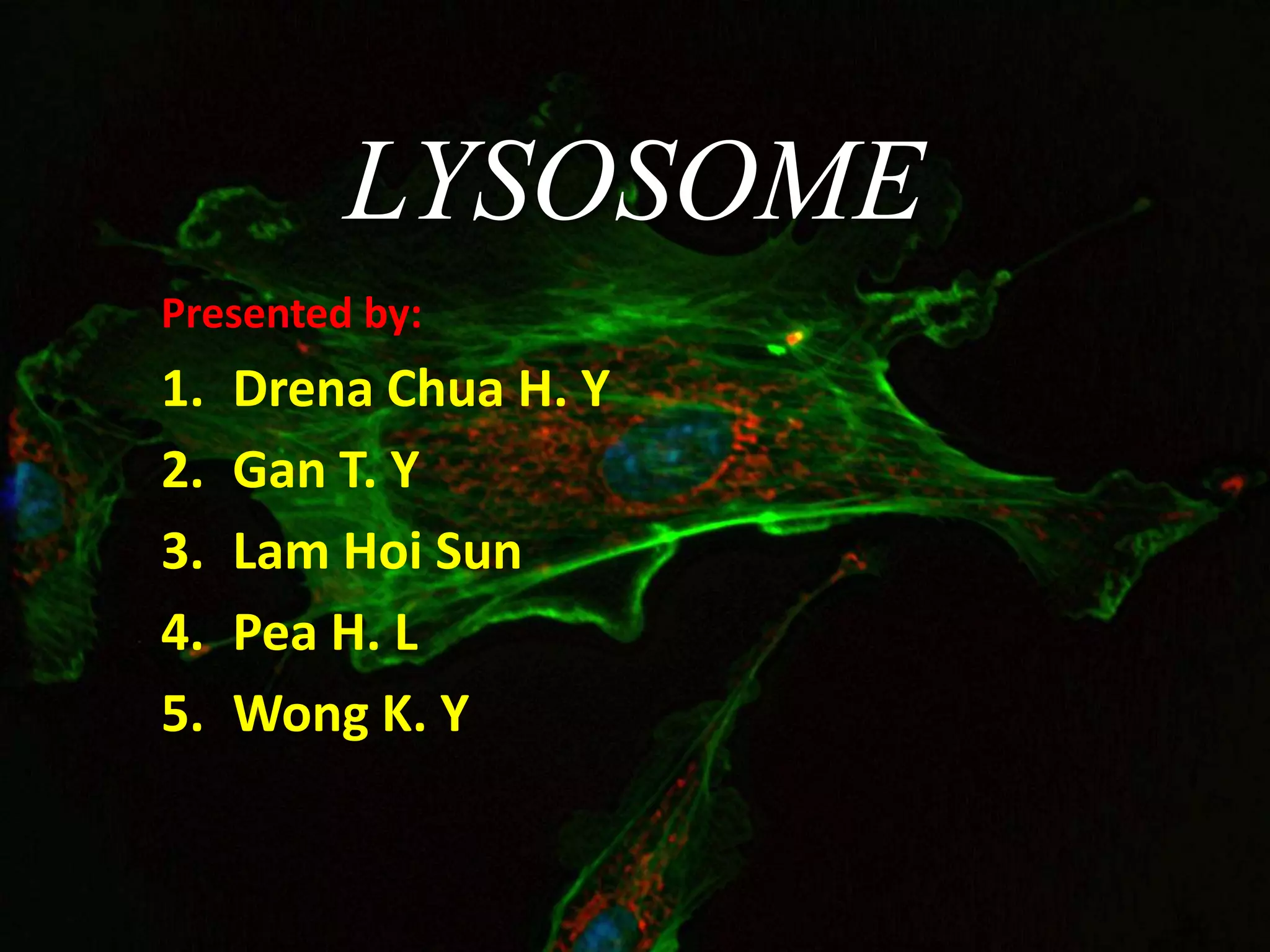
LYSOSOME
Presented by:
1. Drena Chua H. Y
2. Gan T. Y
3. Lam Hoi Sun
4. Pea H. L
5. Wong K. Y
Contents
• Definition of lysosome
• Structure of lysosome
• Discovery of lysosome
• Synthesis of primary and secondary lysosome
• Functions of lysosome
• 4 intracellular processes by lysosome –
phagocytosis, exocytosis, endocytosis and
autolysis *****
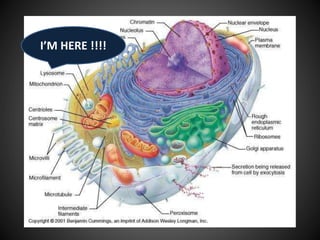
I’M HERE !!!!
Definition of lysosome
• Also known as lysosomal.
• derived from the Greek words
• Lysis = "to loosen" and soma = "body”
• Mostly found in animal cell(WBC) and
prokaryotic cell (protozoa)
• Except : RBC
• Present all over the cytoplasm.
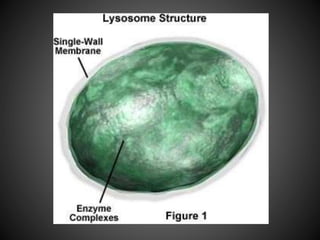
Structure of Lysosome
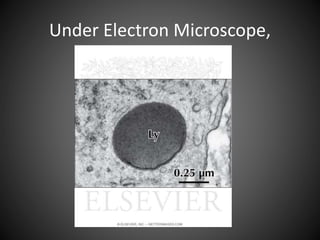
• is a tiny sac like structures
• Also a single membrane bound structure
• Consisting of a phospholipid bilayer
and contain acid hydrolases (acid
phosphatase) which are hydrolytic
enzymes
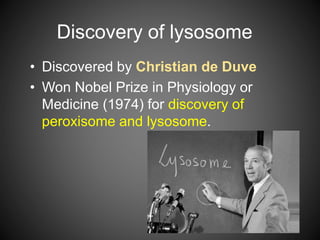
Discovery of lysosome
• Discovered by Christian de Duve
• Won Nobel Prize in Physiology or
Medicine (1974) for discovery of
peroxisome and lysosome.
How did He discovered
• Studying the mechanism of action of a pancreatic
hormone insulin in liver cells
• Focus on glucose-6-phosphatase - which is the first
crucial enzyme in sugar metabolism
• failed to purify and isolate the enzyme from the
cellular extracts of insulin through centrifugation
• To estimate this enzyme activity, they used that of
standardized enzyme acid phosphatase
• Surprisingly, the enzyme activity was increased to
normal of that of the fresh sample
• The result was the same after few times
• This led to conclusion that a membrane-like
barrier limited the accessibility of the enzyme
to its substrate
• They described this membrane-like barrier as
a "saclike structure surrounded by a
membrane and containing acid phosphates"
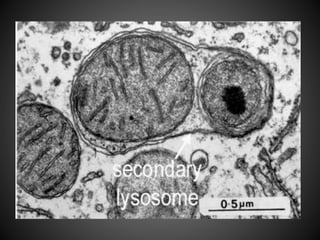
Under Electron Microscope,
Formation of primary lysosome
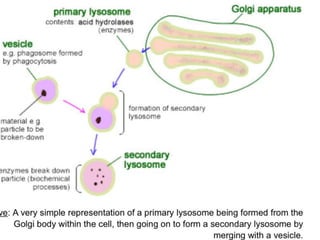
• Enzymes of lysosomes are synthesized by
ribosomes which present in wall of RER
• Packed into transport vesicles and transferred
to Golgi Apparatus
• Further processed in GA
• They budded off from Golgi as primary
lysosomes
Formation of secondary lysosome
• Are formed when primary lysosomes fuse
with other membrane-bound vesicles.
• Are synthesis when there is presence of
foreign particles (microorganism),
old/damaged organelle and their own cell
is sick or damaged.
Functions of lysosome
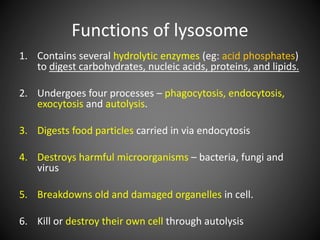
1. Contains several hydrolytic enzymes (eg: acid phosphates)
to digest carbohydrates, nucleic acids, proteins, and lipids.
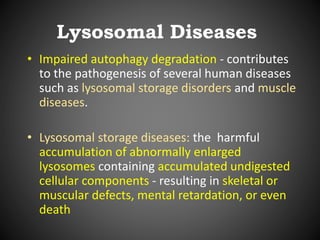
2. Undergoes four processes – phagocytosis, endocytosis,
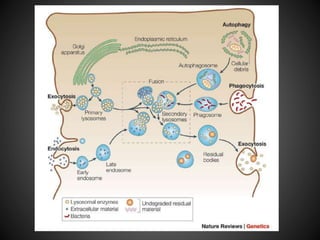
exocytosis and autolysis.
3. Digests food particles carried in via endocytosis
4. Destroys harmful microorganisms – bacteria, fungi and
virus
5. Breakdowns old and damaged organelles in cell.
6. Kill or destroy their own cell through autolysis
NOTE
• To prevent destruction of cell and lysosome itself,
it is important to control enzymes inside from
leaking out
• The best function of enzymes is about pH 5
• How to maintain acidic environment in lysosome?
- The outer membrane transports H+ ions into
the lysosome.
• Since the pH of a cell is generally about 7, these
enzymes will not function if released into the cell
cytoplasm.
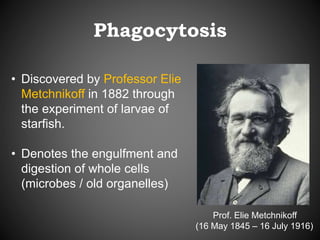
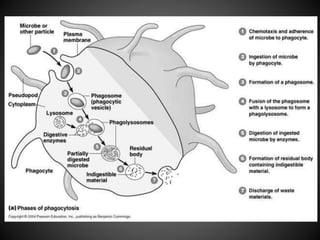
Phagocytosis
• Discovered by Professor Elie
Metchnikoff in 1882 through
the experiment of larvae of
starfish.
• Denotes the engulfment and
digestion of whole cells
(microbes / old organelles)
Prof. Elie Metchnikoff
(16 May 1845 – 16 July 1916)
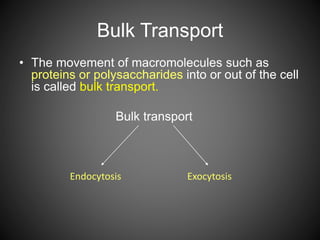
Bulk Transport
• The movement of macromolecules such as
proteins or polysaccharides into or out of the cell
is called bulk transport.
Bulk transport
Endocytosis Exocytosis
Endocytosis
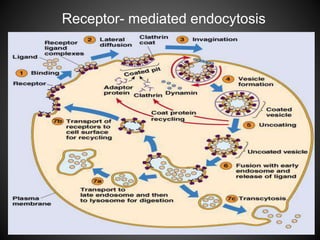
• Endocytosis is the process by which
materials move into the cell.
• There are three types of endocytosis:
phagocytosis, pinocytosis, and receptor-
mediated endocytosis.
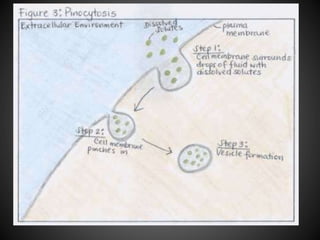
Pinocytosis
• also known as “cellular drinking”
• The cell engulfs drops of fluid by pinching
in and forming vesicles
• is a non-specific process in which the cell
takes in whatever solutes that are
dissolved in the liquid it envelops.
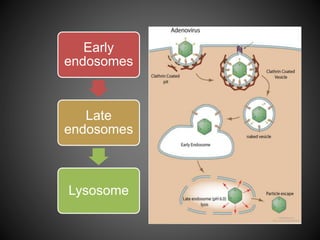
Endosome
• Membrane-bounded compartments in
endocytic pathway inside eukaryotic cells.
• internalize molecules from plasma membrane
and recycle them (early endosomes and
recycling endosomes)
• OR sort them for degradation to lysosome
(late endosomes)
Early
endosomes
Late
endosomes
Lysosome
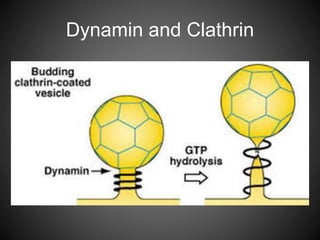
Dynamin and Clathrin
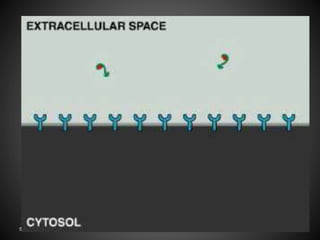
Receptor- mediated endocytosis
9/10/2018
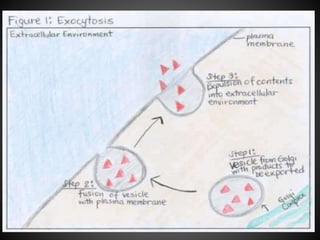
Exocytosis
• Materials are exported out of the cell via
secretory vesicles.
• Generally, the Golgi complex packages
macromolecules into transport vesicles that
travel to and fuse with the plasma membrane.
• This fusion causes the vesicle to spill its
contents out of the cell.
• For lysosome, it releases its enzymes out of cell
as hormones or extracellular digestion
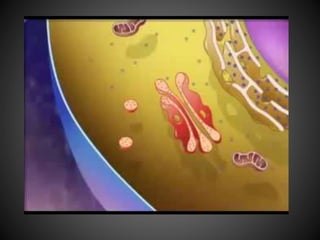
What Does Autophagy Mean?
• It is derived from Greek words:
Auto = “self” & Phagy = “eat”
• also known as organelle turnover
( the regulated destruction of the cell’s own
organelles and their replacement.)
• A catabolic process in eukaryotic cells
Types of Autophagy
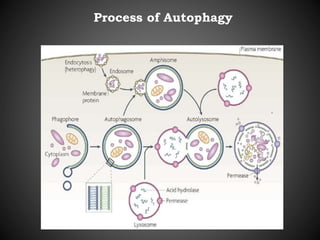
(a) Macroautophagy:
 big vacuole with double phospholipid layer.
 encloses an organelle or cell structure.
 wrapped inside a specialized organelle called
autophagosome, which then fuses with lysosomal
vesicles for degradation
(b) Microautophagy:
 small vacuole with a single phospholipid layer.
 sequesters a small portion of cytosol.
 a process that resembles pinching off of a
phagosomes or pinosomes from the plasma
membrane.
(c) Chaperone-mediated autophagy:
proteins possessing a specific sequence signal
are transported from the cytoplasm, through
the lysosomal membrane, to the lysosomal
lumen.
Process of Autophagy
When Does Autophagy
Occur??
• It occurs all the time, whether the cell is hungry
or not!
• Under NORMAL CONDITIONS: removes damaged
proteins and organelles to prevent cell damage.
• Under STRESS (lack of oxygen, starvation,
absence of growth factors etc.): Intracellular
molecules are digested to provide the nutrients
needed by the cell.
What Does Autophagy Aid In??
• It plays a role in innate and adaptive immunity.
• It is responsible in programmed cell death.
• Prevention of cancer and neurodegeneration
• Slowing the body’s aging process.
• Protects brain cells from continuous damage to
proteins and organelles that is experienced by
these long-lived cells.
Lysosomal Diseases
• Impaired autophagy degradation - contributes
to the pathogenesis of several human diseases
such as lysosomal storage disorders and muscle
diseases.
• Lysosomal storage diseases: the harmful
accumulation of abnormally enlarged
lysosomes containing accumulated undigested
cellular components - resulting in skeletal or
muscular defects, mental retardation, or even
death
Q&A Time!
1. Lysosomes are membrane-bound vesicles that
arise from the
(a)Nucleus
(b)Mitochondria
(c)ER
(d)Golgi Apparatus
(e)Cell Membrane
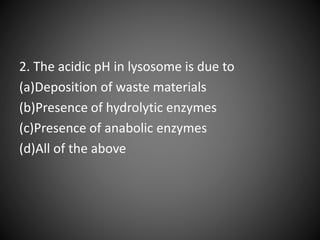
2. The acidic pH in lysosome is due to
(a)Deposition of waste materials
(b)Presence of hydrolytic enzymes
(c)Presence of anabolic enzymes
(d)All of the above
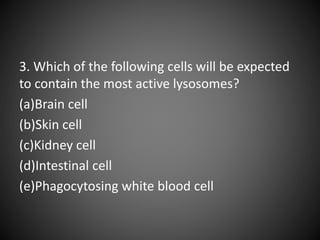
3. Which of the following cells will be expected
to contain the most active lysosomes?
(a)Brain cell
(b)Skin cell
(c)Kidney cell
(d)Intestinal cell
(e)Phagocytosing white blood cell
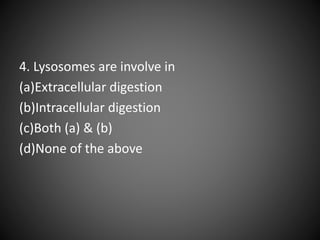
4. Lysosomes are involve in
(a)Extracellular digestion
(b)Intracellular digestion
(c)Both (a) & (b)
(d)None of the above
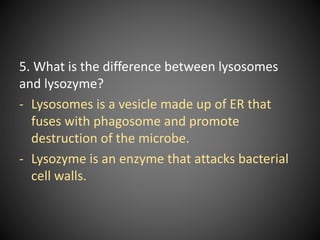
5. What is the difference between lysosomes
and lysozyme?
- Lysosomes is a vesicle made up of ER that
fuses with phagosome and promote
destruction of the microbe.
- Lysozyme is an enzyme that attacks bacterial
cell walls.
If you have answered all the above
correctly…
CONGRATULATIONS!!!
You are a lysosome expert!

Lysosome

  • 1.
    LYSOSOME Presented by: 1. DrenaChua H. Y 2. Gan T. Y 3. Lam Hoi Sun 4. Pea H. L 5. Wong K. Y
  • 2.
    Contents • Definition oflysosome • Structure of lysosome • Discovery of lysosome • Synthesis of primary and secondary lysosome • Functions of lysosome • 4 intracellular processes by lysosome – phagocytosis, exocytosis, endocytosis and autolysis *****
  • 3.
  • 4.
    Definition of lysosome •Also known as lysosomal. • derived from the Greek words • Lysis = "to loosen" and soma = "body” • Mostly found in animal cell(WBC) and prokaryotic cell (protozoa) • Except : RBC • Present all over the cytoplasm.
  • 5.
    Structure of Lysosome •is a tiny sac like structures • Also a single membrane bound structure • Consisting of a phospholipid bilayer and contain acid hydrolases (acid phosphatase) which are hydrolytic enzymes
  • 7.
    Discovery of lysosome •Discovered by Christian de Duve • Won Nobel Prize in Physiology or Medicine (1974) for discovery of peroxisome and lysosome.
  • 8.
    How did Hediscovered • Studying the mechanism of action of a pancreatic hormone insulin in liver cells • Focus on glucose-6-phosphatase - which is the first crucial enzyme in sugar metabolism • failed to purify and isolate the enzyme from the cellular extracts of insulin through centrifugation • To estimate this enzyme activity, they used that of standardized enzyme acid phosphatase • Surprisingly, the enzyme activity was increased to normal of that of the fresh sample
  • 9.
    • The resultwas the same after few times • This led to conclusion that a membrane-like barrier limited the accessibility of the enzyme to its substrate • They described this membrane-like barrier as a "saclike structure surrounded by a membrane and containing acid phosphates"
  • 10.
  • 11.
    Formation of primarylysosome • Enzymes of lysosomes are synthesized by ribosomes which present in wall of RER • Packed into transport vesicles and transferred to Golgi Apparatus • Further processed in GA • They budded off from Golgi as primary lysosomes
  • 12.
    Formation of secondarylysosome • Are formed when primary lysosomes fuse with other membrane-bound vesicles. • Are synthesis when there is presence of foreign particles (microorganism), old/damaged organelle and their own cell is sick or damaged.
  • 16.
    Functions of lysosome 1.Contains several hydrolytic enzymes (eg: acid phosphates) to digest carbohydrates, nucleic acids, proteins, and lipids. 2. Undergoes four processes – phagocytosis, endocytosis, exocytosis and autolysis. 3. Digests food particles carried in via endocytosis 4. Destroys harmful microorganisms – bacteria, fungi and virus 5. Breakdowns old and damaged organelles in cell. 6. Kill or destroy their own cell through autolysis
  • 17.
    NOTE • To preventdestruction of cell and lysosome itself, it is important to control enzymes inside from leaking out • The best function of enzymes is about pH 5 • How to maintain acidic environment in lysosome? - The outer membrane transports H+ ions into the lysosome. • Since the pH of a cell is generally about 7, these enzymes will not function if released into the cell cytoplasm.
  • 18.
    Phagocytosis • Discovered byProfessor Elie Metchnikoff in 1882 through the experiment of larvae of starfish. • Denotes the engulfment and digestion of whole cells (microbes / old organelles) Prof. Elie Metchnikoff (16 May 1845 – 16 July 1916)
  • 20.
    Bulk Transport • Themovement of macromolecules such as proteins or polysaccharides into or out of the cell is called bulk transport. Bulk transport Endocytosis Exocytosis
  • 21.
    Endocytosis • Endocytosis isthe process by which materials move into the cell. • There are three types of endocytosis: phagocytosis, pinocytosis, and receptor- mediated endocytosis.
  • 22.
    Pinocytosis • also knownas “cellular drinking” • The cell engulfs drops of fluid by pinching in and forming vesicles • is a non-specific process in which the cell takes in whatever solutes that are dissolved in the liquid it envelops.
  • 24.
    Endosome • Membrane-bounded compartmentsin endocytic pathway inside eukaryotic cells. • internalize molecules from plasma membrane and recycle them (early endosomes and recycling endosomes) • OR sort them for degradation to lysosome (late endosomes)
  • 25.
  • 26.
  • 27.
  • 28.
  • 29.
    Exocytosis • Materials areexported out of the cell via secretory vesicles. • Generally, the Golgi complex packages macromolecules into transport vesicles that travel to and fuse with the plasma membrane. • This fusion causes the vesicle to spill its contents out of the cell. • For lysosome, it releases its enzymes out of cell as hormones or extracellular digestion
  • 31.
    What Does AutophagyMean? • It is derived from Greek words: Auto = “self” & Phagy = “eat” • also known as organelle turnover ( the regulated destruction of the cell’s own organelles and their replacement.) • A catabolic process in eukaryotic cells
  • 32.
    Types of Autophagy (a)Macroautophagy:  big vacuole with double phospholipid layer.  encloses an organelle or cell structure.  wrapped inside a specialized organelle called autophagosome, which then fuses with lysosomal vesicles for degradation (b) Microautophagy:  small vacuole with a single phospholipid layer.  sequesters a small portion of cytosol.  a process that resembles pinching off of a phagosomes or pinosomes from the plasma membrane.
  • 33.
    (c) Chaperone-mediated autophagy: proteinspossessing a specific sequence signal are transported from the cytoplasm, through the lysosomal membrane, to the lysosomal lumen.
  • 34.
  • 35.
    When Does Autophagy Occur?? •It occurs all the time, whether the cell is hungry or not! • Under NORMAL CONDITIONS: removes damaged proteins and organelles to prevent cell damage. • Under STRESS (lack of oxygen, starvation, absence of growth factors etc.): Intracellular molecules are digested to provide the nutrients needed by the cell.
  • 36.
    What Does AutophagyAid In?? • It plays a role in innate and adaptive immunity. • It is responsible in programmed cell death. • Prevention of cancer and neurodegeneration • Slowing the body’s aging process. • Protects brain cells from continuous damage to proteins and organelles that is experienced by these long-lived cells.
  • 37.
    Lysosomal Diseases • Impairedautophagy degradation - contributes to the pathogenesis of several human diseases such as lysosomal storage disorders and muscle diseases. • Lysosomal storage diseases: the harmful accumulation of abnormally enlarged lysosomes containing accumulated undigested cellular components - resulting in skeletal or muscular defects, mental retardation, or even death
  • 40.
    Q&A Time! 1. Lysosomesare membrane-bound vesicles that arise from the (a)Nucleus (b)Mitochondria (c)ER (d)Golgi Apparatus (e)Cell Membrane
  • 41.
    2. The acidicpH in lysosome is due to (a)Deposition of waste materials (b)Presence of hydrolytic enzymes (c)Presence of anabolic enzymes (d)All of the above
  • 42.
    3. Which ofthe following cells will be expected to contain the most active lysosomes? (a)Brain cell (b)Skin cell (c)Kidney cell (d)Intestinal cell (e)Phagocytosing white blood cell
  • 43.
    4. Lysosomes areinvolve in (a)Extracellular digestion (b)Intracellular digestion (c)Both (a) & (b) (d)None of the above
  • 44.
    5. What isthe difference between lysosomes and lysozyme? - Lysosomes is a vesicle made up of ER that fuses with phagosome and promote destruction of the microbe. - Lysozyme is an enzyme that attacks bacterial cell walls.
  • 45.
    If you haveanswered all the above correctly… CONGRATULATIONS!!! You are a lysosome expert!