This manual was prepared by the Institute of Natural Resources; under the Meghalaya Basin Development Authority.
2
3.1. SPRING MAPPING MANNUAL
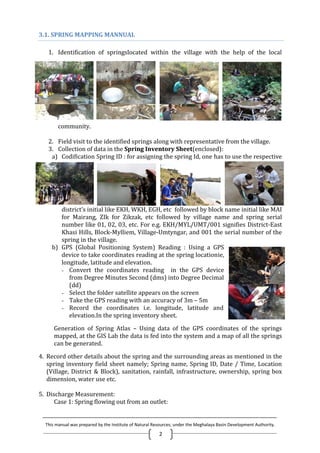
1. Identification of springslocated within the village with the help of the local
community.
2. Field visit to the identified springs along with representative from the village.
3. Collection of data in the Spring Inventory Sheet(enclosed):
a) Codification Spring ID : for assigning the spring Id, one has to use the respective
district’s initial like EKH, WKH, EGH, etc followed by block name initial like MAI
for Mairang, ZIk for Zikzak, etc followed by village name and spring serial
number like 01, 02, 03, etc. For e.g. EKH/MYL/UMT/001 signifies District-East
Khasi Hills, Block-Mylliem, Village-Umtyngar, and 001 the serial number of the
spring in the village.
b) GPS (Global Positioning System) Reading : Using a GPS
device to take coordinates reading at the spring locationie,
longitude, latitude and elevation.
- Convert the coordinates reading in the GPS device
from Degree Minutes Second (dms) into Degree Decimal
(dd)
- Select the folder satellite appears on the screen
- Take the GPS reading with an accuracy of 3m – 5m
- Record the coordinates i.e. longitude, latitude and
elevation.In the spring inventory sheet.
Generation of Spring Atlas – Using data of the GPS coordinates of the springs
mapped, at the GIS Lab the data is fed into the system and a map of all the springs
can be generated.
4. Record other details about the spring and the surrounding areas as mentioned in the
spring inventory field sheet namely; Spring name, Spring ID, Date / Time, Location
(Village, District & Block), sanitation, rainfall, infrastructure, ownership, spring box
dimension, water use etc.
5. Discharge Measurement:
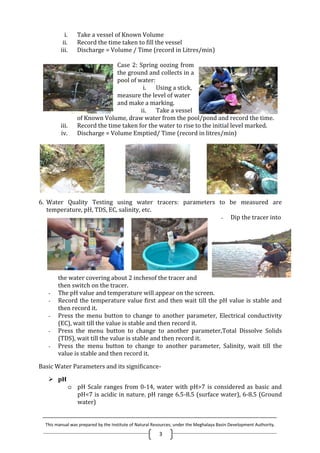
Case 1: Spring flowing out from an outlet:
This manual was prepared by the Institute of Natural Resources; under the Meghalaya Basin Development Authority.
3
i. Take a vessel of Known Volume
ii. Record the time taken to fill the vessel
iii. Discharge = Volume / Time (record in Litres/min)
Case 2: Spring oozing from
the ground and collects in a
pool of water:
i. Using a stick,
measure the level of water
and make a marking.
ii. Take a vessel
of Known Volume, draw water from the pool/pond and record the time.
iii. Record the time taken for the water to rise to the initial level marked.
iv. Discharge = Volume Emptied/ Time (record in litres/min)
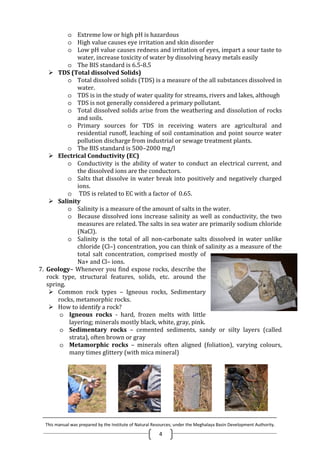
6. Water Quality Testing using water tracers: parameters to be measured are
temperature, pH, TDS, EC, salinity, etc.
- Dip the tracer into
the water covering about 2 inchesof the tracer and
then switch on the tracer.
- The pH value and temperature will appear on the screen.
- Record the temperature value first and then wait till the pH value is stable and
then record it.
- Press the menu button to change to another parameter, Electrical conductivity
(EC), wait till the value is stable and then record it.
- Press the menu button to change to another parameter,Total Dissolve Solids
(TDS), wait till the value is stable and then record it.
- Press the menu button to change to another parameter, Salinity, wait till the
value is stable and then record it.
Basic Water Parameters and its significance-
 pH
o pH Scale ranges from 0-14, water with pH>7 is considered as basic and
pH<7 is acidic in nature. pH range 6.5-8.5 (surface water), 6-8.5 (Ground
water)
This manual was prepared by the Institute of Natural Resources; under the Meghalaya Basin Development Authority.
4
o Extreme low or high pH is hazardous
o High value causes eye irritation and skin disorder
o Low pH value causes redness and irritation of eyes, impart a sour taste to
water, increase toxicity of water by dissolving heavy metals easily
o The BIS standard is 6.5-8.5
 TDS (Total dissolved Solids)
o Total dissolved solids (TDS) is a measure of the all substances dissolved in
water.
o TDS is in the study of water quality for streams, rivers and lakes, although
o TDS is not generally considered a primary pollutant.
o Total dissolved solids arise from the weathering and dissolution of rocks
and soils.
o Primary sources for TDS in receiving waters are agricultural and
residential runoff, leaching of soil contamination and point source water
pollution discharge from industrial or sewage treatment plants.
o The BIS standard is 500–2000 mg/l
 Electrical Conductivity (EC)
o Conductivity is the ability of water to conduct an electrical current, and
the dissolved ions are the conductors.
o Salts that dissolve in water break into positively and negatively charged
ions.
o TDS is related to EC with a factor of 0.65.
 Salinity
o Salinity is a measure of the amount of salts in the water.
o Because dissolved ions increase salinity as well as conductivity, the two
measures are related. The salts in sea water are primarily sodium chloride
(NaCl).
o Salinity is the total of all non-carbonate salts dissolved in water unlike
chloride (Cl–) concentration, you can think of salinity as a measure of the
total salt concentration, comprised mostly of
Na+ and Cl– ions.
7. Geology– Whenever you find expose rocks, describe the
rock type, structural features, solids, etc. around the
spring.
 Common rock types – Igneous rocks, Sedimentary
rocks, metamorphic rocks.
 How to identify a rock?
o Igneous rocks - hard, frozen melts with little
layering; minerals mostly black, white, gray, pink.
o Sedimentary rocks – cemented sediments, sandy or silty layers (called
strata), often brown or gray
o Metamorphic rocks – minerals often aligned (foliation), varying colours,
many times glittery (with mica mineral)
This manual was prepared by the Institute of Natural Resources; under the Meghalaya Basin Development Authority.
5
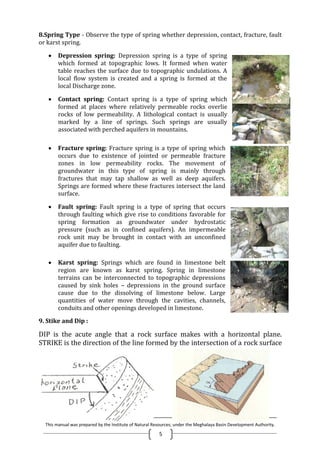
8.Spring Type - Observe the type of spring whether depression, contact, fracture, fault
or karst spring.
 Depression spring: Depression spring is a type of spring
which formed at topographic lows. It formed when water
table reaches the surface due to topographic undulations. A
local flow system is created and a spring is formed at the
local Discharge zone.
 Contact spring: Contact spring is a type of spring which
formed at places where relatively permeable rocks overlie
rocks of low permeability. A lithological contact is usually
marked by a line of springs. Such springs are usually
associated with perched aquifers in mountains.
 Fracture spring: Fracture spring is a type of spring which
occurs due to existence of jointed or permeable fracture
zones in low permeability rocks. The movement of
groundwater in this type of spring is mainly through
fractures that may tap shallow as well as deep aquifers.
Springs are formed where these fractures intersect the land
surface.
 Fault spring: Fault spring is a type of spring that occurs
through faulting which give rise to conditions favorable for
spring formation as groundwater under hydrostatic
pressure (such as in confined aquifers). An impermeable
rock unit may be brought in contact with an unconfined
aquifer due to faulting.
 Karst spring: Springs which are found in limestone belt
region are known as karst spring. Spring in limestone
terrains can be interconnected to topographic depressions
caused by sink holes – depressions in the ground surface
cause due to the dissolving of limestone below. Large
quantities of water move through the cavities, channels,
conduits and other openings developed in limestone.
9. Stike and Dip :
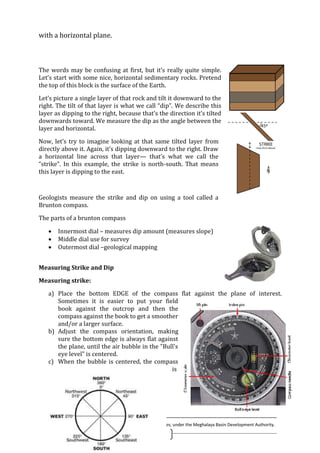
DIP is the acute angle that a rock surface makes with a horizontal plane.
STRIKE is the direction of the line formed by the intersection of a rock surface
This manual was prepared by the Institute of Natural Resources; under the Meghalaya Basin Development Authority.
6
with a horizontal plane.
The words may be confusing at first, but it’s really quite simple.
Let’s start with some nice, horizontal sedimentary rocks. Pretend
the top of this block is the surface of the Earth.
Let’s picture a single layer of that rock and tilt it downward to the
right. The tilt of that layer is what we call “dip”. We describe this
layer as dipping to the right, because that’s the direction it’s tilted
downwards toward. We measure the dip as the angle between the
layer and horizontal.
Now, let’s try to imagine looking at that same tilted layer from
directly above it. Again, it’s dipping downward to the right. Draw
a horizontal line across that layer— that’s what we call the
“strike”. In this example, the strike is north-south. That means
this layer is dipping to the east.
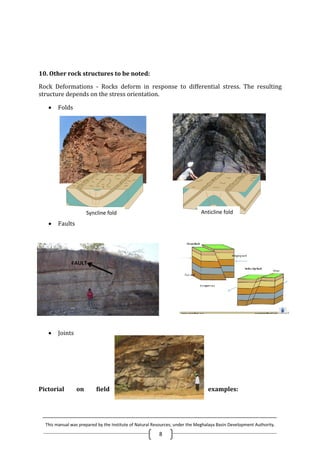
Geologists measure the strike and dip on using a tool called a
Brunton compass.
The parts of a brunton compass
 Innermost dial – measures dip amount (measures slope)
 Middle dial use for survey
 Outermost dial –geological mapping
Measuring Strike and Dip
Measuring strike:
a) Place the bottom EDGE of the compass flat against the plane of interest.
Sometimes it is easier to put your field
book against the outcrop and then the
compass against the book to get a smoother
and/or a larger surface.
b) Adjust the compass orientation, making
sure the bottom edge is always flat against
the plane, until the air bubble in the "Bull's
eye level" is centered.
c) When the bubble is centered, the compass
is
This manual was prepared by the Institute of Natural Resources; under the Meghalaya Basin Development Authority.
7
horizontal against the plane and parallel to the line of strike. Read either end of
the compass needle to obtain the value of strike.
Strike variations from 0° to 360°, shown here in increments of 45°
Measuring Dip:
a) After you determine strike, rotate the compass 90 (The dip line is perpendicular
to the strike line) or take your compass and put its side against the rock so that it
points in the same direction as the line of dip
b) Place the SIDE of the compass flat against the plane.
c) Adjust the lever on the back of the compass until the air bubble in the
"Clinometer level" is centered.
d) Read the dip directly from the scale in the compass. Note the degrees and the
direction. Dip angle can range from 0-90 degrees, dip direction MUST always be
perpendicular to the strike direction (e.g., a strike of 40° could only dip to the SE
or NW, never NE or SW)
Once you’ve made the measurements, you can represent the reading as described below.
Strike is easy enough, since it’s a compass direction. If we measured the rock striking
north-south, we would draw a short, vertical line (assuming up is north). If the rock was
dipping 45 degrees to the east, we would add a tick mark at the midpoint of our strike
line, pointing east. Just below that we would write the measured dip: “45”. It would look
something like the example below. The different colors on the map represent the
different rock layers exposed at the surface, just like looking at one of the block
diagrams from above. Without the strike and dip symbol, we would have no idea if those
layers were dipping to the west, to the east, or were vertical. But by adding this simple
symbol, we can understand something about the 3-D orientation of the rocks.
Strike
Dip angle
Dip
This manual was prepared by the Institute of Natural Resources; under the Meghalaya Basin Development Authority.
8
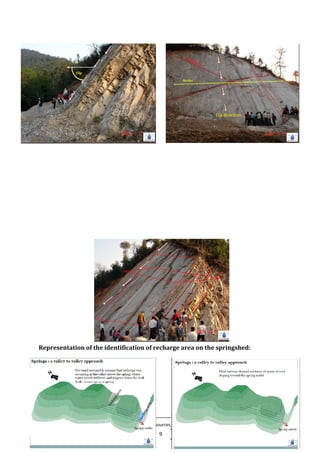
10. Other rock structures to be noted:
Rock Deformations - Rocks deform in response to differential stress. The resulting
structure depends on the stress orientation.
 Folds
 Faults
 Joints
Pictorial on field examples:
Syncline fold Anticline fold
FAULT
This manual was prepared by the Institute of Natural Resources; under the Meghalaya Basin Development Authority.
9
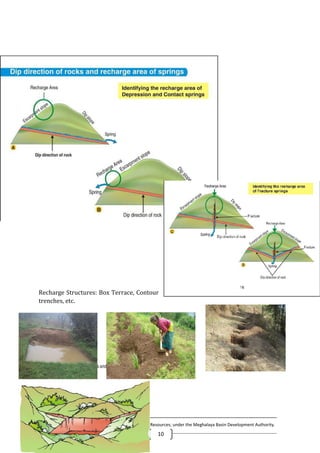
Representation of the identification of recharge area on the springshed:
Dip direction
This manual was prepared by the Institute of Natural Resources; under the Meghalaya Basin Development Authority.
10
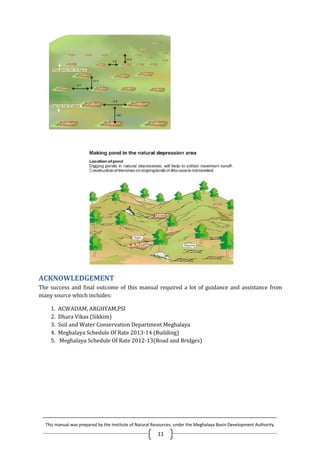
Recharge Structures: Box Terrace, Contour
trenches, etc.
This manual was prepared by the Institute of Natural Resources; under the Meghalaya Basin Development Authority.
10
Recharge Structures: Box Terrace, Contour
trenches, etc.
This manual was prepared by the Institute of Natural Resources; under the Meghalaya Basin Development Authority.
10
Recharge Structures: Box Terrace, Contour
trenches, etc.
This manual was prepared by the Institute of Natural Resources; under the Meghalaya Basin Development Authority.
11
ACKNOWLEDGEMENT
The success and final outcome of this manual required a lot of guidance and assistance from
many source which includes:
1. ACWADAM, ARGHYAM,PSI
2. Dhara Vikas (Sikkim)
3. Soil and Water Conservation Department Meghalaya
4. Meghalaya Schedule Of Rate 2013-14 (Building)
5. Meghalaya Schedule Of Rate 2012-13(Road and Bridges)
This manual was prepared by the Institute of Natural Resources; under the Meghalaya Basin Development Authority.
11
ACKNOWLEDGEMENT
The success and final outcome of this manual required a lot of guidance and assistance from
many source which includes:
1. ACWADAM, ARGHYAM,PSI
2. Dhara Vikas (Sikkim)
3. Soil and Water Conservation Department Meghalaya
4. Meghalaya Schedule Of Rate 2013-14 (Building)
5. Meghalaya Schedule Of Rate 2012-13(Road and Bridges)
This manual was prepared by the Institute of Natural Resources; under the Meghalaya Basin Development Authority.
11
ACKNOWLEDGEMENT
The success and final outcome of this manual required a lot of guidance and assistance from
many source which includes:
1. ACWADAM, ARGHYAM,PSI
2. Dhara Vikas (Sikkim)
3. Soil and Water Conservation Department Meghalaya
4. Meghalaya Schedule Of Rate 2013-14 (Building)
5. Meghalaya Schedule Of Rate 2012-13(Road and Bridges)
Spring mapping manual

Spring mapping manual

  • 3.
    This manual wasprepared by the Institute of Natural Resources; under the Meghalaya Basin Development Authority. 2 3.1. SPRING MAPPING MANNUAL 1. Identification of springslocated within the village with the help of the local community. 2. Field visit to the identified springs along with representative from the village. 3. Collection of data in the Spring Inventory Sheet(enclosed): a) Codification Spring ID : for assigning the spring Id, one has to use the respective district’s initial like EKH, WKH, EGH, etc followed by block name initial like MAI for Mairang, ZIk for Zikzak, etc followed by village name and spring serial number like 01, 02, 03, etc. For e.g. EKH/MYL/UMT/001 signifies District-East Khasi Hills, Block-Mylliem, Village-Umtyngar, and 001 the serial number of the spring in the village. b) GPS (Global Positioning System) Reading : Using a GPS device to take coordinates reading at the spring locationie, longitude, latitude and elevation. - Convert the coordinates reading in the GPS device from Degree Minutes Second (dms) into Degree Decimal (dd) - Select the folder satellite appears on the screen - Take the GPS reading with an accuracy of 3m – 5m - Record the coordinates i.e. longitude, latitude and elevation.In the spring inventory sheet. Generation of Spring Atlas – Using data of the GPS coordinates of the springs mapped, at the GIS Lab the data is fed into the system and a map of all the springs can be generated. 4. Record other details about the spring and the surrounding areas as mentioned in the spring inventory field sheet namely; Spring name, Spring ID, Date / Time, Location (Village, District & Block), sanitation, rainfall, infrastructure, ownership, spring box dimension, water use etc. 5. Discharge Measurement: Case 1: Spring flowing out from an outlet:
  • 4.
    This manual wasprepared by the Institute of Natural Resources; under the Meghalaya Basin Development Authority. 3 i. Take a vessel of Known Volume ii. Record the time taken to fill the vessel iii. Discharge = Volume / Time (record in Litres/min) Case 2: Spring oozing from the ground and collects in a pool of water: i. Using a stick, measure the level of water and make a marking. ii. Take a vessel of Known Volume, draw water from the pool/pond and record the time. iii. Record the time taken for the water to rise to the initial level marked. iv. Discharge = Volume Emptied/ Time (record in litres/min) 6. Water Quality Testing using water tracers: parameters to be measured are temperature, pH, TDS, EC, salinity, etc. - Dip the tracer into the water covering about 2 inchesof the tracer and then switch on the tracer. - The pH value and temperature will appear on the screen. - Record the temperature value first and then wait till the pH value is stable and then record it. - Press the menu button to change to another parameter, Electrical conductivity (EC), wait till the value is stable and then record it. - Press the menu button to change to another parameter,Total Dissolve Solids (TDS), wait till the value is stable and then record it. - Press the menu button to change to another parameter, Salinity, wait till the value is stable and then record it. Basic Water Parameters and its significance-  pH o pH Scale ranges from 0-14, water with pH>7 is considered as basic and pH<7 is acidic in nature. pH range 6.5-8.5 (surface water), 6-8.5 (Ground water)
  • 5.
    This manual wasprepared by the Institute of Natural Resources; under the Meghalaya Basin Development Authority. 4 o Extreme low or high pH is hazardous o High value causes eye irritation and skin disorder o Low pH value causes redness and irritation of eyes, impart a sour taste to water, increase toxicity of water by dissolving heavy metals easily o The BIS standard is 6.5-8.5  TDS (Total dissolved Solids) o Total dissolved solids (TDS) is a measure of the all substances dissolved in water. o TDS is in the study of water quality for streams, rivers and lakes, although o TDS is not generally considered a primary pollutant. o Total dissolved solids arise from the weathering and dissolution of rocks and soils. o Primary sources for TDS in receiving waters are agricultural and residential runoff, leaching of soil contamination and point source water pollution discharge from industrial or sewage treatment plants. o The BIS standard is 500–2000 mg/l  Electrical Conductivity (EC) o Conductivity is the ability of water to conduct an electrical current, and the dissolved ions are the conductors. o Salts that dissolve in water break into positively and negatively charged ions. o TDS is related to EC with a factor of 0.65.  Salinity o Salinity is a measure of the amount of salts in the water. o Because dissolved ions increase salinity as well as conductivity, the two measures are related. The salts in sea water are primarily sodium chloride (NaCl). o Salinity is the total of all non-carbonate salts dissolved in water unlike chloride (Cl–) concentration, you can think of salinity as a measure of the total salt concentration, comprised mostly of Na+ and Cl– ions. 7. Geology– Whenever you find expose rocks, describe the rock type, structural features, solids, etc. around the spring.  Common rock types – Igneous rocks, Sedimentary rocks, metamorphic rocks.  How to identify a rock? o Igneous rocks - hard, frozen melts with little layering; minerals mostly black, white, gray, pink. o Sedimentary rocks – cemented sediments, sandy or silty layers (called strata), often brown or gray o Metamorphic rocks – minerals often aligned (foliation), varying colours, many times glittery (with mica mineral)
  • 6.
    This manual wasprepared by the Institute of Natural Resources; under the Meghalaya Basin Development Authority. 5 8.Spring Type - Observe the type of spring whether depression, contact, fracture, fault or karst spring.  Depression spring: Depression spring is a type of spring which formed at topographic lows. It formed when water table reaches the surface due to topographic undulations. A local flow system is created and a spring is formed at the local Discharge zone.  Contact spring: Contact spring is a type of spring which formed at places where relatively permeable rocks overlie rocks of low permeability. A lithological contact is usually marked by a line of springs. Such springs are usually associated with perched aquifers in mountains.  Fracture spring: Fracture spring is a type of spring which occurs due to existence of jointed or permeable fracture zones in low permeability rocks. The movement of groundwater in this type of spring is mainly through fractures that may tap shallow as well as deep aquifers. Springs are formed where these fractures intersect the land surface.  Fault spring: Fault spring is a type of spring that occurs through faulting which give rise to conditions favorable for spring formation as groundwater under hydrostatic pressure (such as in confined aquifers). An impermeable rock unit may be brought in contact with an unconfined aquifer due to faulting.  Karst spring: Springs which are found in limestone belt region are known as karst spring. Spring in limestone terrains can be interconnected to topographic depressions caused by sink holes – depressions in the ground surface cause due to the dissolving of limestone below. Large quantities of water move through the cavities, channels, conduits and other openings developed in limestone. 9. Stike and Dip : DIP is the acute angle that a rock surface makes with a horizontal plane. STRIKE is the direction of the line formed by the intersection of a rock surface
  • 7.
    This manual wasprepared by the Institute of Natural Resources; under the Meghalaya Basin Development Authority. 6 with a horizontal plane. The words may be confusing at first, but it’s really quite simple. Let’s start with some nice, horizontal sedimentary rocks. Pretend the top of this block is the surface of the Earth. Let’s picture a single layer of that rock and tilt it downward to the right. The tilt of that layer is what we call “dip”. We describe this layer as dipping to the right, because that’s the direction it’s tilted downwards toward. We measure the dip as the angle between the layer and horizontal. Now, let’s try to imagine looking at that same tilted layer from directly above it. Again, it’s dipping downward to the right. Draw a horizontal line across that layer— that’s what we call the “strike”. In this example, the strike is north-south. That means this layer is dipping to the east. Geologists measure the strike and dip on using a tool called a Brunton compass. The parts of a brunton compass  Innermost dial – measures dip amount (measures slope)  Middle dial use for survey  Outermost dial –geological mapping Measuring Strike and Dip Measuring strike: a) Place the bottom EDGE of the compass flat against the plane of interest. Sometimes it is easier to put your field book against the outcrop and then the compass against the book to get a smoother and/or a larger surface. b) Adjust the compass orientation, making sure the bottom edge is always flat against the plane, until the air bubble in the "Bull's eye level" is centered. c) When the bubble is centered, the compass is
  • 8.
    This manual wasprepared by the Institute of Natural Resources; under the Meghalaya Basin Development Authority. 7 horizontal against the plane and parallel to the line of strike. Read either end of the compass needle to obtain the value of strike. Strike variations from 0° to 360°, shown here in increments of 45° Measuring Dip: a) After you determine strike, rotate the compass 90 (The dip line is perpendicular to the strike line) or take your compass and put its side against the rock so that it points in the same direction as the line of dip b) Place the SIDE of the compass flat against the plane. c) Adjust the lever on the back of the compass until the air bubble in the "Clinometer level" is centered. d) Read the dip directly from the scale in the compass. Note the degrees and the direction. Dip angle can range from 0-90 degrees, dip direction MUST always be perpendicular to the strike direction (e.g., a strike of 40° could only dip to the SE or NW, never NE or SW) Once you’ve made the measurements, you can represent the reading as described below. Strike is easy enough, since it’s a compass direction. If we measured the rock striking north-south, we would draw a short, vertical line (assuming up is north). If the rock was dipping 45 degrees to the east, we would add a tick mark at the midpoint of our strike line, pointing east. Just below that we would write the measured dip: “45”. It would look something like the example below. The different colors on the map represent the different rock layers exposed at the surface, just like looking at one of the block diagrams from above. Without the strike and dip symbol, we would have no idea if those layers were dipping to the west, to the east, or were vertical. But by adding this simple symbol, we can understand something about the 3-D orientation of the rocks. Strike Dip angle Dip
  • 9.
    This manual wasprepared by the Institute of Natural Resources; under the Meghalaya Basin Development Authority. 8 10. Other rock structures to be noted: Rock Deformations - Rocks deform in response to differential stress. The resulting structure depends on the stress orientation.  Folds  Faults  Joints Pictorial on field examples: Syncline fold Anticline fold FAULT
  • 10.
    This manual wasprepared by the Institute of Natural Resources; under the Meghalaya Basin Development Authority. 9 Representation of the identification of recharge area on the springshed: Dip direction
  • 11.
    This manual wasprepared by the Institute of Natural Resources; under the Meghalaya Basin Development Authority. 10 Recharge Structures: Box Terrace, Contour trenches, etc. This manual was prepared by the Institute of Natural Resources; under the Meghalaya Basin Development Authority. 10 Recharge Structures: Box Terrace, Contour trenches, etc. This manual was prepared by the Institute of Natural Resources; under the Meghalaya Basin Development Authority. 10 Recharge Structures: Box Terrace, Contour trenches, etc.
  • 12.
    This manual wasprepared by the Institute of Natural Resources; under the Meghalaya Basin Development Authority. 11 ACKNOWLEDGEMENT The success and final outcome of this manual required a lot of guidance and assistance from many source which includes: 1. ACWADAM, ARGHYAM,PSI 2. Dhara Vikas (Sikkim) 3. Soil and Water Conservation Department Meghalaya 4. Meghalaya Schedule Of Rate 2013-14 (Building) 5. Meghalaya Schedule Of Rate 2012-13(Road and Bridges) This manual was prepared by the Institute of Natural Resources; under the Meghalaya Basin Development Authority. 11 ACKNOWLEDGEMENT The success and final outcome of this manual required a lot of guidance and assistance from many source which includes: 1. ACWADAM, ARGHYAM,PSI 2. Dhara Vikas (Sikkim) 3. Soil and Water Conservation Department Meghalaya 4. Meghalaya Schedule Of Rate 2013-14 (Building) 5. Meghalaya Schedule Of Rate 2012-13(Road and Bridges) This manual was prepared by the Institute of Natural Resources; under the Meghalaya Basin Development Authority. 11 ACKNOWLEDGEMENT The success and final outcome of this manual required a lot of guidance and assistance from many source which includes: 1. ACWADAM, ARGHYAM,PSI 2. Dhara Vikas (Sikkim) 3. Soil and Water Conservation Department Meghalaya 4. Meghalaya Schedule Of Rate 2013-14 (Building) 5. Meghalaya Schedule Of Rate 2012-13(Road and Bridges)