Springshed Development and Management:
Concept and Approach
PRASARI
Contributors
Concept of Springshed Development
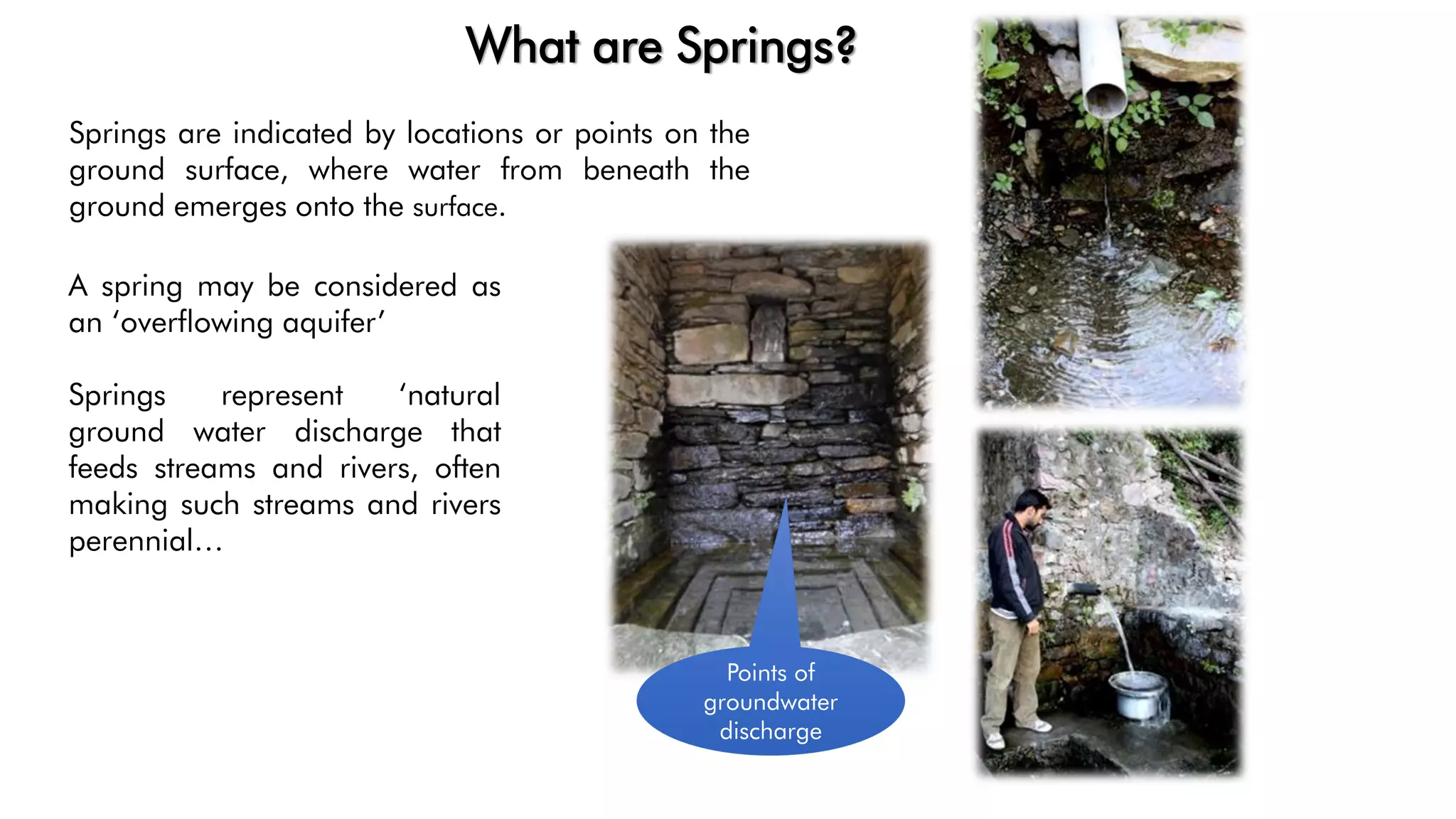
Springs are indicated by locations or points on the
ground surface, where water from beneath the
ground emerges onto the surface.
Points of
groundwater
discharge
What are Springs?
A spring may be considered as
an ‘overflowing aquifer’
Springs represent ‘natural
ground water discharge that
feeds streams and rivers, often
making such streams and rivers
perennial…
Forms of Springs
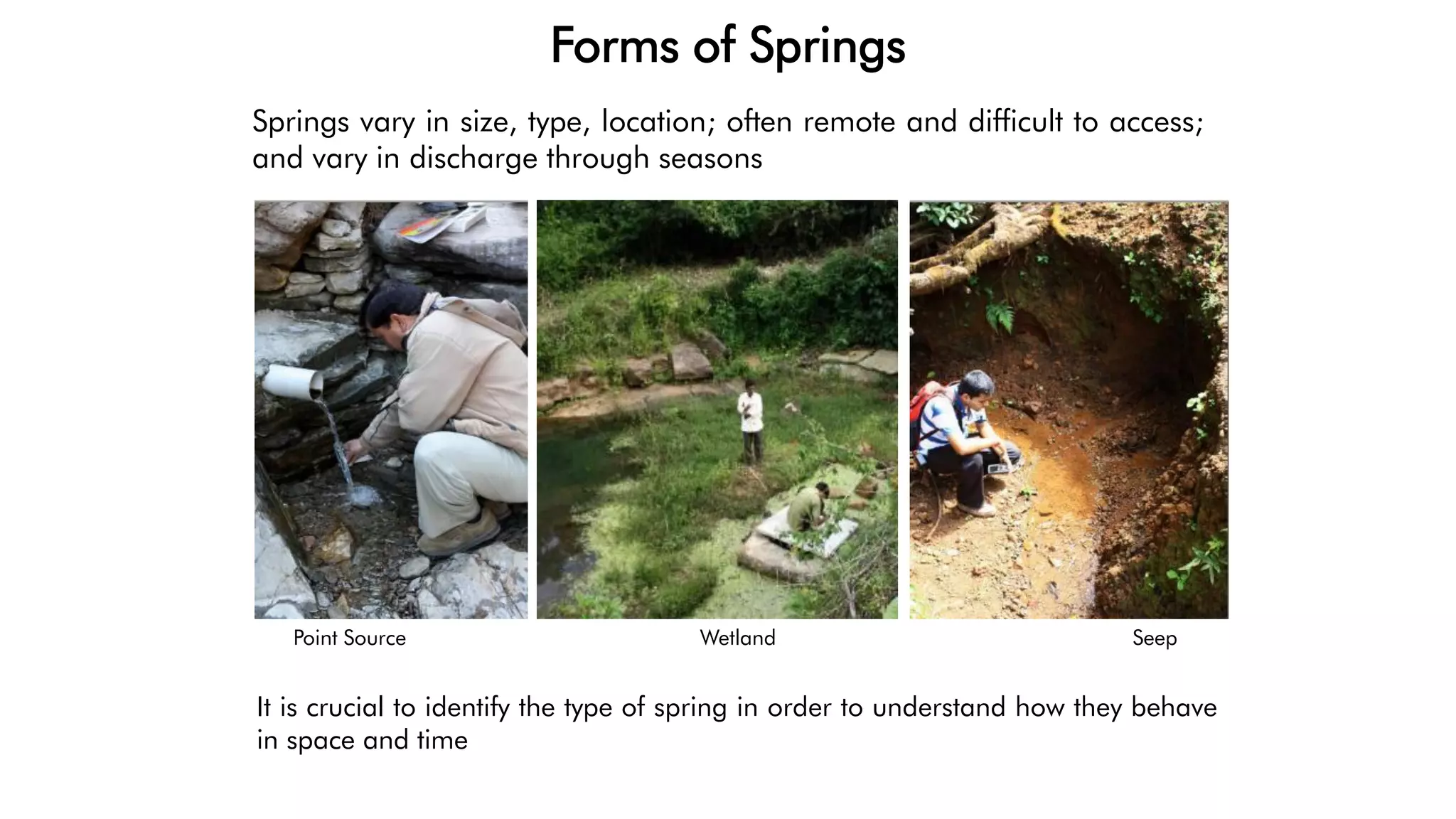
Point Source Wetland Seep
Springs vary in size, type, location; often remote and difficult to access;
and vary in discharge through seasons
It is crucial to identify the type of spring in order to understand how they behave
in space and time
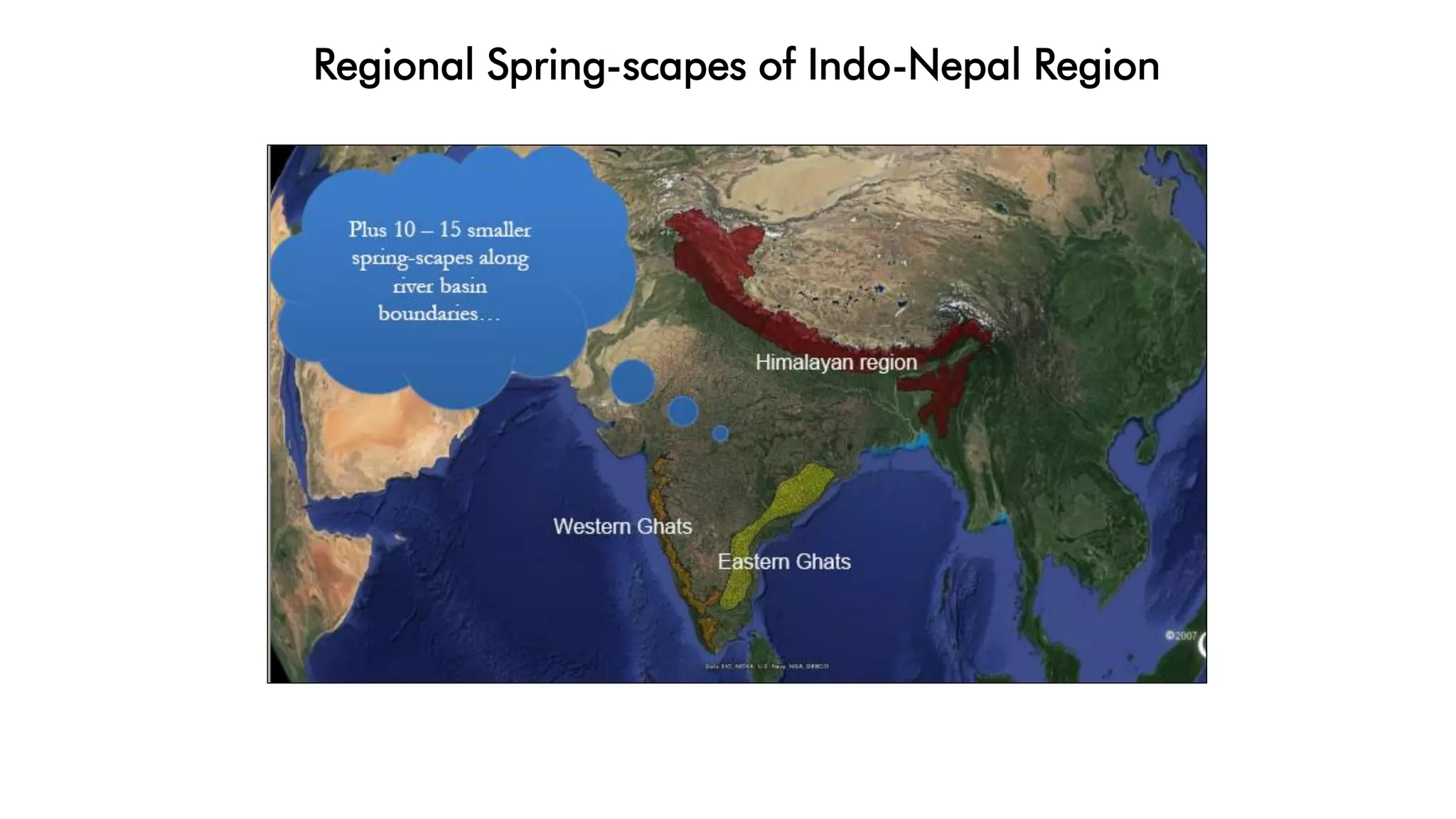
Regional Spring-scapes of Indo-Nepal Region
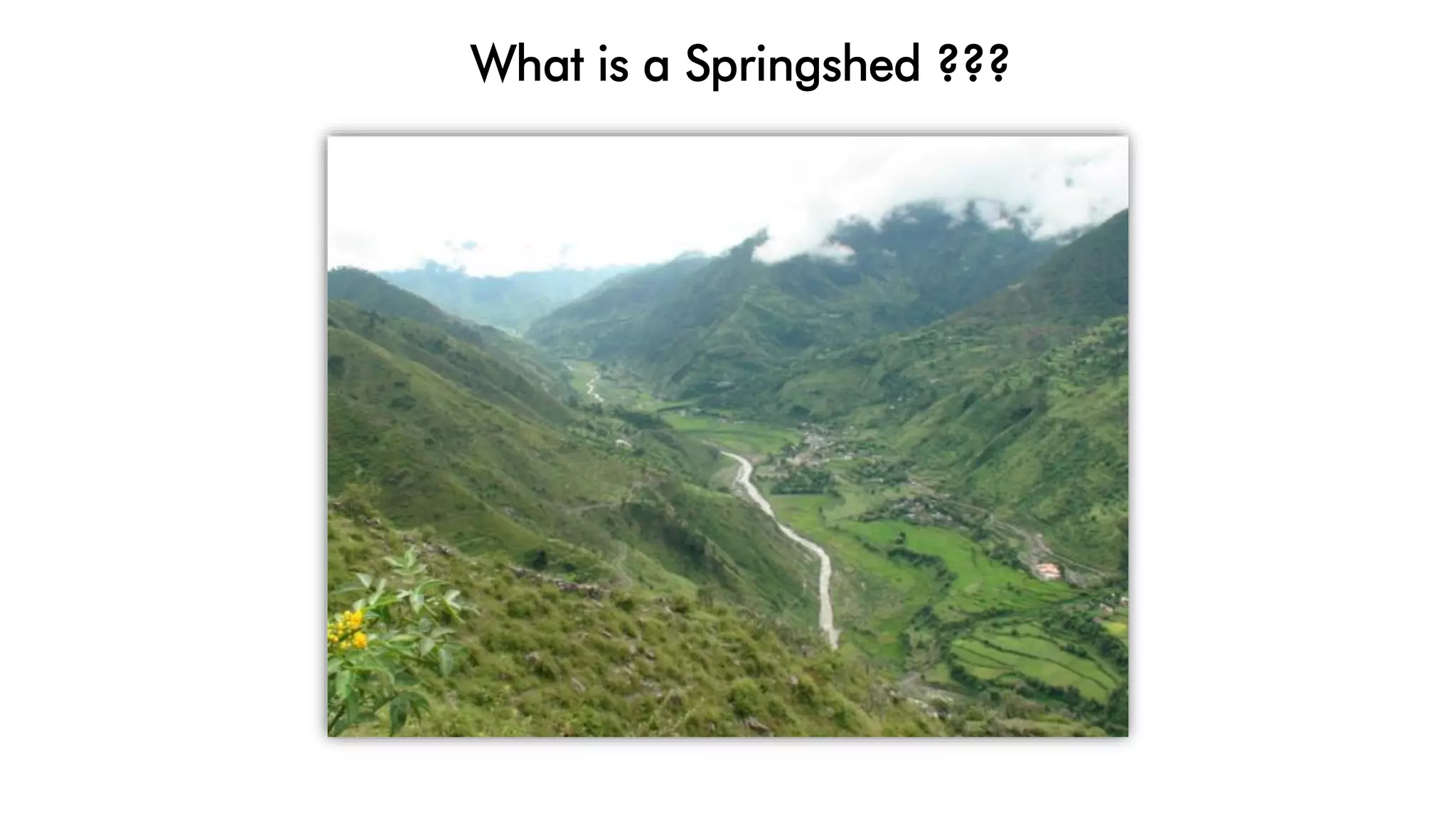
What is a Springshed ???
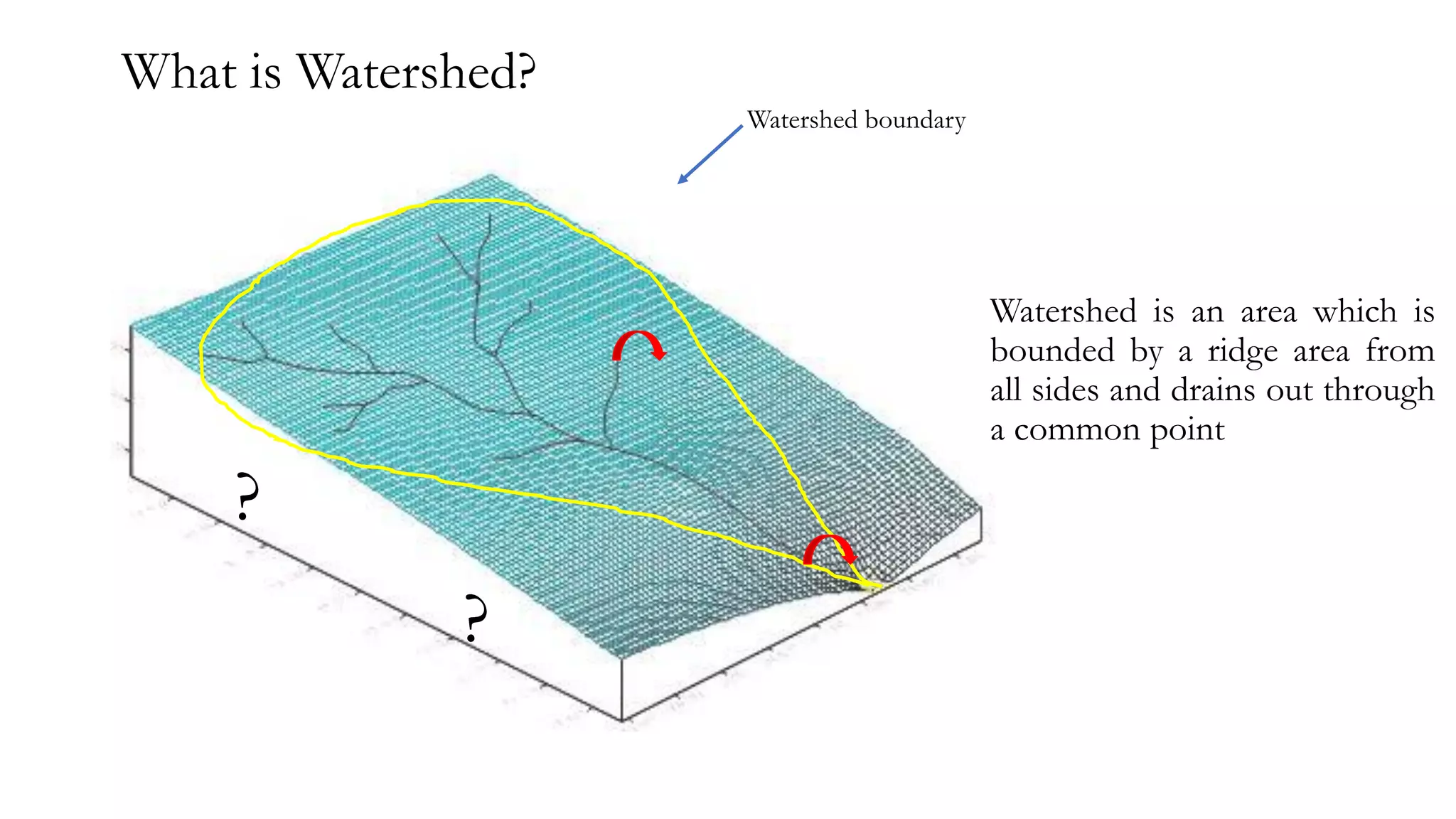
What is Watershed?
Watershed is an area which is
bounded by a ridge area from
all sides and drains out through
a common point
Watershed boundary
?
?
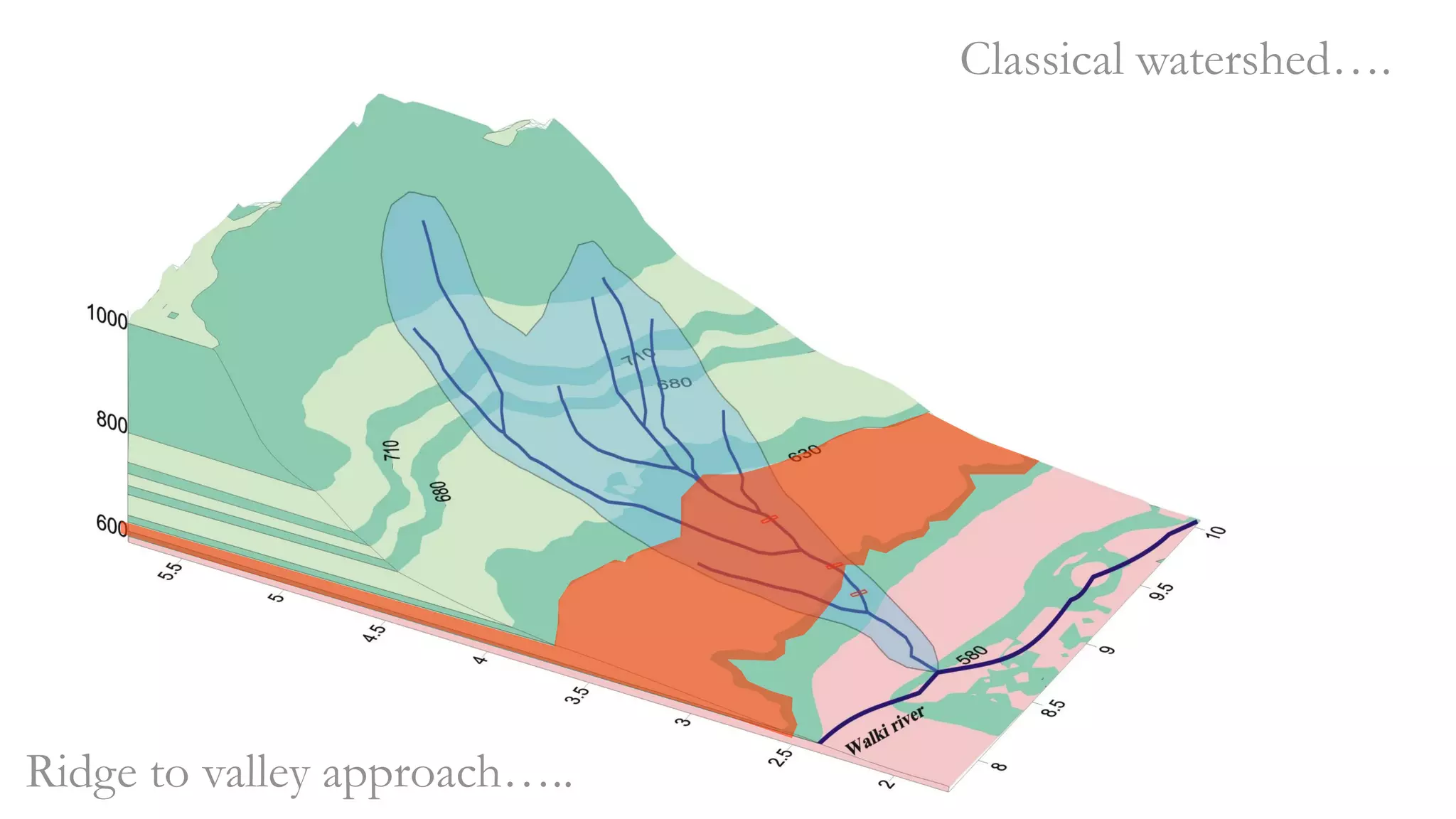
Classical watershed….
Ridge to valley approach…..
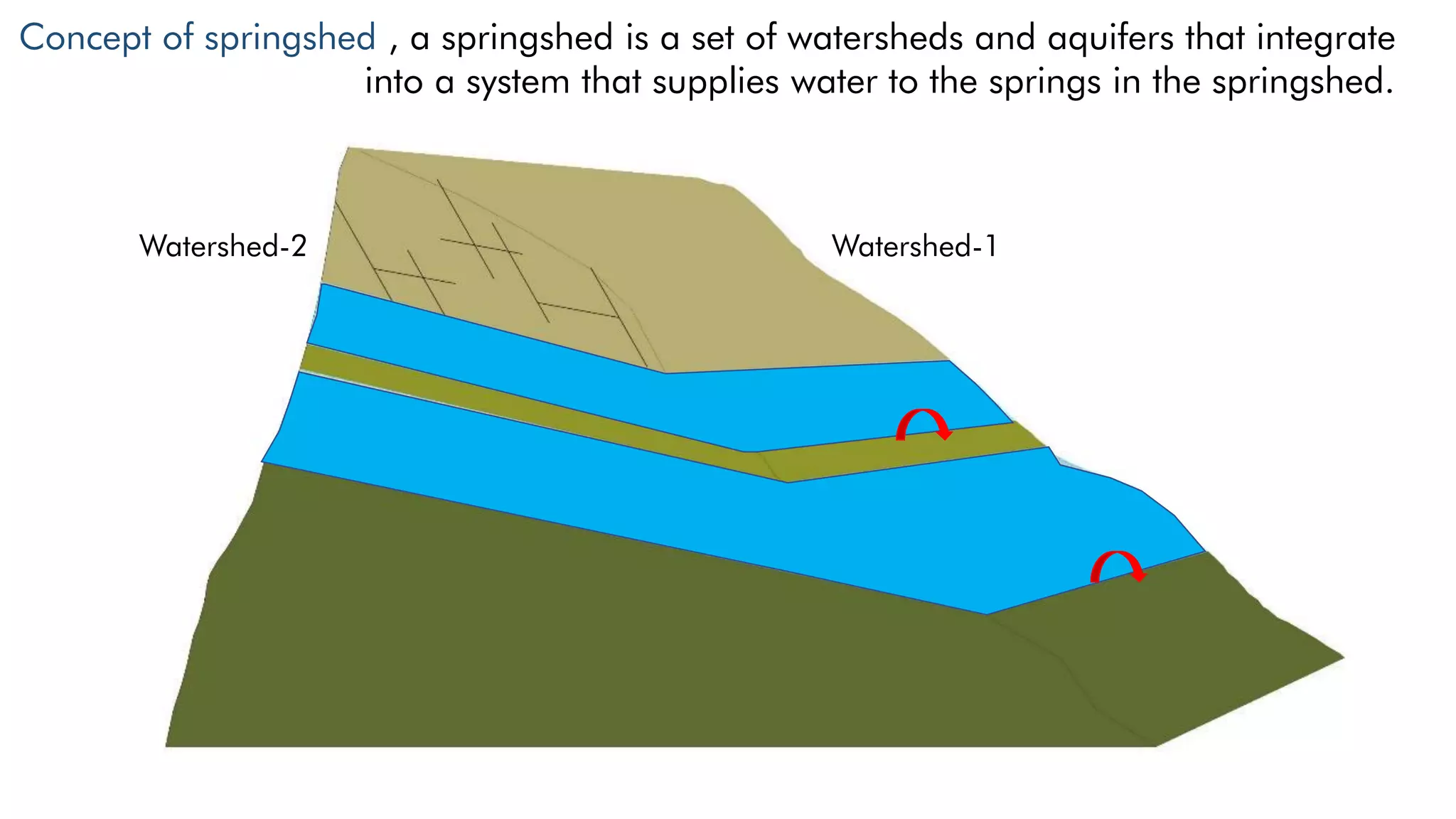
Watershed-1
Watershed-2
Concept of springshed , a springshed is a set of watersheds and aquifers that integrate
into a system that supplies water to the springs in the springshed.
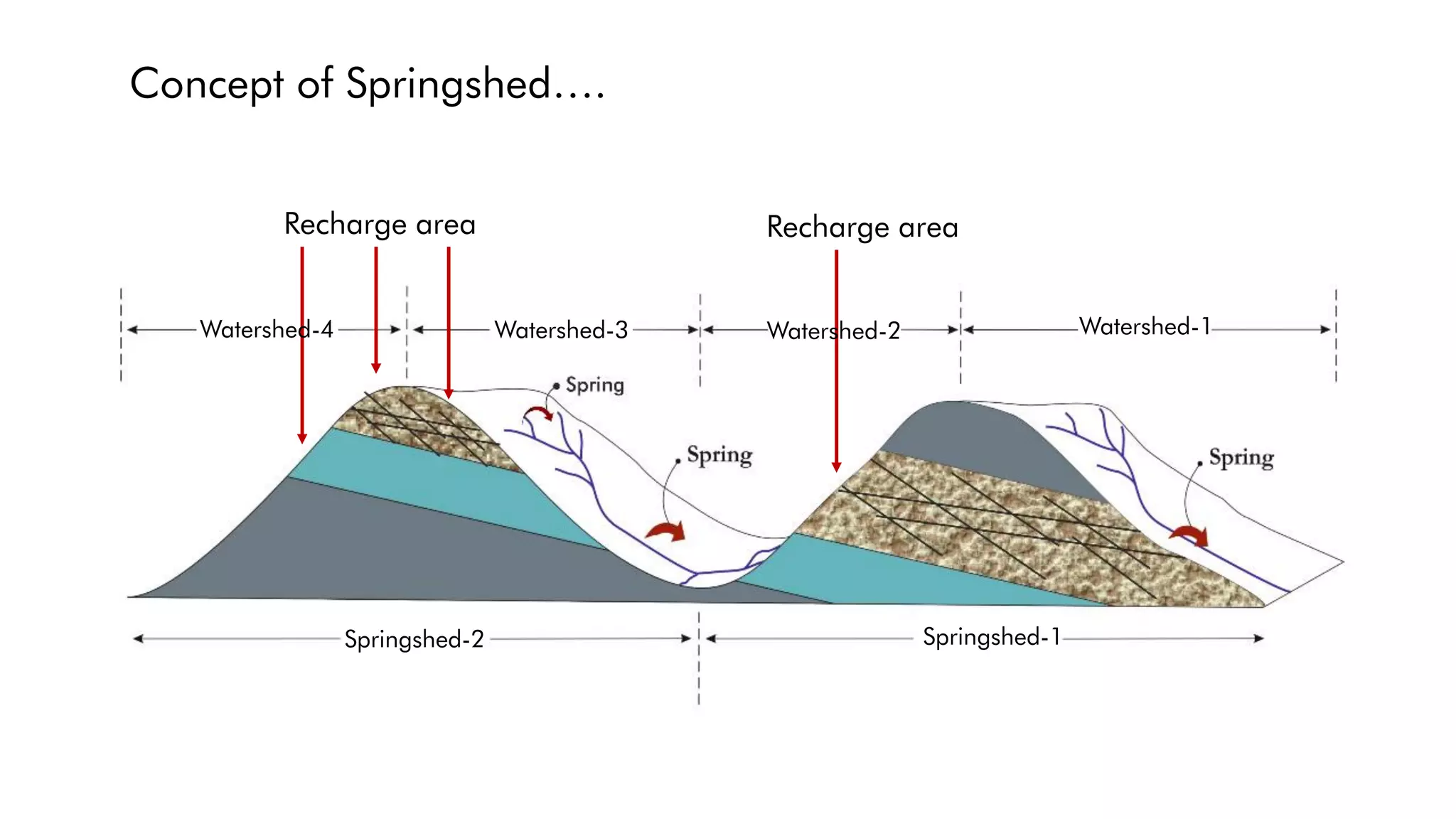
Concept of Springshed….
Recharge area Recharge area
Watershed-1
Watershed-2
Watershed-3
Watershed-4
Springshed-1
Springshed-2
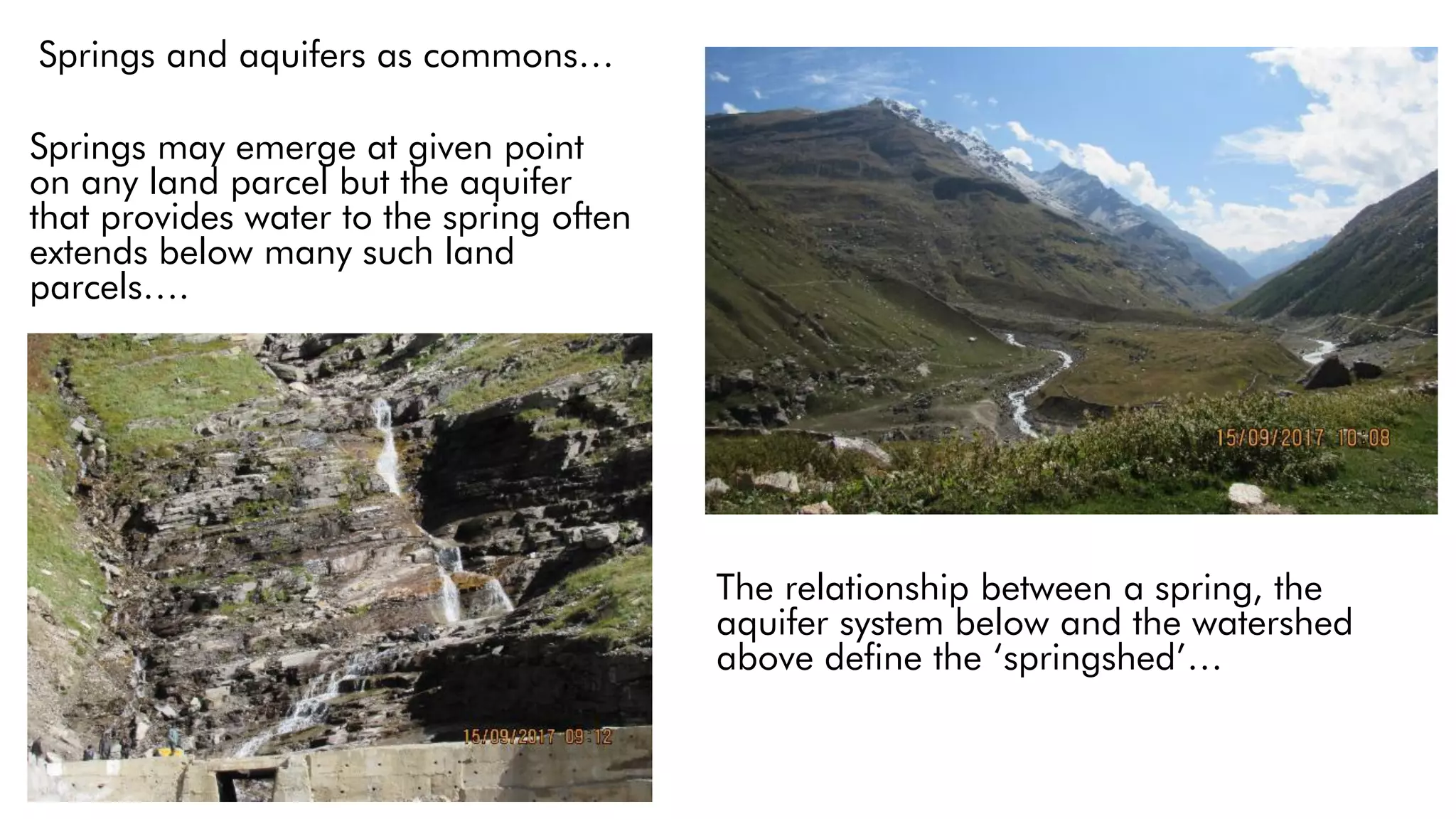
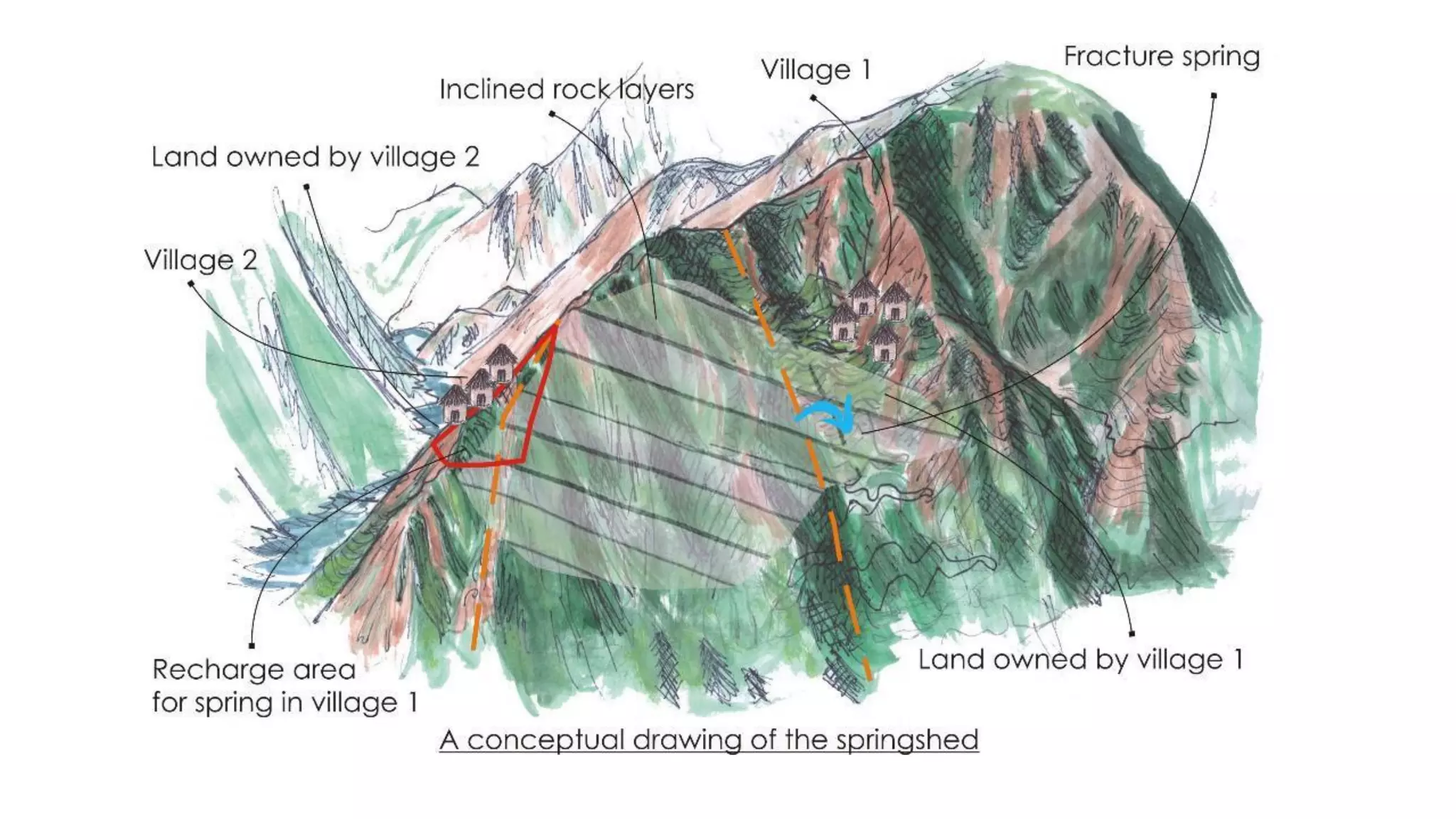
Springs and aquifers as commons…
Springs may emerge at given point
on any land parcel but the aquifer
that provides water to the spring often
extends below many such land
parcels….
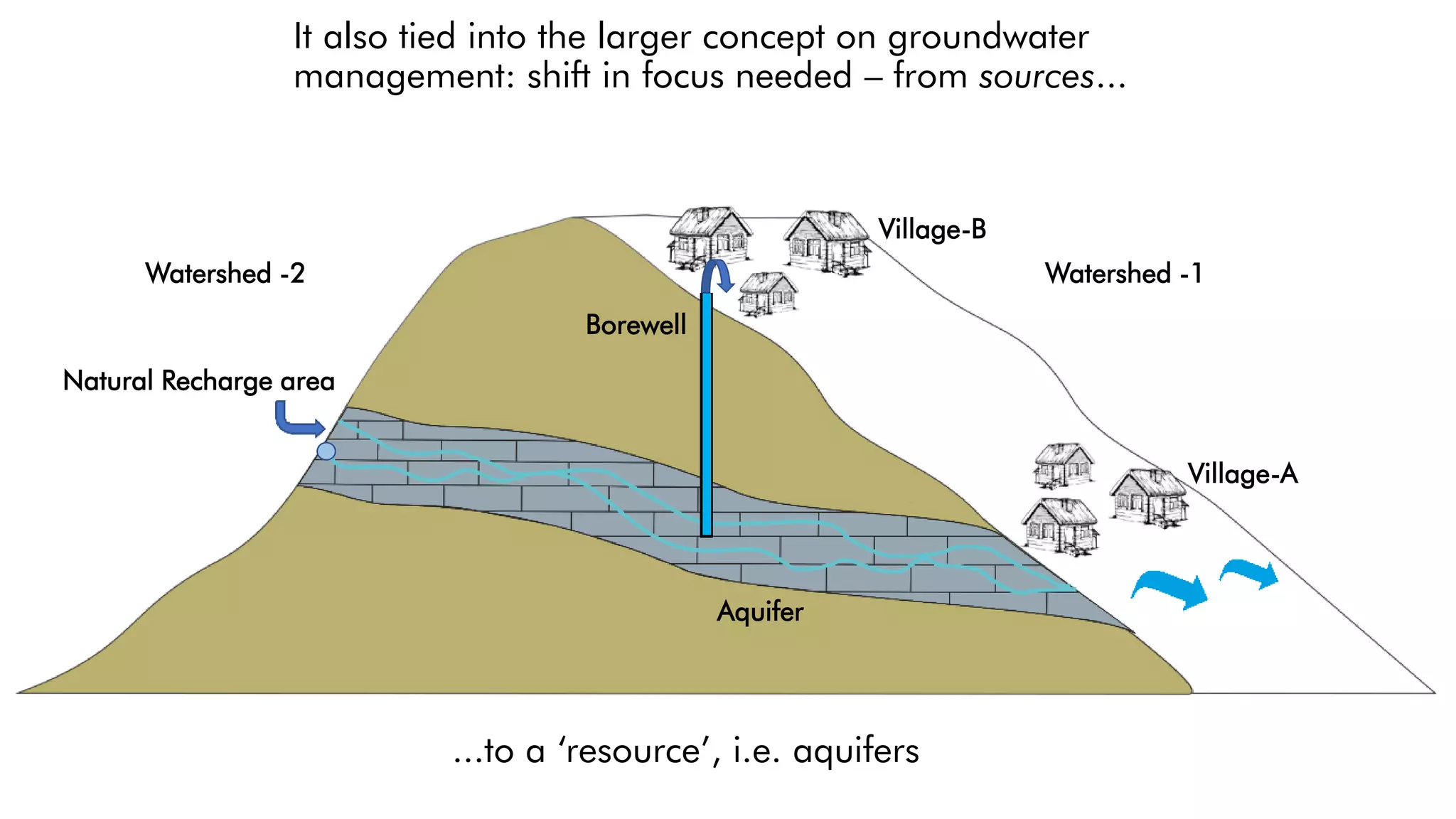
The relationship between a spring, the
aquifer system below and the watershed
above define the ‘springshed’…
Village-A
Village-B
It also tied into the larger concept on groundwater
management: shift in focus needed – from sources...
Watershed -1
Watershed -2
Borewell
Aquifer
...to a ‘resource’, i.e. aquifers
Natural Recharge area
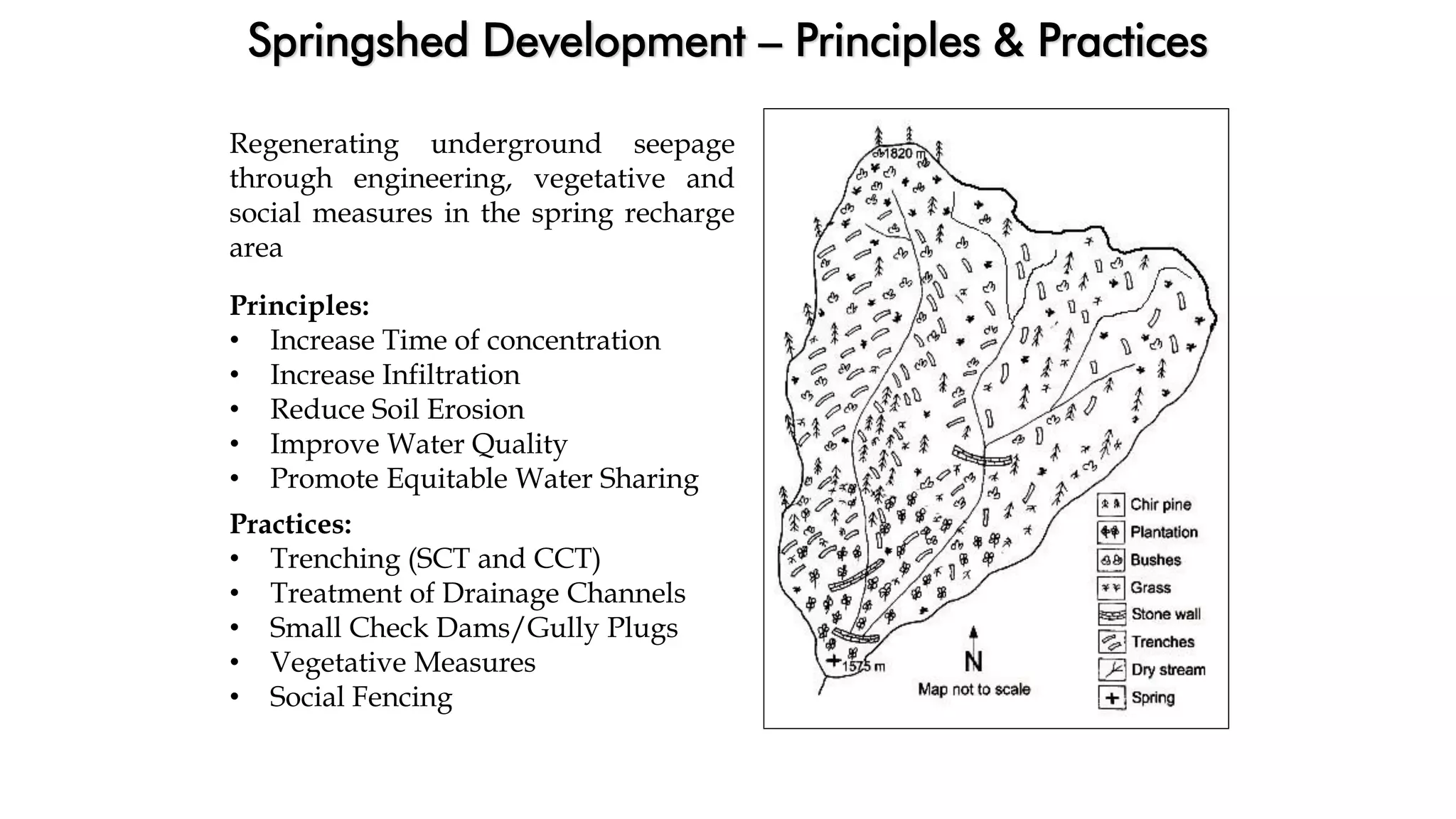
Springshed Development – Principles & Practices
Regenerating underground seepage
through engineering, vegetative and
social measures in the spring recharge
area
Principles:
• Increase Time of concentration
• Increase Infiltration
• Reduce Soil Erosion
• Improve Water Quality
• Promote Equitable Water Sharing
Practices:
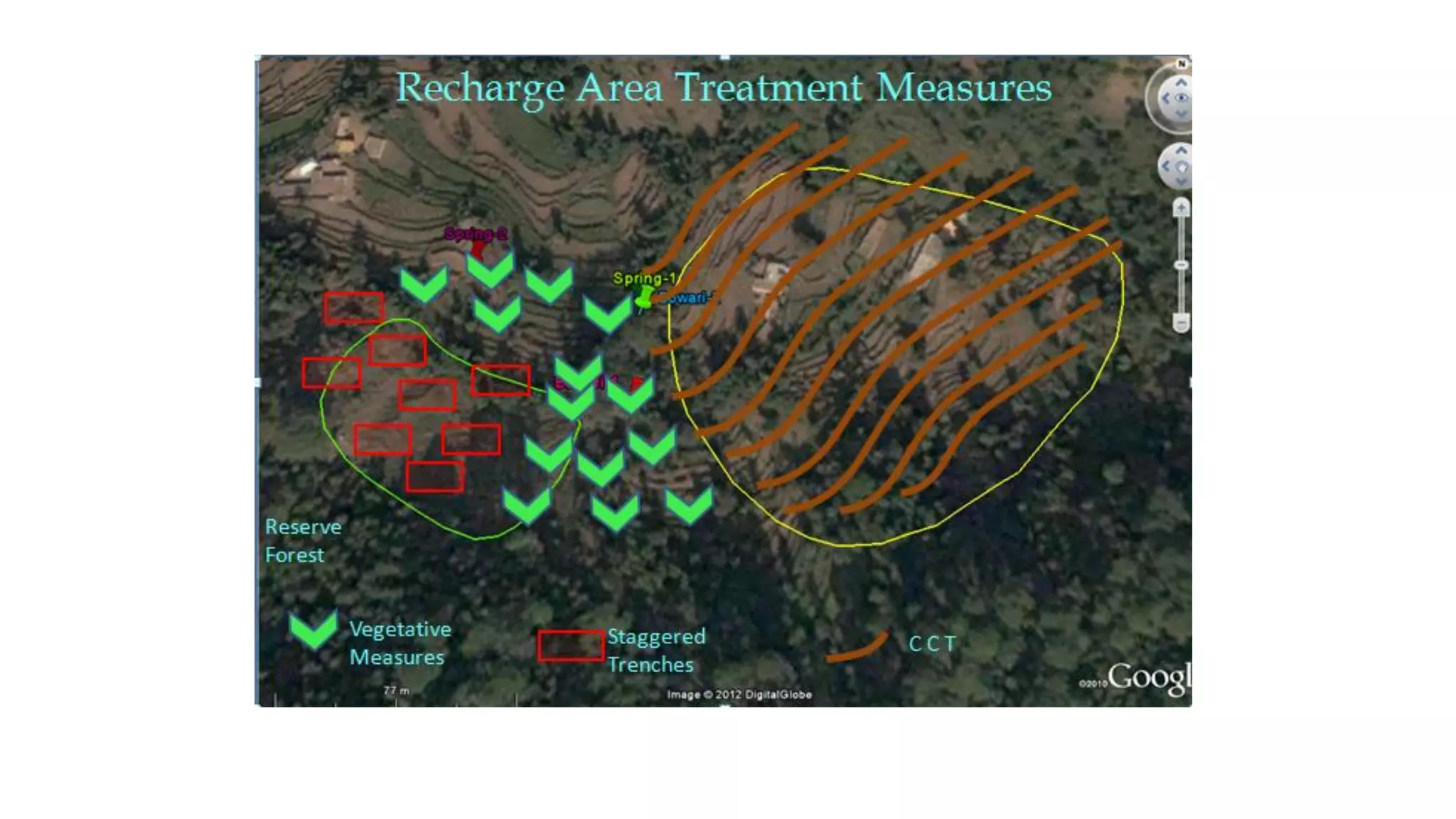
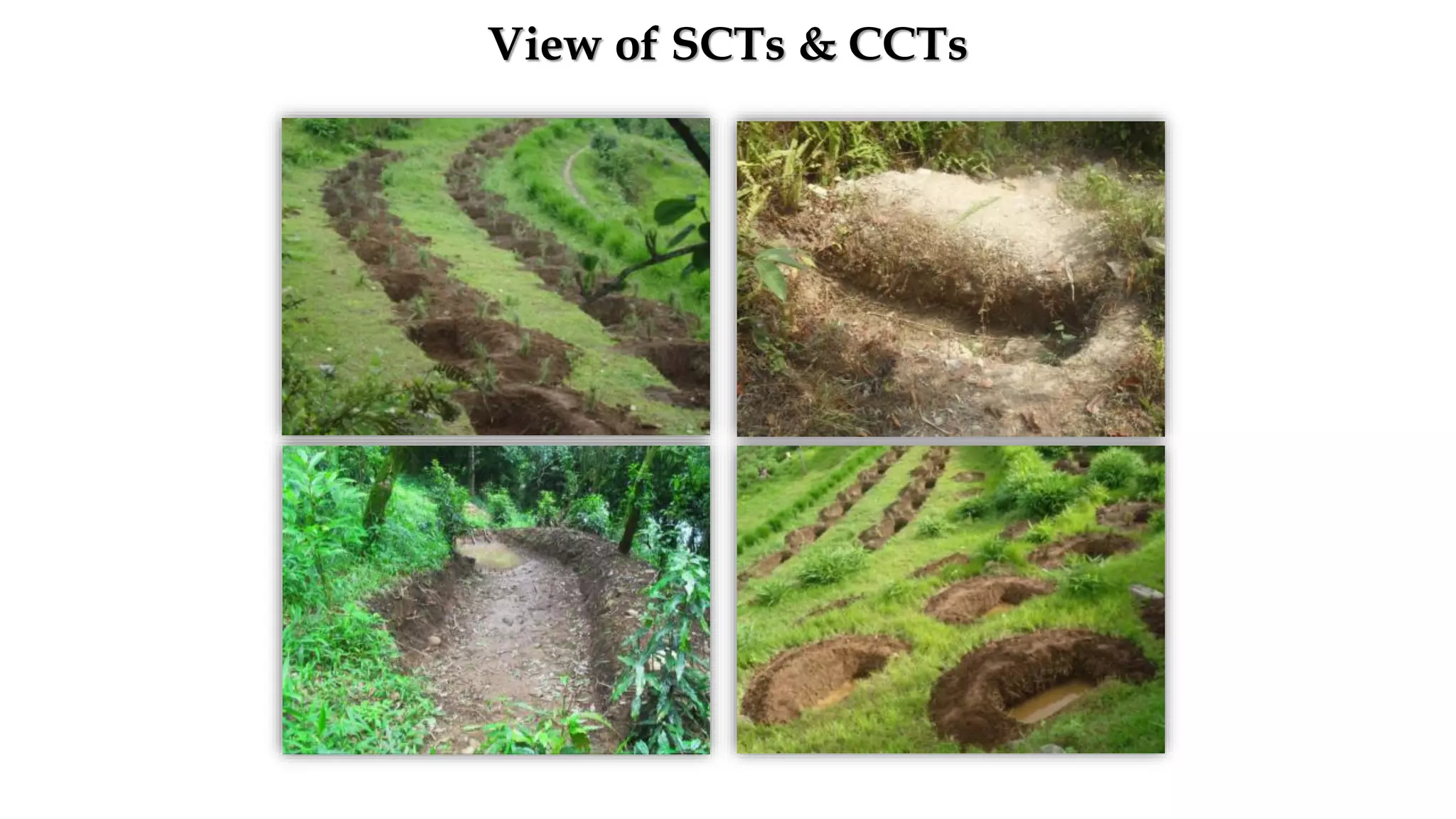
• Trenching (SCT and CCT)
• Treatment of Drainage Channels
• Small Check Dams/Gully Plugs
• Vegetative Measures
• Social Fencing
View of SCTs & CCTs
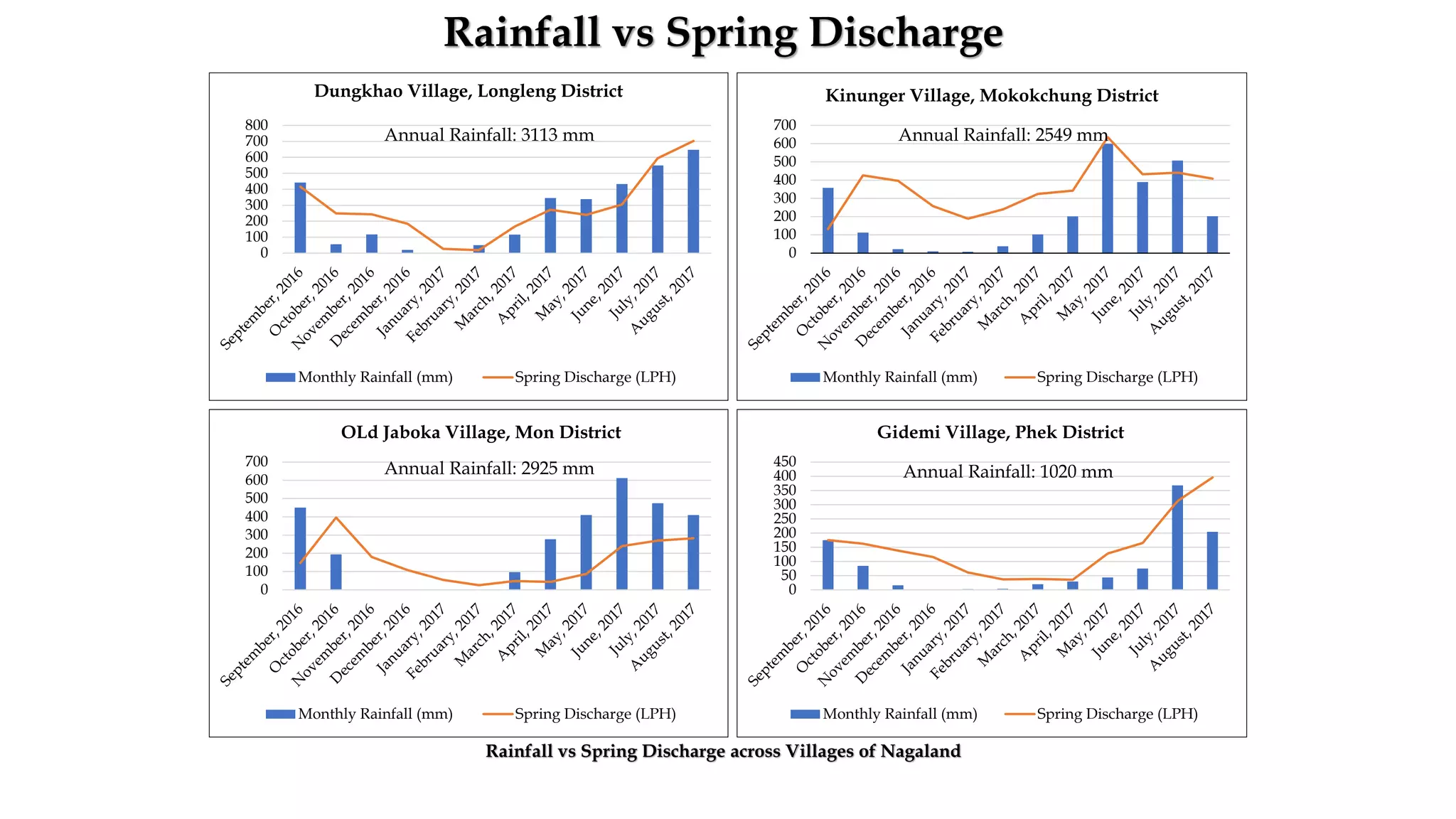
Rainfall vs Spring Discharge
0
100
200
300
400
500
600
700
800
Dungkhao Village, Longleng District
Monthly Rainfall (mm) Spring Discharge (LPH)
Annual Rainfall: 3113 mm
0
100
200
300
400
500
600
700
Kinunger Village, Mokokchung District
Monthly Rainfall (mm) Spring Discharge (LPH)
Annual Rainfall: 2549 mm
0
100
200
300
400
500
600
700
OLd Jaboka Village, Mon District
Monthly Rainfall (mm) Spring Discharge (LPH)
Annual Rainfall: 2925 mm
0
50
100
150
200
250
300
350
400
450
Gidemi Village, Phek District
Monthly Rainfall (mm) Spring Discharge (LPH)
Annual Rainfall: 1020 mm
Rainfall vs Spring Discharge across Villages of Nagaland
0
5000
10000
15000
20000
25000
30000
35000
40000
45000
Daily
Water
Demand
and
Lean
Season
Supply
(Litres/day)
Village, District
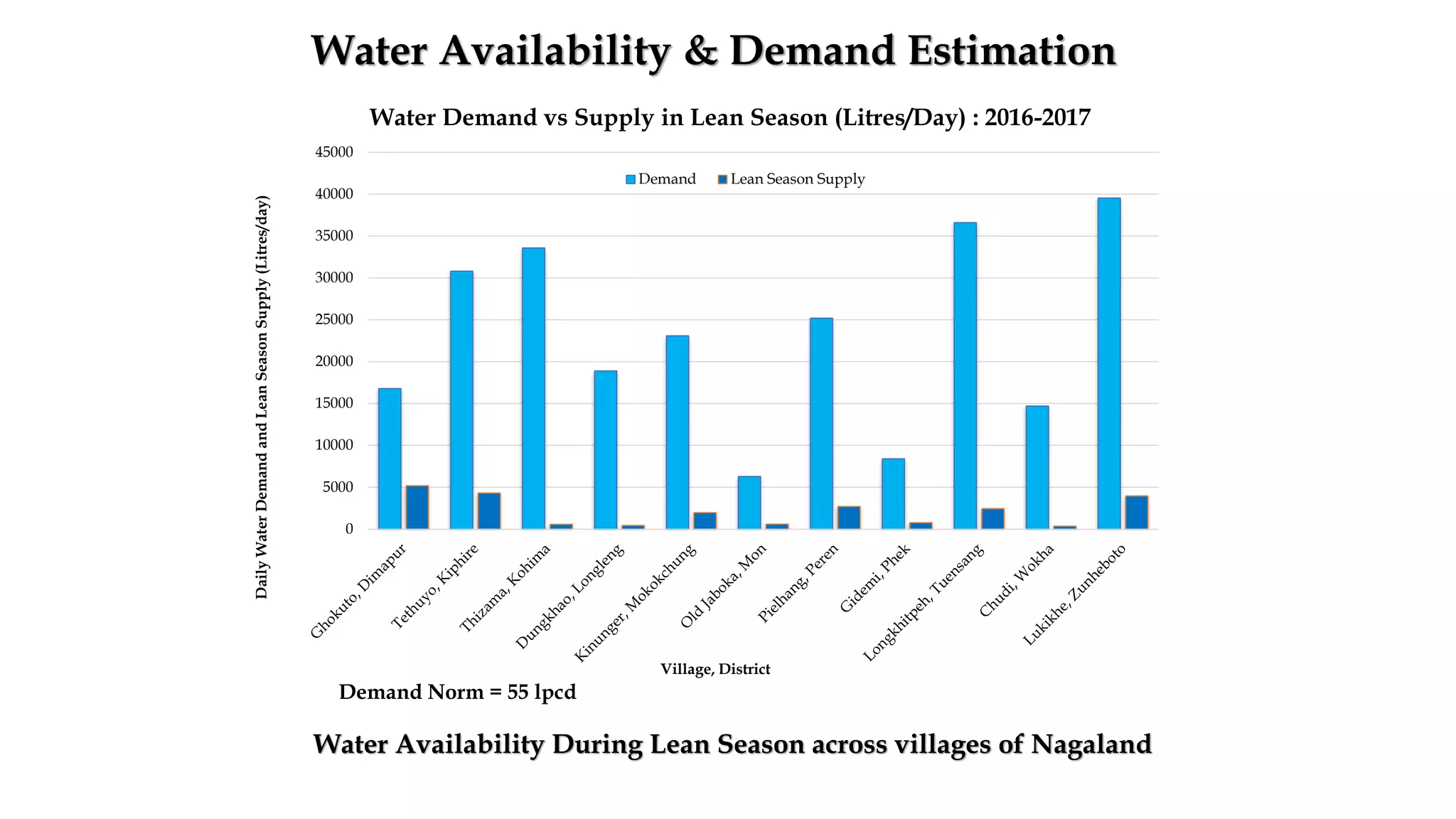
Water Demand vs Supply in Lean Season (Litres/Day) : 2016-2017
Demand Lean Season Supply
Water Availability During Lean Season across villages of Nagaland
Demand Norm = 55 lpcd
Water Availability & Demand Estimation
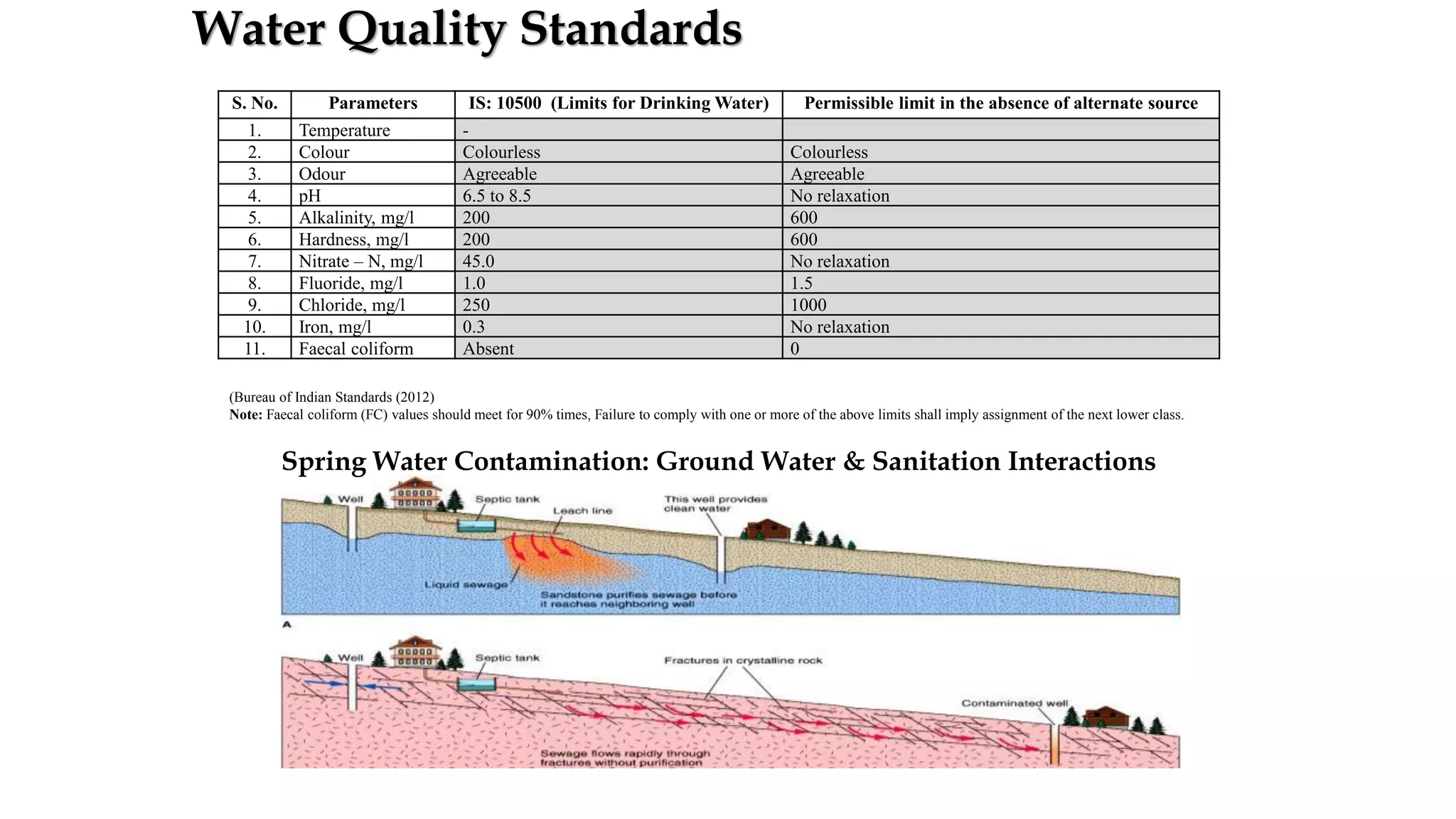
Water Quality Standards
S. No. Parameters IS: 10500 (Limits for Drinking Water) Permissible limit in the absence of alternate source
1. Temperature -
2. Colour Colourless Colourless
3. Odour Agreeable Agreeable
4. pH 6.5 to 8.5 No relaxation
5. Alkalinity, mg/l 200 600
6. Hardness, mg/l 200 600
7. Nitrate – N, mg/l 45.0 No relaxation
8. Fluoride, mg/l 1.0 1.5
9. Chloride, mg/l 250 1000
10. Iron, mg/l 0.3 No relaxation
11. Faecal coliform Absent 0
(Bureau of Indian Standards (2012)
Note: Faecal coliform (FC) values should meet for 90% times, Failure to comply with one or more of the above limits shall imply assignment of the next lower class.
Spring Water Contamination: Ground Water & Sanitation Interactions
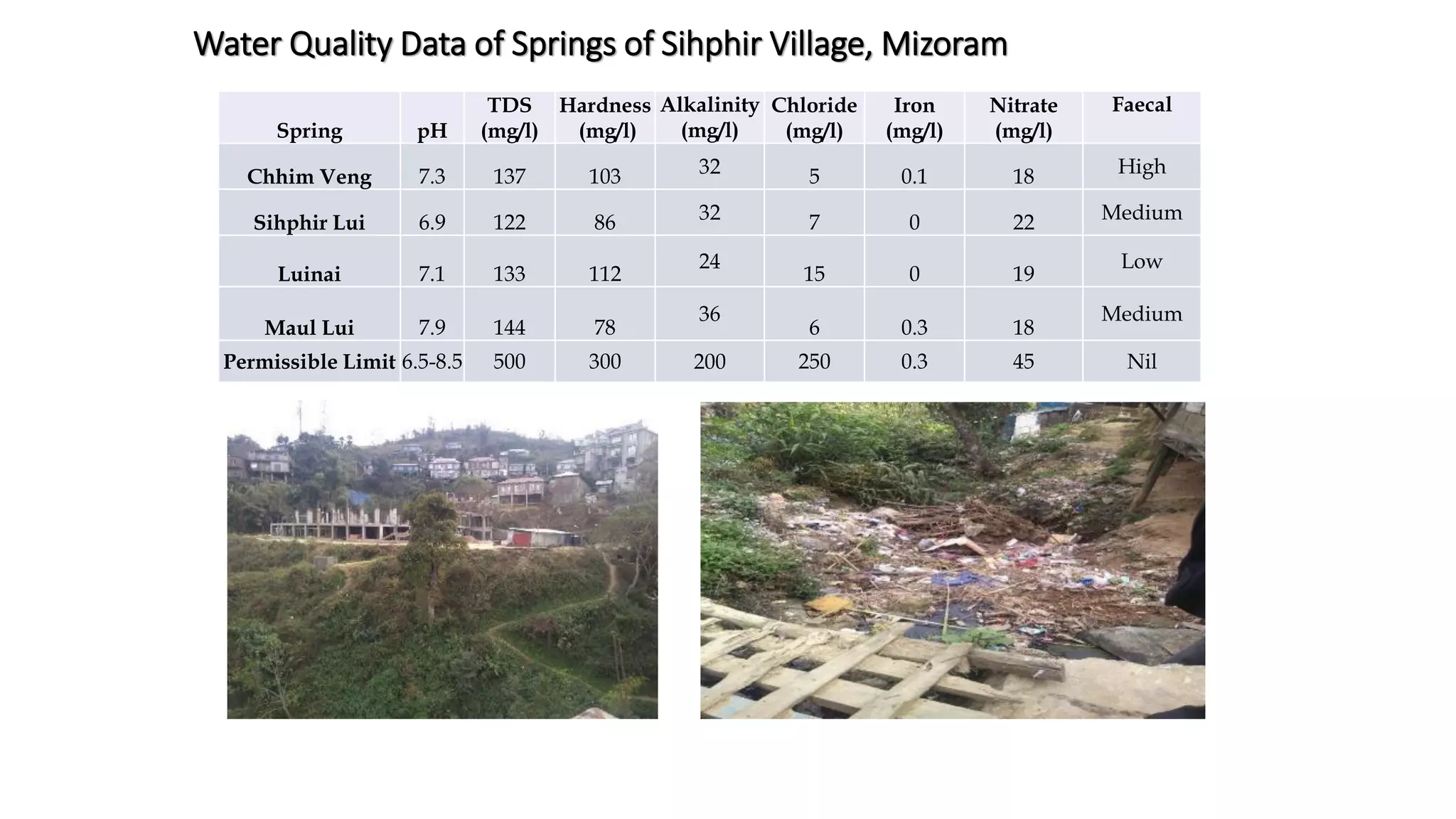
Water Quality Data of Springs of Sihphir Village, Mizoram
Spring pH
TDS
(mg/l)
Hardness
(mg/l)
Alkalinity
(mg/l)
Chloride
(mg/l)
Iron
(mg/l)
Nitrate
(mg/l)
Faecal
Chhim Veng 7.3 137 103 32 5 0.1 18 High
Sihphir Lui 6.9 122 86 32 7 0 22 Medium
Luinai 7.1 133 112
24
15 0 19
Low
Maul Lui 7.9 144 78
36
6 0.3 18
Medium
Permissible Limit 6.5-8.5 500 300 200 250 0.3 45 Nil
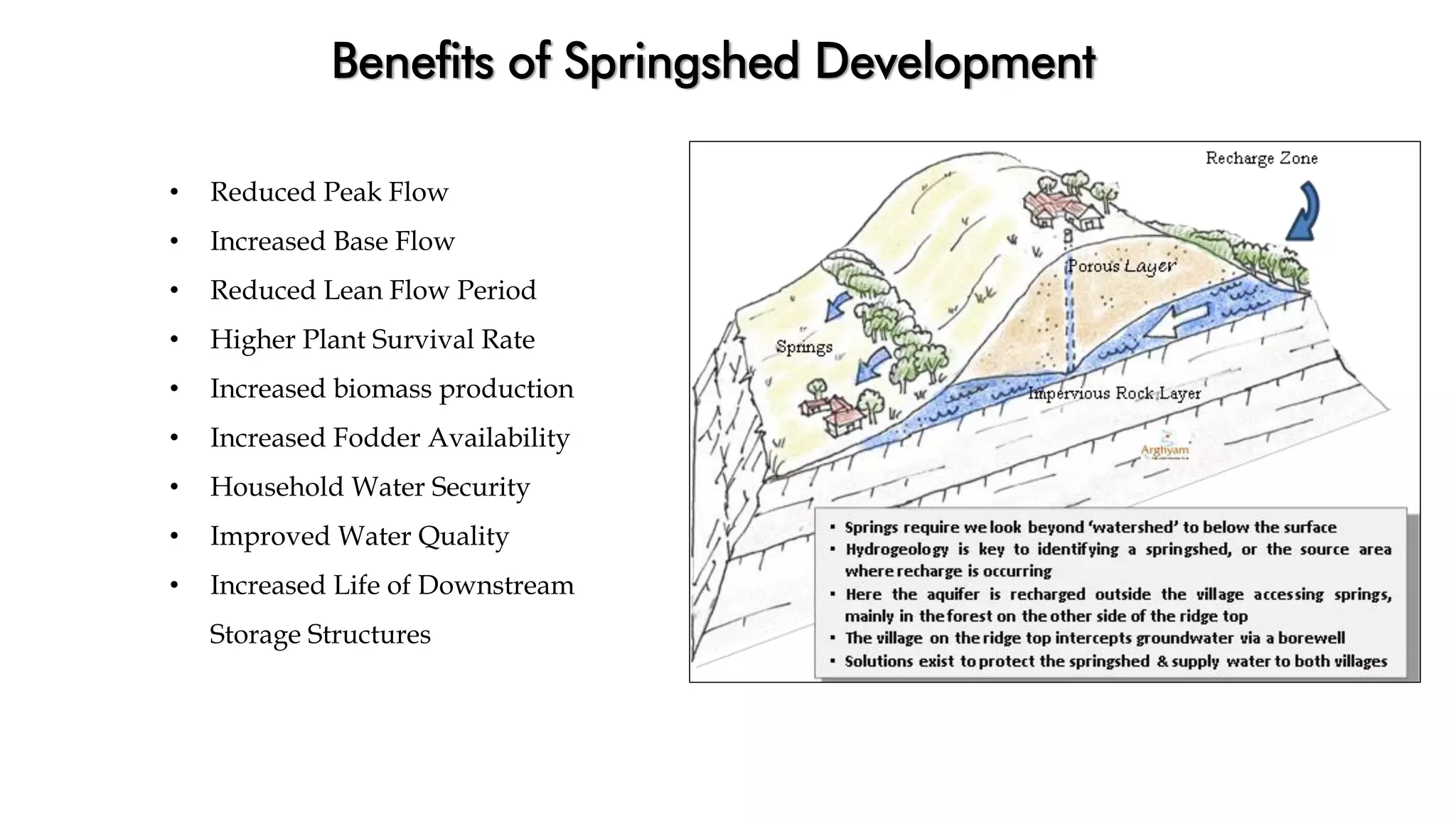
Benefits of Springshed Development
• Reduced Peak Flow
• Increased Base Flow
• Reduced Lean Flow Period
• Higher Plant Survival Rate
• Increased biomass production
• Increased Fodder Availability
• Household Water Security
• Improved Water Quality
• Increased Life of Downstream
Storage Structures
Approach
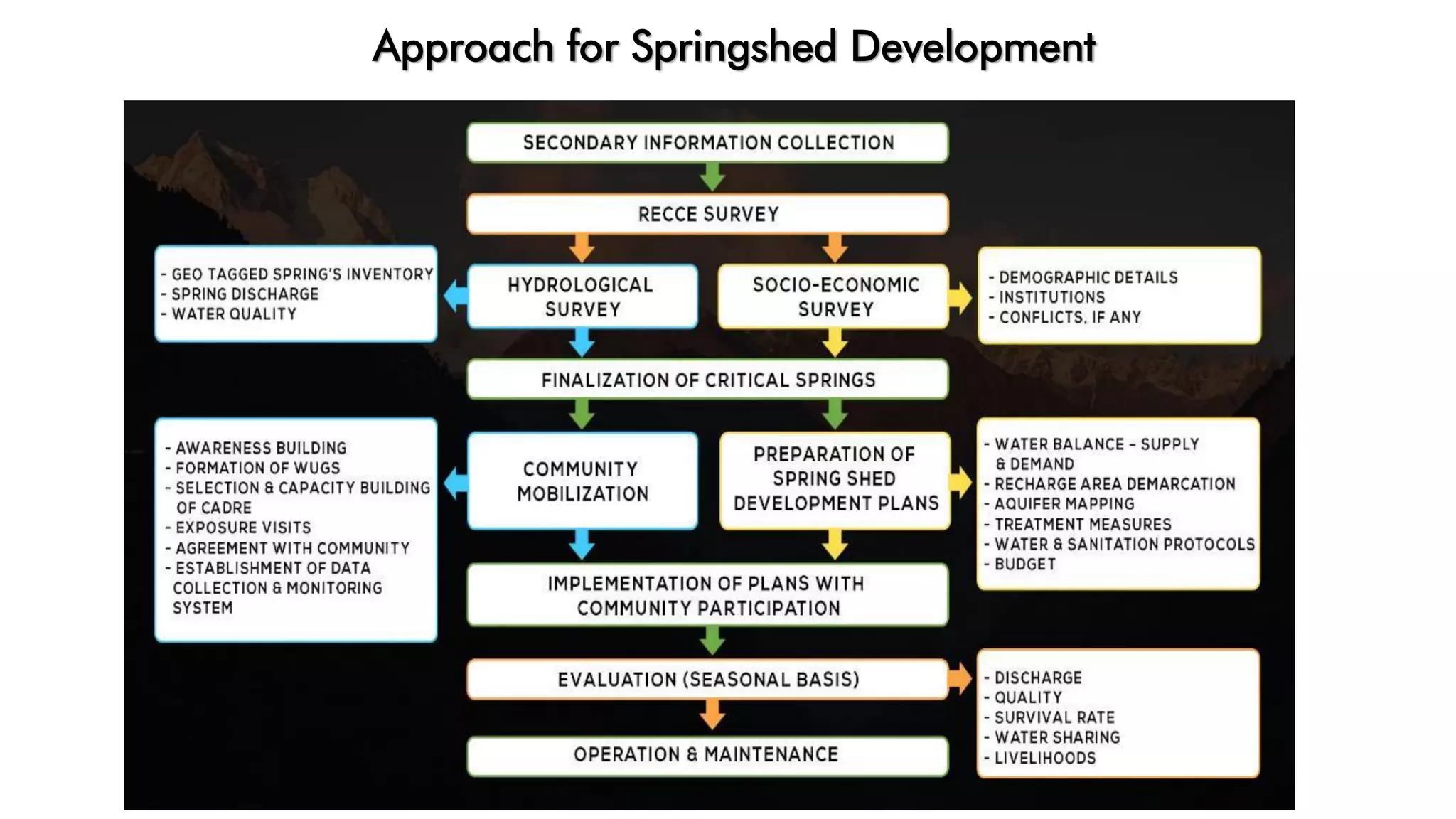
Approach for Springshed Development
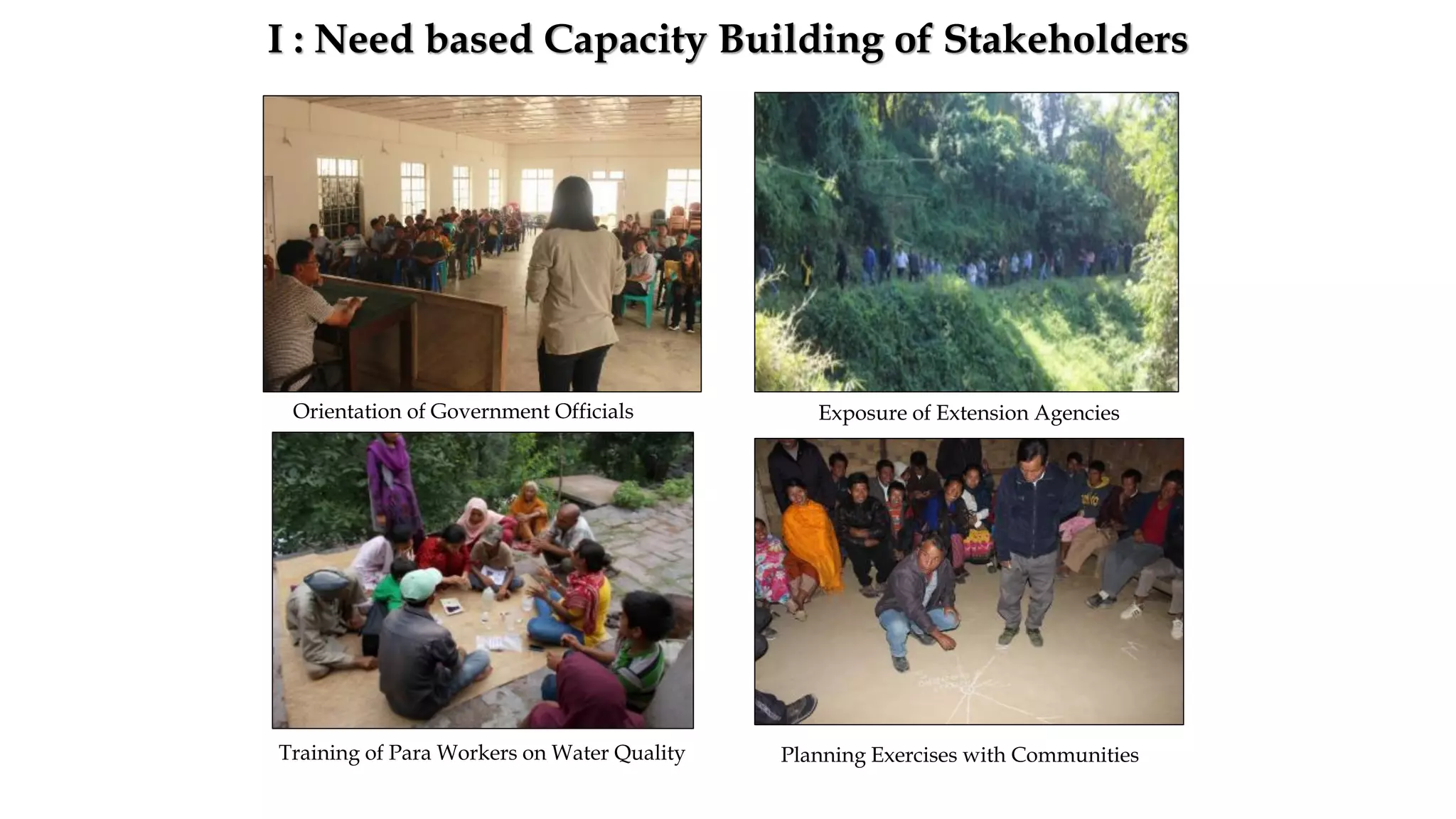
Orientation of Government Officials
Planning Exercises with Communities
I : Need based Capacity Building of Stakeholders
Exposure of Extension Agencies
Training of Para Workers on Water Quality
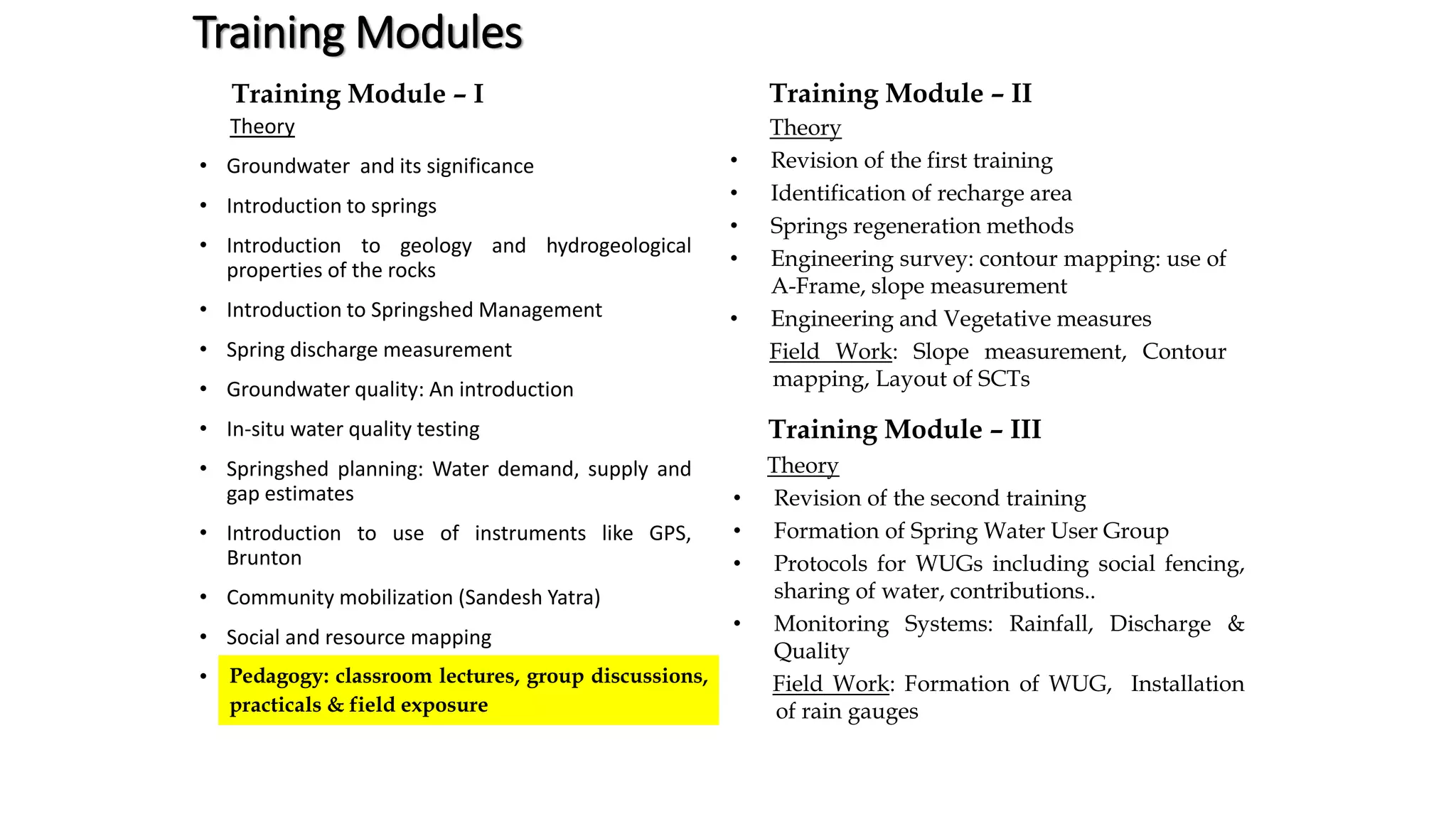
Training Modules
Theory
• Groundwater and its significance
• Introduction to springs
• Introduction to geology and hydrogeological
properties of the rocks
• Introduction to Springshed Management
• Spring discharge measurement
• Groundwater quality: An introduction
• In-situ water quality testing
• Springshed planning: Water demand, supply and
gap estimates
• Introduction to use of instruments like GPS,
Brunton
• Community mobilization (Sandesh Yatra)
• Social and resource mapping
• Field Work: Transect walk, Identification of springs
and rocks, geological mapping
Theory
• Revision of the first training
• Identification of recharge area
• Springs regeneration methods
• Engineering survey: contour mapping: use of
A-Frame, slope measurement
• Engineering and Vegetative measures
Field Work: Slope measurement, Contour
mapping, Layout of SCTs
Training Module – I Training Module – II
Training Module – III
Theory
• Revision of the second training
• Formation of Spring Water User Group
• Protocols for WUGs including social fencing,
sharing of water, contributions..
• Monitoring Systems: Rainfall, Discharge &
Quality
Field Work: Formation of WUG, Installation
of rain gauges
Pedagogy: classroom lectures, group discussions,
practicals & field exposure
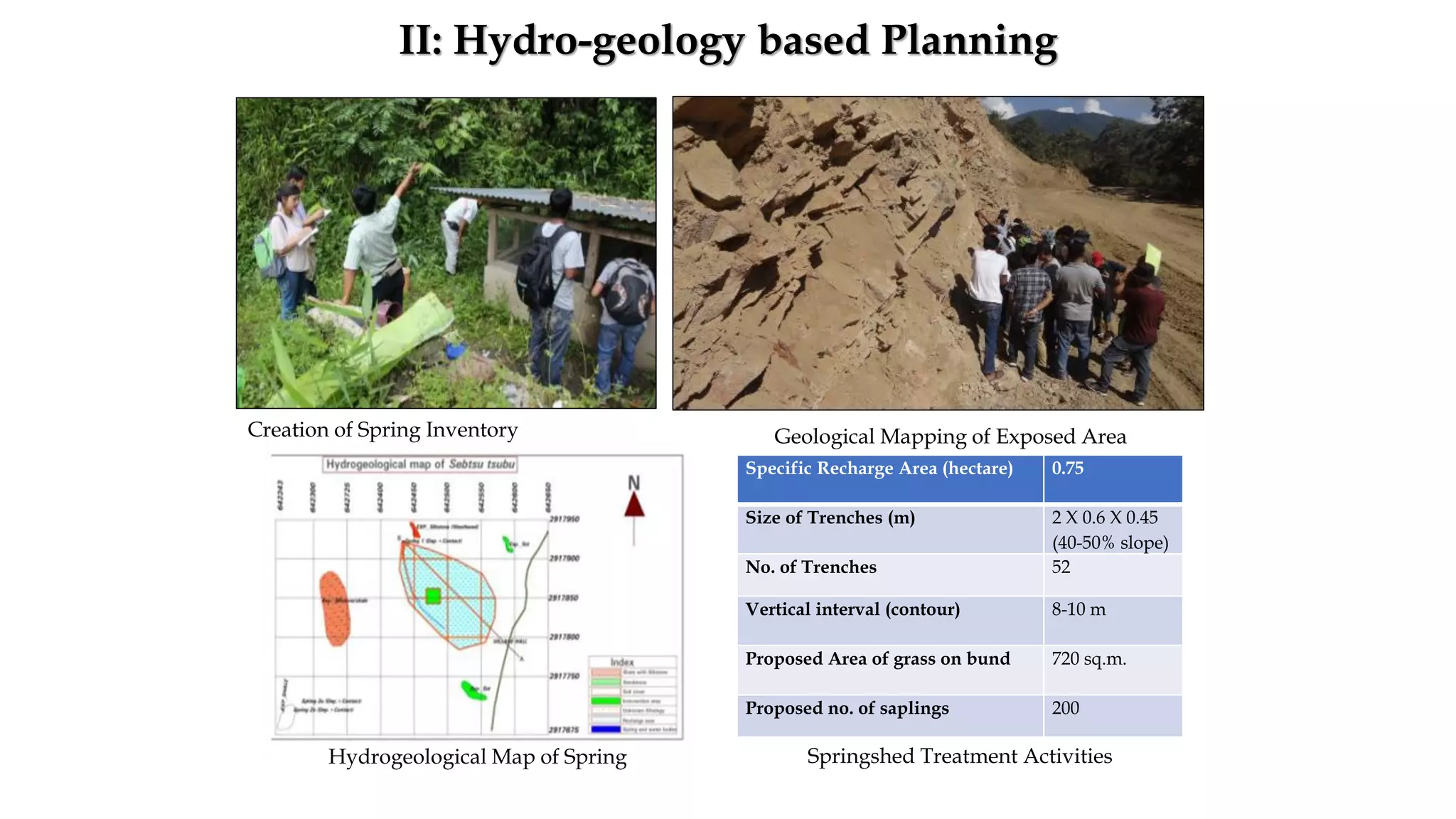
Creation of Spring Inventory Geological Mapping of Exposed Area
Hydrogeological Map of Spring
Specific Recharge Area (hectare) 0.75
Size of Trenches (m) 2 X 0.6 X 0.45
(40-50% slope)
No. of Trenches 52
Vertical interval (contour) 8-10 m
Proposed Area of grass on bund 720 sq.m.
Proposed no. of saplings 200
Springshed Treatment Activities
II: Hydro-geology based Planning
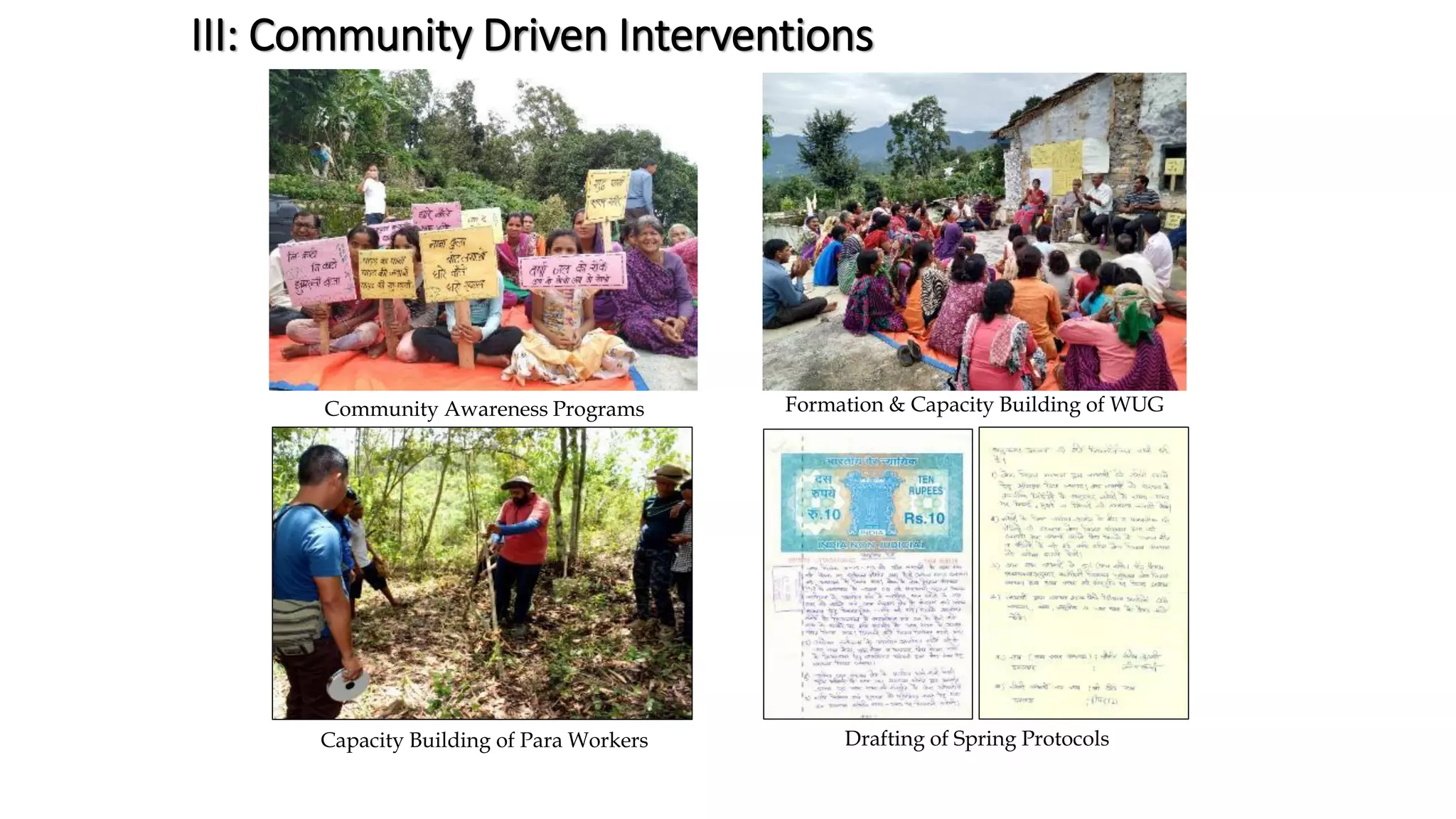
III: Community Driven Interventions
Capacity Building of Para Workers
Community Awareness Programs Formation & Capacity Building of WUG
Drafting of Spring Protocols
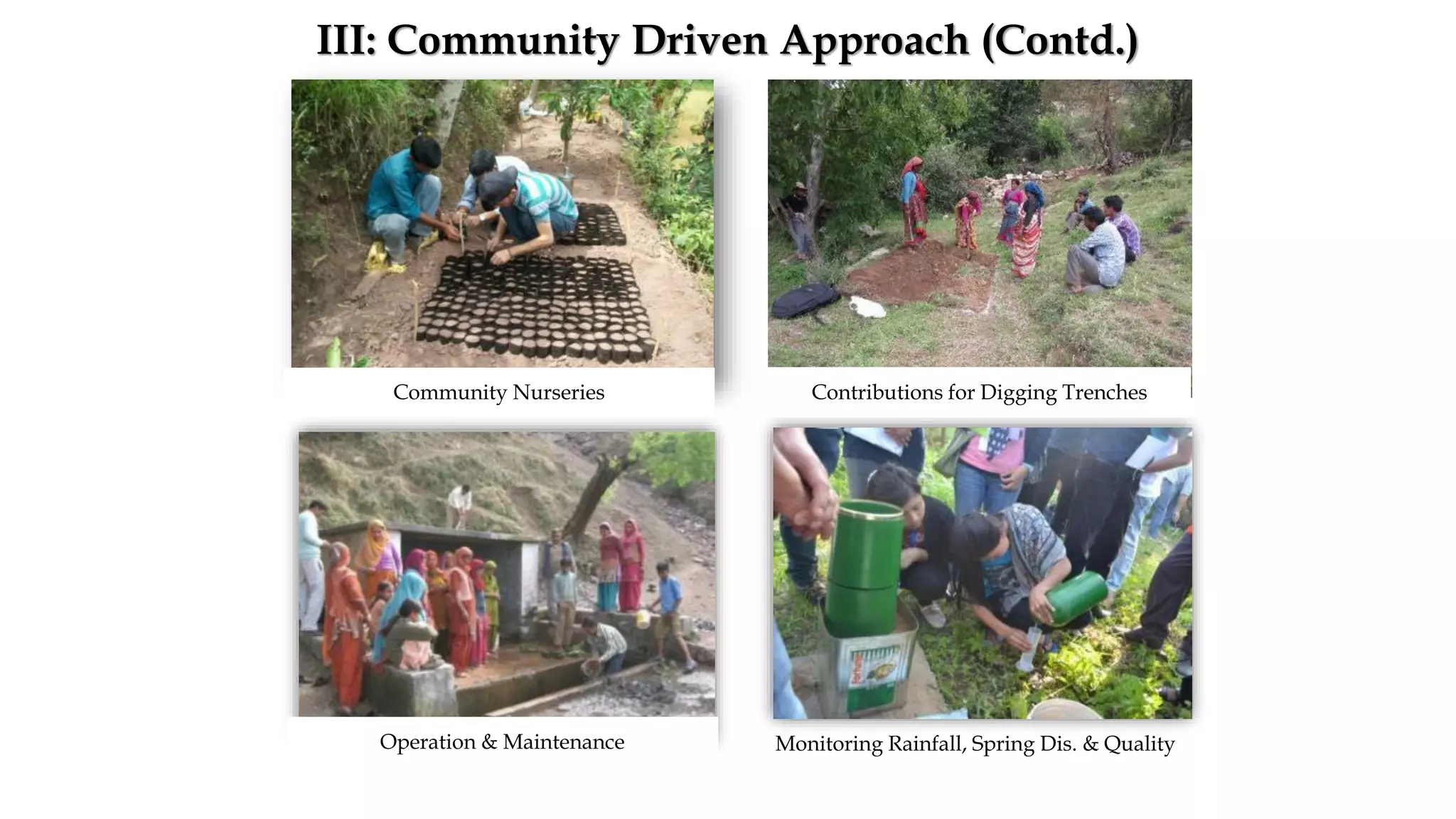
III: Community Driven Approach (Contd.)
Monitoring Rainfall, Spring Dis. & Quality
Operation & Maintenance
Community Nurseries Contributions for Digging Trenches
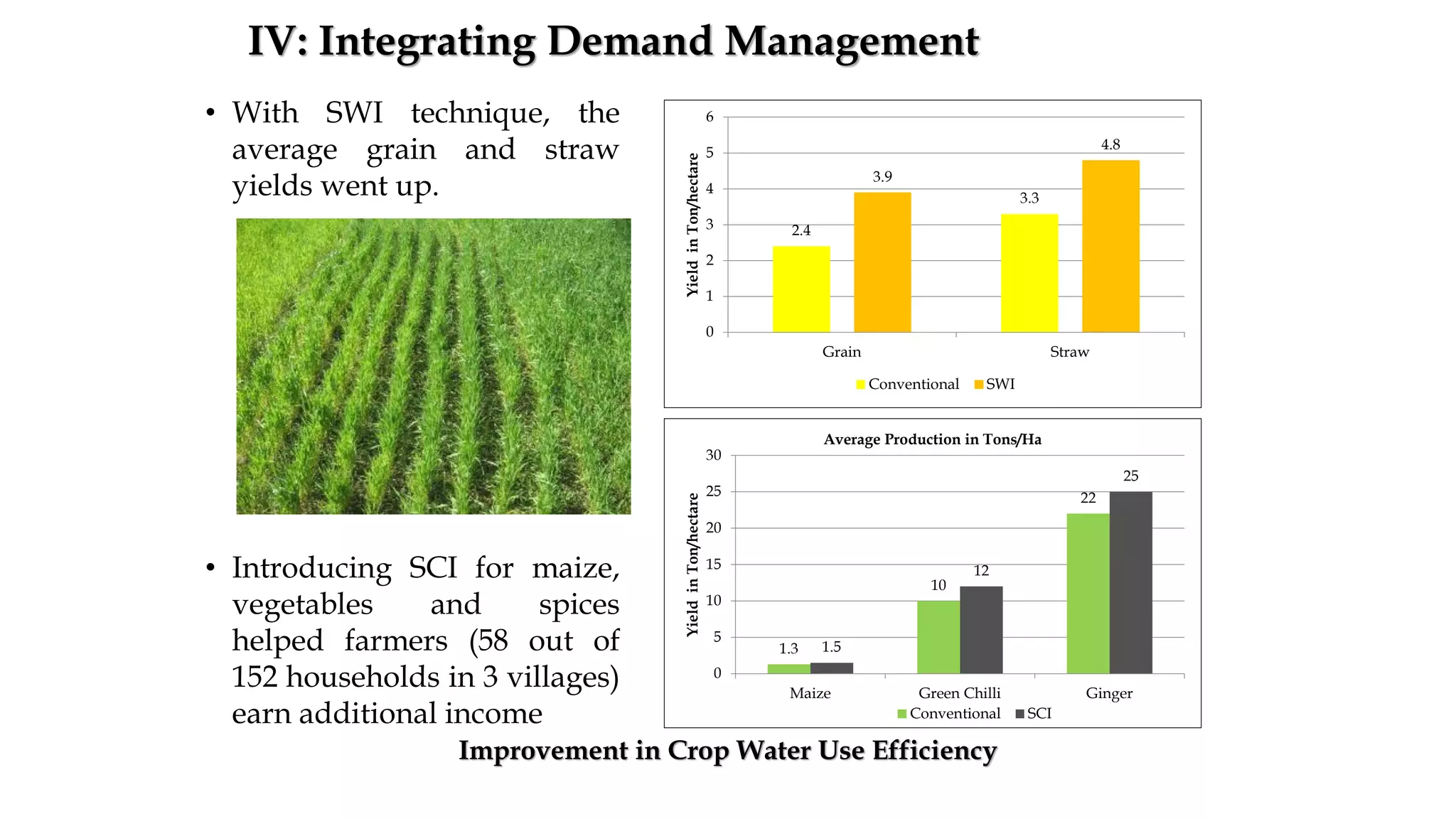
• With SWI technique, the
average grain and straw
yields went up.
• Introducing SCI for maize,
vegetables and spices
helped farmers (58 out of
152 households in 3 villages)
earn additional income
IV: Integrating Demand Management
2.4
3.3
3.9
4.8
0
1
2
3
4
5
6
Grain Straw
Yield
in
Ton/hectare
Conventional SWI
1.3
10
22
1.5
12
25
0
5
10
15
20
25
30
Maize Green Chilli Ginger
Yield
in
Ton/hectare
Average Production in Tons/Ha
Conventional SCI
Improvement in Crop Water Use Efficiency
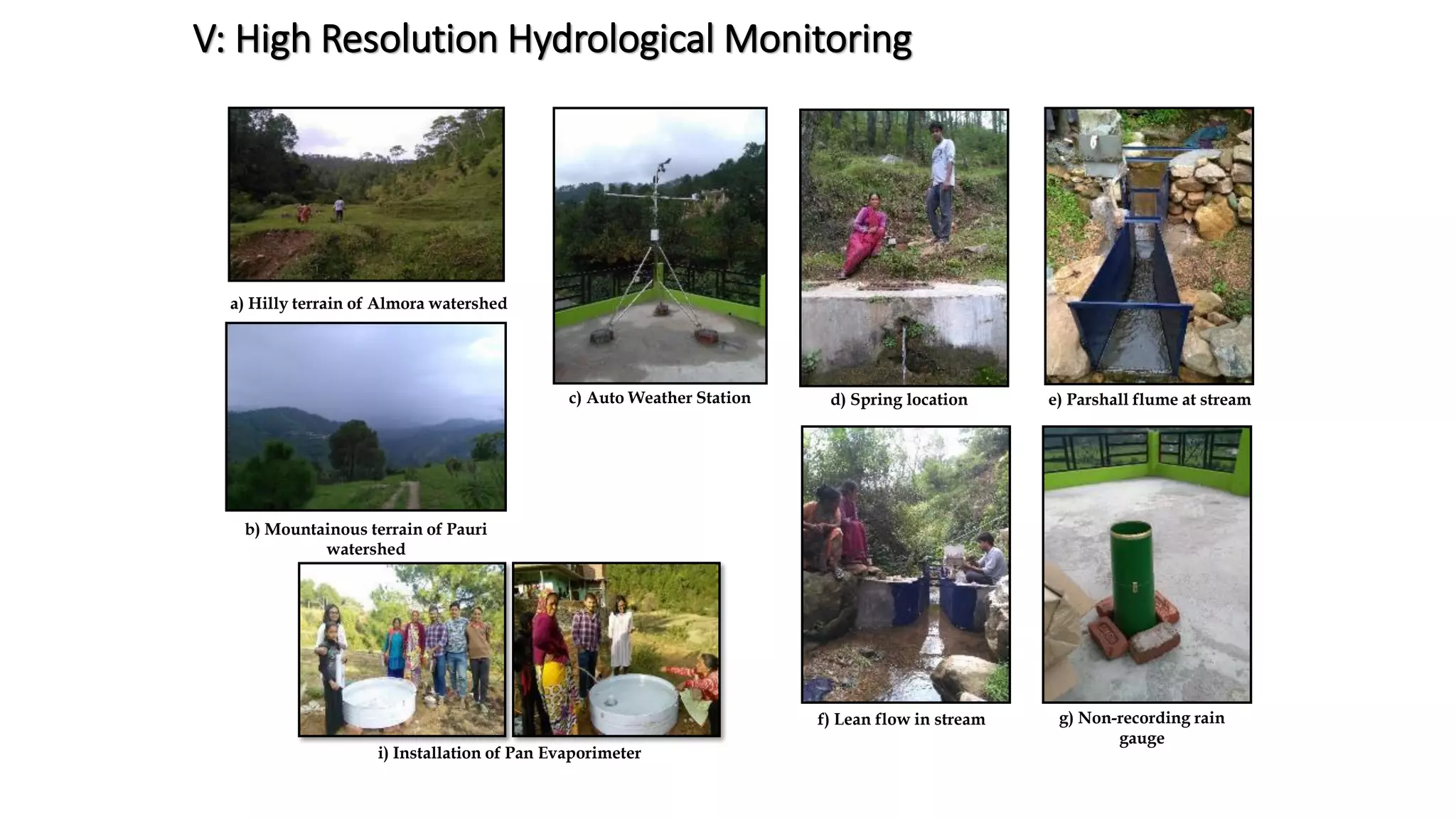
V: High Resolution Hydrological Monitoring
a) Hilly terrain of Almora watershed
c) Auto Weather Station d) Spring location e) Parshall flume at stream
f) Lean flow in stream g) Non-recording rain
gauge
i) Installation of Pan Evaporimeter
b) Mountainous terrain of Pauri
watershed
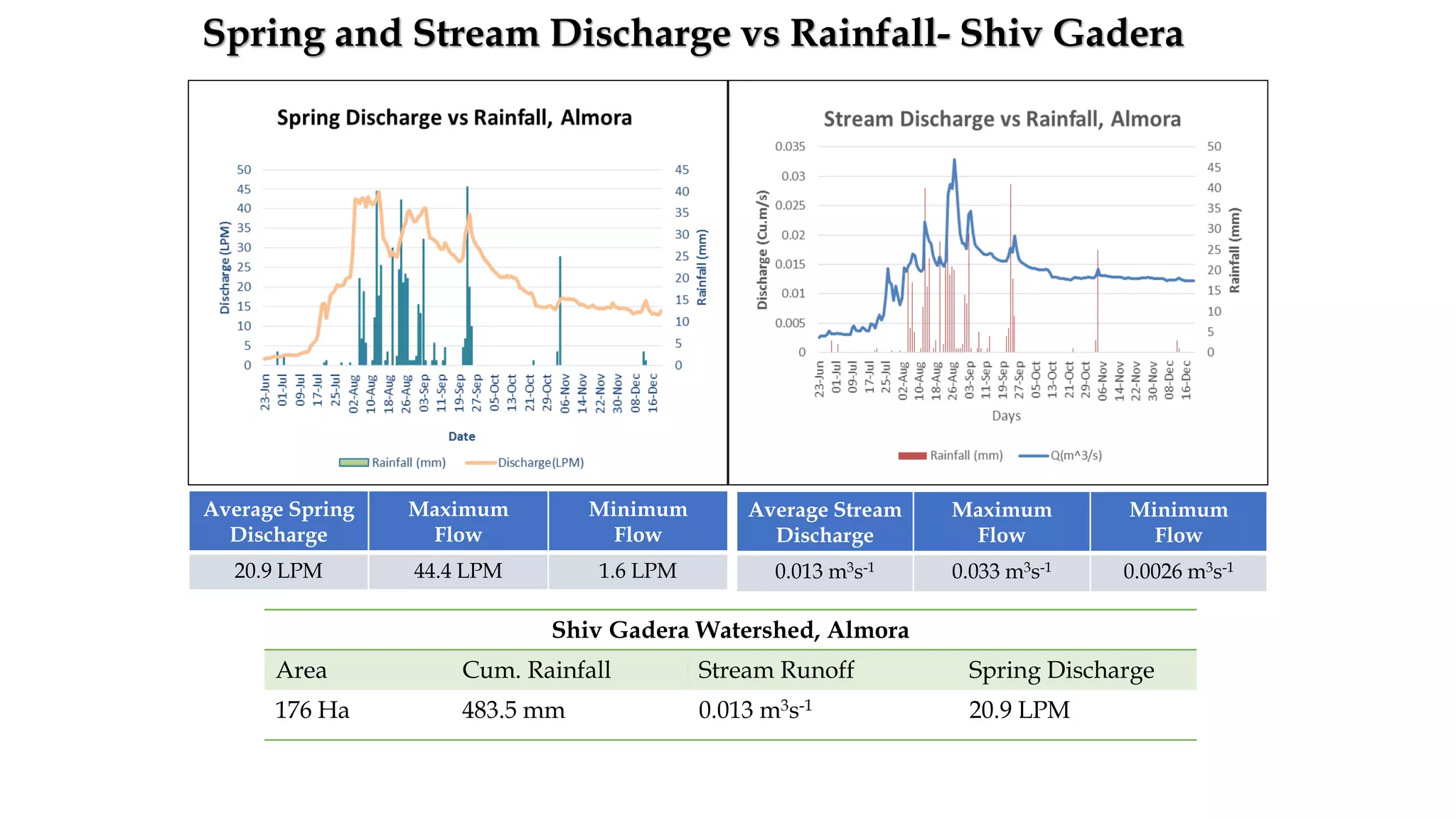
Average Stream
Discharge
Maximum
Flow
Minimum
Flow
0.013 m3s-1 0.033 m3s-1 0.0026 m3s-1
Average Spring
Discharge
Maximum
Flow
Minimum
Flow
20.9 LPM 44.4 LPM 1.6 LPM
Shiv Gadera Watershed, Almora
Area Cum. Rainfall Stream Runoff Spring Discharge
176 Ha 483.5 mm 0.013 m3s-1 20.9 LPM
Spring and Stream Discharge vs Rainfall- Shiv Gadera
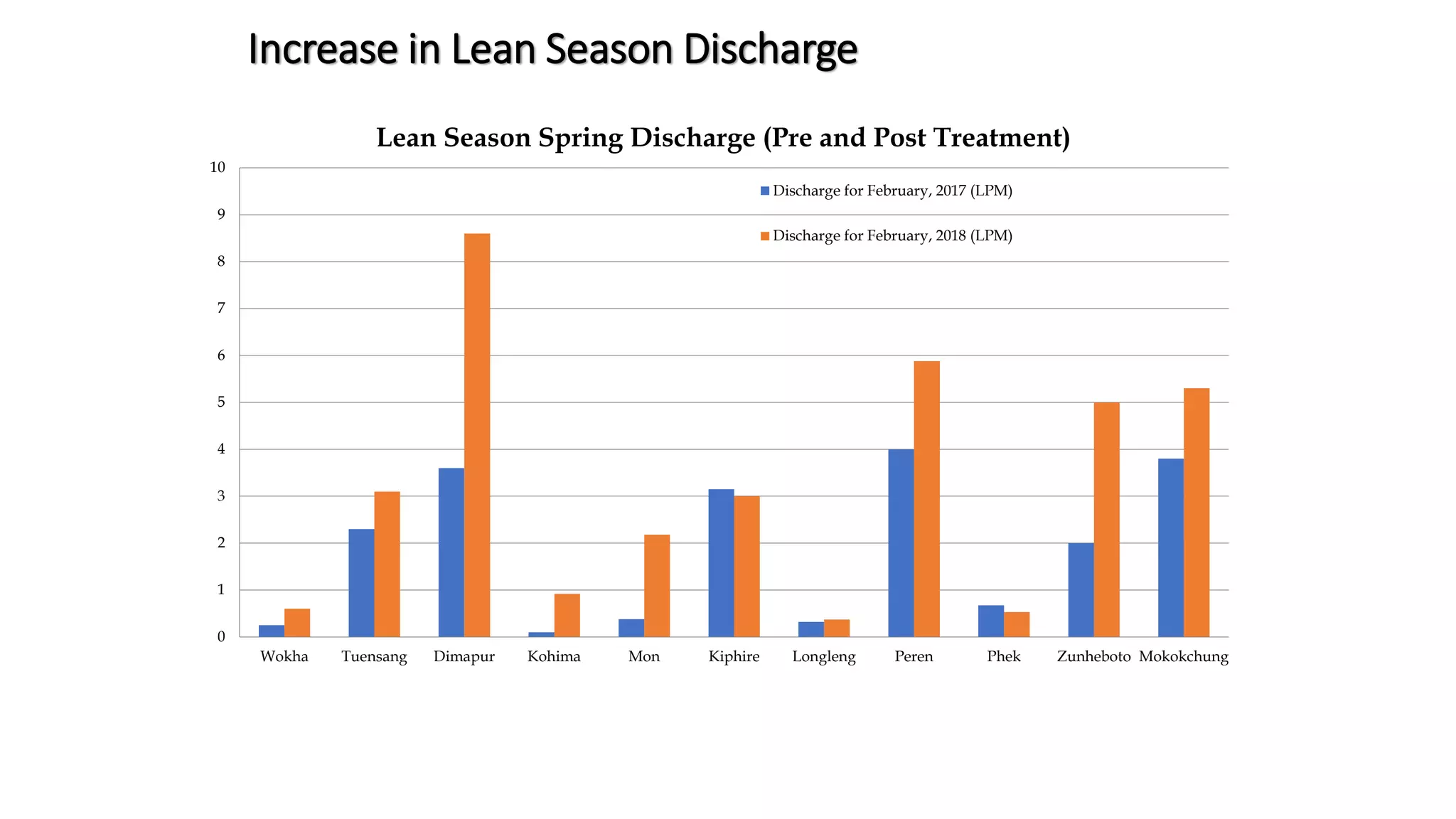
Increase in Lean Season Discharge
0
1
2
3
4
5
6
7
8
9
10
Wokha Tuensang Dimapur Kohima Mon Kiphire Longleng Peren Phek Zunheboto Mokokchung
Lean Season Spring Discharge (Pre and Post Treatment)
Discharge for February, 2017 (LPM)
Discharge for February, 2018 (LPM)
Way Forward
• Village level water security planning based on water budgeting, spring
recharge activities, and capacity building of institutions.
• Introduction of water efficient technologies like SCI leading to more rational
ground water use.
• Creation of a cadre of para-hydrogeologists equipped to extend science
based springshed development in the region.
• Sanitary protocols for recharge areas leading to access to safe drinking water
and reduced health risks
• Community based monitoring of spring discharge and water quality to ensure
ownership and sustainability
• Strengthened village level institutions for managing springs in a sustainable
and equitable manner.
• Monitoring of impacts including access to water, biomass availability, soil
conservation and enhanced livelihoods.
• Documentation of scientific database and hydrological modelling for
planning springshed development in other areas.
Community's involvement helps managing groundwater (springs) as a common
pool resource
PRASARI
Thank You

Concept and approach of springshed development and management 22 jan 2020

  • 1.
    Springshed Development andManagement: Concept and Approach PRASARI Contributors
  • 2.
  • 3.
    Springs are indicatedby locations or points on the ground surface, where water from beneath the ground emerges onto the surface. Points of groundwater discharge What are Springs? A spring may be considered as an ‘overflowing aquifer’ Springs represent ‘natural ground water discharge that feeds streams and rivers, often making such streams and rivers perennial…
  • 4.
    Forms of Springs PointSource Wetland Seep Springs vary in size, type, location; often remote and difficult to access; and vary in discharge through seasons It is crucial to identify the type of spring in order to understand how they behave in space and time
  • 5.
    Regional Spring-scapes ofIndo-Nepal Region
  • 6.
    What is aSpringshed ???
  • 7.
    What is Watershed? Watershedis an area which is bounded by a ridge area from all sides and drains out through a common point Watershed boundary ? ?
  • 8.
  • 9.
    Watershed-1 Watershed-2 Concept of springshed, a springshed is a set of watersheds and aquifers that integrate into a system that supplies water to the springs in the springshed.
  • 10.
    Concept of Springshed…. Rechargearea Recharge area Watershed-1 Watershed-2 Watershed-3 Watershed-4 Springshed-1 Springshed-2
  • 11.
    Springs and aquifersas commons… Springs may emerge at given point on any land parcel but the aquifer that provides water to the spring often extends below many such land parcels…. The relationship between a spring, the aquifer system below and the watershed above define the ‘springshed’…
  • 13.
    Village-A Village-B It also tiedinto the larger concept on groundwater management: shift in focus needed – from sources... Watershed -1 Watershed -2 Borewell Aquifer ...to a ‘resource’, i.e. aquifers Natural Recharge area
  • 14.
    Springshed Development –Principles & Practices Regenerating underground seepage through engineering, vegetative and social measures in the spring recharge area Principles: • Increase Time of concentration • Increase Infiltration • Reduce Soil Erosion • Improve Water Quality • Promote Equitable Water Sharing Practices: • Trenching (SCT and CCT) • Treatment of Drainage Channels • Small Check Dams/Gully Plugs • Vegetative Measures • Social Fencing
  • 16.
  • 17.
    Rainfall vs SpringDischarge 0 100 200 300 400 500 600 700 800 Dungkhao Village, Longleng District Monthly Rainfall (mm) Spring Discharge (LPH) Annual Rainfall: 3113 mm 0 100 200 300 400 500 600 700 Kinunger Village, Mokokchung District Monthly Rainfall (mm) Spring Discharge (LPH) Annual Rainfall: 2549 mm 0 100 200 300 400 500 600 700 OLd Jaboka Village, Mon District Monthly Rainfall (mm) Spring Discharge (LPH) Annual Rainfall: 2925 mm 0 50 100 150 200 250 300 350 400 450 Gidemi Village, Phek District Monthly Rainfall (mm) Spring Discharge (LPH) Annual Rainfall: 1020 mm Rainfall vs Spring Discharge across Villages of Nagaland
  • 18.
    0 5000 10000 15000 20000 25000 30000 35000 40000 45000 Daily Water Demand and Lean Season Supply (Litres/day) Village, District Water Demandvs Supply in Lean Season (Litres/Day) : 2016-2017 Demand Lean Season Supply Water Availability During Lean Season across villages of Nagaland Demand Norm = 55 lpcd Water Availability & Demand Estimation
  • 19.
    Water Quality Standards S.No. Parameters IS: 10500 (Limits for Drinking Water) Permissible limit in the absence of alternate source 1. Temperature - 2. Colour Colourless Colourless 3. Odour Agreeable Agreeable 4. pH 6.5 to 8.5 No relaxation 5. Alkalinity, mg/l 200 600 6. Hardness, mg/l 200 600 7. Nitrate – N, mg/l 45.0 No relaxation 8. Fluoride, mg/l 1.0 1.5 9. Chloride, mg/l 250 1000 10. Iron, mg/l 0.3 No relaxation 11. Faecal coliform Absent 0 (Bureau of Indian Standards (2012) Note: Faecal coliform (FC) values should meet for 90% times, Failure to comply with one or more of the above limits shall imply assignment of the next lower class. Spring Water Contamination: Ground Water & Sanitation Interactions
  • 20.
    Water Quality Dataof Springs of Sihphir Village, Mizoram Spring pH TDS (mg/l) Hardness (mg/l) Alkalinity (mg/l) Chloride (mg/l) Iron (mg/l) Nitrate (mg/l) Faecal Chhim Veng 7.3 137 103 32 5 0.1 18 High Sihphir Lui 6.9 122 86 32 7 0 22 Medium Luinai 7.1 133 112 24 15 0 19 Low Maul Lui 7.9 144 78 36 6 0.3 18 Medium Permissible Limit 6.5-8.5 500 300 200 250 0.3 45 Nil
  • 21.
    Benefits of SpringshedDevelopment • Reduced Peak Flow • Increased Base Flow • Reduced Lean Flow Period • Higher Plant Survival Rate • Increased biomass production • Increased Fodder Availability • Household Water Security • Improved Water Quality • Increased Life of Downstream Storage Structures
  • 22.
  • 23.
  • 24.
    Orientation of GovernmentOfficials Planning Exercises with Communities I : Need based Capacity Building of Stakeholders Exposure of Extension Agencies Training of Para Workers on Water Quality
  • 25.
    Training Modules Theory • Groundwaterand its significance • Introduction to springs • Introduction to geology and hydrogeological properties of the rocks • Introduction to Springshed Management • Spring discharge measurement • Groundwater quality: An introduction • In-situ water quality testing • Springshed planning: Water demand, supply and gap estimates • Introduction to use of instruments like GPS, Brunton • Community mobilization (Sandesh Yatra) • Social and resource mapping • Field Work: Transect walk, Identification of springs and rocks, geological mapping Theory • Revision of the first training • Identification of recharge area • Springs regeneration methods • Engineering survey: contour mapping: use of A-Frame, slope measurement • Engineering and Vegetative measures Field Work: Slope measurement, Contour mapping, Layout of SCTs Training Module – I Training Module – II Training Module – III Theory • Revision of the second training • Formation of Spring Water User Group • Protocols for WUGs including social fencing, sharing of water, contributions.. • Monitoring Systems: Rainfall, Discharge & Quality Field Work: Formation of WUG, Installation of rain gauges Pedagogy: classroom lectures, group discussions, practicals & field exposure
  • 26.
    Creation of SpringInventory Geological Mapping of Exposed Area Hydrogeological Map of Spring Specific Recharge Area (hectare) 0.75 Size of Trenches (m) 2 X 0.6 X 0.45 (40-50% slope) No. of Trenches 52 Vertical interval (contour) 8-10 m Proposed Area of grass on bund 720 sq.m. Proposed no. of saplings 200 Springshed Treatment Activities II: Hydro-geology based Planning
  • 27.
    III: Community DrivenInterventions Capacity Building of Para Workers Community Awareness Programs Formation & Capacity Building of WUG Drafting of Spring Protocols
  • 28.
    III: Community DrivenApproach (Contd.) Monitoring Rainfall, Spring Dis. & Quality Operation & Maintenance Community Nurseries Contributions for Digging Trenches
  • 29.
    • With SWItechnique, the average grain and straw yields went up. • Introducing SCI for maize, vegetables and spices helped farmers (58 out of 152 households in 3 villages) earn additional income IV: Integrating Demand Management 2.4 3.3 3.9 4.8 0 1 2 3 4 5 6 Grain Straw Yield in Ton/hectare Conventional SWI 1.3 10 22 1.5 12 25 0 5 10 15 20 25 30 Maize Green Chilli Ginger Yield in Ton/hectare Average Production in Tons/Ha Conventional SCI Improvement in Crop Water Use Efficiency
  • 30.
    V: High ResolutionHydrological Monitoring a) Hilly terrain of Almora watershed c) Auto Weather Station d) Spring location e) Parshall flume at stream f) Lean flow in stream g) Non-recording rain gauge i) Installation of Pan Evaporimeter b) Mountainous terrain of Pauri watershed
  • 31.
    Average Stream Discharge Maximum Flow Minimum Flow 0.013 m3s-10.033 m3s-1 0.0026 m3s-1 Average Spring Discharge Maximum Flow Minimum Flow 20.9 LPM 44.4 LPM 1.6 LPM Shiv Gadera Watershed, Almora Area Cum. Rainfall Stream Runoff Spring Discharge 176 Ha 483.5 mm 0.013 m3s-1 20.9 LPM Spring and Stream Discharge vs Rainfall- Shiv Gadera
  • 32.
    Increase in LeanSeason Discharge 0 1 2 3 4 5 6 7 8 9 10 Wokha Tuensang Dimapur Kohima Mon Kiphire Longleng Peren Phek Zunheboto Mokokchung Lean Season Spring Discharge (Pre and Post Treatment) Discharge for February, 2017 (LPM) Discharge for February, 2018 (LPM)
  • 33.
    Way Forward • Villagelevel water security planning based on water budgeting, spring recharge activities, and capacity building of institutions. • Introduction of water efficient technologies like SCI leading to more rational ground water use. • Creation of a cadre of para-hydrogeologists equipped to extend science based springshed development in the region. • Sanitary protocols for recharge areas leading to access to safe drinking water and reduced health risks • Community based monitoring of spring discharge and water quality to ensure ownership and sustainability • Strengthened village level institutions for managing springs in a sustainable and equitable manner. • Monitoring of impacts including access to water, biomass availability, soil conservation and enhanced livelihoods. • Documentation of scientific database and hydrological modelling for planning springshed development in other areas. Community's involvement helps managing groundwater (springs) as a common pool resource
  • 34.