Training and Facilitation for achieving Water
Security in 400 CLLMP Villages in
Meghalaya through Springshed Management
PRASARI
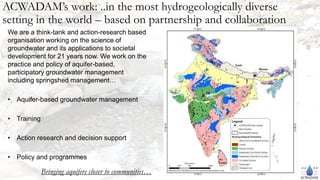
ACWADAM’s work: ..in the most hydrogeologically diverse
setting in the world – based on partnership and collaboration
We are a think-tank and action-research based
organisation working on the science of
groundwater and its applications to societal
development for 21 years now. We work on the
practice and policy of aquifer-based,
participatory groundwater management
including springshed management…
• Aquifer-based groundwater management
• Training
• Action research and decision support
• Policy and programmes
Bringing aquifers closer to communities…
ACWADAM: spring revival through springshed management
• The spring-revival programme was strengthened
through the infusion of demystified hydrogeology by
ACWADAM.
• This concept helped us partner with key agencies
working on spring revival such as PSI, Chirag and
RDD (erstwhile RM&DD) - Sikkim.
• Scaling out the concept of springshed management in
states like J & K, Uttarakhand, Himachal Pradesh,
Nagaland, West Bengal hilly districts, Meghalaya,
Manipur, Tripura and Mizoram.
• Policy: significant contribution to spring-revival
document as part of Niti Aayog’s thrust areas for the
Indian Himalayan Region
• SOPs – beginning with Dhara Vikas in Sikkim and
followed by the Manual on springshed management
(through ICIMOD.
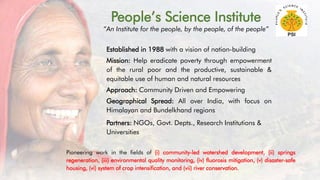
People’s Science Institute
“An Institute for the people, by the people, of the people”
Established in 1988 with a vision of nation-building
Mission: Help eradicate poverty through empowerment
of the rural poor and the productive, sustainable &
equitable use of human and natural resources
Approach: Community Driven and Empowering
Geographical Spread: All over India, with focus on
Himalayan and Bundelkhand regions
Partners: NGOs, Govt. Depts., Research Institutions &
Universities
Pioneering work in the fields of (i) community-led watershed development, (ii) springs
regeneration, (iii) environmental quality monitoring, (iv) fluorosis mitigation, (v) disaster-safe
housing, (vi) system of crop intensification, and (vii) river conservation.
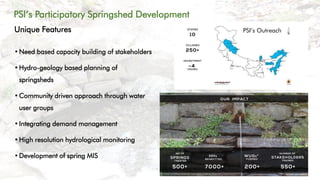
Unique Features
PSI’s Participatory Springshed Development
•Need based capacity building of stakeholders
•Hydro-geology based planning of
springsheds
•Community driven approach through water
user groups
•Integrating demand management
•High resolution hydrological monitoring
•Development of spring MIS
PSI’s Outreach
• A non government organisation founded in 1986 registered under Societies Registration Act,
1961
• Vision - To be a catalyst for the creation of a society rooted firmly in the principles of dignity,
justice and solidarity.
Mission - To improve the quality of life of rural people – especially women and children and
disadvantaged – in the Himalaya.
• Does this through interventions in Health, Education and Natural Resource Management, and by
providing access to diversified Livelihood.
• Promotes the sustainable ownership and management of common resources by the community.
• Over 33 year experience in water sector and in 2006 pioneered the springshed approach to
spring rejuvenation in the Himalayas in collaboration with ACWADAM and PSI.
Central Himalayan Rural Action Group (CHIRAG)
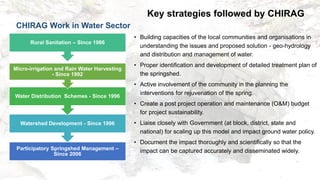
Key strategies followed by CHIRAG
• Building capacities of the local communities and organisations in
understanding the issues and proposed solution - geo-hydrology
and distribution and management of water.
• Proper identification and development of detailed treatment plan of
the springshed.
• Active involvement of the community in the planning the
interventions for rejuvenation of the spring.
• Create a post project operation and maintenance (O&M) budget
for project sustainability.
• Liaise closely with Government (at block, district, state and
national) for scaling up this model and impact ground water policy.
• Document the impact thoroughly and scientifically so that the
impact can be captured accurately and disseminated widely.
Participatory Springshed Management –
Since 2006
Watershed Development - Since 1996
Rural Sanitation – Since 1986
Water Distribution Schemes - Since 1996
Micro-irrigation and Rain Water Harvesting
- Since 1992
CHIRAG Work in Water Sector
PRASARI
• A livelihoods promotion institution registered under Societies Registration Act, 1961
• Works with a mandate to fulfill the need for professional services to disadvantaged families
in the society
• Develops partnership with the National and International Agencies to work with and for the
rural disadvantaged households
• Mainly focuses on three aspects e.g. Natural Resource Management, Research Based
Activities and Policy advocacy
• Strongly focuses on working in collaboration with Local Governments, thus to ensure a
cumulative coverage for vulnerable categories across a larger region
• Women is the ‘key constituent’ for any activity, may be in the form of simple SHGs or in the
form of their larger collectives.
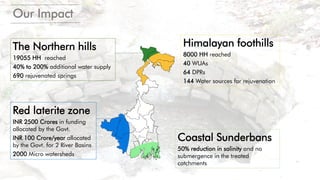
The Northern hills
19055 HH reached
40% to 200% additional water supply
690 rejuvenated springs
Himalayan foothills
8000 HH reached
40 WUAs
64 DPRs
144 Water sources for rejuvenation
Coastal Sunderbans
50% reduction in salinity and no
submergence in the treated
catchments
Red laterite zone
INR 2500 Crores in funding
allocated by the Govt.
INR 100 Crore/year allocated
by the Govt. for 2 River Basins
2000 Micro watersheds
Our Impact
INTRODUCTION
Water cycle, groundwater, aquifers
&
SPRINGS
Springs are important, they need to be
protected and conserved…
• WHY?
• WHAT?
• HOW?
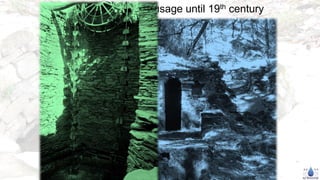
Legacy of groundwater usage until 19th century
• ACCESS: Access was
widespread but from shallow
sources, often ‘community’
dug wells, springs and
qanats (infiltration galleries).
• EXTRACTION: Human and
animal traction – pulleys,
rahats, mhots.
After: Moench, Kulkarni and Burke, 2013
Wells: converting (groundwater)
stocks to flows…
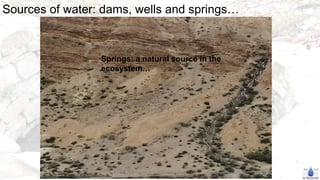
Sources of water: dams, wells and springs…
Dams: converting river flows to stocks…
Springs: a natural source in the
ecosystem…
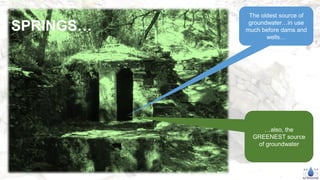
…also, the
GREENEST source
of groundwater
The oldest source of
groundwater…in use
much before dams and
wells…
SPRINGS…
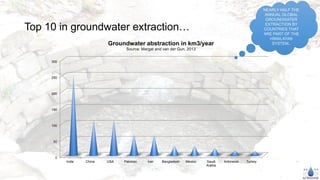
Top 10 in groundwater extraction…
0
50
100
150
200
250
300
India China USA Pakistan Iran Bangladesh Mexico Saudi
Arabia
Indonesia Turkey
Groundwater abstraction in km3/year
Source: Margat and van der Gun, 2013
NEARLY HALF THE
ANNUAL GLOBAL
GROUNDWATER
EXTRACTION BY
COUNTRIES THAT
ARE PART OF THE
HIMALAYAN
SYSTEM..
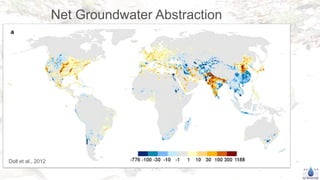
Net Groundwater Abstraction
Doll et al., 2012
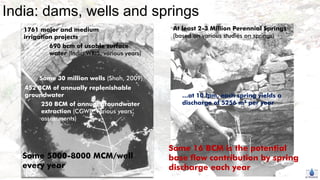
At least 2-3 Million Perennial Springs
(based on various studies on springs)
452 BCM of annually replenishable
groundwater
India: dams, wells and springs
Some 5000-8000 MCM/well
every year
…at 10 lpm, each spring yields a
discharge of 5256 m3 per year
Some 16 BCM is the potential
base flow contribution by spring
discharge each year
1761 major and medium
irrigation projects
690 bcm of usable surface
water (India WRIS, various years)
Some 30 million wells (Shah, 2009)
250 BCM of annual groundwater
extraction (CGWB, various years’
assessments)
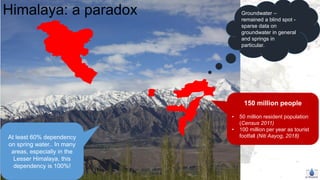
Groundwater –
remained a blind spot -
sparse data on
groundwater in general
and springs in
particular.
At least 60% dependency
on spring water.. In many
areas, especially in the
Lesser Himalaya, this
dependency is 100%!
Himalaya: a paradox
150 million people
• 50 million resident population
(Census 2011)
• 100 million per year as tourist
footfall (Niti Aayog, 2018)
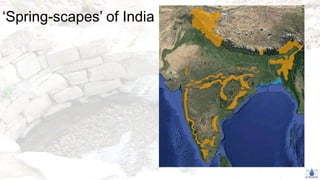
‘Spring-scapes’ of India
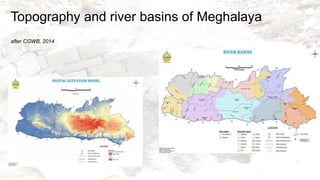
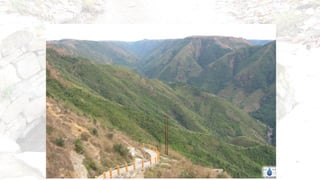
Topography and river basins of Meghalaya
after CGWB, 2014
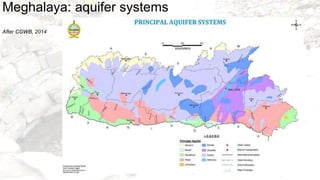
Meghalaya: aquifer systems
After CGWB, 2014
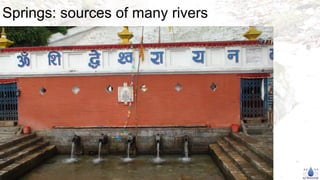
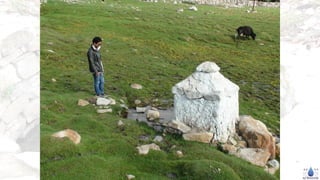
Springs: sources of many rivers
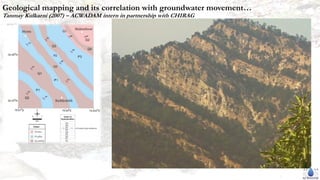
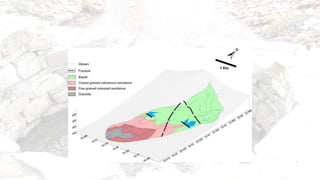
Geological mapping and its correlation with groundwater movement…
Tanmay Kulkarni (2007) – ACWADAM intern in partnership with CHIRAG
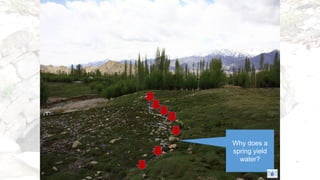
Why does a
spring yield
water?
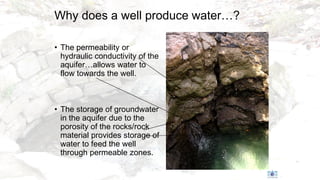
Why does a well produce water…?
• The permeability or
hydraulic conductivity of the
aquifer…allows water to
flow towards the well.
• The storage of groundwater
in the aquifer due to the
porosity of the rocks/rock
material provides storage of
water to feed the well
through permeable zones.
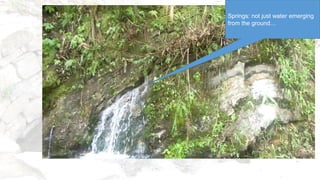
Springs: not just water emerging
from the ground…
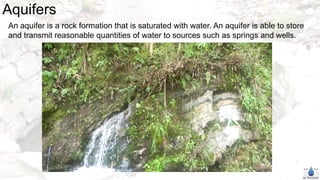
Aquifers
An aquifer is a rock formation that is saturated with water. An aquifer is able to store
and transmit reasonable quantities of water to sources such as springs and wells.
The storage capacity of the aquifer depends on the porosity of the rock formation
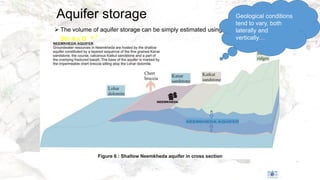
Aquifer storage
➢ The volume of aquifer storage can be simply estimated using the relation:
St= A x D
St= Aquifer storage
A= Surface area on which the aquifer is exposed, i.e. aquifer surface area
D= Saturated thickness of the aquifer
? But we do need another factor to account for the fact that water is stored in rocks / rock material
x ?
Geological conditions
tend to vary, both
laterally and
vertically…
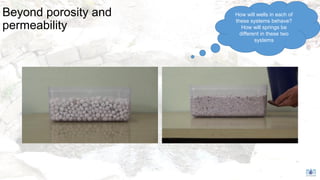
Beyond porosity and
permeability
How will wells in each of
these systems behave?
How will springs be
different in these two
systems
0
20
40
60
80
100
120
0
20
40
60
80
100
120
R
a
i
n
f
a
l
l
(
m
m
)
D
i
s
c
h
a
r
g
e
(
l
p
m
)
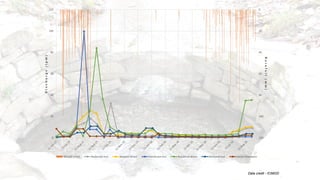
Rainfall (mm) Badarukh mul Baspani dharo Batokuwa mul Bukakhali dhara Maikarol mul Ganja khanepani
Data credit - ICIMOD
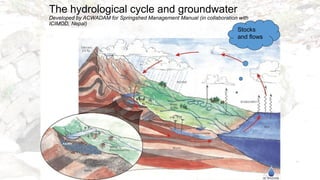
The hydrological cycle and groundwater
Developed by ACWADAM for Springshed Management Manual (in collaboration with
ICIMOD, Nepal)
Stocks
and flows
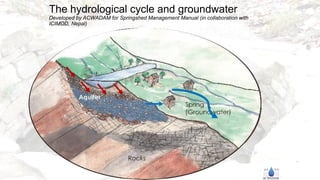
The hydrological cycle and groundwater
Developed by ACWADAM for Springshed Management Manual (in collaboration with
ICIMOD, Nepal)
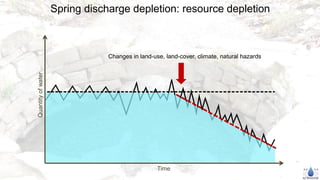
Time
Quantity
of
water
Spring discharge depletion: resource depletion
Changes in land-use, land-cover, climate, natural hazards
0
100
200
300
400
500
600
700
800
900
1000
0
50
100
150
200
250
300
350
400
450
Rainfall (Melli)
PALLO DHARA
SAUNEY DHARA 1
DAHAL DHARA 1
DWAREY DHARA
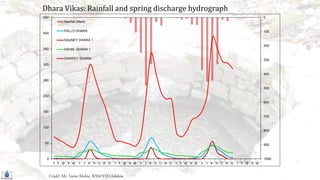
Dhara Vikas: Rainfall and spring discharge hydrograph
Credit: Mr. Suren Mohra, RM&DD-Sikkim
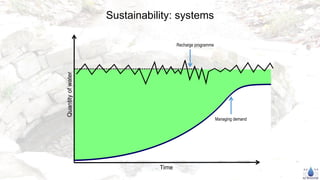
Time
Quantity
of
water
Recharge programme
Managing demand
Sustainability: systems
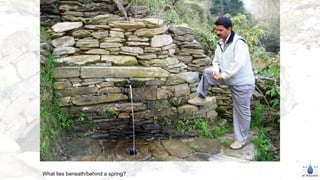
What is behind a spring?
What lies beneath/behind a spring?
Groundwater Model
Spring
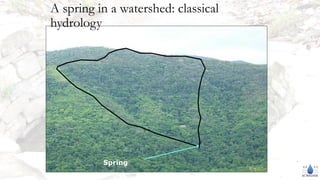
A spring in a watershed: classical
hydrology
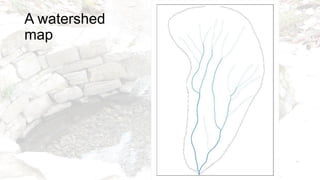
A watershed
map
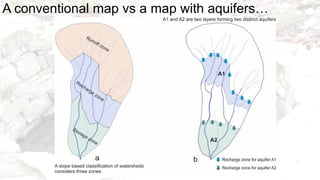
A conventional map vs a map with aquifers…
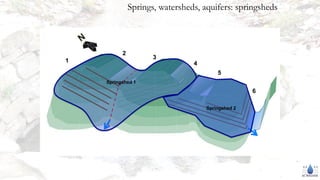
Springs, watersheds, aquifers: springsheds
Springshed 1
Springshed 2
1
2
3
4
5
6
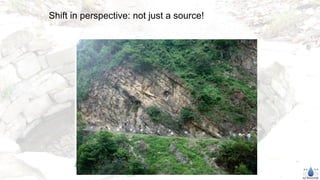
Shift in perspective: not just a source!
Watershed
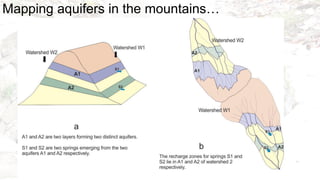
Mapping aquifers in the mountains…
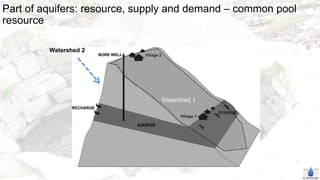
Part of aquifers: resource, supply and demand – common pool
resource
Watershed 1
Watershed 2
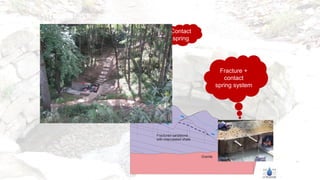
Meghalaya: a schema of spring systems
Laterite
Lithomarge (clay)
Granite
Granite
Fractured sandstone
with intercalated shale
Wetland / bog
with seeps
Contact
spring
Fracture +
contact
spring system
Meghalaya: a schema of spring systems
Bedded sandstone-shale sequence
Springs
Fracture +
depression
spring
system
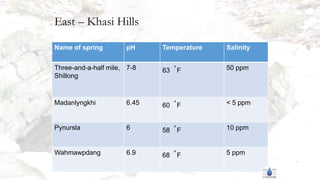
East – Khasi Hills
Name of spring pH Temperature Salinity
Three-and-a-half mile,
Shillong
7-8 63 ̊ F 50 ppm
Madanlyngkhi 6.45 60 ̊ F < 5 ppm
Pynursla 6 58 ̊ F 10 ppm
Wahmawpdang 6.9 68 ̊ F 5 ppm
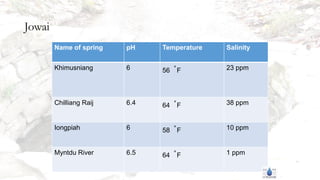
Jowai
Name of spring pH Temperature Salinity
Khimusniang 6 56 ̊ F 23 ppm
Chilliang Raij 6.4 64 ̊ F 38 ppm
Iongpiah 6 58 ̊ F 10 ppm
Myntdu River 6.5 64 ̊ F 1 ppm
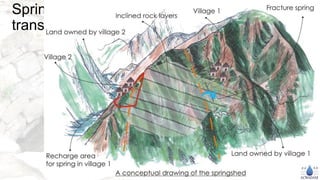
Springshed management is a
transdisciplinary approach
Chakosa Neima, Demul village, Lahaul-Spiti
N32.14o
E78.77o
4600 m asl
Bharmani, Bharmaur, Chamba
N32.43o
E76.53o
2720 m asl
Thori, Ayodhyapuri VDC, Chitwan, Nepal
(India-Nepal Border)
N27.37o
E84.57o
296 m asl

Introduction: Groundwater aquifers

  • 1.
    Training and Facilitationfor achieving Water Security in 400 CLLMP Villages in Meghalaya through Springshed Management PRASARI
  • 2.
    ACWADAM’s work: ..inthe most hydrogeologically diverse setting in the world – based on partnership and collaboration We are a think-tank and action-research based organisation working on the science of groundwater and its applications to societal development for 21 years now. We work on the practice and policy of aquifer-based, participatory groundwater management including springshed management… • Aquifer-based groundwater management • Training • Action research and decision support • Policy and programmes Bringing aquifers closer to communities…
  • 3.
    ACWADAM: spring revivalthrough springshed management • The spring-revival programme was strengthened through the infusion of demystified hydrogeology by ACWADAM. • This concept helped us partner with key agencies working on spring revival such as PSI, Chirag and RDD (erstwhile RM&DD) - Sikkim. • Scaling out the concept of springshed management in states like J & K, Uttarakhand, Himachal Pradesh, Nagaland, West Bengal hilly districts, Meghalaya, Manipur, Tripura and Mizoram. • Policy: significant contribution to spring-revival document as part of Niti Aayog’s thrust areas for the Indian Himalayan Region • SOPs – beginning with Dhara Vikas in Sikkim and followed by the Manual on springshed management (through ICIMOD.
  • 4.
    People’s Science Institute “AnInstitute for the people, by the people, of the people” Established in 1988 with a vision of nation-building Mission: Help eradicate poverty through empowerment of the rural poor and the productive, sustainable & equitable use of human and natural resources Approach: Community Driven and Empowering Geographical Spread: All over India, with focus on Himalayan and Bundelkhand regions Partners: NGOs, Govt. Depts., Research Institutions & Universities Pioneering work in the fields of (i) community-led watershed development, (ii) springs regeneration, (iii) environmental quality monitoring, (iv) fluorosis mitigation, (v) disaster-safe housing, (vi) system of crop intensification, and (vii) river conservation.
  • 5.
    Unique Features PSI’s ParticipatorySpringshed Development •Need based capacity building of stakeholders •Hydro-geology based planning of springsheds •Community driven approach through water user groups •Integrating demand management •High resolution hydrological monitoring •Development of spring MIS PSI’s Outreach
  • 6.
    • A nongovernment organisation founded in 1986 registered under Societies Registration Act, 1961 • Vision - To be a catalyst for the creation of a society rooted firmly in the principles of dignity, justice and solidarity. Mission - To improve the quality of life of rural people – especially women and children and disadvantaged – in the Himalaya. • Does this through interventions in Health, Education and Natural Resource Management, and by providing access to diversified Livelihood. • Promotes the sustainable ownership and management of common resources by the community. • Over 33 year experience in water sector and in 2006 pioneered the springshed approach to spring rejuvenation in the Himalayas in collaboration with ACWADAM and PSI. Central Himalayan Rural Action Group (CHIRAG)
  • 7.
    Key strategies followedby CHIRAG • Building capacities of the local communities and organisations in understanding the issues and proposed solution - geo-hydrology and distribution and management of water. • Proper identification and development of detailed treatment plan of the springshed. • Active involvement of the community in the planning the interventions for rejuvenation of the spring. • Create a post project operation and maintenance (O&M) budget for project sustainability. • Liaise closely with Government (at block, district, state and national) for scaling up this model and impact ground water policy. • Document the impact thoroughly and scientifically so that the impact can be captured accurately and disseminated widely. Participatory Springshed Management – Since 2006 Watershed Development - Since 1996 Rural Sanitation – Since 1986 Water Distribution Schemes - Since 1996 Micro-irrigation and Rain Water Harvesting - Since 1992 CHIRAG Work in Water Sector
  • 8.
    PRASARI • A livelihoodspromotion institution registered under Societies Registration Act, 1961 • Works with a mandate to fulfill the need for professional services to disadvantaged families in the society • Develops partnership with the National and International Agencies to work with and for the rural disadvantaged households • Mainly focuses on three aspects e.g. Natural Resource Management, Research Based Activities and Policy advocacy • Strongly focuses on working in collaboration with Local Governments, thus to ensure a cumulative coverage for vulnerable categories across a larger region • Women is the ‘key constituent’ for any activity, may be in the form of simple SHGs or in the form of their larger collectives.
  • 9.
    The Northern hills 19055HH reached 40% to 200% additional water supply 690 rejuvenated springs Himalayan foothills 8000 HH reached 40 WUAs 64 DPRs 144 Water sources for rejuvenation Coastal Sunderbans 50% reduction in salinity and no submergence in the treated catchments Red laterite zone INR 2500 Crores in funding allocated by the Govt. INR 100 Crore/year allocated by the Govt. for 2 River Basins 2000 Micro watersheds Our Impact
  • 10.
  • 11.
    Springs are important,they need to be protected and conserved… • WHY? • WHAT? • HOW?
  • 12.
    Legacy of groundwaterusage until 19th century • ACCESS: Access was widespread but from shallow sources, often ‘community’ dug wells, springs and qanats (infiltration galleries). • EXTRACTION: Human and animal traction – pulleys, rahats, mhots. After: Moench, Kulkarni and Burke, 2013
  • 13.
    Wells: converting (groundwater) stocksto flows… Sources of water: dams, wells and springs… Dams: converting river flows to stocks… Springs: a natural source in the ecosystem…
  • 14.
    …also, the GREENEST source ofgroundwater The oldest source of groundwater…in use much before dams and wells… SPRINGS…
  • 15.
    Top 10 ingroundwater extraction… 0 50 100 150 200 250 300 India China USA Pakistan Iran Bangladesh Mexico Saudi Arabia Indonesia Turkey Groundwater abstraction in km3/year Source: Margat and van der Gun, 2013 NEARLY HALF THE ANNUAL GLOBAL GROUNDWATER EXTRACTION BY COUNTRIES THAT ARE PART OF THE HIMALAYAN SYSTEM..
  • 16.
  • 17.
    At least 2-3Million Perennial Springs (based on various studies on springs) 452 BCM of annually replenishable groundwater India: dams, wells and springs Some 5000-8000 MCM/well every year …at 10 lpm, each spring yields a discharge of 5256 m3 per year Some 16 BCM is the potential base flow contribution by spring discharge each year 1761 major and medium irrigation projects 690 bcm of usable surface water (India WRIS, various years) Some 30 million wells (Shah, 2009) 250 BCM of annual groundwater extraction (CGWB, various years’ assessments)
  • 18.
    Groundwater – remained ablind spot - sparse data on groundwater in general and springs in particular. At least 60% dependency on spring water.. In many areas, especially in the Lesser Himalaya, this dependency is 100%! Himalaya: a paradox 150 million people • 50 million resident population (Census 2011) • 100 million per year as tourist footfall (Niti Aayog, 2018)
  • 19.
  • 20.
    Topography and riverbasins of Meghalaya after CGWB, 2014
  • 21.
  • 22.
  • 25.
    Geological mapping andits correlation with groundwater movement… Tanmay Kulkarni (2007) – ACWADAM intern in partnership with CHIRAG
  • 26.
    Why does a springyield water?
  • 27.
    Why does awell produce water…? • The permeability or hydraulic conductivity of the aquifer…allows water to flow towards the well. • The storage of groundwater in the aquifer due to the porosity of the rocks/rock material provides storage of water to feed the well through permeable zones.
  • 28.
    Springs: not justwater emerging from the ground…
  • 29.
    Aquifers An aquifer isa rock formation that is saturated with water. An aquifer is able to store and transmit reasonable quantities of water to sources such as springs and wells.
  • 32.
    The storage capacityof the aquifer depends on the porosity of the rock formation Aquifer storage ➢ The volume of aquifer storage can be simply estimated using the relation: St= A x D St= Aquifer storage A= Surface area on which the aquifer is exposed, i.e. aquifer surface area D= Saturated thickness of the aquifer ? But we do need another factor to account for the fact that water is stored in rocks / rock material x ? Geological conditions tend to vary, both laterally and vertically…
  • 33.
    Beyond porosity and permeability Howwill wells in each of these systems behave? How will springs be different in these two systems
  • 34.
    0 20 40 60 80 100 120 0 20 40 60 80 100 120 R a i n f a l l ( m m ) D i s c h a r g e ( l p m ) Rainfall (mm) Badarukhmul Baspani dharo Batokuwa mul Bukakhali dhara Maikarol mul Ganja khanepani Data credit - ICIMOD
  • 35.
    The hydrological cycleand groundwater Developed by ACWADAM for Springshed Management Manual (in collaboration with ICIMOD, Nepal) Stocks and flows
  • 36.
    The hydrological cycleand groundwater Developed by ACWADAM for Springshed Management Manual (in collaboration with ICIMOD, Nepal)
  • 37.
    Time Quantity of water Spring discharge depletion:resource depletion Changes in land-use, land-cover, climate, natural hazards
  • 38.
    0 100 200 300 400 500 600 700 800 900 1000 0 50 100 150 200 250 300 350 400 450 Rainfall (Melli) PALLO DHARA SAUNEYDHARA 1 DAHAL DHARA 1 DWAREY DHARA Dhara Vikas: Rainfall and spring discharge hydrograph Credit: Mr. Suren Mohra, RM&DD-Sikkim
  • 39.
  • 40.
    What is behinda spring? What lies beneath/behind a spring?
  • 41.
    Groundwater Model Spring A springin a watershed: classical hydrology
  • 42.
  • 43.
    A conventional mapvs a map with aquifers…
  • 44.
    Springs, watersheds, aquifers:springsheds Springshed 1 Springshed 2 1 2 3 4 5 6
  • 45.
    Shift in perspective:not just a source! Watershed
  • 46.
    Mapping aquifers inthe mountains…
  • 47.
    Part of aquifers:resource, supply and demand – common pool resource Watershed 1 Watershed 2
  • 48.
    Meghalaya: a schemaof spring systems Laterite Lithomarge (clay) Granite Granite Fractured sandstone with intercalated shale Wetland / bog with seeps Contact spring Fracture + contact spring system
  • 49.
    Meghalaya: a schemaof spring systems Bedded sandstone-shale sequence Springs Fracture + depression spring system
  • 50.
    East – KhasiHills Name of spring pH Temperature Salinity Three-and-a-half mile, Shillong 7-8 63 ̊ F 50 ppm Madanlyngkhi 6.45 60 ̊ F < 5 ppm Pynursla 6 58 ̊ F 10 ppm Wahmawpdang 6.9 68 ̊ F 5 ppm
  • 51.
    Jowai Name of springpH Temperature Salinity Khimusniang 6 56 ̊ F 23 ppm Chilliang Raij 6.4 64 ̊ F 38 ppm Iongpiah 6 58 ̊ F 10 ppm Myntdu River 6.5 64 ̊ F 1 ppm
  • 52.
    Springshed management isa transdisciplinary approach
  • 53.
    Chakosa Neima, Demulvillage, Lahaul-Spiti N32.14o E78.77o 4600 m asl Bharmani, Bharmaur, Chamba N32.43o E76.53o 2720 m asl Thori, Ayodhyapuri VDC, Chitwan, Nepal (India-Nepal Border) N27.37o E84.57o 296 m asl