METHODS OF GROUND
WATER RECHARGING.
Made By: Pravin V. Appa
Guided by: Satish Kane Sir
CIVIL ENGINEERING
DEPTARTMENT
1)Groundwater is the underground water which
occurs in the saturated zone of earth surface.
2)Cracks and pores in existing rocks makes this
ground water reservoir.
3)Ground water utilized through wells and tube
wells.
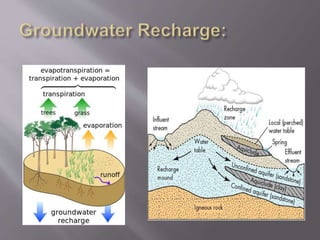
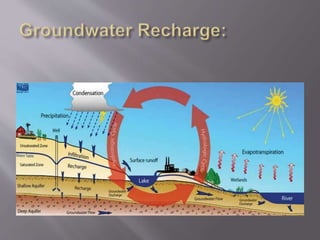
1)Developing of artificial underground reservoir by
artificial recharging for storing water
underground called recharging of underground
water.
2)It is quite advantages as compared with
dams,reservoiers etc.
3)Artificial recharging technique is under intensive
research and is being increasingly used in france,
Germany etc.
Water conservation and
groundwater recharge
techniques
Water harvesting cum
supplementary
irrigation techniques
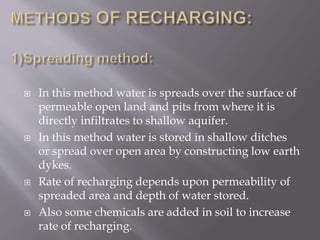
 In this method water is spreads over the surface of
permeable open land and pits from where it is
directly infiltrates to shallow aquifer.
 In this method water is stored in shallow ditches
or spread over open area by constructing low earth
dykes.
 Rate of recharging depends upon permeability of
spreaded area and depth of water stored.
 Also some chemicals are added in soil to increase
rate of recharging.
 In this method water is injected into the bore
holes.
 Water is fed into recharge wells by gravity or
pumped under pressure.
 Ordinary wells also perform the work of
recharging water during off season.
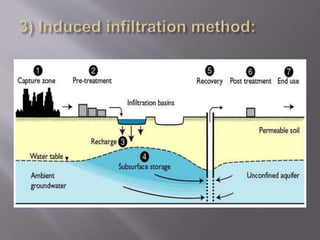
 In this method water table gradient is increased
from source of recharge.
 In this method special type of wells are
constructed near the banks of river having
radial collector.
 The percolating water is collected from radial
collector and the discharge as recharge in to
lower level aquifer ‘B’ as shown in fig.
 Artificial recharge to ground water is a
process by which the ground water
reservoir is augmented at a rate exceeding
that obtaining under natural conditions or
replenishment. Any man-made scheme or
facility that adds water to an aquifer may
be considered to be an artificial recharge
system.
 Water spreading
 Recharge through pits, trenches, wells, shafts
 Rooftop collection of rainwater
 Roadtop collection of rainwater
 Induced recharge from surface water bodies.
 Factors taken for computation :
 Roof top area 100 sq.m. for individual house
and 500 sq.m. for multi-storied building.
 Average annual monsoon rainfall - 780 mm.
 Effective annual rainfall contributing to
recharge 70% - 550 mm.
 Improvement in infiltration and reduction in run-
off.
 Improvement in groundwater levels and yields.
 Reduces strain on Special Village Panchayats/
Municipal / Municipal Corporation water supply
 Improvement in groundwater quality
 Estimated quantity of additional recharge from 100
sq. m. roof top area is 55.000 liters.
 Reduces waterlogging
Ground Water Recharge

Ground Water Recharge

  • 1.
  • 2.
    Made By: PravinV. Appa Guided by: Satish Kane Sir CIVIL ENGINEERING DEPTARTMENT
  • 3.
    1)Groundwater is theunderground water which occurs in the saturated zone of earth surface. 2)Cracks and pores in existing rocks makes this ground water reservoir. 3)Ground water utilized through wells and tube wells.
  • 5.
    1)Developing of artificialunderground reservoir by artificial recharging for storing water underground called recharging of underground water. 2)It is quite advantages as compared with dams,reservoiers etc. 3)Artificial recharging technique is under intensive research and is being increasingly used in france, Germany etc.
  • 7.
    Water conservation and groundwaterrecharge techniques Water harvesting cum supplementary irrigation techniques
  • 8.
     In thismethod water is spreads over the surface of permeable open land and pits from where it is directly infiltrates to shallow aquifer.  In this method water is stored in shallow ditches or spread over open area by constructing low earth dykes.  Rate of recharging depends upon permeability of spreaded area and depth of water stored.  Also some chemicals are added in soil to increase rate of recharging.
  • 10.
     In thismethod water is injected into the bore holes.  Water is fed into recharge wells by gravity or pumped under pressure.  Ordinary wells also perform the work of recharging water during off season.
  • 12.
     In thismethod water table gradient is increased from source of recharge.  In this method special type of wells are constructed near the banks of river having radial collector.  The percolating water is collected from radial collector and the discharge as recharge in to lower level aquifer ‘B’ as shown in fig.
  • 14.
     Artificial rechargeto ground water is a process by which the ground water reservoir is augmented at a rate exceeding that obtaining under natural conditions or replenishment. Any man-made scheme or facility that adds water to an aquifer may be considered to be an artificial recharge system.
  • 16.
     Water spreading Recharge through pits, trenches, wells, shafts  Rooftop collection of rainwater  Roadtop collection of rainwater  Induced recharge from surface water bodies.
  • 17.
     Factors takenfor computation :  Roof top area 100 sq.m. for individual house and 500 sq.m. for multi-storied building.  Average annual monsoon rainfall - 780 mm.  Effective annual rainfall contributing to recharge 70% - 550 mm.
  • 18.
     Improvement ininfiltration and reduction in run- off.  Improvement in groundwater levels and yields.  Reduces strain on Special Village Panchayats/ Municipal / Municipal Corporation water supply  Improvement in groundwater quality  Estimated quantity of additional recharge from 100 sq. m. roof top area is 55.000 liters.  Reduces waterlogging