Groundwater Management
Watershed & Water Regs Basics for
Municipal Officials
October 27, 2016
Russell Urban-Mead, CPG, LEED® AP
The Chazen Companies
Course Outline
• Copious Water
• But Local Overuse & Quality
Problems Possible
• Groundwater Management –
– A Model Ordinance adopted by
Towns
– Under SEQRA by Planning Boards
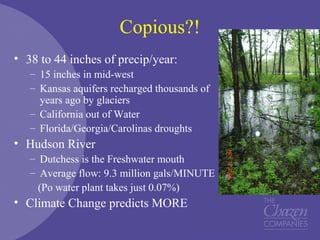
Copious?!
• 38 to 44 inches of precip/year:
– 15 inches in mid-west
– Kansas aquifers recharged thousands of
years ago by glaciers
– California out of Water
– Florida/Georgia/Carolinas droughts
• Hudson River
– Dutchess is the Freshwater mouth
– Average flow: 9.3 million gals/MINUTE
(Po water plant takes just 0.07%)
• Climate Change predicts MORE
Copious?!
Our region could
be thought of as the world’s
Saudi Arabia
of Water
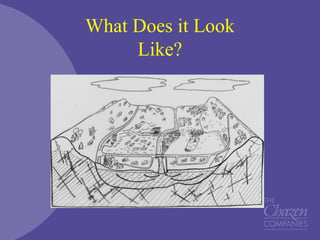
What Does it Look
Like?
Contaminant Sources
• Point Sources – manufacturing, gas
stations, spills, dry cleaners.
• Non-Point – many associated with
broadly distributed land uses
– Road deicers
– Septic systems
– Sediment
– Nutrients (lawns, ag, septics)
Groundwater under
Developed Areas..
• Nitrate and hardness rises where
septics are used
• Sodium & chloride rises where road
density increases, and sometimes
locally due to softeners
• Point contaminants by specific use
Local Over Use
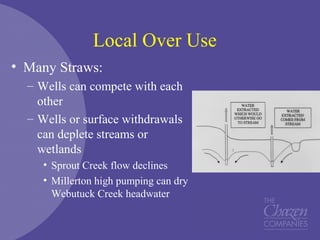
• Many Straws:
– Wells can compete with each
other
– Wells or surface withdrawals
can deplete streams or
wetlands
• Sprout Creek flow declines
• Millerton high pumping can dry
Webutuck Creek headwater
Aquifer Ordinance Developed
by 4 Dutchess County
Towns, supported by
Dutchess County• 6 months - aquifer characterization
• meetings to negotiate viable & technically-
sensible protection levels
• legal consultant and hydrogeologist prepared the
first model ordinance.
• model has been evolving ever since
• the model ordinance has so far been adopted by
Amenia (primary version w/ two zones) and
Pleasant Valley (reduced version w/ one zone).
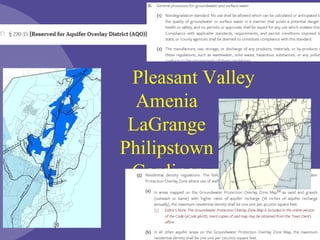
Pleasant Valley
Amenia
LaGrange
Philipstown
Gardiner
Aquifer Protection
Model Ordinance
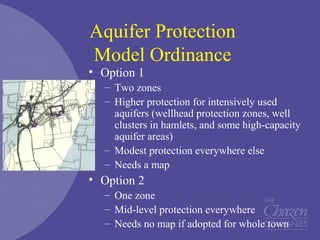
• Option 1
– Two zones
– Higher protection for intensively used
aquifers (wellhead protection zones, well
clusters in hamlets, and some high-capacity
aquifer areas)
– Modest protection everywhere else
– Needs a map
• Option 2
– One zone
– Mid-level protection everywhere
– Needs no map if adopted for whole town
Development Standards in
the Model Ordinance
• Quality:
– Various special permit uses, with an application
process and suggested Special Conditions
– A limited # of prohibited uses in the 2-zone version
– No new buried heating oil tanks under 1,100 gallons
– Cluster subdivision guidance
• Aquifer Capacity:
– Any project that consumes more groundwater than
is recharged on site is a SEQRA Type I action.
– Pumping Test Evaluation Guidance
Cluster Subdivisions
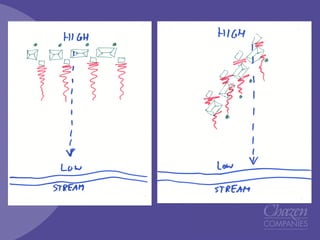
• If you plan to use individual wells and septic
systems, limit water quality defects this way:
– Multiple small clusters better than one big
– Lay out the cluster along a hillside so septic
plumes don’t flow to wells
– Modest size parcels (>1 acre) are better than small
parcels (<1 acre).
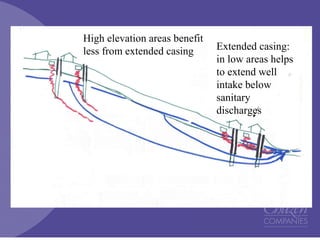
– Extended well casings can help if cluster is near an
aquifer discharge area (lake or river).
Extended casing:
in low areas helps
to extend well
intake below
sanitary
discharges
High elevation areas benefit
less from extended casing
Better Pumping Tests for Reliabilty
and Fewer Off-site Impacts
To satisfy SEQRA and Reliability
• For Community Water Wellfields
– Monitor existing offsite wells
– Monitor streams and wetlands
– Include a water budget analysis
with the pumping tewt report.
– Conduct tests at higher rates if conducted during wet
periods (e.g. 15% more if precip is 15% over average
during prior 4 months)
Better Pumping Tests
• For Major Subdivisions with Individual Wells
– Test 20% of parcels at 5 gpm each, simultaneously for at least
24 hours, using wells predrilled to satisfy DOH
– Monitor streams, wetlands and offsite wells
(these conditions may be waived if parcels exceed County
average parcel size recommendations)
• For Public Water System Wells (restaurants, schools,
businesses)
– Require some of the testing needed
for community water systems
(prior slide)
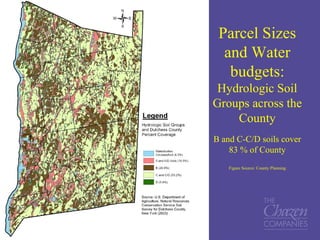
Parcel Sizes
and Water
budgets:
Hydrologic Soil
Groups across the
County
B and C-C/D soils cover
83 % of County
Figure Source: County Planning
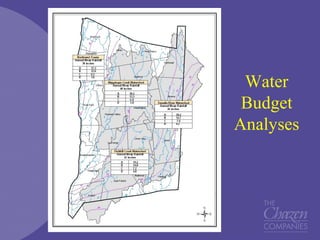
Water
Budget
Analyses
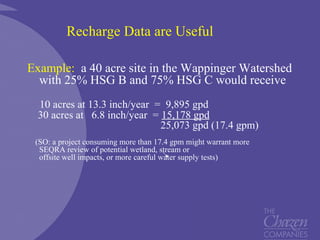
Recharge Data are Useful
Example: a 40 acre site in the Wappinger Watershed
with 25% HSG B and 75% HSG C would receive
10 acres at 13.3 inch/year = 9,895 gpd
30 acres at 6.8 inch/year = 15,178 gpd
25,073 gpd (17.4 gpm)
(SO: a project consuming more than 17.4 gpm might warrant more
SEQRA review of potential wetland, stream or
offsite well impacts, or more careful water supply tests)
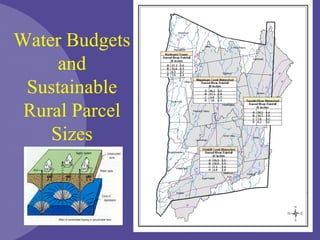
Water Budgets
and
Sustainable
Rural Parcel
Sizes
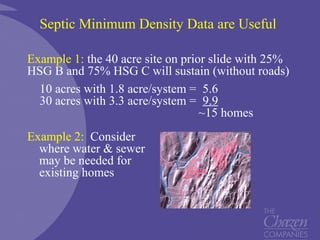
Septic Minimum Density Data are Useful
Example 1: the 40 acre site on prior slide with 25%
HSG B and 75% HSG C will sustain (without roads)
10 acres with 1.8 acre/system = 5.6
30 acres with 3.3 acre/system = 9.9
~15 homes
Example 2: Consider
where water & sewer
may be needed for
existing homes
Towns can adopt the Water Resource Law
or Planning Boards can apply its guidance
under SEQRA
• Groundwater capacity and quality is protected:
– Quality and Capacity Protection
– Cluster Subdivision layout guidance
– Better pumping test protocols
• Many Other Issues are directly/indirectly addressed
– In-Stream flows are preserved if density guidance is used
– Trace Pharmaceuticals in aquifers are diluted
– Impacts of climate change are managed by use of careful
standards for pumping tests and density considerations
– Wetlands and riparian corridors benefit from density
guidance
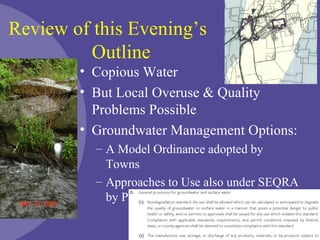
Review of this Evening’s
Outline
• Copious Water
• But Local Overuse & Quality
Problems Possible
• Groundwater Management Options:
– A Model Ordinance adopted by
Towns
– Approaches to Use also under SEQRA
by Planning Boards
Resources and Credit
• Many studies and reports are available on
Dutchess County website.
http://www.co.dutchess.ny.us/CountyGov/Depart
Much of this analysis was funded
by Dutchess County’s Department of
Planning and Economic Development.
• Feel free also to contact Russell Urban-Mead
at Chazen rum@chazencompanies.com

Groundwater Management

  • 1.
    Groundwater Management Watershed &Water Regs Basics for Municipal Officials October 27, 2016 Russell Urban-Mead, CPG, LEED® AP The Chazen Companies
  • 2.
    Course Outline • CopiousWater • But Local Overuse & Quality Problems Possible • Groundwater Management – – A Model Ordinance adopted by Towns – Under SEQRA by Planning Boards
  • 3.
    Copious?! • 38 to44 inches of precip/year: – 15 inches in mid-west – Kansas aquifers recharged thousands of years ago by glaciers – California out of Water – Florida/Georgia/Carolinas droughts • Hudson River – Dutchess is the Freshwater mouth – Average flow: 9.3 million gals/MINUTE (Po water plant takes just 0.07%) • Climate Change predicts MORE
  • 4.
    Copious?! Our region could bethought of as the world’s Saudi Arabia of Water
  • 5.
    What Does itLook Like?
  • 6.
    Contaminant Sources • PointSources – manufacturing, gas stations, spills, dry cleaners. • Non-Point – many associated with broadly distributed land uses – Road deicers – Septic systems – Sediment – Nutrients (lawns, ag, septics)
  • 7.
    Groundwater under Developed Areas.. •Nitrate and hardness rises where septics are used • Sodium & chloride rises where road density increases, and sometimes locally due to softeners • Point contaminants by specific use
  • 8.
    Local Over Use •Many Straws: – Wells can compete with each other – Wells or surface withdrawals can deplete streams or wetlands • Sprout Creek flow declines • Millerton high pumping can dry Webutuck Creek headwater
  • 9.
    Aquifer Ordinance Developed by4 Dutchess County Towns, supported by Dutchess County• 6 months - aquifer characterization • meetings to negotiate viable & technically- sensible protection levels • legal consultant and hydrogeologist prepared the first model ordinance. • model has been evolving ever since • the model ordinance has so far been adopted by Amenia (primary version w/ two zones) and Pleasant Valley (reduced version w/ one zone).
  • 10.
  • 11.
    Aquifer Protection Model Ordinance •Option 1 – Two zones – Higher protection for intensively used aquifers (wellhead protection zones, well clusters in hamlets, and some high-capacity aquifer areas) – Modest protection everywhere else – Needs a map • Option 2 – One zone – Mid-level protection everywhere – Needs no map if adopted for whole town
  • 12.
    Development Standards in theModel Ordinance • Quality: – Various special permit uses, with an application process and suggested Special Conditions – A limited # of prohibited uses in the 2-zone version – No new buried heating oil tanks under 1,100 gallons – Cluster subdivision guidance • Aquifer Capacity: – Any project that consumes more groundwater than is recharged on site is a SEQRA Type I action. – Pumping Test Evaluation Guidance
  • 13.
    Cluster Subdivisions • Ifyou plan to use individual wells and septic systems, limit water quality defects this way: – Multiple small clusters better than one big – Lay out the cluster along a hillside so septic plumes don’t flow to wells – Modest size parcels (>1 acre) are better than small parcels (<1 acre). – Extended well casings can help if cluster is near an aquifer discharge area (lake or river).
  • 15.
    Extended casing: in lowareas helps to extend well intake below sanitary discharges High elevation areas benefit less from extended casing
  • 16.
    Better Pumping Testsfor Reliabilty and Fewer Off-site Impacts To satisfy SEQRA and Reliability • For Community Water Wellfields – Monitor existing offsite wells – Monitor streams and wetlands – Include a water budget analysis with the pumping tewt report. – Conduct tests at higher rates if conducted during wet periods (e.g. 15% more if precip is 15% over average during prior 4 months)
  • 17.
    Better Pumping Tests •For Major Subdivisions with Individual Wells – Test 20% of parcels at 5 gpm each, simultaneously for at least 24 hours, using wells predrilled to satisfy DOH – Monitor streams, wetlands and offsite wells (these conditions may be waived if parcels exceed County average parcel size recommendations) • For Public Water System Wells (restaurants, schools, businesses) – Require some of the testing needed for community water systems (prior slide)
  • 18.
    Parcel Sizes and Water budgets: HydrologicSoil Groups across the County B and C-C/D soils cover 83 % of County Figure Source: County Planning
  • 19.
  • 20.
    Recharge Data areUseful Example: a 40 acre site in the Wappinger Watershed with 25% HSG B and 75% HSG C would receive 10 acres at 13.3 inch/year = 9,895 gpd 30 acres at 6.8 inch/year = 15,178 gpd 25,073 gpd (17.4 gpm) (SO: a project consuming more than 17.4 gpm might warrant more SEQRA review of potential wetland, stream or offsite well impacts, or more careful water supply tests)
  • 21.
  • 22.
    Septic Minimum DensityData are Useful Example 1: the 40 acre site on prior slide with 25% HSG B and 75% HSG C will sustain (without roads) 10 acres with 1.8 acre/system = 5.6 30 acres with 3.3 acre/system = 9.9 ~15 homes Example 2: Consider where water & sewer may be needed for existing homes
  • 23.
    Towns can adoptthe Water Resource Law or Planning Boards can apply its guidance under SEQRA • Groundwater capacity and quality is protected: – Quality and Capacity Protection – Cluster Subdivision layout guidance – Better pumping test protocols • Many Other Issues are directly/indirectly addressed – In-Stream flows are preserved if density guidance is used – Trace Pharmaceuticals in aquifers are diluted – Impacts of climate change are managed by use of careful standards for pumping tests and density considerations – Wetlands and riparian corridors benefit from density guidance
  • 24.
    Review of thisEvening’s Outline • Copious Water • But Local Overuse & Quality Problems Possible • Groundwater Management Options: – A Model Ordinance adopted by Towns – Approaches to Use also under SEQRA by Planning Boards
  • 25.
    Resources and Credit •Many studies and reports are available on Dutchess County website. http://www.co.dutchess.ny.us/CountyGov/Depart Much of this analysis was funded by Dutchess County’s Department of Planning and Economic Development. • Feel free also to contact Russell Urban-Mead at Chazen rum@chazencompanies.com