 CONTENTS
 INTRODUCTION
 DARCY’S LAW
 EXPERIMENTAL SETUP
 EXPERIMENTAL VARIFICATION
 DARCY’S VELOCITY
 VALIDITY OF DARCY’S LAW
 PERMEABILITY
 TRANSMISSIVITY
 CONCLUSION
 REFERENCES
INTRODUCTION
HENRY DARCY
The flow of water was first studied in open channels and pipes in
which turbulent flow occurred and it was found that the rate of flow varied
approximately as the square root of the hydraulic gradient. The flow of water
in capillary tubes was first studied by Hagen and Poiseuille who discovered that
the rate of flow through very small tubes varies directly as the hydraulic
gradient. Later Darcy(1856) varifies this law and demonstrated its application
water percolating through interstices of filter sand.
Darcy's law
“The volume of water which passes through a bed of sand of a given
nature is proportional to the pressure and inversely proportional to the
thickness of the bed traversed”
In analyzing the sub surface movement of water, the actual
paths of the water molecules as they flow through pores, cracks and
crevices of the soil or other aquifer material are taken as smooth paths.
If the water molecules move right through the solid particles. The
resulting smooth lines of travel of the water molecules are called
stream line.
EXPERIMENTAL SETUP
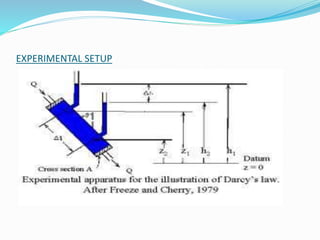
The experimental setup Shows a system of lines, parallel streamlines
below a water table in a vertical cross section of an aquifer parallel to the
direction of flows. Since the streamlines are straight and parallel, The flow of
water does not change with distance. This is called uniform flow. In a non
uniform flow, where the flow changes with distance and streamlines may
curve, diverge or converge.
If piezometer are placed at two points on a stream line (point 1&2)then the
velocity of that stream line flow can be calculated by,
V=K (h1+z1)-(h2+z2)
L
Where V-darcy ‘s velocity of water
h1-pressure head at point 1
h2-pressure head at point 2
z1-elevation head at point 1
z2-elevation head at point 2
L-Distance of flow between points 1 and 2 as measured along stream
line.
K- hydraulic conductivity of soil or aquifer material.
Experimental verification
The experimental verification of Darcy's law can be performed with water
flowing at a rate ‘Q’ through a cylinder of cross sectional area ‘A' packed with
sand and having piezometer a distance ‘L’ a part. Total energy heads ,or fluid
potentials above a datum plane may be expressed by,
P1/ ρ +V1^2/2g+Z1=P2/ ρ +V2^2/2g+Z2+hL ……..(1)
Where p-pressure
ρ -specific weight of water
V-velocity of flow
g-acceleration due to gravity
Z-elevation
hL-head loss
Because velocities in porous media are usually low, velocity heads
may be neglected without appreciable error. Hence by rewriting, the head loss
becomes,
hL =(P1/ ρ +Z1)-(P2/ ρ+Z2) ……..(2)
Hence the resulting head loss is defined as the potential loss within the
sand cylinder ,this energy being lost by frictional resistance dissipated as heat
energy. It is independent on the inclination of the cylinder.
Now Darcy's measurement showed that the proportionalities,Q~hL and
Q~1/L exist. Introducing a proportionality constant's leads to the equation,
Q=-KA hL/L ……..(3)
Expressed in general terms
Q=-KA dh/dl ……..(4)
or
V=Q/A=-K dh/dl …….(5)
where,
V-Darcy's velocity or specific discharge
K-hydraulic conductivity
dh/dl-hydraulic gradient
The – sign of the equation indicates that the flow of water is in the direction of
decreasing head.
Darcy’s velocity
The velocity,
V=Q/A=-K dh/dl
This is referred to as Darcy's velocity because it
assumes that flow occurs through the entire cross
section of the material without regard to solids and
pores.
Validity of Darcy's law
Darcy's law applies to laminar flow in pores media, such as water
flowing in a capillary tube. For flow in pipes and other large sections,
the Reynolds number which expresses the dimensionless ratio of
inertial to viscous forces, serves as a criterion to distinguish between
laminar and turbulent flow.
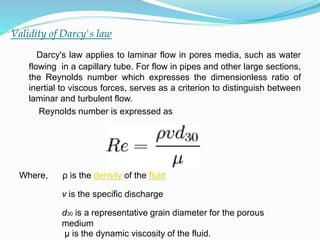
Reynolds number is expressed as
Where, ρ is the density of the fluid
v is the specific discharge
d30 is a representative grain diameter for the porous
medium
μ is the dynamic viscosity of the fluid.
If Re<1 then Darcy's law is valid and it does not depart upto
Re=10 then this represents an upper limit to the validity of
Darcy's law.
fortunately most natural underground flow occurs with
Re<1 so Darcy's law is applicable. Deviation from Darcy's
law can occurs where steep hydraulic gradients exist, such
as near pumped wells, also turbulent flow can be found in
rocks such as limestone that contain large underground
openings.
Permeability
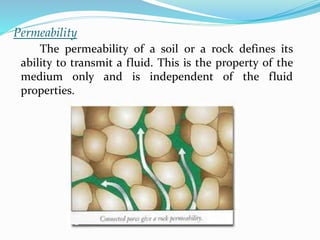
The permeability of a soil or a rock defines its
ability to transmit a fluid. This is the property of the
medium only and is independent of the fluid
properties.
Transmissivity(T)
It is widely employed in ground water hydraulics. It may
be defined as the rate at which water is transmitted through a
unit width of aquifer under a unit hydraulic gradient.
T=Kb
where, K-hydraulic conductivity
b-saturated thickness of the aquifer
Conclusions
Darcy's law is a simple mathematical statement which
neatly summaries several familiar properties that ground
water flowing in an aquifer exhibits,
(1) If there is no pressure gradient over a distance , no flow
occurs.
(2) If there is pressure gradient, the flow occurs from high
pressure to low pressure regions.
(3) The greater the pressure, greater the discharge.
(4) The discharge rate of fluid will often be different, though
different formations.
References
Books
-Series in water resources and Environmental engineering. (Page:36-40)
- M.C Graw Hill
-Introduction to hydrology. (298-301)
-J.R John W Knapp
-Warren Viessman
-Gary L. Lewis
-E.Harbaugh.
-Ground water hydrology. (64-70)
-David Keith Todd
-Hydrology(445-447)
Oscar E.Meinzer
Websites
-http://www.geology.com
-http://www.wikipedia.com
THANK YOU

DARCY’S LAW

  • 2.
     CONTENTS  INTRODUCTION DARCY’S LAW  EXPERIMENTAL SETUP  EXPERIMENTAL VARIFICATION  DARCY’S VELOCITY  VALIDITY OF DARCY’S LAW  PERMEABILITY  TRANSMISSIVITY  CONCLUSION  REFERENCES
  • 3.
    INTRODUCTION HENRY DARCY The flowof water was first studied in open channels and pipes in which turbulent flow occurred and it was found that the rate of flow varied approximately as the square root of the hydraulic gradient. The flow of water in capillary tubes was first studied by Hagen and Poiseuille who discovered that the rate of flow through very small tubes varies directly as the hydraulic gradient. Later Darcy(1856) varifies this law and demonstrated its application water percolating through interstices of filter sand.
  • 4.
    Darcy's law “The volumeof water which passes through a bed of sand of a given nature is proportional to the pressure and inversely proportional to the thickness of the bed traversed” In analyzing the sub surface movement of water, the actual paths of the water molecules as they flow through pores, cracks and crevices of the soil or other aquifer material are taken as smooth paths. If the water molecules move right through the solid particles. The resulting smooth lines of travel of the water molecules are called stream line.
  • 5.
  • 6.
    The experimental setupShows a system of lines, parallel streamlines below a water table in a vertical cross section of an aquifer parallel to the direction of flows. Since the streamlines are straight and parallel, The flow of water does not change with distance. This is called uniform flow. In a non uniform flow, where the flow changes with distance and streamlines may curve, diverge or converge. If piezometer are placed at two points on a stream line (point 1&2)then the velocity of that stream line flow can be calculated by, V=K (h1+z1)-(h2+z2) L Where V-darcy ‘s velocity of water h1-pressure head at point 1 h2-pressure head at point 2 z1-elevation head at point 1 z2-elevation head at point 2 L-Distance of flow between points 1 and 2 as measured along stream line. K- hydraulic conductivity of soil or aquifer material.
  • 7.
    Experimental verification The experimentalverification of Darcy's law can be performed with water flowing at a rate ‘Q’ through a cylinder of cross sectional area ‘A' packed with sand and having piezometer a distance ‘L’ a part. Total energy heads ,or fluid potentials above a datum plane may be expressed by, P1/ ρ +V1^2/2g+Z1=P2/ ρ +V2^2/2g+Z2+hL ……..(1) Where p-pressure ρ -specific weight of water V-velocity of flow g-acceleration due to gravity Z-elevation hL-head loss Because velocities in porous media are usually low, velocity heads may be neglected without appreciable error. Hence by rewriting, the head loss becomes, hL =(P1/ ρ +Z1)-(P2/ ρ+Z2) ……..(2) Hence the resulting head loss is defined as the potential loss within the sand cylinder ,this energy being lost by frictional resistance dissipated as heat energy. It is independent on the inclination of the cylinder.
  • 8.
    Now Darcy's measurementshowed that the proportionalities,Q~hL and Q~1/L exist. Introducing a proportionality constant's leads to the equation, Q=-KA hL/L ……..(3) Expressed in general terms Q=-KA dh/dl ……..(4) or V=Q/A=-K dh/dl …….(5) where, V-Darcy's velocity or specific discharge K-hydraulic conductivity dh/dl-hydraulic gradient The – sign of the equation indicates that the flow of water is in the direction of decreasing head.
  • 9.
    Darcy’s velocity The velocity, V=Q/A=-Kdh/dl This is referred to as Darcy's velocity because it assumes that flow occurs through the entire cross section of the material without regard to solids and pores.
  • 10.
    Validity of Darcy'slaw Darcy's law applies to laminar flow in pores media, such as water flowing in a capillary tube. For flow in pipes and other large sections, the Reynolds number which expresses the dimensionless ratio of inertial to viscous forces, serves as a criterion to distinguish between laminar and turbulent flow. Reynolds number is expressed as Where, ρ is the density of the fluid v is the specific discharge d30 is a representative grain diameter for the porous medium μ is the dynamic viscosity of the fluid.
  • 11.
    If Re<1 thenDarcy's law is valid and it does not depart upto Re=10 then this represents an upper limit to the validity of Darcy's law. fortunately most natural underground flow occurs with Re<1 so Darcy's law is applicable. Deviation from Darcy's law can occurs where steep hydraulic gradients exist, such as near pumped wells, also turbulent flow can be found in rocks such as limestone that contain large underground openings.
  • 12.
    Permeability The permeability ofa soil or a rock defines its ability to transmit a fluid. This is the property of the medium only and is independent of the fluid properties.
  • 13.
    Transmissivity(T) It is widelyemployed in ground water hydraulics. It may be defined as the rate at which water is transmitted through a unit width of aquifer under a unit hydraulic gradient. T=Kb where, K-hydraulic conductivity b-saturated thickness of the aquifer
  • 14.
    Conclusions Darcy's law isa simple mathematical statement which neatly summaries several familiar properties that ground water flowing in an aquifer exhibits, (1) If there is no pressure gradient over a distance , no flow occurs. (2) If there is pressure gradient, the flow occurs from high pressure to low pressure regions. (3) The greater the pressure, greater the discharge. (4) The discharge rate of fluid will often be different, though different formations.
  • 15.
    References Books -Series in waterresources and Environmental engineering. (Page:36-40) - M.C Graw Hill -Introduction to hydrology. (298-301) -J.R John W Knapp -Warren Viessman -Gary L. Lewis -E.Harbaugh. -Ground water hydrology. (64-70) -David Keith Todd -Hydrology(445-447) Oscar E.Meinzer Websites -http://www.geology.com -http://www.wikipedia.com
  • 16.